An overview of the principles, practice and limits of fixed-comb beekeeping for readers with some beekeeping knowledge. Supplementary practical guides cover working with vertically stacked hives of the Christ and Warré types.
The principle of fixed-comb beekeeping
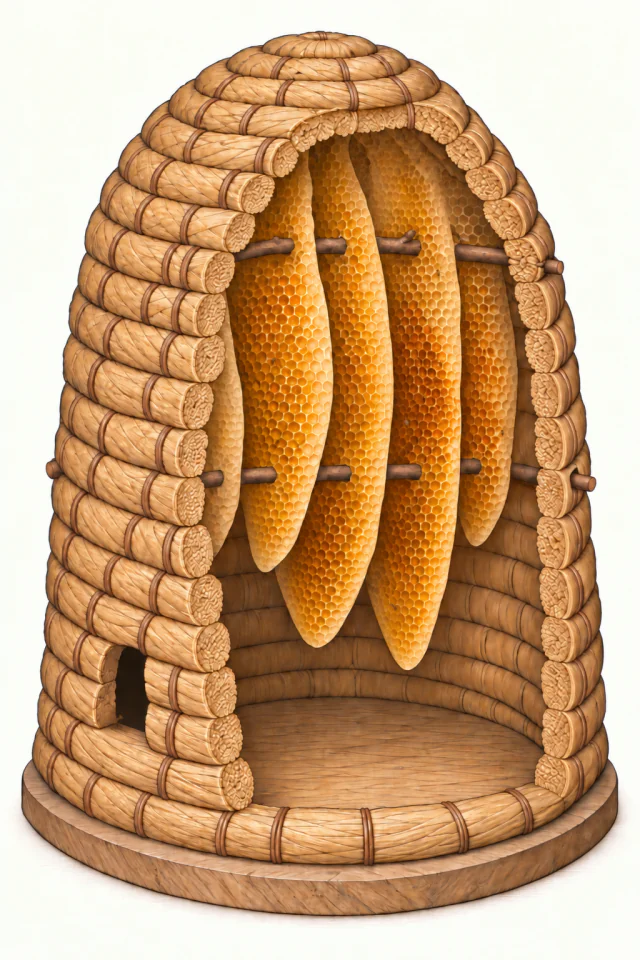
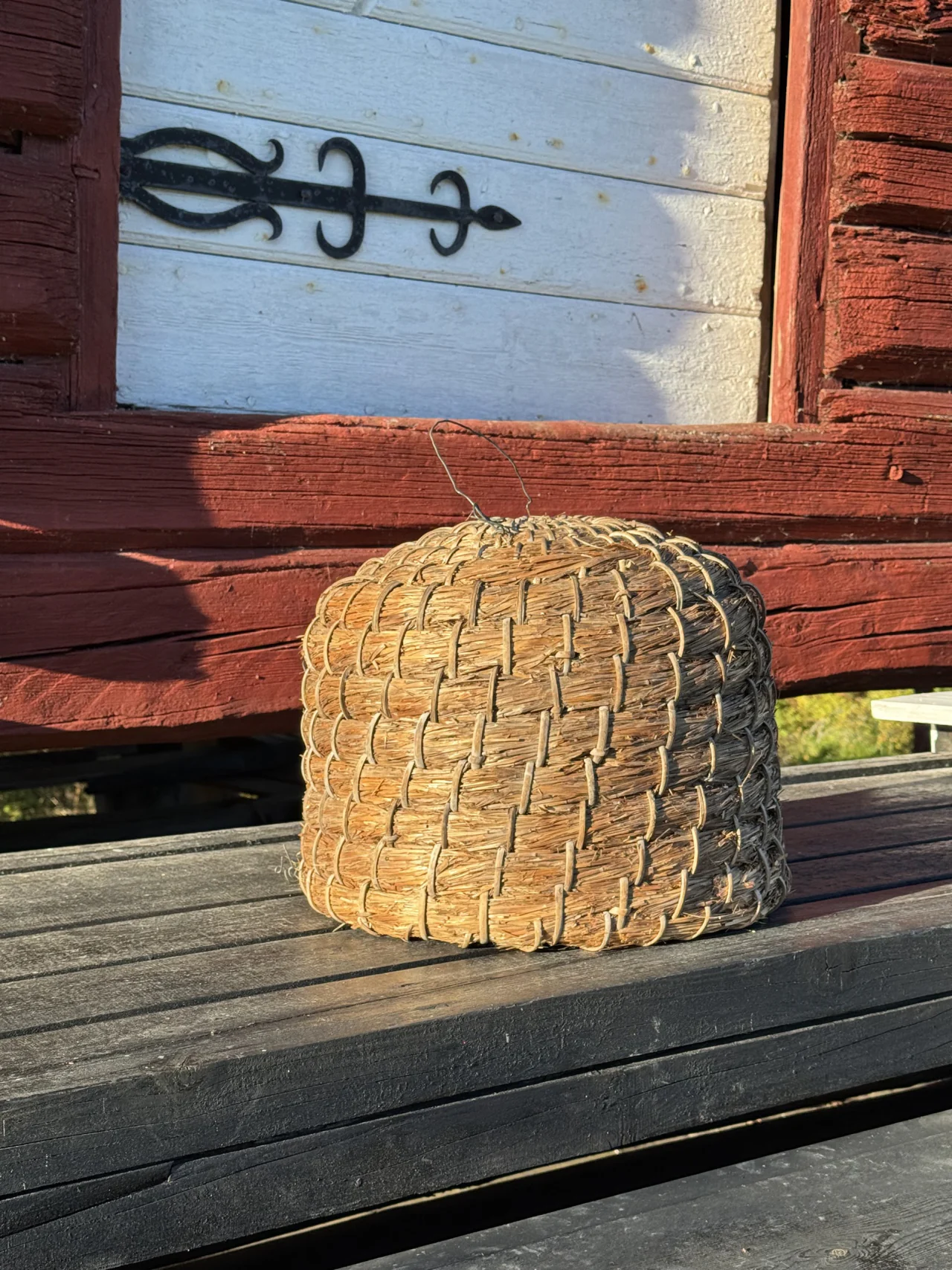
Straw skep. Photograph: Stefan Grunert.
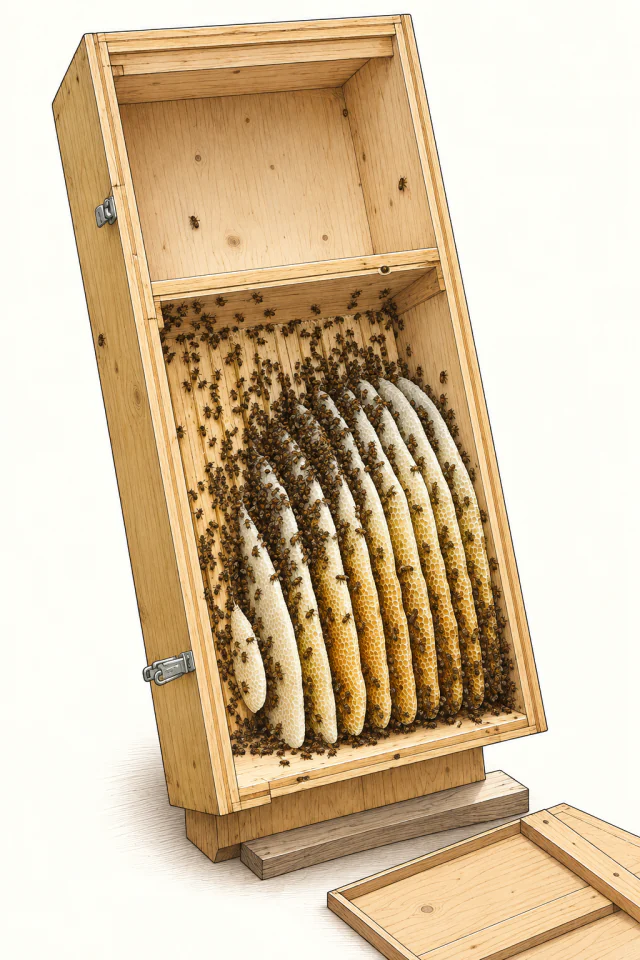
The distinctive feature of fixed-comb beekeeping is that the brood nest remains largely undisturbed for long periods, since individual combs are rarely, if ever, removed. The bees attach their combs to the ceiling or to comb supports, and also to the walls.12
In a hive made up of fixed-comb boxes, adding a box underneath creates space below the existing combs while preserving the position of the brood combs relative to one another. Whole sections of comb can be removed for harvesting.32
Looking into the box: natural comb from wall to wallKevin Pauba, Wikimedia Commons, CC BY 4.0 Original photograph
The Warré hive is one of the stacked-box hives used for fixed-comb beekeeping today. In its construction, it is in a sense a successor to Christ’s hive: both consist of boxes stacked one above another, with fixed combs inside.4
Its designer, , advocated a simple form of beekeeping in 1920s France that would provide honey for the household and for sale. What mattered to him was the return after costs.5 He also recommended beekeeping to manual and office workers as an occupation for their spare time.6 The hive therefore had to be inexpensive to build and require little ongoing work. Simple comb supports spared Warré the construction and maintenance of complete frames, while working with whole boxes was intended to reduce the number of operations at the colony.7
Heat retention was another reason Warré gave for his hive design. He wanted to avoid opening the hive frequently and saw an advantage in adding boxes underneath, as the top of the nest could remain closed. He also favoured a hive with a small cross-section. These comparisons cover hive design and management together; they cannot establish how much of any possible improvement in heat retention is due to comb attachment alone.3
At this point I would like to draw attention to a limitation of fixed-comb beekeeping that matters greatly to the beekeeper: an individual comb can only be removed once its attachments have been cut. This restricts its use for inspection, rearrangement or transfer between colonies.12 This limitation deserves consideration before choosing fixed-comb beekeeping.
Interior layout and access to the combs
A Warré hive in use: three identical boxes, gable roof, alighting boardKevin Pauba, Wikimedia Commons, CC BY 4.0 Original photograph
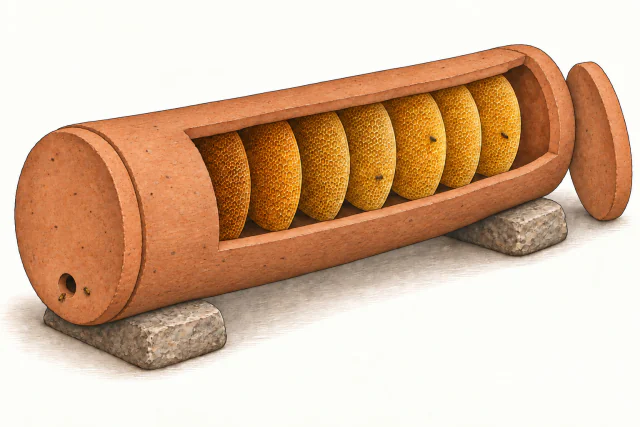
Access to the combs depends on the hive’s internal divisions and openings. Simple log and tube hives have a single cavity whose size is fixed by the enclosure. Where a tube can only be opened at one end, other combs may lie in front of the honey combs intended for harvest and have to be removed as well.1
Dividing the hive into boxes allows fixed combs to be handled in sections. In Warré’s fixed-comb hive, each box carries its own combs on . The bees attach the combs to the sides and may also join them to the top bars of the box below. The beekeeper cuts these attachments when removing a box; the arrangement of the combs within it remains intact.23
Warré combines this construction with expansion downwards, giving the colony room to build new comb below its existing nest. The beekeeper harvests upper boxes provided they contain honey, are free of brood and leave the colony with sufficient stores after removal.456 As long as the colony builds downwards sufficiently, older combs are gradually removed with the harvest. If no such harvest is possible for several years, the comb renewal associated with it does not take place either.56
The is a long box with the brood and honey areas arranged one behind the other. The colony starts building comb at the front; the beekeeper fits separate comb supports in the rear section and opens it for honey storage as a distinct step. Here the extra space lies within the existing enclosure. In spring, the brood nest can also extend into the honey area. At harvest, the fixed combs in this area are cut away from those at the front.789
The removable floor of the Bienenkiste gives access to the combs from below. In a Warré hive, the comb edges become accessible when a box is removed. The facing surfaces of adjacent combs remain largely hidden.103
Hive forms
Hive forms can be divided into enclosures of fixed volume and hives made up of sections that can be added. Either can be arranged vertically or horizontally.
Upright hives of fixed volume
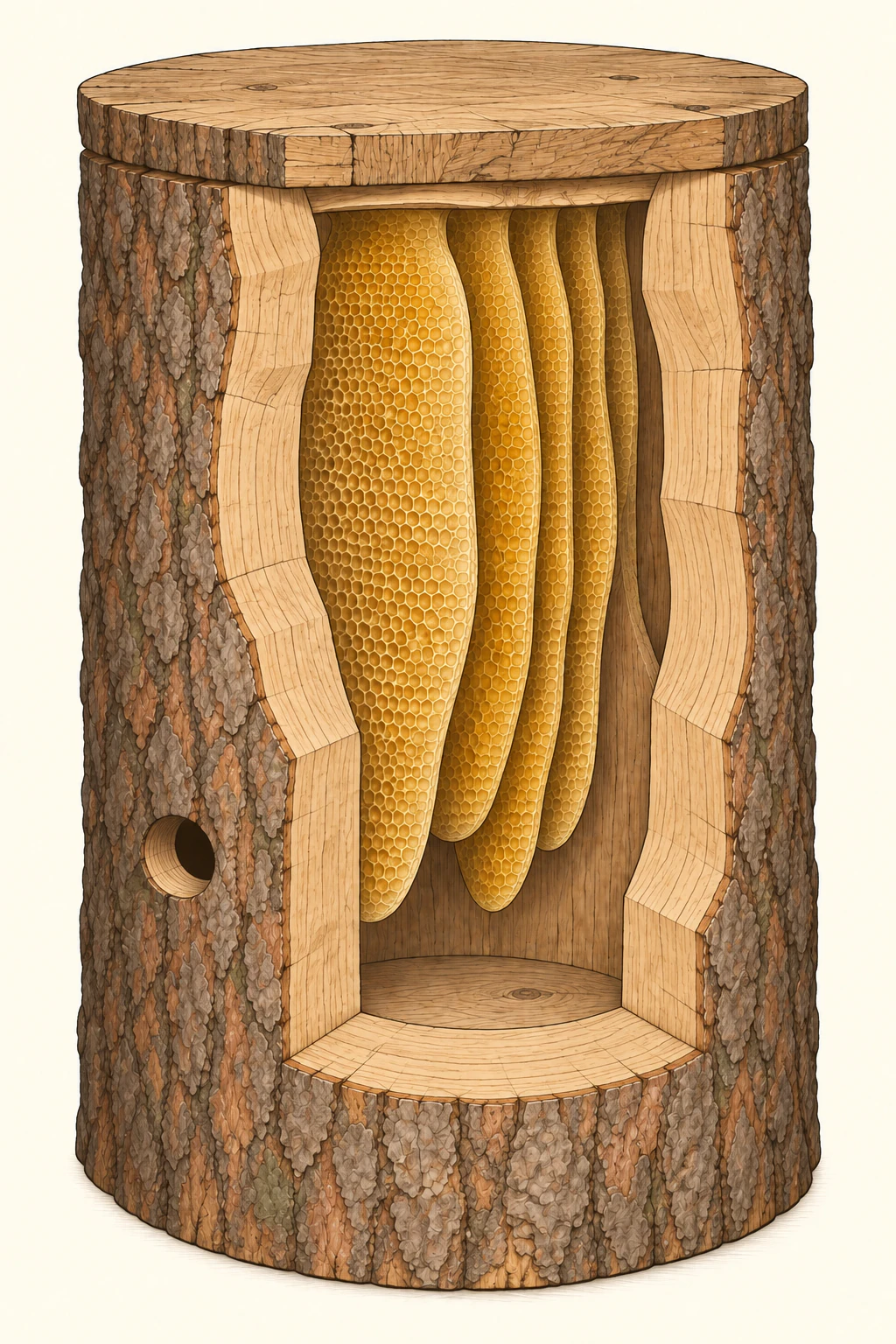
An upright log hive in section. AI-generated schematic illustration.
These include the simple and the upright log hive. Brood and stores share a single cavity whose size is fixed by the enclosure.1
Horizontal hives of fixed volume
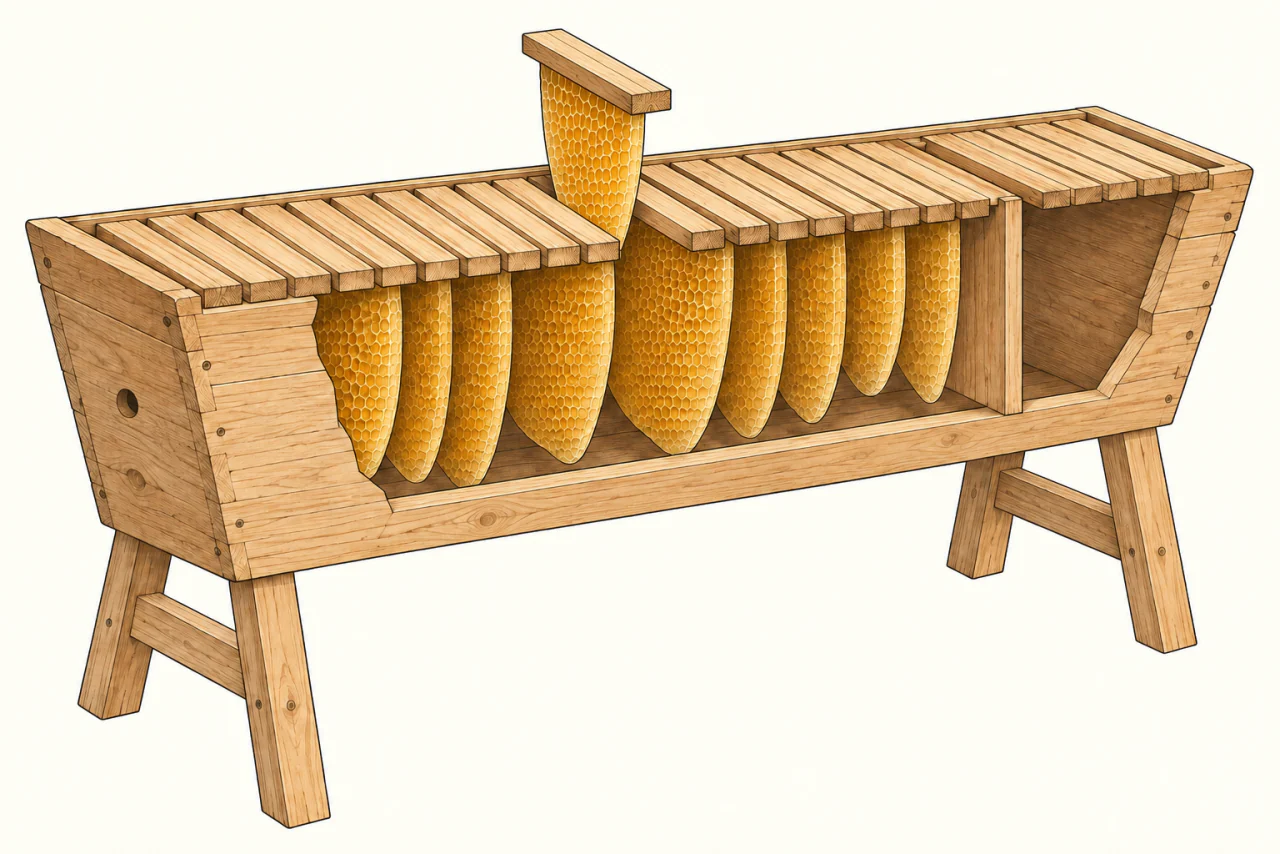
A horizontal top-bar hive with a removable comb on its top bar. AI-generated schematic illustration.
Horizontal log and , as well as the Bienenkiste, belong to this group. A separate honey area, such as the one in the Bienenkiste, also lies within the existing enclosure.12
The horizontal top-bar hive shown here likewise has a fixed enclosure. Its combs can be removed individually by their top bars, so it is a movable-comb hive with naturally built comb.34
Hives with vertically stacked sections
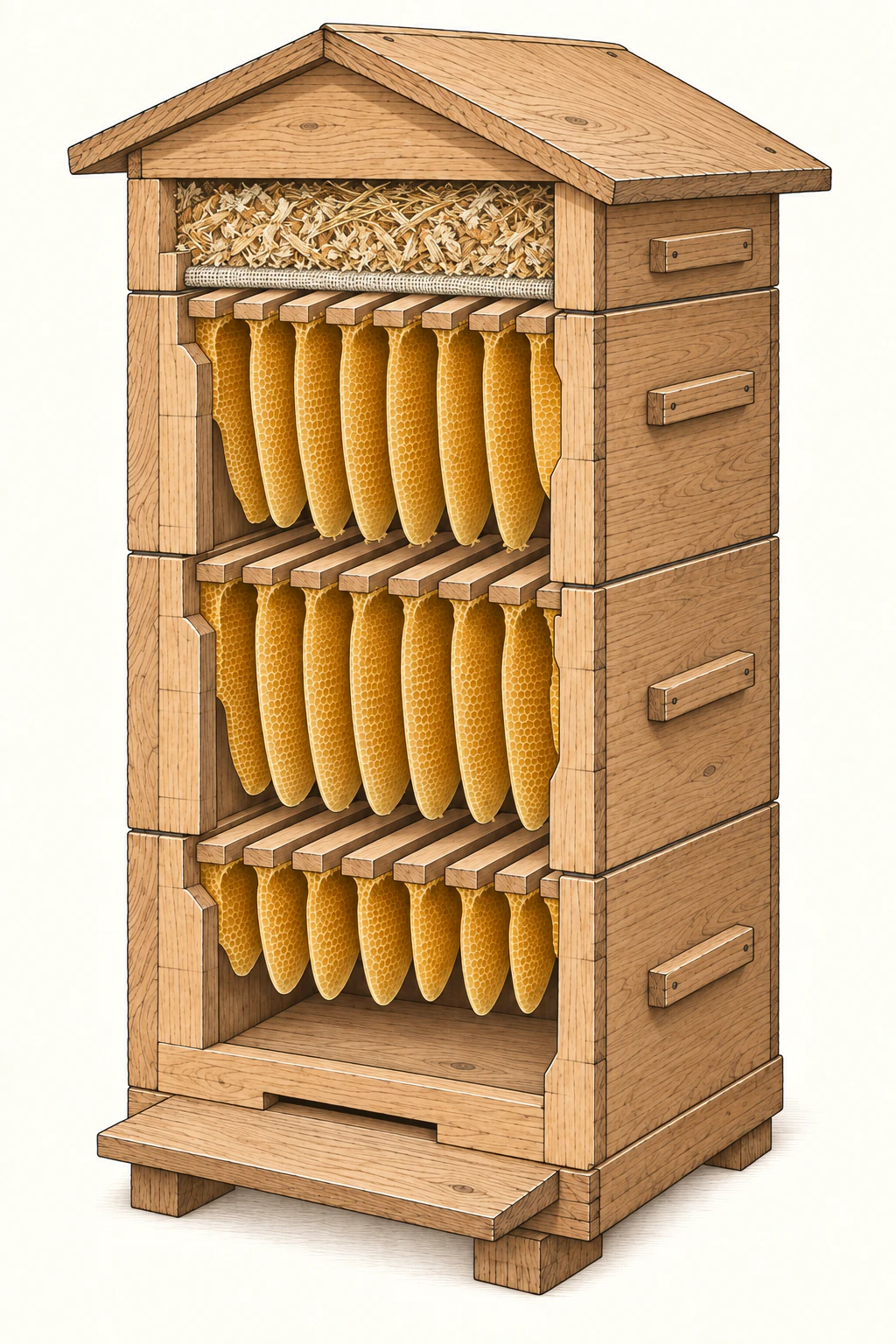
A Warré fixed-comb hive with three boxes and a quilt box. AI-generated schematic illustration.
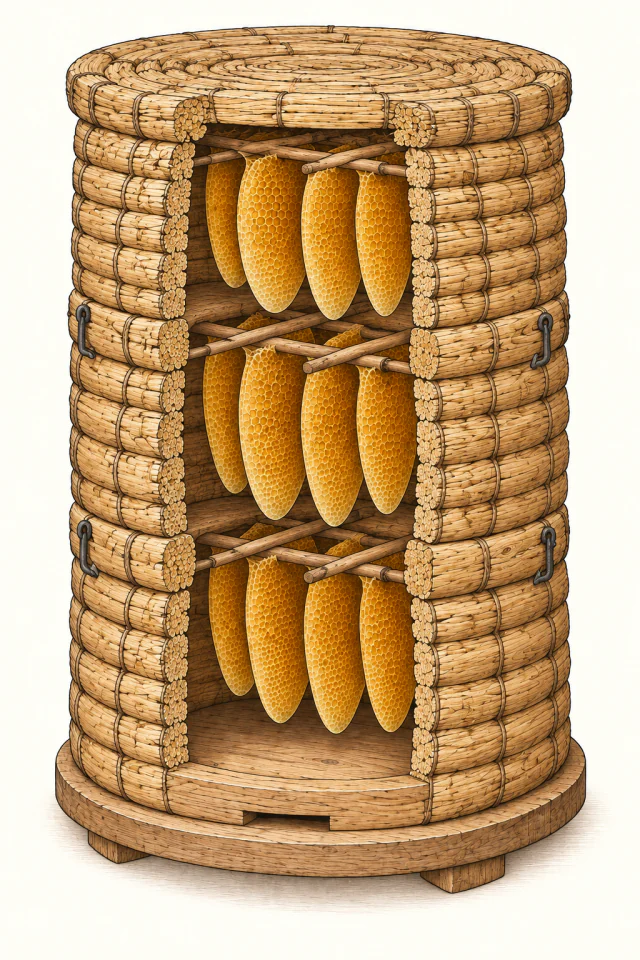
Christ’s and Warré’s hives consist of wooden boxes stacked one above another. Additional boxes increase the space; at harvest, they can be removed with their combs.56 The same principle appears in made up of separate straw rings.7
Hives with sections added sideways
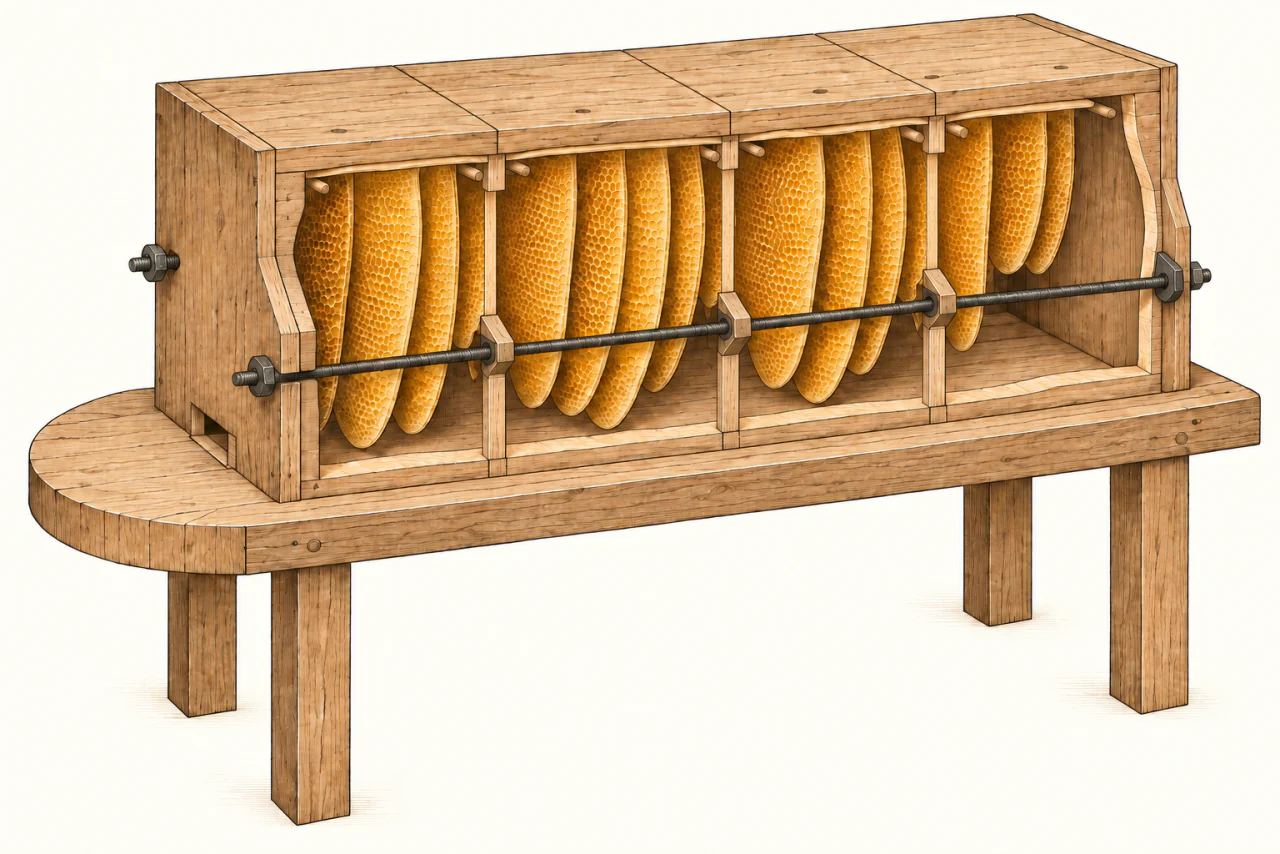
A hive extended sideways, after Vicat’s design. AI-generated schematic illustration.
The historical hive after Vicat shown here consists of four sections placed side by side and held together by tension rods. The sections open into one another to form a continuous interior. Another section can be added to extend it.8
Observation and health checks
The view into the brood nest is limited in a fixed-comb hive. At the entrance, the beekeeper observes foraging, pollen collection and unusual behaviour. Weight checks indicate changes in stores; a window or a view from below reveals the progress of comb building in the visible area. Records make comparisons over longer periods easier. Weather and the course of the nectar flow also inform the assessment.123 If a colony subsequently dies, the cause may remain unresolved even after the combs have been examined, as accounts in the Warré archive show.4
Pollen arriving at the entrance alone proves neither the presence of a laying queen nor the health of the brood. Assessing eggs, larvae and the brood pattern requires a sufficient view between the combs or onto their surfaces. A colony may therefore appear normal at the entrance yet still need closer examination.56 Restricted access also makes the queen harder to find, for instance when requeening is planned.7
Suspected brood disease may require the examination of brood comb or . Samples can be taken from fixed comb, but the relevant area must be accessible. For the Bienenkiste, describes cutting out a piece of comb to obtain stores close to the brood nest. The sample required depends on the diagnostic question and the instructions of the laboratory carrying out the examination.68
Varroa infestation can also be measured without movable individual combs. A suitable monitoring floor allows fallen mites to be counted; other methods examine a sample of bees. For the Bienenkiste, whose basic design has no such floor, the intended diagnostic method uses sampled bees.910
The varroa mite reproduces in capped brood cells and harms bees primarily by transmitting viruses. An increasing infestation can weaken a colony to the point of collapse. Beekeepers therefore need ways to measure and limit infestation in fixed-comb hives just as they do in movable-comb hives.12
Treatment in fixed-comb hives
Established varroa control combines repeated monitoring with biotechnical measures and authorised veterinary medicines. Common active substances include formic acid, oxalic acid and thymol. Their suitability depends, among other things, on whether brood is present, the weather, the level of infestation and any honey harvest still planned. The usual trickling and sublimation methods with oxalic acid are used in broodless colonies. The conditions of use for the particular product govern its application; afterwards, the beekeeper checks the infestation again to establish whether treatment has worked.34 Not every product is authorised in every country.1
A stacked fixed-comb hive can also be treated if it provides the access and space required by the chosen method. An evaporator needs a suitable position; trickling requires access to the spaces between combs occupied by bees. Spray treatments require access to the comb surfaces carrying bees. Removing particular brood combs and caging the queen take more work where the comb is fixed. Such biotechnical interventions can reduce the use of medicines, although some involve substantial disturbance to the brood nest.35
In choosing a method, the beekeeper also considers its safety for bees and the operator, and possible residues in bee products. Mites can develop resistance to certain active substances. Selection for resistant bees is therefore also one of the approaches used in integrated varroa control.35
Treatment-free beekeeping
Treatment-free beekeeping covers various forms of beekeeping without varroa medicines. Some beekeepers include deliberately induced brood breaks, while others rely more heavily on natural selection and the propagation of surviving colonies. They aim to establish colonies that can cope with infestation unaided. In the Warré forum, beekeepers discuss the origin of their bees, their selection history and the surrounding bee population, as well as management and provisioning. Accounts also describe a gradual transition during which treatment initially continues; the success of such an approach cannot be predicted generally from individual reports.6
In a Norwegian population of European honey bees that had survived for many years without varroa treatment, Oddie, Dahle and Neumann found lower mite reproduction than in susceptible comparison colonies. Substantial losses had preceded this survival; healthy survivors were propagated by splitting. The distinction between resistance and tolerance helps in understanding such findings: resistance limits the reproduction or burden of parasites and pathogens, whereas tolerance reduces their harmful effects. For example, increased tolerance of viral infections has been demonstrated in bees from the Swedish Gotland population.72
Loftus, Smith and Seeley investigated the effects of small nests and frequent swarming. In their experiment, colonies in small hives without swarm prevention had lower mite infestations and survived more often than colonies in large hives managed for honey production. Neither group received varroa treatment. Nest size and swarm prevention were changed together, and the hives contained frames. The experiment therefore supports the importance of management conditions but does not demonstrate any particular protection against varroa from fixed comb.8
Stopping treatment in susceptible colonies can lead to severe losses, including the loss of an entire apiary. The Warré archive contains reports of colonies maintained over the long term alongside accounts of almost complete losses during the transition. Recovery through the propagation of survivors is a different outcome from the survival of the colonies originally present. Rebuilding an apiary also takes work and entails lost harvests.67
Peck and Seeley observed bees from neighbouring colonies robbing heavily infested colonies that were collapsing and carrying mites back to their own hives. Other studies show the importance of bees arriving from other colonies; transmission can also occur without a visible collapse. Treatment-free beekeepers still need to monitor infestation to assess the mite burden and the course of disease. A colony that looks healthy or survives may continue to harbour mites and viruses.9102
In his essay on Darwinian beekeeping, Seeley calls for close monitoring and proposes killing colonies at risk before they collapse, or treating and requeening them. The Natural Beekeeping Trust, which publishes the essay, explicitly disagrees with killing colonies as a precaution. Before forgoing treatment, the beekeeper needs to decide how to respond to an increasing infestation.11
There are also legal requirements. In Germany, § 15 of the Bienenseuchen-Verordnung requires annual treatment of all colonies in an apiary when varroa is present. In Norway, the Animal Welfare Act explicitly covers honey bees and requires keepers to protect them from diseases and parasites and provide appropriate care for sick animals.1213
Work through the year
Coming out of winter and spring development
At the spring check, the beekeeper assesses the remaining stores and the colony’s development. Comparing its weight with earlier measurements helps to assess stores, while increasing occupation of the spaces between combs gives an indication of colony strength. If development falls behind, an examination of the brood nest and a check on food supplies may be needed.12
The brood combs usually remain in place during these checks. This makes it harder to balance colonies by transferring individual brood or food combs. Whole boxes can be handled in a divisible hive, but their contents are determined by the existing distribution of brood, bees and stores.3
Comb building and additional space
Additional hive space only becomes usable for brood and stores once it contains comb. When empty boxes are added below a Warré hive, expansion of the nest therefore depends on the colony’s comb building. An empty lower box may remain unbuilt even though the existing combs are already densely occupied by brood and stores. The beekeeper therefore bases the provision of space on comb building, colony development and the nectar flow.45
Further space can be added to a hive made up of separate boxes. In the Bienenkiste, this possibility is exhausted once the rear honey area has been opened, since the enclosure cannot be extended. Warré colonies may swarm even after extra boxes have been added underneath.67845
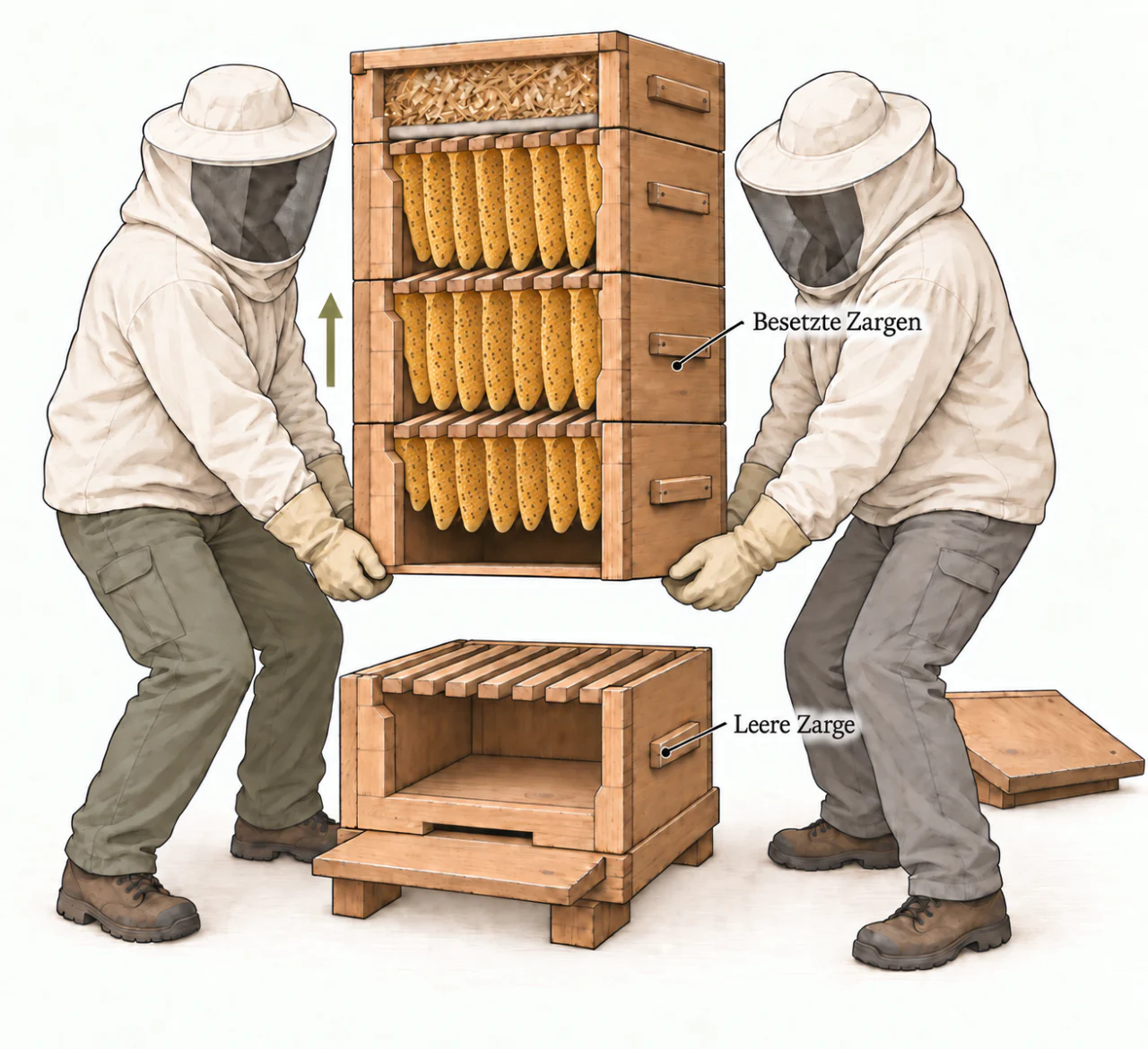
Two beekeepers lift the occupied boxes (“Besetzte Zargen”) to add an empty box (“Leere Zarge”) underneath. AI-generated schematic illustration.
To add a box underneath, the beekeeper lifts the whole stack of occupied boxes, which becomes heavier with each additional full box. Without a lifting device, this can require considerable strength, and some beekeepers need a second person to help.910
In the horizontal top-bar hive described by , space is added sideways without lifting a stack of boxes. Individual naturally built combs can be removed by their top bars for inspection and harvest. This is therefore a movable-comb design.1112
Propagation through swarms fits a system of fixed-comb beekeeping. A captured swarm can occupy an empty hive without brood combs from another colony, but must first build comb and establish stores. Its development depends on the strength of the swarm, the remaining nectar flow and its food supply; feeding may be necessary if no nectar is coming in.13
In the parent colony, the departure of the old queen interrupts egg laying until a young queen has mated and begins to lay. Follow-up care includes checking that this transition succeeds as well as attending to the captured swarm’s food supply. Further swarms can weaken the parent colony. After the prime swarm, the beekeeper therefore checks colony strength and stores and whether brood rearing resumes.141516
Swarm checks in the Bienenkiste involve looking for queen cells along accessible comb edges and in visible spaces between combs. Cells may lie further inside or among irregular comb and remain hidden during a cursory inspection. Finding swarm cells gives an indication of preparations for swarming; preventing a swarm from leaving requires further intervention.17
Divisible fixed-comb hives can also be used to form new colonies without natural swarming. Christ describes splitting a colony in his stacked-box hive into two independent colonies. He also combines the lowest boxes, containing brood and bees, from two or three colonies to make a new colony.18 Warré likewise describes division using whole occupied boxes.3
These methods give the beekeeper less precise control over the composition of the resulting colonies than the selection of individual combs. In particular, each new colony must have sufficient bees and food, and the means either to rear a queen or to receive one.183
Colonies draw on their stores during gaps in the nectar flow and prolonged bad weather. Even a colony that was previously well supplied may therefore need feeding while the flying season is still under way.199
At harvest, the beekeeper removes brood-free combs containing ripe honey, provided sufficient stores remain for the colony. In a Warré hive, this usually means harvesting an upper box; in the Bienenkiste, the rear honey area. The intended separation point makes removal easier but says nothing about the contents of the combs. Brood can extend across the boundary between boxes or temporarily occupy the honey area. In undivided hives, the position of accessible honey combs determines which part can be taken.678202122
Once cut out, honey combs can be crushed and the honey allowed to drain or pressed out. Their structure is lost in the process, leaving the wax available for further processing. Rebuilding requires time and food from the colony. A honey extractor can also be used with fixed comb: Warré describes cages that support cut-out combs during uncapping and extraction.2324
After the harvest, the beekeeper checks whether the remaining stores are sufficient for winter under local conditions. The weight includes the hive, comb and bees as well as food. A known empty weight and earlier comparative measurements allow an approximate assessment of the stores. If they are insufficient, feeding makes up the shortfall in good time.2
Food in the remaining combs must be within reach of the bees from their winter cluster. Its arrangement remains largely unchanged in a fixed-comb hive; moving individual food combs takes additional work. Harvesting and changes to hive space therefore affect the position of the later winter cluster. During winter, weight and indicate consumption and the colony’s position, provided the hive allows these checks.2516
Comb renewal over several years
In a Warré hive, comb renewal can be combined with the honey harvest. A section of comb may first hold brood and later honey before being removed at harvest. This requires the colony to build downwards and the brood nest to shift, as well as sufficient honey to be stored in the upper boxes. If the upper boxes stay with the colony because they contain brood or because stores in the lower boxes are insufficient, renewal is delayed. Beekeepers in the Warré archive also report interruptions lasting several years.12
A separate honey area is renewed through regular harvesting, while its brood combs remain untouched. For the Bienenkiste, Klein therefore describes removing all the brood comb during the brood break associated with swarming. The beekeeper checks the individual colony to establish whether all existing brood has emerged and whether the colony will be able to build again afterwards. An undivided hive does not allow gradual renewal by replacing whole boxes; removing comb there cuts directly into the continuous comb structure.34
Access for examination is a particularly important legal consideration with fixed comb. Rules on animal health and the management of swarms also apply. Each of the following provisions concerns the country named; the sources were checked on 9 September 2026.
In Germany, § 4 of the Bienenseuchen-Verordnung requires the owner or their representative to provide the assistance needed during examinations. It must therefore be possible to carry out mandatory inspections in a fixed-comb hive too. Where varroa is present, § 15 requires annual treatment of all colonies in the apiary unless treatment ordered by the authority under paragraph 2 is carried out.1
In Austria, § 16 of the Tiergesundheitsgesetz 2024 requires access to animals for official inspections, together with the necessary facilities and assistance. The special provisions for bees also govern examinations and measures where disease is suspected or has broken out. The beekeeper must therefore allow for the necessary access to bees and combs when choosing and fitting out a hive.2
In Switzerland, an explicit construction requirement applies to all bee dwellings provided by people: under Article 59 paragraph 3 of the Tierseuchenverordnung, they must permit inspections at any time and allow the brood nests to be opened. This provision does not require frames, but it imposes a specific requirement for examinability. A window alone does not allow the brood nest to be opened. Suspected disease must be reported to the bee inspector.3
In Norway, § 33 of the Dyrehelseforskriften requires beekeepers to take appropriate measures to prevent swarms from leaving the apiary. A management system that deliberately allows swarms to leave without such precautions is therefore incompatible with this provision. § 34 also sets particular requirements for putting out bait hives and accepting captured swarms. These include the appropriate authorisation to conduct inspections and a separate registered swarm apiary.4
Ethical limits of the management system
A management system with limited swarm prevention requires a carefully chosen site. In densely built-up areas or busy locations, departing swarms can cause considerable problems for neighbours and other people using the site. Inaccessible parts of buildings make retrieval difficult. Where such conflicts are foreseeable and the intended management offers little control over swarming, this weighs against keeping bees in that way at that location.12
Working with swarms requires a reliable stand-in if the beekeeper cannot be reached during the swarming season. There must be somewhere to house additional colonies or someone to take them. Capture still depends on where the swarm settles. A bait hive or a neighbour willing to report a departing swarm may make retrieval easier but cannot ensure it. The time needed for observation and possible swarm collection therefore forms part of the assessment of the management system.12
When choosing a hive, the beekeeper also assesses whether the necessary examinations and health measures are feasible under the actual conditions. These may include lifting occupied hive sections, taking suitable samples and gaining access for treatment. If the work cannot be done even with the help available, a more accessible hive is preferable. If adequate care cannot be provided at another site either, the beekeeper should refrain from keeping bees.312
Distribution and current use
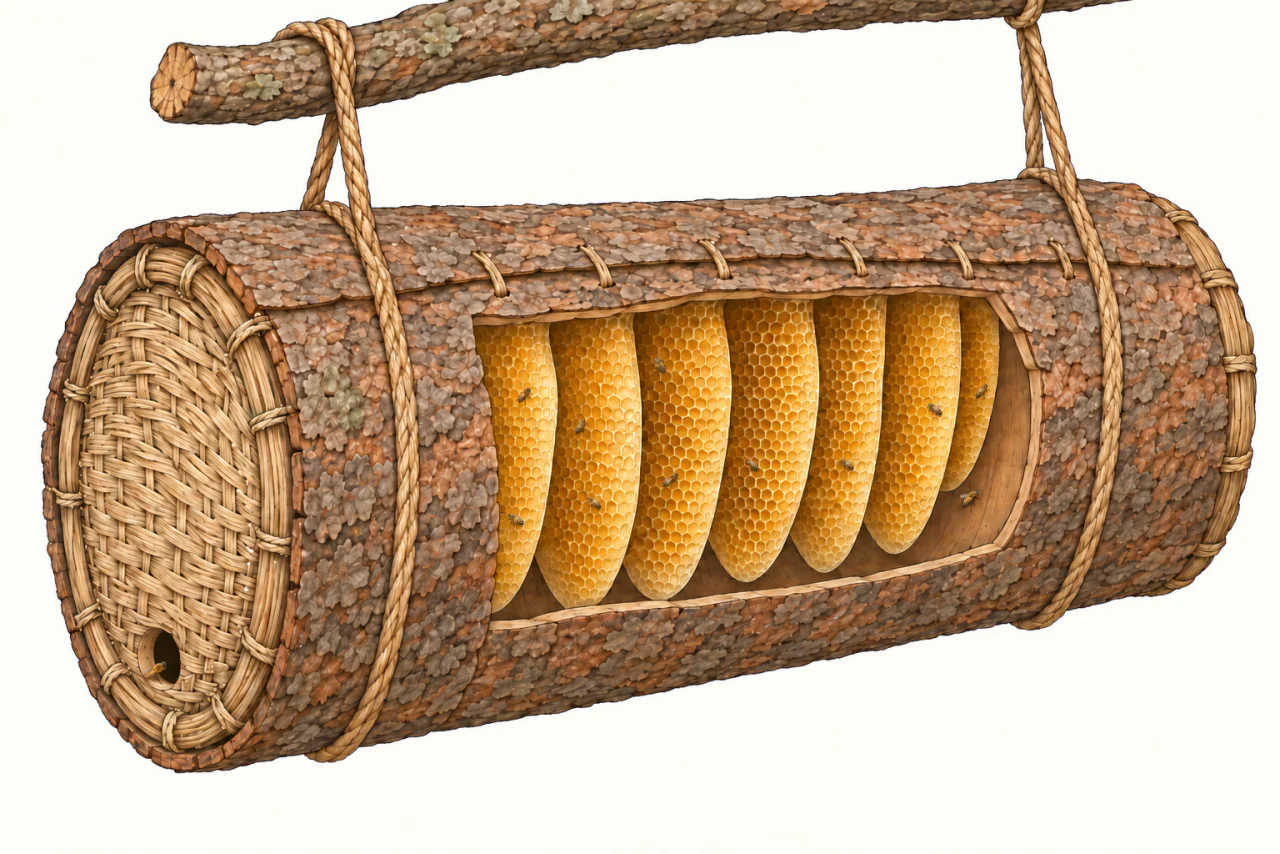
Suspended bark hive with a woven end closure and fixed natural comb. AI-generated schematic illustration.
In many rural regions of Africa and Asia, sales of honey and wax from fixed-comb hives contribute to farming households’ incomes.123 African beekeepers use log, bark, clay and basket hives, among others. Bees for Development promotes beekeeping in such locally made hives, including for people on very low incomes.14 The organisation reports the use of fixed-comb hives in Malawi to produce honey for sale.5 The products can also reach international markets: the FAO report of 2009 describes exports of honey from Zambian bark hives to the European Union.6
In parts of the Himalayas, beekeepers keep the Asian honey bee, Apis cerana, in log and wall hives. ICIMOD documents this beekeeping in Nepal and in Chitral, Pakistan, among other places. There, hollowed log sections are built into house walls; honey sales provide additional income for remote mountain communities.23
In Europe, have revived the keeping of bees in and living trees. They combine the transmission of an old craft with an interest in the way honey bees live in tree cavities. In Germany, Mellifera offers courses in making log hives and creating cavities in living trees. In Switzerland, FreeTheBees reintroduced tree beekeeping in 2014 and now focuses particularly on creating habitats for species that inhabit tree cavities. Honey harvesting consequently plays a secondary role in these conservation projects.789
An international community of beekeepers has formed around the Warré hive. Translations of Warré’s book, freely available plans and accounts of practical experience have spread interest in his management system beyond France. website brings together contributions from Europe, North America and other parts of the world; French- and English-language forums provide places to exchange experience.1011 Bienenkiste beekeepers exchange advice through local meetings, regional groups and a discussion forum.12
Divisible fixed-comb hives also feature in European beekeeping history. Christ’s stacked-box hive combines fixed comb with removable sections. Its construction and his particular management system are discussed on the interpretation page.131415
Economics
Income
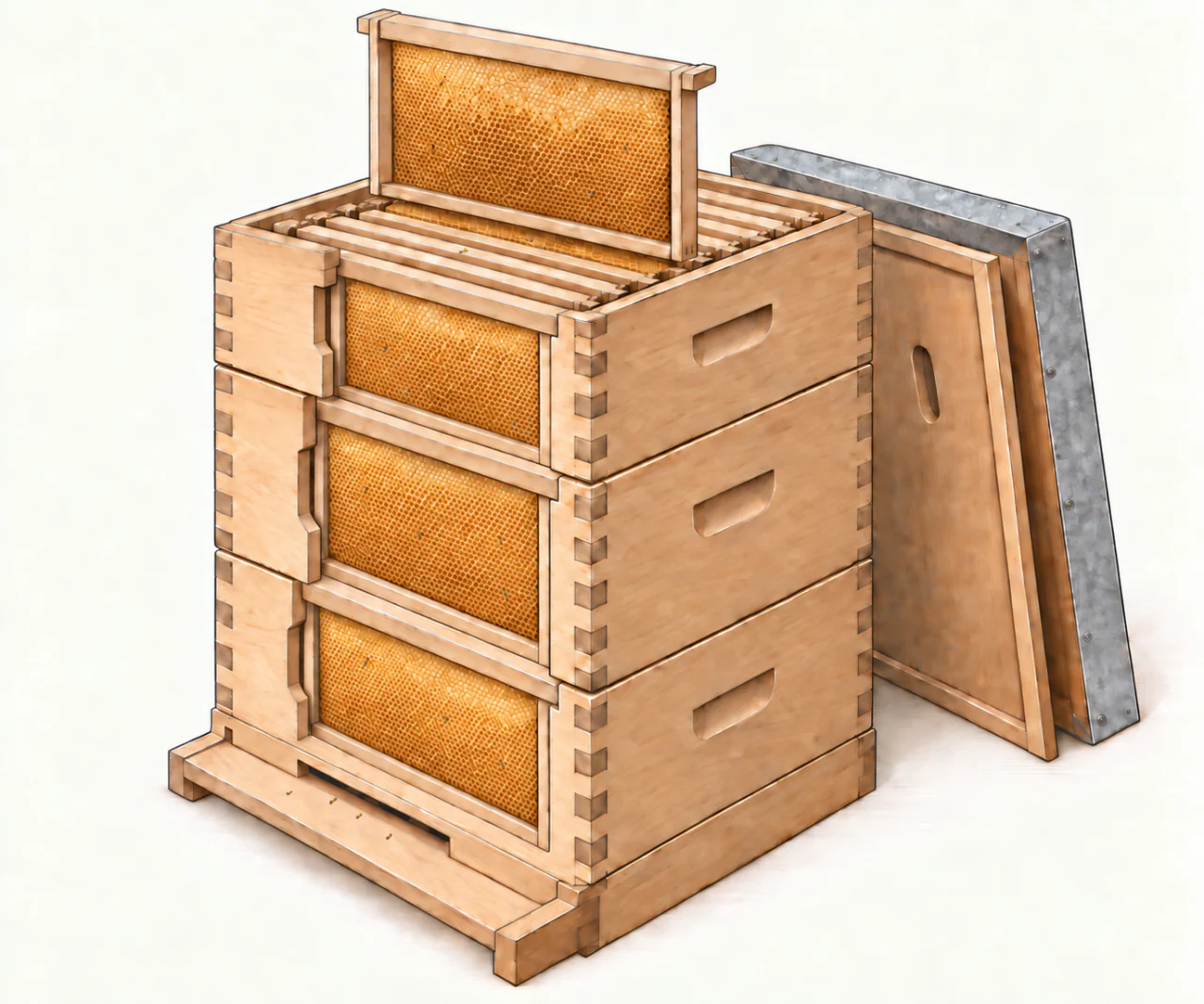
Langstroth hive with individually removable frames, shown for comparison with fixed-comb hives. AI-generated schematic illustration.
Extensive fixed-comb beekeeping, with limited swarm prevention and the harvesting of whole combs, can be expected to yield substantially less honey per colony than intensively managed beekeeping in stacked-box hives. In the latter, beekeepers place honey supers containing foundation or already drawn comb above the brood nest for the nectar flow. Drawn comb is immediately available to receive nectar and can be reused after extraction. Bees must rebuild the combs removed to produce pressed honey; swarming may reduce the yield further. Having empty comb available in time is particularly important during short, strong nectar flows.12
Pressing can release additional pollen from the combs into the honey. A Brazilian comparative study found around 5.6 times as many pollen grains in pressed honey as in centrifugally extracted honey, along with higher concentrations of protein, and several minerals.3 This composition may support a higher selling price for carefully produced pressed honey. If the market will bear that price, the higher return per kilogram can partly offset the smaller harvest.3
Costs
Ready-made fixed-comb hives can cost about as much as stacked-box hives with frames.45 Building simple Warré hives can reduce the initial outlay, depending on material costs and the tools already available; an economic assessment must also account for the builder’s own working time.6
In the African beekeeping described by Bees for Development, the low cost of locally made hives makes it easier to establish honey and wax production. Available materials and craft skills help determine the choice of hive.7
Working time includes journeys to the apiary, site maintenance and processing the harvest, as well as operations on the colonies.8 Pressed or drained honey requires no purchase of a honey extractor. Depending on the method, the beekeeper needs a press or straining equipment and suitable collecting vessels. The combs must be crushed and processed, and the equipment cleaned afterwards.93
Nucleus colony
A new colony formed by the beekeeper rather than by waiting for a swarm. Brood and bees from a strong colony are placed in an empty hive.
Christ makes nucleus colonies “after the Franconian manner”: a piece of brood comb four to five inches square is placed in an empty hive, and the bees rear a queen from it (K1 §5). He prefers this method to swarming and allows about a hundred boxes for an apiary of ten colonies, four of which are to swarm (K4 §26).
Combs in a straw skep are fixed in place. Harvesting the honey requires cutting them out and destroys the colony in the process. The usual practice was to set the skep over burning sulphur and suffocate the bees.
Christ calls this the “old routine of most country people, which can hardly be rooted out: in autumn they slaughter and suffocate the heaviest and the lightest hives, irresponsibly and quite sinfully” (K3 §2).
Christ also objects to the quality of honey obtained this way: it is “fouled with brood, dead bees, the smell of sulphur and the like” (K3 §6).
Christ’s word for an individual box in his stacked hive. It consists of four planed boards, measures thirteen inches square externally and four and a half inches high, and has an entrance at the front, a pane of glass at the back, a cornice at the top and a grid beneath it (K3 §4).
The boxes have neither floors nor lids. The lowest stands on a floorboard that also serves as a landing board (K3 §9); the top one receives a cover of wood, glass or plaited straw (K3 §4).
For a colony that is not to swarm, Christ allows eight boxes over the summer; for a young swarm, six (K4 §26).
Placing an empty box on top of a full one. Christ considers this easier, but nevertheless does not use it to expand the hive:
“Setting on would of course be somewhat more comfortable than setting under; but it will not do. The nature of bees is to build from the top downwards, and to go on building where they have left off.” (K4 §26, footnote)
He does add vessels above for harvesting. Glasses and porcelain vessels are inverted on the top box’s cover so that the bees can build into them from below; the comb is cut with a silk thread or thin piano wire (K3 §5).
The modern German word for any human-made bee dwelling originated in forest beekeeping. Christ writes that forest bees are “drawn into hollow trees or into Büten or Beuten hewn out expressly for the purpose” and belong to the forest owner (K9 §2).
He does not use the word for his own boxes, which he calls Aufsatz, Kästchen, Magazin or Bienenwohnung.
The gap bees leave open in their hive rather than filling it with comb. Combs hung at this distance can be removed individually without cutting. Lorenzo Langstroth described the spacing in 1851 and received a patent for a hive using it on 5 October 1852.
In this repository, the statement is supported by a search summary covering several pages rather than by the patent document itself (source key langstroth-1852).
A measurement from a source read directly appears in Warré. He leaves twelve millimetres between two top bars, expressly “pour le passage des abeilles” [for the bees to pass through] (Warré 1948, p. 49).
Dzierzon
The priest associated with beekeeping’s transition to movable comb. Writing in 1889, Johann Witzgall recounts that Dzierzon began keeping bees “mit dem Christ'schen Magazinstocke” [with Christ’s stacked-box hive] and through experimentation developed “den jetzt allgemein verbreiteten Stock mit beweglichen Waben” [the now widely used hive with movable combs] (Witzgall, Geschichte der Bienenzucht 1889, p. 56).
The changes began with Christ’s comb-supporting grid. Dzierzon fitted the boxes with movable bars and attached comb to them so that each comb could be lifted out separately. Side doors, fixed floorboards, ledges on the inner walls, shorter and taller boxes and a fixed lid followed (Witzgall, Geschichte der Bienenzucht 1889, p. 56). Christ nails down the six wooden strips of his grid (K3 §4).
In 1844, Dzierzon presented his invention publicly. The distinction between movable- and fixed-comb beekeeping dates from that year (Witzgall/Felgentreu 1889, p. 102).
Witzgall writes forty years after the event and does not quote Dzierzon himself.
The opening through which bees enter and leave. Every box in Christ’s hive has one, four inches long and 1¼ inches high, with two metal slides in front (K3 §4).
Christ explains its size in terms of the air bees need when confinement is necessary and the ease of feeding (K3 §4, footnote).
Since every box has its own entrance, adding a box underneath requires another step: two or three hours later, the upper entrance is closed completely, “otherwise they do not readily build on” (K3 §9).
Four strips of wood glued and nailed to the top of each box. They support the grid and project a quarter of an inch outwards (K3 §4).
Christ gives two purposes for the projection. It forms an ornament, shaped with an ogee plane, and ensures that “all the supers fit well on one another and stand firm if one should turn out ¼ or ½ inch larger or smaller than another” (K3 §4).
This projecting rim prevents wall thickness from being read off the engraved plate. The oblique view in Fig. 1 shows the wall and cornice together at the edge.
Émile Warré (1867–1951) was a French priest and beekeeper. His Ruche
Populaire (“People’s Hive”) was intended to be simple to build and manage.
He described its construction and management in L’Apiculture pour tous,
whose twelfth edition appeared in 1948.
Christ’s own addition to the stacked-box hive. A hole seven inches long and two and a half inches high is chiselled in the rear wall of each box, the glass is fitted into it, and a small shutter excludes the light (K3 §4).
At the end of the same section, in a passage for readers wishing to omit all other refinements, he gives his judgement: “A glass pane in the rear board, however, is almost indispensable.” (K3 §4)
He answers the obvious objection from observation. Bees attach comb to glass as firmly as to wood or straw and keep it clean; what they coat in autumn, they clean again in spring (K3 §11).
The French word for a box placed above another. Palteau’s hive consists of a table, three legs, several hausses, a cover and a landing board; each box measures one foot square and three inches high (Palteau 1777, pp. 7–11).
Christ has not read Palteau in the original. In a footnote to the preface, he writes that only years after his own invention did he read “something of similar bee dwellings”, “such as those of Herr Palteau in France and the Vicat one, which Schirach in his allgemeinen Bienenvater describes” (Vorrede).
A textbook of religious doctrine arranged in questions and answers. Every child worked through it in lessons and learnt the answers by heart; the form was therefore familiar even to readers who read little else.
In 1784, Christ applies it to bees while distinguishing his purpose from that of the classroom. Catechetical teaching is “für den gemeinen Mann die faßlichste und deutlichste” [the easiest for ordinary people to grasp and understand]; he intends no catechism “zum Auswendiglernen, sondern blos zum Unterricht und Nachschlagen” [for memorising, but only for instruction and reference] (Christ 1784, p. VI). His Bienencatechismus für das Landvolk consists of 197 numbered questions, some of which state the opinions he opposes.
Log hive
A log hive is a hollowed section of a felled trunk used to house bees. Unlike a cavity in a living tree, the whole hive can be taken to another site.
A word at the foot of a printed page that repeats the first word of the next. The compositor used it to keep the sheets in order.
It can cause errors in this project: including the catchword when transcribing an old page duplicates a word. In the Vicat source text, three catchwords appear at the head of the following page rather than the foot of the preceding one: “festiget,” (110/111), “einiche,” (118/119), “voraus,” (120/121).
Stacked-box hive, Magazin
A hive made up of several boxes stacked vertically, each removable separately. Christ calls it a Magazin or Magazinstock.
He describes bees having “their household in joined supers … that are increased or reduced from time to time as circumstances, the season and one's intentions require” (K3 §3).
Christ presents wood and glass as innovations. The usual stacked hives had been made of straw, “at least I have seen none of any other kind”; their drawbacks led him to square wooden boxes with a pane of glass (K3 §3).
Beekeeping with movable combs. Its German name arose alongside the contrasting term Stabilbau. In 1889, Witzgall and Felgentreu date both to 1844: “Seit 1844, wo Dr. Dzierzon zuerst mit seiner Erfindung öffentlich hervortrat, spricht man in Imkerkreisen von einem beweglichen oder unbeweglichen Bienenstocke, vom Mobil- oder Stabilbau.” [Since 1844, when Dr Dzierzon first presented his invention publicly, beekeepers have spoken of movable or immovable hives, of movable- or fixed-comb beekeeping.] (Witzgall/Felgentreu 1889, p. 102)
Christ predates this distinction. The bee specialist F. Gerstung later defined his contribution precisely: “in Deutschland der eigentliche Begründer der Mobilbienenzucht … freilich nicht so sehr der Beweglichkeit jeder einzelnen Wabe … als vielmehr der Mobilität, d.h. der Beweglichkeit von Teilen des Bienenstockes, von Auf- und Untersätzen” [in Germany the true founder of movable-comb beekeeping … admittedly less of the mobility of each individual comb … than of the mobility of parts of the hive, of upper and lower boxes] (quoted in Bode 1984, p. 381).
Witzgall/Felgentreu 1889, p. 102
Nadiring
The technical term for adding a box underneath: an empty box is placed below a full one. It describes the operation Christ calls Untersetzen.
The earliest vertically divided hive using this method documented in the project is Gedde’s octagonal box. It has two iron handles “for lifting it up when another is to be placed under it” (Gedde 1677, pp. 18–19).
Top bar
A top bar is a wooden strip to whose underside the bees attach a comb. The comb may also be attached to the hive walls. A top bar alone therefore does not make the comb individually movable.
Lorenzo Langstroth described bee space in 1851: a gap of about a centimetre that bees leave open rather than filling it with comb. He received a patent for it on 5 October 1852. Since then, combs have hung in frames that can be removed individually; this remains the most widespread construction in much of the world.
Christ’s stacked-box hive predates this development. In his hive, the movable unit is the box, lifted off whole while its combs remain inside. The bee specialist F. Gerstung therefore called him the founder “der Mobilität, d.h. der Beweglichkeit von Teilen des Bienenstockes, von Auf- und Untersätzen” [of mobility, that is, the mobility of parts of the hive, of upper and lower boxes] (quoted in Bode 1984, p. 381).
Christ uses the word Rähmchen once, in a different sense: the pane of glass in a straw box is “fitted into a small wooden frame” (K3 §8).
A ring skep consists of straw rings of equal diameter, stacked to form a
shared interior. More rings can be added to enlarge the hive. Fixed crossbars
support the combs and allow individual sections to be removed with their comb.
AI-generated schematic illustration after Fleischer (1777).
Fleischer 1777, pp. 311–314; explanation of the plate, Figs. 2–4
Rose, Rosentafel
Christ’s term for a comb. He uses it as a synonym for Wachstafel and combines the two when explaining how young colonies can be recognised: “by the whiteness and delicacy of their wax combs or roses” (K2 §10).
Compound forms occur throughout the book. Honigrosen are honey-filled combs (K3 §5), while Bruttafeln contain brood (K4 §2).
The comb guide in Christ’s box. Wooden strips, each one inch wide, are nailed into the rebates of the front and rear cornice strips; the bees align their comb with them (K3 §4).
The number depends on the position in the stack. Only the top box receives six strips, “so that the bees attach and build their combs in this direction, from the rear wall toward the flight hole”. The lower boxes receive two, since the bees continue in the direction already established (K3 §4).
Christ gives three reasons for using fewer strips below: the colony clusters more closely in winter, debris does not collect on the wood, and bees can move up and down more easily (K3 §4). To support heavy honey combs, each box with two strips also receives a cross made of two round willow or hazel sticks (K3 §4).
A bee that flies out before a swarm to seek a new dwelling.
Spurbiene is Christ’s own term, although he considers the behaviour unproven. The idea that bees “some days before swarming, seek out a hollow tree by means of scouts, or so-called scout bees” belongs, in his view, “in truth quite among the mere conjectures” (K4 §9). He nevertheless accepts it for hunger swarms, having watched individual bees clean an empty hive for days before a swarm moved in three days later. He does not regard scouts as a separate caste: they are “of course no special kind of bee” (K4 §9).
A hundred and eighty years later, experiments with boxes in the forest measured the criteria by which a swarm chooses a nest. These criteria underpin the story “A bee in search of a home” (Seeley and Morse 1978, cited indirectly rather than read in full).
Beekeeping in hives without movable frames. Comb is firmly attached to the ceiling and walls. To remove it, the comb is cut free or taken out with the hive section to which it is attached.
Witzgall and Felgentreu date the distinction between fixed- and movable-comb beekeeping to 1844, the year Dzierzon presented his invention publicly (Witzgall/Felgentreu 1889, p. 102). By 1889, the same authors already regard fixed comb as needing justification. They open their chapter by suggesting that some readers may be surprised to find it included, “nachdem man ja doch schon längst den Stabilbetrieb als veraltet und für die heutigen Zeiten als abgethan betrachtet…” [since fixed-comb management has long been regarded as outdated and no longer relevant to the present day…] (Witzgall/Felgentreu 1889, p. 209).
Christ does not know the term. In his time, there is nothing from which fixed-comb beekeeping needs to be distinguished.
Witzgall/Felgentreu 1889, pp. 102 and 209
Straw skep
The ordinary bee dwelling of country people in Christ’s time: a basket coiled from straw ropes, made in one piece and impossible to divide. Honey is harvested by cutting out the comb, and the colony dies in the process (K3 §2).
Christ proposes his stacked-box hives instead. An apiary of thirty to thirty-six of them is “worth more than an apiary of 100 pieces in straw baskets” (K4 §26).
He also describes continued use of the skep. In K3 §10, he explains how to place a straw skep on a lower hive box, seal the skep’s entrance and thereby draw the bees down into the boxes.
A small basket placed on top of a straw skep for the bees to fill with honey comb. Christ uses the country people’s terms: “the small baskets (caps, hoods) which the country people set on the straw baskets” (K4 §26, footnote).
Their limited use strengthens his objection to adding space above. Of ten colonies, scarcely one or two build into them, and only in a particularly good honey year; many prefer to build outside rather than in the basket above (K4 §26, footnote).
The same box as an Aufsatz, occupying a different position in the stack. Christ explains the term in a footnote:
“I shall hardly need to remark that by lower supers I understand nothing else than those supers which stand lowest, because they are mostly only ever set underneath; and they may all be called little boxes, on account of their likeness to such.” (K3 §4, footnote)
The name follows the position in the stack. The comb-supporting grid differs: six strips in the top box, two in the lower boxes (K3 §4).
Placing an empty box beneath a full one. This is Christ’s way of expanding the hive and the operation around which his entire management system is organised.
He specifies the timing: once the lowest box is “built somewhat more than half or to three parts full”, the next goes beneath it, and so on into August (K3 §9). Only one is added at a time, since “the bees build more readily into one empty super than into two” (K3 §9).
He describes the work twice. His earlier method takes place very early in the morning, with a helper lifting the hive while the other person withdraws the floorboard (K3 §9). His later, improved method is at midday, during peak flight, when “Out of industry and eagerness in bringing in they trouble themselves about nothing” (K3 §9).
The resin bees use to seal crevices and attach comb, now called propolis.
Christ explicitly distinguishes it from wax: “The cement or fore-wax, which is different from wax and is properly a sticky resin, though after being worked and especially in the cold it becomes quite hard” (K1 §14).
He uses it when populating a hive. Melted over coals and brushed into the corners of a new box, it keeps a young swarm in place; a previously used box already coated with resin provides the same advantage without the work (K4 §21).
The old German word for the queen. Christ uses both terms together: “The queen, called by the ancients the Weisel” (K1 §1).
In compounds, the older term has remained more common. Weisellosigkeit means the condition of a colony without a queen; Christ devotes a separate section to it (K5 §6).
A medieval forest beekeeper who kept bees in hollow trees and paid dues for doing so. In his chapter on law, Christ connects the occupation with rights over trees: “the Zeidler company formerly arose from this, who pay a certain rent in honey and wax to the forester or to some other lord of the forest” (K9 §2).
For him, this belongs to the past. The house and garden bees of his own time belong “among our domestic animals” (K9 §2).
The unit of length Christ uses has not been conclusively identified. There was no uniform inch; each region had its own.
Only once in the whole book does Christ write “lines Paris inch”, when giving the length of a queen. Before that, he has already used inch twenty-four times without qualification (Anmerkungen des Übertragers).
The transcriber compared the construction dimensions with Christ’s stated volume of four Maß. Using the Paris inch (2.71 cm) produces a discrepancy of 27 to 34 per cent; the Frankfurt inch (2.37 cm), one of 1 to 8 per cent. He concludes that the lengths cannot be expressed in Paris inches and that the conversion factor lies between 2.4 and 2.5 (Anmerkungen des Übertragers).
This is an inference, not a statement by Christ, who nowhere specifies which inch he means.
The old church due: approximately a tenth of a farm’s annual produce, delivered as crops, wine or livestock. Part of it paid the parish priest, who collected it from the same people to whom he preached on Sundays.
Christ collected tithes himself and went to court over them. When a tithe income ceased, he received land instead, a “Besoldungsstük zum Ersaz des Zehnden” [a plot of land forming part of his salary in compensation for the tithe] (Bode 1984, p. 181).
Bode 1984, p. 181
Bienenkiste
The Bienenkiste is a long, horizontal fixed-comb hive with the brood area at the front and the honey area at the rear. Its removable floor gives access to the combs from below.
Zeidlerei is a traditional form of forest beekeeping in which bees are kept in cavities cut into living trees. Current initiatives revive the craft both for keeping bees and for creating habitats for species that live in tree cavities.
This sample contains stored food taken from close to the brood nest. A laboratory examines it for spores of the bacterium that causes American foulbrood.
Hive debris is material that falls from the colony onto the hive floor, such as wax particles, pollen and dead mites. Its composition and distribution give clues to activity in the colony, including comb building, food consumption and the position of the winter cluster.
Flavonoids are secondary plant compounds that also occur in honey. Their measured total content describes one aspect of its chemical composition. A higher value alone does not demonstrate an additional health benefit from the honey.
David Heaf is a beekeeper and author in Wales. Together with Patricia Heaf, he translated Warré’s L’Apiculture pour tous into English. His website brings together plans, management methods and accounts of beekeeping with the Warré hive.
Phil Chandler is a beekeeper and the author of The Barefoot Beekeeper. He developed his own horizontal top-bar hive for beekeeping with few interventions in the brood nest and published freely available construction plans.