Instructions for the most useful and most agreeable Beekeeping for all regions
by which, in a moderately good bee year, 100 fl. [guilders] may be won from 25 good hives, and in a really good bee year 200 fl., and every hive still remains in good condition; tested and published for common use and pleasure by J. L. Christ First Pastor at Kronberg an der Höh, member of the Royal Electoral Agricultural Society at Zelle
Third, much enlarged and improved edition · With V copper plates · Leipzig, 1798 · at Johann Benjamin Georg Fleischer's
Preface to the First Edition
In the great book of nature, which preaches to us the deep wisdom and power of the adorable Creator, the bees are certainly not to be placed among the last letters. In the animal kingdom and among the insects we find many a creature that possesses an extraordinary skill and performs actions which seem, as it were, to presuppose an understanding, and which we must admire in creatures without reason. How artfully, for example, does the sociable kind of beaver build its rooms and dwellings, its storerooms and separate chambers? How artfully do they saw off the trees for it with their teeth, ram them in, and bring up the earth and the clay for it upon the belly of one of their company, whom four others drag along by his feet like a sledge? How admirably, how wisely, one might almost say, does the ant-lion among the insects make its funnel in order to catch its prey? How regularly, how geometrically and how much in keeping with its purpose does the so despised spider spread out its fine web, and tie its weaver's knots, invisible to the unaided eye, so masterfully into its warp that one must almost be astonished? Yet the skilful actions of these and other animals and insects, which we must admire, do not come up to the remarkable things in the bee republic, where so many thousand members are united for one purpose, and where so many and such various actions run together that they let us recognise a kind of constitution of state among these winged little worms. The more one observes a hive, the more admirable things one sees in it. There we find an at all times unchanging principle of government and order: the deepest reverence and love for the chief person: a singular attention to her pleasure: the greatest watchfulness in serving and protecting her: a constant love of the fatherland: brotherly concord: an extraordinary zeal for work, an incomprehensible diligence in their tasks that has not its equal: the greatest unselfishness joined with the greatest art of household management and thrift: the finest art of measurement, applied in the most beautiful architecture: an exceedingly fine and choice power of judgement and discrimination. A lover of nature cannot look his fill at a bee republic which is so orderly, so wisely and so beautifully arranged in all its parts. He always discovers something new, something particular and engaging, even when he has visited them for many years with searching attention. Indeed he will find so much in them that passes understanding that he will not wonder why so many judges of bees differ from one another in a good many propositions, the one accepting and maintaining this or that which the other again rejects. Is not nature very various and unsearchable in her arrangements? If our finite understanding must fall so infinitely far short of seeing through the depth of the divine wisdom in its most secret paths, in the kingdom of nature too, then certainly with the singular insect the bee as well much will remain incomprehensible and unresolved for us until the end of the world. Bonnet, the great and untiring naturalist, who in his Insects leads us through immeasurable worlds and may well be compared with the Argus of the fable, says quite rightly that we may by no means yet imagine that we have the principles of the science of bees already fully in our hands. At most we have got no further in it than the A. B. C.; for it is, he says, a very deep science. So true is it that the smallest works of the great Creator become worlds to the philosopher, of which he can see only the surface, or better said, only the outermost shell. The least insect is an unfathomable depth in which all the acuteness of the observer is lost. One can speak far more surely of what we do not know than of what we do know. Our not-knowing has no bounds, and all our knowledge, of which small minds make so proud a show, can be got into a little book in vigesimo. Meanwhile, convinced as we are of the incapacity of the human understanding, we may still search out the greatness of the divine works, and the discoveries, even in this little creature the bee, carry us away with pleasure, so that we know and glorify the wonderful God who is so great even in small things. We not only have the most excellent guidance towards virtue from the example of the bees; they also often give us occasion for the finest reflections. Whether we consider the bees in themselves or in their occupations, we see the wise, the universal Creator, who has given his creatures capacities of every sort: to those without reason in such a way that they bring them into the world with them, but to those with reason in such a way that they attain them by degrees through much industry and practice. As soon as the bee is but two or three days old she knows as well as the old one how to gather her honey and wax, to build her cells geometrically and exactly, to keep her watch and to defend her fatherland: indeed she knows how to help herself in cases which often do not occur in a thousand hives, and which really bear witness to deliberation and judgement (in so far, then, as I may say so of creatures without reason). Some years ago, for example, prompted by a similar account in Pluche's Spectacle de la Nature, I let a fairly large red snail crawl into a glass bee house which was not yet fully built out, so that I could observe everything exactly. I at once observed a great uproar and commotion made by the bees running up and down on the glass panes. I was very eager to wait and see how they would help themselves in this predicament, which was extremely serious for them. The snail could not and must not remain in the hive: to drag it out, the load was enormous for them and therefore impossible, and they could hardly count on my help: kill it they could well enough with their stings, but then the putrid exhalation and the stench would afterwards have been so harmful to them that they would all have had to leave their house and honey and brood together and move away. Yet they were not so much at a loss as one should have supposed: for I soon saw that they had beset the poor snail so closely that it could no longer turn or twist itself, (for whether they had stung it to death I could not make out exactly, because of the mass of bees sitting upon it,) until they had built a mound of wax over it and had walled it in, as it were, so that not the least exhalation could come out, all of which was finished in a couple of hours. *
These agreeable bee dwellings have not only given me a great deal of ease and certainty in the handling of the bees, but have also afforded me many and indeed excellent advantages besides; and all my good friends and other bee lovers who have fitted up their bee houses in this way have fared so well with them that they will hear of no other. In order now to make them more generally useful, I have among other things described their construction and arrangement in this treatise for the common good, and presented them most plainly in copper plates. I have shown their usefulness and their advantages over many other kinds, and they are proved by experience. My way of handling the bees, so as to obtain the possible profit from them, is, as will be seen from the treatise, in itself not artificial, but follows their nature. It is simple and easy. The principles on which I build my beekeeping are, among others, chiefly these:
1) Keep large and populous hives.
Only with such can a true profit come out, as is shown more plainly below. Only such are safe from queenlessness, from diseases, and from the dwindling or ruin of the colonies. But how serviceable my kind of magazine supers is for making large and strong colonies even out of middling ones, every reader will perceive, and a bee lover who makes use of them will be completely convinced of it.
2) Harvest your bees' store of honey and wax without harm or ruin to them
In this too, particularly, the superiority of my kind of bee dwellings over other kinds shows itself. In many regions, it is true, people do not kill the bees, although they are kept in straw baskets, but rather they crop or cut them: with some, the one half is taken from the one side this year, and the other half from the other side in the next year: with many they are cropped at the top. But it is certainly easier to lift off one or two, three, four supers full of honey than to go to the trouble of carrying the colony away from its stand, subduing it with smoke and then cutting it, not to mention that in cutting one does not get the pure honey as one does in lifting off, but it is mixed with brood. Besides, such a treatment of bees is chiefly suited only to those regions where the bees find their principal forage in late summer and where there are many heaths; and even there the magazines would certainly bring far greater profit too and afford a much easier way of managing the beekeeping. But in our regions, and wherever the bees must gather their store chiefly in spring and early summer from the blossoms, flowers and honeydews, the cutting of bees, whether it be done about Bartholomew's day or later, is extremely seldom serviceable; taken as a whole it is harmful to our beekeeping, because the bees seldom replace the loss of their building or can bring in sufficient winter food again, and for want of it the hive is ruined.
Now since in our economical times an eye is turned on beekeeping in all countries and regions where bees can be kept, many books have already been written about it. But not all their prescriptions can be used in all regions. We also have from our own regions many new and in part good essays on bees and beekeeping, whose worth I by no means intend to deny in or through the present treatise; rather I owe much to them, for all the sharp attention, reflection and many trials and experiences I have applied: for not every eye sees everything, and not everyone can make all the experiments. But for the most part they already presuppose people who understand bees, and do not at the same time instruct the wholly inexperienced: many contain a good many conclusions and practices built on mere hypotheses, which I have found in experience to be quite mistaken and harmful: some, along with what is good in them, contain so much that is artificial and laborious that a bee lover, especially if he has not much time to spare, and above all the common man, loses heart at the very first glance, and yet the profit of all these efforts is quite inconsiderable and they are merely speculative, as for example the picking out of the queen from the swarm and shutting her up in a little queen cage, and so on.
I have put everything as briefly as possible, and have prescribed nothing but what is reliable, tested and confirmed by experience. I can therefore sincerely assure, and experience will convince every bee lover to his profit and pleasure, that he cannot obtain the possible profit from his beekeeping in any easier way than by the instructions contained herein.
The Author
Preliminary Notice to the Third Edition
The necessity of this yet again new edition affords me, the author, fresh pleasure at the approval given to my treatment of the bees and to the bee dwellings arranged for it. I have now had occasion here to make known to the friends of bees, and to add, several conveniences in the handling of the bees which I have found and tested over various years in one thing and another, together with some improvements. My attention remained in this directed to the economic part of beekeeping; in the physical part I let matters rest at the first principles and hypotheses hitherto generally accepted, partly because the newer hypotheses are not yet so well founded that I could have built upon them with confidence, and because my present leisure and situation deny me the inestimable delight of the soul of lingering long in the sanctuary of the temple of nature with this admirable and inexhaustible insect and of carrying my former observations on to decisive assertions, so that I must leave such things to others. –A wholly new theory is beginning to arise concerning the Genealogy of the bees and the mating of the mother bee or so-called queen, concerning the purpose of the drones etc. Thoughts on this that deserve particular and closer investigation are put forward by Herr Lucas at Nischwitz in his Unterricht zur Bienenzucht, Leipzig 1794, and chiefly in his physikalische Gründe zu seinem Unterricht zur Bienenzucht, Leipzig 1796. In which, among other things, he holds and in part seeks to prove the following opinions:
“The queen or mother bee (otherwise called the Weisel,) not only performs the chief egg-laying from which all that brood arises out of which the worker bees come, but her like can also be generated again out of her eggs, and she is therefore a complete female. But since, besides the queen, there are two further kinds of bee in a hive, namely worker bees and drones, the complete male sex, which must mate with the complete female, cannot so easily be discovered, because until now, in all observations, the queen has never been found upon either of the two kinds in the manner in which mating was imagined. Yet the male sex must be found among the worker bees. But all worker bees could not possibly be taken, without distinction, to be nothing but males, for otherwise generation would bring forth only new organised bodies of one kind; and that would plainly be against the laws of nature, if there were not just as many of the other kind present among them, and in equal proportion, even though they should not appear in the complete female shape. The few Weisel or queens that were produced yearly in a hive could not be reckoned at all to make up the female part by themselves in due proportion; and besides, in many years none were produced at all”
“But since out of that brood which is generated from the eggs laid by the mother bee no other kind of bee comes forth than young queens and worker bees, (inasmuch as the young bees would have to be perfectly like their parents,) it follows from this that the queen mates with worker bees, and that these latter must in part be of the male sex.”
“But one must also in fact be able to get to see the mating of the two sexes, and all the more often and easily since the queen, on account of her strong egg-laying, has need of fertilisation. And this is to be found in the billing, since one sees how the queen is constantly surrounded by a circle of worker bees which caress her and then bill her, holding out their tongues to her. These would be nothing but complete males, which have their generative member in front, as the queen has hers. –The sexual organs in the animal kingdom are quite various: we ought therefore not to wonder if we find them, in animals still unknown to us, quite otherwise than usual and in a quite different place; and that in bees they are not situated at the rear he believes not of the bees alone, but generally of all such insects as carry a sting and a poison bladder behind.” *
Two hypotheses are once again struck to the ground by this occurrence.
“But since, besides that part of the male sex among the worker bees, a part must also be of the female sex, which – although they were not perfectly like their mother, but degenerated, and on account of the different rearing (in respect of nourishment and feeding, of the narrow cradle etc.) and of the unequal development arising from it became, though no bastards, yet a small variety and deviant kind: – could nevertheless not be wholly infertile, having been generated by 2 complete parents: it would be to be concluded that these degenerated female worker bees are the drone mothers.”
“These degenerated female worker bees would be generated right at the beginning of the first brood in spring, and would come forth at the same time as the male worker bees: they fly about in front of all the hives as early as the month of March and are the small, elongated black bees which are called Rächer, and which, like the robber bees, seek to get into the hives. But they were no robber bees, only starved young drone mothers lately run out of the brood, whom the male sex may not yet tolerate, partly because their brood, which they would soon make, is not yet to be used so early, partly also because their own existence, while there is as yet no honey pasture, would be to the harm of the queen and her fertility. They were therefore bitten to death by the male worker bees in front of all the hives. Afterwards, however, when several sets of brood have run out, the honey pasture has become more considerable etc., then in good and populous hives some of the drone mothers may already remain.”
“One would then see in front of all the hives how the worker bees mate with one another. This mating too happens in that wholly surprising manner, quite alone through the billing; and from such time on one also finds in such hives the beginning of the drone brood, as one sees the billing continue in front of the hives”
“But great as the fertility of the queen is, the drone mothers by contrast would have no (visible) ovary; for they laid (presumably) scarcely 1 egg at a time each. On account of their small fertility they therefore agree very closely with the bastards in the animal kingdom, yet in the proper sense they were no bastards, only degenerate females or varieties”
“But since the mating of worker bees of the male and of the female sex is to be called an unequal one (indeed, in comparison with the complete mother bee, an unnatural one): – since the male is completely, the female on the other hand incompletely developed; – the formative drive of nature must, in the fruit that is to be developed, take an already far greater deviation from the natural direction, and the drones become a kind of monstrous birth (and indeed monstra per defectum) and their bodily build be deformed, since it is plain that they have no sting, no poison bladder etc.”
“From such creatures it is not to be expected that, with their bodily weakness, they possess a sexual drive, still less a power of propagation. But what their purpose in the bee republic actually is, was still unknown and still to be spied out. * That they are not the husbands of the queen and the fathers of the worker bees, however, is shown also by the want of all care for the young, in that they let themselves be fed and troubled themselves not at all about the brood. –And with their short life of about 4 months it would in general be something unheard of in all nature, (**) if the wisdom of the Creator had appointed for the bees, and especially for the male sex, such laws by which the one complete sex should be wiped out for the sake of an incomplete one (the worker bees), and the drones at pairing should always suddenly end their life.”
(**) By no means! The silkworm moth lays its eggs after a very short life – and dies. It has fulfilled its purpose, why it was there. And so many others.
However questionable and worth investigating these assertions for the most part are, a great deal could yet be objected against them. –The mating of the queen according to the old hypothesis I have never seen; but that she laid the drone eggs, – often and much and unmistakably: and indeed not merely one drone egg and another, but the whole comb full of drone cells at a stretch, near 200 drone eggs. I found the eggs larger and yellower than the worker-bee eggs: I saw the drone eggs still in their cells on the next day, – I saw them still on the third, and indeed already alive. It was impossible for the worker bees to have carried them all out, so that others of the alleged drone females could have laid in all the cells again without passing over a single one: it would then have been impossible, even had that happened, for the drone eggs to open on the third day and the grub to show itself, as always happens in the whole comb at once. Even by night, still by day, when I have observed them a thousand times for whole 4 to 5 hours together, a worker bee slip with her abdomen into a cell, as the queen does. –But queenless hives I never observed, and I do not deny that it may happen in such.
The fertility of the mother bee in spring, – according to the old hypothesis without drones or males in the hive, – made me very attentive. One summer a solitary-living wasp built a little rosette of some twenty-odd cells in my bee house, outside on an empty little magazine hive. I never saw a male with her. She laid the cells with eggs: I saw her always alone, until the young were fledged. In the following spring the mother wasp came again: – I saw her alone. She cleaned and prepared the cells, laid them with eggs: – I saw her by day, I observed her at midnight with a light (since she was very tame and did not stir from her nest:) – always she was alone. –
It is indeed to be lamented that no naturalist in more recent times, and since Reaumur and Swammerdam, has taken the trouble to develop further the physical system of the mysterious insect the bee and of its economy, since we are still so far behind in it. How much could be discovered and set right in the course of a single year, if one of the many bee societies were to choose a member equal to this business, who would apply himself to it with all exertion, attention and the devotion of all his time! – 2 or 4 glass houses after Plate IV, together with 2 or 4 of the book hives so called by Hüber, * in which nothing but very strong swarms were housed, could give him rich material for a thousand observations, and would certainly reward his researching eye.
Nor should he lack good magnifying glasses for the dissection and investigation of a fifth hive set apart for the purpose at the time of egg-laying. –Such an arrangement would do our age honour, and we should no longer need to repeat after a Reaumur and a Swammerdam, who could often see through their magnifying glasses what they wanted and had imagined beforehand; nor should we need to quarrel over hypotheses or to polemicise about them in vain.
Christ.
Preliminary explanation of the copper plates.
First Plate
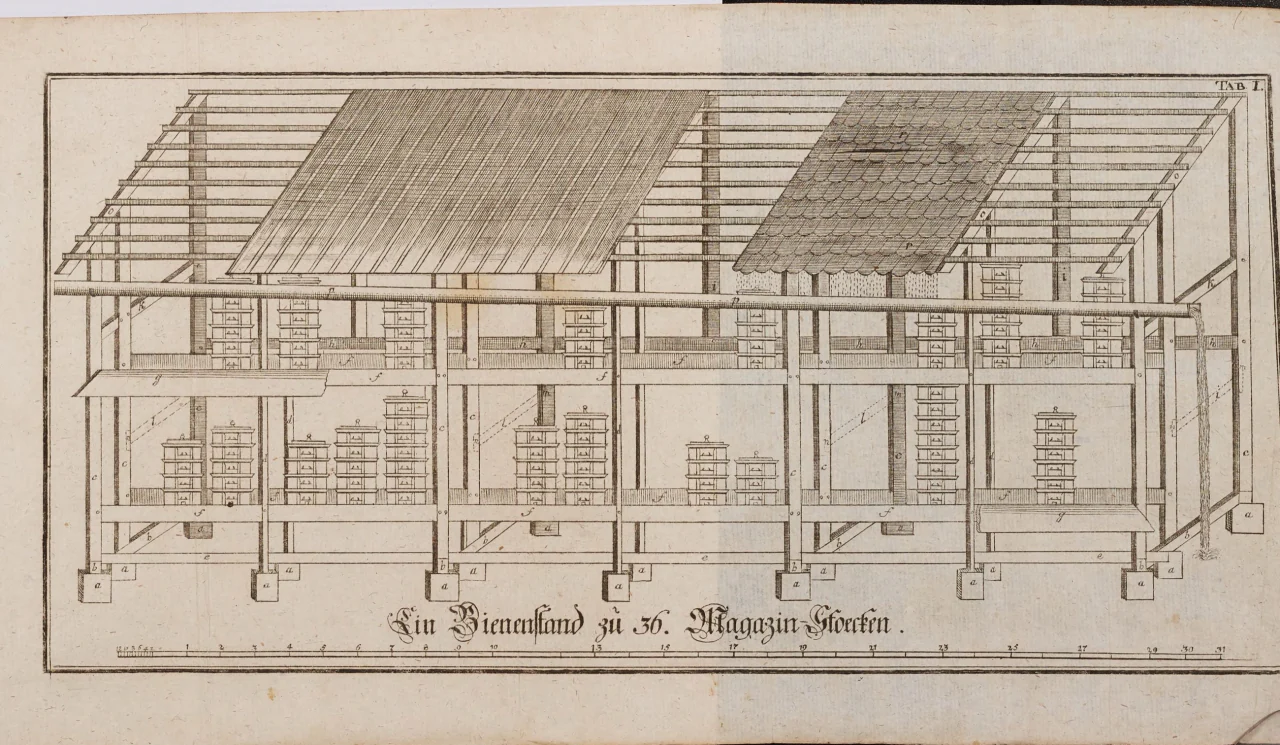
A covered bee stand of 36 magazine hives, some of which are to be seen set up. It has two storeys, each with two rows of hives, each row consisting as it were of 6 compartments, in each of which 3 hives can stand, and the height of these is set so that 8 supers reckoned to each magazine hive have room. The whole length of the bee stand is 31 feet, the breadth 3 feet, the height at the back 10 feet. The closer explanation follows in the second chapter.
Second Plate
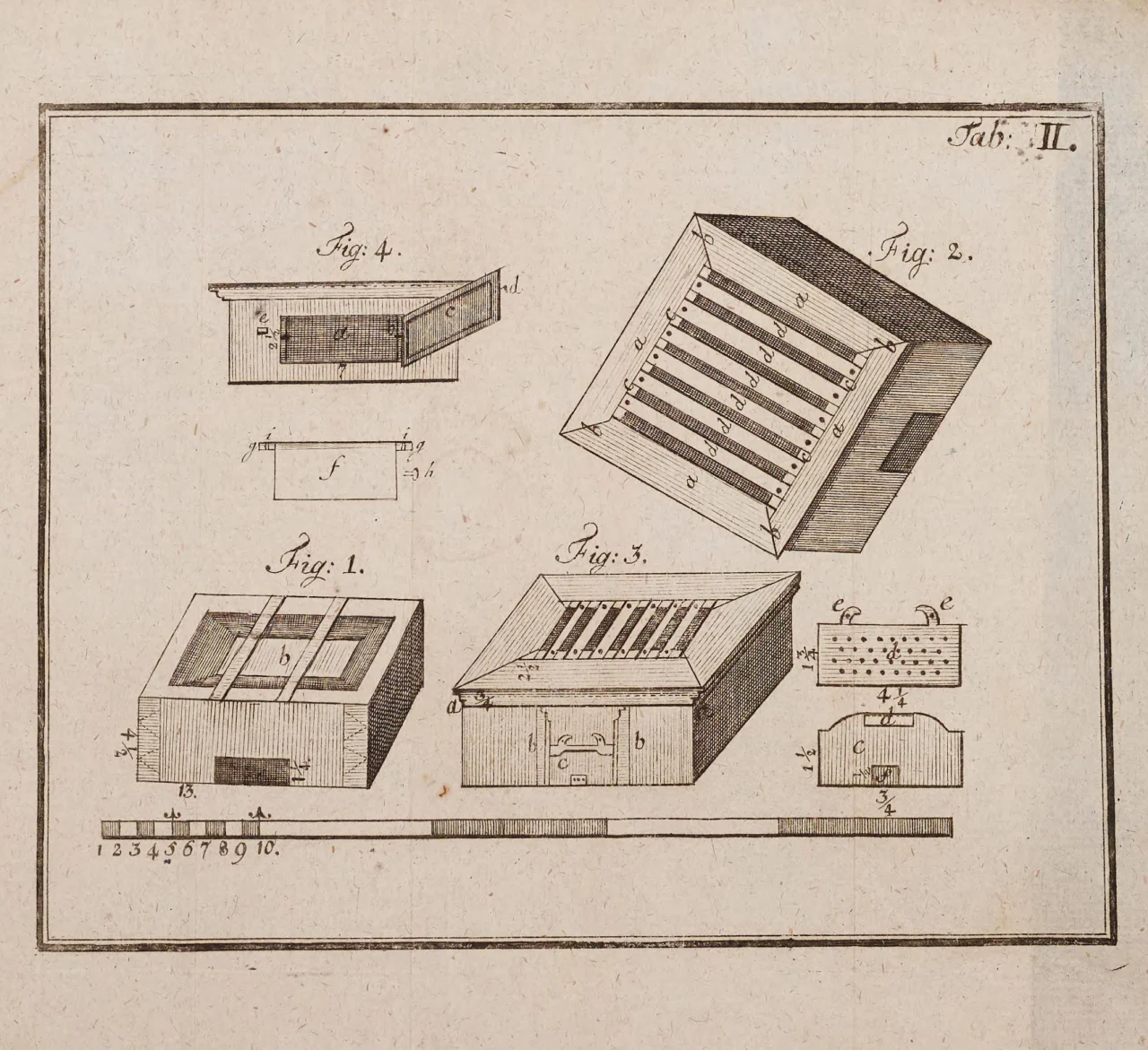
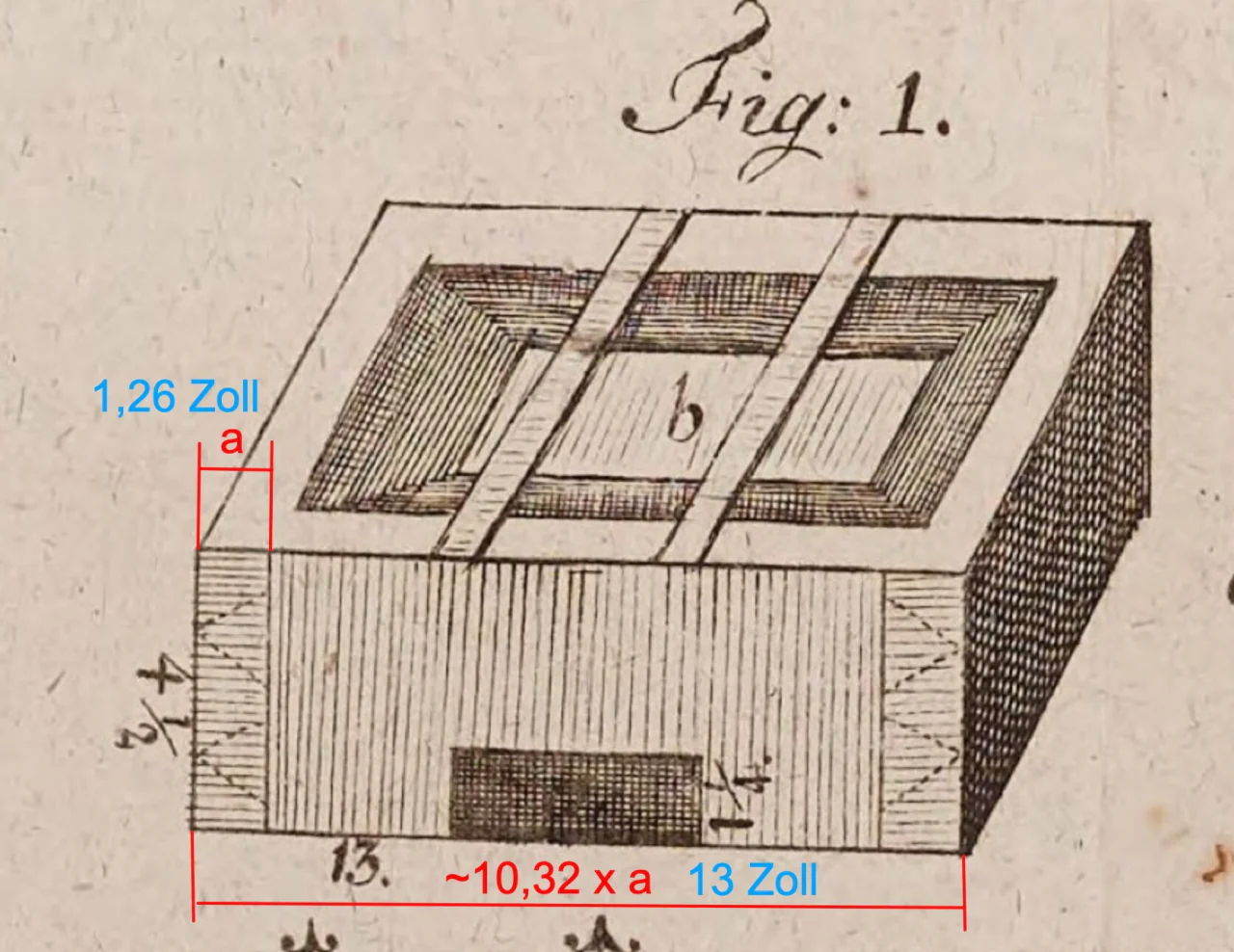
Fig 1. The first joining together and making of a magazine super. The length is 13 inches square. The height 4½ inches. Lit. a. the flight hole. Lit. b. a hole for a glass pane in the back side.
Fig 2. The making of the grating for each magazine super. Lit. aaaa four lath pieces, which are butted together at the corners bb at an angle of 45 degrees. Lit. c.c. a small groove in the lath pieces which are nailed on at the front and back side, in which grooves 6 pieces of wood d.d., each 1 inch wide, are fastened.
Fig 3. At Lit. aa it is shown how the said lath pieces project ¾ inch on the outside and form a cornice. Lit. b.b. are 2 little strips at the flight hole with a small rebate, in which 2 tin sliders run. Lit. c. the front slider, which has a hole f. cut out to half an inch, in order to make the flight hole quite narrow when that is necessary. At the top at g. the tin is bent over a little, so that the slider can be gripped when drawing it up and down. Lit. d. a perforated slider 1¾ inches high, which runs behind the aforesaid slider, has two holes at e.e., in order to be able to push it up and down with a pointed knife should that be needed.
Fig. 4. The magazine super from the back side, in which the glass pane Lit. a. is set. At b.b. small pieces of wood are nailed on beside it, against which the glass pane rests. Lit. c. a little door or shutter in front of the pane, to keep the bees' dwelling dark. At the front it has a little Kräppchen [hook] of wire Lit. d., which drops into a wire bent round at c.
Third Plate
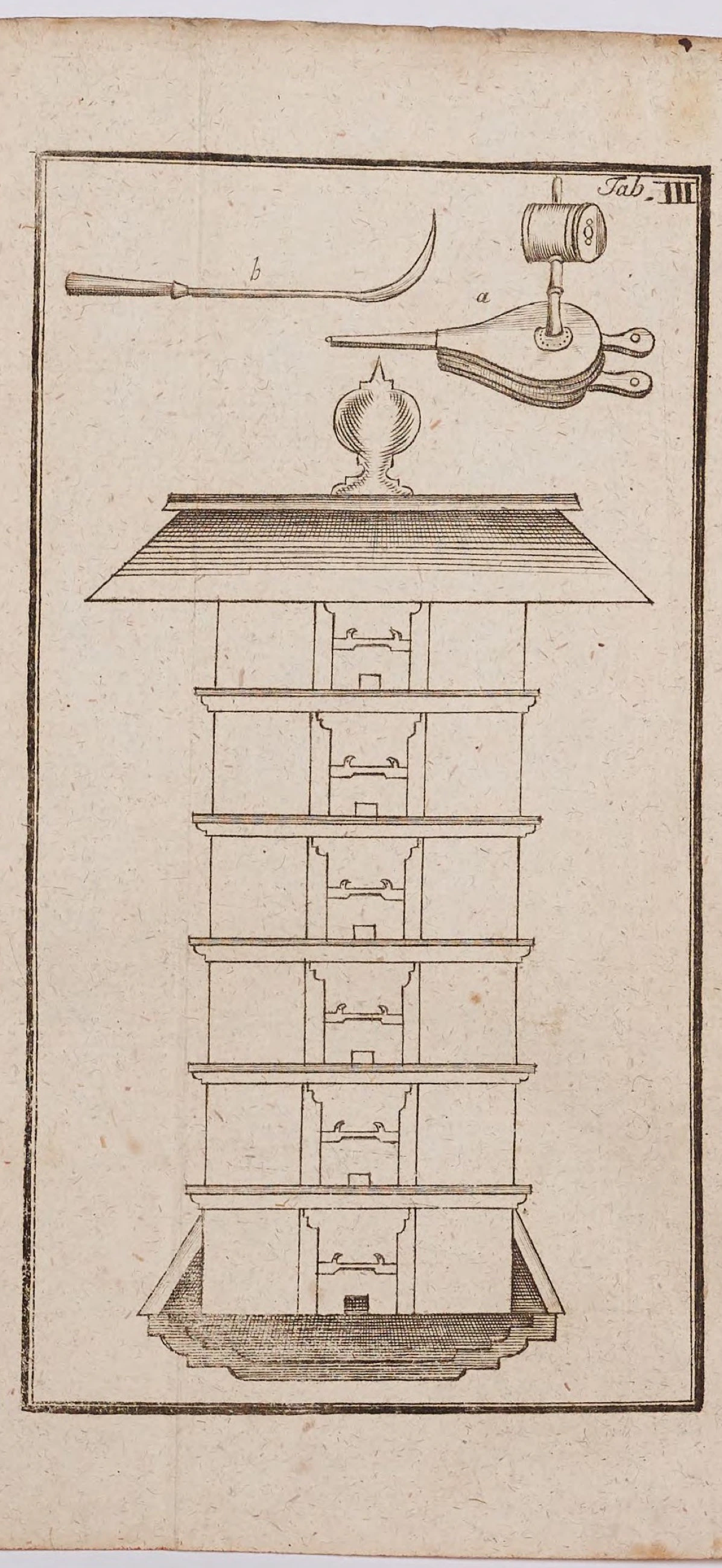
Shows a magazine hive put together with 6 supers and a roof of its own, for the case where one has no covered bee stand and must set one's hives in the open. For this reason a small board is also fitted to the lowest section on each side, so that the driving rain does not stay lying on the base board but runs off.
With it is Lit. a. a bellows with a smoke capsule, which is stuck into its valve, and
Lit. b an ordinary bee knife, whose point is bent crooked and is two-edged.
Fourth Plate
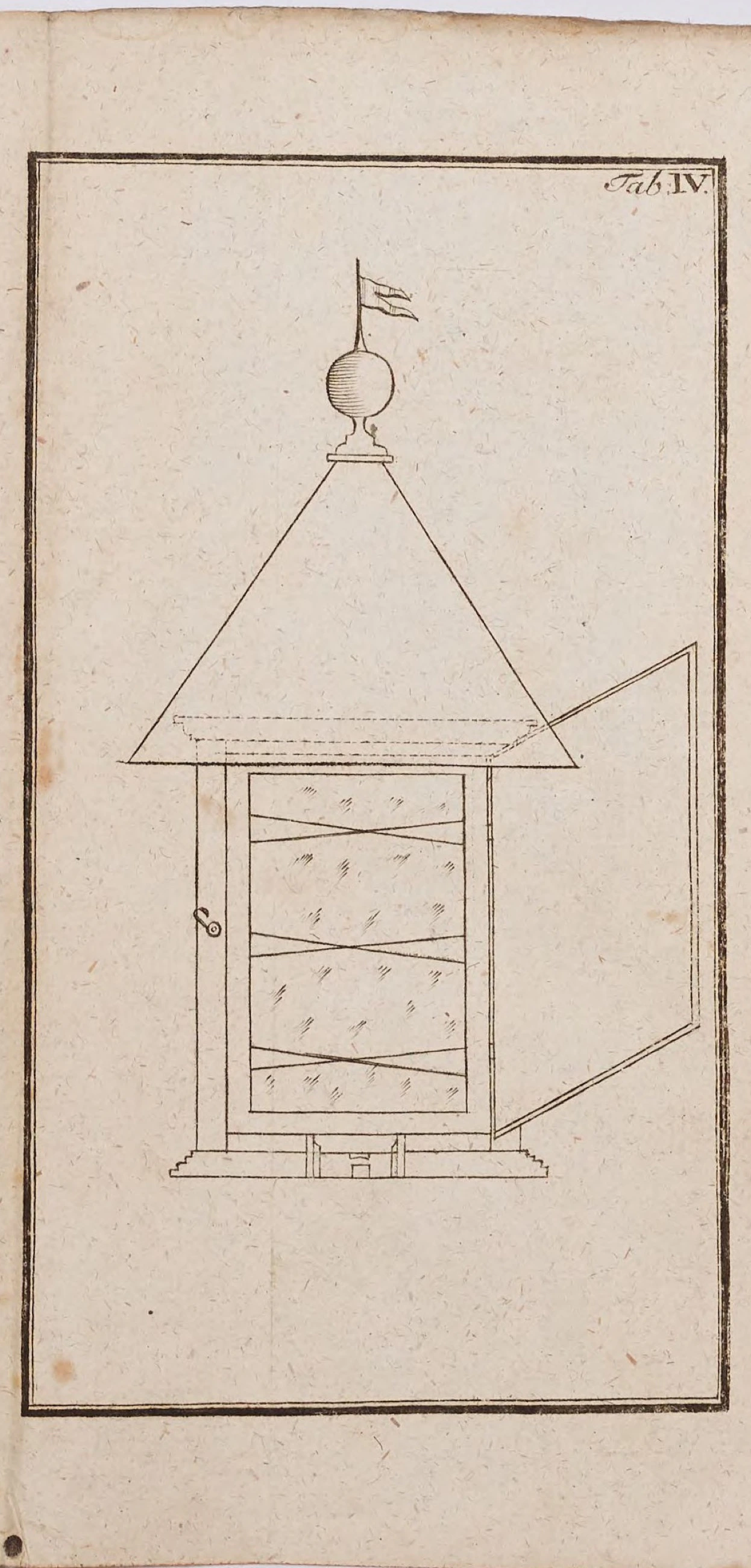
Shows a simple bee house, which is particularly serviceable for pleasure and for observation. Four large glass panes, set in narrow frames, form the 4 sides, each of which has a door or shutter to keep it dark when one is not observing. For a lid it has a square glass on top. The whole bee house without the roof is 1 foot 7 inches high and 1 foot 1½ inches square, and holds 18 Maß. It is set free-standing on a post dug into the ground, so that one can conveniently stand or sit on all sides.
Fifth Plate
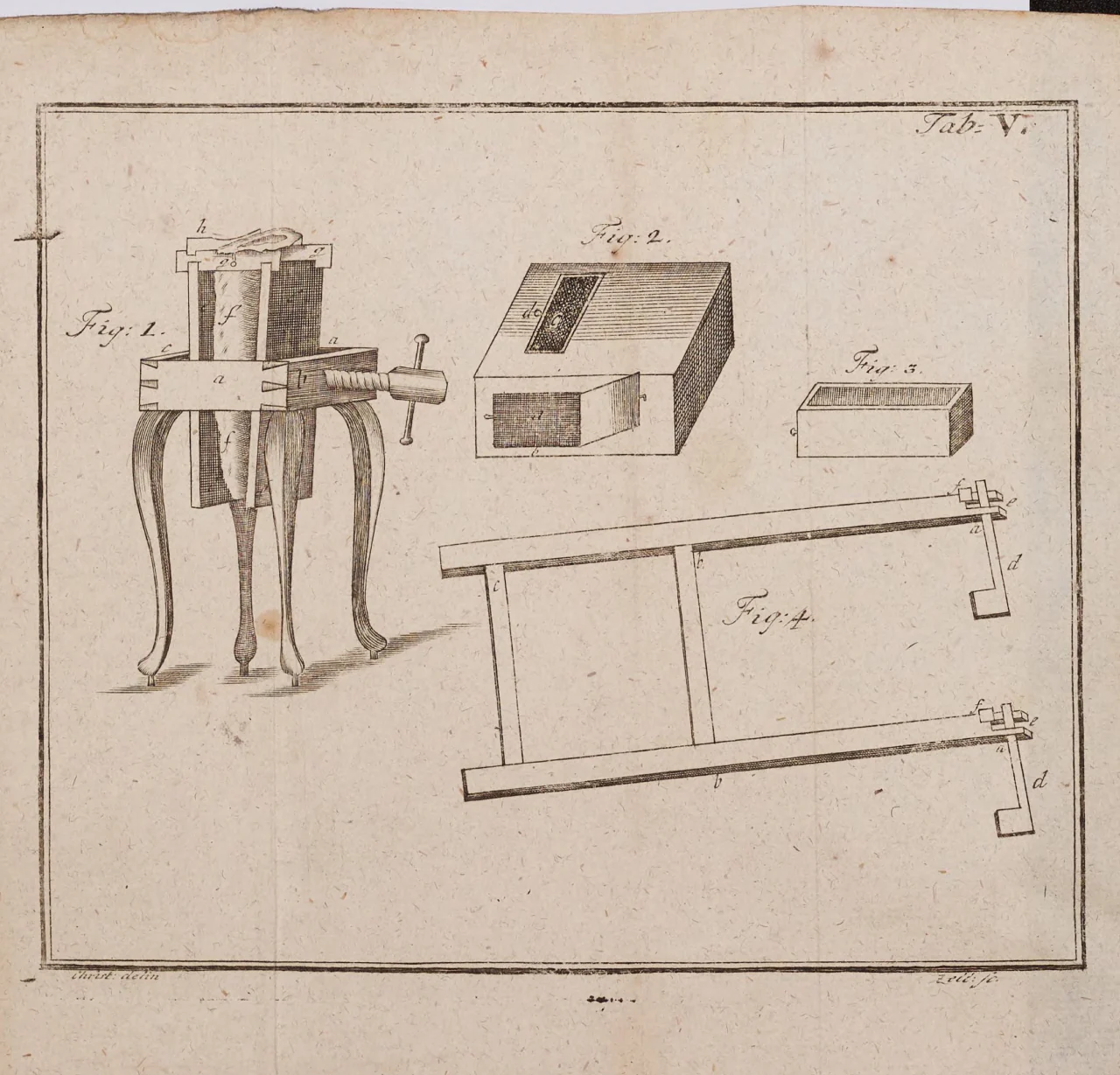
Fig. 1. A wax press, in which the wax bag is fitted so that it hangs.
a.a. are the side pieces, 1 foot 4 inches long, 5 inches high and 2 inches thick. – b. c. the front and back piece, 23 inches thick. – d. the screw, 10 inches long and 2½ inches thick. In the middle each of them has a projecting insert strip. f.f. the wax bag – g.g. two pieces of wood with notches, to hold the boards apart from one another when the boiling wax is poured in – h. a piece of wood curved out, on which the hot vessel with the boiling wax can be rested while pouring in.
Fig. 2. A feeding box, 12 inches square. a is the little door through which the little honey trough is pushed in – b. the front little strip ½ inch high, on which the little honey trough stands. – c. a glass pane on the lid board, so that one can see into the little honey trough. – a hole in the lid of the little box, through which the honey is poured in by means of a funnel.
Fig. 3. The little feeding trough, 2½ inches deep, 10 inches long and 1½ inches wide.
Fig. 4. A Vorlege, or device made of lath pieces, on which one lays the flight board when setting a super underneath, 3 feet 4 inches long.
b.c. are two clasps, 1 foot 3 inches long – which make a hinge at e.e. – f.f. two little pieces of wood which, as turn-buttons, hold the hooks in a straight line when one wishes to put the Vorlage in place or take it away.
First Chapter - Of bees in general
1Of the three kinds of bee
Taken up2
- Das Bienenvolk als GanzesReading
- S00-vorstuecke-kapitel-1Finding
In every hive one finds three kinds of bee, or distinct sorts of bee. The queen, called by the ancients the Weisel; the common or working bees, which are also called the sexless ones, though they are so only by accident; and the drones, or bumble-bees, or, by an improper name, brood bees, though these last are not to be found there at every time of the year.
2Of the queen and her fruitfulness
Taken up3
- Das Bienenvolk als GanzesReading
- Königin, Drohnen und FortpflanzungReading
- S00-vorstuecke-kapitel-1Finding
The queen, so called with good reason on account of her shape, her appearance and her advantages, is the most important, the principal person in a bee republic. Without her the whole colony scatters and perishes. She holds the government and is the soul of all work in the hive. She is the mother of the bees, and so extraordinarily fruitful that one would scarcely believe it, as insects generally, which have a short life, multiply very strongly. In a quarter of a year she begets more than 30000 young bees. For a single swarm, if it is strong, consists of 12000 to 15000 bees, and yet the hive is as full of bees at the end of summer as it was at the beginning of spring, although over and above this at least a tenth part comes to grief in the field during the summer while gathering, partly caught away by birds, partly worn down by wind and weather. Indeed a single really good magazine hive, which one does not let swarm and to which one only keeps adding underneath, can grow to 30 to 40000 bees strong. –One reckons 4000 bees to a pound in weight.
3Her shape, properties and voice
Taken up4
- Das Bienenvolk als GanzesReading
- Königin, Drohnen und FortpflanzungReading
- Christs Bienenkunde aus heutiger SichtReading
- S00-vorstuecke-kapitel-1Finding
Besides her particular fruitfulness the queen also deserves admiration in regard to her shape and her other properties, and she is in truth an excellent creature among all insects. Her smell is like balm. She is much larger and more considerable than the common bees. Her head is rounder and her proboscis shorter than that of the working bees, and her jaws and teeth are notched, whereas those of the common bee lie flat, so that one sees clearly that the queen was not born for work, since by the build of her teeth she is not capable of drawing out and working a single little leaf of wax. They are rather so arranged and fitted to injure the superfluous queens, and to kill them according to the constitution of their wise economy. Her eyes consist, like those of the other bees, of many thousand little mirrors, ground four-cornered, of a purple colour and covered with hairs. Here too we see an admirable wisdom of God, which has formed the eyes of these insects so that the rays of light can fall in from every side. The bees can therefore see exactly in the darkness of the hive, and build by night as well as by day, even when the working ones are surrounded by a whole cluster like bunches of grapes. The wings of the queen agree in length with the wings of the working bees, although they seem short in proportion to her much longer body; a proof that by nature she was appointed neither to work nor to much flying out, (which is otherwise the common business of her subjects). For this reason her hind feet also lack the important hollow that one observes in the working bees, and in which they hang their little bags of flower dust; nor are there on them the many hairs with which this hollow of the working bees is surrounded, as the queen is altogether not so hairy as the common bees. She also has not the brush on the hind legs that the working bees have. As to her colour, her upper parts are somewhat more light brown than those of the other bees. Her abdomen is almost twice as long as that of the common bees, also more pointed at the end than that of the rest, and is not unlike a polished black marble. Further, whereas the two large hind feet of the common bee are black, hers are a beautiful golden yellow, just as the whole underside of the body is adorned with such a shining colour, and under the magnifying glass has such a mixture of colours as indicates something royal. * Her gait too is more majestic, slow and upright.
When several young queens are present, one can clearly distinguish the older from the younger by the voice, since these give forth an ever more delicate tone, and when four of them are there at once, one can hear each distinctly from the other. One also hears the voice of the queen at her singing, as one may call it, at the time when there have been strong honeydews and her subjects are filling the house abundantly with honey. Then I have heard it very often, and indeed in the evening, with wonder. She is apt then to croak now and again, almost as the frogs do.
4Of the raising of the queen in the royal cell
Taken up1
- S00-vorstuecke-kapitel-1Finding
The queen's precedence over all her subjects shows itself already at her raising and birth. The egg from which she is hatched is laid by the mother bee in a special, royal cell, or is carefully carried into it by other bees. This cell is prepared and adorned for the purpose by her subjects with much diligence. In form it differs from all the other cells, which consist of small six-cornered tubes whose pyramidal base is built of three rhombus-shaped pieces, and which lie almost all horizontally. The royal cells, however, are quite different in this and hang perpendicularly, so that the opening of the cell is turned downwards. The arrangement of the build of the common six-cornered cell testifies to an admirable thrift of the bees in regard to wax, but they use it lavishly in the building of royal cells. These are so strong and dense with wax that a single one of such royal cells weighs as much as 150 ordinary cells. It is round and smooth within, and in proportion to the body of the queen has a greater circumference than the common cells, and this superfluous size the bees fill up with a more abundant quantity of better and more palatable food pap than for the other bees. But this royal castle is never raised among other cells; it stands in a special place and hangs down at the edge of a comb, in which there is usually drone brood as well, like an acorn almost as long as a finger; but if the hive is weak in bees, then for the sake of warmth and tending they hang the queen cell on a comb or rose in the middle of the hive. They are constantly busy at such a cell as soon as it is occupied; they show the utmost care, and several bees do not leave it. Some tend the young queen within without ceasing, others make decorations on the outside of the royal cell, which consist of nothing but six-cornered surfaces that keep decreasing in proportion and growing smaller towards the end of the cell. In every hive one finds one such royal cell, in some two, three and more. But once the young queen is hatched and has left her cradle, the bees carry away the greater part of the cell again and use the wax for other necessary purposes.
5From what kind of egg the queen is hatched – And also of the drone-breeder queen
Taken up6
- Königin, Drohnen und FortpflanzungReading
- Christs Bienenkunde aus heutiger SichtReading
- Sein Platz in der ImkereiFinding
- Zeit und UmfeldFinding
- Christ war nicht alleinFinding
- S00-vorstuecke-kapitel-1Finding
Here belongs the question about which so much has been written and disputed: from what kind of egg is the queen hatched? Is it an egg containing the rudiment of a royal grub, from which no other bee can come than a mother bee or queen, seeing that with the best microscope one discovers in the ovary of the queen only two branches of eggs, which yield the drone eggs and the eggs from which the common working bees arise?
Pastor Schirach in the Upper Lusatia, to whom we owe wholly new and useful knowledge through his Polizei der Bienen, has thrown a light upon this matter for us. Through the frequent experiments he made he has proved that a queen can come out of any working-bee grub, provided it be only three days old. He cut out a comb with brood, in which there were eggs, grubs and capped nymphs, and set it with a due number of common working bees into an empty basket, and every time these bees have made themselves a queen. That is to say, they built a queen cell around a grub three or four days old, provided it with stronger food pap, (as they do throughout with queens,) and thus reared it. Since Herr Schirach himself at first supposed, and since the objection was also made to him by others, that he had by a favourable accident met with one or more queen eggs in the cells every time, that is, such as contain the rudiment of a royal grub, which the bees by their natural instinct could well distinguish; (as many still maintain that at various times such queen eggs are kept in store, by which the loss of the mother bee can be replaced when it is needed;) he therefore had twelve small wooden boxes made, and at the same time set into each of them a little piece of brood comb from one hive, only four inches large, in which there were eggs and grubs, and added some working bees; but in all twelve boxes he found after three and four days royal cells with their grubs, and after 17 days reared 15 living and beautiful queens in them. This experiment he repeated every month through the whole year, and every time he obtained queens. Indeed from a single living grub that lay in a common cell he procured a queen.
These experiments prove in the highest degree of probability that a queen can come from any common bee grub, in which most of my divisions, which I made after the Franconian manner, have also confirmed me. One need only take out of any hive one likes a little piece of comb of 4 to 5 inches square that is filled with brood, hang it high up in another empty hive and set that one in the place of the first, and one will soon become aware that the bees which had flown out of the first to gather honey move into this new hive, build some royal cells in it and procure themselves queens in the manner spoken of.
But if a queen can arise from this common bee grub, then it follows: 1) that the outward circumstances, for example the stronger food pap and the larger cell, in which the germ threads of the bee have more freedom to develop, cause a queen bee to arise out of a bee grub from which a working bee was to have come. 2) That all common bees belong originally to the female sex, that they are imperfect females, each of which, however, would only need to be developed one degree further to become the queen and fruitful mother of many swarms. *
A new experience belonging here has been made known by Pastor Ramdor in the Gothaisches gemeinnütziges Wochenblatt, parts XX and XXI, 1782. He discovered, that is, in several hives drone-breeder queens, queens which the working bees had produced from drone brood for want of suitable brood, and after the probable loss of the proper queen and mother bee, and indeed in the way in which they otherwise proceed when rearing a proper queen: they built, that is, a queen cell around the drone grub, presumably added the royal food pap to it, and thereby reared queens which had head, breast and the whole body of the same constitution as other drones, but were more considerable, larger and more shining in colour. –Now the observer did not dissect these drone-breeder queens in order to be assured of their inward constitution and likeness to the drones, which in this rare event and fine discovery is indeed to be regretted. Meanwhile it is still highly probable and reasonable to conclude that these drone-breeder queens were of the male sex. But since in these hives nothing but drones were ever produced, he thinks to solve the riddle of drone-begetting by supposing that there must be some among the working bees which could lay drone eggs.
Indeed he believes that they do it not only in queenless hives, but perform this business in good and healthy hives too, and that they are covered by the drones for that purpose just as well as the queen, by which the multitude of drones in a hive is the more comprehensible to him.
But the riddle seems far from being solved, and this dark matter so little cleared up, that one could subscribe to it without closer investigation and more thorough experience. It would certainly be worth the trouble, in the case of such a queenless hive in which nothing but drone brood is found, not only to examine and search it closely for whether there is not a queen present among the working bees, one equal to the working bees in size as well, being anyway like them in shape, and who must grow smaller when the egg-laying is spoilt and the greatest part of it has dried up which was to have yielded the working-bee brood, but also to anatomise all the remaining working bees found in it and to investigate most exactly in which of them, or in how many, an ovary is to be met with, which at that time in particular could not possibly hide itself? == whether such have the marks of a small queen, for example the absence of the spoon and the brush on the hind legs; a small proboscis; the differing constitution of the feeding pincers and teeth etc. == and whether at the time of the orphaned hive she really yielded the brood for the drones, and whether the entire want of a queen drove her to set herself up as a half-mother: what marks such a one has beyond the others, and the like. –
The objections made in this regard and the doubts as yet unresolved consist chiefly in this:
a) Where in nature have we a known example of animals or insects which can propagate only one kind of their sex, and never their whole sex, male and female together, especially as the former would be wholly without use, which nature does not do at all?
b) Why have the greatest dissectors at no time been able to discover in the working bees even the slightest trace of an ovary? == and why has no observer in glass hives ever seen a common working bee lay an egg, whereas we so frequently come upon the queen at it and observe exactly how she sets both the common working-drone brood and the drone brood?
c) Should the working bees have the power and the natural instinct to beget drones in company with their proper mother: what a monstrous quantity of drones would constantly be found in the hives, even with a good and healthy queen?
d) If the common and working bees beget drones, or bees of the male sex, lay their eggs, and can thus yield the matter and seed for this kind; why does this never happen at those seasons when no drones are present, for example in the early spring, or in the late autumn, when they have usually been disposed of already, seeing that at all these times too hives can become queenless and often really do so, and indeed mostly at this time? == especially as in strong hives new brood is already set about Christmas, particularly in winters that are not very cold. –
In general a naturalist must with great caution hold back his judgement on the first results of his experiments in the so difficult investigation of the laws by which living beings are governed. What often seems to us flatly contrary to analogy and to the ordinary course of nature is not so, particularly with insects. On the other hand we often think, or infer from first experiments not sufficiently investigated or not often enough made and varied, that nature goes this way or that, and yet it behaves quite otherwise. I am therefore very unbelieving in natural history and cannot at once give my unhesitating assent without a trial made by myself, or without knowing it to have been made by several credible naturalists.
Meanwhile the marks of sex in them must be indescribably small, or, still more probably, quite extinguished. For how could the ovaries of these bees have escaped the great Dutch naturalist and dissector Swammerdam, who has described and figured the ovaries of the queens so excellently, how could they have escaped a Maraldi and a Reaumur? But in the development of the sexual parts everything depends chiefly on a certain nourishment arranged for them and on a receptacle in which they have room enough to extend themselves on all sides; if, on the other hand, these two essential circumstances are lacking, then the common bee is condemned to eternal virginity, or rather barrenness, so that they are indeed at bottom true females, but females of a quite particular kind, which beget nothing and also could beget nothing, females which now really are none, but which yet could have become such if in their first shape they had had another situation and received other nourishment. *
There is indeed a principle in natural philosophy, long since proved by infallible experiments, that no living animals can arise out of merely inorganic matter, but one thing is: to arise, and another: that parts be developed. This last is possible and happens very often. Let us hear on this the incomparable naturalist Bonnet. He has shown in his Insektologie on sufficient grounds that the seminal fluid is both a proper nourishing and an irritating juice. He has shown how it can bring about the greatest changes in the inner parts of embryos. Consequently it seems to be nothing impossible that, by means of a certain and superfluous nourishment, limbs could develop in bee grubs which otherwise would never have developed. How many other occurrences have we in nature which confirm this truth? One need not go into the cabinet of an observer of polyps; one need only recall the singular fact that the cock's spur can be grafted onto his comb, over which the most skilful and experienced naturalist may exhaust himself. If one grafts this spur into the double fold of the cut comb, it is not much larger than a hempseed; in this it now strikes root, and within 5 months grows half an inch. After four years it becomes a horn three or 4 inches long, and indeed a proper horn, like an ox horn, and like it has a bony core; it is joined to the head and articulated in it by a ligamentum capsulare and by the bony ligaments. But presumably these means of connection must pre-exist in the spur and in the comb in an invisible manner, only with other determinations than they receive afterwards through the grafting. For the cock's head is a quite different soil for the spur than that where it should properly have grown by its destination. It is known what alterations the juices can cause by their qualities, by their superfluity and want, and that often the slightest injury to a tender fibre extends over the whole subsequent growth, and can change shape, proportion and firmness therein. Consequently the horny substance of the spur, when it unites with the fleshy matter of the comb, can also bring forth new changes.
It is therefore well to believe that the abundant and stronger food pap is for the limbs of the queen bee that is to be a kind of fructification, arranged for the kind of this animal and just as effective as that by which the animal itself is begotten.
In regard to the greater space which the queen has in her cell, the drones give this matter a great probability, since those which are hatched in ordinary working-bee cells (for want of other cells destined for them) and are called hunchback brood are markedly smaller than those reared in the cells proper to them, which are a third larger than the cells of the working bees. For as the grub's body lay too narrowly in the former, it could not grow out fully.
That the queen bee has a shorter proboscis than the common bees, wings just as long, and not the spoons on the hind legs, in no way weakens the conclusions. All these alterations these limbs can suffer from the quantity or the quality of the nourishment given to the grub. The likeness they always keep; indeed these things are just as unchangeable in them, notwithstanding that they arise from accidental causes: causes which none the less bring forth their constant effects therein; for they were taken up by the Creator into his plan when he brought the bees into actuality, and we must also leave it to his fine wisdom how he gave the queen bee an audible voice beyond the other bees. That, for the rest, in the common working bees their sexual parts and their ovaries can as it were be extinguished, of this we find similar examples among other insects. The abbé Boissier de Sauvages, a great naturalist, relates of silkworms: he dissected them at the time when they eat most strongly and when their entrails can be seen most distinctly: in all of them he found an ovary and accordingly met with nothing but females and no males. But if the female ovary is found without distinction in all silkworms, then it is settled that it dries up in the male butterflies, namely in those which by certain unknown circumstances are destined more for the one sex than for the other. If, then, one were to find inwardly in dissected bee grubs ordinarily only a single ovary, or only a granular thread with small nodules: one could draw from this in respect of the bees the very consequences which the abbé Boissier assumed in respect of the male butterflies, and maintain that the ovary dries up in the working bees, namely in those which by certain unknown circumstances have been destined more for the one sex than for the other, which have grown up in a narrower cell, that is, and on account of their situation and their scantier nourishment could not extend their bodily parts so strongly and develop certain limbs as those can which are able to do so in larger cells, in royal cells.
6Of the sting of the queen and of the other bees
Taken up2
- Nahrung und TrachtReading
- S00-vorstuecke-kapitel-1Finding
In the constitution of the queen's body it is particularly to be noted that she is furnished, like the other bees, with a sting, which is somewhat longer still than that of the working bees. —The sting of bees in general is at the outermost part of their body. In the state of rest it is hidden; if one presses this outermost part, one sees it appear accompanied by two white bodies which together form a kind of sheath in which it lies when it is inside the body. This sting is like a small arrow which, although it is very fine, is nevertheless hollow from one end to the other. One may confuse the sting with the horny scabbard, which is itself already very pointed: the sting comes out, that is, through the outer part of this scabbard and is driven out with violence at the same time as the sharp and burning fluid. Indeed this sting is double: there are two of them, which come forth at the same time or at different times as the bee pleases. The outermost of them is cut like a saw, and has 15 barbs or teeth, which are bent on each side so that the points stand towards the root of the sting, which makes it impossible to get it out of the wound without tearing it. The bee must therefore draw it back with all her might. If she does this too quickly, the sting breaks in two and remains in the wound, and as it separates from the body of the bee it tears the poison bladder; a part of the entrails comes out at the same time, so that this separation of the sting is absolutely fatal for the bee, and mortification must follow at once. But when one bee stings another, which can only happen between the rings on the abdomen, the sting does not stick fast, except when it happens to be pressed by the horny part under which it comes, so that it does not come out again quickly, which however rarely happens; the sting, however, is always fatal to the bee that is struck. But although the queen, like the common bees, is furnished with a sting, she never readily uses it to do injury. One can hold her in the hand without any fear as long as one likes; and even if she is often pressed, she still does not sting. One would have to make her very angry and provoke her long before she resolved to sting. But precisely here the wisdom of the great Creator shines forth again, which has arranged everything in nature so gloriously, and has planted it in this little creature's nature to refrain from stinging. For since, as has been said, every bee must die at once when she has stung, and the sting, as mostly happens, remains stuck, whereby the entrails are injured, the queen too would forfeit her life, which is so noble to the bee colony and of the utmost consequence to it, if she were so ready to use her sting for revenge, and consequently the whole republic would be lost as well, since it is known that all her subjects neither desire to live any longer nor can subsist when their head is dead and they have no hope of getting a young queen.
But one is not to believe that this remarkable member of the sting, with its so-called poison bladder, was given to the bee by the Creator merely for defence. It has yet another very great use and important purpose, and in many respects takes the place of the business of the gall in animals with red blood. The caustic and burning juice which is in this bladder is, as the smell already indicates, a concentrated acid with many fiery particles, by means of which the still raw juices sucked in from honey and for wax are dissolved and prepared in the body of the bees, the harmful parts sometimes still present in them are separated off, the fat oil in the honey is divided from the ethereal oil, and thus the wax is prepared from the former. For this dissolving power a sharp fluid with a quantity of fiery particles was required, and that it has such properties is also proved by the burning pain from the discharge of it into the wound at the sting of the bee.
7Of the regard in which the queen stands with her colony
Taken up1
- S00-vorstuecke-kapitel-1Finding
The regard in which the queen bee stands with her colony is extraordinary, and it is founded on an obedience inborn in these creatures and on an admirable esteem, reverence and love towards their queen. Their faithfulness towards her is so great that they not only give up their life for her defence and provision without hesitation, indeed hold it very cheap if they think in the least that anyone is coming too near their queen; but that also, when she is taken from them or has died or perished by an accident, and they have no brood in store from which to raise a new queen, * they mourn over it so that they neither work nor fly nor eat, and either die of hunger, even if the beehouse were filled with honey, or else they at once leave everything, distribute themselves into other hives, or move together into another one and do homage to another queen, or they rove about everywhere until at last they perish and sink under the burden of their sadness. –
If it happens that a hive runs out of honey and the colony must perish for want, they leave something over for their queen, on which she could still live for several days. But the queen loves her subjects just as faithfully; if she is wholly torn away from them, she too mourns herself to death.
8Of the queen's bodyguard
Taken up1
- S00-vorstuecke-kapitel-1Finding
That the queen has her particular bodyguard is founded in truth, and the evidence of the eye shows it constantly. It consists, however, not of drones, but of a number of bees furnished with stings, which are not only constantly about her but also keep licking her and accompany her everywhere she betakes herself in the hive. She is indeed mostly quite hidden in the innermost part of the beehouse, and one does not easily get to see her often, except at the time when she means to bring forth her young into the cells, which mostly happens in the forenoon until towards 11 o'clock. When she then comes into view, she is always surrounded by a circle of bees, her court suite, which keep licking her. The working bees she passes by do the same. Indeed this veneration goes so far that they lick the place and the path on the glass, or on the wax combs, over which the queen, very lovingly too towards her subjects, with whom she often stops as she passes, unites her tongue with theirs, * and altogether behaves so lovingly towards them that one must hear it as fabulous if one does not see it oneself and give one's curiosity this engaging pleasure, which is a particular one to a lover of nature and of her Creator.
9Of the drones and the constitution of their limbs
Taken up1
- S00-vorstuecke-kapitel-1Finding
The second kind of bee found in a hive, though not at every time of the year, are the drones, or bumble-bees, or, as some still call them, brood bees, because it was formerly believed that they had the business of hatching the young bees, which is not so. They are large, and stronger in breast and head than the queen, but their abdomen is quite different from hers and by no means so long and pointed. They have a much rounder head than the other bees, and no projecting teeth as those have; theirs are small, flat and hidden, and different both from the teeth of the working bees and from those of the queen. Their proboscis is also much shorter and finer, but their eyes are larger and much thicker. They cover the whole upper part of the head and make a bulge on each side. The three little eyes (ocelli) which stand on the crown of the head are quite overgrown with brownish-red hairs. The antennae are shining black, quite smooth and without hairs, with a short basal joint, upon which 10 joints stand in their jointed knob. They thus differ very markedly from the antennae of the working bees and of the queens, since the antennae of these have a long basal joint which forms an elbow, upon which 9 joints move in their jointed knob. Under the jaws two little tufts of hair project, forming two beards. On the fourth ring of the abdomen stand long, bristling hairs: but the fifth and sixth ring bend right under, and make the body blunt. They have no sting, and nature, which does nothing in vain, has among other things created them defenceless for this reason too, that at the drone battle, at the time when they are no longer of service to the state, they can be killed and driven out without the loss of many of the industrious bee kind.
10The drones are held to be the males of the queen
Taken up5
- Das VermächtnisReading
- Königin, Drohnen und FortpflanzungReading
- Christs Bienenkunde aus heutiger SichtReading
- Was Oehme aus Christs Naturkunde machteFinding
- S00-vorstuecke-kapitel-1Finding
The drones are held to be the males of the queen, and make the eggs of this mother bee fruitful. I have indeed never yet had the good fortune to see their coupling with her, but other naturalists, and Herr von Reaumur and Herr Riem in particular, claim to have been eyewitnesses of it, both inside and outside the hive, though this last happens extremely seldom. According to Reaumur's report the queen, at one coupling, mounted the drone, in which the male member springs up like a bow, as one can observe in every one of them if one presses her hard in the middle of the body. But it cannot draw back again, since it has as it were two springs which prevent its retraction, and for this reason every male must always die after the coupling; and I have often found such drones dead in front of the hive, which made the matter seem plausible to me. But on account of this loss of the male bees, nature has provided by a considerable number, which in a hive of 15000 bees amounts to about 300 drones, and in a hive of 30000 bees to 700 or 1000 drones, that the necessary fructification should not be wanting. But that on the other side too much should not happen, and the queen should not perish among her seraglio of males, the drone is by nature very sluggish and cold-blooded, and must be roused to love and coupling by the queen, whereupon he also holds his ground until he lies dead beneath her. Besides this, the often strong number of drones is not intended for the old queen in the hive alone, but also for the young queens which are to be set in a hive, although they are not all, and mostly only the very fewest, hatched or left alive. *
It goes slowly, to be sure, before a newly discovered truth in natural science is properly established. The ways of the Author of nature are so admirably various, and the mystery of generation so deeply hidden, that a sound philosophy may very well allow itself to give way even to the very smallest doubts. In general very many extraordinary things are found in experience in the generation of insects, to which our certain knowledge of the ordinary ways of nature seems contrary.
Whether the queen possesses a source of fruitfulness in herself, or whether and how she is fructified by the drones, remains a mystery to us: yet it is not impossible that she could be fruitful without coupling, because we have in nature perfectly similar and sufficiently proved examples. There are insects which propagate both with and without coupling, such as the snails, and above all the plant lice, with which Löwenhof, Gerstoni, Bonnet and others have made experiments and found that they propagated to the tenth generation without any coupling.
But since the plant lice, and indeed one and the same sex, which bear young without coupling, nevertheless also couple, and propagate by means of coupling as well, I conjecture that these little creatures can be fructified for many generations by a single coupling. And so it may be with the mother bee as well. Indeed I believe almost with certainty that the mother bee transmits the fruitfulness received from the male to the daughter, to the granddaughter and so on, so that the queens can be fruitful for several generations and the brood they are to set in future is good and fructified, without the assistance of a male (which admittedly meets with much contradiction, and is to be cleared up by further observations.)
But if the queen bee were to be fruitful without coupling every time, wherein does the secret purpose of the drones consist? For what has wise nature furnished her with so great a store of organs of generation? This may, it is answered, really be very different from all our notions, and the secret purpose of the males may perhaps consist in something which we do not hit upon with all our thoughts. The great quantity of the whitish juice which the drones have in their seminal vessels, and which seminal fluid must be not only an irritating but also a nourishing means, cannot be superfluous at the time when most bees come into view. Who knows whether the males do not let their seed into the royal cells in which an egg or a grub is really present, and whether the queens are thus fructified while still grubs, as the eggs of fishes are fructified? Who knows whether this seed, when it mixes with the nourishment on which the egg or the grub lies, does not strengthen the efficacy of this nourishment and make it fitter for the development of the ovaries? Who knows too whether this seed does not penetrate into the grub itself by quite other ways than we can conjecture or discover.
But since in natural science we ought not to depart from the usual ways which nature goes without sufficiently proved plain examples, and since these usually further the generation of animals by coupling, (excepting such as propagate as it were by offshoots or by division, as for example the polyps and the infusoria,) I therefore believe that the opinion I expressed before might be the best, namely that the mother bee transmits the fruitfulness received by a single or also by a repeated coupling with one or more drones to her child and her children's children, the more so since a plain coupling has already been observed.
How much meanwhile remains hidden from us? What an abyss is a hive in the eyes of the wise? What unfathomable wisdom is hidden in this depth? Where is the philosopher who would dare to explore it? Bonnet says fairly that for dull heads the bees are a very small object: for such, that is, as do not know at all that nothing in nature is small, and that a gnat can exhaust all the notions of the greatest genius. The least insect is a world for the naturalist. But with the bees I believe that many worlds run together there, of which we touch only a few boundaries with our investigations.
11They can do no work
Taken up2
- Königin, Drohnen und FortpflanzungReading
- S00-vorstuecke-kapitel-1Finding
Apart now from the final purpose for which the drones are there, they can do no work, and can neither gather honey nor flower meal (for which last business
their hind legs and feet are also not fitted, and they have no spoon-like hollow,) nor build, nor perform any other common labours. They are very sensitive in regard to cold and fly only in warm sunshine from 11 o'clock in the forenoon until towards 5 or 6 o'clock in the evening, and keep mostly in the warm middle of the hive, where the queen for the most part is, so that the seminal fluid may be kept fluid and strong.
12Of the drone battle and the driving out of the drones
Taken up3
- Spättracht und HerbstReading
- Königin, Drohnen und FortpflanzungReading
- S00-vorstuecke-kapitel-1Finding
The drones are usually not hatched until May, and are then disposed of again by the bees towards the end of July and in August, in some hives not until September, and sometimes not until October, especially when there is an autumn rich in honey. If bad weather sets in during the spring and a want of honey arises, then the drones are disposed of in many hives already, but afterwards new ones are hatched again when there is better honey forage. Just as in general the queen sets no more brood at all when a time of hunger sets in, whereby, however, the hives become greatly depopulated and many perish. But to this sad step of stopping the rearing of the young brood, otherwise so dear to the bees, they are moved not only by the want of honey for feeding the young, but also by the foulbrood to be feared, in case they had to let the young starve during a continuing want, which would cause them certain ruin. –The bees partly bite, partly sting the drones to death, but mostly they drive them out of the hive and bar them the way back, so that they must stray or perish through the cold of the night. The bees display so great a cruelty in the extermination of the drones that then, once the drone battle has begun, they do not even spare the eggs and the untimely births of these males, but tear them clean out and destroy them likewise. But this happens from a ground and purpose very fitting to their wise and fine constitution of state. A drone costs more upkeep in honey than two or three working bees, and does not make shift with a lesser nourishment, as the working bees do, which also eat flower dust and thereby save much honey. They would thus for a good half year be a great burden to the state, and as useless members which do no work would consume what the others have gathered early and late with sweat and toil. Besides, their fructification of the eggs, in whatever manner it may happen, is no longer needed, because few young bees are produced any more before the spring.
Along with this it is to be noted that some bees do not readily go to the drone battle, and often tolerate them long and until October. With such it is well done, especially when the number of drones is strong, (which on the whole I do not much like to see,) if one comes to their help in killing them. To make them fierce, one wounds a few drones several days running and lets them run into the hive again, whereupon the bees, which tolerate no maimed ones, set upon them, and thereby very soon fall into the habit of driving them out. If one helps the bees in killing the drones and presses them apart with a little stick, then those bees which in any case cannot go out for food at that time gain some honey besides, which they suck out of the crushed bodies of the drones.
13Of the working bees, their sex and their bodily constitution
Taken up1
- S00-vorstuecke-kapitel-1Finding
The third kind of bee which dwells in a hive is called working bees, because they alone must do all the work. These make up the great number and have their alternating businesses and offices. According to the remarks above they belong to no sex, although at bottom they are females and could have become such if they had been reared in large cells. Yet I will leave undecided the conjectures and judgements of various naturalists who maintain that some among the working bees begot drones, and that they begot drones among the working bees, and that they are therefore all either of the male or of the female sex (see the Vorbericht).
But as regards their limbs, their proboscis or tongue, which lies in sheaths, is very bright and has a chestnut colour: its build is very wonderful, and too lengthy to describe here. With it they lick the honey out of the cups of the flowers, and bring it by all sorts of movements and shortenings into the furrows of the sheaths towards the mouth and conduct it to the gullet, at whose opening is the proper true tongue, and indeed a fleshy tongue, which takes in the nourishment brought there and sends it to the stomach. For the proboscis is not bored through, so that it might act as a pump in sucking up the honey, since otherwise the bee would not be able to catch and swallow any flower dust and the like through so unspeakably narrow a passage: rather the proboscis is quite hairy and resembles a fox's tail. With it they can lick up much honey very quickly, so that a hive is able to carry off four measures of honey in a day if one sets it out open for them. On the head, between the eyes, they have two antennae which are very sensitive, and with which they especially feel all changes of the air. Indeed perhaps, and very probably, the Creator has laid one or more senses into them which we do not know how to name. At least it is extraordinary how keen their feeling with them is, and how far they smell the honey, since an hour's journey is not too far for them to scent out the honey, or only flowers rich in honey. They have four wings, namely two large ones which cover their body and beneath them two small ones, all of which show the various colours of the rainbow, according as the rays of light or the sun fall upon them. Beneath them are two openings of the lung, through which they draw breath, of which they have four more at the sides of the thorax. Of their six legs the two foremost also serve them at the same time in place of hands. Every leg has two large and two small hooks, and the second and third pair of legs each has a brush, or a four-cornered part set with stiff hairs, which they use in gathering and depositing their little balls of flower dust. On the hindmost legs it forms a shovel on the outside, and has a sunken hollow in which they stick their gathered store of flower meal and the like and carry it home.
14Of their various offices in and outside the hive, and among other things of the preparation of the wax
Taken up5
- Das Bienenvolk als GanzesReading
- Wabenbau und WachsReading
- Nahrung und TrachtReading
- Christs Bienenkunde aus heutiger SichtReading
- S00-vorstuecke-kapitel-1Finding
The working bees have their common and alternating businesses and offices, which they all know, to be sure, but their arrangement is such that some attend to these, others to those offices for a time, and then change about. Some have their business at home, or in the hive: some build the cells, others form chains, each hanging on to the feet of the next, and they often stay hanging so, motionless, for many days, so that the working and arriving bees can conveniently run up and down on them. These chains of all sorts of shapes they make in a position of the body that often seems very uncomfortable to them, especially when they begin to build and the dwelling is still empty, whereupon those bees which come home laden with honey and flower meal feed both those hanging in chains and the working ones, and partly offer them the honey with the tongue, partly let them eat the flower dust off their legs. Others polish the cells and provide them at the top with a cornice: others clean the bee dwelling: others cement up the joints and cracks in the hive: others stamp into the cells the bee bread or the flower dust, which is brought home and only quickly stripped off the legs by the bees working in the field and laid inside: others provide for and feed the young, make and knead their food pap; others keep watch both inside and in front of the flight hole, * and whatever else the various other domestic bee offices may be.
Something else singular is discovered in the bees that keep watch. When day breaks and the dawn announces a fine day, several bees stand inside the flight hole with lowered head and spread wings and make a constant humming, while otherwise all is quiet in the hive, which may be called a kind of reveille, by which they rouse the others to work. This singular humming lasts uninterrupted as long as the morning coolness holds, and until the workers begin to fly out. –Call it fancy if you like, it is singular all the same, and does not have the mere pumping in of the morning air for its purpose. At the least it is a token of joy over the good day for flying out that lies ahead, and an announcement of it; for in unfavourable weather one does not hear it.
Others fly out and fetch partly honey, partly wax, partly cement [propolis], partly water out of brooks or dung puddles etc. They know how to find their way back exactly through the air for an hour's distance, and if their dwelling is meanwhile moved only a hand's breadth, they notice it, and it confuses them. Even through the thickest fog, if it happens to overtake them, they find their way again.
And who does not admire their natural artistry? Who is not astonished at their architecture, to which the most skilful geometer must yield. By one and the same ground rules, and yet with the most manifold variations, in more than one way, they know how to carry out the finest building, however it may be, round or angular, broad or narrow, high or low. Every corner they know how to use and build up most gracefully, and in all this their unalterable rule of thrift with wax and space is at every time observed, (the latter chiefly on account of the necessary warmth,) and everything is arranged in the fittest and cleverest way for their glorious economy. Their artful building of the cells has the most correct ground rules of geometry. The floor of every cell has the pyramid form with three equal and similar rhombuses, which in turn make up a part of the floor of three six-cornered cells set opposite on the other side, by the most correct measure. Every side wall makes in turn a side wall of the six adjoining cells. And as correct and exact as the measure of the narrower cells for the working-bee brood is, so exact and correct and fine are also the larger and wider ones for the drone brood. Everything is arranged most neatly with the greatest saving of wax and of space.
For their offices nature has furnished them with skilful limbs and an extraordinary dexterity and quickness. Partly they suck the honey with their proboscis, partly they bring it into their honey bladder, in which accordingly everything harmful separates off from it, and especially that which is in it from the honeydew, which then goes to the sting and causes the swelling at the sting; but the honey they give out again perfectly good and wholesome into the cells. In general, however, the sweet fluid gathered from the flowers is only prepared and cooked into true, proper honey in the stomach of the bee, the oily and fatty part is divided off from it and brought into the wax stomach, where it is again specially prepared into wax. The flower dust, which the bees use partly for nourishment, partly for feeding the young, they gather up with their feeding pincers or jaws with an incredible quickness, then fly up a little and in flight give it to the front feet, these pass it on to the middle ones, and the middle feet rub it onto the shovels or sunken broad hollows of the hind feet, all of which is done in a moment. This they repeat until the load is full, so that they may then turn home. –On their homecoming they lay it down very neatly in a cell, stretch the two laden feet into it, and strip the two little balls off the hind feet with the middle feet, and leave them lying like two lentils, whereupon another bee, which performs the household business, is at once at hand and kneads and stamps them together with her mouth. –But when it has rained, or when very early in the morning the flowers are strongly moistened with dew, and the flower dust will therefore not ball on the spoons of the hind legs, then she as it were powders herself with it, and hangs the particles of the flower dust on the hairs of the whole body, the head, the breast and the legs, and then comes home quite yellow, or quite green or red, according as the flower is, whereupon she partly takes off her booty herself, as much as she can, but mostly it is picked off by another bee working at home and laid up in store. –The cement or fore-wax, which is different from wax and is properly a sticky resin, though after being worked and especially in the cold it becomes quite hard, the bees gather in a somewhat different way. They bite it off with their teeth from the buds or young shoots of spruce = fir = birch = elm and other trees and shrubs, and stick it to their legs, but not in flight, as with the flower dust, but sitting. It also goes more slowly and laboriously. They bite and pull a very little of it loose with their teeth, that is, and knead it, in which the front feet help to shape it. They then take it down from the teeth and give it to the middle feet, these bring it into the hollow of the hindmost feet and pat it on themselves with three or four strokes. –When they have now loaded as much of it as they can carry, they hasten back. But the bee cannot rid herself of this cement on her homecoming; rather other bees each tear off a little piece with their teeth and carry it with them to where a crack is to be stopped up. They work it at once and raw, without its first coming into the body of the bee like the rudiment of the wax, and they also lay none of it in the cells in store. They use it to stop up all the holes and openings of their dwelling, often also to coat all the walls with it, and especially also to fasten their wax combs with it. But in the gathering of this cement they do not lose the precious time in which they can fetch honey and flower dust; rather it is done only sparingly, in the first period after they have settled in a quite new hive, but more abundantly at autumn time, when they otherwise find little more outside and are preparing for their winter quarters.
Besides this they also fetch water, in which they are not at all squeamish, and they lick up especially from dung puddles, and where urine is poured out, from fresh earth, saltpetrous walls etc. some sediments, bring it into the stomach and carry it home. –Probably they use this alkaline substance for feeding the young brood at a certain age. Perhaps also for the digestion of the flower dust mixed with honey for the preparation of wax in their wax stomach. For what the bee carries home on her legs is by far not yet wax; rather they prepare it in their body by the digestion of the honey and the flower meal, which last they probably also use for it. The experiments are correct, to be sure, that bees shut up and fed with clean pure honey build wax combs, but whether they are not soon exhausted and can sweat out wax in quantity without flower meal I cannot as yet warrant. Out of the wax meal they draw, to be sure, only a very small part of actual wax. The greatest part of this matter serves for their nourishment. *
They eat this wax meal, (as one can also see from their excrement,) and it goes through their mouth into the first stomach, mixes there with honey and then comes into the second stomach, where the separation of the one part for nourishment and of the other part into actual wax roughly takes place, which is sweated out through the six rings that are on their abdomen, and shows itself between them as bright white little leaves, which one can often distinctly see. When, that is, the stomach, which at that time must make wave-like movements, (as indeed it consists of nothing but rings,) has warmed itself properly, then it sweats, and this sweat comes out in very delicate little leaves between the scales or rings which lie right against the stomach. The bees then know how to draw these warm delicate little discs of wax out of their little compartments with their feet with an incredible quickness and to make their cells from them. But for the most part the bees working at the wax building take the wax splinters they need out of the rings of the bees hanging in chains. For when the bee that is building at the cells has worked up her small store of wax, she goes among the crowd and gathers herself anew a mouthful of wax splinters. –For the rest, this digestion and its preparation of the wax assures us, and experience confirms, that the wax is not unwholesome, but can be eaten without any misgiving or harm together with the honey by lovers of honey not run out and still in the combs.
15The origin of the bees and their generation
Taken up6
- EinwinternReading
- Königin, Drohnen und FortpflanzungReading
- Wärme und Klima im StockReading
- Nahrung und TrachtReading
- Christs Bienenkunde aus heutiger SichtReading
- S00-vorstuecke-kapitel-1Finding
As concerns the origin of the bee, she comes from an egg which the queen lays in the cell. In the queen one finds an ovary which consists of a whole bundle of many vessels that spring from a very large fleshy vessel, all pass into a common channel, and are filled with eggs at the laying time. These vessels go towards the hinder part, and the eggs in them are the larger the nearer they lie to it. Those bundles form two ovaries, each opening into a large tube, and these two tubes betake themselves into the common channel, which is the womb. In it is a small round body which yields the sticky fluid, and hangs in such a way that there all the eggs which are to be laid are also coated with that sticky substance, which keeps the laid eggs sticking on the floor of the cell.
The time of egg-laying begins in good and populous hives as early as January, indeed in winters that are not very cold already about Christmas, in others in February, and in weak ones in March, and lasts into September and October. –The brood in winter is set in the middle of the hive on account of the necessary warmth, and serves more for the increase of the hive itself, but that in spring for swarming, which is why in the two months of May and June more bees are begotten than in the whole year besides.
When the queen now means to lay her eggs, she first slips each time into the cell and looks whether everything is clean and in order, then goes out again and at once slips in with the abdomen and lays the little egg right in the centre of the cell, so that one end of the little egg aims at one of the six corners of the cell and the point at the opposite corner. This happens, as reported above, accompanied by her court suite and bodyguard. These bees, at this business, all turn their heads towards the queen's head, caress her with their probosces and legs, and hold a proper feast of friendship around her, which then lasts a little while, until the queen draws herself out of the cell again. –She lays the eggs exactly in those cells which are appointed for them, and must therefore know exactly, before she lays the egg, what kind of little egg she will lay, whether a female or a male one? which is something extraordinary in nature, since for example a hen may not know whether a cock or a hen will come from the egg she lays. I have seen the queen lay eggs in the cells a thousand times already, and have never yet been able to observe that the working bees had exchanged the eggs and carried them hither and thither into other cells, though this may happen now and then with single eggs, but not with a whole comb. For I have seen that the mother bee laid two or three eggs in one cell, and also that for want of empty cells she let various eggs simply fall onto the combs, which her attendants took up with their mouths and seemed to eat, but presumably will have carried them to a suitable place and kept them; but I have never yet seen that they carried a bee egg out of a common bee cell into a drone cell, or a little egg out of a drone cell into a working-bee cell. –If the queen does not find a sufficient number of cells ready for all the eggs which are ripe for laying, of which she lays about 200 a day, then she sometimes sets two or three times into a single cell. But since only one bee can be hatched in one cell, the working bees carry the remaining eggs away and bring them into other cells. Yet it has not yet been observed that there were ever several eggs in a royal cell, presumably because these the working bees themselves pick out and carry in. –Also, when the queen lays her eggs, she does not set a working-bee egg and then a drone egg alternately, but rids herself of the whole ripe ovary of each kind at once, one after another, out of that channel through which each passes. If, for example, she comes onto a wax comb which consists of nothing but drone cells, she lays one or two hundred into them one after another, until her store of ripe drone eggs for this time and for this day is exhausted, or the cells are occupied. And so she does with the working-bee eggs too.
The egg is exceedingly white, and a little larger than the little egg of a blowfly, and has the shape of a thin, smooth little skin filled with a whitish juice. The eggs from which the drones come are somewhat longer than those from which working bees come, and also somewhat yellower in colour than these, which are a brighter white, though this is not very noticeable. –The egg remains in the position spoken of for four days, in which it grows and reaches its opposite angle, whereupon it receives its first life and then becomes a small white maggot or grub without feet, which seems to be composed of many rings and which twists itself about, rounds itself in the centre of the cell like a half moon and stays hanging fast by means of the juice. In this position it not only grows until one end touches the other in the form of a ring, but also until it has the size to fill up the bottom of the cell. During this time the grub or the larva of the bee that is to be is kept warm by the old bees and provided several times a day with serviceable nourishment, which is a fluid shining food pap and consists of honey and flower meal, into which they also mix water, salt parts and a juice similar to the sap that sometimes runs from the oak tree; and one may call its components a fine extract of honey and flower dust diluted with dephlogisticated [https://de.wikipedia.org/wiki/Phlogiston] water, prepared into an ethereal oil. It has a sourish sweet taste, and only becomes yellow shortly before the covering of the grub. For they arrange the food pap according to the age of the grub. At the beginning it resembles a white pap, almost without taste, like a flour pap. The older the grub becomes, the more palatable the food pap becomes; it then tastes more of honey or sugar and turns towards yellow. Quite close to the transformation, that is, when the grub is so large that it fills the base of the cell, it has still more of a sugar taste, becomes sourish sweet, playing towards greenish yellow, and is altogether quite homogeneous to this insect in its whole maggot state, and wholly assimilated to the substance of the body, without the excretion of any excrement. –Once the grub, in seven to eight days of its age, according to the weather, has grown out and become ripe for the transformation, it prepares itself for the second period of its life, it changes its position, throws itself round with all its might, turns with one end towards the entrance of the cell, but always in such a way that it turns forward towards the entrance of the cell with that part which is to give the head. –The grub then needs no more outward nourishment; rather the foster mothers, the sexless bees, close the cell with wax, vaulted and firm, so that it may have the degree of warmth necessary to it, may not be disturbed, and so that disorderly movements of the outer air can make no adverse impression on it. *
– The only thing the grub still does immediately after the closing of the cell is that, as it now leaves its first life in the grub state and as it were goes to the grave, in order to come forth with a new life and a nobler body, with excellently arranged limbs according to its purpose and destination, it prepares itself a silken shroud. It hangs the cell, that is, with a very delicate brownish-red little bag or skin, because at its transformation it may not lie immediately against the walls of the wax cell. –Its spinning tools are at the mouth of the grub between the lips, by which it draws the finest threads about itself and smears them with a tough juice, so that the web looks like a little skin and stays sticking so fast to the cell that it seems to be one with it and as it were glued on. Yet it is not yet settled whether this little skin does not perhaps consist merely of a deposited slime which the maggot brings out of its sucking tube soon after the capping and with which it hangs the side walls of the cell, and which then becomes a shining skin by means of the warmth and the admission of the phlogiston.
Now the second period of its life begins, which, however, is rather to be called a sleep, or more properly a merely inward life. In this course of 11 to 13 days nature works to develop the parts of the bee that lay in the soft mass and had been hidden from our human eyes, without any assistance of the insect, as it were in sleep. A miracle of creation takes place in nature, as good as at the resurrection. There occurs, that is, in 13 days, and in warm weather still earlier, the transformation of the grub by degrees. In three days after casting the larval skin it becomes a nymph or pupa, that is, one sees on it little by little the parts of the future insect; but they are not yet so firm that this insect could use them. They lie therefore on the breast without the least movement, covered with a soft, transparent skin which winds itself so exactly about the surface of each of these parts that one can perceive its shape quite properly. At this new creation there shows itself first the neck and head, which is formed out of the first 5 divisions of the maggot, and on which the mouth parts lie stretched out down the breast. Hereupon the middle part of the body begins to become somewhat thinner or smaller, and the thorax forms itself out of the 3 equally wide divisions which make up the body of the maggot in its thickness. Then, by means of a shrinking of the maggot's body, the 6 feet develop: and finally the abdomen of the bee out of the last 6 rings of the maggot's body. But the wings grow to their perfection while the bee lives in the nymph state. First the large eyes colour brown, then the head and so gradually the whole remaining part of the body. Now a new life begins, and the young bee, the former grub, appears at the latest on the 21st day from its birth out of the egg as a perfect bee. She pushes open the waxen cap with her head, gnaws it off round about, and slips out. But if the cap is somewhat too hard for her, then the old ones sometimes gnaw at it, make room for her and help her out. –In the first moments she seems a little drowsy and her hairs are somewhat wet, and therefore she at once cleans herself and the old ones lick her. She is then distinguished from the old ones by her colour, which for a time is somewhat more bluish. At first she is fed for another day or two by the old ones through the mouth, as the birds nourish their young, until she herself begins to fly out, which happens very soon and within a couple of days, since on the third day she can already fly out, carry in, build and attend to all the artful offices of her kind. *
We see here a very noble, artful insect furnished with admirable limbs arise out of a soft, unsightly grub without feet, whose whole mass seems to be an insignificant pap, of which one would surely not think that the germ of so pretty a little creature might lie in it. –Does not the whole analogy of natural things lead us to the thought of a future development of the germ lying in our so wonderfully and mysteriously built body into a transfigured body, – and does not this miracle of creation described above prove, if not the probability, yet the certain possibility of the resurrection? –If the Author of nature ordered all beings from the creation onwards and originally enclosed the plant in the seed corn, the bee in the grub, the butterfly in the caterpillar, the future generations in those actually present: should he not have been able to enclose the spiritual body according to its germ in the animal one? –Where this germ is to be found and what it is we cannot indeed determine offhand, nor think and say very much about it. We know for example that the so-called vital spirits in our body are something quite distinct from the soul. They are a certain fluid in the nerves which on account of its fineness does not meet the eye, which propagates sensory impressions and comes to the aid of the movements of the muscles. The terribly quick, indeed instantaneous propagation of these impressions, and some other appearances, give us to recognise a certain likeness of this fine and spiritual fluid, this nerve juice, to the matter of fire and of light. It is known that all bodies are filled with fire; it is even frequent in foodstuffs; from these it passes over to the brain, and from there into the nerves. –Should the germ of the spiritual and transfigured body, which revelation sets over against the animal body, this coarse husk, not be composed of this fire of life, and should this ethereal machine, this germ of the spiritual body, not attain by its future development, (which will be the resurrection,) a degree of perfection, and receive new senses which unfold at the same time, multiply man's relation to that world, enlarge his sphere, and make it equal to that of the higher beings of understanding? –If the: How? remains to us so frequent and deep a mystery in a thousand natural things; why then should we want to explain everything in the most artful wondrous structure of our machine from the laws of the bodily world, and, because we cannot, rather deny the matter altogether? –
This side the apostle Paul touches when he speaks as a philosopher and says: man is sown in corruption and will rise incorruptible and in glory. The husk of the seed corn spoils and is dissolved, but the germ endures, and assures man of immortality. In himself man is not that which he seems to us to be. What we notice outwardly in him is only the coarse husk under which he creeps, and which he is to lay aside.
As soon as the young bee is out through the opening she has made in the cell, two old bees come, of which the one takes up the broken-off cap of the cell and kneads the wax of which it was made in her mouth, and uses it elsewhere; but the other makes the cell whole again and gives it back its first six-cornered figure, makes it firm with a cornice and polishes and cleans the cell. Immediately afterwards they carry honey into it, which soon comes out again, but the cell is set with an egg once more. Sometimes young bees are hatched in one cell on five different occasions within six months.
Whatever among the young is crippled and has a natural defect, either in the wings or the feet, or in the least degree otherwise, the old ones push out of the hive, without indeed killing them, yet they let them die outside, because they are regarded as unfit for flight and for the gathering of honey, and thus from the apprehension that by keeping them a loss might come to the family and to the republic. The hatching of the royal eggs, or of the eggs destined for queens, has nothing particular about it beyond the common one, except that the cell is larger and hangs down; but the food pap is prepared by the bees much better and more palatably than for the common brood, and also so abundantly that the grub as it were swims in it. The nymph has her head turned downwards and still has food pap under and about her, which fills the remaining empty space of the cell that the nymph does not wholly take up. She takes the finest nourishing parts of the food pap into herself as it were through an umbilical cord, as the young birds do in the eggs.
As the hatching of the eggs is altogether one of the most important businesses for the bees, and as they care very tenderly as foster mothers for all the eggs, so it happens for the royal ones above all, along with which they at the same time hatch several drone eggs (perhaps for the coupling or fructification of the future queen) in their neighbourhood.
Those who will not yet assent to the highly probable opinion, indeed the one already proved by sufficient trials, that a queen can come from every three-day-old working-bee grub, maintain that the bees keep the royal eggs from drying out in the corners of the combs, but only then set them for hatching when a new queen is needed, when they have either really lost the old one already, (in which case in mild weather they can hatch a queen as early as January,) * or when on account of the frequent egg-laying in spring there is danger of losing her, or when the number of bees in this fully built hive increases and the swarming time comes.
But this opinion, that the bees can keep eggs in store in order to hatch them afterwards when it should please them, is erroneous, since bee eggs have no likeness to hen's eggs, which are surrounded with a hard shell whereby they are secured against drying out. But chiefly no bee eggs can lie in store because they are at all times surrounded with a degree of warmth, whereby the germ of the grub and of the bee larva must develop at once according to the laws of nature, and this happens completely in this insect within a couple of days. –But because a queen easily miscarries in the nymph state and in slipping out of the cell, they often set several at once, which often all succeed, but often miscarry; often one succeeds when they have set only one egg. For the royal eggs they have set they care above all; they would rather neglect the remaining eggs or bring them close to the royal cells, if for want of their small number or on account of cold weather they cannot tend them all and warm the nymphs.
16Of the properties of the bees, and of their natural language among themselves
Taken up2
- Das Bienenvolk als GanzesReading
- S00-vorstuecke-kapitel-1Finding
Of some other admirable properties of the bees we will make mention only in a word. Their order in all their businesses and offices inside and outside their dwelling is great, fine and engaging, and the instinct which the Creator has implanted in them for the observance of it calls out to us in silent nature too that their Creator and the Creator of us all is a God of order. But how, according to the wise plan of creation, could it be otherwise? –What can subsist where order does not rule, where concord does not rule? –Their extraordinary thrift is equally great in regard to both their precious products: wax and honey. Just as (taught by him who is the self-subsistent Wisdom) they apply the utmost saving of space and of building materials in the artful foundation and building of their cells, so that the greatest geometer and the cleverest head could not arrange it more exactly, more sparingly and at the same time more suitably; so prudently do they deal with the wax besides. They let none of it perish; they use resin where the nobler wax would be superfluous, etc. With the greatest store and abundance of honey no bee consumes more than her need requires: with the greatest quantity of honey they dispose without indulgence, according to their economic system and inviolable law of state, of the drones who in winter fall as a burden on the commonwealth, and in doing so do not spare the immature ones which they had reared before with every tenderness. –Their love and faithfulness towards their queen and mother is great and engaging, and just as well woven into the wise plan of their preservation as is their concord among themselves and their mutual defence and rendering of help. Besides their assistance towards the common good, which one is ready to render to the other at the first sight, one is always cleaning the other and going through all her little hairs on the body to take off the dust and whatever else is on it; they share honey with one another on their tongues, they defend one another most courageously and in this stand all for one and one for all. –Their love of cleanliness in their dwellings has not its like.
As regards their natural language among themselves, (if I may express myself so,) a thousand observations prove, and the sense of their hearing is founded on it, that they have certain natural, uniform signs by which they can make their small passions, their needs etc. known to one another. It is admittedly only a very distant analogue of our language, since we can share and make known our sensations and concepts to one another by artificial signs (words). These merely natural signs of theirs are, to be sure, as far removed from our arbitrary, artificially composed words, and stand as far from them, as the natural instincts of animals do from our conclusions of reason, as beings of understanding who can know themselves and rise up to their divine Creator. –Meanwhile, see in a bee the token of joy through the vibration of the wings, through the raising of certain uniform tones, when she comes for the first time to a vessel of honey or has made some other such discovery: how she thereby brings it about that several at once hurry up and fly with her: how soon a whole cloud of bees gathers to lend a common hand. –Note the angry hissing with which they hum about the ears of an observer by whom they believe themselves offended, how they call their fellow citizens up and inflame them with an equal eagerness to follow, and thus by this sound touch the delicate nerves of their brain and make a strong impression, so that the concept of the thing or the action bound up with it is stirred in them. *
17Of the age of the bees and their span of life
Taken up3
- Königin, Drohnen und FortpflanzungReading
- Christs Bienenkunde aus heutiger SichtReading
- S00-vorstuecke-kapitel-1Finding
As concerns the proper age of the bee, these do not live longer than a year, as insects generally which are equipped with thin gauzy wings and multiply strongly live a short time. Of the queen, however, there are proofs that she reaches several years, which may also come from this, that in her domestic way of life she is not subject to the much wearying work as the common bees are, but has altogether a harder and more durable nature than her children: for which reason too she can endure much more in experiments and various handlings than a common bee. But how necessary this is, is easy to guess, since the life of the other bees depends on the life of the mother: – But the working bee which becomes young this summer is old by the next following summer, and mostly dies before the end of August; at most she reaches September. In the months of June and July one sees that the bodies of the old bees begin to shrink and grow small. Their hairs become greyish, and the bee altogether no longer has by far the appearance, the size and the varnished gloss of a young bee. Their wings become greyish and are torn by the much work and frayed at the ends. Not long afterwards some die, partly at home, partly outside when they go after their work, but their wings have become so worn that they can no longer carry the body, especially when it is laden with honey. But on account of the shortness of their life they multiply the more abundantly and never have a want of population, unless one lets them grow small oneself through frequent swarming, to one's own harm, or a time of hunger sets in for them so that the queen thinks it advisable to set little or no brood, or the queen is lost at the wrong time, or her egg-laying is spoilt and no young brood is at hand; which, however, seldom happens with a really populous hive, in which there is always such a warmth that the mother bee can set brood in the middle of winter.
18The burial of the dead
Taken up1
- S00-vorstuecke-kapitel-1Finding
For the burial of their dead, both of the young brood that has come to grief and of the old ones that have died, the bees set aside only warm rainy days, on which they can otherwise do no work in the field and carry nothing in. At this solemnity two or three bees sometimes set to work at one dead bee and get her out to the flight hole, whereupon another bee comes, takes up the body with the front feet, and flies away with it. But if the weight is too heavy for one bee, then two bees set to work at the corpse, the one takes hold at the head and the other at the abdomen, they fly off with it and let their burden drop 10 to 15 paces from the hive. But as soon as a clear sunshine comes out again, they leave everything lying and standing and go after their more necessary work outside and put off the remaining work until the next occasion: but if it is urgently necessary, then they get what is a hindrance and a harm to them in the hive out to the flight hole at night.
For the rest, the bees also have in this respect something excellent and estimable, that they are extraordinarily hot, and can live in very cold countries too, and impart their excellent use in both, which cannot easily be said of other insects. They have therefore something similar to the nature of the Europeans, who inhabit a temperate climate and can live under a very hot and also a very cold sky, which cannot be said of a Moor and of a Greenlander
Second Chapter - Of the apiary and its situation
1The country outside the apiary
Taken up2
- Nahrung und TrachtReading
- S02-kapitel-2Finding
In laying out a beekeeping one has first of all to take account of the country outside the apiary, how far the bees find more or less food there, when in some years there are few honeydews. Those regions are known to be the best where much heather or buckwheat grows or is cultivated, * where there are many and good meadows, where woodland, chestnuts, lime trees etc. are present, where many fields are planted with summer and winter corn or Tölpel or Reps [rape], with broad beans and the like, and where in general many of the best-known bee plants grow, of which a list is appended below.
It is worse still when the bees have to fly over broad rivers to fetch their food, since they are very often beaten down into the water by winds, which are in any case stronger and more frequent by water, especially when they are returning home laden. Apart from that, however, if the bees are not compelled to fly over a broad river lying near by, such an apiary does no harm, especially when the river runs past it to the north. –In the woods themselves the bees stand very well, for anyone who has the opportunity of having them tended there. The bees not only have their food near by, and indeed much food, but are also secure from winds and can fly out and bring in when others in flat country often have to stay at home. They stand more airily, more healthily, and exposed to fewer disturbances than by the houses. Only, in woodland the bees are exposed to several of their enemies, particularly to hornets and wasps, and at swarming time are often hard to catch: yet, as regards this, the making of splits is very serviceable, and as regards their enemies more swallows, sparrows and other birds that catch the bees away swarm about by the houses than in the wood.
2What should and should not be near it
Taken up3
- Der BienenstandReading
- Nahrung und TrachtReading
- S02-kapitel-2Finding
Near the apiary, however, small brooks, and especially dung heaps and dung pools, are very beneficial to the bees, and above all the nitrous particles which they gather from these, as also from fresh earth, from walls, and often enough from unclean places, are almost indispensable to them. All the more disagreeable and harmful to them is the smoke that can press in upon them from a bakehouse or brewhouse, a smelting works or chimneys. Stinking things, above all dead and rotting bodies, must not be left near the apiary. By mills they must stand so that no flour dust can come upon them, through which the honey otherwise falls into fermentation and spoils.
3How the apiary is to be placed, and what its warm situation is, on which most depends
Taken up5
- Der BienenstandReading
- Das Bienenvolk als GanzesReading
- SchwärmenReading
- Christs Bienenkunde aus heutiger SichtReading
- S02-kapitel-2Finding
The apiary itself must be so placed that it is secured against the winds, especially against the north wind on account of the cold, and, if possible, also against the west or evening wind on account of the driving rain, by walls, by buildings, or, where the situation of the site does not allow of that, by fences, or by a back wall boarded up with planks or made firm with clay or with baked stones or in some other way. Only one must be sure to see to it that a small passage is kept behind the apiary, so as to be able to handle the bees from behind, which is almost unavoidably necessary, or at the least makes the work very much easier.
Before all things, however, in laying out an apiary one must look to it and examine whether it has a warm and dry situation. That is a chief matter, which contributes incredibly much to the good prospering of a beekeeping. But this warm situation does not consist merely in the sun lying often before the apiary in summer; in its standing towards the south etc. All that may be so, and yet the stand may at the same time have a cold and wintry and perhaps a damp situation, which is thoroughly ruinous to the bees. The place of the apiary may lie low and remain colder far into the spring than a spot fifty paces away, because the warm air is kept off by buildings, walls, trees and the like standing in front of it and cannot penetrate; consequently the cold left from the winter keeps in the ground and spreads above it to a certain height, for which reason the snow also lies far longer on such patches than on the raised ground round about. An apiary may lie cold when from the side, through buildings or hills and the like, a frequent draught, or a constantly moving current of air, is caused upon the stand or past it, and this causes all the more cold when the draught comes from the north-east or east-north: thick great walls immediately behind the apiary give off much cold in the spring, cause damp, etc.
Such cold situations are very much in the way of an apiary's prospering, and when they are damp as well, entirely ruinous. –A friend in the neighbourhood complained to me some years ago that his bees would not thrive at all, that they would neither swarm nor would his splits get on, and that most of them died. I examined his apiary, which was indeed very convenient and well arranged, but had a hidden cold situation. After the stand had been changed to a place only thirty paces away, the bees have meanwhile done excellently and increased. –The warmer the situation of the apiary is, the earlier the bees swarm, and the better they thrive in every respect.
As to the flying out of the bees, it is of course good if they can fly out and return home freely in front of and beside themselves as far as possible, or at least for twenty to thirty paces; but if the situation of the stand does not allow of a quite free flight out, it does no great harm for the bees to have to fly over high walls and buildings to go after their food; they do this often enough of their own accord and without being forced to it. With me they are surrounded by buildings and even fly away over the church, without its being to their disadvantage. The only thing in it is that up in the air they are the more easily beaten down by a quickly rising thunder wind. But the ringing of bells at churches is quite harmless to them. For although the sense of hearing is by no means wanting in them, since in the hive they know how to make themselves clearly understood to one another by the different kinds of humming, yet the movement of the air makes little impression on them; but at shakings of their dwelling or of the ground on which they stand they are extremely sensitive and feel the step one takes by the apiary; for this reason bees do not stand well near a paved road where many wagons pass, especially in winter, and in summer the dust is at the same time very disagreeable to them, when the wind can blow it over to them. In general all places are to be avoided for an apiary where strong shakings of the ground are caused near by: for example when the apiary adjoins a barn, where the threshing of the crops in winter disturbs the bees and thereby provokes them to consume more. The same happens when the apiary borders on a smithy, which can communicate its blows and shakings to it. –Meanwhile such nearness of workshops of that kind becomes harmful to the bees only when they border directly on the stand and can cause real movement in it: for the sound and the noise in itself has no influence whatever on the bees.
High trees around the apiary are indeed good, if they do not keep off the morning sun but do weaken the midday heat and then give the bees shade, and good in this respect too, that the swallows do not fly about there so much; but if one does not wish to increase one's beekeeping by splits and would rather let them swarm, then the high trees by the apiary are troublesome, because the young swarms like to hang in them and are often very laborious and dangerous to catch. Low trees, however, or dwarf trees and the like make the catching of swarms easier and make it pleasant. –I would especially advise lovers of bees to plant one or several quince trees in front of their apiary. I have noticed many times that the young swarms of bees hang themselves on these exceedingly gladly, and much rather than on other trees. The natural cause may well be this; that such kinds of tree come into strong leaf and bush, and consequently the bees hanging there and gathering find a serviceable covering and shelter from the hot rays of the sun, which is just what they seek and need at that time. Then, too, many bees belonging to the swarm may well be used to flying to these little quince trees, because at blossom time they find much food on them, and the quinces flower every year and have plentiful flowers rich in honey: hence, being used to this flight, they betake themselves there at once, and the first of them show the queen and the rest of the swarm the way there and induce them to come to them. –This kind of tree, the quince, is besides the most serviceable and the most advisable in front of an apiary in the garden, partly because they do not grow high, so that the swarms can be caught from them conveniently, partly because they can be kept pruned as one pleases and be trained so that they do no considerable damage to a vegetable plot with much shade; the fruit too can be put to much household and also medicinal use in autumn, both for dishes and for a refreshing cool drink in summer when the juice is boiled, while the raw juice above all is exceedingly wholesome for bad throats, and quinces dried in slices are very agreeable among other dried fruit. And who does not know what splendid relief quince seeds bring for burnt limbs?
Immediately around the apiary a proper beekeeper will keep the ground clean, free of high grass and bushes, and will either provide it with a kind of firm paving that can be swept often, or strew it with what carries little dust with it. –This keeping clean in front of the apiary has this considerable use besides, that at swarming time one can soon discover and find the queen when, at the swarm's going out, as often happens, she falls down at once in front of the hive for want of wings and comes to grief, whereby a great many swarms move back to the old hive, while another two or three weeks go by until a new queen has been raised, in which time so many bees lying out in front remain without work, and the new swarm comes so much the later.
4The situation of the apiary with regard to the sun
Taken up5
- Sommer und WinterReading
- Der BienenstandReading
- Belege: „der Bien" und der SuperorganismusFinding
- Sein Platz in der ImkereiFinding
- S02-kapitel-2Finding
As to the situation of the apiary with regard to the sun, the country or the site on which one can set one's bees must of course decide the matter; nevertheless its front side and the bees' flying out must not be directed towards the evening, nor towards the south-west, or between midday and evening, and still less towards the north or towards midnight, but their flight out towards the south-east or between morning and midday is the best, and in general wherever they have the morning sun until towards midday. The morning sun calls them early to work, and gives the hive warmth enough that it the midday sun in spring the nibblers and robbers much more to the hives set to it than to such as then have shade, and grow stiff. But where one has to set them towards the south, it is very good if they get shade from a building or a tree at the time of day of the greatest heat, since not only are the bees very much hindered in their diligence by the great heat and then work little, while the others, which stand in the shade at this time, are busy, but it also sometimes happens in very hot summers that in a young hive, whose waxen building is still very tender and as yet not very firmly fastened, the honey runs and melts through the sun's rays striking upon it, and the bees thereby perish and drown. Should this accident occur, as sometimes happens, one must hastily dip a sack or several into a tub of water and lay them round the hive, but first of all set the hive on an empty lower box. –Young swarms newly housed, however, are especially driven out on the second and third day by the sun's heat striking upon them, when they have already built combs the size of a hand and honey and eggs are already in them. This happens frequently, and the owners always say, without seeing the cause: der Bien had a knavish trick in mind. –All this is prevented by a covered and well arranged apiary, on which the roof at the front must come down far enough for the hive to be shaded about half way up when the sun stands highest.
For the rest it is exceedingly convenient and good if the laying out of the apiary can be so contrived that one can look upon it, and especially upon its front side, from the window of the dwelling, though that of course depends only on the situation of the house and the garden.
5Whether bees stand best high or low
Taken up2
- Der BienenstandReading
- S02-kapitel-2Finding
There is the further question, whether bees stand best high or low? For handling the bees, for setting boxes underneath, making splits etc., it is of course more convenient if they stand low, and chiefly too because the wind cannot take hold of them and beat them down so much when storms arise; yet they should stand not less than two feet from the ground; but up high they do well too, and if one has no other suitable place one can at a pinch even let them fly out from the roof of the house or from the upper storey, if one is willing to fit up the place for it; only one must then keep merely to making splits and not let them swarm, and no trade causing vibration may be carried on in such a house.
6Of covered apiaries and their use
Taken up4
- Sommer und WinterReading
- EinwinternReading
- Wärme und Klima im StockReading
- S02-kapitel-2Finding
I come now to the apiary itself, which is also particularly to be taken into consideration. A roofed and well arranged apiary is an excellent advantage and benefit both for the bees themselves and for the bee dwellings. One can of course also set them quite in the open, and to that end dig oaken or fir posts into the ground, the latter of which especially must be charred at the bottom so that they do not rot so soon, and fasten upon them two double planks joined together or other broad boards, and then give every hive a roof of its own that lets no water through. But in spite of this the driving rains in particular cannot be kept off, which not only flood the flight board, one of which every hive must have, and make it damp, so that in summer, when the sunshine falls on it again, it warps and often has to be smeared over anew, while in winter it easily causes mould, but the hives themselves or the supers can also be of nothing like so long a duration as when they are wholly covered and always stay dry; and besides, at free-standing and unenclosed apiaries the bees are hindered in their work in high summer about midday by the heat of the sun striking upon them. For although at this time they generally slacken somewhat even in the field, with all their quite extraordinary diligence, because of the very hot rays of the sun, (except when honeydews have shown themselves;) yet one observes more busyness in bees that have shade at this time. Moreover, in winter the somewhat weak hives have not so much protection from the severe cold at free-standing stands as in a closed or wholly covered apiary: I say this only of somewhat weak hives, (since they do not all always become equally strong in colony, the cause of which one cannot always discover but only guess at;) for the severest cold of our climate cannot easily harm a hive that is populous and provided with a rich store of honey, * both the honey and the colony itself withstand it; only a severe frost lasting far too long can become harmful to them, especially if they get no fresh air.
Honey is, as is well known, of a very heating nature, and the bees, which press together into a cluster in the middle of the hive the closer the greater the degree of cold, produce in the greatest cold, partly by their exhalation, partly by their humming, (for the greater the cold, the more they hum in a populous hive,) such warmth and vapour that in a glass beehouse the upper glass, if one covers it with such, (which in winter, however, should be exchanged for a wooden board) hangs full of great drops, while the four glass panes round the sides freeze full of flowers, like the windows of a heated room, without harm to the bees. Indeed in the middle of winter, in January, I have found with several hives rich in honey and in bees that honey ran out of unsealed cells and trickled out of the beehouse, so that I set little vessels underneath to collect it; which came about because a strong honeydew still occurred in September, of which the bees had brought in much but had not sealed it with wax cappings, partly because so late in the year they no longer build much, partly and chiefly because the cells were not quite filled, since it is their way to carry the honey in from the upper part of the combs downwards and to fill them by degrees, and indeed the uppermost first, and then to begin sealing the full cells, that is, to close them with wax cappings. Now because this honey from the September honeydew had remained uncovered in the middle and lower cells, it trickled out of the cells through the warmth and vapour of the bees in drops as big as peas and fell onto the floor board, from which one caught it up.
But little as the cold harms hives rich in honey and in bees, it is just as beneficial to the weak ones that they be secured against the severe cold. To carry these into the houses, into chambers or rooms, is, besides the great burden, trouble and danger, not beneficial; they stand best in covered apiaries, which for the reasons given and for several others are very good.
7Presentation and description of a covered apiary for 36 magazine hives, which can at the same time serve as a measure and a pattern for others
Taken up3
- Der BienenstandReading
- Christ als ZeichnerFinding
- S02-kapitel-2Finding
In putting up such an apiary not everyone needs to go to great expense; he can govern himself by the number of his bees which he has to begin with, or wishes to procure and keep, or can keep according to the nature of his site, and by his purse. He can, at his own pleasure and discretion, put up an apiary of Schalterbäume and Rahmschenkel and cover the roof with planks. But whoever wants to carry on beekeeping on a somewhat larger scale and to draw an ample profit from it, (which will certainly not fail him with the handling of bees contained herein,) acts well and more economically if he makes the somewhat greater outlay at once and has a durable and roomy apiary made in good time, rather than altering it again every few years and being unable to use the earlier outlay any longer. On the appended copper plate, Plate I, I have drawn and explained an apiary for 36 magazine hives, which can not only serve in its main features as a rule and a measure if one wishes to put up other and shorter stands, but is also the cheapest, and quite serviceable, tried and good, if one wishes to bring one's beekeeping by degrees up to this number.
It has a single roof and is only 4 feet wide, because it is arranged to be set with its back wall against a building or a wall. But if one is put to the necessity of setting it free, then, on account of the somewhat slender height, it must be 6 feet wide, get a double roof, and the back wall must be boarded up with planks at least to half its height, or closed in some other way; the first and middle arrangement then remains, and only the inner passage becomes 2 feet wider.
For the said apiary, then, there are required:
Three Neunterhölzer, cost 3 fl.
Four Reepetten, the piece at 36 kr., makes 2 fl. 24 kr.
Twelve double planks, the piece chosen 10 kr., makes 2 fl
To the carpenter for 5½ days' work on it, together with his journeyman 6 fl.
Explanation
a.a. are hewn stones, or a little wall, on which the sills lie, and the posts stand half a foot above the ground.
b.b. Are the sills, 4 feet long, into which the posts are tenoned.
c.c. The posts, hewn four-square to 4 inches. The front posts are 9½ feet high, without the tenons by which they are joined into the sills and the rafters.
The rear posts are 11 feet 3 inches high, without the said tenons.
The height of the middle post determines the roofing. The middle post stands 6 inches clear from the front one, these being the posts into which the double planks ff are tenoned, on whose edge side the hives are set.
d.d. The posts which carry 3 rafters.
They are cut off lengthwise from the double planks f.f. 3 inches wide, so that those 6-inch-wide double planks which carry the hives are notched in, and fastened with an iron nail.
e.e. Is a cross-beam which binds the sills, notched 1 inch into each and fastened with a lath nail. For this cross-beam the strongest Reeperte can be taken.
f.f. Are the double planks, which are cut 6 inches wide and carry the hives on their edge side. They are planed smooth, let into the posts c.c. to half their depth, and fastened with a wooden nail.
g.g. Are single planks, which are fixed to the double planks just under the hives and project at an angle of 45 degrees, so that the tired bees coming home can rest on them and do not so often fall down under the apiary. The upper ones also serve the hives below as protection from driving rain and from the sun's rays striking on them, and are in general very necessary and good at every apiary.
h.h. A cross-beam on the back wall, into which the bars are tenoned that carry the rafters. It stands 4 feet up from the sill.
i.i. Are bars or supports of the rafters, which do not go down as far as the sill but are only tenoned into the middle cross-beam h.h.
k.k. Are two bars to hold the walls together; only the upper and the lower side wall has such a bar, the middle one has not, because they would only be in the way when one walks in the apiary.
l.l. Are sliding bars, 3 feet 1 inch up from the sill, which however are not kept in place permanently but are pushed in only when one has something to do at the upper magazine hives, and a board is laid over them so as to be able to walk on it *. For this purpose every post of the back wall has:
m.m. A sliding slot, and the middle posts
n.n. an ordinary mortise, for putting in and pushing in the said bars.
o.o. Are the rafters, 6 feet 6 inches long.
p.p. A Kennel, or roof gutter, which however can be left out at need, because so narrow a roof does not drip for long, and the bees can still fly out early after summer rain.
q.q. The roof covered with planks, for which 30 planks are required, and which costs 3 fl. 30 kr.
In covering the roof with planks it is well to note that the boards should by no means be laid along their whole length, but cut into pieces running straight beside one another, and that on every joint where two pieces of plank meet a piece of lath is nailed, so that the rain does not penetrate. For although the boards laid lengthwise lie several inches upon one another, or run over one another, still
the water does come through in long continued rain and runs into the apiary. Cracks and splits from the sun's heat in particular are not to be avoided, and then the water always passes through where the boards run crosswise. But this does not happen with boards that run straight, even if there are splits or cracks in them almost a finger wide, because the water has a conductor along which it can run on and follow the slope: whereas with splits or cracks lying crosswise the opposite is the case. –What the greater amount of lath comes to, moreover, is made up for by needing fewer boards.
r.r. A roof covered with tiles needs 36 laths and 720 tiles, and comes to 5 fl. 30 kr.
The best, lightest and finest roof, however, is covered with slates, for which 24 reject planks and 6 Reiß of slates are needed; such a slate roof comes to 12 fl., and so 8½ fl. dearer than the tiled roof; but it is very durable.
If one wishes to make the apiary handsome and durable, let one paint it with any oil paint one pleases, among which Nürnbergerrot is the cheapest, and the eighth hundredweight at 13½
Pf. costs no more than 22 kr., while altogether only 4 Pf. of paint and 3 Maß of oil are required. I am surety that after some years have passed a friend of bees will not regret the costs he has spent on such an apiary.
8A remark on setting up the hives
Taken up2
- Der zusammengesetzte MagazinstockReading
- S02-kapitel-2Finding
In setting up the hives it is to be noted that they must stand somewhat higher at the back than at the front, about half an inch higher, so that the water and the damp which, especially in winter, runs down inside from the vapour of the bees, can drain away through the flight hole and does not stay lying there, since otherwise mould forms on the wax combs, and damp is in general not healthy for the bees. By this slight slope they can also drag out their dead and other useless things more conveniently; and one must make everything as convenient for them as possible.
9Of moving the bees in summer and winter
Taken up2
- Eine Magazinbeute besiedelnReading
- S02-kapitel-2Finding
As to the moving of the bees, this must, when it is in the neighbourhood of the apiary and except in an emergency, be done very early, and either towards the end of January or at the beginning of February: for as soon as they have flown only twice in fine sunshine they already learn their stand, and one suffers loss if they are moved too late, since they either fly to others, if any stand by the place where they stood before, by which, however, they are partly killed and cause much disorder, or they keep to their old place and die. Indeed I have observed that many still knew their former place at their first flight after the winter and flew there. But if the change of their stand is over a distant road, an hour or more away, then the moving can be done at any time of the year. The bees then notice their change very soon and make themselves acquainted with the new country at once, flying round the apiary on the first day and making an ever larger circle round it until they have their right line of flight, which they then no longer miss; and although they sometimes go astray when the hives stand close together, they at once catch the strange smell of the hive and return to their own.
10Of the purchase of bees
Taken up3
- Eine Magazinbeute besiedelnReading
- Sein Wirken zum Nutzen des gemeinen VolkesFinding
- S02-kapitel-2Finding
In buying other people's bee baskets, out of which one intends to lay out a magazine stand, one has first of all to see that one buys as far as possible young hives, which are also to be recognised by the whiteness and delicacy of their wax combs or roses. Young hives are preferable to old ones both in regard to their inner building and on account of their greater diligence and liveliness.
Let one buy them from people who tend their bees properly, who do not go in for much artifice and doctoring with them, but do keep them clean. –Let one choose apiaries where the bees are apt to swarm early.
Above all the bees to be bought should be lively, populous and of good weight; that is the chief thing. The heaviest basket is worth nothing if it has not much colony in it. Indeed let one not choose quite heavy ones for breeding: those of sufficient weight are the best. For if the cells are for the most part filled with honey, the queen finds few in which she can lay brood early, and for this reason such particularly heavy hives either do not swarm at all the next spring, or very late. For this reason the routine-following bee dealers with straw baskets act most wisely in doing away with the lightest and the heaviest and leaving those of the middling sort on the stand for breeding. For the rest, however, everyone will take the size of a basket into account along with its weight, and will know how to judge from the season and the condition of the bees whether it is not heavy with brood, or even with moths.
The time for buying bees varies, however, and does not always depend on our choice. –To buy in spring towards the end of February and in March is the safest and best, but the dearest, and one cannot easily get a large number, because people very seldom leave bees standing over the winter for sale. In autumn they are the cheapest and most to be had. –Buy when one will, let one examine the baskets, (best about midday, since then even in winter, if the weather is not too severe, one can lift them and turn them over, and when they are flying they sting least, if one handles them gently.) Let one first knock on the basket with the finger and at the same time lay one's ear against it. If one hears a short, broken sound and little humming inside, the colony is weak; but the longer the humming lasts, the more populous the hive. Let one further blow into every hive in turn through the flight hole; those from which the most bees come out and settle in a little cluster in front are the most populous, liveliest and best. Let one then lift them up, or tilt them over, and look at their inner condition: whether they are of good weight: whether the basket is built out or full of combs: whether these are not very black and thick and quite old: whether no traces of moths are to be seen, no web above, or no black droppings from them below on the board or at the side of the basket by the lower combs: whether brood already laid is to be seen, when it is getting on towards February or March, etc.
If the seller is to stand surety for the goodness of a hive until the apple tree blossoms, this must be stipulated, and it depends on the bargain and the price.
When one has actually bought hives, it is most advisable for both parties that they be brought to the place at once. But if this cannot be done, let one seal the lid of the basket on top by means of a strip of paper or a tape drawn over it with two seals; for there are cheating people who afterwards cut away the honey combs at the top and smear the lid over again, and thereby mostly ruin the whole hive.
If one buys young swarms, (which is the most advisable course when one wishes to buy bees from one's own place,) one stipulates for the first swarms, which fall before St. John's day, and had rather give a guilder more for these than for the later ones. One then hands the seller, for each swarm, 3 or 4 little magazine boxes with their proper glass lid and flight board, and has him put the swarm in at once; if it is particularly strong, into 4 supers, if not, 3 are enough. One then transports it at once during the first night and sets it on the new stand. But if a swarm has been put into a straw basket and transported during the first night, one sets it at the new apiary on a white cloth with the magazine supers in front of it, lays a piece of wood between, and knocks the basket against it so that the bees fall down all at once, and, after the basket has been taken away, run into the magazine hive and move in.
11Of transporting and sending bees
Taken up2
- Eine Magazinbeute besiedelnReading
- S02-kapitel-2Finding
In transporting and sending bees one has to take good care that they do not come to grief and that they always have air enough. It is particularly awkward, and requires the very greatest care, to send them in summer time. One can or may then carry them off only by night, and if the journey cannot be finished in one night, one must let them stand in a convenient place during the day and fly out, and then travel on with them again the next night. If it is a fully built hive, one gives it a small empty lower box the day before one means to carry it off, and prepares a carrier such as the salt carriers have, and which some country people call a Reff, which is carried on the back and has no board at the bottom but only two pieces of wood tenoned in. One then ties the hive up well with a single stretched cloth, or, what is still better, one sets it on a board cut out and fitted with a piece of closely woven sieve, ties it well and firmly onto the Reff and goes carefully with it. One must also see well to it that no opening remains where a bee can come out, since otherwise it would make bad business; and it is still advisable to carry a bee cap and gloves with one in any case. To carry bees on wagons, however conveniently these may be fitted up, I hold to be very dangerous, if only because of the unavoidable jolts. If it is in summer, the bees are thrown into the utmost fury by it, and in winter time the wax of the combs is brittle and breaks very easily, so that the comb work is not safe while driving. With simple baskets that are set on their crown it is rather more feasible. Yet carrying is the safest.
Third Chapter - On the best and finest kind of bee dwellings
1A basic rule in keeping bees is: to look to the strength of the colony
Taken up3
- Das GrundprinzipReading
- Das Bienenvolk als GanzesReading
- S03-kapitel-3Finding
It is a basic rule in keeping bees, if one means to draw any profit from them, to see to it that one raises really populous hives. The mere number of hives does not do the thing at all; the inner quality, the great number of bees in one bee dwelling, brings the true advantage. A single really populous hive is worth more and brings in more than four weak hives. In 14 days it brings in more honey than these often do together in 4 weeks. Let me suppose that a colony has 20000 worker bees; of these, 8 to 9000 bees can fly out and bring in each day, while at most 11000 are required to tend the brood at home, to build, and to attend to other domestic tasks. * ______
* Nature has made the wise arrangement among bees that usually only a third of the colony in a hive flies out, so that the hive cannot perish if all those working outside should come to grief by some accident.
From 3 weak hives, however, each reckoned at 8000 worker bees, no more than 3000 bees from each can fly out to work daily; the remaining 5000 stay at home. These 3 weak hives together thus cannot send out daily as strong a number of workers as the single strong one, and they must also do without a great many other essential advantages. The weather may be such for 8 days, and the honeydew so plentiful, that the strong hive can bring in its whole winter food in that time alone, while the weak one, with this same good opportunity, brings in at most a quarter of it. If bad weather then sets in and there is no more honeydew, the strong hive is nevertheless secure, and the 3 weak ones perish in winter or have to be fed, which is bound up with cost, trouble and many inconveniences, and often fails all the same. Not to mention that the weaker one cannot defend itself so easily against robbers, moths, ants and the like, cannot warm itself so well in winter, and that far more bees freeze to death in it, that it cannot resist all sorts of adverse accidents so easily, nor set brood so early, as the stronger one can; and that for this very reason the strong hive extremely seldom, and by no means as easily as the weak one, loses its queen; and there are many further advantages besides, chief among them this, that a strong hive is far bolder and much more industrious than a weak one.
2In ordinary straw baskets one cannot fully reach this aim
Taken up2
- Sein Wirken zum Nutzen des gemeinen VolkesFinding
- S03-kapitel-3Finding
Evident and well known as the merits of a populous hive are, so little can one attain them if one keeps one's bees in the ordinary straw baskets and follows the old routine of most country people, which can hardly be rooted out: in autumn they slaughter and suffocate the heaviest and the lightest hives, irresponsibly and quite sinfully, and thereby do themselves much wilful harm, since they could let these noble creatures, this very model of industry, live, and gain ten times more by it. I once saw a beekeeper slaughter a really heavy hive, which consisted of two young strong swarms that had clustered together in the spring, out of a worry that the great mass of bees might not be able to keep itself alive. Indeed one lout even burnt his young swarms as they hung on the tree with a lighted wisp of straw, because they came somewhat late. I will not dwell on this perverse beekeeping, since all who know bees have long and amply inveighed against it and shown how poorly it pays, and since the tested instruction for a far better beekeeping given in this treatise refutes it by itself.
3Magazine hives are convenient for this, and above all the wooden supers with a glass pane
Taken up4
- Das GrundprinzipReading
- Die GlasscheibeReading
- Christs Zoll, seine Maß und sein PfundFinding
- S03-kapitel-3Finding
If one wants to raise strong and populous hives, one must first prevent one's bees from swarming, that is, from swarming often and out of season, and then provide roomy dwellings, which however must be made roomy only by degrees; for the aim would be missed if one wanted to give the bees very large dwellings at once, which would only dishearten them, so that they would not build out half of them, and which would bring many other disadvantages as well. These dwellings must also be so made that one can handle the bees in them conveniently, and can enjoy their industry and take possession of their surplus of honey and wax without harming them or ever killing them. All this is achieved for us by the excellent magazine hives, in which the bees have their household in joined supers that are increased or reduced from time to time as circumstances, the season and one's intentions require. They are usually made of straw (at least I have seen none of any other kind), and they do very good service, provided they are not, as most of them are, too large. Several inconveniences, * however, which these magazine supers caused me in observing and handling the bees, brought me some years ago to the thought of perfecting the magazine hive as far as possible; and to that end I make square wooden supers out of boards, and set into each of them at least one glass pane, which, although one costs only 1 kr., renders me the most excellent service.
I also went on improving them until I found them the most useful and at the same time the most agreeable of all kinds. The trials which I myself have made with them over several years, and which good friends have made too, along with others who have had them copied, and the excellent profit they have yielded, allow me to make them known to lovers of bees with full confidence and for the common good, the more so as they cost little more than ones of straw (if one wants them plain and simple), last longer, are handsome and agreeable, and can be made anywhere, whereas there is often a great want of people who can make bee dwellings of straw.
Only let no one be deterred by the prejudice that they are too elaborate for carrying on beekeeping on a large scale. Let one only make a beginning with them, and the prejudice will soon vanish.
I will first describe how they are made, and then show their usefulness in general and their advantages over those of straw; but chiefly I will give instruction on how to use them to the greatest profit in beekeeping.
4Instructions for making them
Taken up17
- Das VermächtnisReading
- Das GrundprinzipReading
- Der einzelne AufsatzReading
- Der zusammengesetzte MagazinstockReading
- Die GlasscheibeReading
- Sommer und WinterReading
- EinwinternReading
- Wabenbau und WachsReading
- Christs Buch in drei TeilenReading
- Sein Wirken zum Nutzen des gemeinen VolkesFinding
- Christ war nicht alleinFinding
- Christs Zoll, seine Maß und sein PfundFinding
- Zwei Fundorte vom 10. August 2026: David Heaf und die Hohenheimer GesellschaftFinding
- Johann Thür 1946, und die Frage, wie lang Christs Zoll warFinding
- Christs Maßstäbe, nachgemessenFinding
- Christ 1798 — SpiegelFinding
- S03-kapitel-3Finding
The making of these magazine supers is made clear by the second copper plate.
One takes a clean square-edged double board, of the thinnest sort, or a good single board, of which one can pick out the stoutest, planes it smooth on both sides, trims it quite straight at top and bottom, and cuts it through lengthwise down the middle; here it is necessary that there be no knots at that place. The width of these two half boards determines the height of the supers, which is 4½ inches. One then cuts them into pieces 13 inches long and dovetails them together according to Fig. 1. But whoever cannot handle dovetailing in the joiner's manner, or finds it too troublesome, and yet wants to make them himself and has time for it, may also simply nail them together with lath nails, which holds well too; in that case the two side pieces must be shorter by as much as the two pieces of board standing at the front and the back are thick, so that the little box remains an even square of 13 inches on the outside. Into the front side the flight hole is cut, 4 inches long and 1¼ inches high. *
These six little pieces of wood, and the small nails too, must not stand higher than the lath pieces run, so that the wire does not catch when cutting through (of which below). It is also to be noted that these 4 lath pieces must project ¼ inch on the outside, according to Fig. 3, a.a., so that this projection partly forms a cornice for ornament, to which end one gives it an ogee moulding with the plane, and especially so that all the supers fit well on one another and stand firm if one should turn out ¼ or ½ inch larger or smaller than another, though one must keep to the same measure in all of them as far as possible. As for the lath pieces where they stand inward, they must not project inward at all on the two side faces, but must run flush with the side pieces. The lath pieces at the front and the rear side, on the other hand, must project inward only as far as the rebate worked into them, on which the pieces of wood for the grate are nailed.
A grate of this kind with 6 pieces of wood or bars is needed only for the uppermost box, so that the bees attach and build their combs in this direction, from the rear wall toward the flight hole, which for the most part they follow. The remaining boxes, however, as many of them as come to stand beneath the uppermost, need only 2 pieces of wood, which stand apart from one another at equal distances in this same direction, from back to front, according to Fig. I, Tab. II. More than two are partly no longer needed, because the bees carry on building their combs in the direction in which they once began above; and partly the fewer grate bars in the lower supers are more serviceable and more wholesome for the bees than a whole grate with 6 pieces, for three reasons: first, in their winter quarters the bees stay closer together and more connected in one cluster; next, not so much of the gnawed-off wax refuse and other dirt stays lying in the middle of the hive on the broad little bars, but falls rather through the combs onto the floor, where it is convenient to take away in spring, and the bees do not have so much work carrying it out and cleaning the bars; and finally the bees can get up and down more conveniently in summer than if they have to slip through between the bars. –But so that the combs filled with honey get the necessary hold and cannot break loose, and so that no combs fall off when the full little honey combs are lifted away, every such box with a grate of only 2 bars must be given a cross of 2 round sticks lying one over the other, and that just above the flight hole. For this one bores holes in the corners of the box, into which 2 still pliant round willow rods or hazel switches are forced.
At the cut-out flight hole small strips b.b., Fig. 3, which butt against the cornice above, are glued on, and each is nailed with two half lock-nails with fly heads. If the nails go right through, they must be clenched over on the inside, so that the knife is not ruined when the combs are cut out. It is best to drive them in aslant, so that they bury themselves in the wood. –Into these two strips, however, a small groove, two knife-backs thick, must first be planed, in which 2 tin shutters can run; yet these grooves must not be too wide and must not give the shutters too much room, lest they happen to fall shut of themselves and close the bees in without one noticing it, which could do great harm. For safety one should therefore lay a thin little piece of wood or the like in the two corners of the flight hole, so that if the rear shutter should get room, through the change of weather from wet to dry, to fall shut of itself (which does not easily happen if the grooves are properly made), the bees are not shut in unexpectedly. Then two shutters c.d. are cut out of white tin plate. *
It is a needless worry whether the bees might hurt themselves on the sharpness of the tin. I have never yet found the least trace of it. The notched wings come from the age of the bees, whether they go in and out through flight holes of wood, of straw or of tin. Just as little do they take harm to their tongues when they seal up against the sharpness of the glass or the tin. They work the wax and the propolis not with their tongues but with their jaws, which are horny and hard.
The shutter d. is made 1¾ inches high and is given holes with an iron punch such as the plumbers and locksmiths have, among other things to give the bees a draught now and then, which they often much need, or to be able to shut them in without their suffocating. Here it is to be noted that the little holes are not made too large, that is, not so large that a bee can get its head through. For if they have to be shut, for instance because of robbers, the bees gnaw and work at the holes of the shutters and want to get out; they then force the head through, cannot draw it back again, and perish. This perforated shutter goes behind the front shutter c., and is given two little holes e.e. at the top, so that one can push it up and down with a pointed knife or another pointed instrument, since it must not be bent over for gripping, because of the front shutter running over it.
In the front shutter c. a small square hole f. of half an inch is cut out below in the middle, so that in early spring and in late autumn, at the season of robbing, one can conveniently make the bees' opening small. Yet this small cut-out is not indispensable, since one has to stop it up again when the supers come to stand at the top. One can lay two pieces of brick before the shutter and so make the flight hole small. –At the top of this shutter at g. the tin is bent over a little, so that one can grip it conveniently and push it up and down.
It stands at the bee-friend's discretion, however, to cut and arrange these two tin shutters so that they can be pushed to and fro from the side, and then to nail a small strip b. crosswise over the flight hole; this arrangement too has its convenience, and with it the little doors can never fall shut of themselves.
These shutters can also be made of wood, if one wants to save the outlay for the tin, most easily from the bottoms of boxes, and their thinned edges, where they run in the groove from the side, can be rubbed with soap.
To set in the oblong square glass pane a, Fig. 4, one nails a little piece of wood b.b. on both side faces inside the hole cut or chiselled for it in the rear board, against which the glass comes to rest, and in front of the glass one drives two small iron pins to fasten it from the outside. But if the glass is not well fitted and has too much opening above or below, one must nail on such a little piece of wood above or below as at the sides, or stop it up in some other way, for instance with wax. It is better, however, if in chiselling out one leaves a ledge ¼ inch high and just as thick standing on the inside. –Before this glass pane a little door or shutter * must come, since it is known that the bees, if they have light constantly, smear the glass with wax and propolis and make it quite blind; but if a little shutter stands before it most of the time, they rather keep it quite clean, and one can have it open a whole day and watch their doings without their wanting to smear it.
This little door or shutter c. is fixed on the outside with a small hinge made of tin and hung together with wire, or else merely with wire, after any invention of one's own, taking care only that it holds strongly enough and especially that the shutter opens wide enough; at the front it is fitted with a small wire hook d., and at e. a wire bent round is inserted, into which the hook catches.
With less trouble, however, and saving the tin hinges and the tinned nails, one can set a drop-door before the glass pane, a shutter which falls shut again of itself from above once one has lifted it. One saws a little board a finger's breadth longer than the hole for the glass pane, so that at the sides one has on both sides a round pin or 2 projecting ears; each of these is hung into a wire bent round, h., which is bored and driven in at i. beside the hole for the glass pane, so that the little door goes open and shut in it as on a hinge.
Finally a cover is made for the uppermost super of a hive put together from upper and lower supers *, such as the third copper plate shows; it consists either of a plain fir board, or one makes a square hole in the middle for a glass of whatever size one likes.
* I shall hardly need to remark that by lower supers I understand nothing else than those supers which stand lowest, because they are mostly only ever set underneath; and they may all be called little boxes, on account of their likeness to such.
But since a board made of one piece always warps in the heat and mostly cracks as well, the very best thing is to set a square glass, either of 6 or 7 or 8 inches square, or an oblong square glass 8 or 9 inches long and 6 inches wide, into 4 laths or pieces of board as into a frame, in the glazier's manner, through which one can also see much that is useful and agreeable.
– In order to have such glass covers in store in the necessary number, one may reckon one glass cover to 6 or 7 supers, and have them made. –Whoever does not care to bother with luting these glass covers when they are laid on may keep inch-long screws, such as the gunsmiths use, or any others he likes, and screw a glass cover down at any time, after boring a little beforehand with a gimlet.
These glass covers, however, must be taken away at the beginning of winter, and in their place either a board or, more advisably still, a cover thinly plaited of straw * laid on, and either weighted with something or held somewhat fast at the 4 corners with nails pressed in.
For on the glass, in the cold, large drops from the vapour of the bees hang, and fall back onto them, which can be harmful to them. But with the straw the moisture draws into it. –If there is danger from mice, that they might bite through the straw and make themselves a way into the hive, one can lay a board of the same size on the straw cover. These straw covers can also be left lying on all summer, if one does not want glass covers; and the glass covers are not in themselves necessary and can well be spared.
Then the magazine super would be finished but for the painting with oil paint, which is very serviceable, not only for its exceedingly good appearance but also for its much longer durability. Stone colour is the most durable and the cheapest *.
For 2 kr. litharge; for 2 kr. white vitriol; for 2 kr. Osla Cetae, or burnt whalebone; for 2 kr. sugar of lead, and 1 Maß of linseed oil. The oil is boiled in a pot holding two Maß, or more safely in a Schoppen measure or a kettle; when it begins to boil, one puts in the said ingredients and lets it boil a short time, until it throws up little bubbles. The test whether it has boiled enough is made thus: one holds a pigeon's feather for some minutes in the boiling oil; then one tries the feather, whether it breaks apart, so that it cracks in two; then the varnish is good and is taken from the fire.
This varnish is used, for economy, only for the last coat, by anyone to whom painting with oil paint is unfamiliar. The magazine supers are, as said, most durably, best and most cheaply painted stone colour. That is, one mixes a very little English red into white lead. But since white lead is heavy and, compared with other serviceable colours, dear, the ground is made merely with Nuremberg red. Into 1 pound of this colour a few Kreuzer's worth of litharge is ground, and it is then laid on merely with old linseed oil. When this ground is dry, one draws this colour over it once more with plain linseed oil, and then the stone colour with varnish, from which the gloss comes at the same time. The corners and the lath pieces which form the cornice, as well as the two strips at the flight hole in which the tin shutters run, can be painted and bordered with Nuremberg red for ornament; and whoever wants to make it still more elegant can paint the strips with cinnabar, which costs very little and comes to barely a guilder for 200 pieces. In general, however, one must use old linseed oil with the oil paints, for fresh linseed oil takes a very long time to dry and often stays tacky for half a year, whereas old linseed oil mixed with litharge dries quite hard overnight.
These magazine supers and bee dwellings are not so costly as one might believe, even if one cannot make them oneself. The reckoning for 10 such magazine supers is as follows:
For 10 pieces there are required:
2 double boards, cost – – 20 kr.
5 laths, – – – – 10 –
Large and small nails, for 20 –
10 glass panes, at 1 kr. each
comes to – – – 10 –
One sheet of white tin plate, – – 6 –
1 Schoppen linseed oil – – 12 –
½ Schoppen varnish – – 6 –
8 Lot white lead – – – 2 –
8 Lot Nuremberg red – – – ½ –
Half a board for the little shutters
before the panes – – 3½ –
Wages for the joiner – 1 fl. – –
In such reckonings much of course depends on the price of goods in a district and on what the joiners demand; still, by this fair reckoning one piece comes to no more than 15 kr., while 12 kr. is asked for a super plaited of plain straw, which does not last so long, looks poor, and has many inconveniences. But whoever has a covered bee stand saves a fair amount more on the wooden magazine hives above, since instead of double boards he may take only single boards, of which, however, one must pick out the stoutest. Indeed the common man in the country, to whom the making of the above might seem too troublesome, or still too dear, and who does not look to beauty as well, can simply nail boards together himself, or have a joiner knock them together, who can well make 18 to 20 such in a day; he can leave out the lath pieces, and for the grate let the bars into the boards at the top and nail them in. Instead of the tin shutters before the flight hole he can make such from the bottoms of boxes. A glass pane in the rear board, however, is almost indispensable. But instead of nailing on the little shutter with a hinge, or instead of the drop-door described above, he can set a little board before it with two round pegs pushed in, which he can pull out and so take the board away in order to look after the bees; and in this way 10 supers come to no more than 54 kr., or one piece at most to 6 kr. The boards must at least be planed on the inside, which saves the bees much work and time that they would otherwise have to spend biting off all the splinters and burrs; and it is quite mistaken to believe that bees cannot run up and down well on smooth wood, since their claws are so sharp that they can run perfectly well even on glass, just as a fly does.
Let no one, however, grudge the trouble and the cost of building their dwelling; for they pay ample interest on the little house they inhabit and repay the outlay with great usury.
5How one may get the purest honey combs from the bees the whole year through, without disturbing them in the least
Taken up3
- Die GlasscheibeReading
- Haupttracht: Raum gebenReading
- S03-kapitel-3Finding
Before we leave the arrangement and the making of these useful, convenient and handsome bee dwellings, I must mention one pretty way, agreeable to many friends of bees and of honey, which I often use to get the finest and purest honey from the bees the whole year through, without their feeling it in the least or being in the least disturbed when they have to give it to me in the middle of summer or at any other time. –Instead of the glass covers described above I often take somewhat stout, well dried boards of oak, of lime or of other wood, which cover the uppermost box, and saw into them either 1 or 2 or 4 round holes according to the size of the vessels I have to invert on them. These may be Schoppen glasses, or somewhat wider and roomier ones that are a little lower, of which one finds and can pick out all sorts at the glass dealers'; or they may be vessels and little bowls of porcelain (which, however, have the drawback that one cannot see when they are built full, unless one has a glass standing beside them by which to tell). Since the bees suffer no empty space, especially above them (provided they have good pasture for honey and wax), they build out such glasses and vessels set over them with the finest white wax and fill these cells with the purest and most excellent honey. With newly hived swarms one can set the glasses on at once, and they will fill them in the first few days. They do not, it is true, begin to build at the top inside them as they do in wood or straw, and they are too shy, or rather too clever, to entrust the weight of the honey to the smooth glass and begin above; instead they build them full from below upward. That is, they lengthen the combs begun at the grate in the uppermost super and carry them on upward until above they reach the bottom of the glass and its side faces with their wax combs (and since they do this building sitting, one can watch with pleasure, closely and exactly, how they work). Once they have reached the bottom and the side walls of the inverted vessels, they build the finished and lengthened cells onto the glass as firmly and as handsomely as ever onto wood or straw, and fill each and every cell with the purest honey and cap them. One then cuts through the glass or porcelain vessel at the rim with a silk thread or a very thin piano wire, freeing it from the honey combs below, and sets an empty one of the same width at the bottom in its place. –These glasses built full of honey comb are something exceedingly beautiful and agreeable for the dessert table or otherwise, and to those who do not know the matter something to marvel at, since human hands, art and wit would be unable to bring off the like. One can turn the vessels about, despite their heavy weight of honey, as much as one likes, without a comb falling off or breaking loose from their side walls. One can keep them in such vessels for many years, and in the end the honey in them turns into pure white sugar. –If one has only a single somewhat roomier glass standing in the middle of the cover, one makes a round case or sheath of pasteboard and turns it over the glass, both to keep off the light and so that the glass is not shifted until the bees have sealed it at the rim below. But if one has inverted 2 or 4 on it, one can turn over them a box of stout pasteboard of a proportionate height, which covers all the glasses, and on which the roof also lies more conveniently, should one need special roofs. –Such glasses can also be set on old colonies when the honey flow is good, and they build them full just as well. –The taking off of these honey glasses may indeed be done several times through the summer; but one must not thereby cut too much into what is brought into the hive, and in general one must be guided in this by the weather, the honey flow and the size of the vessels. –Such glasses full of honey are also very serviceable if one should have to feed in spring, since one then need only invert them on the hive.
6On the usefulness of magazine hives in general
Taken up3
- Das GrundprinzipReading
- Belege: „der Bien" und der SuperorganismusFinding
- S03-kapitel-3Finding
The usefulness of magazine hives in general is far more considerable than beekeeping in plain baskets, and in yearly profit alone stands to it as five to one; and if one considers the advantages of beekeeping in magazine hives as a whole, the former bears little comparison with the latter. How easily can a bee stand full of plain baskets perish in a bad year, while magazine hives do so extremely seldom, since on account of the mass of bees in them they can bring in at least enough on the few good days to get their winter food. –All sorts of adverse accidents that weaken a hive, for instance poisonous mildews, robbers, cold winds in spring which exhaust the bees working in the field, beating rain in summer, hailstorms and the like, populous strong colonies can resist more easily, and can soon make good their losses from the brood; but weaker hives, as those in plain baskets commonly are, are depopulated, and often become foul-brooded through such a sudden loss of bees, or at the very least they often cannot properly recover for a year and a day. –A magazine hive seldom loses its queen; at least I have had few instances of it; for so populous a hive begins to get brood as early as January, indeed in December, and brood is set in the middle of winter because of the constant warmth within, so that if the queen should die before April a new sovereign can always be raised. –With magazine hives one can harvest the finest store of honey and wax without needing to kill the useful bees, without even cutting them, and without exposing them and oneself to all sorts of danger and discomfort. –In straw baskets the best hives very often ruin themselves by frequent swarming, but with magazine hives one can for the most part prevent it and break them of it altogether. –In magazine hives the colonies are rejuvenated almost every year, and if a hive has stood 25 years it is never an old hive, since almost every year new lower supers are built full and the combs more than a year old are lifted away with the upper supers. The combs therefore do not turn black, nor the cells narrow, as in old bee baskets, where every young bee leaves its nymph skin hanging in them, until at last such cells become wholly unfit for bringing brood to perfection; which is also why a colony in a straw basket that is 5 or 6 years old and always keeps its old combs can no longer easily swarm. –Because of this same renewal in magazine hives one gets from them no old, sugary honey, but the purest and finest, whereas on the contrary the honey cut out of old baskets, or taken from suffocated bees, is fouled with brood, dead bees, the smell of sulphur and the like. –And what is best of all in magazine hives is that in them one has lasting colonies, which are to be tended in a way that is not at all laborious but very enjoyable.
7On the particular advantages of the wooden magazine supers with glasses or panes
Taken up7
- Die GlasscheibeReading
- Sommer und WinterReading
- Eine Magazinbeute besiedelnReading
- HonigernteReading
- Spättracht und HerbstReading
- Christs Zoll, seine Maß und sein PfundFinding
- S03-kapitel-3Finding
Since it has long been proved that beekeeping in magazine hives is the best and most profitable, my supers described above, made of boards and fitted with a glass pane, and the bee dwellings put together from them, are indeed the best, and have essential advantages over the straw magazine hives. I say nothing of the ornament and the exceedingly good appearance which a fine number of such painted bee houses, all alike, give to a garden or a bee stand, and which is not wholly indifferent to a man of taste and a friend of bees; but how profitable and easy, and at the same time agreeable, does the humble glass pane, which costs only a Kreuzer, make the handling and the tending of the bees for me? Not only can I take pleasure in their work within, and observe them in summer and in winter, and sometimes have the luck, especially in May and June, to see the queen with her bodyguard and to be eyewitness of her setting of brood and of other things, whereas with straw baskets I can observe nothing but their industry from outside and their flight; this visible showing of their inner building and of the bees themselves is also very profitable and necessary to me. –I see how much they have built, and this, as will appear in what follows, is of the utmost importance in harvesting honey, in making artificial swarms or in swarming, in setting supers underneath and in other handling. –When lifting off the upper supers filled with honey I can see how many such supers I may take away without taking too much from the bees and depriving them of the winter food they need. –I know and can reckon how many Maß or pounds of honey and how much wax each hive has, indeed how much 50 magazine houses have together, since every super is of the same measure, and trial has always proved to me that such a full super, which holds 4 Maß when empty, gives 2 Maß of honey and 1½ quarter-pounds of wax. With straw magazine supers, however, where I can see nothing, I have to weigh such a whole heavy basket with much trouble and no less danger, and then take honey off at random all the same, not knowing whether it is too much.
Further, if I want to forbid a colony swarming altogether, or swarming a second time, I must give it a lower super at the right time, that is, as soon as it has built out the lowest one somewhat more than half, or at most to three parts. In my magazine houses I can see this at any moment; but with straw magazine hives one has to tilt the hive over and look, with great trouble and danger and much embittering of the bees, and if it already weighs 70 to 80 pounds this is quite impossible. And if a straw magazine hive has only 3 supers and one wants to tilt it, a super can very easily fall down, unless they are hung together in a costly manner with iron hooks. –Indeed in a great many cases it is quite indispensable to be able to see and examine the inner state of every super, above all when making artificial swarms, so that one knows where to divide, whether each part, the old stock as well as the artificial swarm (that is, the upper supers one means to lift off as well as the lower ones that remain standing), has brood, and the like. –The cleanliness and smoothness of the glass and of the planed boards is also very wholesome and agreeable to the bees. They not only save time and labour, which in straw magazine hives they must waste in biting off all the projecting points and fibres, even when these have been burnt out, and dragging them out of the bee house, time which they could better spend on their best and most needed harvest; they are also in no danger from moths, which, as is known, not only eat their way in from outside but also lodge most readily in the crevices of the straw and cannot be fetched out by the bees so conveniently.
Further, since by the instruction given, of laying the grate in a magazine super in a straight line toward the flight hole, the bees are almost obliged to build their combs regularly, they not only seldom build over the glass pane, but mould also does not so easily arise in their hives in winter or early spring in damp weather, because through the flight hole the air has communication through all the supers and can draw between the combs as much as is needed. *
With this arrangement one can also, on sultry summer days, give the bees great relief by drawing up the shutters in front of the perforated ones, through the fresh air and the draught, which is sometimes most necessary, particularly with strong magazine hives. In winter too, in lasting severe cold and with much roaring in populous hives, one can give them the air they need.
Moreover my kind of wooden magazine house stands firm, they fit exactly on one another, and I have no instance yet of one ever being blown over by a strong storm wind, although they stand quite free on one another. But how lopsidedly the straw magazine hives often stand; they grow crooked and bend under the weight of the honey.
What devastation can the mice work in winter in the straw bee dwellings! but with the wooden ones their efforts to get in are in vain.
Finally, the straw magazine supers are mostly too large, and for that reason stand in the way of many advantages. With them one can easily take too much honey from the bees, though not easily too little, except in this regard, that in one year honey is dearer than in another; for the rest, even if two winters' food were left to a hive, little is lost, in the following year one harvests it double, and they do not for that reason consume a drop more freely, nor yet more sparingly. Yet it is advantageous if one can properly take their surplus from them and draw the interest on the capital in the bee stand yearly and turn it to profit again. –Further, in setting large magazine baskets underneath I cannot always hit the time so that the last one is built out before winter, and this excessive space is very harmful to the bees, in winter because of the cold and in late autumn, and especially in spring, because of the robbers.
In general, however, my small magazine supers have a great many advantages, which one only properly perceives and finds in the handling of the bees. With them one can harvest even in very middling years. –One can provide small, middling and large swarms with dwellings entirely suited to them and give 3 or 4 supers, as serves them best; one can keep enlarging them as long as there is food in the field; one can in autumn, in the middle of winter, in spring and whenever one likes help other colonies that lack honey, and set on them one or two supers with honey from rich magazine hives, or from lifted-off supers kept in store; at any season of the year one can with the least trouble unite 2 or 3 weak hives in a couple of minutes, set a queenless or feeble hive under or on a good one, and in a moment save it from ruin. If by chance and against one's wish a strong swarm comes very late, and one does not find it necessary to unite it with the old hive or with another, and it has all the same not had time enough to provide itself with sufficient winter food or to build out fully, one can before winter take a super with honey from the surplus of another magazine hive and set it on the young strong swarm, and then one has the best magazine hive the next year; and if it had not comb enough yet, a lower super with empty combs can be given it from another. And there are many further advantages of the kind, of which experience will convince everyone still more.
8On the straw magazine supers
Taken up2
- Sein Wirken zum Nutzen des gemeinen VolkesFinding
- S03-kapitel-3Finding
The views, the intentions and the circumstances of beekeepers are, however, various. If the making of the wooden magazine hives is too costly, especially for the common countryman; if he has the chance to have straw hives made nearby and very cheaply, or if he can make them himself, as is very often the case, it is still extraordinarily much more profitable and more advisable that in his beekeeping he keep to straw magazine hives rather than to the ordinary straw baskets. –He therefore needs to know how the straw magazine supers should be made, in order to be able to use them with profit and convenience.
The straw magazine supers or wreaths (as they are often called, especially the round ones) are either square or round. The square ones are best and afford most of the advantages of the wooden magazine boxes. At need one can also fit them with a glass pane at the back, which cannot be done with the round ones. To make them the countryman uses a block or square piece of wood six inches high and eleven inches wide. Over this he plaits all the magazine supers in the way he mainly knows already, so that they become quite equal to one another in height and width. The flight hole is always cut in below, 3 inches long and one and a half inches high, and before it a shutter of wood or of tin is fitted after the manner of those on the wooden boxes, which are pushed in from above and allow a smaller or a larger opening at will. If one wants to set in a glass pane, it is fitted into a small wooden frame, the necessary opening is cut in the rear wall of the straw super, the pane is pegged in, the cracks are luted on the inside, and on the outside a little board is fixed with a few pegs to cover the glass pane and keep off the light. –The inner arrangement of every such straw magazine super consists in this: first, 2 parallel bars or inch-wide pieces of wood are pushed into its topmost ring, running from the rear wall toward the front, where the flight hole is, so that the bees are thereby guided to set their combs in the straight direction from back to front and to make a regular building. Next, to fasten their wax building, 2 round sticks are pushed in crosswise, as is usual in the straw baskets. For every 3 such straw supers a square straw wreath is kept ready, which is each time pinned onto the uppermost super with enough wooden pegs, which can be drawn out again, and luted underneath. Every one of these straw wreaths or covers must keep a hole in the middle, of about 2 inches, for putting in a bung, which is of importance so that one can make a draught in hot weather and can use the opening in winter as well, and so that, if feeding the bees should be needed, one can apply and use the feeding box to be described further on. But if one wants to make only round straw magazine supers, one uses a perfectly round block 6 inches high and 11 inches thick to form them, and for the rest arranges them all according to the size, width and height described above, and as regards the flight hole, the 2 upper bars and the cross stick just as was said of the square ones before.
9How the magazine supers should be used in beekeeping
Taken up9
- Der zusammengesetzte MagazinstockReading
- Der BienenstandReading
- Die HilfsmittelReading
- Eine Magazinbeute besiedelnReading
- Haupttracht: Raum gebenReading
- SchwarmzeitReading
- Spättracht und HerbstReading
- Christs Bienenkunde aus heutiger SichtReading
- S03-kapitel-3Finding
From all this it is already somewhat apparent how these magazine supers are to be used in beekeeping. If one wants to hive a young swarm, and the swarm is very strong and comes early, one sets four such supers * on one another, and that quite free, without joining them together in any way; only where they might not fit exactly on one another are they luted with clay, and then one hives the swarm in them.
In handling the bees, and especially in setting supers underneath, it is a great relief and very good if one can keep room enough between one's hives for a hive to stand between them. In this place one sets the empty super with its board, then lifts the magazine hive onto it, and then moves it back to its own place; thus it goes fastest, and not a single bee is crushed. But if one cannot spare so much room between one's hives, this too is a relief: on the evening before one means to set a super underneath, one places the empty super with its board under the magazine hive, namely under the under-board; then the following morning one lifts the hive a little from the board, the assistant quickly draws out the board on which the bees are sitting, and the other at once sets the hive down on the empty super, whereby again the bees are much spared and none are crushed.
One must also provide oneself for this with the bee veil, gloves and boots, especially when it is warm.
But some years ago I found out a far better, very convenient and welcome method of setting supers underneath, in which one hardly needs to arm oneself at all, seldom a bee comes to grief, and the hive is not disturbed in the least. That is, one undertakes this setting underneath in fine weather about midday, or generally when the bees are in strongest flight. For at such a time one can deal with them very well, provided one handles them gently and kills none. Out of industry and eagerness in bringing in they trouble themselves about nothing, and one must marvel how calm they are. Besides, not a single bee perishes, partly because very many are in the field, partly because those in the lowest box stay at their work of building and do not rush out, and those on the flight board soon fly off and cannot grow numb. For the rest one proceeds as has partly been shown above. If one has room enough in the bee stand to set an empty super with a flight board between one's bees, the thing is so much the easier. And whoever wants to arrange his beekeeping comfortably must set his colonies side by side at such a distance that five hives take up a space of ten feet. If one then moves one to the right close to its neighbour and the other to the left nearer to its neighbour, one can readily set a third between them. If this is to be done, one moves the hive that is to get a super so that one can set the empty super with its flight board in its place. One then lifts the hive off its flight board and sets it gently, yet nimbly, on the empty super. –If one cannot find so much room in one's rows of bees, one places within the bee stand, behind the hive that is to get the super, a chair or the like of about the height of the bee bench, sets the empty super with the flight board on it, and lifts the hive onto that. –As for the under-board left lying by the hive that has been lifted away, there are always many bees on it. At so warm a time of day these soon fly off and into their dwelling. Still, since one partly has no suitable place at hand for laying the board aside, and since partly, in making artificial swarms, which must be done in the morning, still more inconvenience arises on that account, I had to think of a simple device to make this business easier. According to Tab. V, fig. 4 it consists of two small lath pieces, whose length from a. to c. is determined by the length of the flight boards; if these are, for instance, 1½ feet long, the lath pieces from a. to b. must be 1 foot 10 inches long; the remaining length is 1½ feet, and thus the whole length of the device, which may fitly be called a rest, is 3 feet 4 inches. b. c. are two bars on which the flight board taken off, with the bees, is laid. The width of the flight board determines the width; if it is, for instance, 1 foot 2 inches wide, the bars must be 1 foot 3 inches long.
d.d. are two wooden clamps or hooks, which by means of a wooden peg at e.e. form a hinge, and which are fastened below to the lower supporting beam of the bee stand with a small wooden wedge pushed in, or even without one. For this reason the length of these hooks up to their notch must be governed by the thickness of the supporting beam of the bee stand. That is, if it is 5 inches thick, the hook must be a good 5 inches up to the notch, so that it can clamp on, and then one needs no wedge.
f.f. are two small pieces of wood nailed on, which can be turned round as catches to hold the hooks in a straight line when one wants to put the rest in place or take it away.
This rest is put in place so that one can lay the flight board with the bees on it at once, as soon as it has been lifted off. –The advantage of this quite simple device, which costs barely 4 kr., is that especially up high and in the upper storey of the bee stand, as well as in the lower one, one has the most suitable place before one at once for laying down the flight board with the bees on it, so that the bees, since they can enter their old dwelling at once, neither become restless nor fall down half numb and perish when the weather is cool.
If, to increase one's beekeeping, one wants to leave some good hives to swarm, no lower super is given them in spring until they have swarmed; but then one gives the hive that cast the swarm an empty lower super at once, or on the following day at the strongest flight of the bees, and continues so from time to time, so that no after-swarm, or so-called second swarm, follows, which in an orderly beekeeping is of no use at all. It has very seldom happened to me that colonies swarmed to which I had given their lower supers at the said time, or that the others swarmed a second time when I had set a super under them after the first swarming; and under this treatment I have never yet had to fear a maiden swarm. Yet it does sometimes happen that the magazine hive swarms while the lower super is still empty, especially at first, when it is not yet used to the magazine treatment and was used to swarming before, or that an after-swarm follows. In that case one either lets the young swarm build and bring in as much as it can, if the old hive is not too much weakened by it, and then in autumn unites the after-swarm with another hive and sets it on or under that one; or on the morning after it has swarmed one sets the young swarm in the bee house between two chairs in a sieve, places under it a pan of coals into which one throws puffball *, whose smoke stupefies the bees after a few minutes so that most of them fall down as if dead, which is however quite harmless to them, and one can then deal with them as one likes.
Meanwhile one picks out the queen and removes her; the swarm one sets in an empty magazine super under the old hive again, whereupon the bees come to life again within half an hour and stay with their mother hive.
One can also set the young swarm, hived in its new magazine house, under its old mother hive and place the latter with its flight board on top, and leave the flight hole open for a couple of days. The bees that fly out of the mother hive all betake themselves downward to the young swarm, and it so weakens itself that it will at once kill all young queens, if any were still being raised for a swarm, and will give up further swarming. On the third day one draws out the flight board of the mother hive and the cover of the young swarm, and closes the flight hole of the mother hive which had been open above; then the young swarm will soon draw up, unite again with the old one, do away with one of the two queens, and work in common from then on. The empty lower supers are then taken away again, all but one.
Late or poor swarms, if they should happen to occur, can be helped somewhat by setting on them a super with empty combs from another magazine hive, so that they have some comb at once in which to lodge brood and to store. By this they gain 10 to 14 days, as though they had swarmed that much earlier. It is therefore not unserviceable to keep such supers with empty combs in store now and then for any case, although they are often easily spoiled by wax moths. If one has none, and wants to take from the bee stand such as have brood and some honey as well, one does them a still more profitable kindness.
If one wants to unite two hives with little comb, or a weak and a strong one, and that in summer, and one notices that they grow restless and bite one another, which often happens in summer but seldom in autumn or spring, one blows a little puffball smoke in at the flight hole, which humbles them and gives them the same smell; or one sets a little honey under them, and they have soon made friends and forgotten their hostility.
Sometimes it happens that one must set a super underneath while many bees are lying out in front. But one need have no misgiving in this case about setting one underneath with the best success and without alarm or harm to the bees, provided it is done at the strongest flight and most of the bees are in the field. One must always take care not to crush a cluster of bees that may be hanging on, but to set the magazine hive skilfully on the empty super.
The under-boards are always luted where the magazine supers stand on them, if they do not fit very exactly; for this half clay and half cow dung is taken and worked up like a dough with a stick. This lute does not crack so easily and can yet be taken off again at once with a knife when one changes the boards or lifts off supers.
If one has had one's magazine boxes painted with red oil paint, then, since there is often something to lute here and there, one can mix finely ground so-called house colour, or Nuremberg red, into this dough of clay, so that it turns red, and it is no eyesore when one has to cover joints and openings with it.
10How the bees are to be brought from straw baskets into the said magazine supers
Taken up5
- Eine Magazinbeute besiedelnReading
- Spättracht und HerbstReading
- EinwinternReading
- Belege: „der Bien" und der SuperorganismusFinding
- S03-kapitel-3Finding
There remains here the necessary question how a friend of bees who would gladly use this incomparable kind of magazine hive is to bring his bees out of the old straw baskets into magazine supers. It is done most easily and most profitably in this way: if he has, for instance, 12 colonies in straw baskets, let him provide himself before spring with at least 50 of the magazine supers described above. Of his 12 bee baskets let him leave 6 good and strong ones to swarm, and hive the young swarms at once in the magazine hives, taking 3 supers to a swarm at first, and let him treat them through the summer by timely setting underneath, as has been shown above. As soon as a straw basket has swarmed, let him give it a magazine super underneath at once, or on the next day at midday; and since the round opening of the straw basket does not fill out or enclose the grate of the super, let him lay a board over the grate, cut out almost as wide as the rim of the straw basket, and lute up the flight hole of the straw basket the following morning, so that the bees have to fly in and out through the lower super, by which they are then brought to accommodate themselves and to build on into the magazine super. –The flight hole is most easily closed, when bees are lying out in front of it, by pushing a ball of moist clay gradually from one side to the other and then pressing it down.
In this first setting of a super under a straw basket this point is further to be noted, that one should first look into the basket to see how the combs are built and what direction they run in. For very often the combs do not run from the flight hole toward the rear side, but stand crosswise. If one now set the basket on the magazine super so that the flight hole faced the front, the bees, being used to build on according to the combs above and their direction, would build their new combs in the magazine box not along the length of the grate, but crosswise. One must therefore set the basket so that its combs come to stand along the length of the grate, even if the flight hole of the straw basket then stands at the side.
When half of the magazine box set underneath has been built out, as can be seen through the little window, another is set underneath and the upper flight door or shutter is pushed quite shut. This setting underneath is continued as long as they build. It can happen, if the summer is really good, that the basket which has swarmed still builds full 3 magazine supers and fills one of them with honey, which would already be half its winter food. –To the other 6 straw baskets, which are not to swarm, a magazine super is given to each at once in April, when they have forage and have begun to fly strongly, in the manner shown above, and this is continued from time to time. If the summer is good, one of them can build full 3 or 4 magazine supers and, besides its straw basket, fill 1 or 2 supers with honey. After Bartholomew's day, and when the bees' forage in the field is coming to an end, one then looks through the little windows at every hive and examines how many supers are built full and filled with honey. If one of them has built 3 or 4 of them full and filled 2 with honey, it has its winter food of 4 Maß of honey and room enough. On a fine day about midday, when many bees are in the field, one then takes a brass piano wire of No. 0, an ell long, fixes a little stick or toggle at both ends so that one can grip it well and pull with it conveniently, and with it cuts the straw basket free from the little board on which it stands, or rather cuts through the combs that may have been built down onto it, and carries it (while the assistant at once lays a cover on the opening of the uppermost magazine super) 15, 20 or 30 paces away from the bee stand, open, so that whatever will may fly out, and sets it thus between two chairs, with a pan of coals underneath onto which linen rags are thrown; one at once breaks open the upper cover of the straw basket and sets over it 2 magazine supers, or a double one, that is: of the whole breadth of a board, of the same width as they are, which one can have made and kept ready especially for this; between the open straw basket and the magazine super one lays a board with a hole the width of the cover of the straw basket *, and smokes hard away at it, whereupon the bees one and all, together with the queen (unless she has perhaps already stayed behind in a lower super on the stand), draw up into the empty magazine super.
When this has happened, as one sees exactly through the little window, one carries these driven bees back to their former magazine hive and sets them underneath it; they then soon draw up into their upper supers built full, and one can take the empty lower super away again the following morning, or the next evening, and turn the straw basket with its honey to use. Instead of this smoking out of the bees which has been described, one may use the drumming of them out, if that should seem more convenient.
But the most convenient thing, if one can get the straw basket with its lower supers away from the bee stand, or at least up onto the stand, is to drive the bees out of the basket into the supers built full by smoke, by means of the bellows or, failing that, with a short tobacco pipe. For this the bellows described below is very convenient, because one can drive the smoke between the combs and thereby force the bees to leave the basket. –If, because of the height of the hive and want of room, one cannot get at it with the bellows, which must be held up high, one takes a bent tube of tin that fits into the straight pipe of the bellows and puts it in, with which one can then drive the smoke into the basket while holding the bellows low. –If one has no bellows, one can indeed reach the same end with a tobacco pipe, only that it is not so convenient, and is laborious, and tobacco is not everyone's affair. One fills two short tobacco pipes, lights the one, and when it is burning well one puts the bowl to one's mouth, but stretches a little rag of cloth over it so as not to burn oneself, and thus blows the smoke through the stem in between the combs, which then also drives the bees out. Should the one pipe not be enough, one takes up the other as well.
But if another straw basket has built full only 2 magazine supers, or has filled none at all with honey, one drives it out of its old straw basket in the way just described, and sets on it one or 2 supers with honey from the young swarms hived in magazine hives, as much as they can spare, and so provides for it over the winter. But if the store one can take from the young magazine hives is not enough to provide the old bees which were in the straw baskets over the winter, one can help oneself by either cutting a straw basket across in the middle and setting the upper part on a magazine hive that is short, which can be taken off again without trouble the following year, or one can cut honey combs out of the straw baskets that have been taken off, set them into empty magazine supers, fasten and arrange them with little sticks and pegs bored in, and then set them on top of the hive that is short, which I have often done with the desired success. I have made a perfectly good magazine hive when only a single lower super had been built out and there was no honey in it either. I set one or two supers with honey combs into it and then placed them on the bees. If the colony was strong and needed more room, I set under it a lower super from a magazine hive built out with empty combs, and in autumn set some of the late honey, of which more below, on or under it and let them carry it into the cells. Indeed, if all else fails and the year in which one wants to transplant one's bees has been bad, one can set two magazine hives on one another, and they are united at once; and certainly no harm comes of such a reduction in the number of hives, for what follows makes it good twice over and richly. Enough: with this kind of magazine super one can help oneself in almost every possible case, just as one wishes and desires, and that without danger or much trouble.
Since, however, there are often no bee years so rich in honey that a straw basket, especially when it is large, builds out far enough into the boxes set underneath during the summer for the basket to be taken away at the top, and the whole colony rather keeps to the basket, while the beekeeper would nevertheless have his straw baskets turned into magazine hives, he can make the arrangement for it as early as spring, particularly with hives which he does not let swarm, in the following way. When the bees' forage begins, about the end of April or the beginning of May, one takes the straw basket from the bee stand, after first closing or luting the flight hole and generally securing or tying it up so that no bee can get out; sets it on a low chair; draws a circle with chalk round it at a third of the height of the basket, so as to cut the basket through exactly along it; then opens the bung above, or in default of one makes a hole, so that one can get at it with the smoke box and bellows; blows in among the bees with rags and a little puffball smoke mixed in, so that they draw back partly into the middle and the lower part of the basket; then cuts off this third part of the basket with a sharp knife (best with a curved pruning knife); then takes up the wire mentioned several times and with it cuts through the honey combs inside as well, while continuing to blow in smoke; lifts off the cut part of the basket and lays a cover kept ready on it. Then the colony is set back on its stand on the 2 empty boxes made ready there, in the proper direction, and the lowest flight hole is left open. By this reduced space it is then compelled to build the more strongly into the lower supers, and the remaining basket can also be taken away the more readily in autumn. –But since not only the first brood set is in the middle, but the queen also mostly stays there, one should not readily cut away more than a third of the basket. And since further the store of honey is usually at the top, one should not sell or consume the cut-off part at once, because bad weather may easily set in even in the time of blossom, and the honey taken off in the combs can very well be used to support the bees.
If one wants to help a hive that is short by setting a full magazine box with honey under or over it, and to provide for it over the winter, this important rule must be observed, that one never set the super with honey under or over it in such a way that a box with empty combs stands between it and another which also has honey; and I have myself learnt this to my cost. If, for instance, a magazine hive had three supers, of which the two lower ones were empty and only the uppermost had honey, and one wanted to set the super with honey intended for it at the bottom, the bees, being used to consume from below upward, would draw down before winter, empty the lowest box by degrees and live on it. But if it is still cold, so that the bees do not spread apart, and they find no honey directly above them, they stay sitting in the second box, which is empty of honey, and starve, even though they still have much honey above them at the very top. One must therefore always put the boxes provided with honey together, and that at the top. –The same must also be carefully observed when one wants to unite two hives poor in honey before winter and set them on one another. Each has its honey at the top; if one now simply set them one above the other as they stand, then a box with empty combs would come, then again one with honey, the third would again have no honey, and the fourth at the top would be full. The bees would then consume in winter up to the third, empty super and afterwards die of hunger, even though they still had food to spare in the fourth. One must therefore each time take out the boxes with empty combs and set them at the bottom, but those with honey at the top, and that in an unbroken sequence one upon another.
11A kind of square bee house with large panes of glass, for pleasure and for observation
Taken up4
- Die GlasscheibeReading
- Belege: „der Bien" und der SuperorganismusFinding
- Christs Zoll, seine Maß und sein PfundFinding
- S03-kapitel-3Finding
In describing the bee dwellings I must mention one more kind, which I use especially for pleasure and for observation, though I have only a few of them; they are quite useful too, but costly. They are plain square bee houses, in which 4 large panes of glass form the four sides, each of them having a door or shutter with a catch, as the copper plate Tab. IV shows.
I have arranged them so that one does not need to kill the bees when one wants to harvest from them, or to hive a young swarm in them again; for at the top there is a whole glass as a cover, which one can lift off and drive the bees out. The bee house is 1 foot 1½ inches square, 1 foot 7 inches high, and holds 18 Maß. Each of the four posts of fir wood measures 1¼ inches square; there are 4 cross pieces above and 4 below, which are mortised into the posts. Against these and the posts stand the panes of glass, which are set by the glazier in frames as narrow as practicable and provided on the outside with a few small pins which hold the panes and can be drawn out again, so that the whole pane can be taken out should circumstances require it. Inside come three crosses, to which the bees fasten their combs. The topmost cross must come to stand right at the top, because they are very unwilling to begin building on the glass. On top a roof of boards of whatever kind one likes is set over it, with a somewhat stout and heavy knob, so that the storm wind cannot easily move it, and painted with any oil paint one likes. Such a glass house must be set free on an oak post, 3 feet high from the ground, so that one can walk round it conveniently and sit by it. To that end the ground is also well strewn with coarse sand. Such bee houses are exceedingly agreeable for observing the bees and their doings. One can perceive more in them in two years than with baskets in 20 years. Because so much lies open to the eye there, one can see the queen quite often. The bees do not let themselves be disturbed in their building and working if one has the shutters open for half a day and looks on. At first they shy from beginning to build on the glass and hang the first combs on the cross pieces, but they soon lengthen them upward and sideways to the panes, and can then build the wax onto the glass as firmly as onto wood or straw. They keep the glass quite clean, and if in autumn it gets smeared a little here and there through the sealing of the joints and the fastening of the heavy honey combs with propolis, which they draw from resin, they clean it quite bright again in spring.
Since young swarms are best for observation, in that they have still to build their dwelling, one drives the bees out of such a glass house every 3 or 4 years in a good bee summer and transfers them into a magazine hive, in the same way as was shown with the straw baskets. I have often transplanted a young colony in autumn from such a glass house into a magazine hive, one which in 16 days had not only built the whole house full and filled it entirely with honey, but had also built out a half house of 8 Maß below it, which I set under it right after those 16 days, and had carried a fair amount of honey into it as well, so that from the whole glass house lifted off above I harvested 7 Maß of honey and 2¾ pounds of wax, while the transplanted colony was again the best hive the following year; one must of course hive a fairly strong swarm in it, since the house is large from the very beginning. The driving out, however, must be done only in a good bee year; and if the driven colony has not had time to build out sufficiently, one can come to its aid in autumn with a full super of honey from another magazine hive and set it on top, or unite it with a poor hive. Also, if one intends the driving out toward Bartholomew's day, one must plan for it early in the spring and in good time set a magazine box under such a glass hive, or, since it is troublesome to lift afterwards, two at once; if one does not want to let it swarm, the setting underneath is done only when the young swarm has flown off.
12Driven bees, and bees united together, become the best and most industrious
Taken up5
- Spättracht und HerbstReading
- EinwinternReading
- Sein Wirken zum Nutzen des gemeinen VolkesFinding
- Christ — das KompendiumFinding
- S03-kapitel-3Finding
It is remarkable that driven bees, and above all when two different lots are united with one another, are the best, the boldest and the most industrious, which I have observed throughout. This observation has also brought me much profit already. If a colony seems to me not particularly industrious through the summer, or if it has raised a very great number of drones, I often set it in the middle of summer or in autumn or in spring on or under another, even though they could well have remained two separate hives. The doubled industry and the special quality of this united magazine colony then makes good the reduction in the number of hives very richly, and I therefore think much of this uniting, especially since it is so easy and involves so little trouble. If one wants to unite two hives in autumn and before winter and to put them together, and one of them consists, for instance, of 4 supers, two of them filled with honey and the lower two holding empty combs, while the other likewise consists of 4 supers, then from the one that has most honey one takes away, a day or several days beforehand, two empty lower supers, or, if too many bees are still staying in them, the lowest one on the one day and on the other day, when they have drawn further up, the next lower super; then one takes the cover off the other and sets the first on it. After some days, when the bees have meanwhile joined and mingled with one another, one can reduce the supers to 4, and if need be, if one does not want to leave them a great surplus of honey, keep one or two full honey supers as well. The glass pane will soon tell everyone which and how many upper or lower supers he should and may take away. Only, according to the reminder given above, care must be taken that when one unites two hives, especially late, the full honey boxes stay together and no empty boxes filled only with combs remain between them.
Besides this I will mention one more great advantage which one can obtain in autumn and before winter from other people's beekeeping in straw baskets. A friend of mankind sincerely wishes that magazine beekeeping might become general because of its great usefulness. But since it is very hard going, and a considerable time often passes before the obstinacy of many country people about departing from the way of their fathers and forefathers is overcome, and since in voluntary matters, where one cannot compel them by law to their own good, they are to be convinced only by the palpable profit which they see with their own eyes, it is quite permissible to draw a profit from their obstinacy, which consists in this: at the time when they slaughter their heaviest and their lightest colonies, as they call it, and are wont to suffocate them, one buys from them merely the bees, to be driven out; these they let go at a very cheap price, and fair-minded people will rather give them away for nothing to be used, and grant them their lives, than kill them. When one has driven these bees out of their straw baskets with smoke into a double super, or 2 magazine supers set on one another, in the way shown in §10 just above, one sets them under one's magazine hives, and on the next day, after the bees have united with those in the hive, takes the empty magazine boxes away again, and so strengthens one's magazine hives considerably in bees; from which one will get quite uncommon profit in the following year, since they will not only bring in a great deal on account of their strength and their great number of workers, but will also show excellent industry and quality, as was just remarked at the beginning of this section.
Fourth Chapter - On the Increase of Hives.
1The increase of hives is an essential part of beekeeping, and happens partly through natural swarms, partly through artificial splits
Taken up1
- S04-kapitel-4Finding
As little as any true and certain profit is to be hoped for from beekeeping when a man is eager only for a great mass and number of hives, be they good or bad: so natural is it that one wishes for the increase of one's beekeeping, since 20 hives bring in twice as much as 10, and 40 twice as much as 20. Indeed, once a man already has his set number of magazines, as many as he can set up, he often unites two of them with one another and makes only four- or five-and-twenty out of thirty. At every honey harvest in autumn one also wishes to cut out a couple of dishes full of really fine, white and appetising combs of honey, and to keep them for a lover of honey. Not to mention that once a man has tasted the charming and real pleasure of beekeeping, he very easily thinks every year of enlarging his apiary, and can hardly get enough of it. The increase of hives is therefore an essential part of beekeeping. Mother Nature has provided for it richly, since no creature may well be more intent on the increase of its kind than the bee. But since here too nature can be guided by art to our greater profit, human ingenuity has made in this matter, especially in our newer and more enlightened times, many a good discovery and useful experiment. –A new republic and household of bees, which springs from an old one and is set up, is commonly called a young swarm; the ancients chose this word because the young bees, which separate from the old ones, move out with a quite extraordinary swarming tone, such as one otherwise never hears from them, and with violent swarming and flying among one another, and betake themselves into a new dwelling.
The young swarms are partly natural swarms, where one lets nature take its course as to how and when they separate from the old hive, and partly artificial swarms or splits, with which the ingenuity and diligence of those who understand bees occupies itself. Both kinds have their advantages, and I will show them, and also give the best instruction on how to conduct oneself with them and how to make the latter in the easiest and most advantageous way.
2The different kinds of artificial swarms or splits, and which is the best and easiest kind
Taken up7
- Die HilfsmittelReading
- Frühtracht und VolksentwicklungReading
- SchwarmzeitReading
- EinwinternReading
- Belege: „der Bien" und der SuperorganismusFinding
- Sein Platz in der ImkereiFinding
- S04-kapitel-4Finding
Artificial swarms or splits are made in various ways. The great and famous natural philosopher Swammerdam, who also made himself very deserving in the knowledge of bees, kindled a light for us in the art of making splits as early as the last century, * and Pastor Schirach, who in more recent times broke the ice, has written a treatise of his own about it. But all his ways of making splits are very laborious and cumbersome. They therefore find few enthusiasts, and I will not recommend them either, since we now have an easier and better method of going to work. But because they do make the real essence of splitting clear to us, and because many a friend of bees is eager to know them as well, I will first of all indicate a few of his kinds quite briefly.
The first Schirachian way of making splits is done by cutting some brood cells out of hives fit for the purpose, and pinning them into smaller wooden boxes, which one has made beforehand for that purpose. That is to say, towards the end of April or the beginning of May, on a fine day in the morning, one takes a populous hive out of the apiary, carries it some distance away after having first humbled the bees with smoke and driven them upwards, sets it upside down on a chair or table, and cuts out from the middle, or where most of the brood is, a few pieces of comb the size of a hand with brood, which must consist of eggs, small grubs and capped nymphs from which worker bees will come, but not of drone brood, for that is of no use here, because the bees cannot raise a queen from it. These pieces and brood combs are pinned into the wooden boxes with little sticks and pegs, in the position in which they hung in the old hive, the upper part uppermost again and the lower part at the bottom, and the bees which are on the brood are left undisturbed and put into the boxes with them. Beside the brood combs one sets full combs of honey, if one can get them in the old hive, and in default of these, empty wax combs. One then takes a few more spoonfuls of bees out of the old hive, as many as one believes are needed to brood the inserted little brood combs, and puts them into the box. After this one carries the old hive back to its place; the box, however, is closed with a perforated sheet of metal or a piece of wire sieve, after one has first put in a little trough of honey if no honey combs have been pinned in, and one carries it for a few days into a temperate and dark room or chamber, where it stays quiet and there is not much noise. The windows may be opened now and then for the sake of fresh air, and when the weather is fine one sets it out on the stand during the day and opens the flight hole; then the bees, which at once begin to build a queen cell and to raise a queen, will fly out and in and bring in stores. But if there are cold nights and rough weather, one had better leave them in the room, or carry them in again in the evening. If after 16 days (in which time the feeding must not be forgotten) one notices that they have obtained a queen, one brings the split, or as many of them as one has made, to completion, and stocks it with more bees.
But one can easily tell whether such a split has successfully obtained a queen; for sometimes the bees cannot wait for the time when their queen is ripe, and bite her out before her time, especially if one looks in on them often before the time and disturbs them. It is therefore very good and necessary that these split boxes should have one or more glass panes, like my kind of magazine supers, with which one can perceive everything without disturbing them further than by a brief brightness. Through these little windows one can now see whether the queen has properly run out, namely when the royal cell has a round opening at its lower hanging end. For if such an opening is on the side, it is a sign that she has been bitten out before her time. In general, however, one sees that the bees have obtained a queen when they carry out dead queens. For they often start 3, 4 and more queens, of which they then keep the finest and kill the rest and carry them out of their dwelling. Finally one recognises the presence of a queen clearly when the bees are lively, bring in stores diligently and build in the box. Once one is convinced of this, and there is sufficient food in the field for the bees, one takes an empty hive on a warm and fine day, fastens some clean wax and honey combs in above, then looks for the queen in the brood box, shuts her up in a queen cage, fixes it in the said hive and drives the remaining bees into it. * Then, about midday, when the bees fly out most strongly, one takes a populous hive away from its place and sets it somewhere else in the apiary, and in its place the new hive, in which are the imprisoned queen with her small number of bees and some wax and honey combs fastened in. The bees which have flown out of that hive moved from its place, and which fly out of it the following day as well, will go loaded from the field into this new hive, will fasten the inserted wax and honey combs, continue the work, and make a good hive. After a few days, when the bees are used to the queen, who during this time is fed by them, one lets her go free among them, and she will then at once lay brood and increase the hive.
The second way of making splits is done by exchanging an empty hive for a good populous one, and agrees with the first kind of splitting, except that the queens are not raised beforehand in brood boxes. Already in February, before the bees fly out, one sets such a good stock, from which one intends to make a split, quite alone in a special place; (for if other hives stand beside one from which a split is made, the bees that have flown out do not, at the time when it is moved, go into the empty hive set there for them, but distribute themselves among the nearest ones, and besides that cause much disorder in the apiary). As soon as there is full food in the field in spring, one sets an empty hive for a few days under the full hive intended for splitting, so that it may take on the smell and the bees become used to it. On a fine day about midday, or at 10 o'clock, when most of the bees go to the field, one takes the full hive from its place, sets an empty one there in the meantime so that the bees coming from the field or flying off during the carrying can gather there, turns the full hive over, and drives the bees back with smoke so that one can see where the brood described before is; then one cuts out a few combs, and pins these pieces of brood, together with some empty wax combs and honey combs if one can get them, properly into the top of the empty hive that had been set underneath, so that they can be occupied and brooded by the bees; to this end one must fasten various rods and little sticks lengthways between them, together with some crossways, so that the combs can rest upon them, as the thing itself will teach everyone. When all this has been done, one sets the hive thus furnished with brood combs in the place where the old stock stood, and this is put back into the stand with the other bees. The bees which have gathered at the empty hive, as well as those which come from the field that same day, will occupy the brood combs, raise a queen and set up a new republic. At first, to be sure, the bees show themselves very restless at this change, because of the empty hive and the lack of their queen; they run out and in, and often fly into the air as if they wanted to be off and away: but since they do not know where else to go, they soon accommodate themselves to beginning a new household and raising a new queen for themselves, and by evening all is quiet. But if one finds that the bees which have gathered are not enough for a strong split, one can drive out a further number from the old hive and let them fly off, so that they too betake themselves into the new hive for the split. If bad weather happens to set in soon afterwards, the split must be fed until it can bring in stores again, otherwise one can very easily lose it, just as one may lose the young swarms when their feeding is neglected in bad weather.
There is yet another way of making splits, and this consists in drumming out half the bees together with the queen from a full hive. But this kind too, like several more of the same sort, is very laborious and troublesome; as are the two kinds described before, which are besides risky on account of shutting up the bees and costly on account of the long feeding. Many bees, and often the queen too, perish in the process: the good hives are weakened, set back and hindered in their bringing in for several days, and in fine weather and a full honey flow this is a great disadvantage. In the operation of cutting out the brood and honey combs robbers are easily attracted and provoked, and in the end the splits are weak all the same and need a good while to become strongly populated, so that the best season of the year passes over it: indeed, without having the handling shown to one, one cannot well get on with it.
The best, easiest and surest way of making splits, however, is done by dividing a magazine, that is, a stock of bees consisting of several supers. This is particularly easy, agreeable and safe with my kind of magazine supers. One goes to work thus: the best and most populous magazine hives, which consist of 4 or 5 supers, are chosen for splitting, and are often examined through the little windows to see whether they are fairly well filled with bees, and also whether brood has been laid in the three lowest boxes, or at least in the second and third super, and the stocks are therefore soon ripe for swarming. With some, and the best ones, this is already found towards the end of April and the beginning of May, but with weak ones towards the end of May up to St. John's Day. Now if the magazine hive consists of four supers and one finds that in the second super there is not honey alone but also some brood laid in, (for in the two lowest there is then brood enough in any case,) one chooses a fine day, (in which one may also consult the weather glass, whether further good weather is to be hoped for,) and from 9 or 10 o'clock in the forenoon until 2 in the afternoon undertakes a division of the magazine hive. With a knife one scrapes off a little of the loam between the second and third super, if there is any there which hinders, sticks a knife or a chisel in at that place so that the supers are lifted a little, then draws the wire through gently — it may be of No. 0 or No. 1, such as is used on the pianoforte — and after one has lifted the loosened supers a little with the chisel, blows a few good draughts of smoke from the tobacco pipe in, to humble the bees or to drive them away, (which, however, is not absolutely necessary if it should be too troublesome under the bee cap, or if one has no bellows with the smoke capsule at hand.) Meanwhile an empty under-box with its board is held in readiness on a chair or little table standing at hand, or better still is set beside the hive to be split, so that the split can be lifted onto it at once, if one has that much room in the apiary; and while the helper lifts off the two uppermost supers and sets them at once on the under-box standing in front or beside, the other lays a cover on the two opened lower boxes which remain standing, and which make up the young split. The lifted-off colony, or the old split, is then carried with its empty under-box to another place in the apiary, * or better, if one can, set right beside it,
The bees of the lifted-off hive, however, will not like this separation at first, and they will fly little for a few days, both on account of the new place, whose flight path they must learn, and chiefly on account of the loss of so many bees, until new brood has run out again and they have strengthened themselves once more. But one must not let this mislead one; they are all the more diligent soon after. –As soon as these two new hives have built out three quarters of the under-boxes they were given, one gives each of them another, and so on, so that they do not perhaps take to swarming, which would not be in keeping with a regular beekeeping. –One can indeed often make two splits from one good hive, the first at the beginning of May and the other about St. John's Day: but in truth one has more profit and a richer harvest to expect if one contents oneself with one split.
Under the aforesaid circumstances, then, the splitting can hardly fail of good success. For in whichever of the two hives the queen may have remained, the one that lacks her almost always has brood with which to replace her. But since one cannot always see the brood in the upper supers, and it is often in the middle while honey is at the sides, and one nevertheless wishes to make a split, one must undertake the separation in the morning in good time, because the queen, outside the time when she is laying brood, does not readily stay in the lowest storeys but usually in the second from the top downwards. From 9 o'clock until midday, however, is mostly her time for laying, so it could happen that one got the queen with the brood in the lower boxes, while in the upper ones there was just no serviceable brood, and thus the split would be queenless and made in vain. If this case unexpectedly occurs, one can easily notice it within the first 8 days, by the poor and sullen flight and the lack of diligence in the bees, since they neither build nor bring in on their legs, and none are to be found at the flight hole which in warm weather turn their heads towards it and fan with their wings. Then one must unite both hives with one another again and set the lifted-off one, without the empty under-box, back in its former place.
If one wishes to make a split from a magazine hive with 5 supers, one proceeds as reported before, but leaves the 3 uppermost supers together, because the upper part may rather be the larger, while the lower is nevertheless more populous, and there are more bees in it, and it has more plentiful brood, and the bees which are in the field also gather to it.
If one wishes to make a split from a magazine with three supers, one leaves only the lowest standing and gives it another empty under-box. With regard to the queen one goes quite safely about it, and it may well turn out as good as a swarm from a straw basket, but it does not make a strong magazine hive that year. The magazines of 4 and 5 supers are the best for making splits.
A quite incomparable kind of split, which I use most of all, is given by two or three different magazine hives. That is to say, in the manner shown before, one takes away from each of two good magazine hives, by cutting with the wire, the lowest full box with brood and bees, sets them one upon the other, and gives them an empty under-box beneath. –The procedure is this: one puts ready on a chair an empty box with its flight board or under-board, and at the same time just such an empty box with a board beside the magazine hive from which one wishes to take an under-box for the split: one cuts off the lowest box with the wire, having first closed the tin slide on it so that no bee can get out, then nimbly lifts the magazine hive onto the empty box standing beside it, and just as quickly the helper standing by lays a cover in the meantime on the split box that has been cut off, and sets it at once on the empty box that is on the chair; whereupon one proceeds at once to the other magazine hive, which is to give up the second box with brood and bees, and after one has carried the chair with the half split over to it, one deals with it in the same way. The box taken off is set on top of the one standing on the chair, after one has taken the cover away, or one lets the cover lie and lifts the box with the glass cover up off the empty box, and sets the second split box between them. –This does not of course come off entirely without crushing a few bees, and one must arm oneself well for this sharp operation. Meanwhile one can do good service by applying smoke, and the small loss of bees is very quickly made good at that season. –If one wishes to take a further under-box with brood from a third populous hive, the split becomes all the more excellent. The loss inflicted on the magazines in this way is not very keenly felt by them and is soon made good, and yet one obtains the best splits in this manner. –One need not fear that these bees from different hives will bite and kill one another. Not only do they get on with one another perfectly well at that very moment, but they at once make common cause, and are even more diligent than bees from one mother.
But if anyone should object that in this way, when one makes only one split from several hives, one comes short by a split, then let it be known that within 14 days one can make just such a good split again from these same hives, without the hives being so noticeably weakened as when one takes away from one of them half its dwelling and its population.
This method of making splits is especially good, and the only applicable one, when the hives still have very full supers left over from winter, filled with honey, and one cannot suppose that there is brood in the upper boxes which one would have to leave standing.
If now, after the split, the hive set in another place is found in the one case or the other to be too greatly weakened in population, then at the time of day when the bees fly out most plentifully, one should set the too greatly weakened one in the place where the strong split stands, and this one in the place of the weak one, until the evening; the bees that have flown out from the strong split will then strengthen the weakened one; or one can also, to strengthen it, set another populous hive from the apiary in its place until the evening, and it in the place of that one, and thus let it be strengthened.
Likewise one need not be anxious that in this manner of strengthening, by moving the weak one to the place of a populous hive, the bees might bite and pursue one another; neither do those that move in do so, because they can quarrel about no queen, nor do those already at home in the hive set themselves to defend it, because they are not only weak, but it is also their maxim of state to let in unhindered any strangers laden with honey and stores, who are consequently not hostile in intent, and such are especially welcome to them.
These kinds of making splits now described remain unquestionably the best, easiest and surest, and I therefore pass over all the remaining ways of splitting, which are troublesome and uncertain, are mostly only recommended, but have been little, and sometimes not at all, practised and tried.
Meanwhile there are still some important rules to be observed in making splits.
First, one must certainly not make splits too early in the year, not before a hive has properly populated itself and has laid sufficient brood, and consequently not before there is abundant honey pasture and bee food available. Otherwise one anticipates nature and does oneself harm. We may well guide nature, but not master her. Many spoil both the old and the young split by separating them too early. For if the stock of bees has not much population and consequently little brood, nothing can come of either. Even if the one raises a queen for itself, it is still, like the other which still has one, so weak that both need the whole summer merely to recover somewhat, or they perish altogether if the summer turns out bad: at the least no profit whatever comes of it. One must therefore wait with the making of splits for the beginning of the swarming season: and just as one hive swarms earlier than another, so the sight of the flight of the bees, and the view through the glass pane in the magazine supers, shows from which one can make a split earlier or later, namely whether there is population and brood enough, and so much of it that the one can soon populate itself properly again. –It goes without saying too that there should be full food in the field for the bees, and warm weather, otherwise they cannot go on building.
Secondly, in splitting one must consider which of the two splits, the upper or the lower, one should leave standing in its accustomed place. That one usually becomes the strongest which stays in its old place, because many bees from the split set aside fly back to their old flight hole. One must therefore always leave the weakest in population, and particularly in brood, in the old place. If on the third day one observes that far too many bees betake themselves to the split in the old place, then one either exchanges the two, or, what is still better, one sets each of them at the halfway point, if they stand beside one another; that is to say, one moves both, the one up and the other down, quite close together, so that each takes up half of the first place, and the one stands as far from the point of the original flight hole as the other. In this way the bees flying in divide themselves and stock both hives equally strongly. –That is a very convenient method of dividing the bees. –After a few days, when each is used to its dwelling and has its flight path, one can move each hive 1 to 2 inches daily, until they come to stand in order again.
If one wishes to know whether the young split has a queen already run out, or at least started, or whether it has neither of the two and the queen cell is in the upper supers that were left behind, then one should pay attention to the behaviour of the bees after the lapse of a few hours, or on the following day: if they are quiet and go on working as though nothing had happened to them, especially if they stand before the flight hole with lowered heads and fan with their wings, then they already have a queen, or at least have one to expect within a few days. But if they are restless, run out and in, and even fly into the air with a swarming tone as if they wanted to be off and away, then they have neither a queen run out nor one already started. But they soon come back down from the air, become calm, and at once accommodate themselves to raising a queen from a common worker bee's egg, or from such a young grub a few days old: and as soon as they have made arrangements for this, they work on quietly as though they already had a queen, and let their joyful tone be heard before the flight hole. Meanwhile the young splits at once drive out their drones, in order to get rid of the superfluous eaters, until they have strengthened themselves properly in population again: they do this even when they already have a queen that has run out.
For the rest, let no one think that he spoils his bees by splits, as many keepers of bees are too faint-hearted to set about this useful business: if only the hives are somewhat populated, and have brood especially below, let a man divide them boldly; after 14 days, when he looks at them again, he will certainly feel no regret.
3In what the benefit of splitting consists, and under what circumstances one should most advisedly keep to it
Taken up2
- SchwarmzeitReading
- S04-kapitel-4Finding
The chief benefit of splits consists in this, that one gets them some weeks earlier than the swarms, but particularly in this, that one is relieved of the trouble of waiting for the swarms, which besides sometimes lie out for a long time, and of catching them, often with danger, from high trees, and also in this, that they cannot abscond or fly away. In regions, then, where the bees swarm late or very seldom, the splits or artificial swarms are preferable: or for whoever has his apiary in a situation that is not very warm and is shady: whoever has no time to be in the garden in good season during the swarming period and will keep no attendant: whoever will not deal with the catching of swarms, and has high trees around his apiary: or whoever has set up his bees in the upper storey of the house — he does most advisedly to resolve upon splitting. –Besides, the splits have this advantage over natural swarms, that the latter perish in setting and persistent rainy weather if they are not fed; the splits, on the other hand, which already have honey and food in the boxes, can withstand long spells of bad weather.
But since the natural or voluntary swarms too have their certain advantages, indeed, as I must candidly confess, several advantages, and since there is also much pleasure in catching them, especially when there are low trees around the apiary, or when they hang themselves in tubs or baskets put out for them, they rightly find more enthusiasts as well; and therefore the necessary instruction about them must be given too.
4On natural swarming and how it goes on
Taken up3
- SchwärmenReading
- Christs Bienenkunde aus heutiger SichtReading
- S04-kapitel-4Finding
When the bees find full food in the field in spring, then, following the drive which the Creator has laid into their nature, they think of their increase, and chiefly the young ones think of setting up a household of their own. Accordingly, when the hive is soon numerous, a young queen is raised as future mother and regent. They then wait for a fine day, when, having first provided themselves in all haste with a store of honey from the mother hive for their new household, * they move out, or, as one is wont to call it, swarm.
If the weather is dry, they gladly wait for a rain, and then move out the following day when the sun shines again, often also on the very same day, if it does not get too late and only a morning rain has fallen. They swarm particularly gladly when there has been a honeydew the day before, all from the wise purpose of the drive of their nature. At their actual swarming and moving out it is a true delight to look on and to observe them. They fling themselves out, as it were, and indeed with such vehemence, as though they were being driven out with a whip, so that one tumbles over the other, which often, when the swarm is strong, lasts as long as 6 minutes. When the swarm is half out, there is suddenly room behind the flight hole, and the queen then appears alone, (for she gets her bodyguard only in the new dwelling, unless the old queen moves out with them, which also often happens; indeed many maintain that it happens most often of all,) with majestic steps, runs once or twice up and down on the flight board, looks about for the advance party, and then betakes herself to the swarm, which has partly settled already and is partly still flying about in the air. Then follows the other half of the swarm, which likewise betakes itself to the cluster, after it has amused itself for a while in the air. Often the queen also comes right at the beginning of the swarm. –At this solemnity the bees let a very distinguished tone be heard, which they do not otherwise give, even when they fly about among one another in greater numbers at the strongest flight. During this exodus one can mostly seize the queen with the fingers, as I have often done, but it must be done carefully so that she is not squeezed and injured. If one holds her between the fingers and goes with her to the largest part of the swarm, it will in a short time settle entirely on one's arm, without the slightest danger of being stung by them, and one can then comfortably shake them off in front of the new bee dwelling. One can also, when one has seized the queen on the flight board, let her run at once into the new dwelling, if only one lets a few more bees gather to her, and then the whole swarm will draw in of its own accord, and one will have not the slightest further trouble with it. For the bees know the smell of their queen quite exactly. Only one must, as has been said, hold the queen with the utmost care so that she is not damaged, and to that end catch her with a woollen glove which gives a little.
5On the usual time and hour of swarming
Taken up3
- SchwarmzeitReading
- SchwärmenReading
- S04-kapitel-4Finding
The months in which the bees mostly swarm are, as is well known, May, June and July, although those of the last month by no means turn out as good as those of the first or the second, and even in good late summers the latter keep a great advantage over them. But the time and hour when the bees swarm is uncertain, and it is therefore necessary that around the swarming season, when it is not raining or cold, one should be diligently in the bee garden or have someone keep watch. For when the bees have swarmed they do not hang for more than half an hour, especially if they are exposed to the sun's rays and are not sprinkled with fresh water, but fly up again and move into hollow trees, or openings in high walls, etc. –Sometimes it happens, though seldom, that the bees stay hanging for 2 hours, but if a rain overtakes them they sometimes still hang on the tree the next morning.
Commonly the prime swarms come between 9 and 12 o'clock. But I have also had such swarms in the morning before 8 o'clock and in the afternoon at 5 o'clock. The after-swarms, however, come in the afternoon between 12 and 5 o'clock; extremely seldom does such a one fly off in the forenoon.
6On the different sorts of swarms and their names
Taken up2
- SchwärmenReading
- S04-kapitel-4Finding
That a prime swarm or chief swarm is that which a stock of bees throws off for the first time in the year, everybody knows. After-swarms or secondary swarms are the name for the second, third and fourth swarms, which come from that same old stock of bees according to the state of the weather and the treatment by the master of the bees. An after-swarm is also the name for it when an old split now and then lets yet another swarm fly off. The first after-swarm usually comes on the seventh or ninth day; but if unfavourable weather has come in the meantime, it may well come only on the fourteenth or seventeenth day. After that, however, no further one follows, and the after-swarms have united through this delay. That is also why in such late first after-swarms there are often 5, 6 and more queens, whereas the early after-swarm has only 3, at most 3. A maiden swarm is the name for that which comes from the first and chief swarm, and is also to be regarded as that swarm's chief swarm. Likewise a maiden swarm is the name for that which comes from a young split. –It too comes most often in the forenoon and usually not before 40 days after the hiving of the first and chief swarm. After 7 days, when the maiden swarm has flown off, there often follows yet another swarm from the first and chief swarm, and this is called the after-swarm from the chief swarm. Emergency swarms are the name given to those which, against all expectation, come very early, either in April or at the beginning of May, from a hive which indeed has much population but little honey, and sometimes is not even fully built out. But an emergency swarm arises further and more often (sometimes in autumn as well) from this, that because of the loss of the old queen several queens have been started and raised. But since, according to the way of bees, all superfluous queens are killed, it happens that one is pursued by the other and the weakest is forced to move out with a part of the population and to swarm. Usually one also hears at such a time the queen's signal for the march, or her piping. Hunger swarms or beggar swarms, finally, is the name for it when the whole population with its queen moves out of a fully built hive, because there is not the least thing left to live on in it. Such hunger swarms seldom settle and mostly move straight into another hive that is rich in honey. –But it is not only from want of honey that many swarms in spring move out of their dwelling and into another hive; it is also often on account of moths that have got the upper hand, which have spun themselves into the bee basket and have filled a great part of it with their web, which resembles cobwebs. For then they too are forced to leave their dwelling and to betake themselves to others for good. But because they come uninvited, yet not to any harm, they may well be called beggar swarms.
7On the various signs of imminent swarming
Taken up4
- Haupttracht: Raum gebenReading
- SchwarmzeitReading
- SchwärmenReading
- S04-kapitel-4Finding
The signs of when a swarm will move out are mostly very unreliable, and never wholly infallible, but usually they are indications all the same. Of this kind is the calling and piping of the queen. With a first and chief swarm one seldom hears it, but with the after-swarms always. This is otherwise the most reliable sign that the swarm will come tomorrow, provided no rainy weather sets in; but if that happens, the calling continues into the third day, and then they move out if it is at all possible as regards the weather, in which they are not so delicate as the chief swarms; but if they cannot swarm on the third day, the young queens are all killed and the bees stay together. But however usual and generally indicative this calling of the queens may be, it sometimes happens that even in fine weather the bees will not follow the queen who is sounding for departure, but stay with their old regent, while the young queens are killed.
The frequent lying out of the bees, when they often hang down like a great cluster, is indeed a further sign that they will soon swarm, and proves their great number and the warmth in the hive which their multitude causes. But sometimes they also lie out for many weeks, indeed the whole summer, and they swarm and lie out little or not at all. But since long lying out is harmful to the hive and to beekeeping in general, inasmuch as such bees lying out do no work, or rather cannot work, * one must remedy this evil, and as soon as the good swarming season, namely up to St. John's Day, has been spoiled, give such a hive that is lying out an under-box, so that the bees can go on working properly and bringing in stores.
But the long lying out of the bees without swarming mostly comes from this, that at the time when the bees should soon have swarmed, the old queen in the hive has been lost, while the young queen belonging to the new swarm, in default of the old one in the mother hive, has stayed on as regent, and there was no other in stock. Until a new one is raised again, 2 or 3 weeks pass, and then they often no longer resolve to swarm at all. But if they have lain out for a long time and finally have swarmed after all, then the cause is that the young queen was started somewhat late, and it can also sometimes be that such a one was bitten out by the bees too early and came to grief; whereupon time passed again until a new one was raised.
A surer sign of their imminent departure on the very same day is when the bees coming from the field do not lay down their little loads, but partly run about inside the hive with them, partly hang themselves with them onto the cluster lying out. This store they keep for their new household, and thus they already know that it is to have its beginning this day. This is also proved by many of the bees which come from the field and belong to the hive that has swarmed. If the swarm is still hanging on the tree, or has already been caught, they do not go to the old hive but straight to the young swarm, and they keep their gathered booty for it too.
When the drones fly out and in a great deal in the forenoon, that too is a sign that the bees will soon swarm.
A sign of the near departure for swarming is when the bees lying out draw into the hive. For that is the moment when they provision themselves for the march and pack up a store of honey. One will therefore also perceive a strong noise and humming inside the hive, which is caused by these bees running to and fro and provisioning themselves.
A sure sign of their quite imminent departure, finally, are the bees running quite restlessly up and down at the flight hole, which announce to the rest lying out, as it were, that the departure has been resolved upon within. Soon more come after them, and fly into the air with their field cry, whereupon the ones lying out at once fly off with them, and those in the hive fling themselves out so violently that most of them fall over one another, bottom and top, and then fly off, which is in truth a right delightful spectacle, which a lover of nature would not exchange for the finest opera.
But those which fly off with the swarm are not all young bees; there are also some, though few, old ones among them, not as though these were to instruct the young ones in building and the like, as the ancients dreamed, for they bring their skill with them into the world, and a bee can do the tasks as the old one does when she is only 1 or 2 days old. –Those which move out with the young queen resolve of their own free will to follow her, just as those which stay behind do not desire to go with her. But not so many will fly off that the hive is left too bare. In particular none of those bees go with them which on the day of swarming have the brood to look after; for the care of the brood is one of their very most important concerns and an inviolable law.
8What is to be done when the bees actually move out, with regard to the flight hole
Taken up2
- SchwarmzeitReading
- S04-kapitel-4Finding
But when the bees actually move out and swarm, one must not, as some quite wrongly do, open the flight hole very wide for them, or even push something under the hive so that the swarming bees can get out everywhere and quite quickly; yet one must not make the flight hole too narrow for them and block it either, because otherwise the queen easily fails to find it soon, goes astray in the hive and stays behind, and then the swarm goes back to the old hive: rather one leaves the opening for them as they otherwise need it for an ordinary strong flight. Then it takes long enough for the first half, which is tumbling about in the air, to grow somewhat tired, and it soon accommodates itself to settling and waits until the queen is together with the whole population; whereas if, on the contrary, they can come out all at once, they easily rise and make off. For settling has no other ground than that they wish to gather all together and also to wait for those which are in the field. Now when they have rested for some time, and at most an hour, * and one does not assign them a new dwelling that suits them, or does not sprinkle them well with water, they leave the master of the bees to look after himself, and take their leave all together.
9What is to be thought of the so-called scout bees?
Taken up2
- SchwärmenReading
- S04-kapitel-4Finding
That the bees, some days before swarming, seek out a hollow tree by means of scouts, or so-called scout bees, where they intend to set up their dwelling if they abscond, or if one hesitates too long to catch them, belongs in truth quite among the mere conjectures. One has often and much seen a few bees fly out and in at hollow trees as well as at baskets set out, etc., cleaning and tidying inside them, and then in a short time thereafter seen the whole swarm move in. I have myself once seen at a friend's house that into one of his bee houses, which had panes of glass and was full of empty wax combs from a stock of bees lost in the previous winter, a few bees came and cleaned and cleared inside it, so that we were eager to learn whether a young swarm would move in: and this really happened three days later, when a strange swarm of bees took possession of this bee house about midday. It is also known that hunger swarms move only into such hives as have much honey. But whoever has already had such a moving-in and has watched it attentively finds it very probable that the bees in distress may have sought out such a hive beforehand by means of scouts (which, however, are of course no special kind of bee). They do not distribute themselves among several hives, but come with united force to one and the same hive. They do indeed smell the honey, but this investigation and choice too must already have taken place before the swarm comes.
10Sprinkling at the right time is the most serviceable thing in swarming, but ringing does nothing to make them stay
Taken up3
- SchwärmenReading
- Christs Bienenkunde aus heutiger SichtReading
- S04-kapitel-4Finding
As soon as the swarm has moved half out of its hive, however, and is up in the air, then the best thing, if one wants to do something, is to sprinkle clean water beneath it, which moves the bees soonest to settle, since their wings become wet and heavy and they tire all the sooner, and perhaps they also think it is raining. Yet one must not do it too soon, not before one sees or supposes that the queen is already out of the hive, or may at least soon come. For if she catches sight of wet bees coming back, she believes it is raining and stays behind. At the least one must take care that no drops fall on the flight hole, by which the queen is deterred soonest of all from flying off. This sprinkling is not properly done with a watering can, because with it one can seldom sprinkle as high as the bees fly. But a hand syringe made from a small musket or pistol barrel is the most convenient thing of all for it, and with it one can readily reach 2 or 3 storeys high. But one places oneself with it somewhat away from the swarm, and sprinkles over them, so that the drops come among them as they fall down. For otherwise the force of the syringe harms them.
Chiming and ringing with scythes and the like does no good, unless it be done to avoid disputes with a bee-keeping neighbour, and to indicate thereby that the swarm which is actually moving out, and may perhaps settle in the neighbour's territory, belongs to this apiary. Although the bees hear well, they care nothing for music or for shooting.
11Why the bees often do not all settle, and the swarm goes back
Taken up2
- SchwarmzeitReading
- S04-kapitel-4Finding
As soon as the swarm is in the air, let one observe its flight and its sound. If the bees fly in a circle and draw themselves ever more together towards one another, and if at the same time their voice and the sound they give out is bright: then they have the queen with them, and the swarm will soon settle. But if their flight is scattered, and their voice soft and not so joyful, as one can perceive quite exactly, then the queen is not among them, but has either stayed behind in the hive or fallen to the ground. The swarm will then not settle, and even if a cluster of bees has already settled here and there, it will very soon fly off again and join the ones swarming about, and then approach the mother hive once more. Now if it happens that the bees will not all settle and are partly straying about everywhere, one need only search soon in the region of the apiary, where the queen will be lying on the ground, because she was either still very young and not fully able to fly, or had a defect in the wings * which often occurs, since sometimes she has no wings at all. One can soon find her if one only pays attention to where a little cluster of bees is lying.
These cover the queen, who lies beneath them. One then lifts them up and lays them before the flight hole of the new dwelling, into which she will betake herself in haste, and her people will soon follow her. –If it happens that the swarm is already about to move back into its old mother hive, because one has perhaps hesitated too long with the searching out of the queen, then let one quickly take the mother hive away and set the new dwelling with the queen that has been found in its place for the time being, and they will soon have moved in joyfully.
Sometimes the bees also go back into their old hive because the queen has stayed behind in it. Sometimes she becomes irresolute again and may well turn back from the flight board: but that happens seldom. If it does happen, the swarm follows either on the same day or on the third day: if not, the queen has had to pay for it with her life and has been killed. One may then safely give the hive an under-box, because a swarm will hardly follow any more.
12What is to be observed meanwhile when the swarm is hanging, and how it is caught
Taken up4
- Eine Magazinbeute besiedelnReading
- Belege: Schwärmen, Varroa und Gesundheit des BiensFinding
- Anleitung: ein Teilstück des Christ-SpiegelsFinding
- S04-kapitel-4Finding
But when the bees have all settled * and are quiet, then my way is that I gently sprinkle the cluster by means of a dusting or sweeping brush, (for which, however, one may also take a wisp of straw or a handful of green twigs,) which is dipped in clean fresh water but freed of the heavy drops before one sprinkles the bees with it.
They are then easier to handle and do not fly up so strongly when they are shaken off. Yet one must not make them too wet. When this has been done, the new dwelling held in readiness for them is meanwhile prepared and set with its under-board on a white cloth spread out under the tree or near the swarm, and indeed in such a way that the bee house stands open at the front, where the flight hole is, by the breadth of one or two fingers, by means of something laid underneath, so that the bees can run in comfortably. The preparation of the bee dwelling, so that they will gladly move into it, is best done in this way: one looks in every super to see whether there are any spiders, ants or other insects present, sweeps them clean out with a feather duster, and brushes the grate in every super with honey diluted with water, using one feather or several tied together, or a brush. That is the best and most natural cosmetic. For the bees love honey above all things. The rubbing out of hives with all kinds of herbs does not please me, since it only makes a mess and pastes in the dust or the cobweb that sometimes hangs inside. But the thin honey must be brushed only onto the grate and above, and not below, because otherwise the bees delay over licking off the honey and are long in drawing upwards. When this preparation has been done, one holds a sieve with narrow holes, or in default of that a light tub or basket, close under the swarm, and shakes with the other hand, or, if one has a helper (who indeed is often indispensable), one has him shake the branch strongly, so that the bees fall at one jolt all, or at least for the most part, into the sieve; one then quickly pours them out in front of the new bee house that has been set up, and sprinkles them again at once with water so that not so many fly up again. If the queen was among the heap at the first shaking, then she is, so to speak, the first to go hastily into the new dwelling, and it is then a delight to see how her faithful subjects follow her in squadrons and march after her as if in ranks and files. One must watch with pleasure with what order, with what joy and jubilant tone this people takes possession of its new dwelling. As they are poured out in great numbers before the flight hole, they lie in clusters over one another: but those lying lowest do not move at all, and let all those which run outermost pass over them, and only then, when they feel none running over them any more, do those lying below set out and march after the rest, and always the upper ones first, so that not the least disorder arises. A great multitude of bees stand singly around the flight hole, all with their heads directed towards the gate of their city, in a line, in one posture, the head pressed down and the body raised, and all make with their wings one unanimous cry of joy, such as one otherwise never hears from them in this manner. –One then fetches the rest from the tree and pours them in with them. The few which stay hanging and fly up again come of their own accord, or, if one wishes, one can drive them off with a smoking match, or lay wormwood, if it is at hand, or camomile, close beside them, or rub the place with it, and then they will move away, because the smell of it is extremely repugnant to them. Yet one must not rub the place where the swarm hung with these herbs that they hate, if it was a convenient spot for catching, because other swarms very gladly settle again where others have hung before.
13How one is to conduct oneself when it has settled around a trunk or a post
Taken up2
- Anleitung: ein Teilstück des Christ-SpiegelsFinding
- S04-kapitel-4Finding
If it happens that they settle all around a whole trunk, or on a post, or elsewhere where one cannot shake them off, then they must be brushed into the sieve with a feather duster, which is of course more laborious, and the bees are made somewhat angry by it. And in order to get them away with one stroke or a few, one drives them closer together with smoke, or, better still, with a handful of wormwood. But if one can conveniently set or tie the hive on a branch standing next to the swarm, then one can comfortably drive the swarm into it with smoke.
14What is to be done when it hangs on a small twig
Taken up1
- S04-kapitel-4Finding
If the swarm hangs on a twig which one can conveniently cut off, then one lays it with the twig before the new hive, and then needs no shaking off. But one must detach the twig without strong movement, otherwise the bees fall to the ground and fly up again.
15How to set about it when it hangs on a high tree, or has moved into a hollow tree
Taken up2
- SchwarmzeitReading
- S04-kapitel-4Finding
But if it happens that the swarm hangs on a high tree and one cannot get to it, then one has a long pole in readiness with an iron hook fastened to it; to another pole one ties a tub or basket, or a bag made for the purpose and stretched open with a small hoop, which is held under the swarm; the helper, however, shakes the branch with the hook, and in this way one brings it down.
If a swarm has drawn into a hollow tree or a hollow branch, then the state of the circumstances must teach how one can get hold of it. If one can saw the branch off, it is convenient to lay the opening before the flight hole of the empty hive into which it is to go, and drive it in through a running bag, by means of persistent knocking against the branch in which it is; or to compel it to draw in by means of smoke driven in from behind; or one drives it out with smoke through an opening made or a hole bored, so that it settles and one can catch it. –In such driving out, however, the bellows with the smoke capsule does the best service, since it is often hard to get sufficient smoke in through the bare match, whereas through the bellows it can be driven in with all comfort.
16What is to be done when it is divided into several clusters
Taken up1
- S04-kapitel-4Finding
Sometimes the swarm has divided itself into several clusters, and that is a sign that there are several queens among them. Let one then take them all, and pour one after the other before the new dwelling;
the following day the bees will themselves have chosen a queen and killed the superfluous ones.
17A means by which one can drive a swarm off and out, which surpasses others
Taken up2
- S04-kapitel-4Finding
- S07-kapitel-7-9Finding
Meanwhile the cases cannot all be named in which the bees often settle when swarming. The state of the circumstances must teach everyone himself how he is to go to work in it, and how he is to help himself. Water, and especially smoke, does the best service in extraordinary cases. If the swarm hangs in such a way that it could not be caught at all, then one drives it up with a smoking match, so that it has to settle in another place, and if the bees were ever so stubborn, one need only plait a lock of human hair into a match, which is usually made of linen rags tied together somewhat loosely *; with this one can also drive them out of a hollow tree, when one is not able to drive them out by any fumigating or other means. But because the bees, on account of the smell of the queen, very gladly settle again where the first swarm had settled, one must brush such places, where they have hung inconveniently, with wormwood and stinging nettles, or camomile and other foul-smelling herbs, or lay these upon them. They flee from wormwood especially, and one can drive them away with it as with smoke, and it is altogether very serviceable to have a stock of wormwood growing in the garden somewhat away from the apiary.
18How one is to conduct oneself when the swarm has been hived
Taken up3
- Sommer und WinterReading
- Eine Magazinbeute besiedelnReading
- S04-kapitel-4Finding
But I come back to the hived swarm which stands on the white cloth. It often happens that half the swarm settles round the outside of the new hive at the bottom, and sometimes the queen joins them. These bees staying outside, especially when they are in great numbers, must not be tolerated outside, but one keeps brushing them little by little into the bee house with the feather duster, and makes use of sprinkling as well. Otherwise it can happen that the outer bees take a fancy to rising again with their field cry, and then they all follow after and make themselves invisible. But this can happen all the sooner when the sun's rays can fall violently upon them. Therefore it is very necessary that one should cover the hive into which they have been caught, if it could not be set in the shade, with twigs, or a shutter, or something else, and make shade for it. And this same thing must also be done for several days afterwards in the apiary, if it is not covered and the heat is very great. I once learned this necessity to my own cost, when the heat of the sun drove out a hived swarm on the second day, although it had already built a few combs and laid in honey and brood.
19It should be carried at once to its place in the apiary
Taken up2
- Eine Magazinbeute besiedelnReading
- S04-kapitel-4Finding
But when the hived bees are quiet and have all gone in, (for one must not mind a very few,) then the hive is set properly on its flight board, and is then not left in the place until evening, as many do, but carried at once to the spot in the apiary where it is to stand this summer. For if one leaves it until evening in the place where the swarm had settled, many bees learn the flight path to it, and let themselves be seen there for 3 or 4 days. Besides, they still bring in stores on that very same day if they are set in their place, and they begin their economy at once.
20On searching out and shutting up the queen
Taken up2
- Eine Magazinbeute besiedelnReading
- S04-kapitel-4Finding
Of the searching out and shutting up of the queen for security, so that the swarm may not abscond again, which many extol, I do not think much, and it would be far too troublesome for me. And what friend of bees would gladly give his eyes and fingers the laborious business of grubbing out, searching out and disturbing again the queen among many thousand bees at every swarm, and then of setting the queen free? Not to mention how easily harm might be done to the queen, so that the whole swarm would thereby be lost? Even if one swarm in 50 should abscond again, one would rather miss it than have done such laborious work 50 times. But they do not readily move out again once they have been caught, and do not go off before the catching. Let a man only keep his new hives clean, and guard them against fouling by mice, against cat hairs and the like; for if they find uncleanliness in them, they do not stay in such dwellings.
21A good and natural means to keep a hived swarm from leaving its dwelling again
Taken up2
- Eine Magazinbeute besiedelnReading
- S04-kapitel-4Finding
I believe I make use of a very good and natural means to keep the bees from moving out again, in that I take some of their fore-wax [propolis], with which among other things they cement up cracks and openings in their dwellings, let it melt over coals in a tin spoon, and with it enliven a few corners in the new hives. This is the natural and agreeable smell of their dwellings. In general, however, they gladly stay in my kind of wooden and clean magazine supers, and this all the more when these have already been used, and are thus cemented and provided with their agreeable smell. If therefore one already has among one's stock a few magazine supers that have been lifted off and emptied, one can take such an already used and resinified super for the hive into which one intends to catch a young swarm, and then the bees will go in all the more willingly and stay in it all the more gladly. –The said fore-wax can be collected from an old straw basket and scraped out of the joints, or knocked out, like tartar from a cask. One can also make as good use of it as of mastic [Mastix] for incense.
22On the settling of swarms in tubs or baskets hung out
Taken up2
- SchwarmzeitReading
- S04-kapitel-4Finding
I must mention here another easing of the business of catching swarms, which one can procure especially at apiaries where there are few trees or none at all. If one puts out one or two baskets or tubs on poles 8 feet high, at a distance of 15 or 20 paces from the apiary, then the swarm that is moving out gladly settles in them, and once one has swarmed into them, the remaining swarms commonly all go in. In some years nearly all of them have swarmed into such a tub for me, in others not. The catching is then quite comfortable, and one need only take the tub down and pour the swarm out before the new bee dwelling. It goes without saying, then, that the tub must not be fixed or tied to the pole, but only hung freely on a nail driven in or on a projecting broken-off twig. Nor must one hang the tub on a post or the like which is immovable, because often half the swarm hangs on the pole, and it must then be pulled out of the ground. –In some regions the swarms are hived at once into the bee baskets and a cloth is thrown over them. But apart from the fact that pouring them out before the bee dwelling is mostly just as comfortable, with the magazine hives it cannot be done otherwise.
23What is to be done when two swarms settle together
Taken up1
- S04-kapitel-4Finding
Sometimes two swarms from two different stocks come together and settle in one cluster. Now if one can forestall it, when the one has already settled and the other is only about to fly to it, then one ties a cloth around the first swarm; but if they really do come together, then let one hive them, in proportion to their number, in a dwelling enlarged with several magazine supers. Often they divide themselves in it of their own accord, and one can then set them apart from one another again; or if they stay together, one has no loss either, for so strong a swarm brings as much profit, and probably more, as two which are only half as populous.
24One should in any case provide oneself with the bee cap etc. when catching swarms, together with a description of a very convenient kind of bee cap
Taken up3
- Die HilfsmittelReading
- S04-kapitel-4Finding
- S07-kapitel-7-9Finding
In these operations it is advisable that one should arm oneself and provide oneself with a bee cap, but better still with boots. One would indeed seldom need it if one could know beforehand how the swarm to be caught would behave. One often catches half a dozen swarms and no bee wants to sting: but by chance one has to do with one that is bad and from which, unarmed, one could not save oneself.
But for this the usual bee cap is the most troublesome thing of all, under which one may soon languish, because this business always falls at the greatest heat, and the perspiration under it has no free outlet but is checked. I have therefore made myself a new invention of a bee cap which does incomparable service. It is entirely of fine wire, and resembles a round basket with a flat round lid, likewise of fine wire. One buys the material from the sieve makers, who keep such pieces in stock for the millers' grinding gear, which they call Abreiter, and which are 1¼ ell long and one and a half quarter-ells wide, which width gives the height of the bee cap. Such a piece of wire sieve of the said length gives the circumference of the bee cap: yet it is somewhat narrow, and one does well to set a gusset a hand's breadth wide from an old wire sieve, such as these people always have, into it at the back, so that the cap becomes somewhat wider towards the mouth than at the top. For the lid these people have a round piece for a small sieve, which fits exactly. These two pieces are edged with a tape and then sewn together, but at the bottom, all around it, half an ell width of soft fine cloth, which is tied together at the neck with two tapes. Under such a basket-like bee cap one is free in the air, and it is not at all troublesome, nor does it disfigure the catcher of the bees, as the usual monstrous bee caps do. One can also make a little hole in the said cap at the front near the mouth and stitch round it, and hang a little plug on it, so that if necessary one can push a short tobacco pipe through, in order to have smoke at hand at once, which one often needs in other operations with the bees as well. This bee cap is altogether very serviceable and convenient.
25Young swarms must be fed if bad weather sets in at once in the first days
Taken up2
- Eine Magazinbeute besiedelnReading
- S04-kapitel-4Finding
If after the day of hiving a swarm, or a few days afterwards, rainy weather sets in, so that the bees cannot fly out and bring in stores, then, as has already been noted above with the splits, one must by no means neglect to feed such young swarms, otherwise they perish. It is bad if the young bees do not have good weather right at the beginning and in the first 8 to 14 days; it sets them back for the whole summer, and a swarm which comes 3 weeks later but has good weather at once for bringing in stores turns out better than the early swarm which met with bad weather right at the beginning.
26How many and what kind of hives one should let swarm or devote to splits
Taken up10
- Das GrundprinzipReading
- Der zusammengesetzte MagazinstockReading
- Frühtracht und VolksentwicklungReading
- Haupttracht: Raum gebenReading
- SchwarmzeitReading
- Spättracht und HerbstReading
- SchwärmenReading
- Wabenbau und WachsReading
- Christs Bienenkunde aus heutiger SichtReading
- S04-kapitel-4Finding
But however much that is agreeable and charming the swarming of bees has for a friend of bees, and however advantageous it is when it is regularly arranged and stays within its bounds, so harmful for beekeeping is disorderly, frequent and late swarming. This is well enough known, but the desire merely to get many hives misleads many people into spoiling old and young alike, by not setting proper bounds to the swarms. If one lets a hive swarm more often than once, it turns to its disadvantage; it not only loses honey, which the young swarms take with them and pack up as their dowry, but it is also depopulated and consequently cannot bring in much for want of a strong population, and if the late summer is not good the after-swarm perishes too, especially in regions where there are no heaths. But suppose they all turn out well, even the third swarms, which plainly ruin a mother hive, then one may be assured that a good stock of bees which has thrown off only one swarm, or has given only one split, is better and more profitable both for that same year and for the future, and is worth more than that one. A hive should deliver only one split or swarm, and a weak one one should not let swarm at all.
It is true that sometimes the second swarms and the maiden swarms turn out well too, and at the same time the old hives recover in population and are rich in honey in autumn: but that happens extremely seldom, and only in the best years, which also have the most favourable weather in the late summer. But one cannot know that beforehand, and it often comes true scarcely once in 7 years. It is therefore not prudently done to risk something at a loss six times where it can turn out well only the seventh time: especially since I have the advantage for certain if I hinder frequent swarming as much as possible, even if a desired late summer should follow upon a favourable spring.
At least it is, in those regions where there are no wild heaths, a necessary rule for the most part for those who wish to increase their beekeeping by swarms, that as soon as the week of St. John is past, they give new under-boxes to all the hives which they have left standing for swarming, and wish for no more swarms after this time. –Also, when a hive has lain out strongly for several weeks without swarming, let one give it an under-box, even if the swarming season were not yet over. For thereby work is given to thousands of bees which are idle, and which might perhaps remain idle for several weeks more; and if a queen has by then been started for swarming, they will swarm all the same even though they have an under-box.
But as to how many, even of the best stocks, one should assign to splits or swarms, that depends on the friend of bees, on how many magazine hives he can set up, and how many bees he wishes to keep, or is able to attend to. If he still has a small number, he can assign half of them to splitting or swarming, and must then for the time being set the increase of his beekeeping against the gain of a richer honey harvest, which he has all the more to hope for in the following years. If he has got further with it, he devotes only a third part to it. First of all, however, he must make his estimate and in good time provide himself with a sufficient number of the magazine supers described above. One procures them only once, and then one has them to enjoy with great profit and pleasure for life. For a magazine stock which is neither to swarm nor to give a split, 8 supers must be reckoned for the summer if the summer turns out good; and for a young swarm 6 supers. An apiary of 10 stocks, of which 4 are to swarm, therefore requires about 100 supers, including those in which the stocks already are, of which, however, about 40 become empty again by autumn and are in stock for the coming year. Those magazines, then, which are not to swarm are given an under-box * as soon as the new bee food begins in the field, in the manner already shown above.
To set under earlier is not advisable, for the reason that with an empty space in the early spring the bees suffer more attacks from robbers, and cannot hold the flight hole so well when there is much empty space below. It is also unnecessary, since they do not begin to build before it is warm and there is full food in the field. –But when this super that has been given is built out to three quarters or half, one sets under again, as has already often been shown above, and one can at once close the upper flight hole and leave only the lower one open. –And thus the setting under is continued into August, whenever the last under-box is built out more than half. If one delays too long with the setting under, especially in May and June, and they have built everything out, then they start a queen and accommodate themselves to swarming, and then the setting under no longer always helps, but they often swarm all the same. If it is such a good bee year that the hive becomes too heavy with honey to lift it and give it an under-box, then early on a fine morning one cuts through one or two of the uppermost supers with a wire in the manner shown above, and lifts them off. The few bees which are in them are knocked out at some distance from the apiary, and those which hide are swept out when the honey combs are cut out.
But those hives which are to swarm are given no under-box, except at that very hour when they have swarmed, or on the following day when most of the bees are in the field, so that the after-swarm may thereby be prevented. When this under-box too is built out to three quarters, one sets under again, and so on. Should an after-swarm nevertheless follow, which happens rather seldom, one can either unite it with the old one again within 8 days and set an under-box beneath it, or one can do so in the autumn, if it is not very much weakened. At this time, namely when it is already beginning to grow cold, this union takes place without the bees biting one another in the least, or becoming restless; in summer, however, it sometimes happens, though seldom with my magazine supers. But as soon as one notices it, one need only blow a little puffball smoke with the bellows into the lowest and middle flight hole, and they will soon be humbled and stay quiet. –Likewise an under-box is given every time to the young swarm when its first supers are built out, so that no so-called maiden swarm may follow, which are still less useful than the after-swarms.
Thirty to six-and-thirty magazine hives, all of which are in good condition, and of which one lets no more than 5 to 8 swarm yearly, or assigns to splitting, is already called a considerable beekeeping, and is worth more than an apiary of 100 pieces in straw baskets. Every good and populous magazine stock stands at the value of eleven guilders.
Fifth Chapter - On the Care of the Bees
1Tireless care and attention are required in beekeeping
Taken up2
- Frühtracht und VolksentwicklungReading
- S05-kapitel-5Finding
It is a quite mistaken and harmful opinion, held by many inexperienced country people, that one must leave the bees in peace without looking after them, and only sweep and clean them in spring and examine in autumn which of them is good and which cannot overwinter. Such beekeeping certainly does not last long and yields poorly. Rather, a tireless care is required with bees, which they thoroughly deserve. But it is not a laborious occupation; it is rather to be called an agreeable and delightful attentiveness. It is not confined to certain times and months alone; a careful beekeeper will look after his bees from time to time and often daily. A single glance sometimes reveals to him an important circumstance that may have consequences. In the month of August, for instance, I once walked past my hives towards evening and saw before one of them a whole clump of drones in front of the flight hole, which they had completely besieged and so blocked up that they seemed wedged in. I opened the shutters, since it was an entire glass house after Tab. IV, and saw the bees in astonishing agitation and dismay; it would have taken little time for them all to suffocate. Because the colony was very strong, it had driven out all its drones in almost a single day. Towards evening many of them retreated back to their mother hive, into which they were no longer let, and at last lay quite motionless, and partly in and partly before the flight hole they crammed themselves into one another and blocked it up entirely, so that the bees inside could scarcely get the least air any more. In great haste I cleared them away and pushed a chip of wood under the hive, whereupon the bees poured out in numbers and recovered, which showed me well enough that it had been high time they were helped. Soon afterwards they went back in and all became quiet. So a single chance glance can sometimes save not only a few bees but whole colonies. Indeed a proper beekeeper will not let a single bee perish if he can save it, and above all in spring, when one overwintered bee is worth more than four or five in summer.
2In spring a main inspection and the cleaning of the bee dwellings are to be carried out
Taken up5
- Der zusammengesetzte MagazinstockReading
- Die GlasscheibeReading
- Frühjahr: AuswinternReading
- HonigernteReading
- S05-kapitel-5Finding
In general, supervision of the bees and attention to them is most needful of all in spring, both because of their enemies, which trouble them most sorely until after the middle of May, and because of their various needs.
In the very earliest spring, before there are mild days and before the bees can fly out, one should look carefully at every hive to see whether the flight hole is blocked with dead bees and wax crumbs, and carefully clear away all refuse, or, which is best, change the floor board or alighting board at once and give a fresh dry one. –Many a hive perishes in this way, and the bees suffocate when they want to begin flying out and the flight hole is obstructed and blocked. Sometimes in winter the bees sit chiefly on the front side, so that not only the crumbs from the gnawed-off wax cappings of the opened cells but also the dead bees fall straight down in front of the flight hole; and besides, the vapour and the moisture run down onto them, and everything freezes together, and the flight hole is blocked altogether. When mild weather then sets in and the bees want to come out to relieve themselves, this brings harmful consequences unless it has been cleared beforehand, or better, prevented by a fresh alighting board. –A careful beekeeper will therefore, in the middle of winter, when mild weather sets in, as very often happens, so that the bees can fly out and relieve themselves, take away the damp and dirty floor board and lay a dry and clean board underneath instead; and the mere lifting of the hive already gives them a wholesome cleansing and refreshment of the air.
Above all, however, around St Peter's day, in February, according to what the weather is like and whether the first spring comes sooner or later, one must carry out a main inspection of all one's hives and at the same time undertake the main cleaning.
On a mild day one looks (and how easy that is with my kind of magazine supers with glass panes?) whether and how much honey is still in store, whether the bees and their combwork or their combs still look good, and so on, so that one can take one's measures accordingly. –If the bees are handsomely perfect and have a glossy colour, as though coated with varnish, then they are healthy and in good condition. –By the cleaning I mean partly the cutting out and cutting away of the lower wax combs where these have gone mouldy, * partly the sweeping out or removal of the crumbs and gnawed-off wax, the dead bees and all the refuse that lies from the winter in the hive and most of all on the floor board.
The bees do indeed clean their dwellings themselves when they are strong: but by this small effort one not only saves them much time and labour; it can also happen that, before they get good days for cleaning, some maggots creep into the cells of the combs and make double work for the bees, or even become very harmful to them.
The old floor boards that have been taken off are cleaned afterwards, dried out and kept for further use. But the crumbs that lay on them are by no means thrown away; they are carefully collected, for they are the best wax, and one can press them together * and keep them until one dries out more wax.
After fresh boards have been given, the hives are smeared up below with loam anew, in case they should not sit quite snugly. –But if one finds that this or that magazine hive has superfluous lower boxes with empty wax combs, these must be taken away. Inspection by eye must show here how many supers a hive should keep. A hive still populous, which still has 2 full honey supers, should not be left more than 4, at most 5 supers. Two lower boxes with empty combs are enough for it to start its brood in the early spring. But it must have these too, if it can occupy them shortly. Particularly, however, one must take away the lowest ones if they are not fully built out, or have become somewhat tarnished or mouldy from the winter damp. Otherwise the bees do not like to build on at them, and often bite them half away before they build on again. This removal of the lower boxes with empty wax combs is advantageous not only for the gain in wax, but is also wholesome for the bees and for the whole of their building. For in this way the hive renews itself from below upwards as well.
3On the Feeding of the Bees
Taken up10
- Die HilfsmittelReading
- Frühjahr: AuswinternReading
- Frühtracht und VolksentwicklungReading
- HonigernteReading
- Spättracht und HerbstReading
- EinwinternReading
- Wärme und Klima im StockReading
- Christs Zoll, seine Maß und sein PfundFinding
- S05-kapitel-5Finding
- S07-kapitel-7-9Finding
At the inspection and main visitation mentioned, it must first of all be looked into how much honey is still in store? For let no one think he has won the day once the bees have brought themselves through far enough to fly out for the first time. At the beginning of the month of March they must still have at least half their winter food, even though in April they sometimes already find blossom and may also enjoy a honeydew. For in spring, because of the brood, they often need as much in 8 days as in 8 weeks in winter. In the cold they consume little, and I have often found that a really good hive consumes barely one Maß of honey, or 5 pounds in weight, in 8 to 10 weeks. But let no one think on that account that a colony is so easily brought through. Such a one must have 2 full boxes before winter, that is 4 Maß or 20 lb. of honey, and with that it sometimes has little or no surplus if the spring is bad, though it ought fairly to have some. For once a hive has eaten up everything, matters already stand badly even if one feeds at once. At the beginning of March it must therefore still have 2 Maß of honey, that is, by my magazine supers, one full sealed super, which holds 10 lb. or 2 Maß of pure honey. If a colony no longer has that much, and cold and bad weather still come in April or May, then one must simply bring oneself to feed in good time. That, to be sure, is not the affair of a proper beekeeper, who would always rather leave his bees a surplus store than take too much honey. But whoever will hear nothing of feeding at all has not yet had many hives, among which circumstances sometimes arise with one or another such that, for all one's care and for all regular handling of the bees, one must nevertheless sometimes feed and come to their aid, even if it happens only out of caution. I have sometimes fed even though I could still see sealed honey in the hive. For with a strong lot of brood laid down in particular, one must on no account let the bees eat everything up, or the harm is sure and certain, even if the colony itself were not to die out. Indeed, whoever would boast of never yet having fed at all has certainly not yet lived through any bad years, which are precisely the true years of apprenticeship. Sometimes a spring falls out so fatal for the bees that one must still be feeding at Whitsun, indeed at St John's day, when persistent north winds consume the sap of the flowers and frustrate all honeydews; and with that a hive has sometimes eaten up 4 to 5 Maß of honey held in store from the winter. One may also try one or another hive in autumn for a Maß of honey, or some accident occurs otherwise. Should one then neglect a hive on that account and leave it at random to its fate for the sake of one Maß of honey, or in order to have the name of never feeding? But if one finds oneself compelled to feed one or another colony of bees, and one has no full magazine supers to take from others or in store, that does not mean setting under only a few spoonfuls of honey every day, which would also be very burdensome and no thrifty husbandry. For from a little the bees consume far less sparingly than from much that they can carry into the cells. One therefore gives them at least a good half Schoppen at a time, until they have a store, and for as long as it takes until they find good food in the field. To that end one keeps ready such feeding troughs as are made to the width of the flight hole with the slides drawn fully up, and which by the measure of my magazines hold ¾ Schoppen. They are very convenient, and with them one never has to raise or lift a hive. If the lower box is fully built out so that the feeding box cannot be pushed in, one sets an empty lower box underneath; or whoever wishes can nail together such low lower boxes with wide flight holes especially for this, so that one can put in a Schoppen or half a Maß of honey at a time without having to lift the hive any further. Such feeding troughs are made most conveniently and best of box bottoms; one nails the two side strips and the narrow front and back together with small nails and runs melted wax round the inside corners, or coats them inside entirely with such hot wax, which keeps these vessels very clean and is agreeable to the bees. To the inner size of the feeding troughs one makes lids of very thin box wood, which float in the honey when the troughs are filled, and one cuts holes in these lids as long and broad as a bean, through which the bees can suck the honey and none of them drowns in it. The honey is melted over hot coals, whereupon it becomes fluid even if it were sugary, and one then adds a sixth part of water to it and stirs the two well together. The water keeps the honey fluid, so that the bees can take it better and faster and give it out again conveniently into the cells. For the honey which the bees carry in from the field from the flowers and honeydews is at first as fluid as if a fourth part of water were mixed into it; but it thickens through the separation and preparation in the bee's stomach much sooner than honey in a vessel into which that much water has been mixed. Indeed this honey mixed with water turns sour in 14 days in the warmth; but the honey which is given to the bees as food and laid by them into the cells stays good and never sours, which lets one suppose that it is purified at once in their stomach. I have it besides from a credible friend of bees that sour honey is not harmful to the bees, and that in an emergency he used it very usefully for feeding.
If the bees are sitting far up and will not soon come down to the honey, one may safely set the honey under somewhat lukewarm; it does them no harm, and they have the scent of it at once, for they smell warm honey extraordinarily far off and quickly.
The feeding is done at evening time, when no bees are flying any more; and if one wants to feed by day, it must be done in rainy weather, when the bees are not flying anyway, and one must then close the slides of the fed bees.
But in order to be able to feed at any time and all day long as well, and with more convenience and advantage, I have devised a feeding box, and found it well proven in the trial, which is set on top of the hive. On account of its usefulness and manifold benefit I have wished to present it on the V. copper plate, Fig. 2 and 3, and to describe it here briefly.
Fig. 2 is the feeding box, of the size of an ordinary magazine box, 12 or 13 inches square, and half a plank high. Over the top of it is one whole piece of board, in which a glass pane is set.
a. Is the little door through which the little honey trough, Fig. 3, is pushed in.
b. Is the front little strip, ½ or ¾ inch high, on the inside of the box, over which the little feeding trough is pushed in and on which it stands, as far back as the other little strip is placed, which faces the front one. Lengthwise on these two cross strips a thin little board is let in, so that the little feeding trough runs along on it when it is pushed in.
c. Is a little glass pane, through which one can see into the little honey trough from outside, whether the honey overflows while being poured in, whether the feeding honey has been eaten up, and so on. –Over this glass a little cover with a little knob must be laid.
d. Is a hole in the top of the box lid beside the glass, through which the feeding honey is poured into the little honey trough by means of a funnel; at other times one closes it with a plug standing up a finger's length. –This plug can be tied on so that it does not get lost by chance.
Fig. 3 is the little feeding trough, which may be of fir, lime, beech or other wood, only not of oak. It can be chiselled out of one piece, or nailed together from 5 pieces and then run with wax in the corners. –If it is 2 ½ inches deep, 10 inches long and 4 ½ inches wide, it holds about half a Maß, or 2½ pounds of honey. –On top of the honey, along the length of the little trough, strips of box bottoms are fitted, or a single piece provided with holes, and the honey is completely covered with them, so that no bees drown in it.
The feeding box just described has several essential advantages. With it one can not only feed conveniently, in that one can let the honey run in from outside through the funnel, but one can feed them at any time, even when the bees are flying somewhat. One can let the feeding trough stand day and night without having to fear robbers on that account, because the honey stands well shut up above and is not smelled from outside, and at least no bee from outside can get at it. The feeding box is much more convenient to set on and fit above than feeding below is, especially when the lowest magazine box is full of combs and one has to lift the hive in order to set an empty one underneath, and to repeat this often. Besides, when the bees need feeding they always sit at the top and smell it at once; whereas on the contrary, if it is only a little cold, they do not go down and often starve with honey standing below them. If one now wants to feed with it, one takes away the lid on the magazine hive and sets the feeding box on it, and pushes it back with the feeding box, and lets it stand on the topmost super. If in autumn one wants to strengthen this or that hive with late honey, and on taking off the lid many bees are sitting right at the top, so that their flying out and getting in the way is to be feared, one blows a little smoke in with the tobacco pipe or with the bellows and drives them back. –If one has several hives to feed, one either sees to one after another; or, since it does not always admit of delay, one does well to have a few feeding boxes made, or to nail them together, as they cause little trouble and cost.
As to feeding in itself, moreover, let no one think that one makes the bees lazy by feeding, or by a large store of honey that one has left them. No! it is precisely the opposite. The more store a colony has, the more industrious it is, and by so much the more courageous and bolder in defending its store, as their sting convinces those persons who approach incautiously or put it to the test. But a hive which has little or no store is dispirited, both in its work and in its defence. As soon as it is fed, on the other hand, and its hope grows, its industry and its courage grow too. One observes this with honeydews as well. The bees never sting more readily than when there has been a honeydew. But their sting is also worst at that time. Feeding or giving honey is now and then, and under certain circumstances, not without use even with a hive rich in honey, and I firmly believe that a swarm is thereby stirred to fly off sooner.
In feeding one should always go to work carefully, so as not to crush any bees, nor to lure robbers by spilling honey about. As regards the honey one feeds, too, one must know for certain that it is pure, unmixed, not from colonies that have died out or been killed which still had brood, and so on; Polish and other barrel honey is also dangerous, even if it has been boiled down to a third over a gentle fire and well skimmed, because with it almost all the dross is usually thrown together and mixed into the honey kettle. It is therefore a necessary rule for a prudent beekeeper that he constantly keep one honey harvest in store, since one can never know beforehand what the following year will be: and that one never take too much from one's bees. Most people do not believe it until they have lived through a real bad year: and then one can suffer astonishing loss. Just as at the beginning of beekeeping one is commonly swarm-mad, so afterwards one easily becomes honey-greedy, and would rather take too much from one's bees than too little. –The many artificial bee feeds that have been invented, with boiled and skimmed sugar, with syrup, with cream of sweet milk, with juniper juice, beet juice, plum juice, mulberry juice, birch juice and so on, are not only very doubtful but in part plainly harmful. In the utmost need the bees do indeed take to themselves all kinds of sweet juices from vegetables, and it is with that just as with people who live on roots in a time of famine, or bake bread from acorns and the like. Usually dying follows on such famine, and so it is with the bees too. Commonly, years of hunger among them are also years of dying. Artificial, invented feeds can do good for a while: but if they last too long, if one has to begin with them too deep in the winter, if honeydews or pure honey food do not soon come to their aid in a favourable and early spring, so that the bees can relieve themselves in good time, then things look dangerous for them. Among the emergency feeds (to which I have indeed never yet had to resort, and to which one is very rarely driven in beekeeping with magazines) I hold this the best, if one can in no way obtain sufficient good honey: that one prepares a honey from the juice of good pears and sets it before the bees as fare, mixed with a little bee honey. The way to prepare this artificial honey is as follows: one takes for it the best sweet pears (for which the so-called apothecary pears, in various places sugar pears, Bons Chretiens, serve particularly well); one lets the pears lie 8 or 10 days in an airy room or chamber before they are pressed, so that they become tender and lose all harsh roughness. The must from them is then boiled straight from the press in a new glazed earthen pot and skimmed continually, until the juice is entirely pure and clear. When the must has boiled down considerably and the pot is nearly half empty, it is put into a smaller pot, because otherwise the juice takes on too brown a colour and a burnt taste. In this smaller pot it is boiled again until about a third is left and the juice draws like a thin honey. When it has cooled a little, one pours it into clean earthen or stoneware or glass vessels, ties them well shut and keeps them in a cool place. Such a well boiled juice keeps for many years, and one does well to provide oneself with such juice in good fruit years, especially as it can also be used very well in the household, and not only saves much sugar and other good honey with all kinds of dishes, but is also excellent to take with mustard *.
Meanwhile one does not have this bee syrup in store every year, especially where wood is dear, or when the fruit has failed. The very lean time for the bees which set in almost everywhere, particularly in the year 1780, therefore turned my attention to examining and testing at various apiaries an artificial bee feed which is good and can be made everywhere, at any time, cheaply and in quantity besides. It is prepared from crushed barley, and if one is brewing beer anyway, it is obtained without particular cost and trouble. We find the preparation of this feed described in various bee books, and wheat malt is prescribed; but since no wheat beer is brewed in our regions, malt of barley can well take its place, and this has already been found good at very many apiaries. –If one is brewing beer anyway and has mashed in 2 Malter (they may weigh 300 to 330 pounds) of barley malt for a brew (air-dried malt being preferable here to kiln-dried malt on account of its sweetness), then, if much bee feed is required, one can pour on so much boiling water that 12 Viertel (that is 48 Frankfurt Maß) of wort can be drawn off, after which one can still make one's household drink.
These 12 Viertel of wort one boils a good half hour, then lets it settle and draws it off pure and clear, so that 10 Viertel, that is half an Ohm, or 40 Maß of clear wort, remain. To this one adds 20 pounds or 4 Maß of honey and boils it down, skimming constantly, into a syrup which is very like liquid honey once the mass has grown cold.
But if one has not so much good honey in store, and has trouble obtaining it, then take 9 pounds of white sugar and 5 pounds, or one Maß, of honey to the above bee wort, and boil the wort down with it to two thirds, skimming constantly. Although this syrup becomes somewhat thinner than the first, the bees take it readily all the same. –If one has to feed long and deep into the spring, it is particularly necessary to let this syrup stand in the cold, or in the cellar, so that it does not turn sour: and if the weather is cold at the feeding, it is good if the feed is put in somewhat warm for the bees: they then smell it more strongly and go to it more readily. But it is especially good to give the bees half a Maß at a time when the weather is mild, so that they can carry it into the cells.
But if one wants to prepare this bee syrup outside the brewing season or in a smaller quantity, then take a heaped Simmer, or 42 pounds, of air-dried barley malt, have it coarsely crushed and mash it in; that is (for anyone unacquainted with brewing) one pours onto the grist, onto the crushed barley malt, so much lukewarm water that it is like a porridge or a thin dough, which must be stirred diligently but gently and worked through until no lumps remain in it into which the moisture has not penetrated. When this has been done, 8 Viertel, or 32 Maß, of boiling hot water is poured onto the mash, which one can pour into a settling vat or into a tub with a tap; then it is covered and left standing for one or one and a half hours. Thereupon it is drawn off and poured into a vessel in which it must settle. Then the wort is clarified and boiled, as one is accustomed to boil it in brewing beer, here for about an hour. After this has been done, the wort is poured into a vessel in which it can cool and settle, and then strained through a woollen cloth, so that all the floury parts stay behind. –Then it is set on the fire again, and as soon as it begins to boil, 1 pound of honey reckoned to two Maß of wort (or, for want of sufficient honey, 12 Loth of sugar and 8 Loth of honey) is put into the kettle, and both together are boiled down to two thirds, skimming constantly.
4How one should counsel one's bees in years of hunger and failure
Taken up2
- Spättracht und HerbstReading
- S05-kapitel-5Finding
But what is to be done if such a year of hunger and dying for the bees should set in (from which may heaven preserve us!) that one cannot provide one's considerable number of colonies with sufficient winter and spring food? Magazine hives that are strong in bees very rarely fall into such decay, and it has been shown above how soon, given a few good weeks, they can at need provide for themselves for the whole winter. But should so distressing a case occur at an apiary, the best counsel is to unite 2 or 3 hives together at a time. * One sets 2 poor ones upon a better colony, gradually takes from all of them the superfluous, quite empty magazine supers and lower boxes, and adds to each as much honey as one is able; only that the honey is all set together at the top.
It is better to make ten or fifteen good colonies out of thirty than that all of them should stand in evident danger of dying out. A single good bee year replaces everything again.
Nor should one think: what the many bees can live on in one hive will also keep them in three hives. But experience and the nature of the matter teach that a colony which is not numerous consumes more in winter, in proportion to the number of bees, than a strong one does. A colony, for example, which has only 90000 bees may consume as much as a colony of 15000 bees. For fewer bees cannot warm one another as well as a great heap can. Bees that are not numerous must therefore consume more in order to be able to protect themselves against the cold. Besides, the bees do not multiply nearly so strongly in a bad bee year as in a good one, and in a year of failure they melt away astonishingly in August, once the old ones have gone the way of all the world. Years of failure are years of apprenticeship, and whoever loves his beekeeping should always keep a dozen full honey pots in store. The honey is never lost and in such a year of failure can be worth ten times as much as in a good bee year that went before.
5What to do when mould is present
Taken up2
- Frühjahr: AuswinternReading
- S05-kapitel-5Finding
At the main inspection in spring one has further to see whether there is any mould on the combs. Even with the best hive it sometimes arises when there has been much rain and little dry cold and the hives stand in the open. In that region where the bees sit in a cluster no mould can arise; it comes mostly only in the lowest box. If the mould is not heavy, the bees clean it away themselves when it grows warm and they begin to fly. They often bite half the combs entirely away and build them anew. But if the lower box is badly attacked by mould, it is taken away entirely at the cleaning.
6How queenlessness is to be recognised, and how it is to be remedied?
Taken up5
- Frühjahr: AuswinternReading
- Frühtracht und VolksentwicklungReading
- Königin, Drohnen und FortpflanzungReading
- Christs Bienenkunde aus heutiger SichtReading
- S05-kapitel-5Finding
A chief point of attention at the inspection of the hives must further be directed to whether each one still has its queen or not. But queenlessness, which is most dangerous in spring and autumn, cannot easily be recognised earlier or more surely than at the time when the bees can fly out and carry in. At that time the bees which have lost their queen will run about lonely and timid on the alighting board, fly out and in but little, and will neither defend themselves bravely against the robbers nor readily want to sting. They will not come from the field laden with pollen loads, and when one knocks on the hive they will let a broken and mournful tone be heard. Nor will there be bees to be seen before the flight hole taking up that particular posture of turning the head towards it, stretching the hinder part of the body up in the air and making a sustained humming with their wings (which is otherwise the plainest sign of a good condition in a hive, as is likewise the watering, as the common man is accustomed to call it, when, the weather being a little cool from dew, one notices a wetness before the flight hole, as though it had dewed for a hand's breadth in front of the flight hole, which comes from the vapour of the multitude of bees and is a good sign that the hive is populous and healthy.) – In a queenless hive one will further see or find no young brood laid down, which is at the same time a mark that the queen went some time ago and not just very recently.
The causes of queenlessness are various. The queen does have a longer life than the common bees, because she is not weakened by so much labour and by the changes of the weather, and because nature has in general set her a longer term. At last, however, she goes off from age; and if brood and common worker larvae are then present, or young queens have already been laid down in their cells, one does not notice the departure of the old queen, and the hive cannot properly be called queenless. But if the young queen that has been laid down fails, or the several that have been laid down (for out of great longing for a new sovereign the bees often bite the young ones out untimely, and then the opening is on the side and not properly at the cap), then the signs named soon bring to light that the hive is queenless, in case no other three-day-old worker larvae are present out of which they can raise a new queen.
Sometimes, and especially in spring, when the young bees sun themselves in numbers before the flight hole in pleasant sunshine, as it is usually called, flying strongly up and down and as it were playing before the hive, it happens that the queen also takes fresh air and goes out of the hive, mostly in the company of many other bees, whereupon she is easily snapped up by the birds; but still more easily, since she is not used to flying, she loses her way and enters another hive, especially when the hives stand close beside one another; and in the strange hive she is killed. For this reason one must look in the evening at such hives as have played strongly before the hive, to see whether the bees are quiet, or run anxiously to and fro on the alighting board and seek their queen in fearful longing, by which one can be convinced of this circumstance very plainly and surely on the first day.
Some teachers of beekeeping will maintain that around swarming time the bees often deprive themselves of their queen, and that in error and in their zeal, when, in order to do away with the superfluous queens, they wound them all and the right queen dies of it after some days; but from many observations and perceptions it may safely be concluded that worker bees never under any circumstances kill a queen, and that the queens throttle one another themselves. *
Hence it can come about, and really does happen now and then, that the old queen either so exhausts and hurts herself by her repeated single combat with the young queens that she falls ill and dies of it, or that she is herself wounded by one or another young queen defending her life, and afterwards must pay with her own life, as sometimes goes in a duel. –If now no suitable brood is at hand from which to raise a new one, the hive becomes motherless or queenless. There is indeed always brood present at that time; but it may chance that either the larvae are all already too large or are already in the nymph state.
This queenlessness is remedied most quickly and easily by setting the hive under a good hive that has its queen. For this uniting one can choose the weakest, because it is thereby considerably strengthened. But if one would not gladly do that, and would rather keep one's number, then take from a good populous hive a magazine super in which brood is to be seen, and set it above or below the queenless one, but best between the supers where the bees mostly stay; then it is helped and will soon have raised itself a queen. But if such a super is lacking, one need only cut out a piece of a comb sheet full of young brood, with bee eggs still in it, and put it into the queenless hive. If a convenient space for it is lacking in the lower box, then seek to cut a piece out of a suitable one and to stick or pin the other in its place; the queenless hive will not resist violently. –But the aforesaid uniting of a queenless colony with a good one is far preferable, easier and surer, and one loses nothing by it. For what is lost in the number of hives is replaced by the quality of the united colony.
7How the bees that grow numb in spring and seem dead are to be revived
Taken up2
- Frühjahr: AuswinternReading
- S05-kapitel-5Finding
In spring the bees are extremely eager to go out after their food. They do so whenever it is even a little possible. But it often happens that in the early spring many bees grow numb from cold winds and the still somewhat raw air. When they come home laden from the field, they stay sitting on the alighting board from faintness in order to rest, or hang themselves on the outside of the bee dwellings, or fall to the ground in front of them. There it goes with them in many cases as with travellers, and especially drunken ones, in great cold, who mean to rest on the way and at last fall asleep without waking again. Such bees grow numb and stiff with cold. But even when they seem quite dead, one can revive them and set them right again, provided they still have the tongue in its sheath and do not stretch it straight out (which is otherwise a sign of their real death), even if they have already lain numb or in the snow a whole night. As the righteous man has mercy on his beast, so does a beekeeper too, and at the same time for the sake of the value that an overwintered bee has and in view of the benefit she brings. One gathers the numbed bees into a glass, covers something over it and carries them into a warm room, but one must not set them on the hot stove. At once they will first move their antennae, and after some minutes revive completely and grow lively. But one must not leave them too long in the glass, or they work themselves to death, and then the raising from the dead no longer takes place. As soon as they can run about at the top of the glass, one must let them fly out. One goes with them in front of the apiary and lets them fly off, whereupon each distributes herself to her own hive; or, if there is sunshine, one lets them fly out of the window, where they soon find their way. But if one gathers the frozen bees in the evening, and there is no longer the time and the weather to revive them and bring them into the hives, then one lets them lie numb in the glass until midday of the next day, when they are carried into the warmth. But one must let them stand in a cool place that night, so that they do not begin to revive before the right time. Whatever lies numb through two nights, however, comes to life no more, or at least not to such strength that they can fly to their bee dwellings.
If one gathers only a few in front of the apiary, one can put them into a little box and stick it in one's pocket or in one's bosom, or warm them with repeated breathing. In general a true beekeeper will let no single bee perish needlessly or come to grief through him.
8The necessary supervision in winter time
Taken up5
- Sommer und WinterReading
- EinwinternReading
- Wärme und Klima im StockReading
- Christs Bienenkunde aus heutiger SichtReading
- S05-kapitel-5Finding
Supervision of the bees and attention to them must not be left off entirely in winter time either. It has already been recalled above that it is most beneficial for the bees and their inner building to let them stand on or in the apiary through the winter, and that the hardest cold does them no harm if they are rich in honey and in bees and if the apiaries stand, as is usual, sheltered against the north winds. In buildings and chambers the wax combs go musty and mouldy for want of fresh air; the bees are easily disturbed by shocks or noise, consume more and have to be shut in, which is also harmful to them, as will shortly be shown.
Still less should anyone believe that he will find a benefit in burying the hives in the earth. Out of 10 hives scarcely 2 or 3 will come off with their lives, and these will come out faint and wretched for want of the necessary air, and will be long in recovering, if indeed they ever can. The maggots and moths will get the upper hand and nest there, the combs will go mouldy and spoil, and for all this great loss and danger one will gain a few pounds of honey. Certainly! a badly understood and dearly paid gain. Through the actual cold winter time, in which alone the bees can be buried, they consume the least of all; but the consuming only begins in the early spring. Then more honey goes with them in 14 days than in 5 weeks in the cold. Do grant them their winter food, which they so well deserve. Underground too they consume, if they come off happily, though they consume somewhat less than on the stand. For the bee is not an insect created for that, like a gnat, a wasp and the like, which through the winter is in an insensibility and a peculiar sleep, or rather a death slumber, and consumes nothing, and whose nerve spirits and concentrated juices are preserved according to the plan of nature of the wise Creator until they become fluid again through warmth and begin to move. The natural instincts of the bees themselves already refute the notion that they could survive the winter without food. For why do they exert themselves to gather so rich a store for the winter, almost insatiably, if they needed no food in it? The insects, on the other hand, which pass the winter without perceptible life gather no store for it either, because they need none. What such insects carry in during summer is only for the rearing of their young brood.
I have had various trials with burying carried out by friends of bees, and found in them, first, that in most cases more hives come to grief than come off with their lives: secondly, that the bees which do stay alive have indeed, on account of the even temperature of the air, not consumed as much as on the stand; but what one saves in honey one loses twice over again, partly through mould on the comb sheets, partly through the rotting of the hives: thirdly, that the buried bees did not lie in the so-called winter sleep but lived properly, because in some of them, on digging them out, I found brood already capped. I made another trial with regard to the winter sleep, and stupefied an earthen vessel full of bees with puffball, covered them well and buried them in a dry place; but in the spring, as I had reckoned beforehand, they were dead and mouldy.
Still less will one achieve one's greedy intention of saving much honey by burying one's bees in the oats in the loft. There, in mild weather, they will consume more than on the stand, and will not escape the harmful consequences of enclosed air and many other discomforts, and will be constantly disturbed by the mice. A good colony of bees stays healthiest and best on its stand, and a poor one is good for nothing, whether it stands in the air or is buried.
But on the stand too one should not entirely block the flight hole of one's bees in winter, even when snow lies, not even if it is done with a perforated slide. That is once and for all no good, and I have had the most convincing proofs of it. There are sometimes very mild days in winter, often to be called warm, when the bees fly in great numbers as if it were summer. In such weather the bees cannot possibly be shut in without the greatest harm to them. They come before the flight hole and want to rid themselves of their excrement. If they are then shut in, they either foul the combs and their whole dwelling, which gives them an unhealthy smell and is a filth so disagreeable to them and so hard-sticking on the comb sheets that they go about gnawing it off very unwillingly and not for a long time; or they hold their filth back and thereby cause their death. –Besides, the bees work and gnaw at the perforated slide all day long as long as it is warm, and thereby not only stir up a vapour, so that the combs sweat and grow mouldy and black, but the bees also die by hundreds and indeed by thousands, work themselves to death and grow stiff with cold. Allow them therefore their free flight, even when snow lies. It is true that in the snow the bees grow numb the moment they merely touch it. But this loss too can be prevented. Firstly, if they stand somewhat high, the bees do not easily approach the snow. Secondly, one can lay a few bundles of straw on the snow in front of the apiary, or scatter them there. Better still and more convenient is to lay old boards on the snow, which one can conveniently turn over when it has snowed again and so always cover the snow afresh. Thirdly, as reported a little earlier, the chilled and numbed bees can be revived; and finally, if all this were not so, I would rather lose a few bees in the snow than let the bee dwelling and comb sheets be so fouled, tarnished and made mouldy and see ten times as many dead bees besides.
Among other things one has to take care in winter, in mild and damp weather and especially with very populous magazines, to draw up all the front and unperforated slides on the upper supers, so that the bees may get some fresh air through the small holes of the perforated slide, which is certainly useful and healthy for them and noticeably keeps them from consuming so heavily, and must indeed be agreeable to them since the air does not touch them directly; and so that the air may also get some draught from the flight hole, to secure the combs against mould.
But as good and useful as this admitted moderate air is for the bees in mild weather in winter, so harmful would it be to them if in cold weather, without the utmost necessity, one wanted to undertake anything else with them in which the whole hive is taken off its floor board. Such a strong chilling is not beneficial to the bees, and in general one must not disturb them in winter, especially when they are sitting quietly; when drawing up the slides, too, one must take care not to knock against the hive or otherwise shake it. For this causes many bees to separate from the cluster and run down and onto the outer combs, where they remain hanging and freeze to death.
In hard frost one has to look often to see that the flight hole does not freeze up. Sometimes the vapour of the bees running off at the side causes the drops to remain hanging at the flight hole and to freeze. If wax crumbs and dead bees come to this from inside, and perhaps some snow from outside as well, then the flight hole blocks up and freezes shut; for which reason one must look now and then and clear it.
From mice there is no danger with these wooden magazines, since they must give up finding a way in, because in winter the flight hole is not pushed open wide enough for a mouse to creep through in any case. With straw bee dwellings one has more to fear in this respect, since sometimes a single mouse can ruin the finest colony.
9On the Diseases of the Bees
Taken up4
- Frühtracht und VolksentwicklungReading
- KrankheitenReading
- Belege: „der Bien" und der SuperorganismusFinding
- S05-kapitel-5Finding
I come now to the diseases of the bees. But let no one expect a great list here, since fortunately I know of no true bee disease and all quackery with bees is repugnant to me. Their simple food from the best sap of plants and flowers preserves them from diseases in general. Only the bad handling by their owners and impure feeds often cause them an ill which no apothecary's shop can remedy. Keep only strong and populous hives and always leave them a strong store of honey, and one will remain, to one's profit and satisfaction, a stranger to bee diseases and their cures. If one does suspect something amiss in a hive, unite it with good, lively bees; that is the quickest and best means, and it always helps. The loss of having one hive fewer is replaced, as has often been mentioned, by the quality of the other; and it is certainly more advisable to have one strengthened colony than to be burdened with a limp one that will not get on, or even to ruin it with all manner of uncertain and often harmful remedies. On all medicines for the bees I set little or nothing. The only thing I can approve of, and of which I have seen good effects, is honey mixed with a little good old wine, and chiefly, if one can have it, with Spanish wine. Honey in itself is the bees' only universal remedy, just as it is their chief food. They become livelier at once when one has set some before them, and the wine strengthens them too. If one has given a suspect colony pure honey with a little good wine to take, and it does not become lively and industrious, then unite it confidently with another hive. One has all the less need to scruple at this uniting, since usually and in most cases the hive which becomes ailing is a weak one. At least I have never yet seen a strong and populous colony sick or faint. But if one were to suspect and notice in all one's hives that they may have suffered from harmful and poisonous dews, then give them the said honey with wine; they will become livelier, and at least one need not fear that one has administered a dangerous medicine to them.
10On dysentery and where it may come from
Taken up2
- KrankheitenReading
- S05-kapitel-5Finding
Meanwhile we must nevertheless say something of the partly alleged diseases and partly real ills which afflict some bees, but mostly only weak and poor bees.
Dysentery, which I do not myself know, is mentioned in many and in most bee books and described as a disease to be recognised by the reddish excrement, which is to be distinguished from their ordinary, more yellowish excrement, and this red-coloured filth they also let fall onto the combs and beside the hive, whereas otherwise they rid themselves of their ordinary excrement outside the hive in free flight. This disease may come chiefly from shutting the bees in during winter, when their air is tainted by the complete stopping of pure fresh air, and when they either hold their filth in too long or thereby befoul their dwellings and one another and infect them with a sharp moisture. The same ill is sometimes caused by a long-lasting cold in winter, in the midst of which often no mild day comes in 6 weeks on which the bees can relieve themselves outside their hive. Such cold winters are not beneficial to beekeeping, and it is an error to believe that the bees consume less in cold winters than in warm ones. –For the rest, what is needful about the handling of bees in severe and lasting cold has been considered above in Chapter II, §6. –As a remedy against dysentery, however, honey with wine and a little white sugar and a little grated nutmeg is advised.
11The growing faint and numb from cold
Taken up1
- S05-kapitel-5Finding
The growing faint and numb from the cold in a whole hive takes place only in those which have few bees and therefore mostly little honey as well. If one notices this at a time when other bees are flying, one must carry such a hive into a temperate room, close it by means of the perforated slide, set under it lukewarm honey mixed with wine, and carry it back to the stand in mild weather; but as soon as possible after that one must also set under it a sufficient store of honey for carrying into the cells, at the right time and in a couple of goes. But the best thing is to seek always to keep strong hives.
The signs of this growing faint, chiefly from hunger (in which the body can of course protect and maintain itself badly against the cold), are first their quite soft, long-drawn, hissing hum, which they let be heard when one taps on the hive with a finger: then the poor look of their thin and emaciated bodies, with which they draw themselves slowly together when one touches them, or when they stretch their abdomen quite slowly up in the air and put out the sting, which for some time they cannot hide again. –But if want and famine come upon the bees in summer during persistent rain or dry north winds and the like, they first of all tear out all the drone brood, whose juice they also consume, and kill all the reared and grown drones: the queen ceases to lay brood, and at last even the worker brood in the cells is drawn out in numbers; of this, however, it is not to be supposed that they tear it out with the same intention as the drone brood, merely to be rid of it, for their love towards these young ones as their fellow brethren is far too great; rather the young worker bees drawn out have already died from want of honey for feeding, and their putrefaction, if they did not remove them, would bring the hive to complete ruin. But one must not wait that long with the feeding, and it is already high time when they begin to kill the drones.
12Foulbrood, bee plague and the mad disease
Taken up3
- KrankheitenReading
- Christs Bienenkunde aus heutiger SichtReading
- S05-kapitel-5Finding
Foulbrood, when it is severe and has taken over whole comb sheets, is the worst bee disease and misfortune. It consists in the dying and fermenting putrefaction of the capped brood, and it can be recognised already by this, that the caps of the capped nymphs, instead of being raised and vaulted, appear quite low and pressed in. If this foulbrood is not frequent and comes only from the wrong turning, when the full-grown larva tumbles in the cell and, instead of coming forward with that part which is to become the head, turns it to the bottom of the cell, and therefore dies and rots in the nymph state because it cannot get out on account of the wrong position, then it is of no consequence and does the bees no harm, since they bite out such rotten brood, carry it away and clean the cells. Such foulbrood is often found, and in almost all hives, even the best. But if the foulbrood arises in the whole hive, or at least in the greatest part of it, and that in the young brood which lies in its proper position in the nymph state, then it is all over with such a hive. For with the quantity having got the upper hand, the bees are not able to complete this work, which is extremely disagreeable to them in any case, and are either moved by the putrid and hideous stench to move out altogether, or they perish.
This ill arises partly from impure and harmful honey which is given to the bees, or which they come upon, and with which they feed the young brood, which then dies of it, as for instance when they get at honey mixed with beer yeast, with which many kill the robber bees and which they sometimes set out for them openly: partly the foulbrood comes from the chilling of the young, when either by an accident the hive suddenly loses a great part of its bees, for example when it has turned robber and one has given it something to eat, so that it forgot to come back: or when a sudden hailstorm has arisen during the strongest flight of the bees, in which those out in the field came to grief, which however, given the greater number of bees remaining at home, is of no such destructive consequence, unless many others have gone off as well, so that there is not a sufficient number of bees to cover, warm and feed the brood: hives are especially much depopulated when on raw days in spring some gleams of sun come and soon afterwards cold and severe winds, which numb the bees that have flown out after food: partly this mischief may also sometimes come about because the young brood has been suffocated and killed by too violent smoking during some operation undertaken.
Not seldom, too, foulbrood arises from spoiled flower meal when the bees prepare the food pap for the young out of it.
To remedy this mischief, wherever it may come from, there is no readier and surer means than to drive out the bees of such a foulbroody hive, unite them with a good healthy colony, and then give the honey contained in it to the bees for their benefit; it is harmless to them, provided the foulbrood has not arisen from impure and injurious honey, of which one must be certain. But this honey must not be pressed out, because some of the foulbrood easily gets into it that way; one must set it out in the combs, so that the bees can pick it out and leave the bad behind. This uniting of a colony that has had foulbrood is the only means to be used in this case, and otherwise neither medicine nor starvation cure helps; let nobody be talked into anything on that score, nor plague himself in vain with all sorts of remedies and experiments, unless the ill comes from spoiled flower dust that has been carried in, which one cuts out diligently from time to time.
The real bee plague and general dying, in which whole apiaries and whole districts die out of bees, so that they fall down with a swollen abdomen, is not known to me from any account!
A kind of it, though not general, is said to be the so-called mad disease of the bees, in which they likewise get a distended abdomen and rush about on the ground as if mad, tumble over and suddenly die. It comes chiefly from the poisonings of robbers with beer yeast and the like. –If one becomes aware of such a thing, then the beekeeper who has caused this poisoning, if one traces him out, is bound, and is to be held to it by the authorities, to make good such damage, even if these bees had themselves been robbers, because he has used so ruinous a means, by which many apiaries are put to great disadvantage.
13The so-called horn disease
Taken up3
- KrankheitenReading
- Christs Bienenkunde aus heutiger SichtReading
- S05-kapitel-5Finding
What is further given the name of horn disease in bees are the shapes resembling little posies which grow out on the bees' heads between the antennae. At first these little posies have only 1, 2 or 3 branches and are greenish, but after several days a whole yellow tuft comes of it, on which I have often counted 48 branches, and they have exactly the shape of a flowering posy. Under the magnifying glass one finds that it is a bright yellowish fluid enclosed in very fine little skins, and the root, which runs into the head, has a distinct blood vessel. The yellow bloom, as one may call it, and as it entirely appears to be, is pollen which attaches itself to these so-called horns when such bees slip into the calyxes of the flowers. These horns or little posies are found from the month of May, and generally at swarming time, on various bees of the most populous hives. After St John's day, however, they are very seldom seen. Knowledge of the cause of this peculiar appearance is still very far off, and all the conjectures put forward so far mostly refute themselves. It is not to be called a real disease. After the time of its ripening the bees cast off this growth, together with the innermost little blood vessels: they bring it between their mandibles and bite it off; but mostly they bite it off one another, and often before it is ripe. I have sometimes seen one bee tear such a posy off another with much force and effort, which the afflicted one patiently allowed, and in doing so the inner fluid drew out like a very fine hair, a finger's length; but for all my attention I have never yet been able to discover that a bee died either of this violent surgical cure or of this growth at all, and I have never seen a single dead one that had this little posy on its head. It is very probable that it does them no harm, because such bees are lively and fly out and carry in like the others, though it may be inconvenient enough for them.
14On the bee lice
Taken up2
- KrankheitenReading
- S05-kapitel-5Finding
As at last almost all animals and insects have their lice, so the bees too are sometimes not without this plague, especially in very dry and lean summers. This reddish vermin sits on their backs like a millet grain and is sometimes motionless for a long while, but it can also run very fast. The bees often take much trouble to rid themselves of it, but it is mostly in vain unless it is taken off them by others. When the bees are bitten by these lice they make very violent movements, from which one can see that it must be very painful to them.
The origin of the bee louse is still very unknown. But as unnoticed as it arises, so easily it disappears again. –Some hold that they are wood insects which the bees bring with them from the oak trees and which sometimes stay hanging on them; but this opinion is very improbable and is refuted by their occasional multiplication in a hive. I have also looked about several times on the bark of the oak trees for this kind of louse, and particularly in the rotten wood meal of the same, whose colour this louse does have; but apart from various other species I could not discover this insect which is called the bee louse. –One often finds in the best and most populous hives one bee or another which has such a louse on it, and sometimes two or three of them, and the queen herself is often not spared, as a friend of bees once brought me a queen which had seven lice on her. But in populous hives they signify nothing and do not easily get the upper hand there; nor have I yet seen a strong colony rich in honey which was much plagued with them. But in the poor and weak hives which are on the wane, and to which every misery soon comes, this ill too can become general, and there good counsel is dear. Who would gladly unite a lousy hive with a healthy one? If one wants to bathe or drown such bees, many lice do come off, and the bees come alive again within half an hour. But since one has to go to the trouble of driving out the bees, either by smoke or by drumming them out, then of letting them revive between two sieves when they have been bathed, and then of bringing them back into the hive, this cure is not only burdensome but does not help completely either, because many lice stay hanging on the bees and revive again with them. It is more advisable to make them lively by feeding with honey and wine; then they rid themselves of them more easily on their own. But in general keep only good and populous hives, and one will learn little of bee diseases and other ills.
15On the enemies of the bees
Taken up1
- S05-kapitel-5Finding
So too the multitude of bees in a hive is the best means against their many enemies, since a strong colony is no longer noticeably depopulated, because it soon replaces its losses. Meanwhile one must always keep a watchful eye at one's apiary on what can be harmful to the bees, and on their enemies: particularly in spring, when they not only appear most frequently but when the loss of bees is also most damaging. Some of these enemies of the bees devour the bees themselves and have them for a delicacy; others rob them of their honey, their only sustenance; others ruin their combwork or their wax buildings: and others do both at once. They are therefore called enemies of the bees, not as though they did them harm out of true aversion; they are mostly only all too great lovers of the bees and their honey, and thereby cause them damage and loss.
16On robber bees and a very serviceable means of meeting them
Taken up5
- Der zusammengesetzte MagazinstockReading
- Frühjahr: AuswinternReading
- Frühtracht und VolksentwicklungReading
- Spättracht und HerbstReading
- S05-kapitel-5Finding
Among the most dangerous enemies the robber bees are first to be counted, which are no particular species * but mostly the best bees, which sometimes to all appearance take to robbing by chance, but are led into it partly by scattering and spilling honey and partly by untimely or careless feeding, though mostly they are moved to robbing by want of their own.
That one can also make one's bees into robber bees deliberately may well be correct too, though fortunately it is very rare, and robbing usually has another cause.
But it is a very vexatious thing to get a visitation of robbers at one's apiary. They not only fetch away the honey and sometimes empty a hive clean out, so that it is done for on that account alone, but the hive is weakened by the fighting and biting, and often the queen is murdered as well; whereupon the robbed one makes common cause with the robber, goes off with him in a body, packs up even the honey it still has in store and leaves its former dwelling. When such a robber colony has finished with one hive, it mostly goes on to the next neighbouring one and can often ruin many hives; indeed bees from other apiaries very often join it, and soon there is a general robbery, by which a whole apiary can be ruined in a few days. One must therefore keep a good watch for such thieves, especially in spring and late in the year, when there is not yet full food for the bees in the field, or when it has come to an end. Mostly they attack only weak and feeble hives, because they find the least resistance there, but especially queenless hives, which do not defend themselves at all because they have no queen; strong and lively colonies, however, are less assailed at the outset and defend themselves from the first in such a way that the robbers give up their design.
Can one soon recognise whether there are robbers at one's hive? At first they fly quite timidly up and down at the flight hole, look for a way in beside it and everywhere, and sometimes venture among the watch as well. If the watch gets into a scuffle with the robber bees, others take the opportunity to push in. Once several of them are in the hive, they are seldom pursued inside. They then fill themselves with honey and hurry home again. At once more of them come straight to the hive that is to be robbed, exactly as though they had let one another know. And that really does happen, as I have plainly experienced, and the trial of it can be made daily: if one sets some honey in a vessel before the flight hole, or even at a distance, and a few bees, or even a single bee, come to it, she will sate herself there in all haste and hurry into her hive at once; but before she gives the honey out again into the cell, still below the flight hole or further inside, she will make a peculiar sound and humming, so that in a moment more bees appear and at last press out in waves to follow up the intelligence received.
If more robbers now arrive, the fight becomes more serious. Here one sees a little clump of bees hanging on a robber bee and biting away at her, and there a little heap, and meanwhile others keep slipping into the hive. But now it is time to check the mischief. First of all one makes the flight hole narrow, so that only a few bees can come out side by side; yet it must not be made too narrow, but according to the size of the colony, or one may make them anxious as well. At such a narrow pass the bees of a hive can defend themselves very easily. For this reason one must always keep the flight hole narrow at robbing time, that is in the early spring and late in the year, when there is no more food in the field; and for this reason, as described above, I have cut a small square piece out of the outer tin slide of my magazines, so as to be relieved of the trouble of blocking it with little stones, and to have it conveniently arranged for everything altogether *.
I proceeded in the manner described above, dusted the robber with crushed chalk in order to trace him out, and moved him ten paces away onto another bench and stand, whereupon he soon stopped robbing, and both this hive and the other one it had meant to rob did extraordinarily well that same year.
But if the robber colony is not from one's own apiary, then one follows it, if that can be done, or inquires at the apiaries, if there are not too many of them in the place, to whom it belongs. If it can be traced, the finest means is to buy the robber from its owner and to set it at once at one's own apiary in the place of the robbed one, and the robbed one at that apiary in the place of the robber. Then the robbing will soon be at an end, and at the same time the robbed one will be helped out with many bees. For those bees which had flown out before to rob will fly to their old place again, enter the one formerly robbed, stay with it and strengthen it. But if the owner of the robber will not enter into any fair settlement and will not sell his hive, then he must remove it or move it an hour's distance away to another village, to which the authorities everywhere are bound to hold him. If that does not happen, or if one cannot trace the robber bees and the danger of losing one's whole apiary stands, then I will impart here the most advisable means of getting the robbers off one's neck, * and one which yet does not conflict with the love of one's neighbour. One has white hellebore fetched from the apothecary for 2 kr., has it finely crushed, and mixes it into thinned honey.
It further does good service against the robbers to cover the assailed hive with a cloth, but to prop the cloth up a little in front of the flight hole so that the bees of that hive can come out and in. Such a changed shape of the hive puts the robber bees somewhat at a loss. Yet it does not do good for long. It is also serviceable to cover the straight entrance into the flight hole and to make a screen before it, by boring a piece of wood obliquely and fastening or gluing a stiff paper in the shape of an arch in front of the entrance. But even if it helps now and then, the robbers set to work at the neighbouring hives, and one always has so much to do that in the end one must choose the shortest way of making them forget robbing for good.
All the hives at the apiary must be closed by means of the air plate when one sets out the said mixed honey for the robbers. *
For the most part, however, robber bees arise through another's negligence, and the owner cannot help it if the neighbour handles honey so carelessly that the bees are lured into robbing by it. One should therefore not readily set out honey, or vessels smeared with honey, openly and near the apiary for the bees; at least, if one does want to do it, set it at a somewhat roomy distance, where they will find it soon enough anyway. But neither should one keep weak hives, which are of no use in any case; unite them with good hives, an advantageous thing which I cannot praise enough. Do not leave one's bees flight holes that are too large in spring and in autumn, and much less leave them two flight holes, of which the upper one is good for nothing at all and gives the greatest assistance to robbery. Look diligently to see whether a plank or board has warped anywhere, or whether there is some other unguarded opening at the hive. Never let a little feeding trough, or anything that smells of honey or is smeared with it, stand under or beside the hives. Do not leave the bees an empty lower box, nor much empty room below, at robbing time.
But if one notices that one has a robber among one's own bees which takes to this forbidden trade, an upright beekeeper will take no pleasure in it; he will move it, and if that should not help, have it taken to an acquaintance in another village for a while, and will conscientiously make good whatever damage his neighbour has suffered.
One recognises most surely that one has robber bees of one's own which rob by this, that towards evening, when others are already sitting quiet, many bees fly out and in quickly and with a singing tone. Yet one must not be mistaken and take them for strange bees which have been fetching from that hive. One can recognise that by day from the biting and the defending, and particularly late in the evening, when many still fly out then and do not come back, for those are robbers who have loaded up and are going home. Indeed many of them stay overnight in the attacked hive and only return home early in the morning. –But it is not only fair that one should knowingly keep no robber bees; caution requires it too, since other hives very easily join in and rob along with them, and in the end will rob one another.
Among the robber bees belong the nibblers too, bees from strange hives which come only singly and creep and steal in, now at this hive, now at that, wherever they can, in order to nibble and fill their stomachs. They fly about everywhere, and quite timidly at that, until they can get to some flight hole and steal in. Although these nibblers do no considerable damage, they are true rogues among the bee folk; for they lie in wait especially for the bees coming home laden with honey. These often rest for one or two minutes at the apiary before they fly to the flight hole and lay down their burden. When a nibbler comes upon such a honey-laden bee somewhat apart from her comrades, either on the ground by the apiary or on its alighting board, she falls upon her, tugs and worries her so long and does not let her out of her teeth until she puts out her tongue and gives up her honey from her stomach to the robbing nibbler. Only then does she leave off from her and fly away.
17On the moths or maggots of the night moths
Taken up1
- S05-kapitel-5Finding
Very harmful and dangerous enemies of the bees are, further, those commonly called moths or maggots. These are nothing other than a kind of smooth and white, and in part blackish, caterpillars with a brown head, which arise from the eggs of certain night moths that look white and mottled grey and have somewhat thick bodies, and are their larvae. These night moths are more frequent in some districts and with some situations of the apiaries than in others, and also more in one year than in another. One sometimes finds them by day sitting quite still in covered places of a hive; but at night they fly, and when their laying time comes they slip very boldly in at the flight hole, and often even through the strongest bee watch; for partly because they are very slippery and smooth, and partly on account of their dust on wings and body, the bees do not like to take hold of them. They then settle in the hive either in corners and crevices, or hang themselves on empty comb sheets that are not beset with bees, and lay their eggs there in numbers. * These eggs are hatched by the warmth of the hive, and the caterpillars grow until the twelfth day. Meanwhile they feed on the wax crumbs and waste wax, and on honey too if they can get a share of it; but then they begin to become really harmful to the bees, in that they gnaw through the comb sheets, hollow them out, spin themselves in and become pupae. In this state the bees can do little more to them and cannot get at them on account of the web. Indeed this web so afflicts them that, when it has got the upper hand, they move off one and all and often leave behind the finest store of honey, which happens particularly often with straw baskets, but seldom occurs with wooden magazines, even when these have not been very populous.
As pupae they stay only until the spring if they are laid very late towards autumn: but in summer they transform within a few weeks, whereupon this species of night moth comes out again and lays many eggs anew.
One sees very soon at the bottom of the hives whether there are maggots in them, from the black refuse which they let fall in quantity and which looks like the droppings of silkworms and is very recognisable. This mischief easily befalls only weak hives, which cannot beset the lower combs for a long time and which, on account of their few bees, do not seek out these caterpillars or maggots in good time and drag them out of the hive, and which besides are often neglected by careless hive owners in the sweeping and cleaning, or rather in the laying under of fresh alighting boards. But strong hives will not suffer a single such caterpillar, nor can the eggs from which they come easily be laid in the bees' cells. Indeed, if in a strong hive such a caterpillar has hidden itself in a crevice, or between the edge of the glass pane where this does not fit quite exactly and yet the bees cannot get at it, then several bees post themselves as sentries and often guard it a whole day without moving from their place, until it comes into view and can be caught by them and dragged out to the flight hole, which they do with evident anger and fury.
If one wants to be spared the misfortune mentioned above, then it is an empty consolation and a vain effort which some bee books propose, that one should set up burning lights in front of the apiary for several nights so that the said night moths fly into them and burn themselves. Who would make beekeeping so burdensome to himself as to pass whole nights sleepless over it? Besides, such a means is not really directed against the night moths which lay the commonly so-called moths or large harmful maggots, but against quite small white night moths called light flies (Lampyridae), which are a kind of small clothes moth and do the bees no further harm, but only give the watch much to do from nightfall until towards midnight, in that they drive them off with a singing tone and push them from the alighting board. But whoever would be surely guarded against the ill of the harmful moths or maggots should keep his hives populous and not be greedy for many hives before the time, or at the wrong time when the bee years are bad. A hive already spun over by moths is not particularly helped by cutting out, which is burdensome and vexatious in any case; one does best to unite it with a good hive, or to drive it out for that purpose in a manner shown above.
18On the earwig
Taken up1
- S05-kapitel-5Finding
A somewhat similar enemy, though not a frequent one and appearing at only some apiaries, is the earwig, which lays its brood, which also causes some webbing, in the crevices and in the wax crumbs of the hives, and this brood finds its food in the wax. One must therefore keep the hives and crevices well smeared up from outside and look after them diligently.
19On the birds which are harmful to the bees
Taken up1
- S05-kapitel-5Finding
But the bees have very many enemies among the birds, since they are a delicacy to all those which live on insects. Some can catch them more quickly and more skilfully, namely those which have their food from insects alone; but others, which live on fruits as well, like the sparrows, are not so skilful at catching bees. In the field and at the flowers many are snapped up, and often still more at the apiary, if one harbours such bee thieves. Among these are chiefly the swallows. These do the bees the greatest damage in rainy weather, when they fly about constantly in the low air and about the houses and catch away the gnats and the bees. For this reason one must suffer none of their nests on the neighbouring houses or in the stables near the apiary, but destroy them as far as one can.
Still worse are the redstarts and the wagtails, of which last there is a kind that nests by dwellings and in crevices and walls. All of these are proper professional bee thieves. The former settle quite boldly in front of the apiary, come back every moment and feed their young on nothing but bees if they can catch them undisturbed. The wagtails also catch the bees away very skilfully, particularly at the dungheaps and puddles. The most damage is caused by these birds until into May, especially in rainy weather; but afterwards, and when the weather is warm, they lead their young into the field, where they find sufficient food in various kinds of insects. Meanwhile one must destroy their nests as much as possible. But the best thing is to shoot them with the fowling piece wherever one can and may.
A quite shameless guest in front of the hives is often the sparrow as well. The sparrows not only pick up the young bitten drones and bee larvae in front of the hives, which one would gladly grant them, but they also catch the flying bees; indeed they settle without shyness before the flight holes and eat their fill of bees and feed all their young with them, so that sometimes a hive to which they direct their flight is so depopulated that it perishes if one does not check it in time. It has been observed that two sparrows used 3360 caterpillars in one week to feed their young. If such a pair now falls upon a hive and feeds its young with the sweet honey flies (as they gladly do especially in rainy and cool weather, when other insects do not show themselves much), then the reckoning is easy to make, that a single pair of sparrows could ruin and depopulate a whole colony in two weeks; observations of this kind I have already made often, especially with hives standing by barns or under the roof, particularly as this bird mostly keeps to one hive, to which it has once directed its flight and which is nearest to its nest. –With it they are very cautious on account of the sting. They first crush the bee with their hard beak, lay it down again and look at it to see whether it is dead, and then swallow it. Nor are they easily driven off by scaring or throwing, or by nets and papers; they soon come back. They do the most damage at the apiary in spring in cold and raw weather, when they can get no other insects and there are no fruits in the field yet. Yet they often carry on their vexatious trade for a long time once they have got used to the flight to the apiary. –A handful of shot frees the apiary from such harmful visits best of all. If shooting is not possible, one must catch them with a kind of cage or with snares or nooses of horsehair, or set up a bell before the apiary and pull it often when they arrive, by which they are most readily made shy. But their nests in the neighbourhood of the apiary must be destroyed as much as possible.
The tit, which is dangerous to the bees in autumn and winter in some gardens and pecks on the alighting board in front of the hives until the bees come out, can be caught away very easily with tit boxes in which nut kernels or pumpkin seeds or tallow or mealworms have been put.
But against those birds which catch the bees away in the field the best means is to keep strong and populous hives, which do not feel the loss and replace it richly and abundantly through the brood emerging daily. Among these birds harmful to the bees I must mention the stork in passing, of which one would not believe that so large and otherwise harmless a bird should take a liking to the little bees. But one need only watch him as, with his slow steps through the grass, he snaps the poor bees now to the right, now to the left from the flowers during their busy gathering. Destroy such birds harmful to the bees, and their like, confidently and without any superstitious scruple.
The woodpecker is dangerous to the hives chiefly in woodlands only. He not only puts his long tongue into the flight holes and fetches out as many bees as he can get, but he also hacks holes into the hive if it is of straw, and thus ruins a whole colony.
20On the spiders
Taken up1
- S05-kapitel-5Finding
Besides birds, the spiders too do the bees some damage by their webs, which they spread chiefly only for the sake of flies and gnats, but in which many a bee also perishes; and when the spider has grown so large that it can master the bees, it catches them too. At the least, the sharp claws and the hairy body of the bee are very easily entangled in a spider's web, and she loses her life miserably in it. One must therefore look diligently at the hives, especially in spring, and sweep away the spiders' webs, and also seek out and kill the spiders themselves, which are most conveniently found at evening time.
21On the ants and the means of keeping them off
Taken up1
- S05-kapitel-5Finding
Finally there are still lesser enemies of the bees which do them no great damage but often make them very anxious, and on which one must nevertheless keep a watchful eye. Such are the garden ants, which go very strongly after not only the dead bees and chiefly the young brood that has been drawn out, but also after the honey, and which sometimes press the weak hives hard in particular. This happens most in the month of May. When that is past, the ants disappear from the hives as well. They very readily creep in below at the edge if it is not well smeared up. The populous hives they must flee. The bees cannot bear ants at all; nor do they readily take hold of them with their teeth, but drive them off by beating their wings. One must not only seek out their nests and heaps and kill them with their eggs by boiling water, since they are of little use in a garden in any case; this too is a very good means of keeping them off the apiary, that one rubs strong cords with dead or already stinking fish and ties them around the posts of the apiary. For the ants cannot endure dead fish, and if one lays them in their heaps they disappear and are driven away by it. They do not like to run over dry ashes either, and it does no harm to strew the earth at the posts with them. To smear the posts with ship's tar or with cart grease also does good; the ants cannot run over it and stay stuck. Only one must tie a stiff paper over the ring so that no bee stays stuck to it, and repeat the smearing after three or four days. because the tar dries out in warm weather.
The light flies, of which something was said earlier, which often appear before the flight holes in the evening and at nightfall on sultry summer days, signify nothing at all and only give the watch a little to do in driving them off.
The frog, the toad and the lizard are lovers of the bees too, if they can snap them up; but they do not come into consideration, because they not only catch few, but also because a good beekeeper will not suffer grass in front of his apiary, or will at least keep it low, so that such vermin cannot stay there; and for this reason one must not set one's hives too low either.
More dangerous in June, July and August, however, are the wasps, and especially the hornets, which last often do the bees very great injury, particularly in woodlands, and catch them in flight at the apiary like highway robbers, or take them from the flight hole and eat them up down to the wings and feet. With such bee murderers one can do nothing further than to lie in wait for them now and then and strike them dead, and to destroy their nests with boiling water or fire if one can trace them. But the small wasps, which go only after the honey, can be caught with an ordinary Bouteille [bottle] that has a long neck, if one fills it more than half full with beer sweetened with a little honey and sugar, or with honey water, and sets it in the apiary, whereupon they creep in and drown, while the bees do not go in. If one shakes the drowned wasps out of the Bouteille, they must be trodden on, because otherwise they are dried by the sunshine and revive again.
The mice are dangerous only to the straw baskets, and that in winter; and from the weasels, martens and such animals, which love honey and pursue it, one has nothing to fear outside the woodlands.
In many districts the dormice too do great damage to the hives in gardens, and one must catch them away with traps or otherwise keep them off.
22Harmful accidents for the bees in respect of the weather
Taken up3
- EinwinternReading
- Wärme und Klima im StockReading
- S05-kapitel-5Finding
Besides the many enemies, the bees have various harmful accidents in respect of the weather. Fog spoils the flowers, so that they can drive out little or no honey, unless on a hot day following a honeydew arises from it by means of the sun's heat.
Persistent drought and dry weather is also harmful to the flowers and to the honeydews. The flowers lose their sap and honey, and if the air is not moist and warm now and then, there are no honeydews
Persistent north winds cause the very same. The flowers dry out; there can be no dew, and honeydews are not to be thought of.
In general, many winds quickly dry up the honey sap and the pollen, so that it cannot be gathered by the bees, and they hasten the withering of the flowers.
Driving rain, or heavy rain driven by wind, harms the flowers and kills the bees which are caught by it in the field, unless warm sunshine comes again before night and they can revive.
The weather when there are frequent thunderstorms is indeed the best honey time for the bees. For in that way the air is moist and warm, by which the sap of the flowers is driven out most and the honey is generated, as one also sees when thunderstorms are about, or when the bees can fly out after the storm; * but since the lightning causes a harmful fermentation in the very blossom of the fruit trees at blossom time, and often spoils it within a few hours so that it looks like brown burnt stumps, this spoiling of the apple trees' blossom is harmful to the bees in respect of their food at this season, namely where the apple blossom is the chief food of the bees in spring in a district. In very many other blossoms and flowers the lightning does not have this harmful effect. Pear blossom does not suffer so strongly from it, and stone-fruit blossom still less.
Warm wet winters are as little good for the bees as cool summers, for in the former they easily get mould in the combs, and in the latter there are seldom honeydews. –As regards warm winters, meanwhile, most beekeepers hold that the bees then consume most, but least in cold winters. But that is incorrect, and rather the reverse. As regards their winter consumption it depends chiefly on this, that the winter does not last long into the spring, but that the bees find something in good time and can fly out and carry in; for they consume most at the end of the winter, when because of the brood already laid down they need far more than at other times.
Cold nights in summer are not beneficial to the bees, for they make the flowers useless to them, and without warmth little honey is generated, and then wax is inevitably lacking too. Indeed without quite warm weather the bees cannot build, and can neither sweat out the wax nor work it.
23On the bee sting, its nature, its avoidance, and a proven remedy against it
Taken up5
- Der BienenstandReading
- Das Bienenvolk als GanzesReading
- Christs Bienenkunde aus heutiger SichtReading
- S05-kapitel-5Finding
- S07-kapitel-7-9Finding
I must further mention something about the bee sting, its nature, its avoidance and its cure. Bad a thing as the sting of the bees is on account of the swelling that commonly follows, it is not so frequent that one has to fear it as much as some persons do, who on that account are not well disposed towards bees and beekeeping. One need only be somewhat careful with them and observe one thing and another. –The bee does not sting outside the district where her dwelling and her mother colony is. If a bee comes into the room and settles on a person's face or hand, he will certainly not be stung, so long as she is not pressed. Chase a bee from one flower to the next, and she will sting as little as the bees disturb one another at work and gathering when quite strange bees come to that same flower. The bee is not malicious in herself. She commonly stings only at the hive, from concern that one may come too near her queen or put her store or her republic in danger. But one can easily avoid her sting by various precautions. One must, for example, not stand in front of the flight hole, so that they are not disturbed in their free flight. Yet they sting not so much because of this obstruction, since they adjust their flight to it, as because it seems suspicious to them and one at once catches the eye of the watch. Beside and particularly behind the bee dwellings one can stand safely. –Further, one must not approach them straight away when one is in a heavy sweat, and especially not uncovered. They cannot bear sweat on people. One must further be bold with the bees, yet always handle them gently at the same time. If, for example, one wants to fetch a bee out of the heap at the flight hole with one's fingers, one must indeed grasp boldly, but not move too quickly or jerk the hand back. Also, when a bee hums around one's head, one must not draw it back quickly, but quite gently; and if one sees that she is flying up and down at one's face in warning, one holds both hands before the face and withdraws gradually, if the bee will not go away. If one wanted to scare her off and strike at her, one would have the sting as good as certain. Only then is there no time to lose in getting away, when she goes straight at one like an arrow or has already alighted on a covered part. If one is pursued by one or more bees, one puts one's head into a green bush or shrub, if one cannot escape quickly otherwise, whereupon the pursuing bees soon draw off again. If a bee gets into the hair, in which she easily becomes entangled and is thereby irritated and angered, one must leave the apiary at once, because her angry humming immediately draws other bees. If one then has somebody nearby, room can soon be made for her so that she can get out. But if one is alone, one must simply let the bee do as she will at a distance; she gets herself out and comes out into the open again more easily than she gets onto the skin. A laden bee will not sting; she is intent only on carrying in her booty, and from such bees one has nothing to fear. –When the weather is sometimes not very warm, or the bees have made a long flight from the field, they rest a little at the apiary or on the alighting board before they lay down or empty their load. Then they very often settle on one's face or on one's hands as well. But even if they sit half a dozen at a time on one's face or on one's eyes, one need have no misgiving or worry at all about being stung. They sit quite still for about two minutes, catch their breath for a while and fly off again. One therefore stays quite calm, or walks gently away from the apiary with them, until they rise again of themselves. Only around midday in great heat, and especially when there has been a honeydew, are they most dangerous, and at such times they must be visited very carefully. But if one has received a bee kiss all the same, then withdraw at once, unless one wants more of them, since the other bees at once catch the sourish smell from the torn poison sac and come along too.
Bees which are visited diligently become much tamer and do not sting nearly so readily as those which stand high and to which one seldom comes, or which one does not visit so often. In particular these attentive little creatures learn to know their master, who can also take far more liberties with them than a stranger can.
If one has something to do with them and to undertake, one must simply handle them quite boldly. They notice at once that one is not afraid of them, and are tame. But as soon as one has once taken flight before them, one can no longer accomplish the least thing with them unarmed, or let oneself be seen by them. It is especially good, when one has something elaborate to undertake with them, to take them some distance away from the stand and then to handle them quite boldly. They notice at once that they have lost the game and no longer take it into their heads to want to sting, especially when a signal of smoke has been given them. But at the stand one must always handle them from behind; for this reason those stands are no good where one does not have a passage and sufficient room behind the hives.
They are also more dangerous to some people than to others. Some they cannot bear at all, which probably comes from that exhalation in which we differ from one another: just as the bees cannot bear the exhalations of dogs and cats either, and therefore show these animals the way back at once when they come to the apiary. But the sting of the bees is also more potent and worse in some people than in others, which has its ground in the nature and constitution of the blood. In some it does not swell at all, in others a little, in others very much; and sometimes, besides, bright blisters full of yellowish water come up at the sting and its neighbourhood, quite similar to and almost the same as the blisters drawn by a Spanish-fly plaster. The sting itself is also worse and more poisonous at one time than at another. Thus it is worse than at other times when the bee has been much angered, or when there is great heat, or when there has been a honeydew. Then the swelling usually rises for 48 hours at times, and until it disperses again, falls and goes away entirely, another 4 days sometimes pass. Yet afterwards it has no harmful consequences for the health. Only it could become life-threatening to be stung inside the mouth near the throat: for this reason a helper must not keep his mouth open when shaking and taking in a swarm from a tree; as people who have enjoyed no education sometimes have such a habit and, when looking upwards, open their eyes and their mouth at the same time. One must also be careful not to let any children walk about in the bee garden or by the apiary with bread spread with honey.
For the rest, the bee sting is not such an ill that one can make so much fuss about it as some very sensitive and fearful people do. The pain is indeed very piercing and violent, but quite short and lasts only a few moments. The most vexatious thing, however, is the swelling, which, because the sting mostly lands in the face, disfigures a person greatly and causes him house arrest for a couple of days. But this swelling too can be prevented, or at least driven away again within a few hours. One will search in vain in the bee books for a universal remedy against the bee sting. For neither vinegar, nor fresh earth, nor parsley herb, nor the crushed bee, nor Seorpionöl [?] and the like prevent the swelling when the sting and the nature of the body are such. Meanwhile I have hit upon a remedy which has always helped me and which, when swelling was already present before its use, drove that away at once. This consists of the ordinary Eau de Levante [spirit of lavender, as explained later]. The better it is, the better the effect it has. One moistens with it a little cloth of linen folded fourfold and lays it on. If the little cloth begins to dry, one repeats moistening it strongly with it again. As soon as it begins to burn a little on the skin, whatever swelling may have arisen passes off and is dispersed. I have found spirit of sal ammoniac, which is prepared with quicklime [unslaked lime] and is also praised against the bee sting, by no means so proven as spirit of lavender. Whether it helps everybody I cannot vouch for, since the fluid parts of people are infinitely various. Some are helped by Spiritus alcali volafilis, others by Spiritus falis ammoniaci dulcis shaken thoroughly together with a third part of water: others by sweetened spirit of nitre, Spiritus nitri dulcis: others merely by linseed oil.
One should take very careful precautions that no hive is knocked off its stand by accident, because otherwise great mischief and misfortune to people and cattle could arise from it. In such a case one must at once bring the overturned hive back to its former place and set some honey before the angered bees, so that they are appeased by it. But any animal attacked by the bees must be led into a dark stall and a single opening made in it towards the light, where the bees take their way back and leave off from the animal, which is furthered still more quickly if one smokes the animal heavily and has help for it at the time. But if a person happens upon such a mishap and can no longer save himself quickly enough by flight, let him lie flat on the ground on his face and keep still until help comes or the bees leave off; let him also take his handkerchief to help him secure the uncovered parts of his face as well as possible.
How wisely and well, moreover, has the Creator arranged it that the bees do not sting outside their district and the vicinity of their dwellings! == Should we not have to exterminate them instead of tending and keeping them in order to draw benefit from them, if we were nowhere safe from their sting? What labourer in the field could hold out, and how badly off would the cattle in the meadows and pastures be at the same time? == and behold, it was all very good .–
Sixth Chapter - On the Honey and Wax Harvest
1On the bees' gathering of honey from the flowers
Taken up2
- Nahrung und TrachtReading
- S06-kapitel-6Finding
The chief purpose of beekeeping is that one should obtain honey and wax. In some years the bees bring us the honey in a very abundant yield, which depends on the weather and on the region where an apiary is set up, and which is more or less rich in such blossoms, flowers and plants as are of use to the bees. For honey arises either from the flowers or from honeydew.
Almost all flowers have, some more and others less, a sweet juice at the bottom of the calyx, which is called the nectary. This juice is most plentiful in the flower when it begins to bloom. For at that time it is at the degree of its perfection, and the juice has been digested and purified in its filtering tubes by the sun and the air. From then on it inclines gradually towards its decay again. The plant sap, which is very fluid, is consumed again by the air, and still more by the wind, the more so since the flower is no longer closed. For this reason the north winds, which dry out the most, are very harmful to the honey and to the bees, and most bad years, which however are not frequent, arise more from the north winds than from much rain. For the north winds not only frustrate the honeydew, but also consume the juices of the flowers very quickly, and they hinder the night dews, so that the flowers cannot be refreshed and the sweet juice which is to enter into their calyces remains behind in the pith of the tubes. They also cause the flowers themselves to wither before their time.
Now because the sweet flower juice is fluid like water, it can be licked up very quickly by the bees and conveniently brought into their honey bladder. In their body they then prepare it into a true, wholesome honey. Whatever of it they do not themselves digest for their own nourishment, or use to feed the young, or the bees working at home, and often the queen as well, they then give out from themselves again into their cells, still very fluid indeed, though somewhat thicker than before; there it soon becomes denser through its gradual evaporation and through the warmth of the bees, and sometimes, especially when it is a year and more old, quite hard and sugary. But then the bees can no longer enjoy it, and for lack of fluidity cannot lick it up or suck it and bring it into their stomach for digestion; instead they must die of hunger amid any quantity of such sugary honey, if they have no fluid honey alongside it. But in order to prevent this thickening and candying of the honey in the cells for as long as possible, the wise Creator has given these little creatures the instinct, and laid it into their nature, that they build a wax lid over the honey-store cells, so that the heat in the hive may not so soon take away the watery moisture in the honey and thicken it, but that it may remain fluid and fit to eat as long as possible. –But the honey thickens by degrees in such a way that at first it gets white grains which are dry within and resemble white sugar, and at last the still somewhat fluid honey surrounding them also turns into grains and in time becomes a hard sugar. But when the honey has been rendered out and has become hard and sugary in the vessels, (which is a proof of its purity and goodness,) it can always be made fluid again for a time, if one only sets it in the warmth or lets it melt at the fire.
In the bees I have often observed an admirable foresight which they employ in regard to the sugary or granular honey that has remained over in their wax combs from a year and more. When, namely, there is abundant honey food for them, they bite open the cells where old sugary honey from the previous year is standing, carry the fluid honey that is of use to them into other cells, throw the grains of sugar out, and then fill the emptied cells again, little by little, with fresh fluid honey. –It is remarkable how at once they set about such a work with unanimous agreement. I have sometimes seen them by the hundred bite open such a year-old honey comb and empty the cells. I could not make sense of it at once. I saw that they were not robbers, but the bees of the hive. I saw that they did not do it out of need and hunger, because they had a quantity of open cells filled with fluid honey; until at last, to my astonishment, I discovered their shrewd intention and was convinced of it by the evidence of my eyes. –Such tasks, however, they perform at a convenient time, when they can no longer do much work in the field, towards evening, or at night, in rain etc.
2On the different kinds of honey
Taken up1
- S06-kapitel-6Finding
The honey * which the bees gather from the flowers is indeed the most delicate, most flavourful and best, especially that which is gathered from the lime blossom; but for the most part, at least in regions where there are no heaths, it does not yield the abundance which the bees bring together in most years.
Their most abundant honey harvest they make from honeydews. This honeydew is of two kinds. The one is known under the name of honeydew, which seems to fall upon the leaves of various trees, blossoms and plants, on which account Pliny calls honey a sweat of the heavens and a juice of the air purifying itself; and the other comes from the aphids.
3On the honeydew which seems to fall from the air, and which sweats out of the leaves, flowers and plants
Taken up4
- Haupttracht: Raum gebenReading
- Nahrung und TrachtReading
- Christs Bienenkunde aus heutiger SichtReading
- S06-kapitel-6Finding
The first kind seems to fall from the air on warm days, and indeed not merely in greater heat, but only when the air is moist and warm, most frequently in May and June, and very readily when a warm rain falls with the sun shining through it; but most of all when a high haze shows itself, that subtle mist up aloft which resembles a smoke and consists of the finest vapours that come down from the higher region of the air and always signify fine weather. This refined mist thickens the plant sap, so that it can no longer circulate properly and pass through the filtering tubes. It therefore emerges through the breathing-holes of the leaves as a sweet juice, especially when the warm rays of the sun coming upon it drive the sap and bring it into fermentation. –The very same happens when in summertime a mist rises in the morning and the sun then shines really warm upon it; from that too honeydew arises almost every time. The moist cool mist likewise thickens the sweet and tougher juices in the flowers, leaves and plants, and the sun's heat falling upon them immediately after brings them into extraordinary fermentation, so that they sweat them out *.
If the honeydew fell from the air like a gentle rain, it would have to spread itself without distinction over all kinds of bodies, and not strike merely certain plants, and even only some parts of these, whereas one does observe that it does not fall on stones, wood, or on all kinds of trees and plants. And again one often finds honeydew on grape-vine leaves, on the leaves of the young shoots of the plum-like trees etc., which are trained against the houses and are partly covered by the roof, so that such leaves cannot be reached by the rain. Now if the honeydew did not sweat out, but only fell from the air, none could be found on such covered leaves.
Sometimes there are honeydews as early as April, and especially at the time of the trees' blossoming, though they are then harmful to the fruit. I have also observed that there were still some in September, when the nights and the weather had been warm. They are often so strong that the honey runs off the leaves drop by drop.
In such honeydews 25 populous hives can very well bring in 100 Maß or 500 pounds of honey within only 8 days, if heavy rains do not come immediately after and wash the honeydews off again. The bees are then also so extraordinarily busy that they not only fly out at daybreak and carry in until nightfall, but also go out to this harvest in greater numbers than is otherwise usual. For whereas usually two parts of them stay at home and only the third part goes out to work in the field, after honeydews have fallen scarcely half of them stay at home. One also sees it at once in their flight when there have been honeydews, for it is not only more frequent, but also much more vehement, quicker and more industrious, and joined with a greater noise and din than usual. On this occasion above all one cannot look one's fill at their diligence, and one is astonished how much these honey-flies can bring together in their unanimous zeal.
This honeydew is chiefly to be found on the leaves of the oak trees, of the mulberry trees, on the elder, on lime trees, vine leaves and especially on all plum-like trees and on all sorts of blossoms, to which however the honeydew is mostly harmful if it is not licked up by the bees, in which respect the bees are also very useful animals in a region. Among others, the honeydew is often heavy on the ears of corn, and indeed on those which are still green and have as yet no grains, so that one's clothes become quite sticky when one walks through them. From this extraordinary fermentation in the stalk and ear of the corn there then arises, if the honeydew is not licked off by the bees, the so-called ergot, the large black protruding kernel and excrescence, which however, when it is ground in quantity into the flour, is said to be unwholesome and to cause the creeping sickness. In general the honey sweated out on the leaves is harmful to men and animals on account of the disorderly, violent fermentation. If one makes the trial and licks off several such leaves with honeydew, one gets gripes in the belly. In cattle, frequent eating of such violently fermenting plants gives rise to the cattle plague and lung rot: but the nature of the bee has been so arranged under the wise plan of creation that it gathers what is harmful to the sting, to the so-called poison bladder located there, or more properly the gall bladder, while the bee gives out the honey again from its stomach quite harmless, indeed wholesome, for our enjoyment.
4On the honeydew which comes from the various kinds of aphids
Taken up2
- Nahrung und TrachtReading
- S06-kapitel-6Finding
The second kind of honeydew comes from the aphids, a small and, to appearance, ugly-looking insect, which in these parts is commonly called vermin by ordinary people; and indeed it is their excrement, which they give out behind, but which is a very good, flavourful honey, and as such is diligently gathered by the bees and carried in for us. *
There are almost as many particular kinds of aphids as one knows kinds of plants, and they all live in company and in heaps at different places on one and the same tree or plant, and are partly winged, partly without wings. The large, thick aphids, which chiefly distil the honey juice that the bees fetch, are blackish and have no horns like the smaller ones, but instead of them, at that spot, a small black knot which shines like amber. They dwell chiefly on the oak trees. They hold the abdomen, which is twenty times thicker than the head and thorax, constantly aloft, and out of it there emerges a small, transparent and amber-coloured tube of juice, which they throw some inches away from themselves. The little drops then fall on the leaves and are licked up by the bees and especially by the ants as well. Sometimes such little drops fall on one's hand when one stands under the tree. Many such aphids also keep to lime trees, which are therefore gladly visited by the bees outside the flowering season too. But the bees do not go so close to the aphids as to lick them, as the ants do, which run about on them.
There is a kind of aphid which keeps chiefly in company on the young shoots of the pear trees. Their body is built quite differently from that of the ordinary aphids. They are quite flat, and with their wings lying along their sides they have entirely the appearance of a half-grown bug or bed-bug, which in some houses is only too well known. Their colour is partly sea-green, and on the back they have red-yellow stripes and various dots, which under the magnifying glass make an incomparable appearance and the most agreeable mixture of colours. Others are browner in appearance and show under the microscope the most splendid colours mixed with gold and silver. Others resemble, under the same, a tortoise seen from above, and have a shield most splendidly and evenly marked. They are much livelier and run more swiftly than the ordinary aphids. This last-named kind gives out the most honey, more than those with thick bodies. They are therefore also constantly quite covered by the ants, which are always busy licking off their sweetness. But they do not fling the honey so far as the ordinary aphids, and so the frequent visit of the ants is all the more beneficial to them, since otherwise they would constantly stick together.
The honey which comes from the aphids is already purified, because it is prepared in their entrails. Whereas the honey from the supposedly fallen, or rather sweated-out, honeydew is purified only in the body of the bees, and without that purification would be harmful, as was mentioned before.
5On the different times for making the honey harvest
Taken up2
- HonigernteReading
- S06-kapitel-6Finding
Now as concerns the time when one should harvest the honey gathered by the bees in so many ways and with so much diligence and industry, or lift off the supers filled with honey which they can spare, it is usually September and October. One can of course lift off such supers in summer too, and is often obliged to, when the magazine hive becomes too heavy from the quantity of honey for one to lift it conveniently in order to set a box underneath. But it is somewhat more troublesome on account of the bees still inside them, which one must then partly drive and knock out at a distance from the hive, and partly brush off the cut-out honey combs. The angered bees, too, which storm out above when the supers are separated, make the work harder, and strange bees are easily attracted if some honey is spilt, which is often unavoidable. But in September or October, when cool nights are already setting in, the bees gather together into the middle storeys, and one can often lift off two supers without finding ten bees in them, even though the hive is really populous. And by the time they become aware of the reduction of their store and come up, everything is in order again and the lid sealed.
To make the honey harvest in the spring would always be safer, especially if one had no glass panes on one's hives and had to judge merely by the weight how many supers full of honey one might take away. Yet since a prudent beekeeper must in autumn too leave the bees a superabundant rather than a scanty store against a spring that may be long drawn out, one may well make part of the honey harvest in October. However, as has been said, on account of the uncertainty of a favourable or unfavourable spring one should leave every hive ample provision, and take only so much of its surplus as if one still meant to lift off a store at the beginning of the honey flow in April or May. If the spring is then favourable, this gain was not lost over the winter: but if adverse weather then sets in, one has perhaps gained ten times as much by one's foresight, and has thereby kept one's hives in good condition, which otherwise would have fallen into great decline, indeed often into complete ruin.
That one takes away part of their surplus honey in autumn happens chiefly because the upper honey sometimes becomes very granular and sugary through the winter, and one has some loss if one only wants to render it out then, since in that way much sugary and hard honey remains behind in the wax residue. Even if it is put to another use and forced to flow over a stronger fire, there is still some loss of pure honey. Besides, the bees gather up above again early in spring, and at this time the possible loss of ten bees is more considerable than that of fifty at another time. If moreover it is cold then, this chilling, especially from above, is not good for the bees and their brood; and if it is weather fit for flying, robber bees are more easily attracted than in autumn. Meanwhile all this can well be avoided with the necessary care, and the main honey harvest in spring always remains the most prudent and safest.
6How to take off the supers full of honey
Taken up4
- Das GrundprinzipReading
- Die HilfsmittelReading
- HonigernteReading
- S06-kapitel-6Finding
The manner of taking off the upper supers full of honey has already been touched on somewhat above. After a careful inspection has been made of how many supers are filled with honey and, as it were, sealed by the little wax lids, one first closes the flight hole, so that the bees cannot come out and disturb the work. One lays ready a spare lid, which for the winter may now consist of a smooth board or a small plaited straw mat, and draws the wire through in the manner described more than once, between the super which, with the rest, is to be separated from those below. But the wire must run along the length of the combs, and so must first be pushed in at the front on the corners, where the flight hole is, and drawn towards oneself to the rear. If, in a warm season, when one wants to lift off for particular reasons, one expects much resistance from bees hurrying up, one can also draw the wire through on the evening before and lift the super off quickly the following morning, when the bees are quite calm again. When the supers have been lifted off and the lid put on, one must turn the lifted supers over so that the open part is uppermost, since otherwise a comb often breaks while being carried away and falls to the ground, whereby honey is lost and scattered. If the supers cannot be turned over and there are too many of them, one sets them down at once at the apiary on a base board, or on a broad flat dish, and carries them away on it. One performs this business on a bright morning after which a fine day may be expected, since such mornings are usually the coolest and the bees the quietest. One can then do it quite comfortably at the apiary and has no need to carry the hives to a distance, which with heavy magazine hives often cannot be done at all, and by which movement the bees only become restless and come up above too soon. Without a helper, however, one cannot manage.
7How much should be left to the bees for winter and spring food
Taken up3
- HonigernteReading
- Spättracht und HerbstReading
- S06-kapitel-6Finding
A chief point here is, as has often been recalled and again just now, that one should not take off too much honey. Since, on the above scale of my kind of bee dwellings, every full super yields two Maß and half a Schoppen of rendered honey, * it can also be determined through the glass pane, without undertaking a troublesome and awkward examination of the hives by scales and weight, how much honey is to be taken from a hive and how much is to be left to it.
One may not reckon a populous hive less than two really full supers for its winter food: but it should then keep one more in reserve according to the size of the colony, unless a great deal of unsealed honey is to be seen besides, as is usually to be expected. In winter itself it mostly consumes scarcely half; but often the spring comes somewhat late, and then the bees consume all the more on account of the brood; and if there is an early spring favourable to the bees, what remains of the honey will not be lost in the least, and can then be harvested all the more abundantly in April or the following autumn. But for a completely bad year, which fortunately occurs rarely and at least never everywhere, one cannot leave the bees a store of honey, otherwise one would never harvest at all. For this case, however, a prudent beekeeper must always keep a honey harvest in store in pots.
If already in autumn one wishes to designate some magazine hives for swarming and for splits, and to that end not to leave them too many supers, and to take away a lower box with empty wax combs, then one must see to it that one does not leave them too many supers full of nothing but honey. Otherwise they often lack empty cells in spring, especially if it is a really good one, in which to start the young brood. Even if the young swarm should come somewhat later because of the greater room, the swarm that is then 8 or 14 days later makes up for that time abundantly by its size. One sees it clearly in somewhat lean hives, which in spring had not half so much honey left over, indeed which have even been fed, though abundantly, that these often swarm first and best, to which however the feeding contributes most.
9How the honey is to be rendered out and handled, together with the description of a very convenient machine for it
Taken up5
- Die HilfsmittelReading
- HonigernteReading
- Christs Zoll, seine Maß und sein PfundFinding
- S06-kapitel-6Finding
- S07-kapitel-7-9Finding
This honey that has been lifted off is the purest and best, mixed with no flower meal or brood or other impurities; for that reason it can also be rendered out very pure, and it keeps for very many years, indeed it finally becomes like a sugar.
For rendering out the honey I have had a machine made for me by a potter to a certain scale, which I found far more serviceable and convenient than a press for pressing out. It consists of three pieces: an oblong rectangular vessel, a strainer [sieve] and a lid. The first resembles a roasting pan, as it is called and commonly used by the country people in our region. The long side measures one foot 6 inches, it is 10 inches wide and 4 inches high, and provided inside with an ordinary glaze. At the front in the middle there is a round hole for a tap, on which there is a spout, beneath which one sets a pot into which the honey that has run out flows. But this hole must be quite level with the bottom, so that the honey can run out to the last drop. For this vessel a strainer has been made which has just this shape, but is 6 inches high. It is 1 inch smaller on the four sides, so that it can stand in the said vessel and no honey can drip out beside it. It has 4 feet, which are 4 inches and thus as high as the lower vessel, in whose corners they come to stand, and it has a glaze inside and out and a convenient handle on the two narrow sides. The holes in the bottom, through which the honey drips, are the thickness of an ordinary nail-borer, and to the upper rim of this strainer a lid is fitted which has a rim three fingers high, so that one can lay coals on it as required and make the honey fluid, if one happens not to have so much that one finds it necessary to heat the baking oven for it.
But one can make this arrangement more easily and more cheaply by means of a small basket woven from willow instead of the strainer. According to the size of the serviceable earthen vessels, dishes or roasting pans which one has or wishes to procure and devote to the purpose, one has baskets plaited of white peeled willows, plainly and somewhat open, and sticks into them 5 feet made of a stout willow, so that they can stand conveniently in the vessels. –That these little baskets must be 1 or 2 inches narrower than the earthen vessels in which they are to stand, so that no honey drips out beside them, goes without saying. –The earthen vessels should be of such a size that they go into the door of the baking oven, or, if one has no great quantity of honey to render out, that a few of them go into the oven-pipe of the room stove.
When the honey combs are put into the little baskets or into the earthen honey machine described above for rendering out, they must first of all be cut up and stirred about. Then one sets them either into the little oven of the heated room stove or, according to the quantity, into the baking oven. But it must not be hotter than that one can still hold one's hand in it. If it is hotter, not only does the wax melt and stop up the holes of the strainer and the openings between the willows, but the rendered honey also becomes too brown and unsightly.
But if one wishes to make the first run, the so-called virgin honey, then the combs or honey tablets of white wax, in which no young brood has been raised and in which no flower meal is to be found among the honey cells, are picked out for it, and the wax lids are cut off with a clean, sharp and rather long knife, and as it were peeled off, so that the honey can run out. But it must not go into any heat, and must be put neither into the heated room stove nor into the baking oven, nor be pressed out; only what runs out of itself is to be collected, which is the purest, finest and noblest honey. Should it happen not to be fluid, coming perhaps from the cold, it can be set, in the little baskets or earthen machines, into the heated room, or otherwise in a warm but not hot place. –But whatever does not flow out of these honey combs by itself is cut up and stirred, and taken in among the other honey combs, which are rendered out in the heat of the baking oven etc. in the manner stated above. –The little wax which runs through the holes with the honey into the lower vessel and into the pot can be skimmed off the top with a spoon the next day. The honey which remains behind in the wax husks and in the vessels is then got out in another way and put to various uses. One pours warm water, at discretion, but not too much, yet enough for them to float, over the residues and marc, and adds the honey water with which the vessels and utensils have been washed off and out, and also the wax skimmed from the filled honey pots, and lets it all soak in it for 24 hours, stirring it well through several times during that period. But if one devotes the honey water to be extracted to mead or honey wine, then those wax and honey combs which have no capped cells, but only here and there open honey cells, and among them many cells filled with flower meal, (which one lays aside when cutting out the honey, and does not mix with the pure honey combs, in order to render the honey really pure,) are put not into warm but only into cold water, (so that the smell of wax and bees is not drawn out so strongly,) and this too is left to soak for 24 hours. Then everything is poured through a willow basket which is set on 2 pieces of wood over a tub or other vessel, and is put to the various uses of which we shall speak hereafter. –The small particles of wax which may run through the basket with it can be fished out of the tub, in which they float on top, with a disc and laid to the stock of wax to be rendered out.
The pure honey is kept and stored, tied down with paper, in stoneware pots or in new earthen pots which are glazed inside. It stands best in dry chambers. But one must secure it against the mice by a small board or lid laid on the paper, for they are lovers of honey. In some houses there are also ants which pursue it eagerly. In this case one must strew sifted ashes around the pots, over which they cannot run. One can also have one or more little chests made for the store of one's honey, to the height of the pots, and keep and lock these well, since it is altogether a tempting delicacy, and a whole pot can easily be spoilt by disorderly nibbling. Bread crumbs sour the honey very soon: nor may one reach into a honey pot with any knife, at least not one with bread sticking to it. All flour, too, must be carefully kept away from it. Nor may any water or the like be mixed with it, otherwise it soon turns sour and goes into fermentation. Honey which has been rendered out too hot at the fire becomes brown and loses much of its agreeable, flowery taste.
Meanwhile, however great the store of honey may be, one must deal carefully and economically with what one does not turn into money as dispensable, and not readily allow anyone a free hand with it. Much honey is very soon nibbled away; and once one begins to use it for all sorts of dishes, it will soon disappear. For most dishes and warm drinks sugar comes cheaper and sweetens more strongly than honey, which moreover gives many dishes, cooked fruit excepted, no suitable taste. For tea and coffee, for example, honey is of no use, because its flowery taste makes them unpleasant and unnatural. Only one who drinks his beverages very little sweetened can use it there instead of sugar, since it sweetens and yet one does not smell it. But for a great many other uses, and especially for medicine, it is well known to be very useful, and by itself an agreeable and wholesome food for most persons. For it resists putrefaction, dissolves tough phlegm and is especially salutary, soothing and healing in coughs, sore throats, obstructions of the lungs, shortness of breath etc.: it possesses something balsamic and strengthens the stomach. For external cures it is deservedly known among country people as a very good remedy, in that, for example, it heals swellings, draws ulcers and is an excellent remedy for wounds and bruises.
9How the waste honey which remains in the wax husks etc. is to be used, and how among other things a drink, and especially good vinegar, can be prepared from it
Taken up5
- Die HilfsmittelReading
- HonigernteReading
- Christs Zoll, seine Maß und sein PfundFinding
- S06-kapitel-6Finding
- S07-kapitel-7-9Finding
The water honey or waste honey mentioned above, which is pressed out of the drained wax husks and out of the washings, is also very useful to employ. One can either set it under those hives which have no superfluous store, mixing in some pure honey if it has turned out too thin; or one can make from it a good wholesome honey wine, a drink which is called mead, or good vinegar.
If one wants to feed it, one must not let it stand more than 8 or 10 days, otherwise it turns sour. Yet it is good if it stands for several days, because it becomes thicker and also clears itself; but if it is boiled down thick, it keeps for almost a year and a day.
If one wishes to make a good and durable drink from it, one mixes all kinds of good spice into this honey water. Cinnamon, Nägelein [cloves], mace, saffron, juniper berries and the like, whichever one likes, and one lets it boil down by two parts and skims it diligently. A fuller description of how to make mead proper, which is indeed rare with us, but which, being pleasant and wholesome, sometimes finds a lover who wants to make it at least in a small portion, is the following: To 1 Maß of honey one takes 6 Maß of good well water, or however much one wishes to make, in each case six parts of water and 1 part of honey, and lets it boil in a kettle over a gentle fire until the third part or somewhat more has boiled away. –But if one has the collected honey water in the kettle, (in which case one cannot be so exactly assured of the proportion of the honey in it to the water, but must judge it only by taste from the greater or lesser sweetness:) then one must boil the mead and let it boil down until a freshly laid egg floats in it so that one can see a surface of it the size of a Groschen piece. Yet the taste can decide best whether and when the mead mash is sweet enough. The sweeter it is, the better the mead becomes. When the mead begins to boil, one puts in, in proportion to the quantity, a couple of handfuls of good hops, which are tied with a washed pebble into a little cloth of linen so that the hops are held at the bottom, and leaves them in until the mead is finished. The scum must be taken off with a skimming spoon as long as the least of it shows itself. Afterwards one takes cinnamon, Nägelein, Paradieskörner [guinea pepper], nutmegs and mace, ginger, galangal, pepper, whole saffron, juniper berries and whatever other spice one likes, * ties it into a little cloth and lets it boil along in the kettle for half an hour.
3 handfuls of hops (which however is boiled with the first brew)
1½ handfuls of dried sage
6 Lot of Dosten [oregano] or Wohlgemut [the same]
3 Lot of betony
12 Lot of herb bennet
1 Lot of white tansy
1 Lot of yellow tansy
1 Lot of Resinae or resin
1 Lot of coriander
1 handful of linseed
Cloves and coarsely pounded cinnamon they hang only towards the end of the fermentation, tied into a little cloth with a small stone. through the bung hole into the middle of the cask.
Then one takes the mead from the fire, pours it into a clean wooden vessel, and when it has grown cold one fills it into a small cask, or, according as it is much or little, into smaller or larger vessels, which are all the more suitable if wine has lain in them before; one hangs the little cloth with the spice into it, brings it into the cellar and lets it work for 4 to 6 weeks, after which it can be drunk. But it becomes all the better if it has lain bunged up for a year and a day, especially if it has thrown off the impurities well. It may well ferment for 12 weeks. But when one wants to bung it up, one must first take out the little cloth with the spice and squeeze it out well into the cask, fill it quite full, and let it lie a few days more to see whether it will yet throw off anything impure. One can also lay it into bottles or jugs and keep it a long time in a cool place. but this must not happen too early, and probably only after three quarters of a year, because otherwise many bottles are burst. –It is very serviceable to it, and makes it more wine-like, if it is racked off several times and drawn onto another cask. This can be done the first time after the right point of fermentation, namely when one perceives a spirituous smell and a certain sharp taste.
Then it is drawn off from the cask, filtered and brought back into the same cask, after this has first been burnt out. After 4 to 6 weeks it is drawn off again, and the cloudy matter still at the bottom is filtered, after which it can remain lying in the cask well bunged up, whether it is full or not.
This mead or honey wine is a very wholesome drink; it is a true medicine especially for consumptives, and in Poland, where it is drunk frequently, one will very rarely find consumption of the lungs. In such cases, however, one must leave out the heating spices in its preparation. *
When the fermentation of the mead, which lies in a cask that is not quite full, is about to come to an end, one takes an elongated glass which can pass through the bung of the cask and hold about 4 Lot of water, puts into it chalk to a quarter part, after it has been crumbled small, and pours a quarter part of water to it; one then ties a string around the neck of the glass and hangs it into the bung hole, level with it: Then one pours in about a quarter as much weak spirit of vitriol as the glass holds, and lets it down immediately deep enough into the cask, namely so deep that nothing of the drink can run into the glass to the spirit of vitriol. To that end one holds the string fast until the bung has been driven in, so that the glass does not slip down: and when afterwards the bung is to be knocked out again, one must take care that the glass does not fall into the drink, and to that end hold the string fast.
The fixed air generated out of the glass by the spirit of vitriol will now draw itself little by little into the drink and will not only refine it and take from it the repellent sweetness which is often proper to mead, but at the same time impart to it the sparkling quality of champagne wine, and also prevent it from turning sour. –After several months one can draw the drink into bottles. The quantity stated is sufficient for 9 gallons contains four English Maß or cans and is thus equal to the said Stübchen. – (The measure of honey which is reckoned for mead according to English measure is three and a half pounds of honey to every gallon or Stübchen of water.)
For the rest, since spirit of vitriol is not seldom prescribed as medicine, it would always be harmless if some of the spirit of vitriol should rise up with the fixed air, or otherwise come into the drink by some accident.
The deep wine colour can be given to the mead by raspberries, gooseberries and the like preserved with sugar or honey. If a suitable quantity of them is put into the mead at the time of fermentation.
The pleasantly tart Pontal taste and colour can be given to it by the juice of ripe sloes: the colour alone, however, with bilberries: the taste and colour of claret wine with elderberry juice.
It is further to be noted regarding the fermentation of the mead that one should make it a rule to stop it as soon as the mead is in a wine-like condition. For if it has fermented too strongly, it begins to grow sourish: but if it has not fermented enough, it becomes cloudy and unpalatable and also cannot keep. –To promote the fermentation one must see to it that the cask is not shaken, is always kept warm, and is guarded from much air as well as from much light. The bung hole, too, must be only lightly covered. But if it ferments too long, some sulphur, which one throws on glowing coals and sets under the cask, can remedy the evil on the spot, as with any other fermenting liquid.
But the vinegar which one can make without art from the pressed-out honey water surpasses all fruit vinegar, and when it lies long it equals wine vinegar. When one has rendered out 25 Maß (that is 125 pounds) of honey, one can make an Ohm (that is 80 Maß) of vinegar from the remains. The sweeter the water is, the more quickly it becomes vinegar. If from the remaining wax husks, out of which 25 Maß of honey have been pressed, and from what one otherwise brings together from the vessels and the utensils smeared with honey, one wants to make only 50 to 60 Maß of vinegar, it becomes so much the better and so much the quicker a vinegar. This honey water indeed turns sour of itself in a few days, especially if one sets it in the sun or on the warm stove. But one can bring it to a stronger fermentation and acidity by sourdough or other things serviceable for vinegar making. The best, however, is to lay in a piece of mother from wine vinegar, or, in default of it, to pour in good wine vinegar and keep it in the warmth at first. Also, if one wants to make vinegar from the said waste, there is no need to press out the husks with hot water; one need only throw the wax husks and the honey rinsed together into a vessel with clean water and let the honey draw out in it for several days. If the water is sweet enough, one pours it through a thin cloth, in which the wax husks remain behind, into the cask or vessel in which it is to become vinegar, and lets it ferment out in the warmth, or also in the cellar, with some wine vinegar or mother of vinegar. This is the best use of the waste honey.
10How the waste honey can be prepared in order to use it for sweetening dishes
Taken up1
- S06-kapitel-6Finding
But if one wants to use the waste honey or the honey water by itself, and to use it instead of good honey for food or drink, it is boiled and thereby thickened as required. Only one must then take from it a certain repellent and nauseous taste by the following treatment: As soon as the juice has been taken from the fire and poured into a pot, freshly glowed charcoal powder is tied into a clean little cloth and put into it for a time, which swallows up what is repellent in the honey. Lime-wood coals are especially proven for this. They are glowed once more and extinguished again in a pot by covering. Thereupon they are pounded warm in a mortar, tied into a little cloth and hung into the juice.
11How the wax is best and most usefully to be pressed out
Taken up5
- Der PfarrerFinding
- HonigernteReading
- Wabenbau und WachsReading
- Christs Zoll, seine Maß und sein PfundFinding
- S06-kapitel-6Finding
A further very useful product of beekeeping is the wax, although the profit from it stands to the gain from honey roughly as 1 to 6, since as many wax combs as yield 4 Maß of honey usually give ¾ lb. of wax. *
But most beekeepers do not turn the wax to the best account, in that they partly press it out so badly that a fifth part remains in the residue, and partly sell it unpressed for half its value to the Jews who trade in it. If one wants to draw the greatest possible profit from it, one must not let empty wax combs, or pressed-out wax husks either, lie long without being boiled out. For the former get mites and are greatly consumed, especially if they are not pressed firmly together, while the latter become musty and mouldy and also suffer loss.
For pressing wax one must have a sack sewn together from strong but not closely woven hempen cloth, which is wide at the top and, for convenient filling, is further sufficiently widened by two inserted gussets, but runs round or else pointed at the bottom. To roughly this length one also makes two boards, best of oak wood, between which the wax in the sack is pressed out. The press with a good screw may be of any sort, but I have found the most convenient to be one in which the wax sack is screwed in hanging, so that one can set beneath it a tub or other vessel with cold water into which the wax runs. The same service as this press is also performed by the front or back vice of the joiner's workbench, if one has only a little wax to press out. –The wax husks and empty wax combs are boiled hard with water in a kettle or other convenient and safe vessel. But the kettle must not be full, for the wax, like oil and fat, boils over very easily. When the wax has boiled really hard and stands on top like melted fat, it is carried to the press and poured into the sack over the tub half full of water. But the sack must have been dipped in water beforehand, and the boards and everything the hot wax may come upon must have been washed off with water and wetted beforehand, because otherwise the adhering wax does not peel off, but sticks so fast that one can get nothing off it except what one cuts away with the knife. When the kettle has been emptied into the sack, it is tied up and pressed out between the two boards. But one must not let it rest at this single pressing; instead one puts the pressed husks from the sack into the kettle once more, lets them boil up well again with a little water and then presses them hard a second time, whereby one usually obtains a fifth or sixth part more. The pressed-out wax, which floats on top of the water, is taken out and squeezed well and formed into balls. Many small globules of wax also float on top of the water, which one cannot get all of either with a skimming spoon or with the hand; instead one must pour the water through a cloth, and then the wax stays hanging in it and so nothing of it is lost.
All the wax is then gently melted with a little water in a dish which is wider at the top than at the bottom and smeared with a little oil or tallow, so that the wax comes away by itself; but one must not let it become too hot, otherwise it loses its fine yellow colour and also much of its goodness and strength, and becomes brown and unsightly. Nor may one pour cold water on it to make it harden quickly: otherwise the cake of wax shrinks and does not become nicely smooth. –When the wax has melted, the little scum which may still show on top is taken off with a wet spoon and it is then left standing quietly overnight. But let one take good care not to set the hot wax in a place where the bees can get at it at once. They smell it a great way off and take it for honey, whose smell and origin are so closely related to each other. They come in numbers; and if the wax is still hot and fluid, they all drown and burn. The next day one takes out the cakes of wax, and the impurity that was in it, which has settled at the bottom, is scraped off with a knife until it is quite clean; but the scrapings, in which there is always some good wax, one keeps until one presses wax again, and then puts them to the wax husks. One also collects throughout the whole year whatever one gets from sweeping out the hives or otherwise of wax, and deals sparingly with it. –The cakes of wax must not be kept in warm places, they dry down in weight, and anyone who sells the wax soon gains something in weight, since it becomes lighter over a long time. –If one wants one's rendered and melted cakes of wax to be really fine and smooth above and below, one must melt the pressed wax completely in a kettle or other vessel with a little water and then let it stand for a while, until all the impurity has settled to the bottom; but before it begins to congeal, pour it off gently into a dish which has been smeared with fat beforehand and warmed a little, yet not all of it, but only as long as it runs quite clear, leaving the rest behind and keeping it for when one presses wax again. –This is a very serviceable way of making the finest cakes of wax.
12The description of the most convenient wax press
Taken up2
- Die HilfsmittelReading
- S06-kapitel-6Finding
But since a good and convenient wax press is of importance, I have presented such a one on the V. copper plate fig. 1, and will explain it here piece by piece.
The wax press consists of four pieces of beech wood, which are dovetailed together, and into whose corners four feet are mortised, which make the press 2 feet 9 inches high, so that one can conveniently screw it down and work at it standing.
The feet can be made somewhat ornamental of walnut wood, because one can lay a table top on the press and, apart from its use in the bee garden, can use it as a table. One also does well not to have the feet glued in, but only fastened with a wooden peg which can be pulled out, so that one can lift the feet out and conveniently fold up, pack and transport the press.
a.a. The side pieces are 1 foot 4 inches long, 5 inches high and 2 inches thick. On the inside they have two small ledges on which the hanging boards run.
b.c. are called the front and back pieces. –Both have the same height as the side pieces, 5 inches. But they are 1 foot 6 inches long and 2¾ inches thick, and may also be 3 inches, because the front piece b in particular receives the screw nut, and both must withstand the greatest force. All four must therefore also be dovetailed together very carefully and accurately, and the dovetails made strong.
d. The screw is 10 inches long and 2½ inches thick in diameter.
The screw must be of good dry hornbeam or other hard wood and must not run too tight, because otherwise it is hard to work with, and in pressing it can also easily become wet and swell.
e.e. are strong oak boards, between which the wax in the sack is pressed out. They are 2 feet long, 11½ inches wide and 1½ inches thick. At the midpoint of their length (so that they hang in balance) two broad sliding battens are fitted, which run on the inner ledges mentioned above on the side pieces as in a rabbet, when one screws them together. But on account of the force to be withstood the sliding battens must not be cut deep into the boards, but must project and remain thick. The screw presses on the midpoint of the sliding batten of the one press board, and the sliding batten on the other board bears against the back piece.
Between these boards hangs
1.1. the wax sack. Because it must be strong, it is best made of coarse hempen cloth. –The two pieces of which it is put together are governed by the width and length of the boards; it must not be wider than the boards, so that it does not squeeze out at the sides and leave a part of the wax combs unpressed. –At the bottom it is cut not pointed, but only rounded off. At the top it must have two gussets, so that it is wide enough for convenient filling. A hand's breadth down from the hem, two tapes an ell long are sewn on. –On the four sides at the top, half a hand's breadth below the hem, a finger-long tape is sewn on, each with a hanging ring, so that the sack can be hung up.
To that end there are
g.g. two pieces of wood with notches, which not only hold the two press boards apart until the hot wax has been poured into the sack, but each of them also has in the middle a projecting nail with a head, on which the little hanging ring on the sack is hung. (The two other nails for the two other little hanging rings on the sack stand at the top on both boards.)
b. is a curved piece of wood with a notch, on which one can lay the hot vessel with the boiling wax, in order to be able to pour it conveniently into the sack, and neither to blacken the sack nor to burn oneself.
When the wax combs are boiling well with water over the fire, one first of all sets a tub half full of water between the feet of the press, or lifts the press over the tub; takes the kettle boiling from the fire, lays it in front on the curved piece of wood and empties it into the sack. Then the little rings are lifted off the nails, the sack is held up and tied shut with the tapes. The two pieces of wood with notches, which have held the press boards apart and in position, are laid aside and thereupon it is screwed shut. –And so that one is not spattered by finely spurting wax, one hangs two little curtains of linen cloth, (which have however been dipped in water beforehand, so that the wax comes off again,) on the open sides of the press boards.
When it has been well pressed together, so that the sack is only a thumb's thickness more and one can screw no further, the sack is unscrewed at once, so that it does not grow cold, folded double and pressed once more. After that the wax residue is taken out again and boiled and pressed a second time as before.
Among the many sorts of other presses I have found this kind of hanging wax press the most convenient and the best, and the one with which the least wax is lost or smeared away, and with which nothing perishes.
13How and from what the wax arises, and how it is to be brought back to its first original white colour, or bleached
Taken up4
- Wabenbau und WachsReading
- Wärme und Klima im StockReading
- Christs Bienenkunde aus heutiger SichtReading
- S06-kapitel-6Finding
Wax is a gift of nature, and a true fat of the plants and of their honey juice, which comes to us only through the bee. Ingenious as our age is, and rich as men are in all sorts of inventions, they have not yet learned to imitate the bees' wax, at least not in such goodness and usefulness. It has already been mentioned above that the bees sweat out the wax through the rings of their abdomen, and that it emerges there in very delicate small scales, which they draw out with their feet in an incredibly swift manner, work in the mouth, keep soft and warm and then build in. Sometimes one sees such fine little splinters of wax projecting between the rings of their abdomen, but often, at the beginning of a new building, such lie below on the alighting board inside the hive, having sometimes fallen from the working bees. –The wax is thus separated from the honey in their stomach and entrails and prepared chiefly by means of the acidum of the clear fluid in their poison or gall bladder, for which the bees indispensably need a certain degree of atmospheric warmth, so that this fat, separated from honey and then combined with the phlogiston or combustible matter, may penetrate as delicate scales into the outer parts of their artfully formed body between the rings, and they may as it were sweat it out, and at the same time may knead it to the necessary toughness and pliability and work it into their building. –That the honey is chiefly the source from which the bees bring forth wax is quite evident. For without abundant honey food they do not build, and bees shut up and fed on pure honey build at least a few pieces of wax comb. But whether the flower dust which they carry in on their legs * and which partly they themselves, partly and especially their young brood consume, does not also contribute something to it; whether they do not need for its production the alkaline and nitrous matter which they gather from fresh earth, saltpetrous walls and other places where such is to be had, cannot flatly be denied.
They do indeed work wax even in the middle of winter, in that they close with little wax lids the cells in which the first young of the year are started, or when there is otherwise a necessity to paste something up or to coat it with wax: But at this time they do not sweat the wax out, they do not bring it forth from the rings of their body, but only gnaw off wax already worked and apply it as required, just as they also do in autumn and at any time in cool weather, because the closing of the young bee near the nymph state suffers no delay, but must happen at the right moment if it is not to perish. –Meanwhile the bees have their time and order for building in warm weather too. Towards the end of the summer they build no more, or at least very little, even when they have honey, flowers and hot weather.
Although the bees can therefore work already worked wax over again, and make it soft and usable in their mouth, they are yet unable to make regular and durable cells, or a whole piece of their kind of building, from it. This wax that has already been worked remains far too brittle. It also keeps its colour as it was when bitten off, because it has not come into the bees' body again and been prepared anew, but has only been softened in their mouth.
That the wax is originally quite white and pure is proved by the sight of the quite freshly built wax combs, in which no honey or young brood has yet lain and which have not yet been made damp by the vapour of the bees. And indeed such wax combs, if they are carefully melted in warm water immediately after they have been built, yield white wax without loss. For the loss which otherwise occurs in boiling out the wax combs comes from the impurities mostly exhaled by the bees, and especially from the husks and skins of the young bees, which they have left behind in the cells in which they grew up. But through the honey, and through the exhalation and vapour of the bees, a yellow colour draws itself through these delicate thin wax discs and leaves, which however, as with cloth, can be drawn out of the wax again by the heat of the sun and frequent watering, as is done in the wax-bleaching works. Whoever has a mind to make the trial himself and to provide himself now and then with some white wax, let him melt the yellow wax with water over a moderate fire: When it has melted, one takes thin discs of wood, which one must carve beforehand, wets them in water and dips them into the melted wax, draws them quickly out again and holds or throws them into cold water, so that the wax stuck to them comes away in thin little sheets. One continues with this until all the wax from the kettle has hung itself on the wooden discs. When it has come away from the discs by itself, or has been taken off by hand, and now shows itself as thin leaves, one lays it on a wetted linen cloth or a wet board, or on glass panes which are somewhat hollow so that water can stand on them, sets it in a place where the sun shines the whole day, and waters it often, and also turns it over frequently, until it is bleached as white as one wants it. Then it is melted together again over a gentle heat into whatever forms one pleases. If the bleaching can be done in a place which is overgrown with grass and free from dust, it is much better. But if that cannot be, one must carefully prevent dust, sand or other impurities from getting on the wax in windy weather. In such weather the wax must indeed be kept constantly wet, but at the same time covered with wet cloths. If, when the leaves have been melted together again, one finds that the whiteness of the wax is not perfect, one melts it again, makes thin leaves of it and bleaches it anew. But melting the wax very often is not good for it; for it becomes brittle and is diminished by the heat of the fire.
Seventh Chapter - On the Implements and Tools which in Beekeeping are partly necessary, partly convenient.
1With what intention a somewhat large list of implements has been made here
Taken up2
- Die HilfsmittelReading
- S07-kapitel-7-9Finding
Let no friend of bees take fright if he finds here a large list of all manner of implements and tools that are serviceable in keeping bees. Everyone will be able to judge for himself what, according to the nature of the situation of his beekeeping and other circumstances, is indispensably necessary to him or may be dispensed with: what is convenient and serviceable to him in it: whether he intends to make his increase of bees by splits or by swarms: whether he could get this or that in case of need from a good friend nearby, and the like. Nor is it said that he must procure everything at once and at cost. One can come by it little by little without great expense, just as one sometimes comes by one's own stocks of bees little by little. Yet I will advise that one procure what one buys and has made for oneself good, durable and convenient, as is the case with all items in husbandry when one will act as a good manager, and that one rather spend a few kreuzer more upon it than have it made new again soon after, or, at every use, have to look at it with vexation on account of the bungling done upon it, which is excused by the all too cheap price.
2What implements are required and serviceable at swarming
Taken up2
- Die HilfsmittelReading
- S07-kapitel-7-9Finding
Among the implements partly necessary, partly convenient and serviceable in beekeeping I reckon the following, to be kept at once to hand in the bee garden or elsewhere, and first of all at swarming:
1) The bee cap. This is needed not only in catching swarms, but in a great many ways. One can indeed often catch several swarms quite unarmed: only, since one cannot know beforehand whether it will go off as well this time, the safest is that one arm oneself: especially, however, when the swarm hangs badly, so that it has to be brushed in. But since in various operations with the bees, for example in setting under, uniting, lifting off etc., one needs a helper, one must be provided with two bee caps, or know how to get the second to hand. How troublesome the usual bee caps are in great heat is well known. I have therefore described and shown a very convenient kind in the fourth chapter, §24.
2) Woollen gloves, and indeed somewhat close ones, or gloves flocked on the inside. Woollen ones are the most wholesome for the bees, because their sting does not so easily stick fast in them, whereas leather gloves cause the death of many, because the bee cannot draw its sting back out of the leather, while the sting itself, if the leather is not close, penetrates it and reaches the skin. It stands otherwise with greased leather, such as is on shoes and boots. Into this the bees cannot and will not sting, and bee gloves made of such greased leather are very serviceable and to be preferred to the woollen ones, seeing that they are very durable and can easily be cleaned when they get smeared with honey or otherwise. Besides, they do not make one so warm as the woollen ones, and are thin and convenient for taking hold of something and handling it. To the gloves a kind of sleeve must be sewn, with two tapes, so that one can tie them above or below the elbow. It is still more convenient if one sews only a single tape to each bee glove, and to that tape a little hook made of a strong pin bent crooked, so that one can hook the tape in when the arm is firmly wound about with it. For in this way one needs no helper who ties, but can help oneself with one hand. –This is indeed a trifling advantage, but still a convenience which sometimes prevents a bee sting. –For a helper too one must see to a pair of gloves.
3) A match. This is made of linen or cotton rags, which are rolled up together somewhat loosely and tied. One must also keep a match in readiness into which a lock of human hair is tied, and with which, according to §17 of the fourth chapter, one can drive a stubborn swarm from an inconvenient place or also out of a hollow tree. –Matches that have cotton rags on the outside and a little roll of tow inside burn on best and do not go out.
4) A long ladder, in order to be able to fetch a swarm down from a high tree; and
5) A shorter ladder.
6) A double gardener's ladder. This often affords one great convenience in catching swarms, especially when the bees have hung themselves on an outer branch against which no simple ladder can be set, and which is yet too high to reach them from a chair. One can easily make such a ladder oneself. One takes two strong scaffolding poles or rammer legs, which are usually 11 feet long, and saws them lengthwise down the middle, so that they become four springy scaffolding poles or four really strong laths, planes these smooth and bores in them the holes for the 9 rungs, so that each stands 1 foot from the next. The rungs are 2 feet wide below at the foot of the ladder; above they taper to 10 inches. The rungs must be made of young oak wood so that they do not break, especially as the lower rungs become somewhat springy on account of their width. At the top the two ladders are hung together by the locksmith with a hinge, and at the bottom provided with four spikes, so that the ladder cannot slip.
7) A hand syringe. This serves during swarming to keep the bees in check, so that they do not easily go off. One can make it from a pistol or musket barrel
8) Two long poles. These are needed when a swarm has hung itself on a high tree, and indeed at the outer end of a branch which the long ladder does not reach, or which the branch will not bear. To the one pole a basket or tub is tied, or a sack stretched open with a hoop, and to the other a hook is fastened with which the branch is shaken, so that the swarm falls into the tub or sack held beneath.
9) A sieve, basket or tub, in order to catch the swarms and to bring them before the empty hive and pour them out there, together with a white cloth to set the hive upon: also a swarm sack, which is stretched open with a small hoop and hangs movably between two forks of a pole, in order to catch a swarm from a high tree.
10) A sweeping broom and feather dusters, in order with the former to sprinkle the bees conveniently, and with the latter to brush the swarms in when they cannot be caught otherwise. At a pinch one can also do it with a bunch of green twigs.
11) A water bucket, watering can or other vessel filled with water, which must always be kept in store in the bee garden, and which one often needs, sometimes quite unexpectedly and in haste.
12) Some pure honey, in order to brush the new bee dwelling with it above before the swarms are caught, so that the bees go into it willingly.
13) Loam for smearing up the hives and the cracks, which must always be in store and not too soft. –It serves best when the loam is mixed with cow dung.
14) Some cement or fore-wax from an old bee basket, in order to give the new bee dwellings their natural and agreeable smell, so that the swarms stay in them willingly and do not move out again.
3What tools are necessary and convenient in other operations with the bees
Taken up2
- Die HilfsmittelReading
- S07-kapitel-7-9Finding
Besides the implements and tools which are to be used at swarming, there are various ones which in other operations with the bees are partly necessary, partly convenient and serviceable. To these belong:
1) The bee knife. See Tab. III Fig. b. It is made of iron only, so that one can bend the front point, which is two-edged and fairly narrow, as crooked as one will, according to need.
2) A chisel which is somewhat thin, and which one often needs.
3) A brass wire, or a well-annealed iron one, about two feet long. To each end of it a little piece of wood or toggle is fixed, so that one can hold it conveniently when one wants to separate the supers from one another, in order either to make splits or to harvest honey.
4) A bellows with a smoke capsule according to Tab. III Fig. a. One often needs to humble the bees with smoke. With this tool, however, one can most conveniently bring the puffball smoke or other smoke in at the flight hole, or also drive it down from above. The smoke capsule, which has in its lid an air hole with a flap through which the air draws, must be fastened with a tube to the upper opening of the bellows, at the valve. This capsule is made quite simply of white tin plate, as if a lid had merely been made upon a tin pint measure. Only the capsule or canister must not be soldered together, but merely grooved one over the other, so that nothing can melt in any event. –When one wants to use this tool, one lays a lighted and smoking match in the canister.
5) Several puffball fungi, described above, which are often very serviceable to use.
6) Pounded white chalk, in order to strew it upon the robber bees and so find them out.
7) Finely pounded white hellebore, in order, if need be, to rid oneself of the destructive robber bees.
8) A weather glass. This can do especially good service in the making of splits, since in that work one must choose weather that is likely to turn out good, so that the splits can work on and carry in at once; whereas if bad weather sets in immediately, they have to be fed, unless they should have honey, which is however seldom. At the least they are hindered in building.
9) An earthen honey machine, or a small basket of white peeled willow fitted for the purpose, for running the honey out, as is described in the preceding chapter, §9.
10) A press or small wine-press for the wax, and also for the after-honey, as has been mentioned above.
11) Some feeding troughs and feeding boxes, the most convenient kind of which is described in the fifth chapter, §3.
12) A honey harvest kept in store, or a good supply of pure honey proportioned to the number of one's stocks of bees. A prudent beekeeper takes this precaution against a bad year or all manner of mishaps all the more, since by it he can sometimes ward off great damage from himself, and with this very store sometimes make a considerable gain.
13) Some yellow wax, of which one often has need at the bee dwellings, as indeed in the household generally.
14) A glass of Eau de Lavande, or spirit of lavender, to preserve oneself or others from the swelling after a bee sting. See the V. chapter, § 23.
15) Hammer, pincers, nails, screws for the glass lids etc.
Eighth Chapter - A list of those excellent plants which are beneficial to the bees and from which they gather honey and wax and flower meal.
*
1Why this list has been appended
Taken up1
- S07-kapitel-7-9Finding
I make this small extract so that a bee lover may both judge of his own region, how it is constituted with a view to beekeeping, and also so that one man and another who has opportunity for it may, in the arrangement of the rest of his agriculture, take account of what is best for beekeeping as well, and plant and cultivate something which affords it good use before other things, and may likewise encourage others of his bee neighbours to sow and plant such things as would indeed be useful even if they had no bees, but which at the same time can also help beekeeping along, and such plants as suit his region. Nor is there any need to block up one's gardens with nothing but bee herbs, and thereby to do away with their chief use. For the little that is grown for the bees' sake near the apiary and in the garden within a small compass does not signify much, for this reason too, that the bees, even when it is often the best, do not readily stay near at hand but rather go out into the field, unless it be rainy weather, when the flowers they have near the apiary are most welcome to them. A bee lover should think particularly of how he may promote the cultivation of such plants useful to bees as his region lacks at a certain season of the year. For in some regions find And so it is again in those regions where the bees' chief food comes only in the late summer. If there comes either a mostly wet or a quite dry and hot summer, there will again not be much to harvest, unless the honeydews in the spring have been very abundant and plentiful. And yet in almost all places beekeeping could be made a considerable and useful part of agriculture, if in higher quarters a particular eye were turned upon it, and the heads of the communities were given closer instructions on this point concerning the planting of various trees along woodlands or on waste and empty places, where many a fine lime tree, poplar and others might stand, if there were more bee lovers, or if at least those who are in one place drew closer together and united to make their region more profitable for beekeeping. Kindly nature is helpful to us in this in all regions. No region is so poor as to have nothing at all, and none so barren that one could not add something for the bees, if only every owner of bees in a place does something in this matter, which taken as a whole would already afford great advantages for the advancement of beekeeping.
2On plants which, with a view to the beekeeping of a region, afford general and considerable benefit
Taken up2
- Nahrung und TrachtReading
- S07-kapitel-7-9Finding
Those plants which, with a view to the beekeeping of a region, afford general and considerable benefit are chiefly these:
Heath-corn, or buckwheat. This gives the best honey harvest, and its long-flowering little blossoms yield a great quantity of honey. It is planted extensively in sandy regions and serves excellently for the fattening of cattle. The wild heaths too are a very considerable and long-lasting food for the bees; but they give a brownish honey.
Good meadows, which bring forth sweet fodder and are therefore also rich in flowers, do not a little to advance beekeeping. In the late summer too, when the hay has already been made, the bees find much honey on the white clover.
Winter seed, which flowers early in the spring, and summer seed, which comes very opportunely for the bees in the late summer and is called Rebs and Rübsen in some regions, give much honey and wax.
The Spanish Genst [Spanish broom] too is an excellent honey food for the bees. A field planted with Spanish Genst yields wax and honey enough for 10 good hives. For this Genst not only gets a great quantity of flowers, but also stays a long time in bloom.
Broad beans, of which in some places many Morgen of fields are cultivated for the fattening of pigs, give rich honey and are an excellent food for the bees.
Where many podded fruits are grown, the bees also thrive very well. They find much honey on them about St. John's Day and on into August, especially on the vetches, from which they fetch the honey not out of the calyces of the blossom, but outside at the outermost end of the flower where the calyx is. Since the vetches are also grown chiefly for the green feeding of cattle, some of them are sown late as well, and these still serve the bees for honey forage in the autumn. To the podded fruits belong also the peas, lentils, garden beans etc.
The poppy or Magsamen, especially the single kind, gives the bees good food in bee bread and wax. Their little loads look ash-grey from it *.
They visit it only in the morning, or after a rain, and get a load of it very quickly. The hemp too they visit very strongly, and find much wax and honey on it.
The fruit trees, so useful in every way, and among them particularly the apple trees and the plum-like trees, and the cherry trees too, give much honey at blossom time. How many a fine place that stands waste and empty might be set with them!
Among the wild trees the lime trees are well known, and cannot be praised enough. Their blossom not only gives the most abundant material for wax and the best honey, but besides that often has honeydew sprinkled about by the aphids sitting on it, which the bees eagerly gather. The honey from it is of an agreeable and balsamic taste and excellent for medicine, for which reason it is also paid for in the apothecaries' shops much more dearly than the best honey otherwise. How many a place one might find to plant this honey tree, which moreover spreads so refreshing a smell beneath its shade.
The palm willow or sallow, which grows quickly especially in swampy or moist places, and indeed the male one, which is distinguished from the female palm willow by its flower dust, is extraordinarily useful to the bees. Its flowering catkins are not only the first in the year, and the bees can gather their dust in quantity, but they also strengthen them uncommonly on account of their excellent, volatile, balsamic nature, whose smell yields nothing to the lime trees or to the Spanish elder. To these belong also various other kinds of willow, all of which, under a good village police, can be planted plentifully and easily along the brooks and meadows. Häge [enclosures] and fences mixed with many gooseberry bushes, alder buckthorn, bramble-, Schießbeer [sea buckthorn?] and raspberry bushes, barberry or Berberis, give a bee region much that is excellent. The gooseberry comes to the bees' aid very early, is very wholesome for them, and gives honey and wax. The raspberry gives very much honey, and the bees are on it from early morning until evening. It blooms far into June.
Where there is much clover growing, the bees also find much bee forage. The white clover, lucerne clover, Esper (sainfoin), great Berggeisklee, blue bugloss etc., and especially the melilot, give much honey. This last kind of clover the bees love exceedingly, and more than the cornflower, and they visit it frequently at the time of the lime blossom. They find much honey and wax on it. The melilot has small yellow flowers which open one after another over a long time. The red clover has indeed much honey juice, and the bumblebees turn it to excellent account; but for the tongues of the bees the calyces are too deep, as they are also with the so-called Jörgerosen, which otherwise have an excellently smelling honey and also spread a glorious scent about the summer houses, so that they cannot reach the honey except at the lower small buds not yet opened, which they visit only in the early hours. But when this clover has honeydew, which is often and frequently on it, the bees lie on it very strongly.
The abundant yellow flowers which the Astarian tobacco bears for a long time also give the bees much honey and wax.
3On individual trees, flowers and plants which are beneficial to the bees
Taken up3
- Nahrung und TrachtReading
- Christs Bienenkunde aus heutiger SichtReading
- S07-kapitel-7-9Finding
Besides these and other trees and plants which are excellent for beekeeping and are planted in various places plentifully and over large stretches of field, there are many single trees, flowers and plants which are beneficial to the bees and belong to that great table which the Creator has laid for them. Among these the following are known:
Wild chestnuts, which give the bees much propolis, wax and honey. The flower dust from them looks dark red on their legs.
Almond- and peach trees, give honey and wax. Quinces mistletoe bushes, hazel shrub and hawthorn, wax.
Alders, give wax and propolis; and the oaks, whose leaves often drip with honey, can yield the bees very much honey at the time of the high hazes and the honeydews. –On fir trees and spruces the bees find much honey very early in the year, as also in hot weather, and bees stand very well in fir woods.
The aspen (Populus tremula) and the other poplars, especially the balsam poplar, osier or palm willows, especially Salix aurita, arenaria &c. much flower meal and propolis.
The Zapfenbaum, whose small white blossoms are visited extraordinarily strongly by the bees, affords them much honey.
Larch tree (Larix) wax and propolis.
Herlitzen- or Welschkirchen, also called cornelian cherry tree, supplies the bees with the first material for wax.
Elms, Maßholder [field maple], wax and honey.
Wild and tame currants, Beinholz, ash, sloes, bird cherries, celandine, bilberry and lingonberry bush give much honey. So too the buckthorn gives honey.
Ground ivy (Hedera terrestris) Hederich or Meirich give much honey; this little herb in particular affords the bees the first honey and flowers as early as March. Winter- and wolf's root, (Aconitum hyemale:), snowdrops, (Viola odorata:) yellow violets or pansies or heartsease, (Viola tricolor:) much honey. Wild rosemary or Porsch (Ledum palustre:) honey, columbine, (Aquilegia:) cornflowers, (Centaurea cyanus:) broom, (Spartium Scoparium:) Quendel or field caraway, (Thymus Serpyllum:) much honey.
Marsh marigold, (Caltha) much wax and honey. So too the great coltsfoot (Petasites) and wood sorrel, (Acetosella), both kinds of lungwort, (Pulmonaria) honey.
Noble liverwort, (Anemone hepatica) wax. Pasque flowers (Pulsatilla) much wax.
The vervain gives much honey. It has oblong dark green leaves, drives up a stalk with many branches and on them many blue little star flowers following one after another. The seed is eagerly sought out and eaten up by poultry, and the bees love the blossom so much that one finds them on it frequently even during the said flowering of the heath-corn. The blossom shows itself at the end of July and lasts into the autumn.
All kinds of dead nettles, March violets, scurvy grass, give much honey.
The dandelions (Tarazacum) give much wax and honey. Speedwell and hyssop, honey. Wild scorzonera, wax and honey. Wild sage, the blue snapdragon-like flowers in the meadows, much honey. If one presses such a blossom with the fingers, a little drop of the best honey comes to view, the size of a pinhead.
Woodruff (Matrisylva Lonicera Caprifolium L.) and very many large-flowered vetches, honey. Ginstern, (Genistella) wax and honey. Comfrey, heartsease, (Viola tricolor) honey. Field mustard, honey and wax. The kinds of poppy, spring saffron, yellow narcissus, honey.
Peonies, give much wax, lilacs, white crocus and the Jerusalem flower, much honey. Wild jasmine, wax and honey. This is excellent for a hedge around a bee garden. One can easily distinguish the honey gathered from it, in roses that have been cut out, from all other honey by its balsamic smell and taste.
Rhubarb, gives honey and wax.
Bärwurz, the kinds of leek, garlic, onions, are serviceable to the bees for strengthening.
Scurvy grass gives much wax and honey. If it is sown at the right time in the autumn, it is in the spring one of the first plants on which the bees fall exceedingly strongly.
All kinds of cabbage and turnips, wax and honey, and it is just the same as the Rebsaht – Garden cress, all kinds of mustard and radish serve the bees for building. The blossom of the winter cress (Barbarea) lasts very long and is visited uncommonly often by the bees.
All kinds of hawkweed (Hieracium) and the goat's beard (Tragopogon) give wax and honey. The kinds of rose, wax. The Turk's cap lily, (Lilium floribus reflexis) much wax. Raspberry, honey and wax. Blackberry, Weinblume, (Lysimachia) wax and honey. The kinds of Stendelwurz, (Orchis) the globeflower, (Trollius) wood balm, (Melyflophyllum) good honey. Great meadow rue, (Thalictrum) great daisies, wax. Watercress, small yellow meadow rue, wax and honey.
The kinds of thyme, especially the wild one, the Quendel or field caraway, which grows even in the most barren region, is to be regarded as one of the foremost bee herbs. They give much honey of particular goodness.
All kinds of mallow (Malva) give honey and wax. The blossom of the cheese mallow (Malva Sylvestris) in particular, which is present for more than three months from May onwards, is exceedingly rich in honey. The bees that have gathered from it come home as if powdered with ashes.
Bretonien and scabious give much honey and some wax. Self-heal, honey. Wollkraut [mullein], (Verbascum) wax and honey. St John's wort, honey. The kinds of houseleek, (Sedum) also the kinds of thistle, wax and honey.
Wohlgemut, (Origanum) gives good honey, mint, goatsbeard, wax and honey. Marshmallow, the kinds of Hirschwurz, wax and honey. Horehound, (Marrubium) devil's-bit, (Succisa) heather (Erica) and quail-wheat, (Melampyrum Coma purpurascens) much honey. Cow-wheat (Melampyrum luteum latifolium) and the blue cornflower, wax and honey. The middlemost florets of this last flower are balsamic, and the bees love them so particularly that they often go after them at the time of the stronger lime blossom, and even fall upon their buds before these have opened.
White Hedderich, Flachsdotter, give very much honey. Carrots, black cumin, hemp nettle, eyebright, honey. Nightshade, sow thistle, hemp, hops, roses, honey and wax.
Hyssop, balm, lavender, rosemary, much honey. These last three herbs are among the most excellent of all for the bees. From the blossom of the rosemary, which grows wild in the fields about Narbonne, the bees bring in the most delicate honey, which surpasses all others, and much of it comes to the apothecaries' shops in Germany. The balm is excellent too and is therefore also called the honey flower. With lavender, balm, marjoram and thyme one ought to border one's flower beds and walks, instead of with the exhausting, foul-smelling box tree, which is indeed already banished from most gardens.
Germander, catmint, (Nepeta) honey. Lavatere, much wax and honey.
Endives, Wegwart or chicory, scorzonera, Haberwurz, lovage, fennel, anise chervil, Schabenkraut, wax and honey. Winter marjoram, honey. Great Rudbeckia, much honey and wax.
Borrage, or borage much honey. This herb multiplies exceedingly, like a weed in a garden, has prickly leaves, and when they are young they are taken for salad and taste like Eucummern [cucumbers]. For that reason it is also called Eucummerkraut [cucumber herb]. The blossom is a fine light blue, formed like a star. It lasts from St. John's Day into the winter and until November, so long only as the frost does not spoil it. It is one of the very finest honey flowers for the bees, and one ought to let it grow in all the useless corners of the gardens.
Yellow turnips, cucumbers and pumpkins also give much honey. The bees particularly love the cucumber blossom.
The sunflower, much wax, honey and propolis. This flower too is very good for the bees and serves them until the winter. The seeds give much and very good oil. One might border the potato fields and other fields with them, since they would hinder nothing and would bring much benefit, both in oil and in bee forage.
Basil, balsams, aster, some wax. Fenugrec [fenugreek], marigold, wax and propolis. Great velvet flower, (Tagetes) nasturtium, savory, honey.
There are besides also flowers and plants which the bees partly abhor and which are partly harmful to them. Among those which they flee are: camomile, Christwurz, hellebore, Hundsblume, spurge and wormwood. The wormwood does them no harm, but it is against their nature. The tulips kill the bees in this way, that they close a little in the afternoon, and the bees shut up inside them cannot get out again because of the smoothness and the inward curve of their petals, and so must perish within; but this is of no account, such that one should on that score wish to do away with them in a garden where there are bees.
From the crown imperial much honey is indeed brought in by the bees, but it is said to have a harmful property. So too they suck honey from the poisonous Aconitum [monkshood], with which many are accustomed to adorn their gardens, and this honey is likewise held to be harmful. They do the same from the larkspur, which is believed to be of a sharp and unwholesome property.
Ninth Chapter - Something on Bee Law
1Why Roman law in part, and the old German laws in particular, can no longer be valid today with regard to beekeeping
Taken up1
- S07-kapitel-7-9Finding
What the teachers of law in old and partly also in more recent times have laid down by statute concerning bees and beekeeping is of little use to us today, because beekeeping has changed. Roman law did indeed judge much of it fairly enough, and some old German laws are founded upon it; others, however, and especially the Saxon law, depart from it still further, and can in no way be valid under our present bee constitution The mistaken determinations of bee law by the old and by various more recent teachers of law come partly from the old mistaken principle that the bee is (in the expression of the Saxon Weichbild art. 119) a wild worm, and therefore res nullius, quea occupanti cedit; which might indeed formerly have been said with some justice, since the bees were kept in forests only and without any handling, and were regarded as it were as game. Yet whoever had the right to hunt had also the right to appropriate to himself the bees, the honey and the swarms that he found: partly the mistaken legal pronouncements sprang from the want of insight into beekeeping and into the difference between house bees and forest bees.
The best and most reliable thing we have in this matter is to be found in the excellent and highly esteemed work which appeared at Berlin from 1775 to 1778 at Joachim Pauli's in quarto under the title: Oeconomia forensis, oder kurzer Inbegriff derjenigen landwirtschaftlichen Wahrheiten, welche allen sowohl hohen als niedrigen Gerichtspersonen zu wissen nötig.
2Who has the right to appropriate a young swarm of bees when it settles in the territory of a third party
Taken up1
- S07-kapitel-7-9Finding
In practical beekeeping the question chiefly arises who has the right to take possession of a young swarm of bees that has gone off, and to appropriate it to himself, when it settles in the territory of a third party?
Since in our times the ownership of all things is far more definitely settled than it formerly was, the disputed questions and doubts raised by the ancients in such matters mostly fall away of themselves, especially as they often consist in such trifles that under the present judicial constitutions a lawsuit between reasonable people is hardly to be feared over them. It is accordingly, as the famous author of the Oeconom. forens. says, an almost inept question in law whether the owner may pursue a swarm that has gone off from his apiary and, if he finds it, take it into a hive? It will always remain a natural consequence, since the ownership of bees is nowadays everywhere determined, that the brood of them too, which in the language of those who understand bees is called swarms, belongs to the owner of the bees, as Roman law already decides this matter to the effect that he may do so as long as he keeps the swarm in view. Nothing, then, can well be found that runs more against all natural equity, indeed almost against reason itself, than when some teachers of law, from the ill-understood interpretation of the Saxon law, are of the opinion that a swarm of bees which has gone off and settled on the ground and soil of a third party may not be pursued and vindicated, because this third party is entitled to refuse the owner of the bees entry upon his ground and soil. *
A legal ruling of the Leipzig Schöppenstuhl from the year 1663, upon the request for counsel of Hieronymus von Wingwitz, runs thus: “Although the said Franz has taken a swarm within your jurisdiction at Briesen out of an oak behind the parsonage yard and has carried it away. But since it is nevertheless not to be gathered from your question that you had seized such bees and brought them into your keeping; so no theft could be committed upon such wild and unseized bees by virtue of the law; and accordingly the prisoner is with justice released from his imprisonment upon a customary Unfrieden, v. R. w.” Berlich p.5. Concl. 50. n. 10. And in Schneidew. ad §14 Inst. de. rer. div. & adq. ear. dom. it runs: “When a young swarm goes off without the owner's knowing it, then whoever will may take it, even if the owner saw it and could prove that it had gone out of one of his hives.”
If a calf dropped by my cow runs over onto another man's ground and soil, surely nobody will be so foolish as to refuse me the fetching of it back. But why the same should not hold with a swarm of bees that has gone off, the ownership of which belongs to me just as surely as that of the calf, for this no reasonable ground even moderately probable will be able to be given.
The old German laws, therefore, no longer come into consideration here, which award a swarm outright to the man in whose territory it settles and to whom the tree, or whatever the swarm hangs on, belongs, and this even when it is merely on such a branch as hangs over into his garden and from which he otherwise has the enjoyment of the fruit that falls; which opinion rests on the §14 Inst. Tit. de rerum divisione et acquirendo aerum domino, no longer serviceable in our days, in which it is maintained quod apium fera natura fit. Both the forest bees and the garden or house bees now have their determinate owners. The former are now drawn into hollow trees or into Büten or Beuten hewn out expressly for the purpose, and belong to the owner of the forest, and nobody has the right to climb to them but he, or the man to whom he leases the use of the bees; as indeed the Zeidler company formerly arose from this, who pay a certain rent in honey and wax to the forester or to some other lord of the forest. The house and garden bees, however, belong among our domestic animals, and are treated by the farmers after the manner of tame animals, put into special receptacles and bee dwellings made for the purpose, and tended and cared for so that they carry in honey. And how could the right of ownership in them be made disputable, since they become ours either by purchase, exchange, gift, inheritance or the like, and in inheritances too come into division like other cattle and movable goods. If then I have the right to pursue each of my domestic animals that has run away from me, even onto my neighbour's ground and soil, and to take possession of it or to demand it back, why should I not be able to take or to separate my young swarm wherever it is to be got at. So too, where it has attached itself only in a foreign territory, it is to be got at. So too no reasonable man will declare the bees wild on the ground that they fly about everywhere and seek their food. They have, after all, according to the old and well-known Roman legal expression, animum reuertendi, like the pigeons which by day fly about in the field and in the evening return again to their dovecote, and are accordingly to be regarded as the true property of him who keeps them, tends them and feeds them in winter time. Indeed, as little as the geese and hens cease to be the property of their master when they fly into the field, so little does the farmer reasonably lose his right of ownership in his bees, even though they roam about in fields and forests, or their brood and swarms fly thither.
It stands otherwise, however, with a swarm of bees that is found somewhere. If it is not pursued by the owner or possessor of the stock from which it issued, and if it is consequently not provable that it went out of one of his hives, then it belongs to the man who discovers and finds it; only he must take it in such a way that he causes the other no damage to his property, tree, house etc. on which the swarm has hung itself, or else that the damage caused be made good.
3What is lawful in equity with regard to robber bees
Taken up1
- S07-kapitel-7-9Finding
Among bees there are, as is well known, often robber bees, which particularly in spring and towards the end of summer rob the hives of a third party, and not only carry off the honey from them but often also ruin and destroy the whole colony within. For want of insight into this matter and into the nature of robber bees, various old legal pronouncements on the point have turned out quite mistaken. Those teachers of law who believed that robber bees were a particular kind of bee which carries on its harmful trade for ever, pronounce for the burning and the complete destruction of them. But since the case with the robber bees is quite otherwise, and since they arise partly out of the best bees, which have not robbed before, without one's often being able to discover the cause, and since after a change in the position of the robber bees, or after their removal into a distant district, they forget robbing, such a complete destruction of them is needless and unjust. Since, further, to the good fortune of beekeeping there are few such bee owners as know how to make robber bees, or are unscrupulous enough to do it (who in fairness ought to be visited with severe punishment, if it were so easy to prove that they had done it,) but most owners of robber bees cause such damage by disorderly handling of their beekeeping, by untimely or too violent cutting of the honey and by putting the bees into want, whereby they are compelled to seek their food elsewhere; so it is fair and right that they be not only held to make good the damage caused, but also that, for the prevention of further inconvenience, such robber-bee hives be banished an hour's journey away for the space of a year. After such time, however, they may safely be set back in their old place, since they then rob no more, both because in this time they have been weaned from the flight to their former booty, and because the old bees which have robbed are for the most part already gone, it being settled that the lifetime of a working bee does not extend beyond a year.
As to the making good of the damage caused by a robber-bee hive, it is fair to have regard in this to whether and how far that bee owner whose bees have been robbed is himself to blame for the robbery or not, since such a thing happens through inexperience and bad handling of the bees, or through carelessness with the honey and wrong feeding of the bees.
4In what case one is bound to make good the damage caused to others by the bees
Taken up2
- Belege: Schwärmen und RechtFinding
- S07-kapitel-7-9Finding
Experience teaches that considerable damage is sometimes done by the bees when they are knocked over or otherwise made angry, and that horses and other animals not seldom lose their lives by it. Every careful beekeeper will accordingly see to it that his bees have such a stand that cattle cannot easily get at them, and that neither the bees themselves nor, through them, the cattle or people can be harmed. It is also forbidden in the laws and in the statutes of the land to set up hives quite close to public roads or in such places where cattle can easily get at them and damage can arise. Whoever, then, is to blame for such damage through his thoughtlessness and negligence: whoever has set his bees too near the road, or has not properly fenced or secured his garden in which the bees stand low, he is bound to make restitution for whatever damage may have occurred. But if the place or the garden where the bees stand is sufficiently secured, and an animal nevertheless breaks through by force unexpectedly and is harmed by them, or if a similar damage happens through a swarm of bees that has gone out, (which last case does indeed occur extremely seldom,) then no compensation is awarded.
5On the punishment of the theft of bees and of damage done to them
Taken up1
- S07-kapitel-7-9Finding
The theft of bees was according to the laws often punished harshly, partly with banishment from the land, partly with imprisonment, and according to the nature of the case and the size of the theft with the rope. According to the Saxon law p. 4. c. 36 banishment from the land was awarded to bee thieves. Thus the Leipzig jurists gave the Responsum: “Since the said Inquistin has freely confessed and admitted that at night, while her husband slept, she climbed over the wall, cut out the two hives and took the honey from them, and thereby so ruined these hives, which were valued at 5 Thaler, that they will hardly recover again, as also the honey alone that was found on the Inquistin was worth 18 gr. etc. So she is with justice punished for such committed and confessed theft with temporary banishment from the land. B. R. W.” According to the nature of the theft, bee thieves were punished with death like other poachers. Costit. Eleckt. Sax. 36. p. 4. But if this theft did not run to more than five gold guilders, such thieves were punished either with imprisonment or with banishment from the land or also with a public flogging. Berlich. p. 5. concl. 50 n. 7. In general, however, this restriction was made in the matter by the Elector August: “Theft committed upon bees and honey shall in our lands be punished no more highly than other thefts, and the severity of the Saxon law shall not be kept herein” Par. IV. Constit. XXXVI.
Whoever did damage to another man's bees had to make it good, and was punished in money or otherwise at discretion. Brunnem ad D. l. 49 de L. Aqu. Thus a Leipzig Responsum of the year 1620 runs. “Whereas H. H. in the March last past, when the sun shone warm and it was a fine bright day, set out in his garden a dish of honey with which, as is to be presumed, other things too were mixed, and when his neighbours' bees smelt this, flew to it in numbers and settled on it, he crushed and killed a great many of them with a chip of wood, meanwhile keeping his own bees shut up in his barn and covered with cloths so that they should not fly there likewise; and when this was complained of by his neighbours, he brought forward in his defence only this, that he had taken them for robber bees which meant to carry off the honey of his own etc. Therefore the aforesaid H. H. is bound to make good to his neighbours the loss of the bees and the damage arising therefrom, as much as each shall attest, and may at discretion be punished either with 3 or 4 days' imprisonment or with a considerable money fine according to his means, yet so that the same shall not extend beyond one Silberschock. V. R. W.”
To damage or to steal bees which stand within walls or in secure places increases the punishment. The better secured and the safer the places are, the graver is the crime. Arg. §. 10. Inst. de rer. diu.
6Whether and when the bees can be regarded as a Beilass (item of inventory)
Taken up1
- S07-kapitel-7-9Finding
Whether and when the bees can be regarded as a Beilass (item of inventory)? *
Among the cattle Beilass the bees are not to be forgotten, especially when the use of them has been reckoned in with the valuation for the purchase. But if no apiary has been brought into the valuation, then it follows of itself that the seller may in that case take the existing hives away with him.
In purchases which are founded on no preceding valuation, but where the Beilass has been bought along with the rest, the existing bees always belong to the buyer, because it is to be presumed that the contrary can never be proved against him for want of a valuation for the purchase.
7On the difference between house bees and forest bees, and that in the separation of the fief from the inheritance the former do indeed belong to the allodial heirs, but the latter must remain absolutely with the fief
Taken up1
- S07-kapitel-7-9Finding
On the difference between house bees and forest bees, and that in the separation of the fief from the inheritance the former do indeed belong to the allodial heirs, but the latter must remain absolutely with the fief *.
That the hives belong to the inheritance (Allodio), and that the successors to the fief can in no way lay claim to a right in them, has been laid down by the teachers of law with unanimous approval. This opinion is also perfectly in accordance with the general principles adopted in this separation of fief and inheritance. For the bees and hives are just as much undisputed items of Beilass as the sheep and cows, and in their kind far less necessary than these for the maintenance of the feudal estate.
But it is not unknown to those who have some knowledge of this branch of husbandry that in many places where there are great forests the chief apiary consists in the so-called Büten.
Experience teaches that in such forests, especially spruce forests, the bees are accustomed to nest in the hollow trees in great numbers, and to build in them and carry in their honey. By all presumption these now wild-natured bees have arisen from the tame house-bee swarms that went off for want of sufficient supervision. Meanwhile these bees have, where they are not disturbed, multiplied in many places to such an extent that they bring in a great deal to their owners.
One sees of oneself that the case with these forest bees is quite other than with the ordinary house bees, and that the opinions which the teachers of law have uttered concerning the latter find no application to the former. If the heirs to the land might and would take away these forest bees too as belonging to the allodial inheritance, it would be a natural consequence that they would also have to be allowed to fell the trees in which these bees have taken their dwelling. This, however, will and can never according to sound reason be held admissible.
From the foregoing economic description of these bees it follows quite clearly that they are anything but items of Beilass. They are rather undisputed appurtenances of those trees which they inhabit, because these trees, if the bees were to be taken away from them by allodial heirs, could not remain trees. Since now the trees of the forest are to be reckoned among the undisputed appurtenances of the fief, and the appurtenances of the parts are at the same time appurtenances of the whole, it lies before all the world that such forest bees cannot be separated from the fief, and consequently cannot become any part of the inheritance.
To set out properly this undisputed difference between house bees and forest bees is the more needful, since otherwise the general opinion of the teachers of law, that the bees belong absolutely to the allodial heirs, might in those places where forest bees are present as well very easily give occasion to all manner of useless disputes, indeed to well-nigh impossibilities. It is very probable that the aforementioned difference between house bees and forest bees was not known to the teachers of law when they settled their opinion, since otherwise, as reasonable men, they could not possibly have passed it over.
May the Lord of nature, of whose goodness the earth is full, and whose wisdom and power even the least insect preaches, favour with his blessing the so useful and agreeable beekeeping.
Copper plates
Copper plate I,
Image source: Bayerische Staatsbibliothek, Münchener DigitalisierungsZentrum
Copper plate II,
Image source: Bayerische Staatsbibliothek, Münchener DigitalisierungsZentrum
Copper plate III,
Image source: Bayerische Staatsbibliothek, Münchener DigitalisierungsZentrum
Copper plate IV,
Image source: Bayerische Staatsbibliothek, Münchener DigitalisierungsZentrum
Copper plate V,
Image source: Bayerische Staatsbibliothek, Münchener DigitalisierungsZentrum
Notes by the transcriber
Johann Ludwig Christ - far ahead of his time
I really only wanted to read a little in this book, since I am interested in near-natural beekeeping, and in particular in the “Warré method”. The name Johann Ludwig Christ and his magazine hives were known to me superficially, and I wanted to know how the construction of the Warré hive differs from the Christ hive. But nothing came of the quick reading. The “Anweisung” drew me under its spell so completely that I began to take notes as I read. An obvious thought then was to make the work publicly available in digitised form. *
The third edition as the basis
As the basis for the transcription I chose the third edition. This one (and the 4th as well, which however does not differ substantially from the 3rd) was still published by Christ himself in his lifetime and is therefore authentic.
In later editions the content was in part rewritten by the editor, and certainly not always to its advantage and in Christ’s sense. One example shall be given here, namely that Christ already at that time supposed the drones to be the male bees, together with other naturalists, but contrary to the common opinion. The editor of the 5th edition of 1829, a certain Heinrich Friedrich Oehme, negated this statement completely, and did so without any indication of it.
Christ in the original of 1798:
“The other kind of bees that are found in a hive, though not at every season of the year, are the drones, or bumble-bees, or as some still call them, brood bees, because it was formerly believed that they had the business of hatching the young bees, which however is not the case. “
“The drones are held to be the males of the queen, and make the eggs of this mother bee fertile. I have indeed never yet had the good fortune to see them mate with her, but other naturalists, and especially Mr. von Reaumur and Mr. Riem, claim to have been eyewitnesses of it”
Oehme’s version of 1829:
“The other kind of bees that are found in a hive, though not at every season of the year, are the drones ... or bumble-bees, or as they ought rightly to be called, brood bees, because the hatching of the young bees appears to be their principal and perhaps their only business.
Formerly the drones were generally held to be the males of the queen, and the fertilisation of her was ascribed to them. - But the investigations and experiences of more recent times have shown up the error of this opinion, and it now stands firm that the drones are not of the male sex and consequently cannot accomplish the fertilisation of the mother bee.”
From this small example one sees how progressively Christ thought and acted, how far ahead of his time he was; supported by attentive observation, exact study and freedom from prejudice.
Sources for the transcription and the illustrations
- Text: https://archive.org/details/bub_gb_XJ9bAAAAMAAJ
- Copper plates urn:nbn:de:bvb:355-ubr14634-7
- Adjustments to the content
- Since the present book is more or less a factual text, I have taken the liberty of bringing various passages, which would otherwise be hard to understand, closer to present-day German. That has happened only where in my opinion it really helps the flow of reading.
- An approximation to today’s orthography and word usage has been made where it seems useful for comprehension. Expressions no longer in use today whose sense nevertheless becomes clear while reading were deliberately left unchanged.
- Units of measurement and coins
I do not know exactly which of the possible equivalents the measures given in the book have, in particular the measures of length. In one place, but only one, Christ writes of Paris inches (“A common queen bee of middling size, which in life is 10 to 11 lines Paris inch long, thus measures only 1 line more than a dead worker bee, which is 5½ to 6 lines long when dead, and at most 7 lines when alive and young.”). If one assumes that all statements in inches, and hence in feet and lines, refer to this, it is still not necessarily given that the conversion
- 1 Paris foot ~ 32,48 cm =
- 12 Paris inches (á ~ 2,71 cm)
- 144 Paris lines (á ~ 0,226 cm)
- (Source: http://www.daniel-stieger.ch/masseinheiten.htm)
- was the one in use at the time Christ’s book was published, since the uniform metric system was introduced only in 1799.
If one starts from the conversion 1 foot = 32,48 cm, the magazine house presented does indeed have enormous dimensions. “The front posts are 9½ feet high [3,09 m], without the tenons by which they are joined into the sills and the rafters.
The rear posts are 11 [3,57 m] feet 3 inches high, ...”
Note on the units of length
My supposition is that Christ, even if this admittedly seems very odd, actually uses two measures for the unit inch. For all dimensions except the one he has explicitly called “Paris inch”, the Frankfurt inch, current in his region in Christ’s lifetime, would then come into question by my reasoning. I think so for the following reason.
The dimensions of the magazine boxes are given as 13 x 4 ½ inches
“The width of these two half boards determines the height of the supers, which is 4½ inches. One then cuts them into pieces 13 inches long and dovetails them together according to Fig. 1.”
On the wall thickness Christ unfortunately gives no figures, possibly because this measure was implicit at that time for “boards”, “double boards”, “half boards”. H. F. Oehme, the said editor of the 5th and 6th editions, writes on this:
“The author has omitted to state the thickness of the boards from which the magazine boxes are to be made. And yet this is a very important circumstance. For if boards that are too thin are taken, perhaps only 1/2 or 3/4 inch thick, the boxes will easily warp and buckle, get cracks and gaps and afford no warm winter dwelling. ... If therefore those ills are to be avoided, posts at least 5/4 or 6/4 inch thick must be used for making the boxes, by which of course their price comes out much higher than Christ has assumed.”
From this, and also from the proportions of the magazine boxes visible on copper plate II, I conclude that the thickness of the boards Christ used must have lain somewhere between 1 and 1¼ inches. If figure I of copper plate II is to scale, the wall thickness was 1¼ inches, as can be seen in the illustration below.
As the volume of the magazine boxes Christ names 4 Maß.
“ ...since every super has the same measure, and the trial has proved to me every time that such a full super, which holds 4 Maß when empty, gives 2 Maß of honey and 1½ quarter-pounds of wax. “
For the conversion of Maß to litres the factor 1,793 is usually given, and consistently so. Accordingly 4 Maß correspond to ≈ 7,17 l
If one now takes the Paris inch (conversion factor 2,71) as the basis for converting the dimensions, one obtains
at a wall thickness of 1 inch:
Width 13 inches * 2,71 = 35,23 cm - 2*2,71 cm = 29,79 cm
Height 4,5 inches * 2,71 = 12,2 cm
29,79 cm * 29,79 cm * 12,2 cm = 10827 ccm = 10,83 l
and at a wall thickness of 1¼ inches:
Width 13 inches * 2,71 = 35,23 cm - 2*3,39 cm = 28,43 cm
Height 4,5 inches * 2,71 = 12,2 cm
28,43 cm * 28,43 cm * 12,2 cm = 9861 ccm = 9,86 l
If on the other hand one goes by the Frankfurt inch (conversion factor 2,37)
then at a wall thickness of 1 inch there results:
Width 13 inches * 2,37 = 30,81 cm - 2*2,37 cm = 26,07 cm
Height 4,5 inches * 2,37 = 10,67 cm
26,07 * 26,07 * 10,67 = 7252 ccm = 7,25 l
at a wall thickness of 1¼ inches:
Width 13 inches * 2,37 = 30,81 cm - 2*2,96 cm = 24,89 cm
Height 4,5 inches * 2,37 = 10,67 cm
24,89 * 24,89 * 10,67 = 6610 ccm = 6,61 l
Conclusion
From the calculations it is easy to see that, if all the length figures in the book referred to the Paris inch, the volume calculated from the dimensions differs quite considerably from the value Christ gives, namely by +51,0% (at 1 inch wall thickness) and +37,5% (at 1¼ inch) respectively. The magazine boxes would then have a volume of at least 5½ Maß (at 1¼ inch wall thickness).
With the Frankfurt inch, on the other hand, these deviations (+1,1% and -7,8% respectively) lie within the tolerance range. Although we cannot know whether the volume figure of 4 Maß is a rounded value, my conclusion comes out clearly. The length figures in the book cannot be expressed in Paris inches, but either in Frankfurt inches or in some other inch format whose conversion factor lies between 2.36 and 2.44.
If then figure 1 on copper plate II is to scale, and “4 Maß” is an exact value for the cubic content of the magazine boxes according to Christ, a conversion factor of about 2.43 results. To reach 4 Maß of volume in a magazine box at a wall thickness of 1¼ inches, these dimensions would be needed:
Width 13 inches * 2,43 = 31,59 cm - 6,075 cm = 25,52 cm
Height 4,5 inches * 2,43 = 10,94 cm
25,52 * 25,52 * 10,94 = 7125 ccm = 7,12 l
There are further indications in the book that could confirm my assumption
- The unit of measure “x lines Paris inch” occurs only a single time, and only after Christ had used the term inch (without any further specification) a full 24 times. It is at least unusual that a unit of measure, if it needs it at all, is not defined at its first use.
- Christ uses only 6 wooden strips as guides for the comb building. If the magazine boxes are built by Paris inches, with about 29 cm internal width, that will probably produce wild comb. Using the Frankfurt inch results in an internal width of 25 to 25,5 cm and thus appears more suited to practice (the comb spacing still being relatively large).
- The apiary described in the book seems to me somewhat oversized when it is calculated by Paris inches and feet.
- Why did he do that?
- The measurements for the apiary, the magazine boxes and so on serve more or less as a building plan for the professional workshops of that time. It is possible that Christ therefore gave a commonly used unit rather than the academic one.
- For the measurements of the bees, the figure refers to lines of a Paris inch, which was possibly the customary unit in Christ’s day among “insect dissectors” and other naturalists.
- Christ may have taken the passage in question from one of the naturalists of that time, as Mr. Eric Zeissloff suggests: “Most authors copied from Maraldi, Réaumur or Lhuillier.” (Source: http://www.dheaf.plus.com/warrebeekeeping/zeissloff_cell_size_de.pdf)
- Coin
kr: Kreuzer
fl: guilder = 60 Kreuzer
Length
Paris inch = 12 lines ≈ 2,71 cm
Paris foot = 12 inches ≈ 32,48 cm
Frankfurt inch = 12 lines ≈ 2,37 cm
Frankfurt foot = 12 inches = 28,46 cm
Volume
Maß ≈ 1,793 l
Ohm = 80 Maß ≈ 143,42 l (Frankfurt am Main)
Mass
Loth ≈ 14,6 g
Pound ≈ 467,9 g
Zentner = 100 pounds
Sources for the conversion of the units of measurement:
https://de.wikipedia.org/wiki/Alte_Maße_und_Gewichte_(deutschsprachiger_Raum)
https://www.chemie-schule.de/KnowHow/Alte_Maße_und_Gewichte_(Hessen)
Stefan Grunert
at a wall thickness of 1¼ inches:
Width 13 inches * 2,37 = 30,81 cm - 2*2,96 cm = 24,89 cm
Height 4,5 inches * 2,37 = 10,67 cm
24,89 * 24,89 * 10,67 = 6610 ccm = 6,61 l
at a wall thickness of 1¼ inches:
Width 13 inches * 2,5 = 32,5 cm - 2*2,5*1,25 cm = 26,25 cm
Height 4,5 inches * 2,5 = 11,25 cm
at a wall thickness of 1¼ inches:
Width 13 inches * 2,43 = 31,59 cm - 6,075 cm = 25,52 cm
Height 4,5 inches * 2,43 = 10,94 cm
25,52 * 25,52 * 10,94 = 7125 ccm = 7,12 l
This makes it possible to build a largely faithful Christ hive.
Dimensions of the magazine boxes, rounded for simplicity:
Wall thickness: 3,0 cm
Height: 11,0 cm
Outer edge length: 31,5 cm
Inner edge length: 25,5 cm
Volume: 7153 ccm = 7,15 l
6 top bars
Comb spacing: 42,5 mm
7 top bars, preferred
Comb spacing 36,4 mm