Picture gallery
Historical depictions of beekeeping and new illustrations of hive designs and working methods.
Historical depictions of beekeeping and new illustrations of hive designs and working methods.
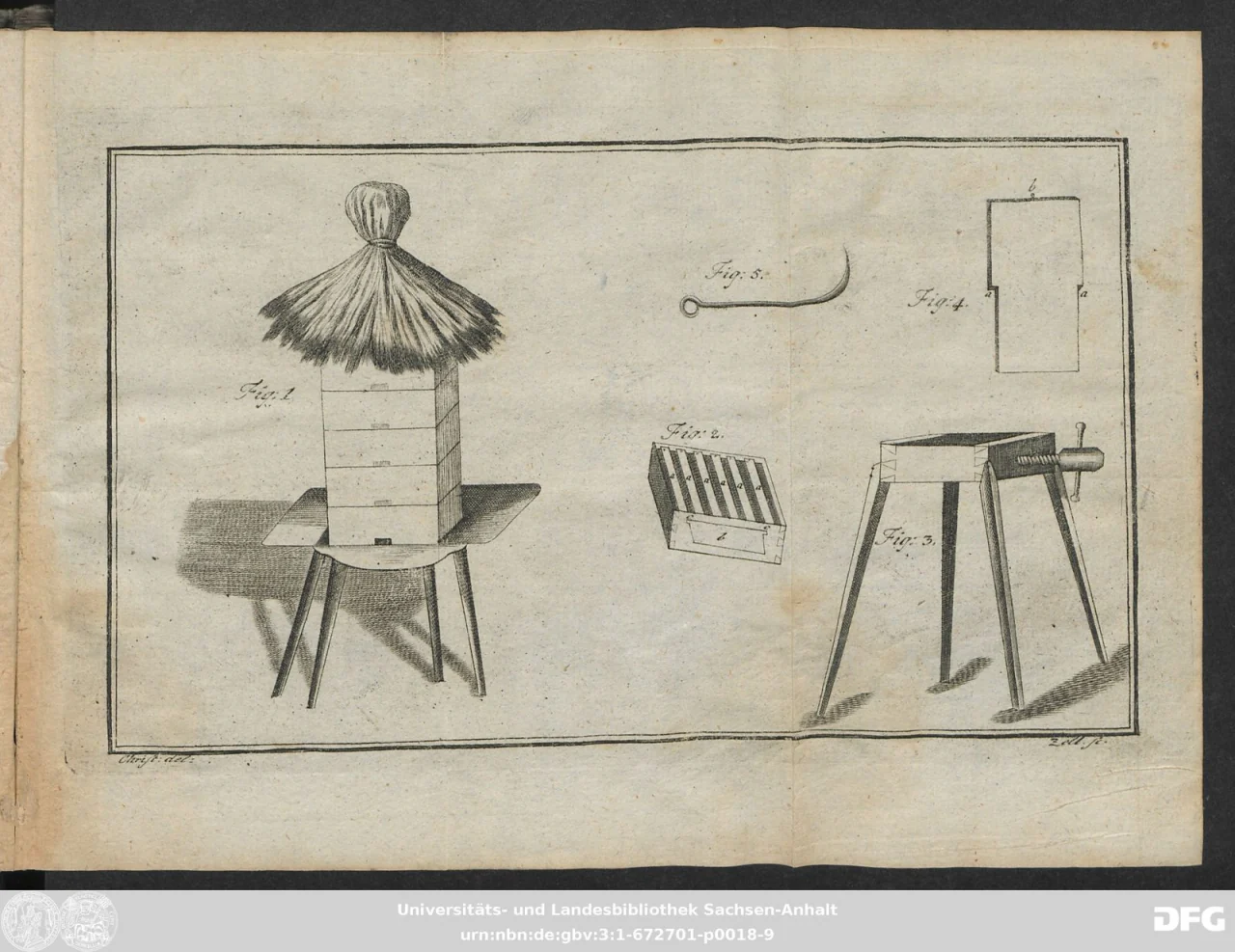
Christ's magazine hive, drawn by himself
Johann Ludwig Christ, Bienencatechismus für das Landvolk, Frankfurt und Leipzig, bei Johann Georg Fleischer, 1784
The only copperplate in the volume, laid in sideways. Fig. 1 a magazine hive of five small boxes with a straw cap as its roof, standing on a small skep with an alighting board; Fig. 2 a single box from behind with its grid, the six clasps a.a.a. and the little shutter b in front of the pane of glass; Fig. 3 the square casing of the wax press with its screw; Fig. 4 a pressing board; Fig. 5 a curved bee knife. Bottom left „Chriſt. del.“, bottom right „Zöll. ſc.“. No scale bar on the sheet. Along the lower edge the burnt-in footer of the digitised copy: „Universitäts- und Landesbibliothek Sachsen-Anhalt“, „urn:nbn:de:gbv:3:1-672701-p0018-9“ and the DFG logo.
PDF page 18 of the digitised copy; unpaginated plate leaf in the front part, verso (PDF page 19) blank. The accompanying „Erklärung der Kupfertafel“ [explanation of the copperplate] stands on PDF page 16. · Photograph: Universitäts- und Landesbibliothek Sachsen-Anhalt (Halle); auf dem Titelblatt der Stempel „Bibliothek des landw
Released by the operator. The rights status of the digitised image itself has not been looked up at the source.
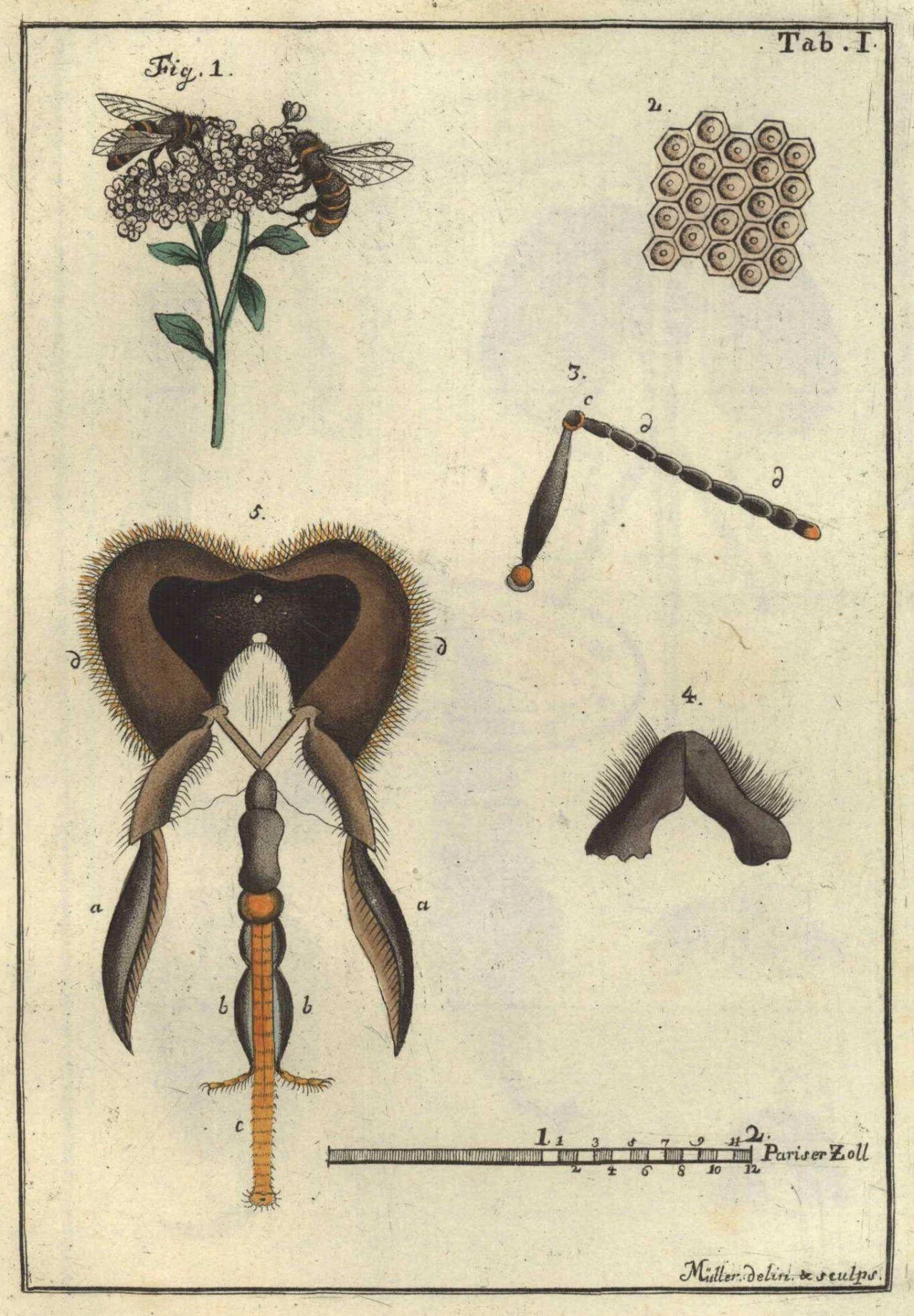
The honey bee, with a scale in Paris inches
Johann Ludwig Christ, Naturgeschichte, Klassification und Nomenclatur der Insekten vom Bienen-, Wespen- und Ameisengeschlecht, Frankfurt am Main 1791, in der Hermannischen Buchhandlung
Tab. I of the plate volume, hand-coloured: Fig. 1 the honeybee on a flower umbel; Fig. 2 a piece of comb from above, hexagonal cells with the eggs in them; Fig. 3 the antenna; Fig. 4 a pair of mandibles; Fig. 5 the head with its mouthparts and proboscis, greatly enlarged. Bottom right „Müller. delin. & sculps.“ Below it an engraved scale bar with the label „Pariser Zoll“, divided into two inches of twelve lines each; its evenness has not been checked.
PDF page 536; first plate of the unpaginated plate volume (Tab. I of LX, PDF pages 536–595). · Origin of the digitised image cannot be determined
Released by the operator. The rights status of the digitised image itself has not been looked up at the source.
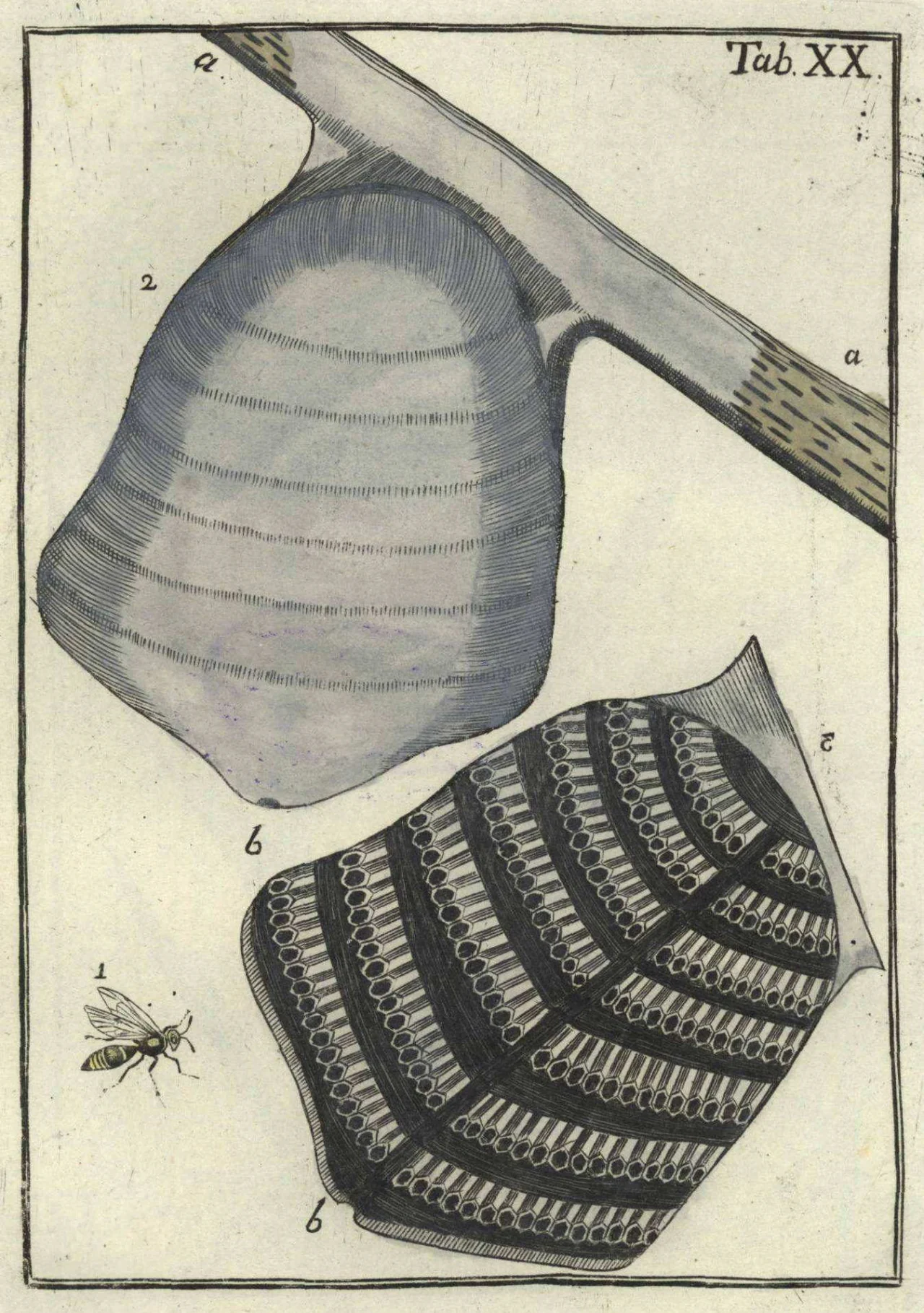
A hornets' nest, open and closed
Johann Ludwig Christ, Naturgeschichte, Klassification und Nomenclatur der Insekten vom Bienen-, Wespen- und Ameisengeschlecht, Frankfurt am Main 1791, in der Hermannischen Buchhandlung
Tab. XX, hand-coloured: a hornets' nest (Fig. 2) hanging from a branch a in its smooth paper envelope, beside it (Fig. 3) the nest cut open, with the comb storeys lying horizontally one above another and the hexagonal cells opening downwards; Fig. 1 the insect. No scale bar.
PDF page 555; Tab. XX of the unpaginated plate volume. · Origin of the digitised image cannot be determined
Released by the operator. The rights status of the digitised image itself has not been looked up at the source.
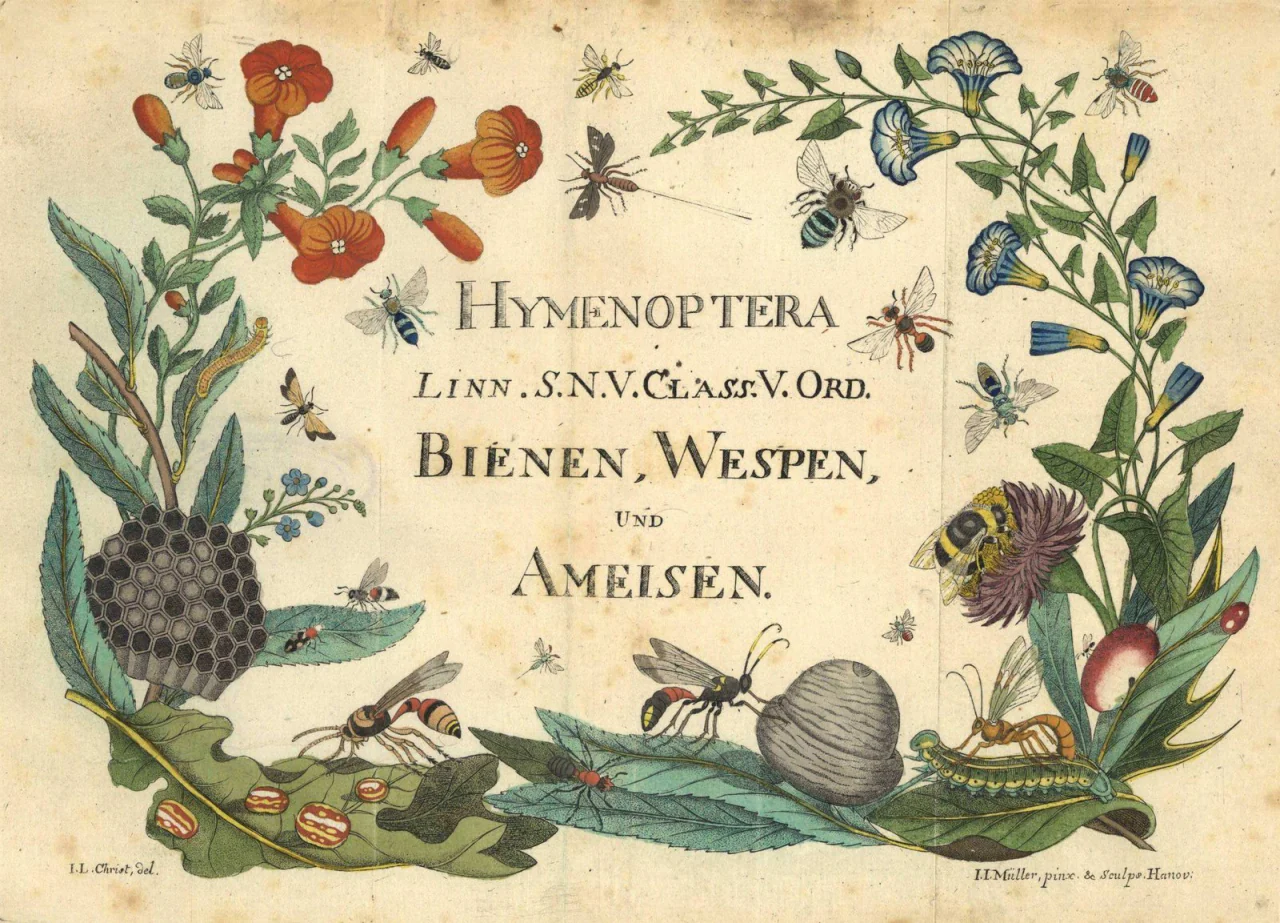
Frontispiece to Christ's work on insects, hand-coloured
Johann Ludwig Christ, Naturgeschichte, Klassification und Nomenclatur der Insekten vom Bienen-, Wespen- und Ameisengeschlecht, Frankfurt am Main 1791, in der Hermannischen Buchhandlung
The coloured title engraving of the plate volume, landscape: a wreath of blossoms, leaves and insects around the inscription „HYMENOPTERA / Linn. S.N.V.Class.V.Ord. / Bienen, Wespen, und Ameisen.“ Bottom left within the wreath a piece of comb with hexagonal cells, bottom centre a wasps' nest, and around them bees, wasps, bumblebees, larvae. Bottom left „I.L.Christ, del.“, bottom right „I.I.Müller, pinx. & Sculps. Hanov.“ Hand-coloured. No scale bar. No burnt-in footer.
PDF page 535 of the digitised copy; unpaginated title leaf of the plate volume. The title page of the text volume (PDF page 1) announces: „Mit LX. ausgemalten Kupfertafeln in einem besondern Band, und einem ausgemalten Titelkupfer.“ [With LX coloured copperplates in a separate volume, and a coloured title engraving.] · Origin of the digitised image cannot be determined
Released by the operator. The rights status of the digitised image itself has not been looked up at the source.
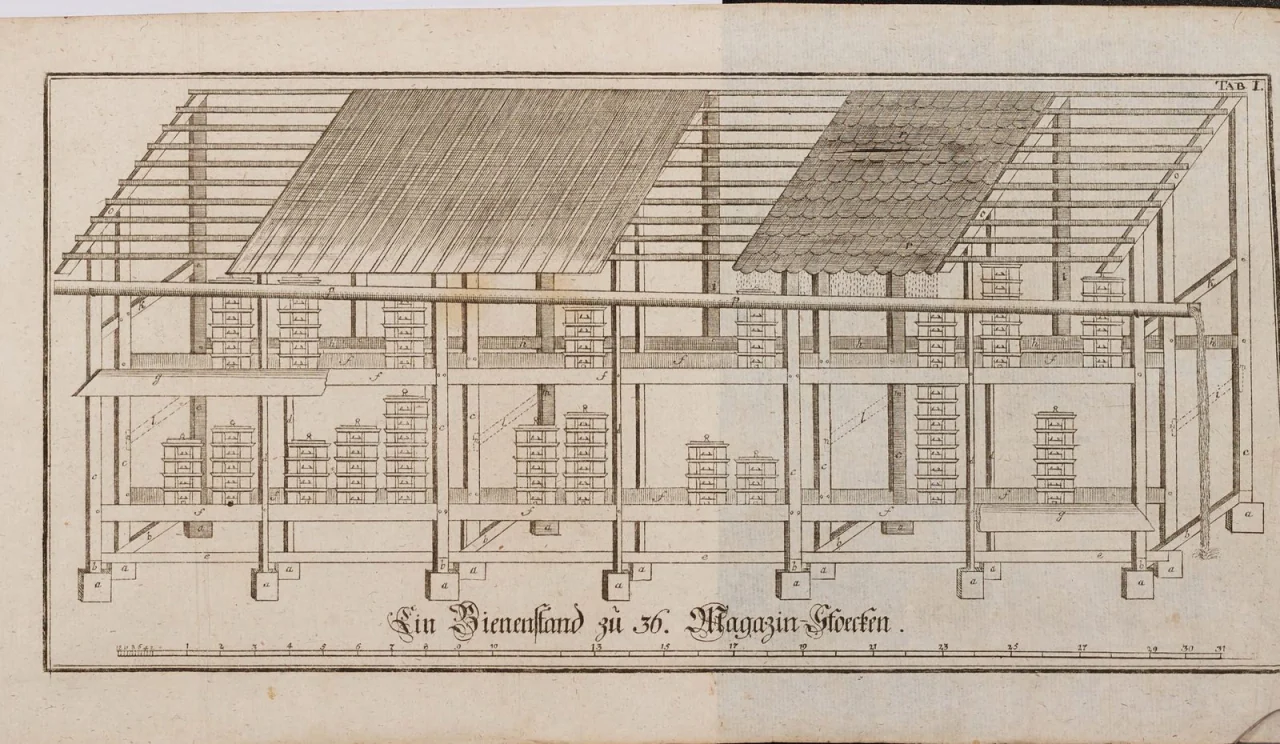
Christ's bee stand for 36 magazine hives
Johann Ludwig Christ, Anweisung zur nützlichsten und angenehmsten Bienenzucht für alle Gegenden, dritte Auflage, Leipzig 1798
First copperplate: a covered apiary for thirty-six magazine hives, two storeys of two rows each. Along the lower edge an engraved scale bar reaching to thirty-one feet, with its first foot divided into twelve inches. Measured on 7 August 2026 it is even, with a spread of 1.2 to 3.6 per cent.
First copperplate, to chapter 2 §7 · Photograph: Münchener DigitalisierungsZentrum, Bayerische Staatsbibliothek
Released by the operator. The rights status of the digitised image itself has not been looked up at the source.
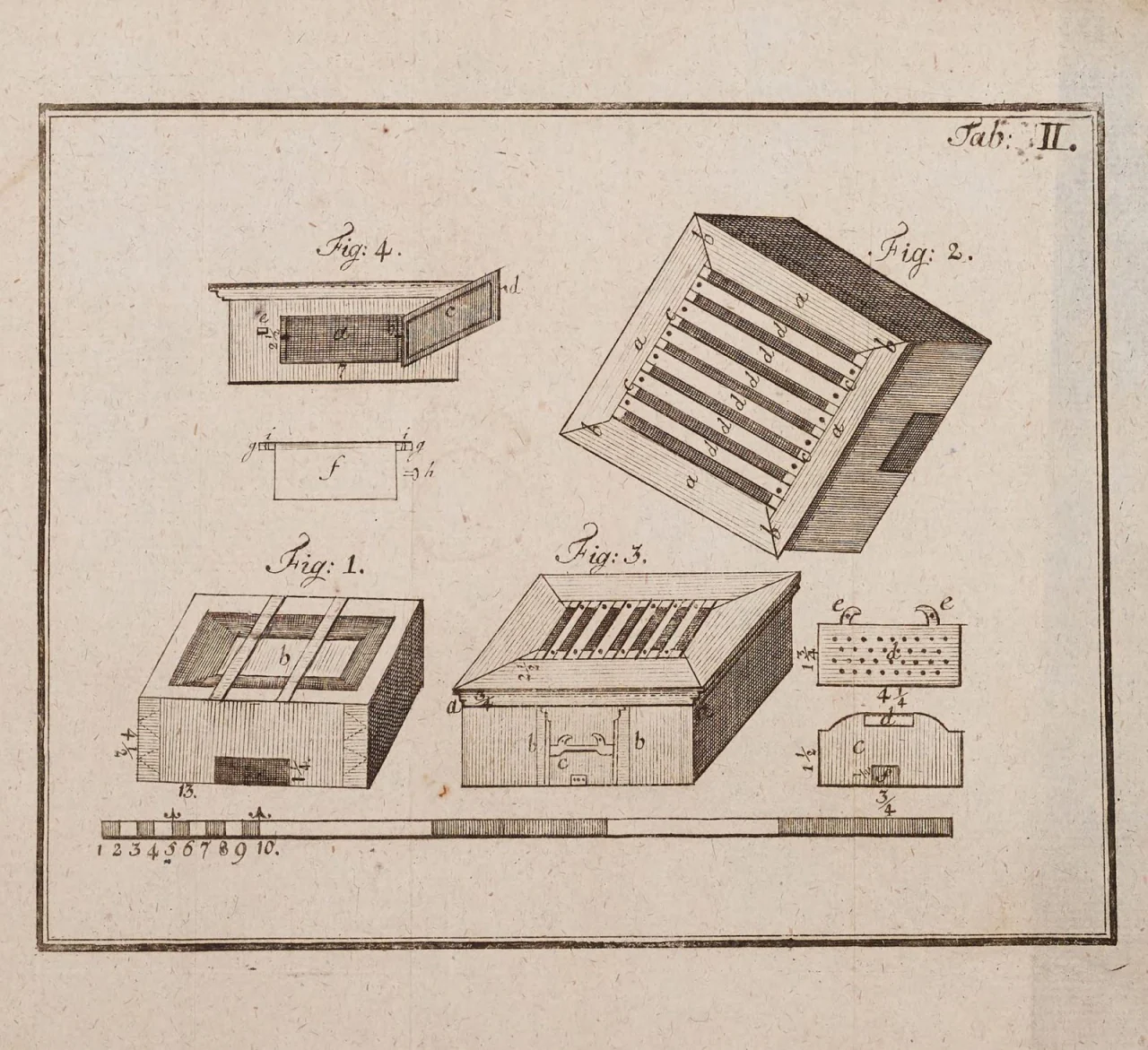
The magazine super: thirteen inches square, four and a half high
Johann Ludwig Christ, Anweisung zur nützlichsten und angenehmsten Bienenzucht für alle Gegenden, dritte Auflage, Leipzig 1798
Second copperplate: the single magazine box from above with its grid of six sticks (Fig. 1), the box in oblique view with the grid battens (Fig. 2), the lid and the sliders (Fig. 3), the back with the opening for the pane of glass (Fig. 4). Bottom left a scale bar of ten inches in alternately hatched fields; measured, it varies by ±1.6 per cent.
Second copperplate, to chapter 3 §4 · Photograph: Münchener DigitalisierungsZentrum, Bayerische Staatsbibliothek
Released by the operator. The rights status of the digitised image itself has not been looked up at the source.

The magazine hive of six supers, with bellows and knife
Johann Ludwig Christ, Anweisung zur nützlichsten und angenehmsten Bienenzucht für alle Gegenden, dritte Auflage, Leipzig 1798
Third copperplate: the assembled magazine hive of six supers under a protective roof, beside it the bellows with the smoke capsule and the curved bee knife.
Third copperplate, to chapter 7 · Photograph: Münchener DigitalisierungsZentrum, Bayerische Staatsbibliothek
Released by the operator. The rights status of the digitised image itself has not been looked up at the source.

The glass observation house, a showpiece
Johann Ludwig Christ, Anweisung zur nützlichsten und angenehmsten Bienenzucht für alle Gegenden, dritte Auflage, Leipzig 1798
Fourth copperplate: the glass observation house, one foot seven inches high and one foot one and a half inches square, holding eighteen Maß. A display piece and not a working hive.
Fourth copperplate, to chapter 3 §11 · Photograph: Münchener DigitalisierungsZentrum, Bayerische Staatsbibliothek
Released by the operator. The rights status of the digitised image itself has not been looked up at the source.
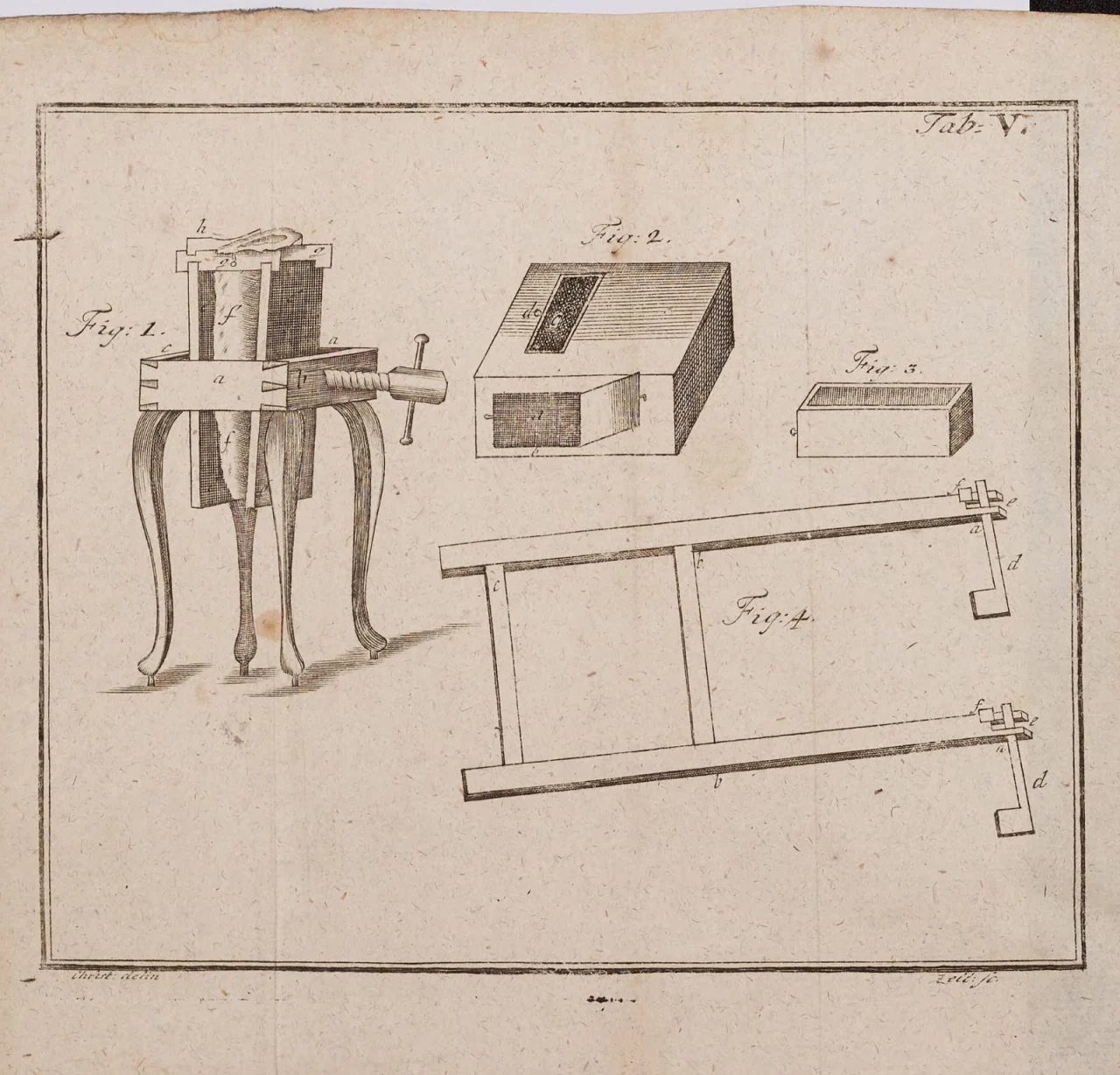
The wax press, beside it the feeding box and the little feeding trough
Johann Ludwig Christ, Anweisung zur nützlichsten und angenehmsten Bienenzucht für alle Gegenden, dritte Auflage, Leipzig 1798
Fifth copperplate: the wax press with its hanging bag, beside it the feeding box with the pane of glass in its lid and the little feeding trough.
Fifth copperplate, to chapter 5 §3 and chapter 6 §12 · Photograph: Münchener DigitalisierungsZentrum, Bayerische Staatsbibliothek
Released by the operator. The rights status of the digitised image itself has not been looked up at the source.

The same bee stand in the edition of 1820, photographed still folded
J. L. Christs Anweisung zur nützlichsten und angenehmsten Bienenzucht für alle Gegenden, herausgegeben von Friedrich Pohl, fünfte Auflage, Leipzig, bei Friedrich Fleischer, 1820
Plate I of the fifth edition: covered apiary for 36 magazine hives, in longitudinal section with its storeys, magazine hives on stands and roof structure. In the digitised copy the sheet was photographed still folded — only the right-hand strip lies open, and the larger left-hand part stays hidden in the fold. Along the lower edge an engraved scale bar of which only the marks 25, 27, 29, 30, 31 are visible; its evenness has not been checked.
PDF page 350; unpaginated plate leaf at the end of the volume, after p. 320, verso (PDF page 351) blank. Explanation of the plates: „Vorläufige Erklärung der Kupfertafeln“ [provisional explanation of the copperplates], PDF page 26 („Erste Tafel“), referring to chap. 2 § 26, pp. 60–64. · Photograph: Münchener DigitalisierungsZentrum (MDZ)
Released by the operator. The rights status of the digitised image itself has not been looked up at the source.
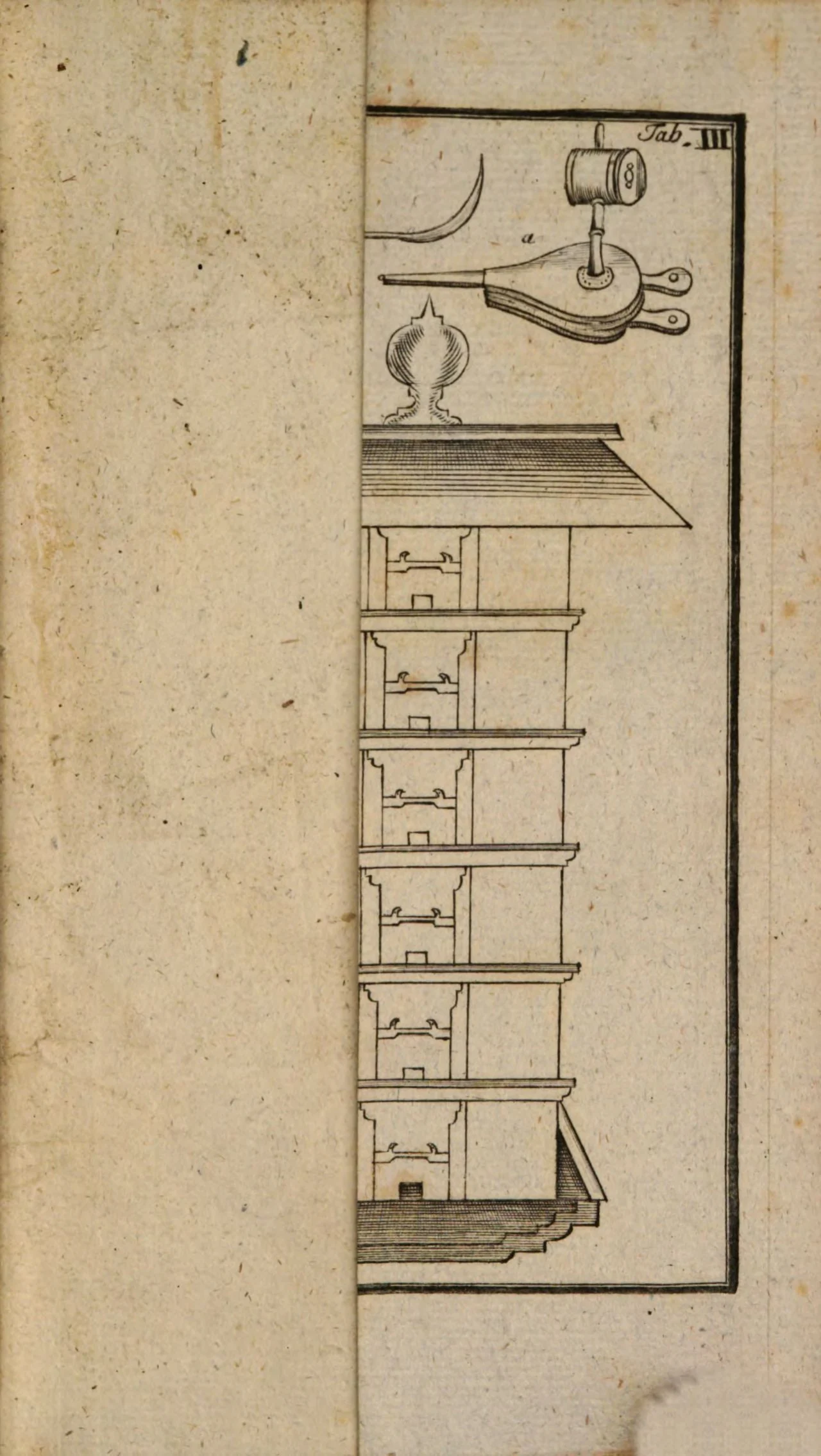
The magazine hive of 1820, only partly unfolded
J. L. Christs Anweisung zur nützlichsten und angenehmsten Bienenzucht für alle Gegenden, herausgegeben von Friedrich Pohl, fünfte Auflage, Leipzig, bei Friedrich Fleischer, 1820
Plate III: assembled magazine hive of six supers with a roof of its own for the free-standing apiary, drawn in section, with the alighting board beneath it; above, Lit. a a bellows with smoke capsule and Lit. b an ordinary curved, double-edged bee knife. This sheet too was photographed folded — only the right-hand strip is visible. No scale bar in the visible part.
PDF page 352; unpaginated plate leaf at the end of the volume, verso (PDF page 353) blank. Explanation of the plates „Dritte Tafel“ on PDF page 26. · Photograph: Münchener DigitalisierungsZentrum (MDZ)
Released by the operator. The rights status of the digitised image itself has not been looked up at the source.
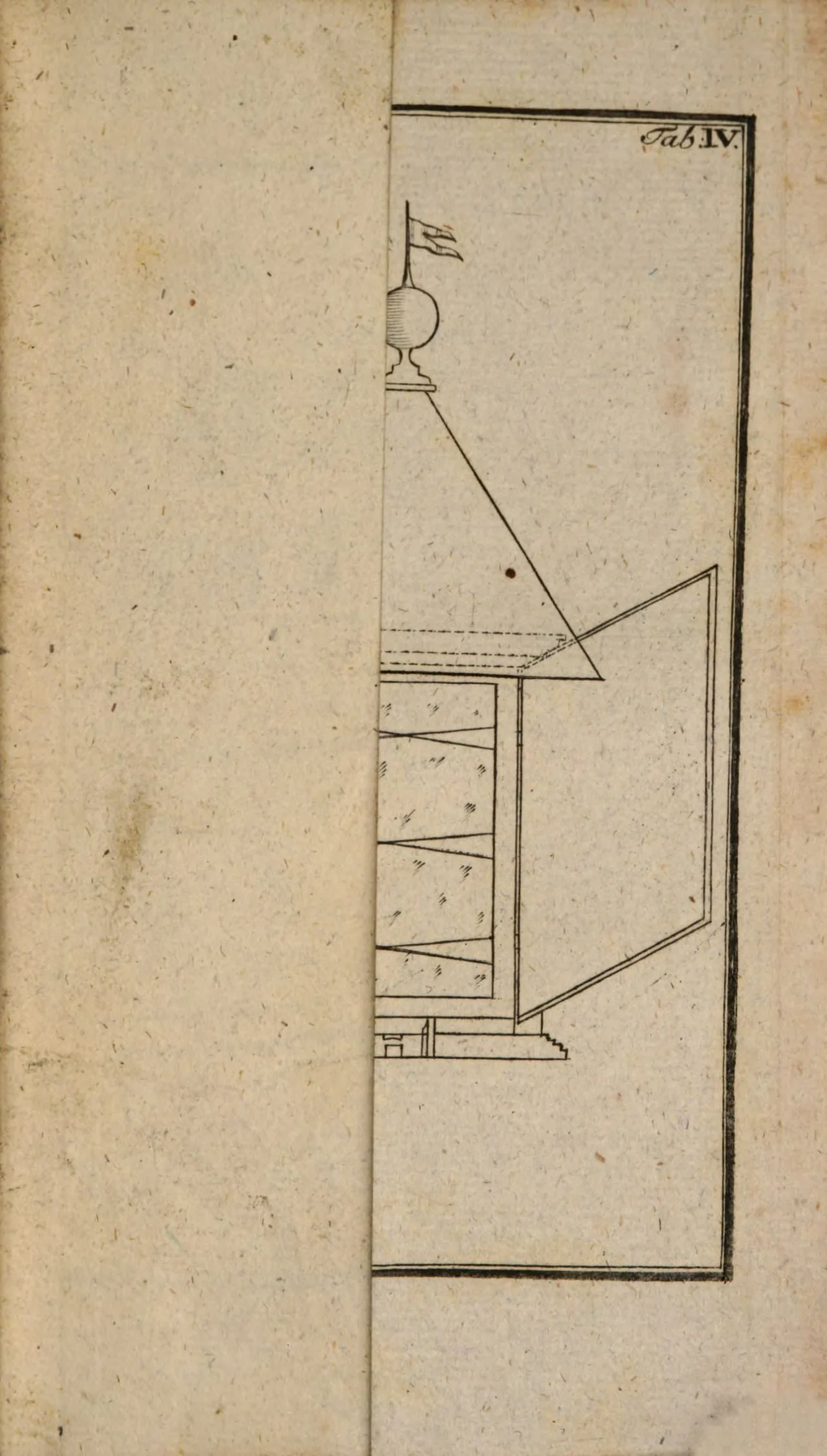
The observation house of 1820, with its vane
J. L. Christs Anweisung zur nützlichsten und angenehmsten Bienenzucht für alle Gegenden, herausgegeben von Friedrich Pohl, fünfte Auflage, Leipzig, bei Friedrich Fleischer, 1820
Plate IV: the simple observation bee house, whose four sides consist of large panes of glass set in narrow frames, with gable roof, knob and vane, standing on a post sunk into the ground. Photographed folded, only the right-hand strip visible. No scale bar in the visible part.
PDF page 354; unpaginated plate leaf at the end of the volume, verso (PDF page 355) blank. Explanation of the plates „Vierte Tafel“ on PDF page 27, referring to § 36 p. 80 and § 51 p. 110. · Photograph: Münchener DigitalisierungsZentrum (MDZ)
Released by the operator. The rights status of the digitised image itself has not been looked up at the source.

Clasp and feeding box, plate V of the edition of 1820
J. L. Christs Anweisung zur nützlichsten und angenehmsten Bienenzucht für alle Gegenden, herausgegeben von Friedrich Pohl, fünfte Auflage, Leipzig, bei Friedrich Fleischer, 1820
The fourth plate present in the volume, photographed folded; here it is the left-hand strip that lies open, and the plate number at the top right stays in the fold. Visible are „Fig. 9“ (a wooden clasp) and „Fig. 2“ (a feeding box of 12 inches square, with a little door, a pane of glass in the lid board and a filling hole), together with a stand. According to the explanation of the plates, Fig. 2 „Ein Futterkasten“ and Figs. 8, 9 and 10 „Eine hölzerne Schließe“ belong to the Fifth Plate, so the sheet is Plate V. No scale bar in the visible part.
PDF page 356; unpaginated plate leaf at the end of the volume, versos (PDF pages 357–360) blank. Explanation of the plates „Fünfte Tafel“ on PDF page 27, referring to pp. 76, 78, 98 and § 98 p. 166. · Photograph: Münchener DigitalisierungsZentrum (MDZ)
Released by the operator. The rights status of the digitised image itself has not been looked up at the source.
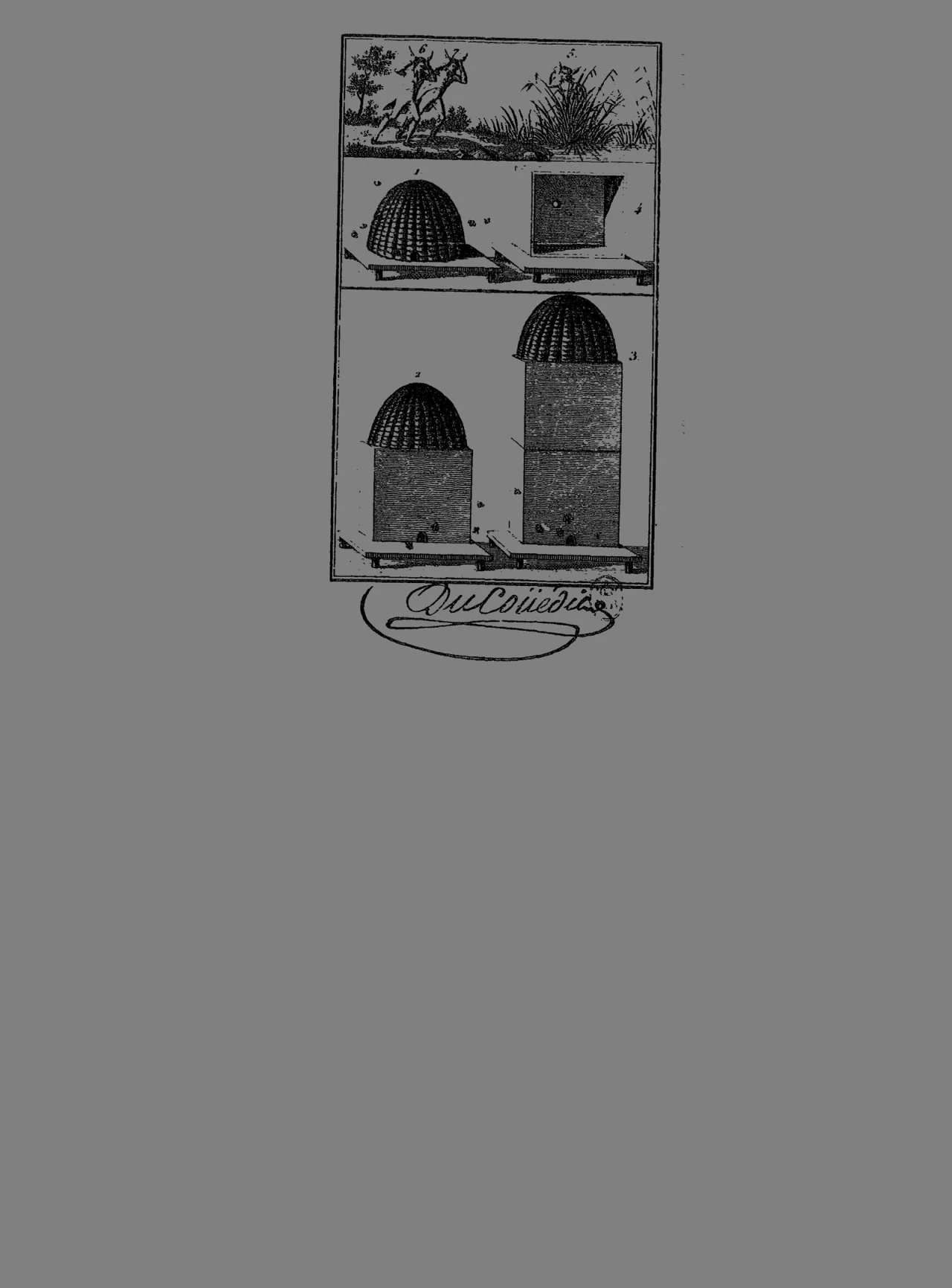
The pyramid hive: three straw skeps one above another
Pierre-Louis Du Couëdic de Villeneuve, La ruche pyramidale, 1813 (Quellenschlüssel decouedic-1813)
The frontispiece: the ruche pyramidale of three straw baskets one above another, with straw cap (chapiteau) and alighting board. The only engraving in the volume; its explanation stands on view 259.
View 3 of the Gallica facsimile · Photograph: Bibliothèque nationale de France
Released by the operator. The rights status of the digitised image itself has not been looked up at the source.
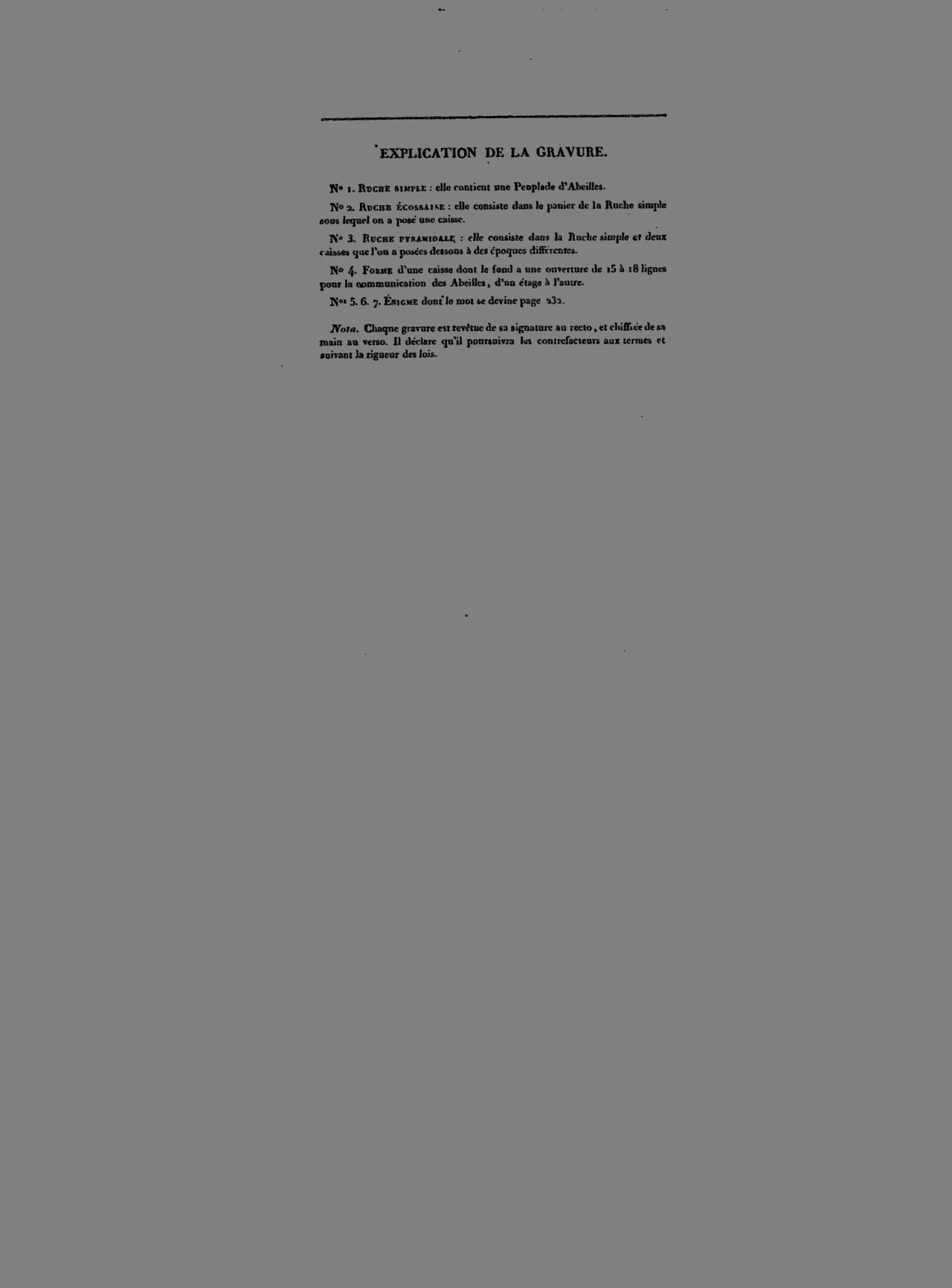
Ducouédic's explanation of his one copper engraving
Pierre-Louis Du Couëdic de Villeneuve, La ruche pyramidale, 1813 (Quellenschlüssel decouedic-1813)
The „Explication de la gravure" — not a picture but the page that explains the frontispiece: ruche simple, ruche écossaise, ruche pyramidale, the box, the floor hole of 15 to 18 lines. It belongs to the frontispiece and is unusable without it.
View 259 of the Gallica facsimile · Photograph: Bibliothèque nationale de France
Released by the operator. The rights status of the digitised image itself has not been looked up at the source.
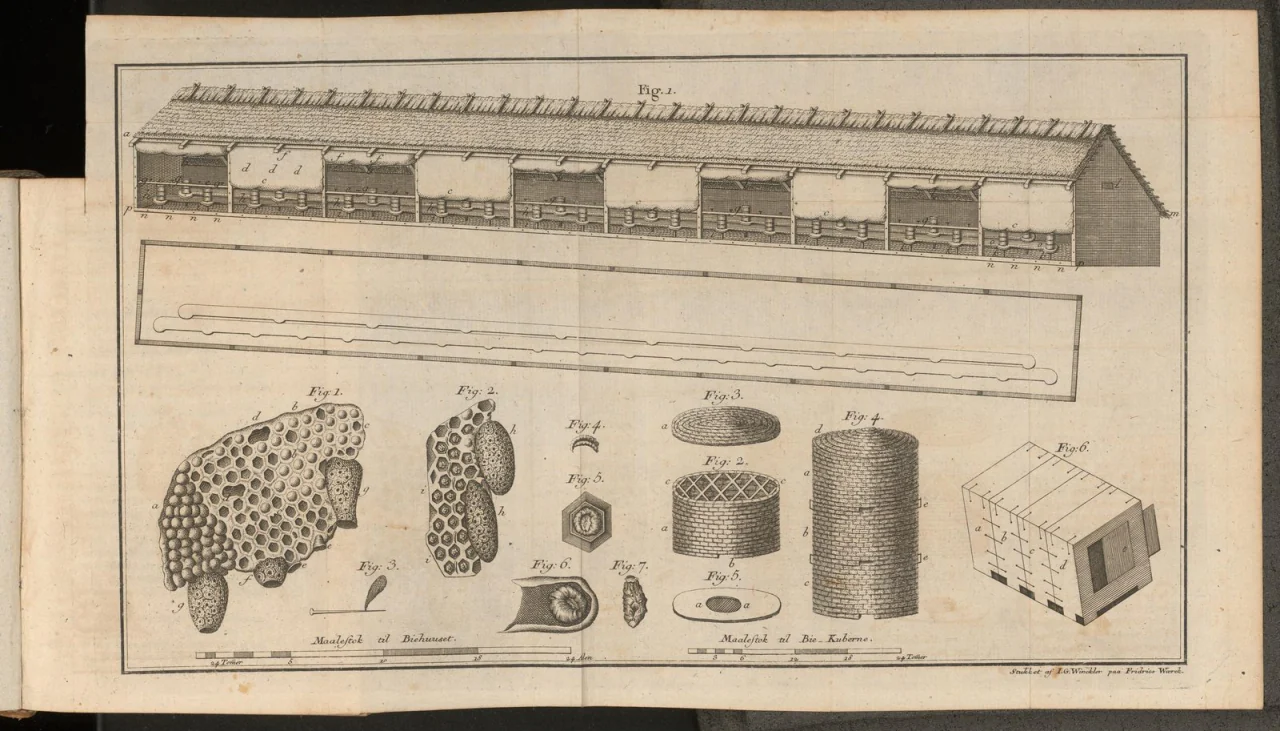
The bee house at Jægerspriis, with straw skep and magazine hive
Esaias Fleischer, Udførlig Afhandling om Bier, Kopenhagen 1777
The only copperplate in the volume, two plates on one sheet: above, the Jægerspriis bee house in elevation and ground plan; below left the comb and brood figures; below right the hives — Fig. 2 the single straw basket with the transverse sticks driven in crosswise (ends c·c), Fig. 4 the magazine of three storeys, Fig. 6 the wooden colony hive in four parts. With them two engraved scale bars, one in Alen for the house, one in Tommer for the hives.
View 157 of the facsimile, between p. 106 and p. 107; explanation on views 159–162 · Photograph: Nasjonalbiblioteket, Oslo
Released by the operator. The rights status of the digitised image itself has not been looked up at the source.
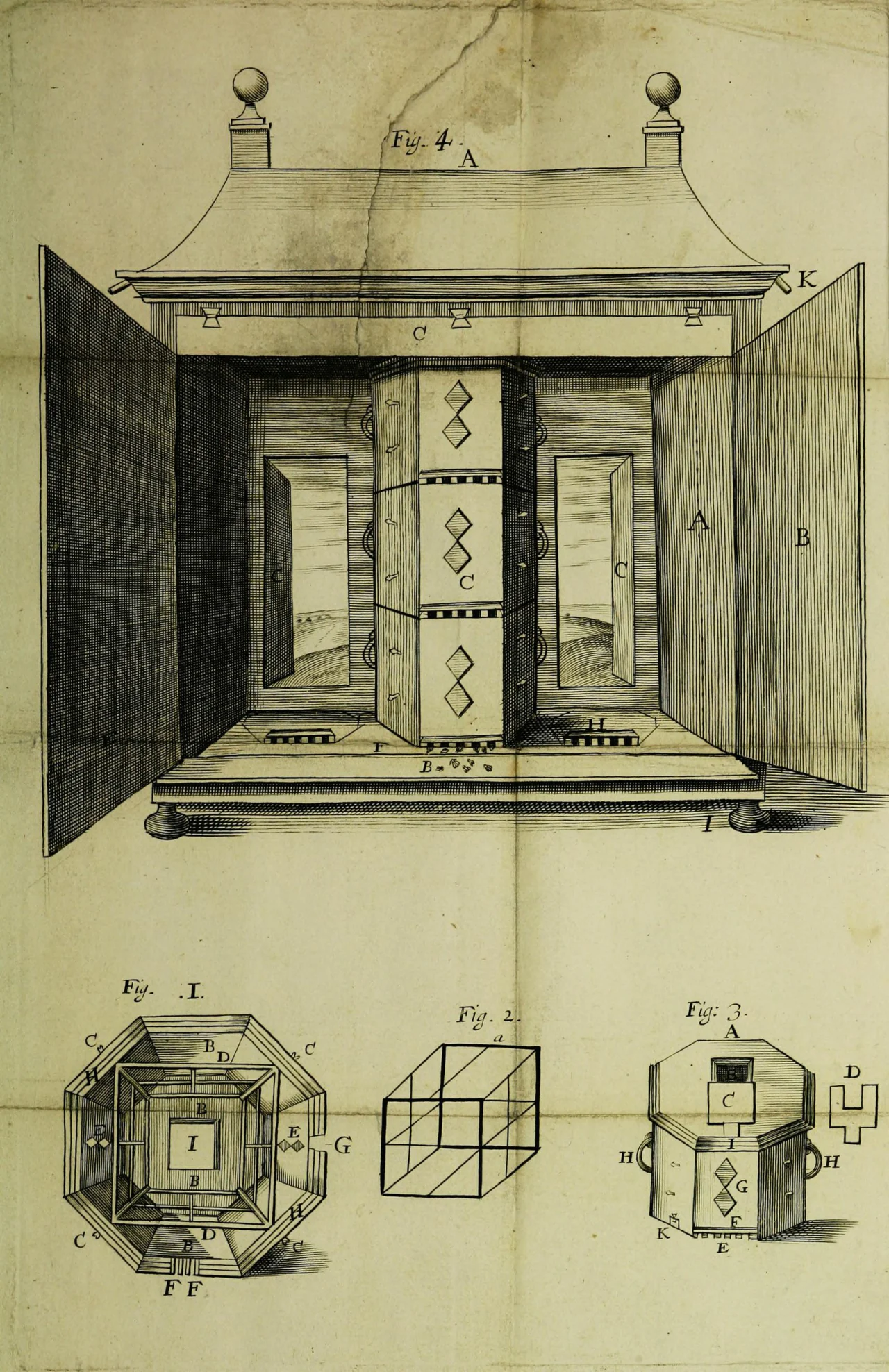
Gedde's octagonal box and the Colony of three
John Gedde, A New Discovery of an Excellent Method of Beehouses, and Colonies, 3. Auflage, London 1677
The copperplate of the volume: Gedde's octagonal box and the build-up of the Colony from three boxes one above another. Scanned at a higher resolution than the text pages. No engraved scale bar — the dimensions stand only in the text (pp. 17–18).
View 9 of the facsimile · Photograph: Cornell University Library, Everett Franklin Phillips Beekeeping Library; Aufnahme gefördert von der Mann Library
Released by the operator. The rights status of the digitised image itself has not been looked up at the source.
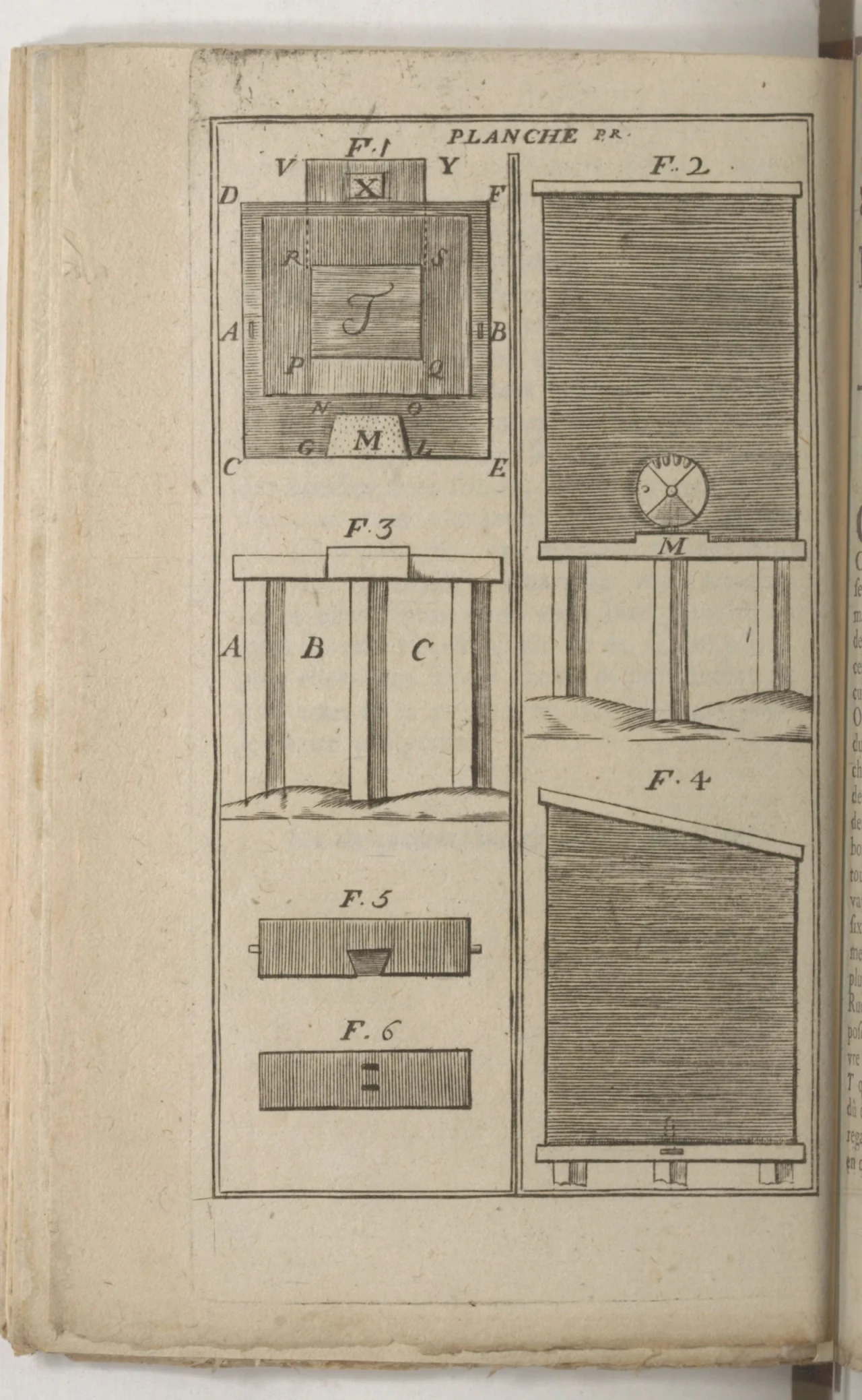
The outer case with the dial at the flight hole
Guillaume-Louis Formanoir de Palteau, Nouvelle construction de ruches de bois, Metz und Paris 1777 (Quellenschlüssel palteau-1777)
PLANCHE P.re — the surtout, the casing around the boxes. F.1 the ground plan with the table T and the entrance M, F.2 the casing from the front with the cadran, the round entrance disc with four settings, F.3 the table on its four legs, F.4 the casing from the side with its sloping roof, F.5 and F.6 details. No engraved scale bar — the dimensions stand only in the text.
View 454 of the Gallica facsimile · Photograph: Bibliothèque nationale de France, Sciences et techniques, 8-S-5026
Released by the operator. The rights status of the digitised image itself has not been looked up at the source.
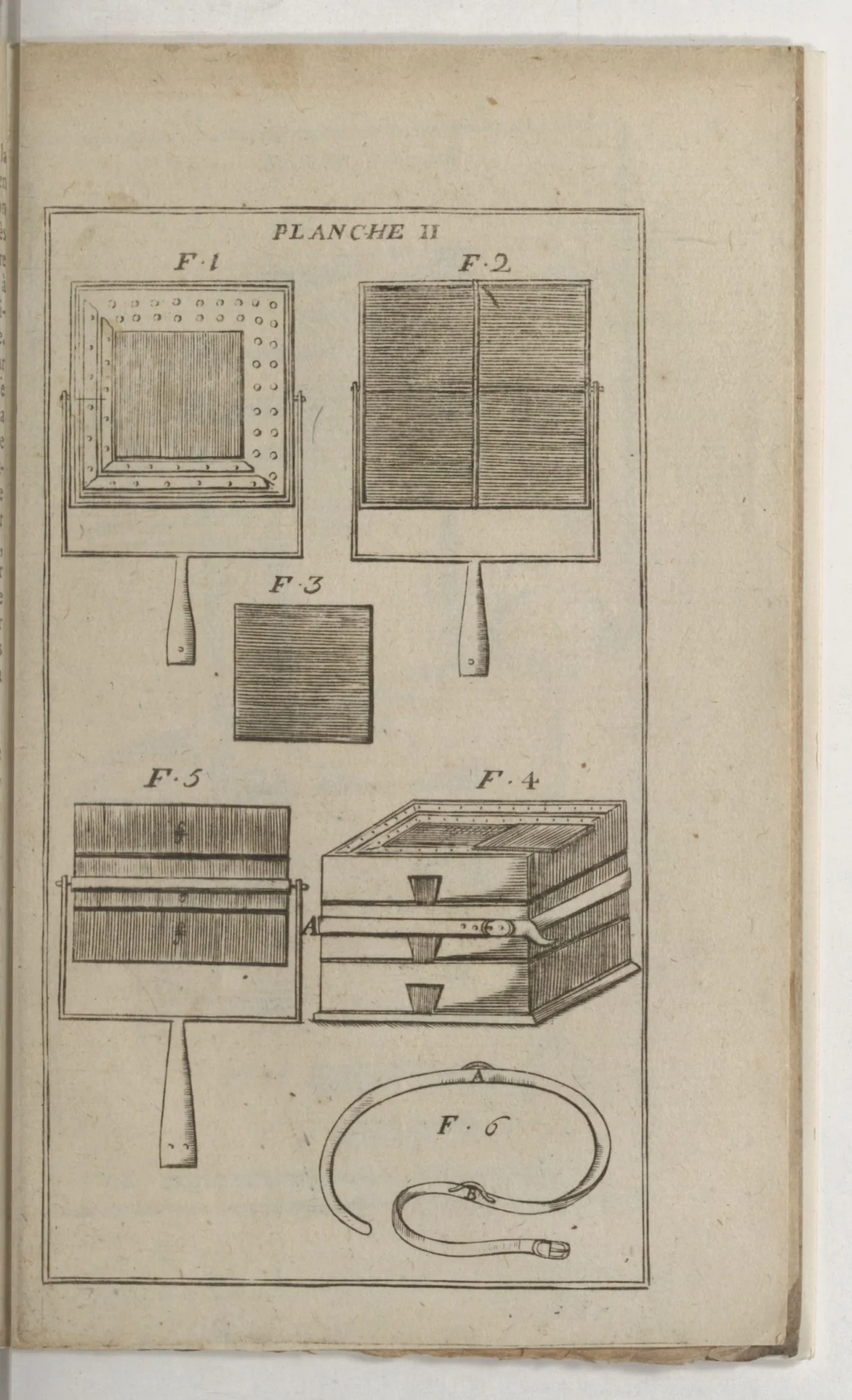
The box itself, one foot square and three inches high
Guillaume-Louis Formanoir de Palteau, Nouvelle construction de ruches de bois, Metz und Paris 1777 (Quellenschlüssel palteau-1777)
PLANCHE II — the box (hausse) itself, with entrance and cross bar, and the lid. This is the part the whole book is about. Scale bar not established.
View 457 of the Gallica facsimile · Photograph: Bibliothèque nationale de France, Sciences et techniques, 8-S-5026
Released by the operator. The rights status of the digitised image itself has not been looked up at the source.
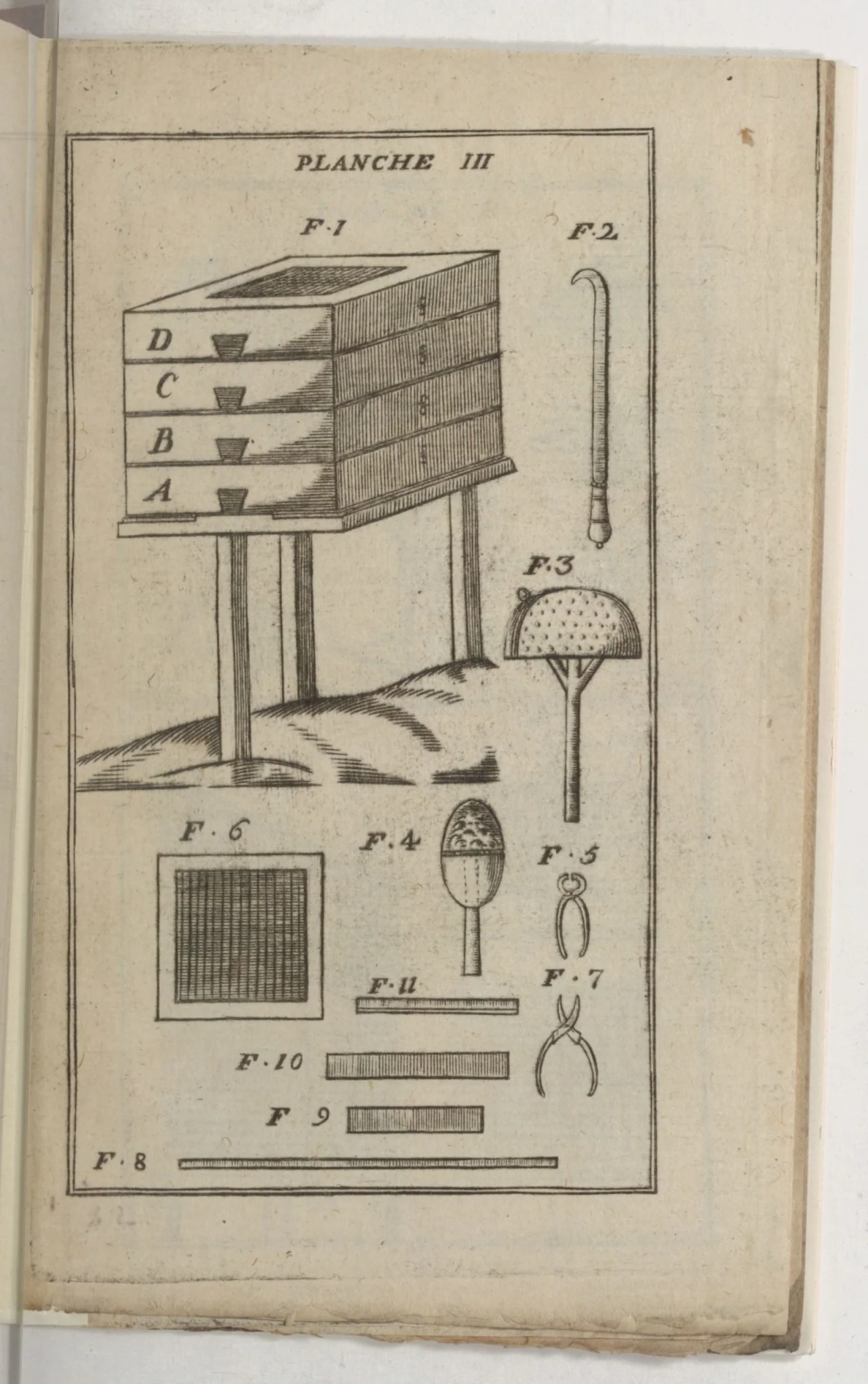
Hook, tongs and stand for nadiring
Guillaume-Louis Formanoir de Palteau, Nouvelle construction de ruches de bois, Metz und Paris 1777 (Quellenschlüssel palteau-1777)
PLANCHE III — boxes joined together, iron hook, tongs, stand and small boards: the equipment for setting boxes underneath and taking them off. Scale bar not established.
View 459 of the Gallica facsimile · Photograph: Bibliothèque nationale de France, Sciences et techniques, 8-S-5026
Released by the operator. The rights status of the digitised image itself has not been looked up at the source.
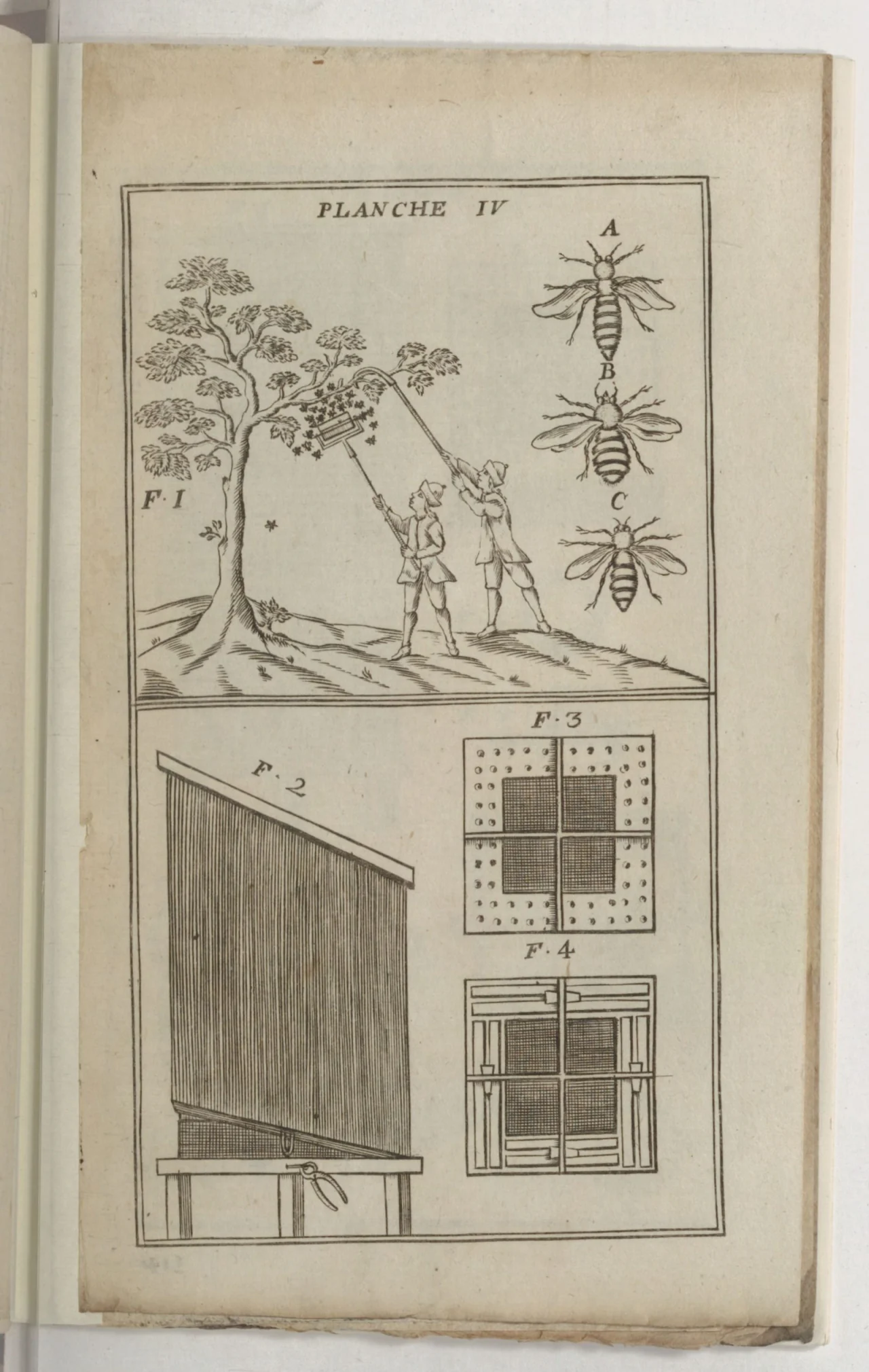
Catching the swarm with the see-saw, with queen and drone
Guillaume-Louis Formanoir de Palteau, Nouvelle construction de ruches de bois, Metz und Paris 1777 (Quellenschlüssel palteau-1777)
PLANCHE IV — catching the swarm with the see-saw (bascule), together with queen, drone and worker bee, and the casing. Scale bar not established.
View 461 of the Gallica facsimile · Photograph: Bibliothèque nationale de France, Sciences et techniques, 8-S-5026
Released by the operator. The rights status of the digitised image itself has not been looked up at the source.
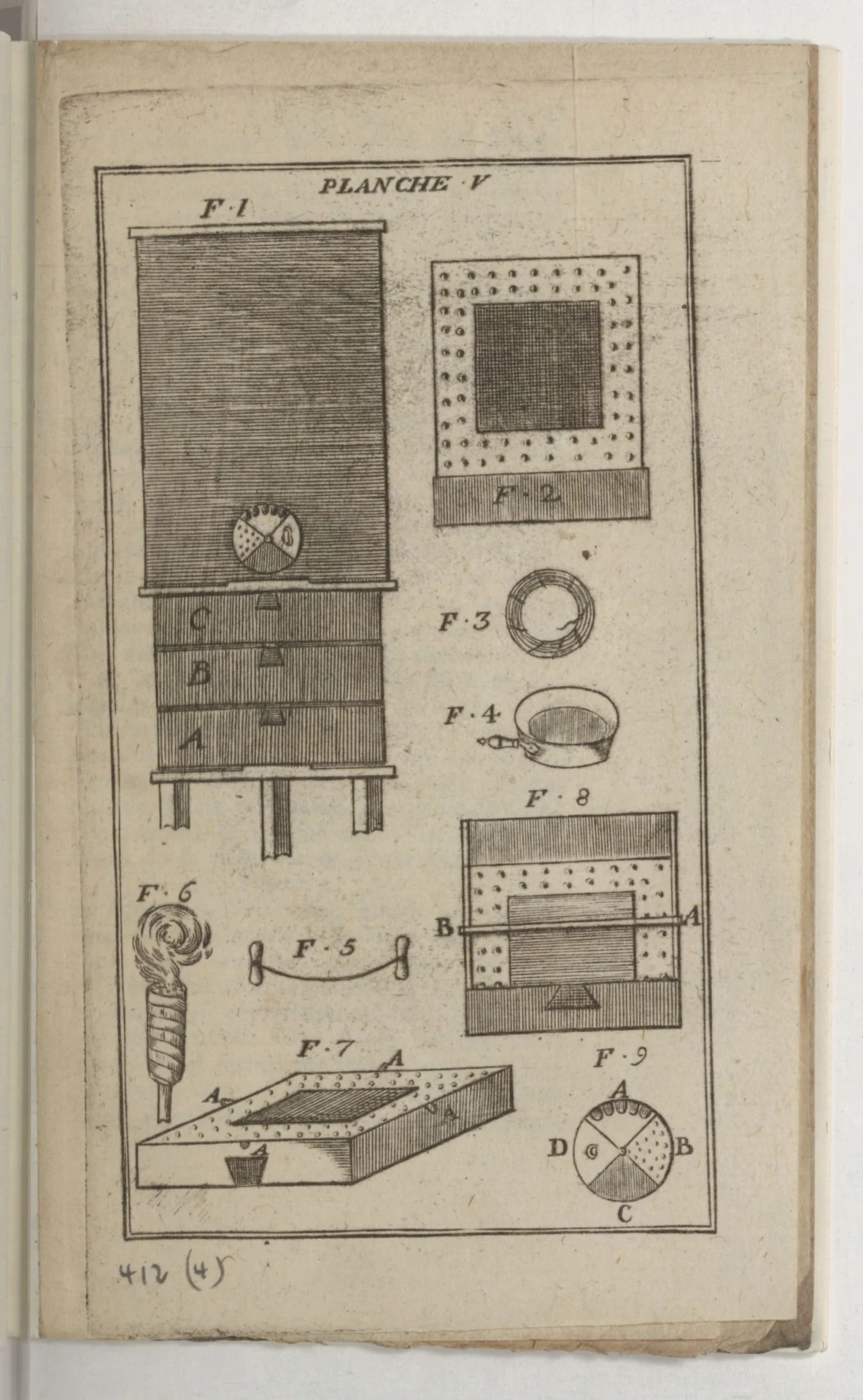
Dial, boxes and the smoke roll
Guillaume-Louis Formanoir de Palteau, Nouvelle construction de ruches de bois, Metz und Paris 1777 (Quellenschlüssel palteau-1777)
PLANCHE V — the cadran, the boxes, the entrance and the smoking roll (cinse). Scale bar not established.
View 463 of the Gallica facsimile · Photograph: Bibliothèque nationale de France, Sciences et techniques, 8-S-5026
Released by the operator. The rights status of the digitised image itself has not been looked up at the source.
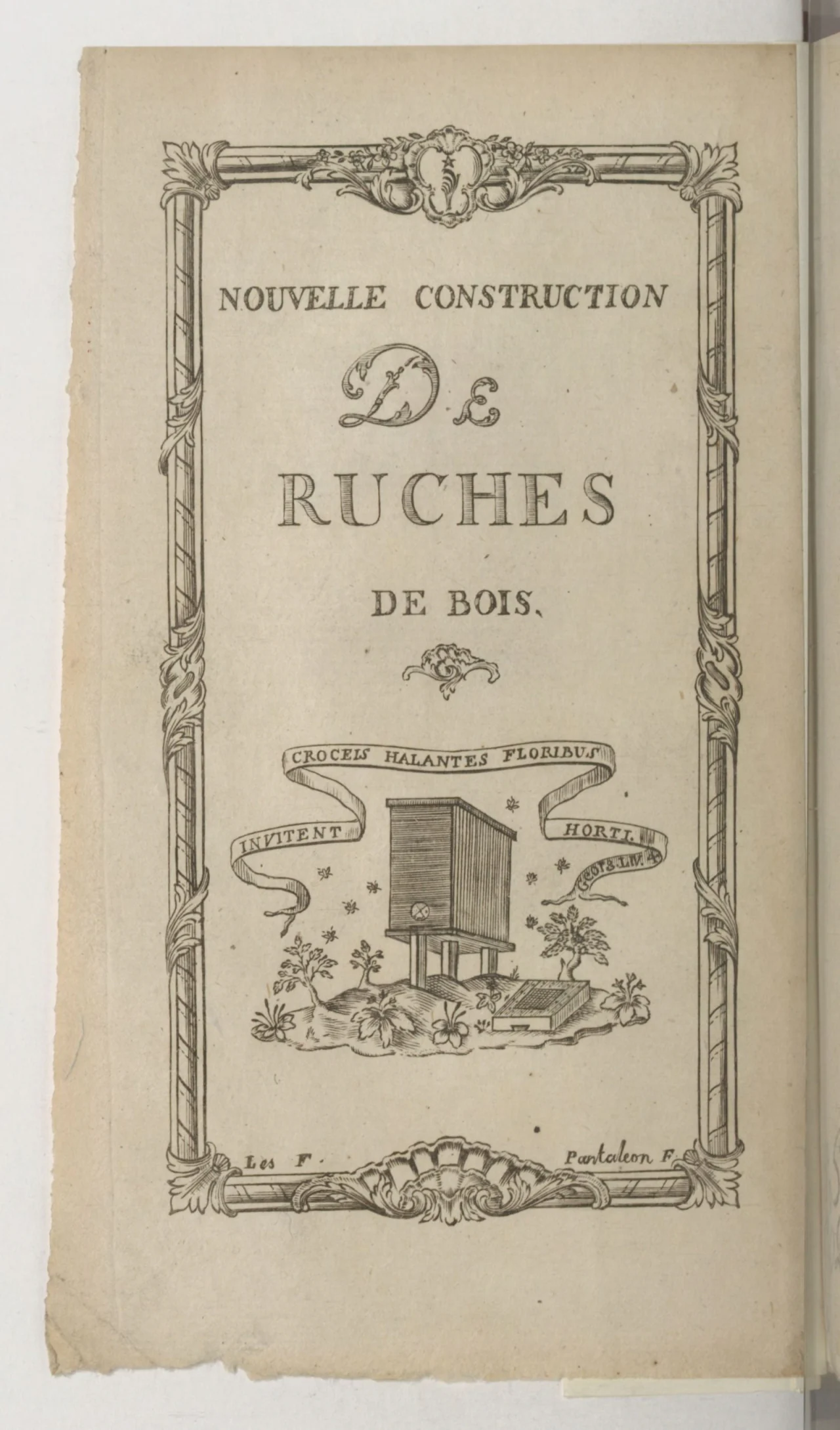
Palteau's engraved title: a wooden hive in the garden
Guillaume-Louis Formanoir de Palteau, Nouvelle construction de ruches de bois, Metz und Paris 1777 (Quellenschlüssel palteau-1777)
The engraved title: a wooden hive on feet in a garden, with the motto CROCEIS HALANTES FLORIBUS INVITENT HORTI and the reference „Georg. Liv. 4." — Vergil. Signed „Pantaleon fecit". No scale bar.
View 12 of the Gallica facsimile (front matter, unnumbered) · Photograph: Bibliothèque nationale de France, Sciences et techniques, 8-S-5026
Released by the operator. The rights status of the digitised image itself has not been looked up at the source.

First plate, visible in the scan only as a strip
Adam Gottlob Schirach (Hrsg. u. Übers.), Sächsischer Bienenvater, oder des Herrn Palteau von Metz neue Bauart hölzerner Bienenstöcke, Leipzig und Zittau bey Adam Jacob Spiekermann, 1766
A narrow strip of a copperplate that was never unfolded: sectional views of hives with the letters D, A, C, s, V, R, P, N, G, B, t and the figure designations „F.“ and „F. 6.“; the header with the plate number lies under the folded-over paper and cannot be read. Presumably the first plate, and therefore Palteau's hive: the stock of letters agrees with the explanation of the 1st plate, 1st figure (board/floor board A B – C D E F, chin M, cladding N O, raised part P Q R S, hole T, slider V Y) and with Fig. 7 of the straw basket (entrances s s and t t) in Schirach 1766, explanation of the plates pp. 1–2 and pp. 6–7. The attribution is a supposition; it would be refuted by a legible header on the unfolded sheet, and it has not been checked against the image. No scale bar visible. Photographed above all as evidence of the state in which the plates of this digitised copy are.
PDF page 834 of the facsimile, the first plate leaf behind the explanation of the plates · Photograph: Bayerische Staatsbibliothek München / Münchener DigitalisierungsZentrum (MDZ)
Released by the operator. The rights status of the digitised image itself has not been looked up at the source.

Palteau's equipment as Schirach gives it: wire roll, fire pan, flight-hole disc
Adam Gottlob Schirach (Hrsg. u. Übers.), Sächsischer Bienenvater, oder des Herrn Palteau von Metz neue Bauart hölzerner Bienenstöcke, Leipzig und Zittau bey Adam Jacob Spiekermann, 1766
Palteau's hive and its equipment, not Schirach's and not Vicat's. The 5th copperplate, its header „V. Tafel“ legible at the top right. Visible are Fig. II the perforated pass-through board with the hole of eight inches square (the driving method, for renewing old stocks), Fig. III the roll of wire for tying the supers together, Fig. IV the fire pan for bees numbed in March, Figs. VII and VIII a super (magazine box) from the side and lying down, Fig. IX the round entrance disc with its four settings A B C D. The explanation of these figures stands in the wording of the Palteau translation (Schirach 1766, explanation of the plates pp. 16–18). No engraved scale bar on the visible part. In the digitised copy the sheet was not unfolded: the left half lies folded over the plate, so about the left third of the engraving is missing from the image (among others Figs. I, V, VI).
PDF page 838 of the facsimile; the plates are bound unnumbered at the end of the volume, behind the explanation of the plates, whose last printed page (p. 24 of its own numbering) stands on PDF page 833. Explanation of the figures: explanation of the plates pp. 16–18 · Photograph: Bayerische Staatsbibliothek München / Münchener DigitalisierungsZentrum (MDZ)
Released by the operator. The rights status of the digitised image itself has not been looked up at the source.

Vicat's container, re-engraved by Schirach
Adam Gottlob Schirach (Hrsg. u. Übers.), Sächsischer Bienenvater, oder des Herrn Palteau von Metz neue Bauart hölzerner Bienenstöcke, Leipzig und Zittau bey Adam Jacob Spiekermann, 1766
Vicat's hive, not Palteau's and not Schirach's own. The 6th copperplate, its header „VI. Tafel“ legible at the top right. Visible are Fig. IV the table (floor board) of the „Behälter“ from below, with the notches F F for the feet, the groove G for the drawer and the opening for inspection, and Fig. V the drawer of the table with the ventilation plate B B, the handle a and the battens b b. The „Behälter“ is the Swiss form of four chambers screwed together with comb-bearing bars (two lengthwise in each), which Schirach takes over from Madame Vicat (Schirach 1766, p. 138 ff.; explanation of the plates pp. 19–20 — at that place the text does not give the name Vicat, the attribution comes from p. 138 ff.). No engraved scale bar on the visible part. This sheet too was not unfolded in the digitised copy; the folded-over left half covers about a third of the engraving, including Figs. I–III with the chambers and the comb-bearing bars.
PDF page 842 of the facsimile; explanation of the figures: explanation of the plates pp. 19–20 · Photograph: Bayerische Staatsbibliothek München / Münchener DigitalisierungsZentrum (MDZ)
Released by the operator. The rights status of the digitised image itself has not been looked up at the source.
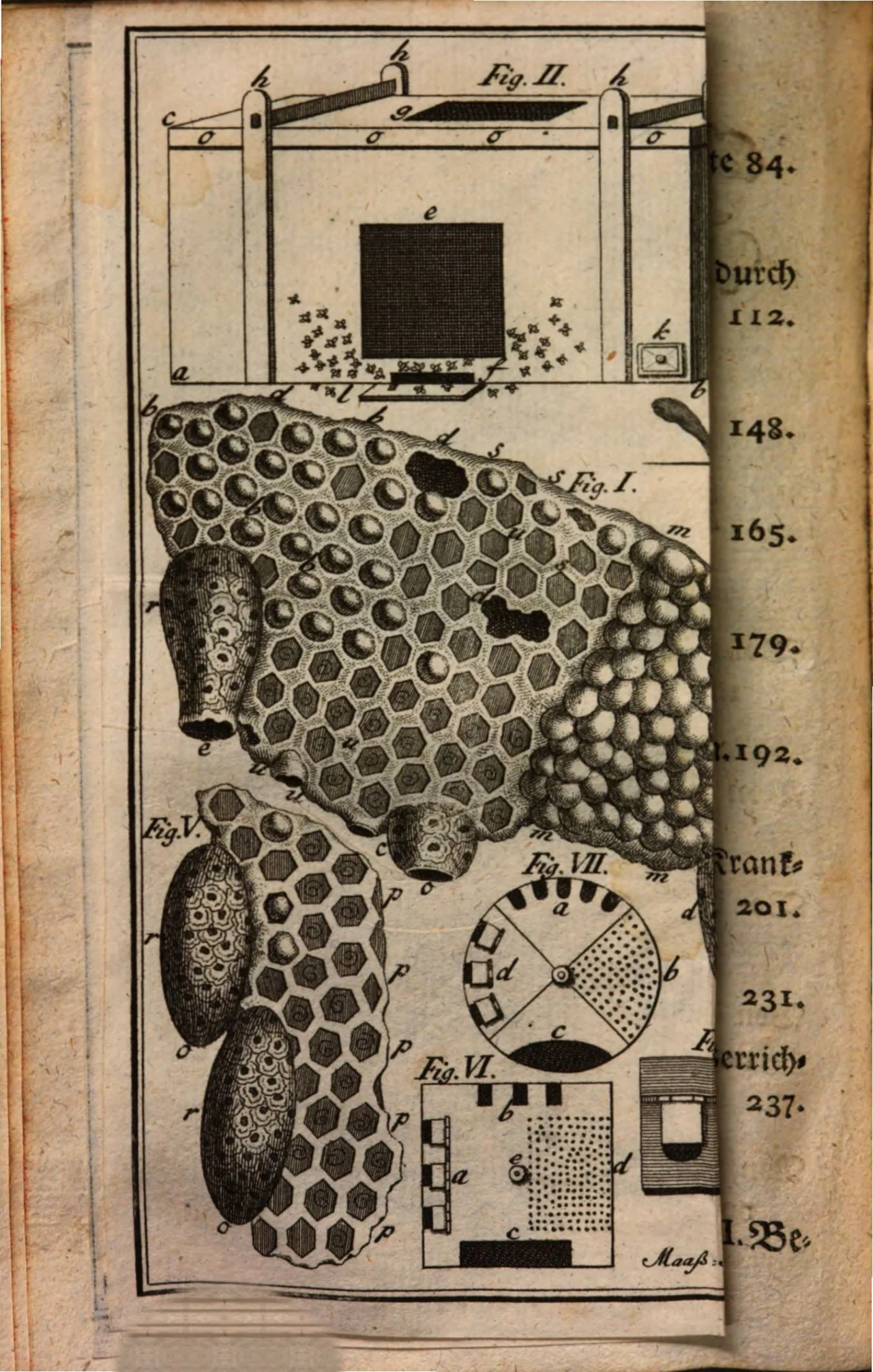
Schirach's own equipment: nucleus box, brood comb, drone trap
Adam Gottlob Schirach, Bayerischer Bienen-Meister, oder deutliche Anleitung zur BienenWartung. Auf höchste Veranlassung Sr. Churf. Durchl. zu Bayern abgefaßt. Mit einem Kupfer. München 1770, verlegts Johann Nepomuck Fritz
Schirach's own equipment, neither Palteau's magazine hive nor Vicat's chamber hive. The only copperplate in the volume; the title page itself says „Mit einem Kupfer.“ Eleven figures, explained in the unnumbered front matter under the heading „Erklärung der Figuren, die in der Kupfertafel zu finden“ (PDF pages 18–21). Clearly visible: Fig. I a whole cake (comb) with sealed cells b b b b, cells with grubs u u u, cells the bees have left s s s, a spoilt queen cell c. o., two acorn-shaped queen cells the queens have left, capped honey m m m m and the passages d. d.; Fig. II the bee box „worinnen man junge Schwärme erzielet“ — Schirach's nucleus box, measured in Leipzig feet, with lid o o o o, two air holes e and g covered with gauze, four posts h h h h, entrance f, small alighting board l, peg i and little feeding box k; Fig. V a piece of brood comb with two sealed queen cells r. o. r. o.; Fig. VI a square plate of 4 inches, with its four sides a (three flaps for the drones), b (three small openings), c (a cut-out) and d (air); Fig. VII the same disc in the round, with its four settings a b c d. The scale: according to the explanation, Fig. XI is „ein Maaßstab nach dem bekannten Leipziger-Fuß. Hier sind 2. Fuß angegeben“; on the engraving only the word „Maaß=“ can still be seen at the lower edge of the image, since the scale bar itself lies under the neighbouring sheet resting on it and is not in the picture. Its evenness is therefore not checked either. The sheet was photographed incompletely in the digitised copy: the index leaf lying over it on the right covers about the right fifth of the plate, including Figs. III, IV, VIII, IX, X and Fig. XI. Fig. VII is identical in construction with the round entrance disc that Schirach four years earlier calls „die palteausche runde Scheibe“ (Schirach 1766, explanation of the plates p. 7) — a comparative reference, not a checked attribution; in 1770 Schirach explains it as a device of his own without naming Palteau.
PDF page 23 of the facsimile (295 pages); title page PDF page 6, explanation of the figures PDF pages 18–21 (printed front-matter pages). The plate is bound unnumbered between the explanation and the contents. · Photograph: Bayerische Staatsbibliothek München / Münchener DigitalisierungsZentrum (MDZ)
Released by the operator. The rights status of the digitised image itself has not been looked up at the source.
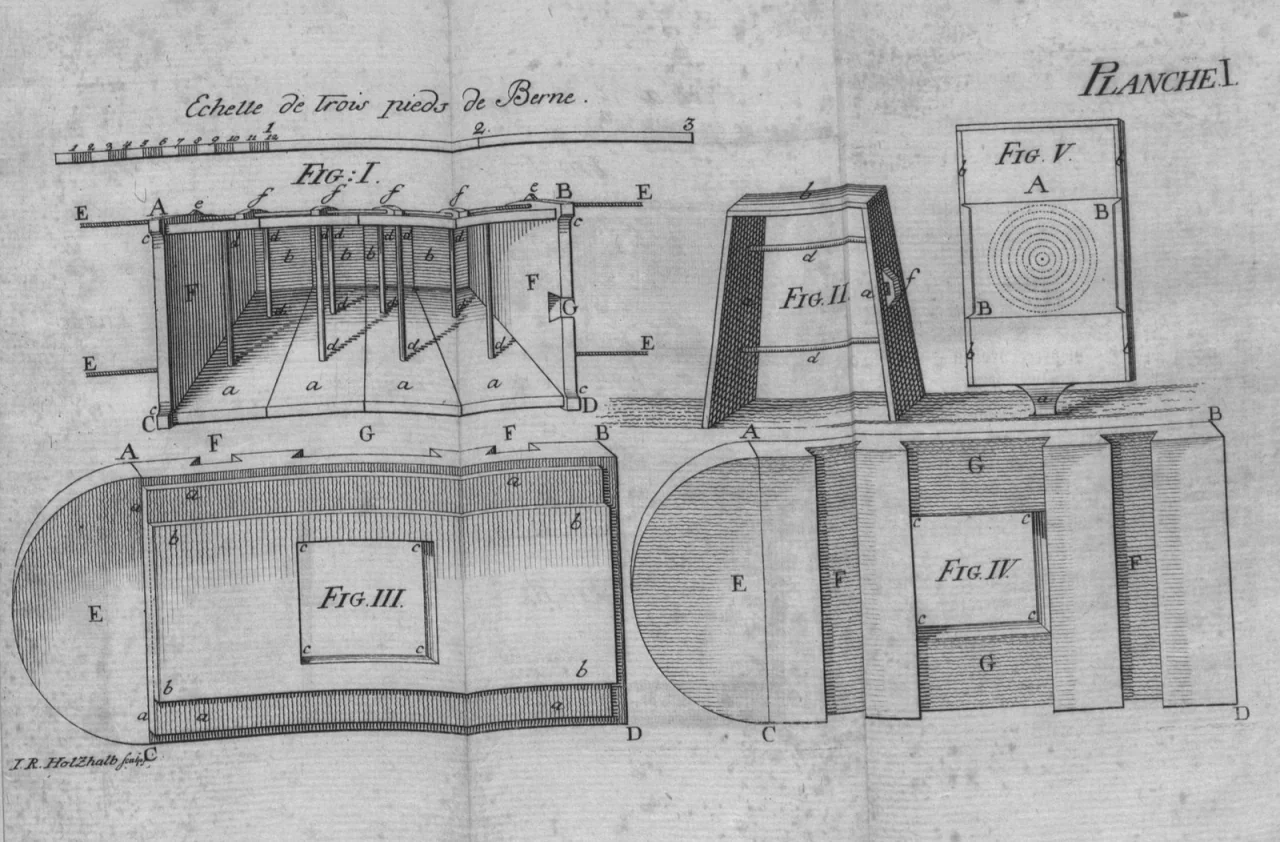
Vicat's container taken apart, with the scale in Bernese feet
Frau Vicat, geb. von Cürtas, „Anmerkungen über die Bienenzucht", in: Abhandlungen und Beobachtungen durch die Ökonomische Gesellschaft zu Bern gesammelt, Band 5 (1764), Erstes Stück, S. 79–126, mit zwei Kupfertafeln
PLANCHE I of Vicat's hive, „PLANCHE I." legible at the top right, inscribed at the bottom left „I. R. Holtzhalb sculp.". Five figures: Fig. I the Behälter of four chambers joined together, lying on their sides aa, with the screw rods EE, the nuts ee, the front and rear parts FF, the mouth G, the notches cc and the eight comb-bearing bars dd (two per chamber, lengthwise); Fig. II a single chamber in oblique view, with its two bars d d, the entrance a and the quadrant f; Fig. III the table from above, with the rebates aa for the outer casing and the opening cc; Fig. IV the same table from below; Fig. V the drawer with its metal plate. Top left an engraved strip „Echelle de trois pieds de Berne", three Bern feet, the first divided into twelve inches. This scale bar has been measured: over the three feet it holds to 1.4 %, and at the level of the pairs of inches it varies by about ±3 % — unlike Fleischer 1777, where one section is compressed by up to a third. 1 inch = 37.7 px in this file. The sheet is folded; the crease runs vertically through Fig. I and Fig. III. Earlier history: on 7 August 2026 Stefan had filed two files `vicat-tafel-1.png` and `vicat-tafel-2.png` which were byte-identical (MD5 dfc460a8bb7dfd7b49fd8d8ffd5e361e, 2942 × 1962) and both showed Planche I. Their larger pixel count was not a higher resolution: over the same stretch of the plate they carried only about half the energy of this scan in the fine frequency band, scaled up by a factor of 1.06 and blurred in the process. They have since been removed.
the two plates are bound unnumbered after p. 126. Explanation of the plates on the printed pp. 123–125. · Photograph: ETH-Bibliothek Zürich
Released by the operator. The rights status of the digitised image itself has not been looked up at the source.
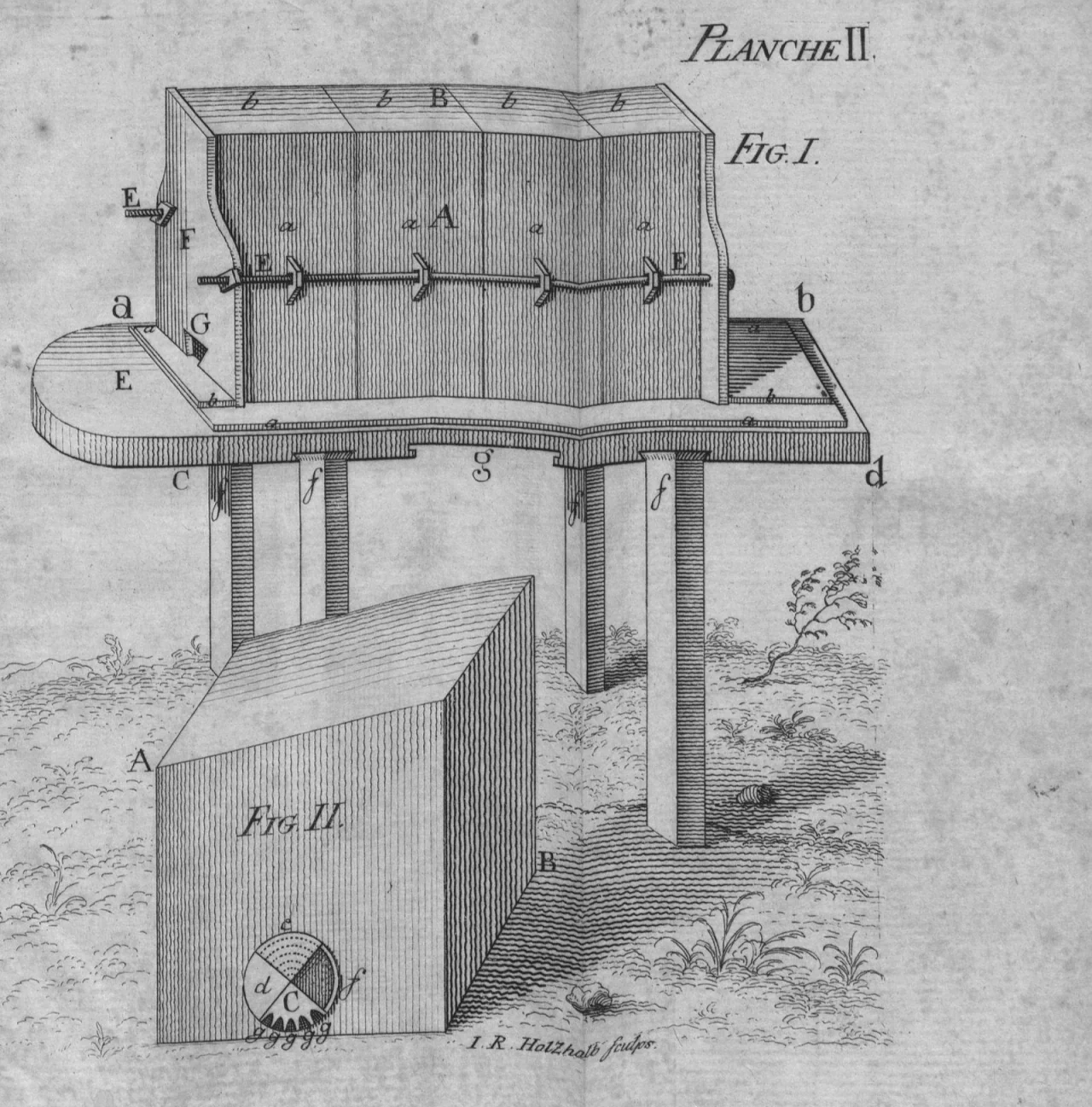
The container assembled, on its table
Frau Vicat, geb. von Cürtas, „Anmerkungen über die Bienenzucht", in: Abhandlungen und Beobachtungen durch die Ökonomische Gesellschaft zu Bern gesammelt, Band 5 (1764), Erstes Stück, S. 79–126, mit zwei Kupfertafeln
PLANCHE II, „PLANCHE II." legible at the top right, inscribed at the bottom centre „I. R. Holtzhalb sculps.". Two figures: Fig. I the whole Behälter assembled from its four chambers, standing on its table, with the screw rods EE running right through, the four feet ff, the alighting board and the semicircular projecting table top, and in front of it the opened-out corner with E, F, G; Fig. II the Surtout (the upper outer casing) as a closed box with a sloping roof, at the bottom left the round quadrant with its four fields c, d, f and the arcs gggg. The background is engraved as a meadow, with herbs and single bees. This sheet carries no scale bar; the Echelle stands only on Planche I.
unnumbered, after p. 126. Explanation of the two figures on the printed pp. 125–126. · Photograph: ETH-Bibliothek Zürich
Released by the operator. The rights status of the digitised image itself has not been looked up at the source.

The quilt under the roof, against cold and damp
Abbé Émile Warré, L’apiculture pour tous, douzième édition, 1948
„COUSSIN": the quilt as a shallow box in oblique view, with the cloth A, the dimensions 0.335 · 0.335 · 0.10 and the caption „A. — Toile d’emballage ou de vieux sacs."
printed p. 52 = view 58 of the Gallica facsimile = page 60 of the local PDF (lower figure) · Photograph: Bibliothèque nationale de France, 8-S-21885
Released by the operator. The rights status of the digitised image itself has not been looked up at the source.

The jig the box is built to
Abbé Émile Warré, L’apiculture pour tous, douzième édition, 1948
„GABARIT pour amorcer les porte-rayons": four stages side by side, A the jig, B the top bar, C jig and bar together with a hand holding them, D the finished bar with its wax starter melted on. Melting on the starter of wax, in four pictures.
printed p. 86 = view 92 of the Gallica facsimile = page 94 of the local PDF (upper figure) · Photograph: Bibliothèque nationale de France, 8-S-21885
Released by the operator. The rights status of the digitised image itself has not been looked up at the source.

Box and jig side by side
Abbé Émile Warré, L’apiculture pour tous, douzième édition, 1948
A box in oblique view, with the top bars lying in a notched jig; below it the dimensioned section of the jig with 24 m/m, 12 m/m and 300 m/m, and the caption „GABARIT pour mettre les porte-rayons en place et les y maintenir pendant le clouage."
printed p. 86 = view 92 of the Gallica facsimile = page 94 of the local PDF (lower figure) · Photograph: Bibliothèque nationale de France, 8-S-21885
Released by the operator. The rights status of the digitised image itself has not been looked up at the source.

The box, thirty centimetres square
Abbé Émile Warré, L’apiculture pour tous, douzième édition, 1948
A single box (hausse) of the Ruche Populaire in oblique view, with the eight top bars laid on it (porte-rayons), the cloths turned back and the letters H, H', J, I, G, K; at the right-hand edge the figures 24 and 12 (millimetres: top bar width 24 mm, gap 12 mm). Below it the printed caption „Hausse de la Ruche Populaire."
printed p. 49 = view 55 of the Gallica facsimile = page 57 of the local PDF · Photograph: Bibliothèque nationale de France, 8-S-21885
Released by the operator. The rights status of the digitised image itself has not been looked up at the source.

The floor board with the flight hole
Abbé Émile Warré, L’apiculture pour tous, douzième édition, 1948
The floor (plateau) of the Ruche Populaire in oblique view, with the projecting alighting board, the battens A and A', the points B and B' and the dimensions 0.34 · 0.34 as well as the centimetre figures 11, 5, 12, 11, 7 at the entrance.
printed p. 51 = view 57 of the Gallica facsimile = page 59 of the local PDF (upper figure on the page) · Photograph: Bibliothèque nationale de France, 8-S-21885
Released by the operator. The rights status of the digitised image itself has not been looked up at the source.

The eight top bars of one box
Abbé Émile Warré, L’apiculture pour tous, douzième édition, 1948
Two top bars on their own, side by side in oblique view, with their two different lower edges. Without a caption; the text on the same page explains melting on the starter of wax with a bottle and closes with the Nota that the underside of the bars must stay rough and unplaned so that the wax will hold.
printed p. 88 = view 94 of the Gallica facsimile = page 96 of the local PDF · Photograph: Bibliothèque nationale de France, 8-S-21885
Released by the operator. The rights status of the digitised image itself has not been looked up at the source.

The section through the People's Hive, the plate that carries the measurements
Abbé Émile Warré, L’apiculture pour tous, douzième édition, 1948
The vertical section through the whole Ruche Populaire, the most dimensionally exact sheet in the volume: three boxes one above another (D, D, C), top bars F, F and E with the starter strips melted on, quilt H, roof G, floor A–B. Dimensions entered in metres: 0.465 (roof width), 0.345, 0.34, 0.30 (internal measure), 0.41 (floor board), 0.40. Below it the printed caption „Coupe de la Ruche Populaire." with its explanation. The dimensions are given as figures and cannot be taken off with dividers; an engraved scale bar is missing.
printed p. 50 = view 56 of the Gallica facsimile = page 58 of the local PDF · Photograph: Bibliothèque nationale de France, 8-S-21885
Released by the operator. The rights status of the digitised image itself has not been looked up at the source.

The same roof in section
Abbé Émile Warré, L’apiculture pour tous, douzième édition, 1948
„COUPE DU TOIT-CHALET": the dimensioned section through the chalet roof, with the hand-set dimensions 6 cm, 21 cm, 21 cm, 35 cm 5, 16 cm, 12 cm. A plain working drawing.
printed p. 52 = view 58 of the Gallica facsimile = page 60 of the local PDF (upper figure) · Photograph: Bibliothèque nationale de France, 8-S-21885
Released by the operator. The rights status of the digitised image itself has not been looked up at the source.

The chalet roof from outside
Abbé Émile Warré, L’apiculture pour tous, douzième édition, 1948
The „Toit-chalet" of the Ruche Populaire in section and in oblique view, with quilt, insulating material and air space; the numbers 1 to 5 refer to the legend set beside it. In the book the figure is printed turned through 90 degrees (upright on the page); the crop reproduces it as it stands there, and it has to be turned to be looked at.
printed p. 51 = view 57 of the Gallica facsimile = page 59 of the local PDF (lower figure on the page, set sideways) · Photograph: Bibliothèque nationale de France, 8-S-21885
Released by the operator. The rights status of the digitised image itself has not been looked up at the source.

The economical roof, for anyone who wants to spend little
Abbé Émile Warré, L’apiculture pour tous, douzième édition, 1948
The „Toit économique" drawn in two pieces one above the other: above B with the battens F, F, below A with D, E, C, C'; dimensions 0.465 (several times), 0.345, 0.365.
printed p. 53 = view 59 of the Gallica facsimile = page 61 of the local PDF · Photograph: Bibliothèque nationale de France, 8-S-21885
Released by the operator. The rights status of the digitised image itself has not been looked up at the source.

Warré's People's Hive as a whole
Abbé Émile Warré, L’apiculture pour tous, douzième édition, 1948
The woodcut of the finished Ruche Populaire: three identical boxes on the floor with its projecting alighting board, above them the gable roof, letters A on the roof and on the gable end. A crop from the text page; Warré's dimensions stand in the text of the same page (boxes inside 0.21 high, 0.30 wide and long; wall thickness at least 0.02; entrance 0.12 wide, 0.04 deep). There is no engraved scale bar on the picture, and the dimensions stand in the text alone.
printed p. chapter „Construction de la Ruche Populaire à rayons fixes" · Photograph: Bibliothèque nationale de France, département Sciences et techniques, 8-S-21885
Released by the operator. The rights status of the digitised image itself has not been looked up at the source.

A swarm hangs and waits for an address
Stefan Grunert, eigene Aufnahme
A swarm hanging in a lilac bush: a cluster of many thousand bees hooked into one another on a branch, with single bees walking over the outside or flying in. The state in which a colony has no dwelling and in which the scouts are sent out. Portrait format, 1010 × 1628 pixels.
— · Photograph: Stefan Grunert, eigene Aufnahme
Released by the operator. The rights status of the digitised image itself has not been looked up at the source.

Boxes, lid, entrance slot: the dwelling the narrator knows
Stefan Grunert, eigene Aufnahme
Three framed hives of present-day construction, each of several boxes of equal size stacked one above another, with a flat metal cover and an entrance slot running across the full width of every box. The boxes stand on a wooden stand in the open. Exactly the dwelling the narrator looks at from the inside in Part 2. Portrait format, 1146 × 1628 pixels.
— · Photograph: Stefan Grunert, eigene Aufnahme
Released by the operator. The rights status of the digitised image itself has not been looked up at the source.
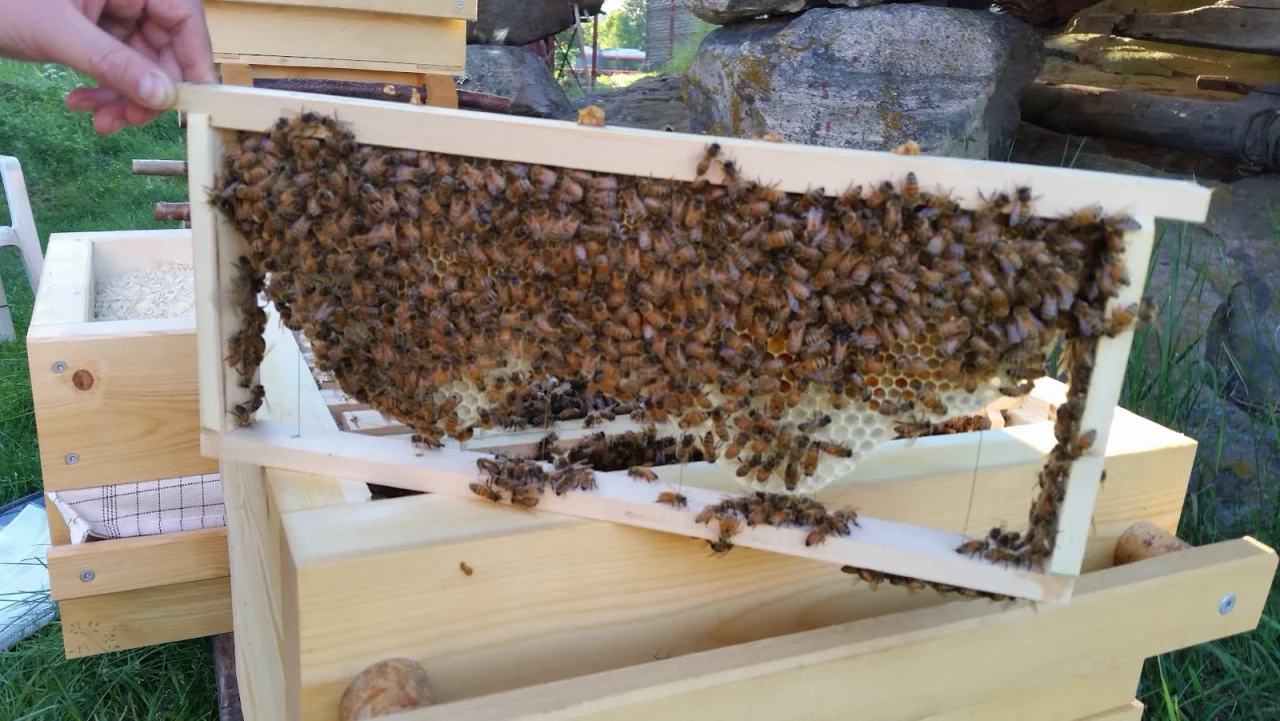
A frame drawn from the hive: the colony in the beekeeper’s hand
Stefan Grunert, eigene Aufnahme
A hand holds a wooden frame drawn from an opened hive. The comb is built freely into it, hangs from the top bar and fills the frame only in part; bees sit on it packed close, and clusters of them hang over the bottom bar. Below, the open box; in the background further hives on a meadow. Landscape format, 1616 × 910 pixels.
— · Photograph: Stefan Grunert, eigene Aufnahme
Released by the operator. The rights status of the digitised image itself has not been looked up at the source.
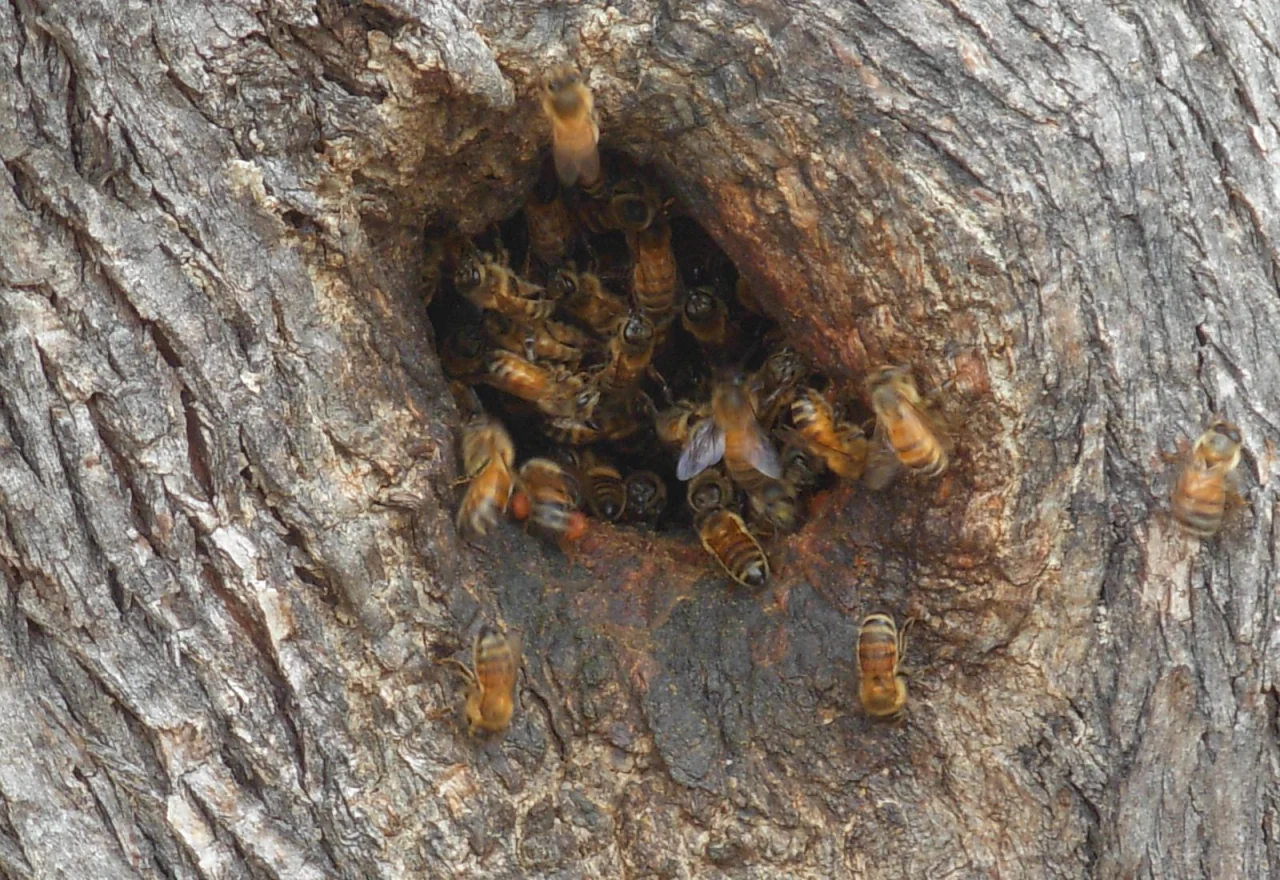
A wild colony in a tree, Western Australia
Wikimedia Commons, Aufnahme von JarrahTree
The entrance of a wild colony of bees in a tree, seen close up: an opening in the bark, the wood around it dark and worn smooth, thickly covered with bees, single ones in the air in front of it. Landscape format, 1685 × 1158 pixels.
Drummond Nature Reserve near Bolgart, Western Australia · Photograph: Wikimedia Commons, File:Bee hole
JarrahTree, Wikimedia Commons, CC BY 2.5 AU. The licence has been looked up at the source: CC BY 2.5 AU — Creative Commons Namensnennung 2.5 Australien.

Skep beekeeping as Christ found it; the engraving is some two hundred years older than his book
Jan van der Straet (Stradanus), Bäuerlicher Bienenstand
A peasant apiary: on the right, under a protective roof, the straw baskets in two rows on boards, and in front of them people with veils and gloves. One is climbing a ladder up the tree and holding a basket to the swarm; on the ground lie overturned baskets, a wheel, tools. On the left there is banging and clattering with poles and kettles. Landscape format, 788 × 473 pixels.
Detail; the complete sheet has not been obtained · Photograph: Wikimedia Commons, File:Jan-van-der-Straet Bauerlicher-Bienenstand

Kronberg in Merian, 1655, a hundred and thirty years before Christ became parson there
Matthäus Merian, Topographia Hassiae
Kronberg from the south-west: on the left the castle on its rock with the tall keep, below it the walled town with close-set gabled roofs and a church tower, in front of it fruit trees and slopes, in the background the range of the Taunus. Landscape format, 1024 × 768 pixels.
Engraving of 1655 · Photograph: Wikimedia Commons, File:Merian Cronberg
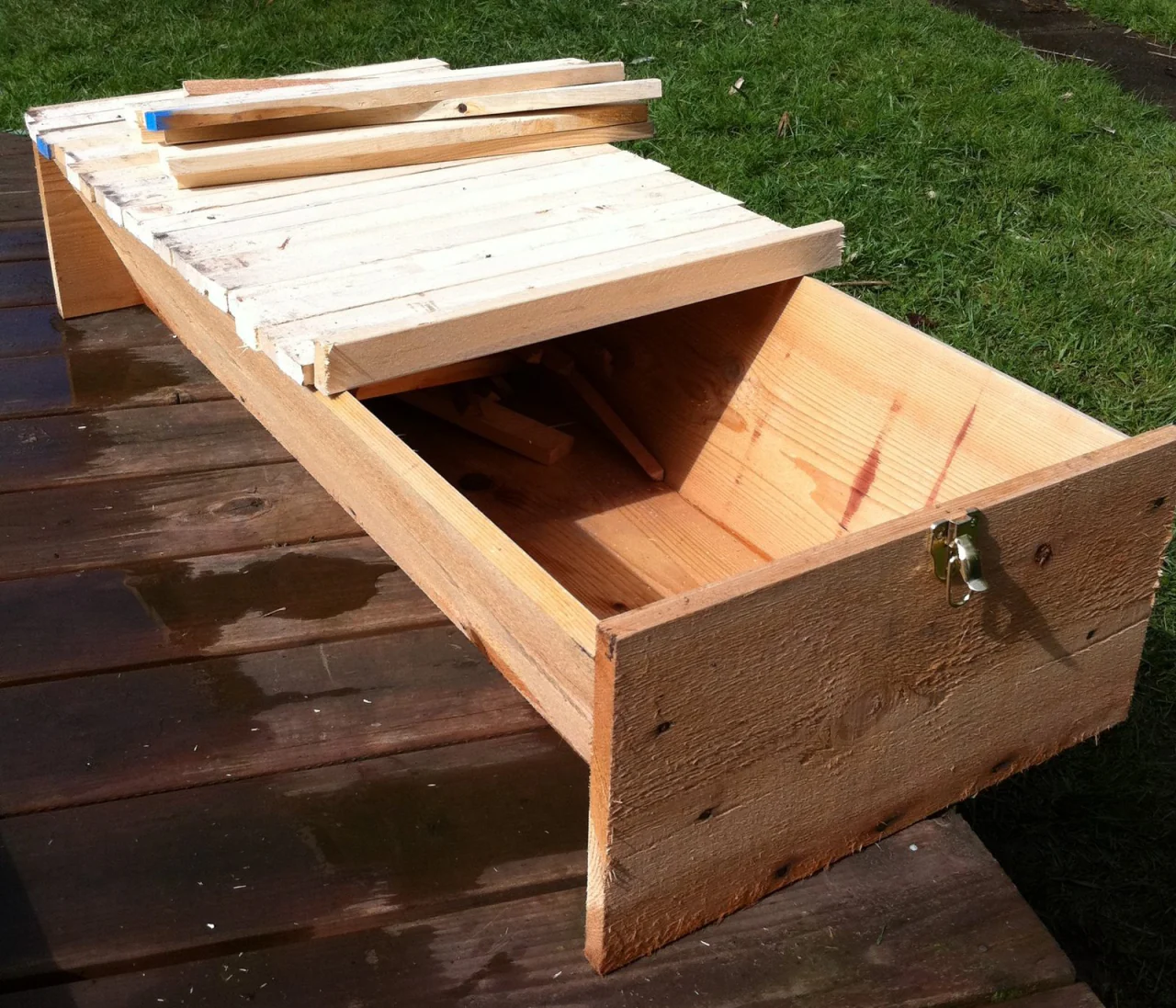
An empty top-bar hive: the bars lie loose on top, and the comb will hang from them
Wikimedia Commons, Aufnahme von Jordan Schwartz
An empty horizontal top-bar hive of roughly sawn wood, seen at an angle from above. The lid has been taken off, some of the bars lie across the opening and the rest are pushed aside; in the open part the sloping side walls and the floor can be seen. Landscape format, 1921 × 1646 pixels.
„Rough-sawn Top Bar Hive for honeybees (not occupied by bees)“, taken 27 March 2011 · Photograph: Wikimedia Commons, File:Top Bar Bee Hive
Jordan Schwartz, Wikimedia Commons, CC BY 2.0. The licence has been looked up at the source: CC BY 2.0 — Creative Commons Namensnennung 2.0.
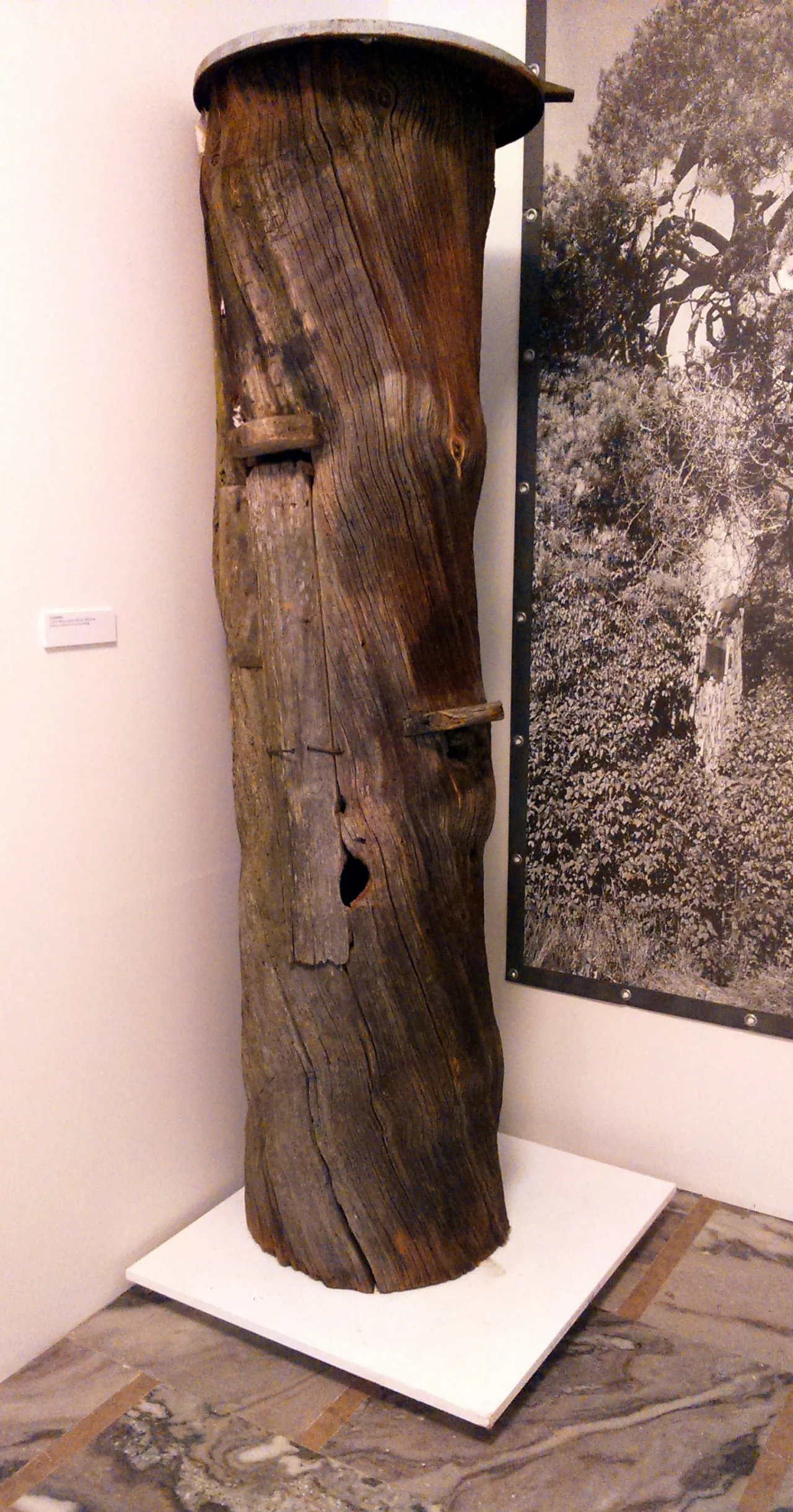
A Kurpie log hive in the museum: the lengthwise closure, with the flight hole below it
Wikimedia Commons, Aufnahme von Maria Weronika Kmoch
An upright log hive made from a hollowed-out trunk, in a museum on a white plinth. On top a flat lid, on the front the lengthwise closure of inserted boards, held by two wooden pegs, and beneath it the entrance. Portrait format, 1523 × 2904 pixels.
„Kurpian wooden hive“, taken 24 February 2016; museum piece from the Kurpiowska Heath, Czarnia · Photograph: Wikimedia Commons, File:Ul kłodowy Czarnia Kurpie bartnictwo
Maria Weronika Kmoch, Wikimedia Commons, CC BY-SA 4.0. The licence has been looked up at the source: CC BY-SA 4.0 — Creative Commons Namensnennung, Weitergabe unter gleichen Bedingungen 4.0.

A Warré hive in use: three identical boxes, gable roof, alighting board
Wikimedia Commons, Aufnahme von Kevin Pauba
A Warré hive in the grass under trees: three pale wooden boxes one above another on a narrow stand, with a shallow gable roof projecting at the edge. At the foot an alighting board. On the left of the picture the legs of a person standing beside it. Landscape format, 640 × 480 pixels.
„Basic Warre Hive“, taken 12 October 2014 · Photograph: Wikimedia Commons, File:Warrebasic
Kevin Pauba, Wikimedia Commons, CC BY 4.0. The licence has been looked up at the source: CC BY 4.0 — Creative Commons Namensnennung 4.0.
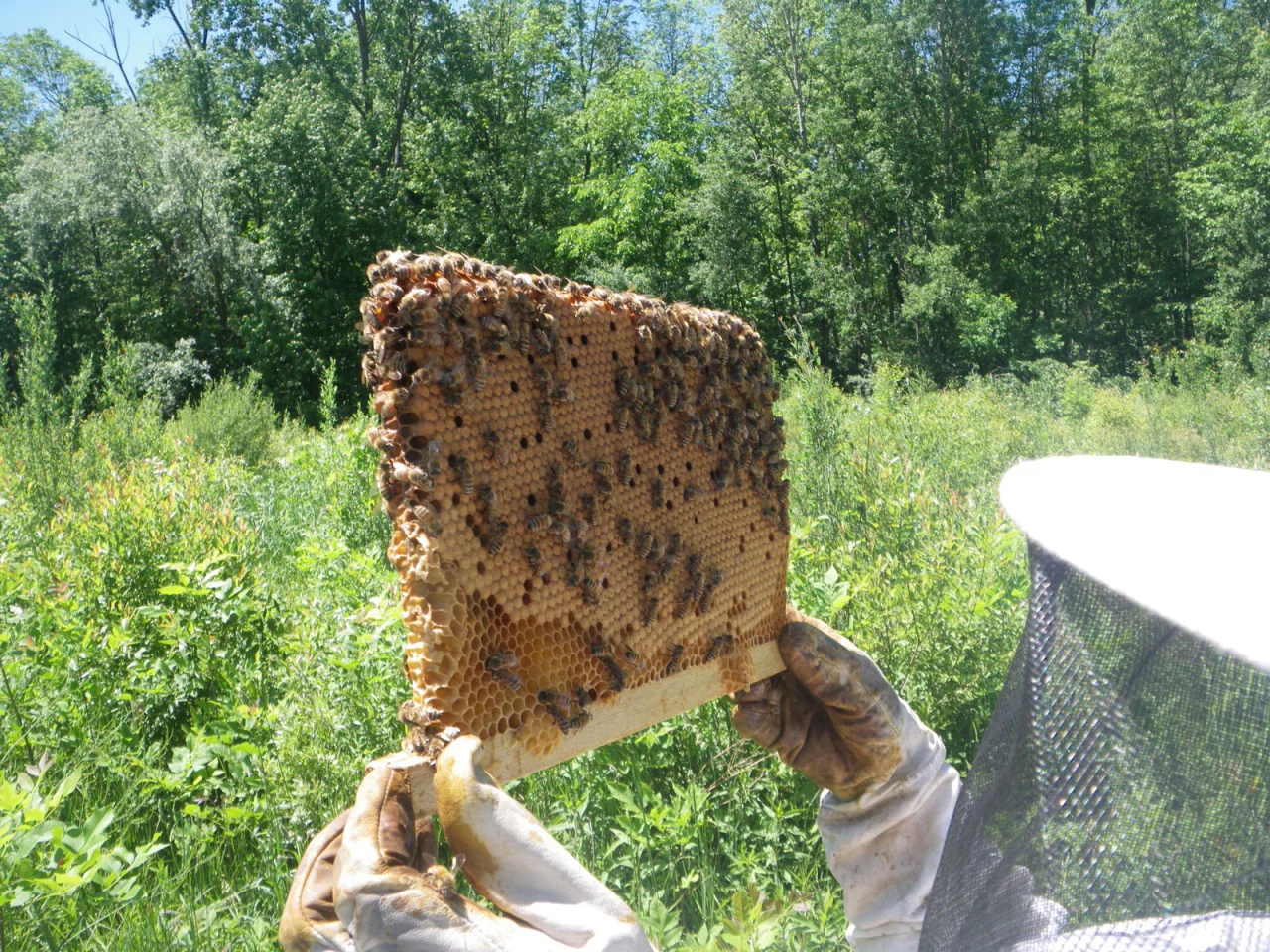
A comb from a Warré hive, hanging from its bar alone
Wikimedia Commons, Aufnahme von Shawn Caza
A gloved hand holds a built-out comb up by its top bar; on the right the beekeeper's veil. The comb hangs from the narrow wooden bar alone, its edges free and wavy, thickly covered with bees, with sealed brood in the middle. In the background a woodland meadow. Landscape format, 4000 × 3000 pixels.
„Beekeeper inspecting the brood on a top-bar comb from a warré hive“, taken 4 June 2013 · Photograph: Wikimedia Commons, File:Top-bar brood comb from a warre hive
Shawn Caza, Wikimedia Commons, CC BY-SA 3.0. The licence has been looked up at the source: CC BY-SA 3.0 — Creative Commons Namensnennung, Weitergabe unter gleichen Bedingungen 3.0.

Looking into the box: natural comb from wall to wall
Wikimedia Commons, Aufnahme von Kevin Pauba
A view from above into an opened Warré box: eight thickly covered natural combs run parallel from wall to wall, the spaces between them full of bees. At the upper and lower edge the notches in which the top bars rest. Landscape format, 849 × 637 pixels.
„Combs in a Warre hive“, taken 12 October 2014 · Photograph: Wikimedia Commons, File:Warrecombs
Kevin Pauba, Wikimedia Commons, CC BY 4.0. The licence has been looked up at the source: CC BY 4.0 — Creative Commons Namensnennung 4.0.

The top bars of a Warré box, with the gaps between them
Wikimedia Commons, Aufnahme von Kevin Pauba
A close view of the top bars of an opened Warré box: pale wooden bars side by side, the narrow lanes between them, and bees walking over both. One bar is dark with propolis. Portrait format, 478 × 637 pixels.
„Top bars in a Warré hive“, taken 12 October 2014 · Photograph: Wikimedia Commons, File:Warretopbars
Kevin Pauba, Wikimedia Commons, CC BY 4.0. The licence has been looked up at the source: CC BY 4.0 — Creative Commons Namensnennung 4.0.
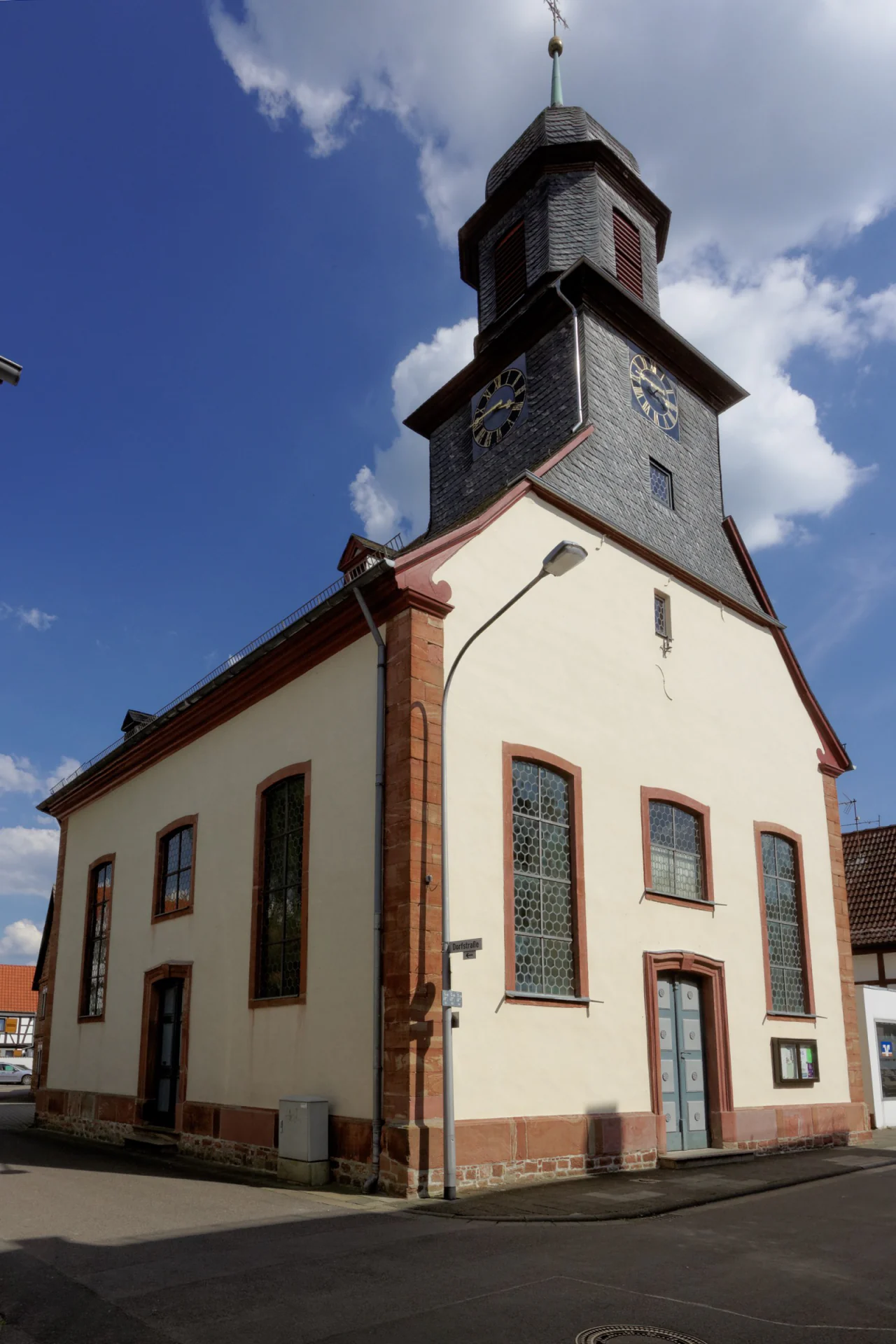
The church at Harreshausen, built in 1784 to Christ's design
Wikimedia Commons, Aufnahme von E-W
The Protestant church at Harreshausen, seen obliquely from the street corner: a rendered hall building with red sandstone at the corners, window surrounds and portal, above it an octagonal tower entirely slated, with two clock faces and a curved cap. Portrait format, 3456 × 5184 pixels.
Harreshausen, a district of Babenhausen in Hesse · Photograph: Wikimedia Commons, File:Harreshausen_Evangelische_Kirche
E-W/Wikipedia, CC BY-SA 3.0 de. The licence has been looked up at the source: CC BY-SA 3.0 de — Creative Commons Namensnennung/Weitergabe unter gleichen Bedingungen 3.0 Deutschland, https://creativecommons.org/licenses/by-sa/3.0/de/legalcode. Der Urheber hat die Bedingungen am 19. August 2026 selbst mitgeteilt: Nennung als „E-W/Wikipedia", ein Link auf das Originalfoto und der Lizenzvertrag am Bild. Die Dateiseite bei Commons trägt am selben Tag {{self|cc-by-sa-3.0}}, also die unportierte Fassung; die genannten Auflagen sind die engeren und werden erfüllt..
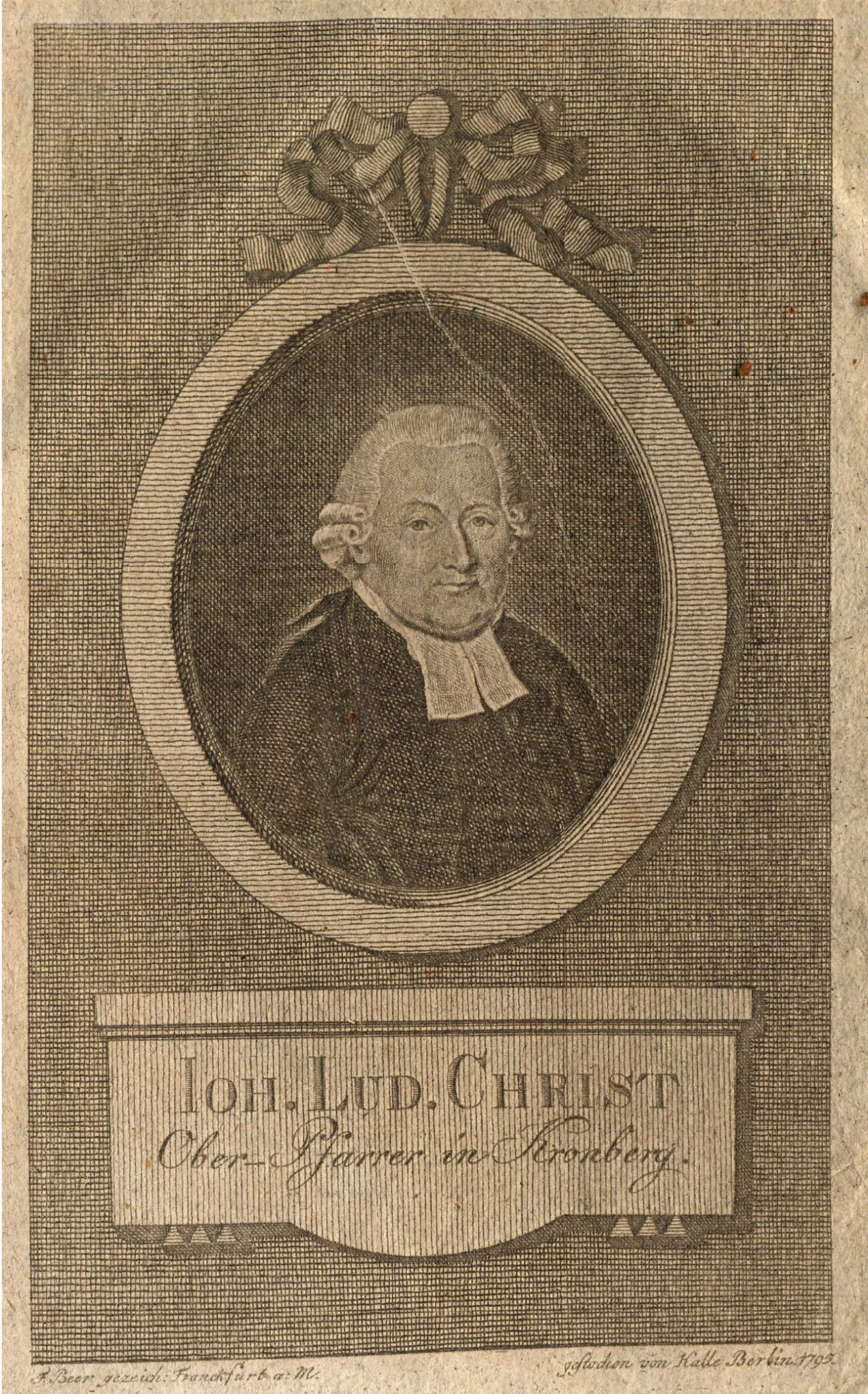
Christ as senior parson in Kronberg, the plate dated 1795
Johann Georg Krünitz, Oeconomische Encyclopädie, oder allgemeines System der Land- Haus- und Staats-Wirthschaft, Band 73. Berlin: Pauli, 1798
Christ in bust, turned half to the right, in a wig with side rolls, a dark coat and the white bands of a preacher. The portrait stands in an oval medallion hung from a bow; beneath it, on a plinth, „IOH. LUD. CHRIST" in capitals and in script „Ober-Pfarrer in Kronberg.". Under the plate, on the left „F. Beer gezeich: Franckfurt a: M.", on the right „gestochen von Halle Berlin 1795.". Portrait format, 1580 × 2536 pixels.
Frontispiece of the volume. Etching after a drawing by Johann Friedrich Beer (1741–1804), engraved by Johann Samuel Ludwig Halle (1763–1829); the plate itself is dated 1795, the volume appeared in 1798. · Photograph: Trierer Porträtdatenbank tripota der Universität Trier, Datensatz 121_krue_0073
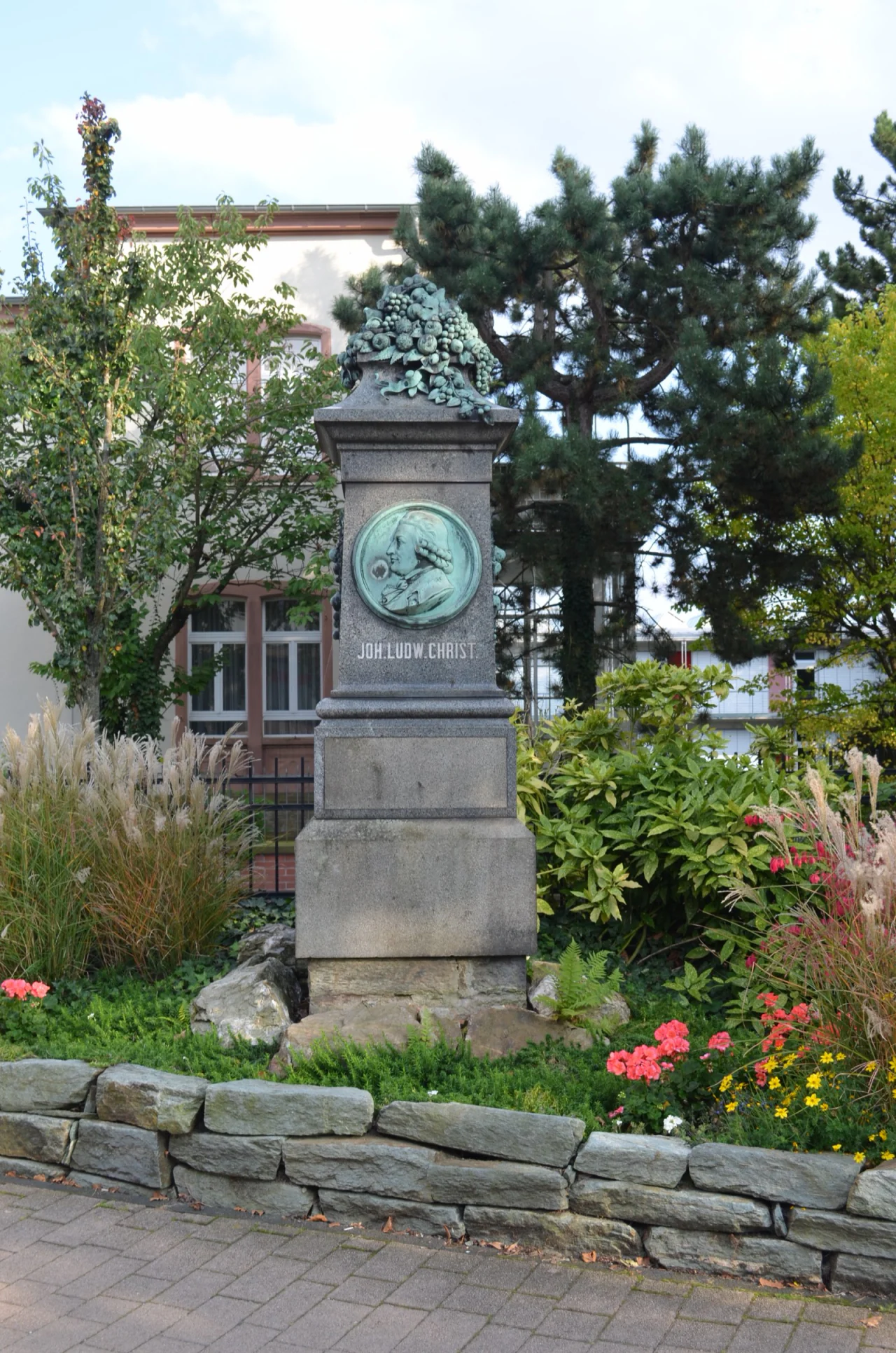
The Kronberg monument of 1885, with portrait plaque and wreath of fruit
Wikimedia Commons, Aufnahme von Karsten Ratzke
The Kronberg monument: a granite pedestal carrying a round bronze medallion with Christ's head in profile, in wig and queue, beneath it in capitals „JOH. LUDW. CHRIST.". The finial is a bronze wreath of fruit and foliage, apples, pears and grapes among it. The pedestal stands in a bed behind a dry stone wall. Portrait format, 3264 × 4928 pixels.
Kronberg im Taunus, in the Katharinenstrasse, on the former grounds of Christ's nurseries · Photograph: Wikimedia Commons, File:Kronberg,_Denkmal_Johann_Ludwig_Christ
Karsten Ratzke, Wikimedia Commons, CC0. The licence has been looked up at the source: CC0 1.0 — Creative Commons Zero, Verzicht auf alle Rechte, https://creativecommons.org/publicdomain/zero/1.0/. Die Dateiseite trägt am 19. August 2026 {{self|cc-zero}}..
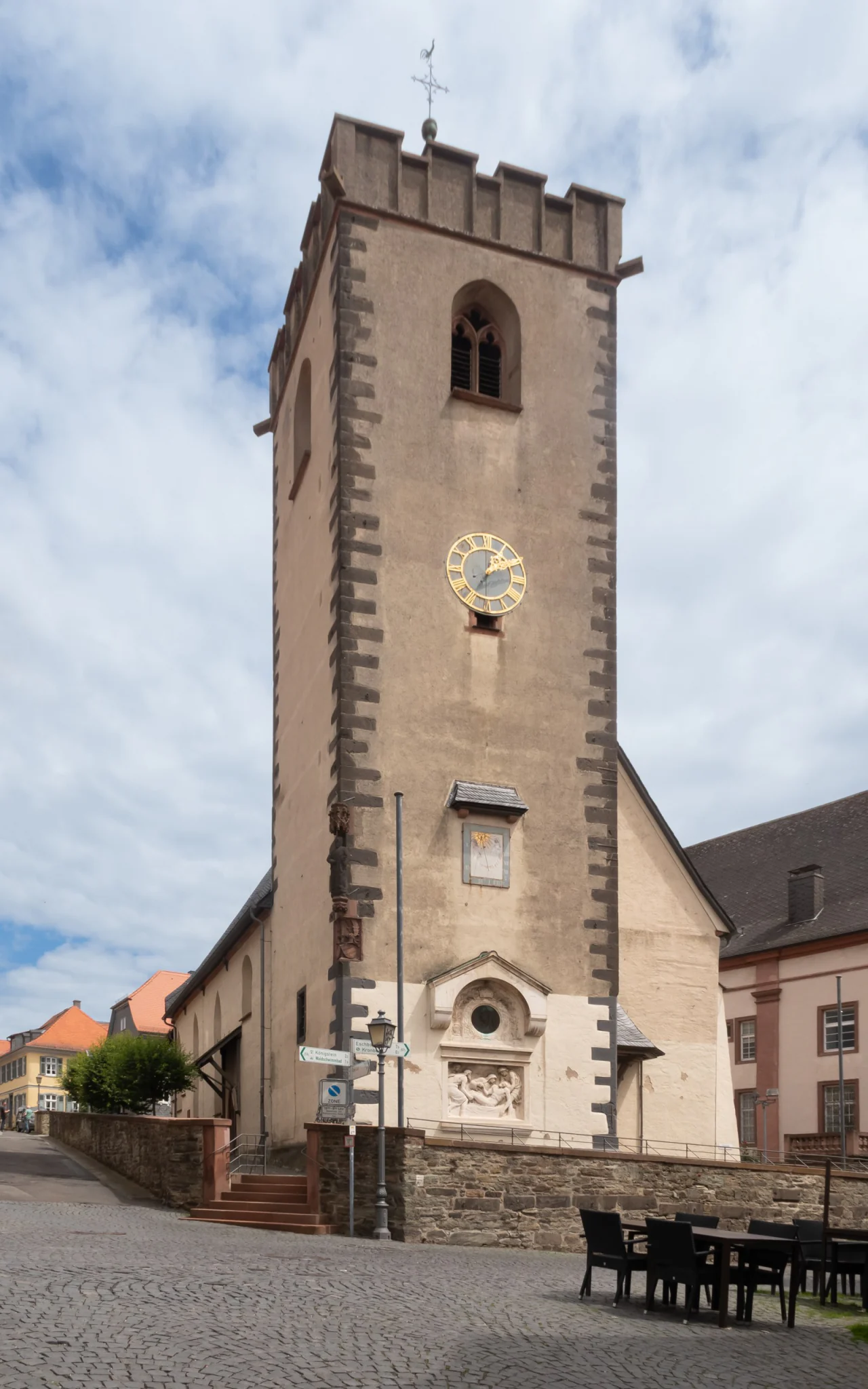
The town church of St. Johann, Christ's church in Kronberg
Wikimedia Commons, Aufnahme von Michielverbeek
The tower of the town church of St. Johann at Kronberg seen from the cobbled square, from the south: a tall rubble-stone tower with a crenellated parapet and weathercock, a gothic traceried window in it, below that the gilded clock, a sundial, and over the portal a relief of the entombment. To the left the lower nave adjoins under its slate roof. Portrait format, 3000 × 4800 pixels.
Kronberg im Taunus, the town church of St. Johann, from the south · Photograph: Wikimedia Commons, File:Kronberg im Taunus, evangelische Pfarrkirche Johannes der Täufer Dm99116 IMG 1692 2024-05-27 13
Michielverbeek, Wikimedia Commons, CC BY 4.0. The licence has been looked up at the source: CC BY 4.0 — Creative Commons Namensnennung 4.0 International, https://creativecommons.org/licenses/by/4.0/. Die Dateiseite trägt am 19. August 2026 {{self|cc-by-4.0}}. Die Auflage ist die Namensnennung; Weitergabe unter gleichen Bedingungen verlangt diese Lizenz nicht..
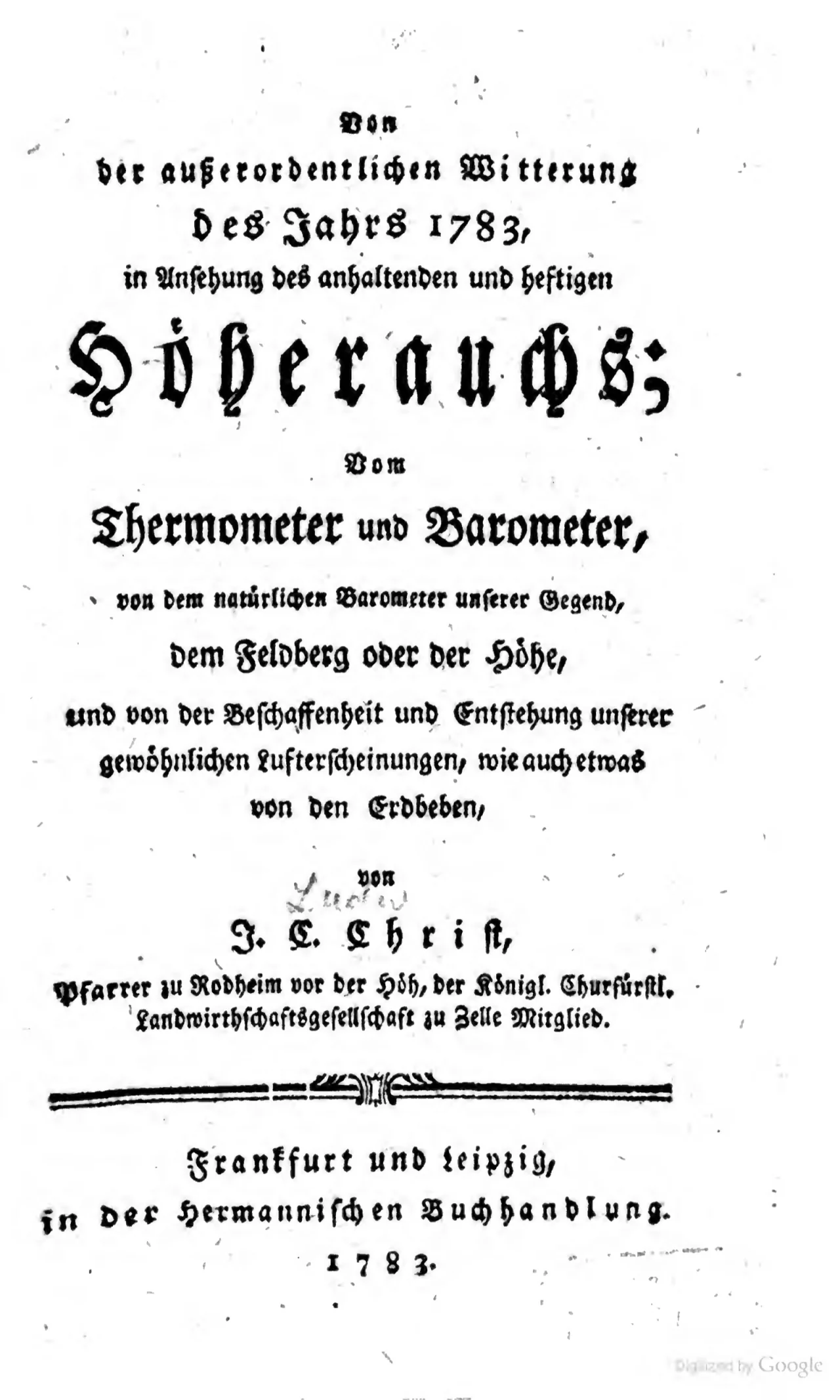
The title page of 1783, printed in the Rodheim years
Johann Ludwig Christ, Von der außerordentlichen Witterung des Jahrs 1783, in Ansehung des anhaltenden und heftigen Höherauchs, Frankfurt und Leipzig, in der Hermannischen Buchhandlung, 1783
The title page of the tract of 1783, Fraktur in eight sizes. At the top the long title „Von der außerordentlichen Witterung des Jahrs 1783, in Ansehung des anhaltenden und heftigen Höherauchs", the last word in the largest type on the sheet; below it the three appended chapters on thermometer and barometer, on the Feldberg and on the ordinary phenomena of the air together with earthquakes. In the middle the author, „J. L. Christ, Pfarrer zu Rodheim vor der Höh, der Königl. Churfürstl. Landwirthschaftsgesellschaft zu Zelle Mitglied"; above the printed name a handwritten addition by a former owner. At the foot „Frankfurt und Leipzig, in der Hermannischen Buchhandlung. 1783." Portrait format, 2280 × 3800 pixels.
Title page, page 3 of the digitisation · Photograph: Internet Archive, bub_gb_XpQ5AAAAcAAJ, aus einer Google-Digitalisierung; am Fuß des Blattes die eingebrannte Zeile „Digitized by Google"
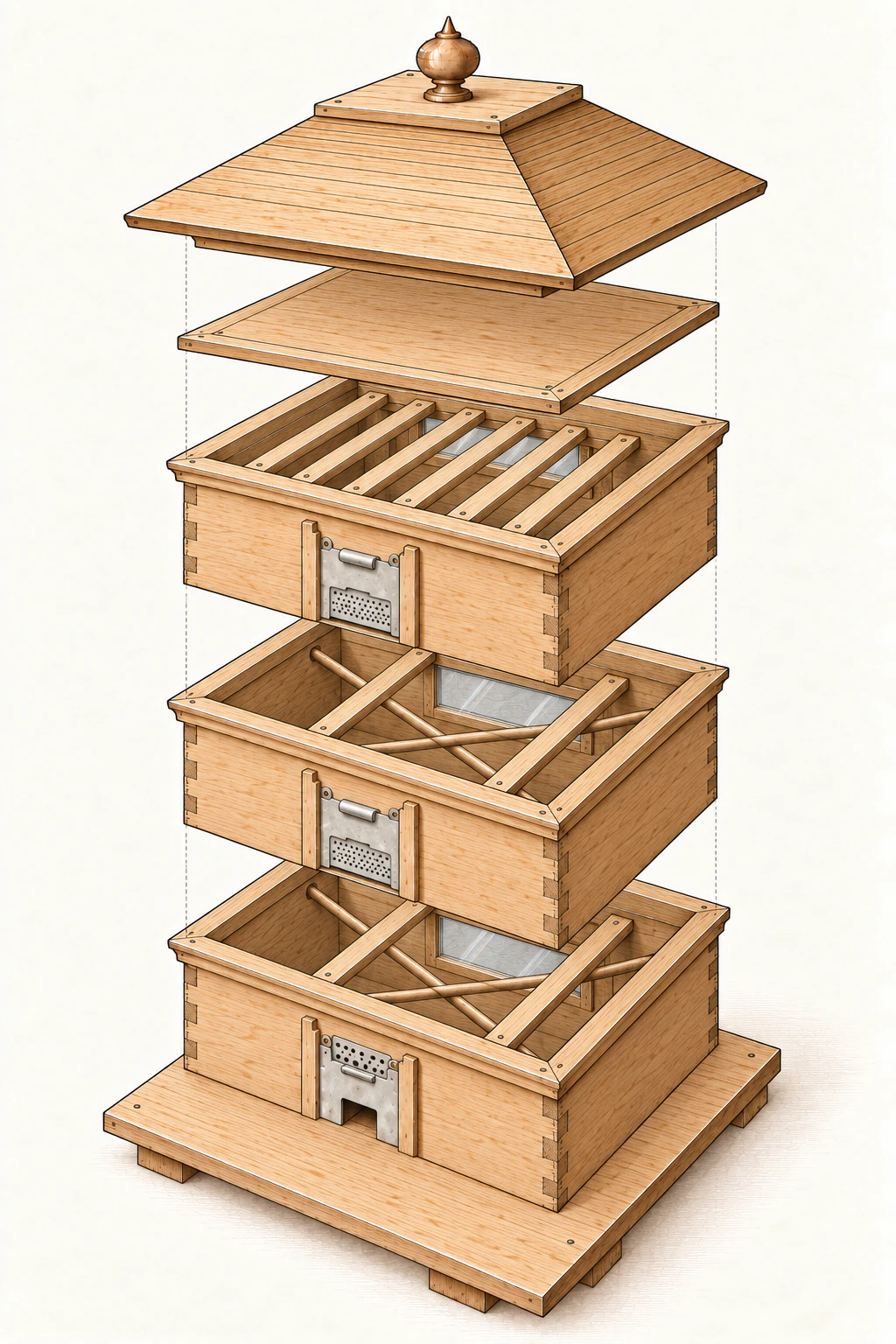
Exploded view of Christ’s hive, illustrated with three sections. The top section has six fixed bars; each lower section has two bars and crossed sticks. Observation windows are set into the rear walls. AI-generated schematic illustration after plate II and chapter 3.
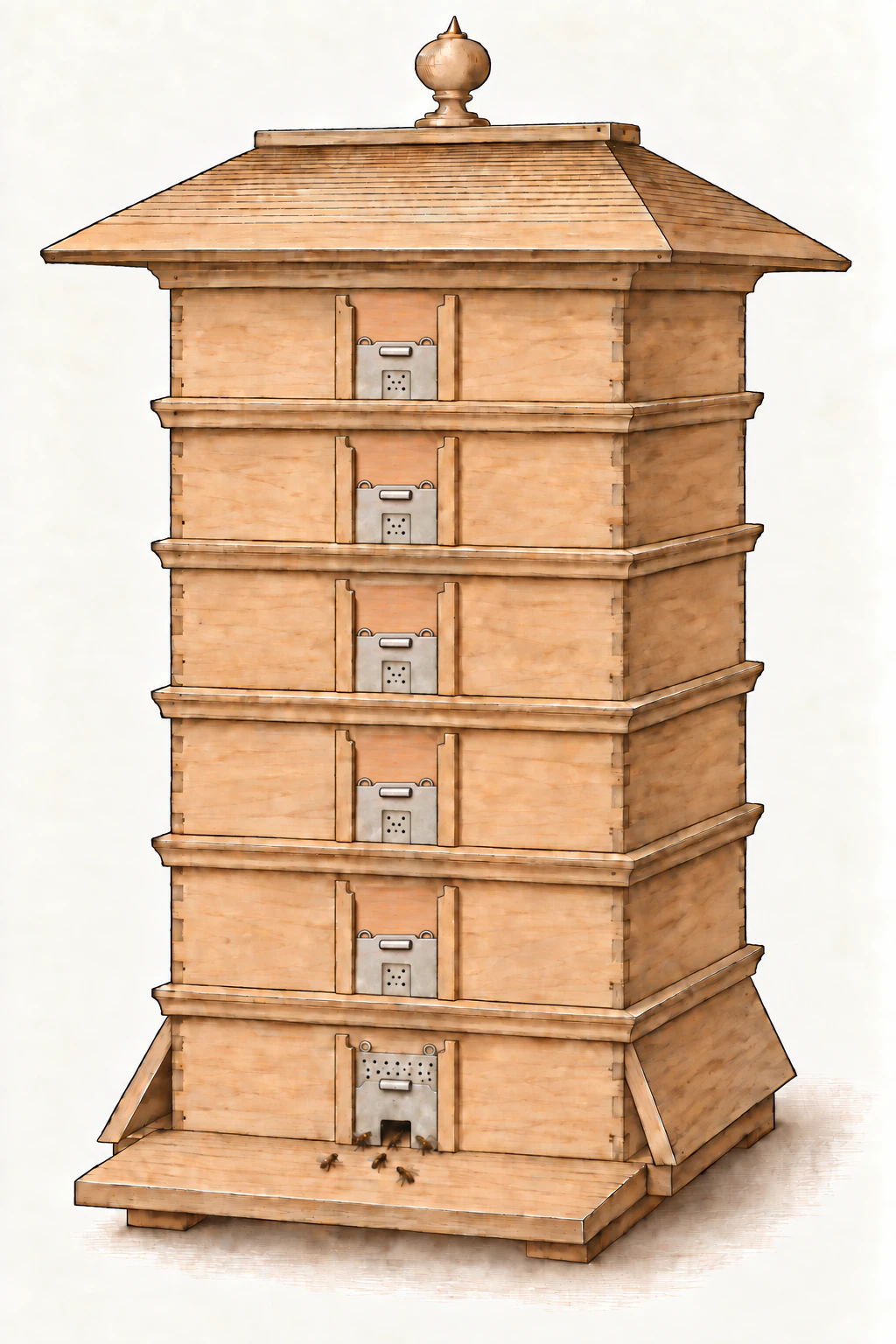
Christ’s magazine hive with six shallow sections and a weather roof. After plate III and chapter 3 (1798). AI-generated schematic illustration.
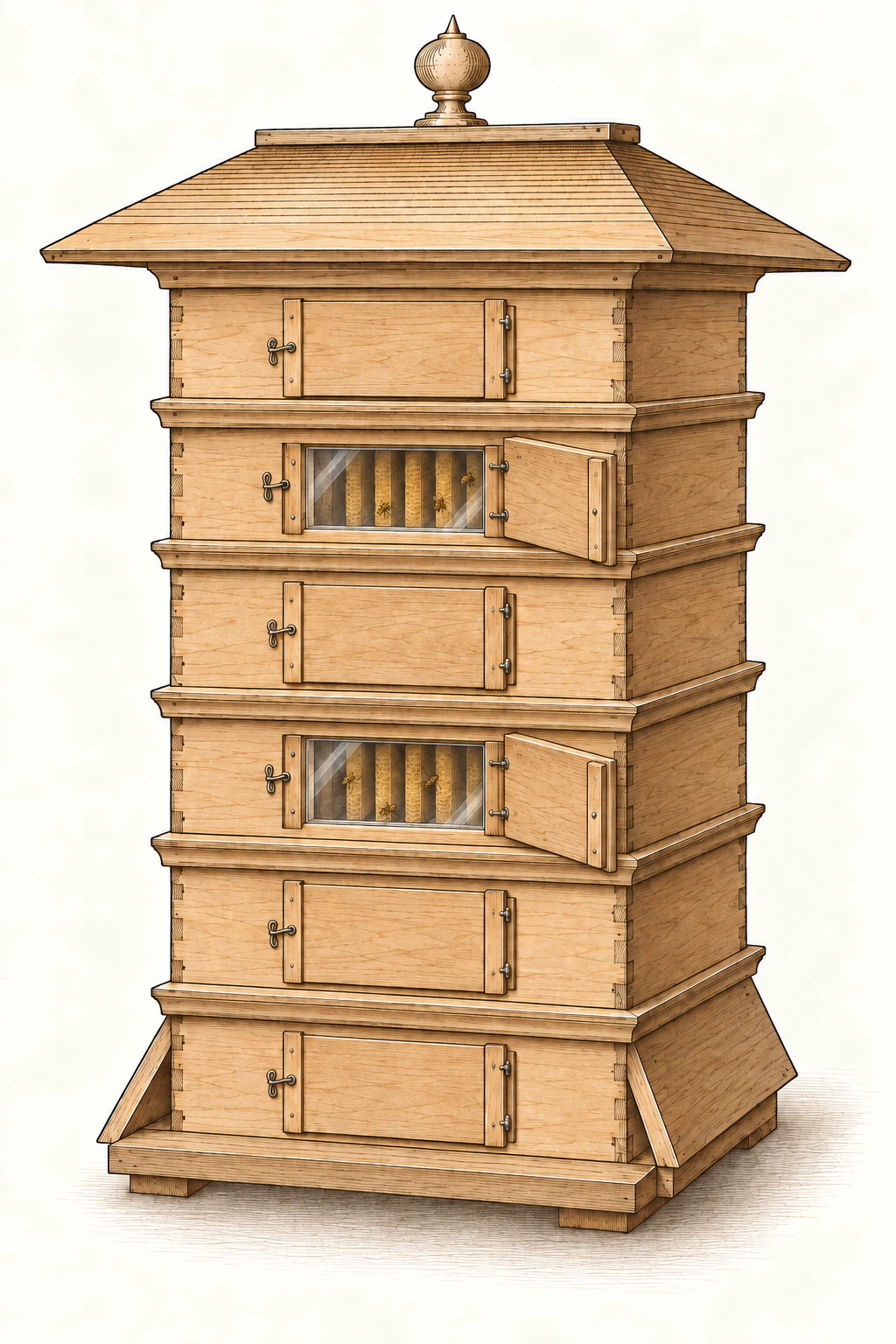
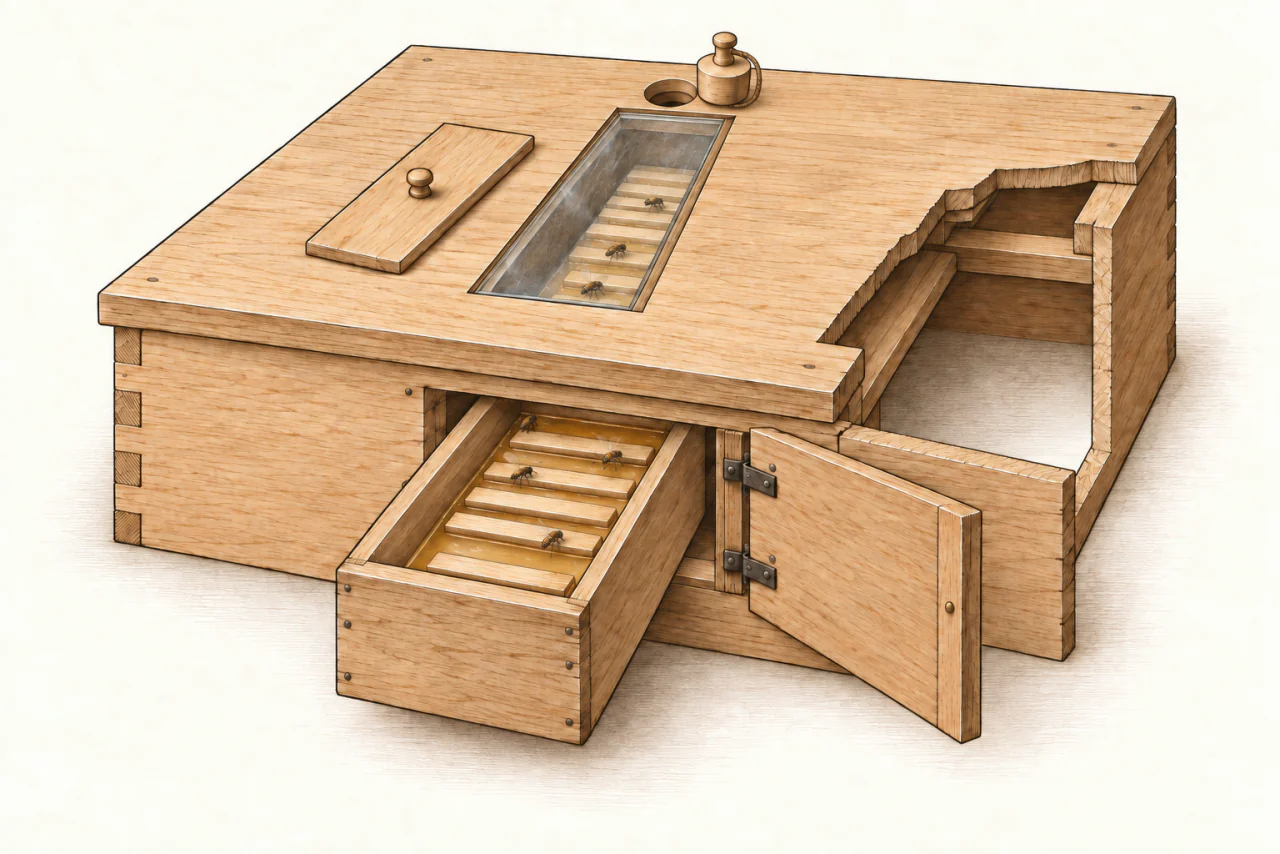
Rear view of Christ’s hive with observation windows and two open shutters. AI-generated schematic illustration.
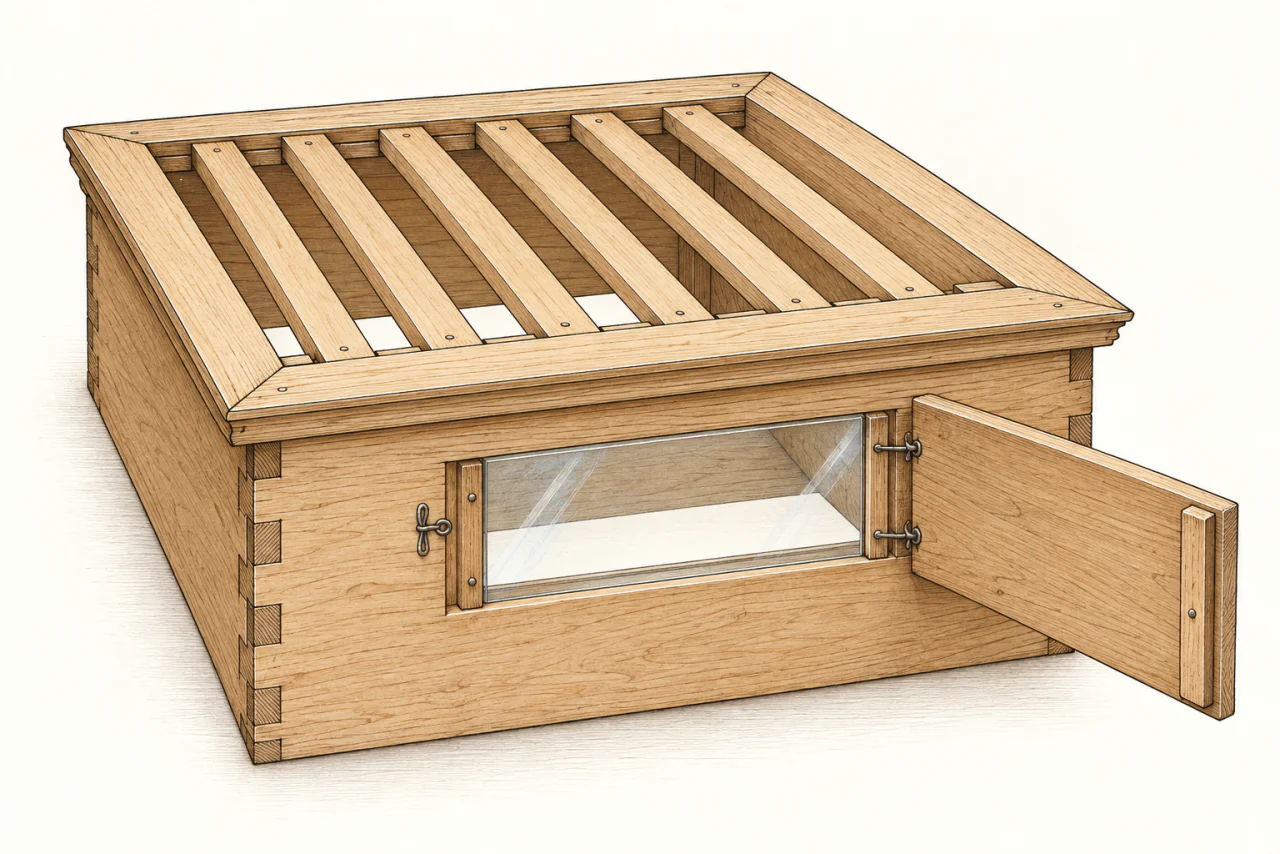
Top section of Christ’s hive: six fixed wooden slats and a window behind its open shutter. After plate II. AI-generated schematic illustration.
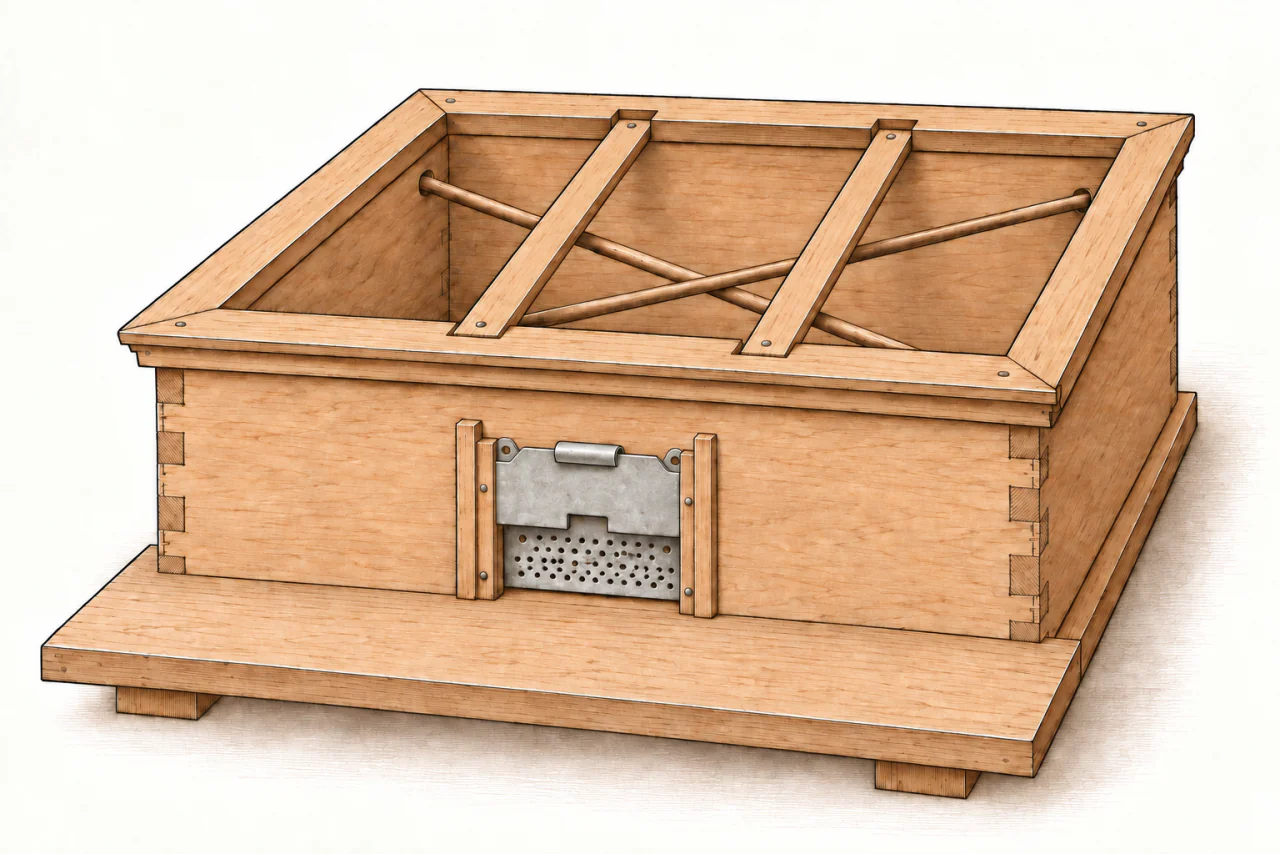
Lower section of Christ’s hive with two fixed wooden slats, crossed sticks and two entrance slides. After plate II. AI-generated schematic illustration.
Christ’s feeding box with a sliding trough, floating wood slivers and a glass cover. After plate V and chapter 5. AI-generated schematic illustration.
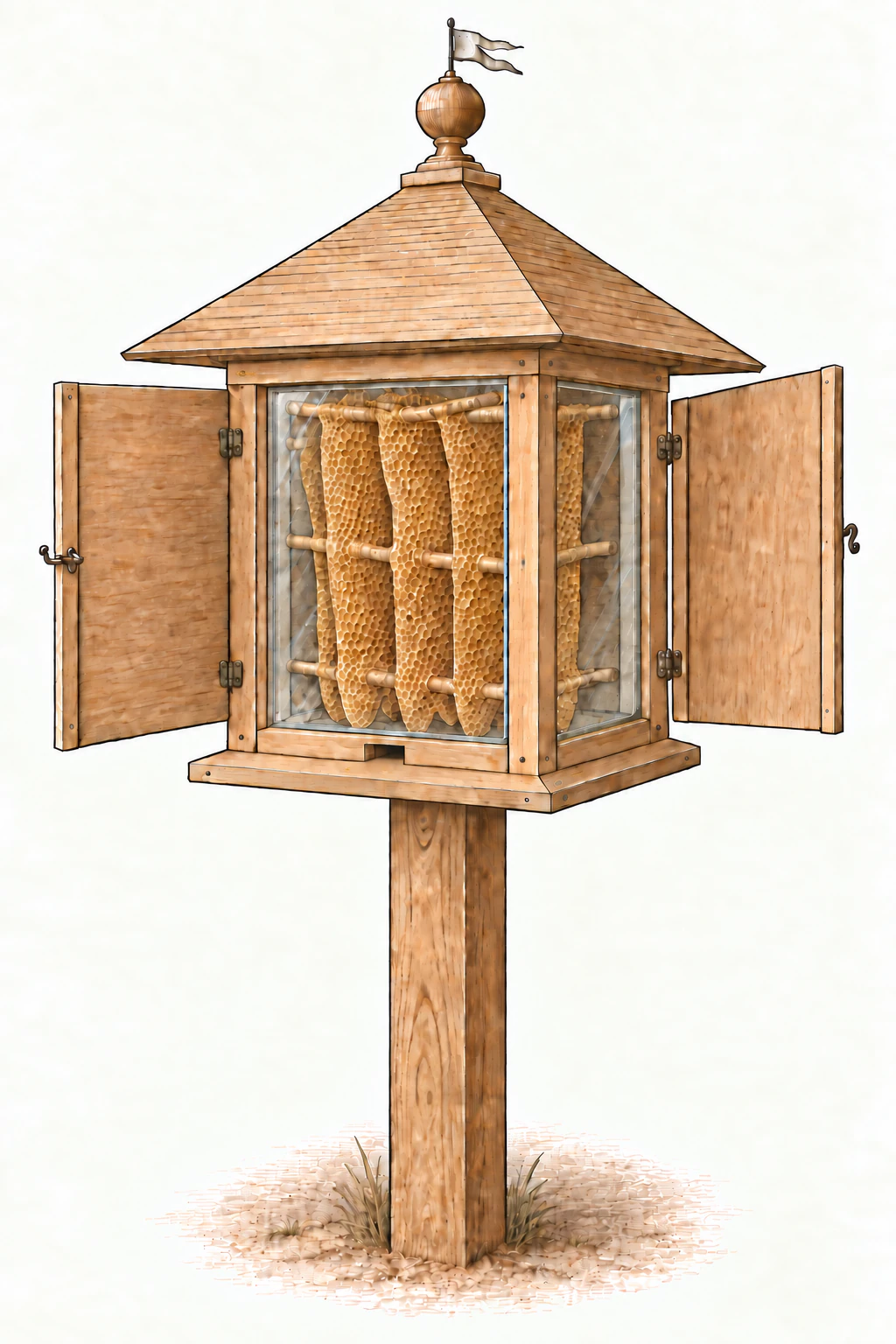
Christ’s glass observation hive with wooden shutters and fixed cross-sticks. After plate IV and chapter 3. AI-generated schematic illustration.
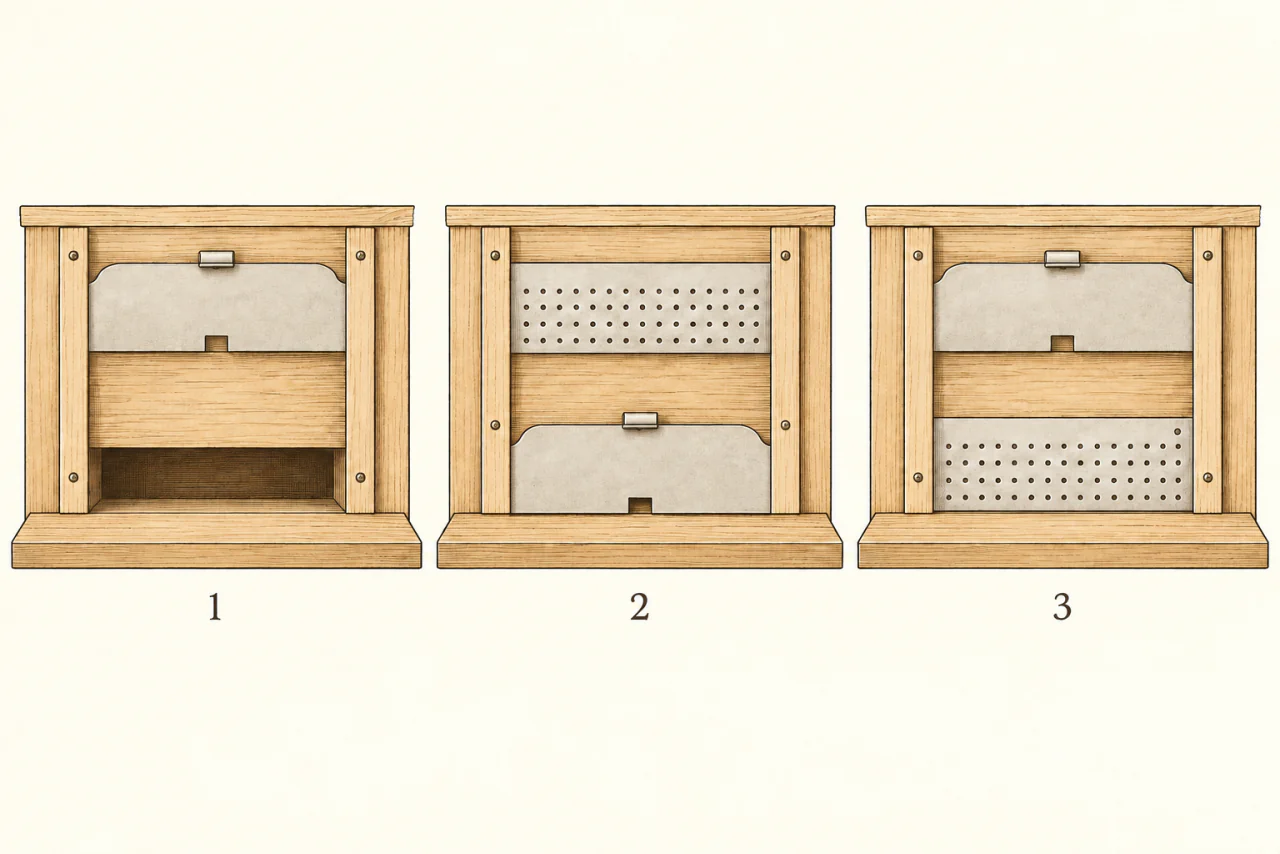
The two entrance slides after Christ (K3 §4): 1 the large opening exposed; 2 reduced to a small bee passage; 3 closed to bees by the perforated rear slide, which admits air. AI-generated schematic illustration.
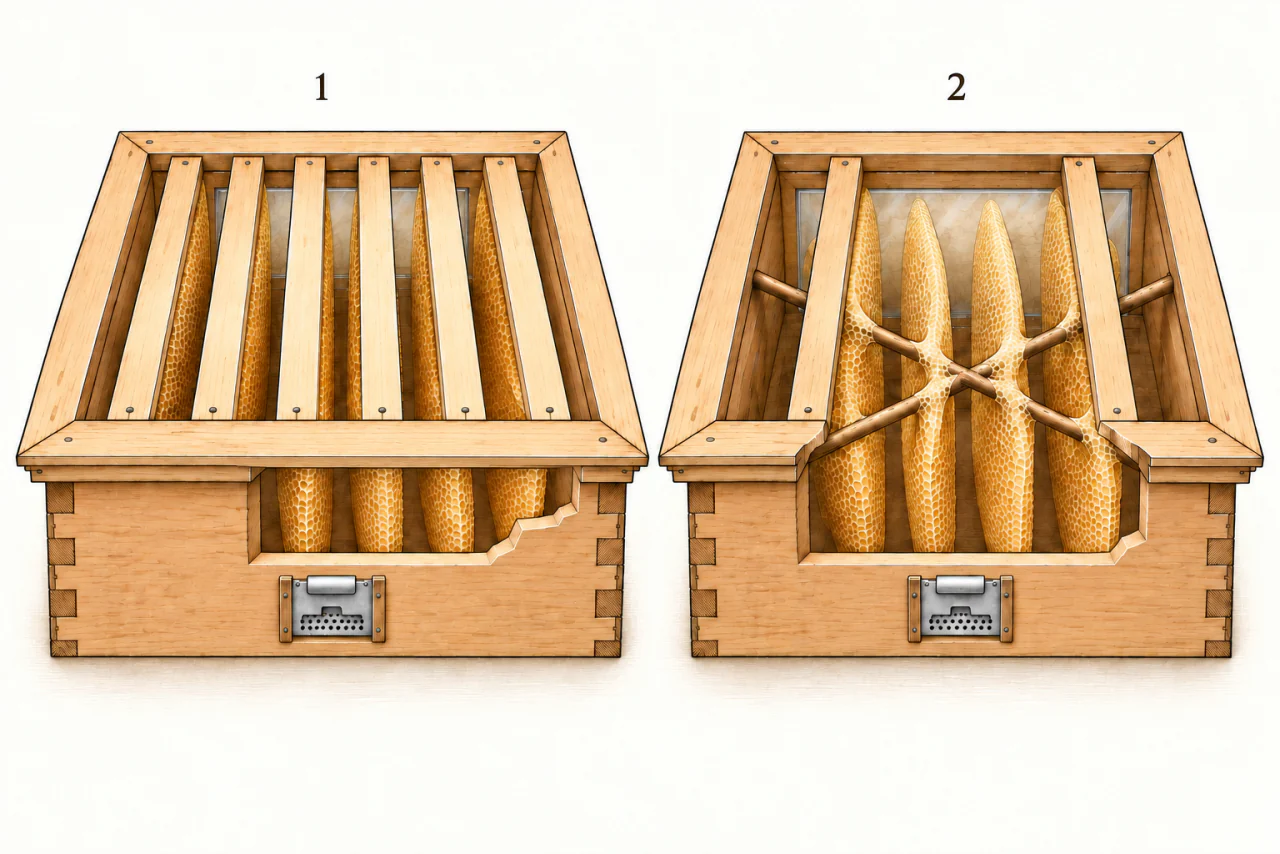
Comb supports after Christ (K3 §4): 1 the uppermost section with six fixed strips; 2 a lower section with two strips and thin crossed sticks. Cutaways reveal how the comb is attached and supported. AI-generated schematic illustration.
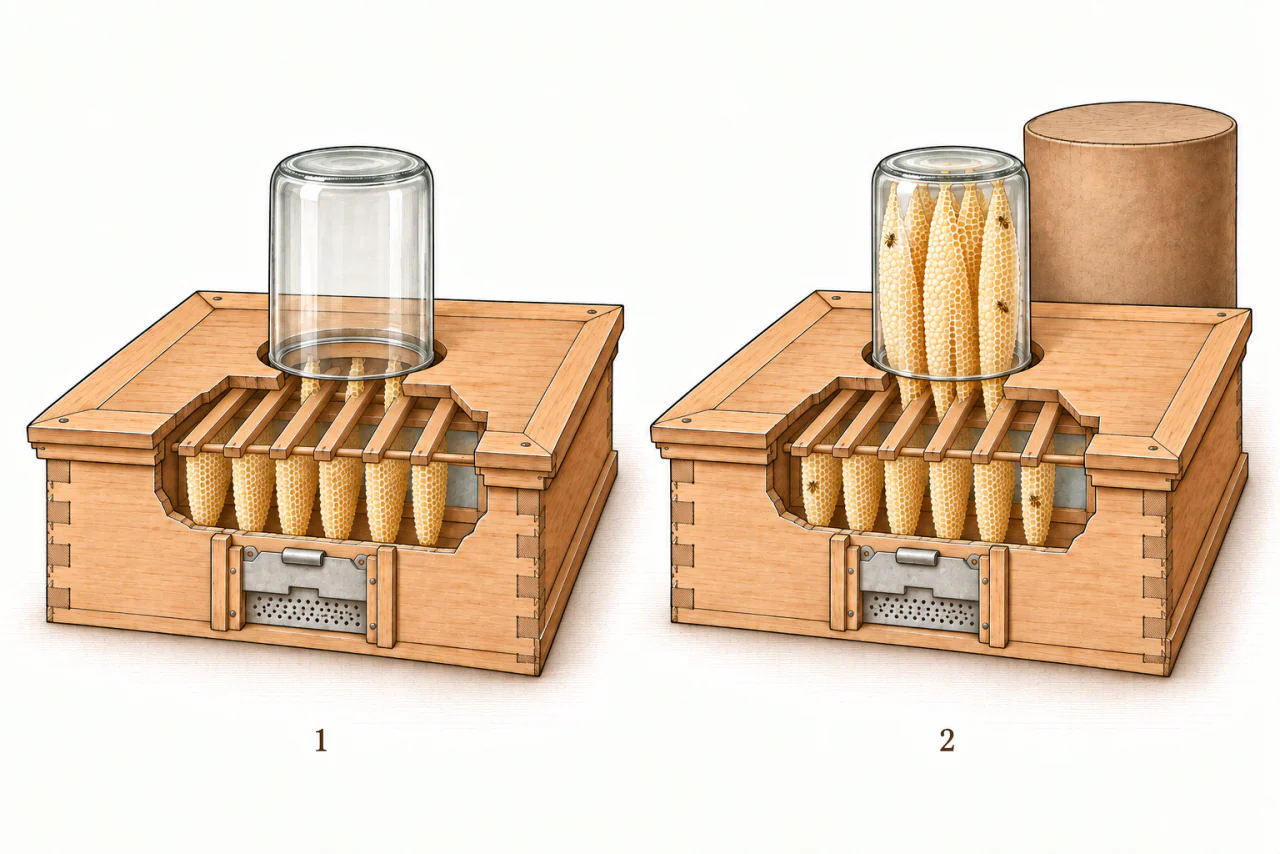
(1) An empty glass is inverted over an opening in the cover. (2) The bees have extended the combs of the upper box into the glass; its cardboard cover has been removed. After Christ (1798), chapter 3, section 5. AI-generated schematic illustration.
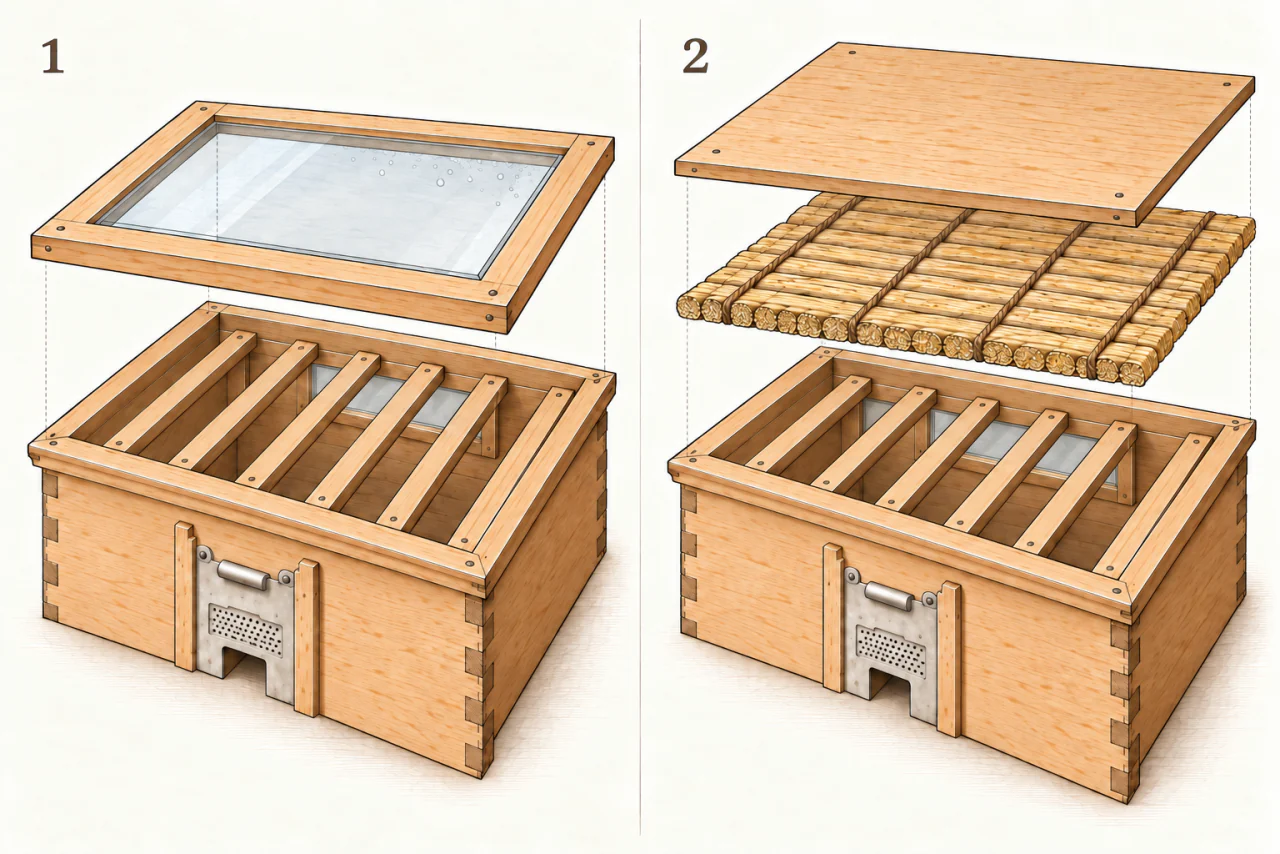
Top closures after Christ (K3 §4): 1 a glass lid in a wooden frame; 2 a thin mat of bound straw cords with a protective board against mice. The straw closure replaces the glass in winter and may also remain in summer. Parts are separated for clarity. AI-generated schematic illustration.
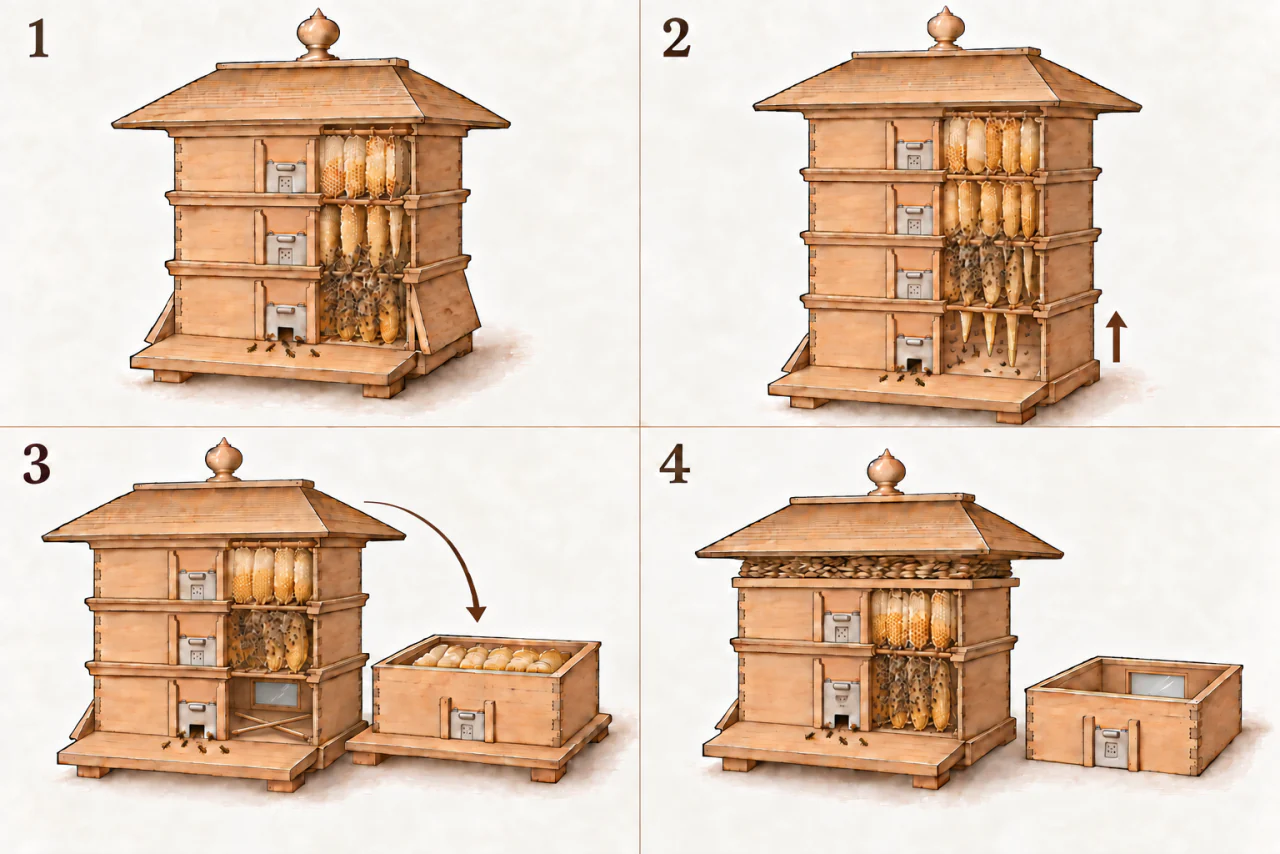
Christ’s hive through the year: 1 occupied hive; 2 space added below; 3 honey removed above; 4 unused lower space removed where needed and winter covering fitted. Box counts are examples and do not indicate the winter stores required. After K2 §6, K3 §§4 and 9, K4 §26 and K6 §§5–7. AI-generated schematic illustration.
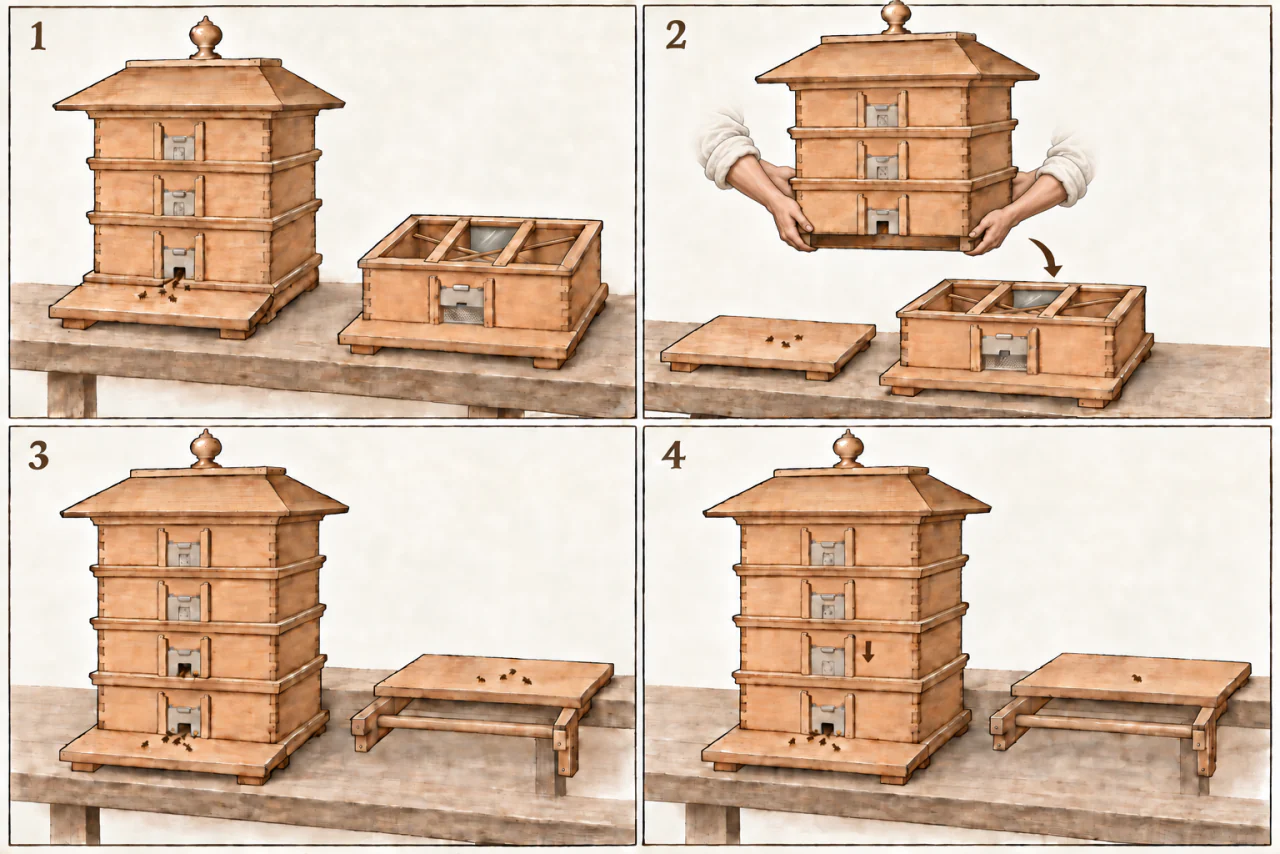
Adding a box below, after Christ (K3 §9): 1 prepare an empty box on a new floorboard; 2 move the occupied stack onto it; 3 place the old floorboard with its remaining bees on the shelf; 4 close the former entrance later. AI-generated schematic illustration.
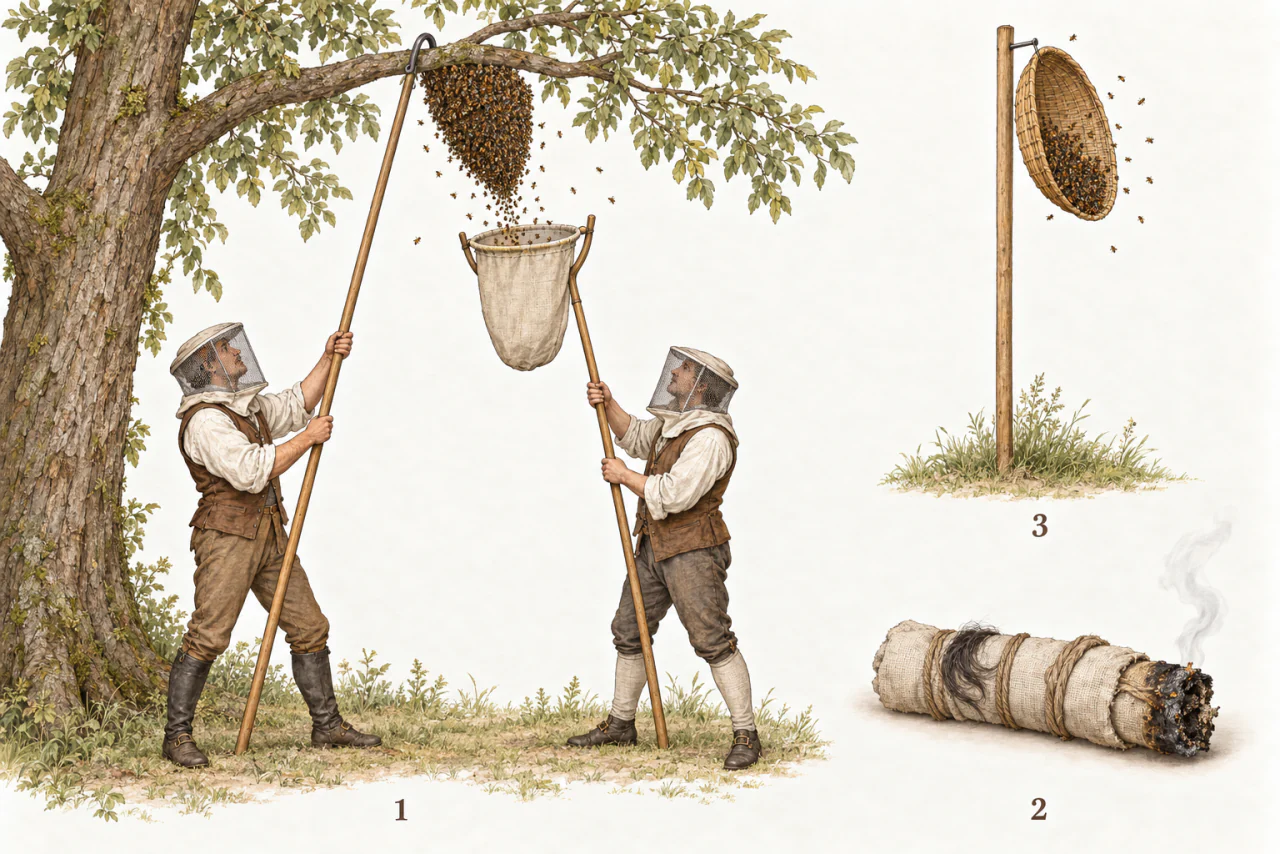
1: Swarm capture with two poles: a hook on the branch and a sack suspended in a fork beneath the swarm. 2: Smouldering cloth roll containing human hair. 3: Basket hung freely from a nail as a gathering place. Its shape and angle are reconstructed. After Christ, K4 §§15, 17, 22; K7 §2. AI-generated schematic illustration.
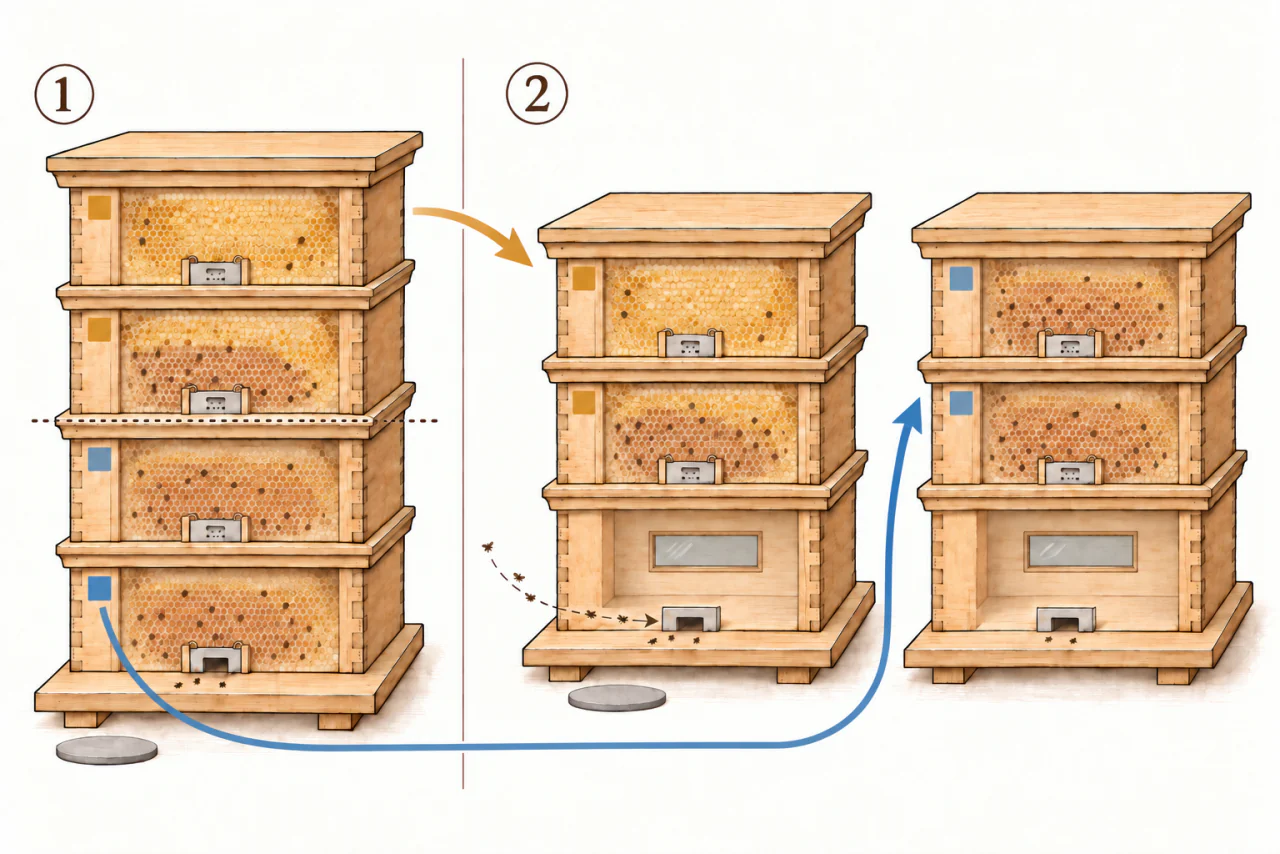
Dividing a colony after Christ (K4 §2), at the start of the swarming season with abundant forage: four occupied boxes become two colonies, each with two occupied boxes and an empty box below. Colours track their origin; the stone marks the original site for the weaker part. Both need brood. AI-generated schematic illustration with simplified comb views.
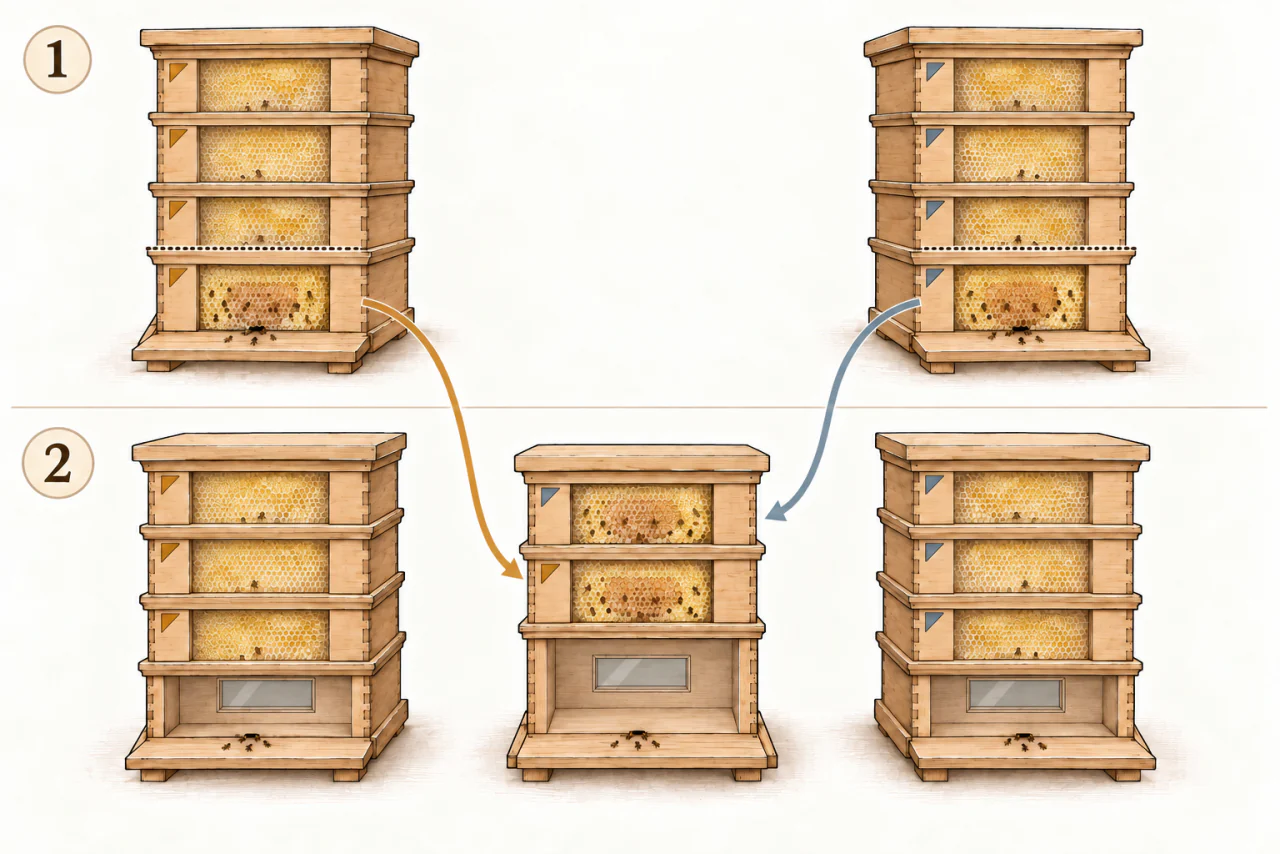
Making a new colony from several colonies, after Christ (K4 §2), at the start of the swarming season with abundant forage: the lowest brood box from each of two colonies forms the new colony. It receives an empty box below, as does each donor to replace the removed box. Colours identify the donors. AI-generated schematic illustration with simplified comb views.
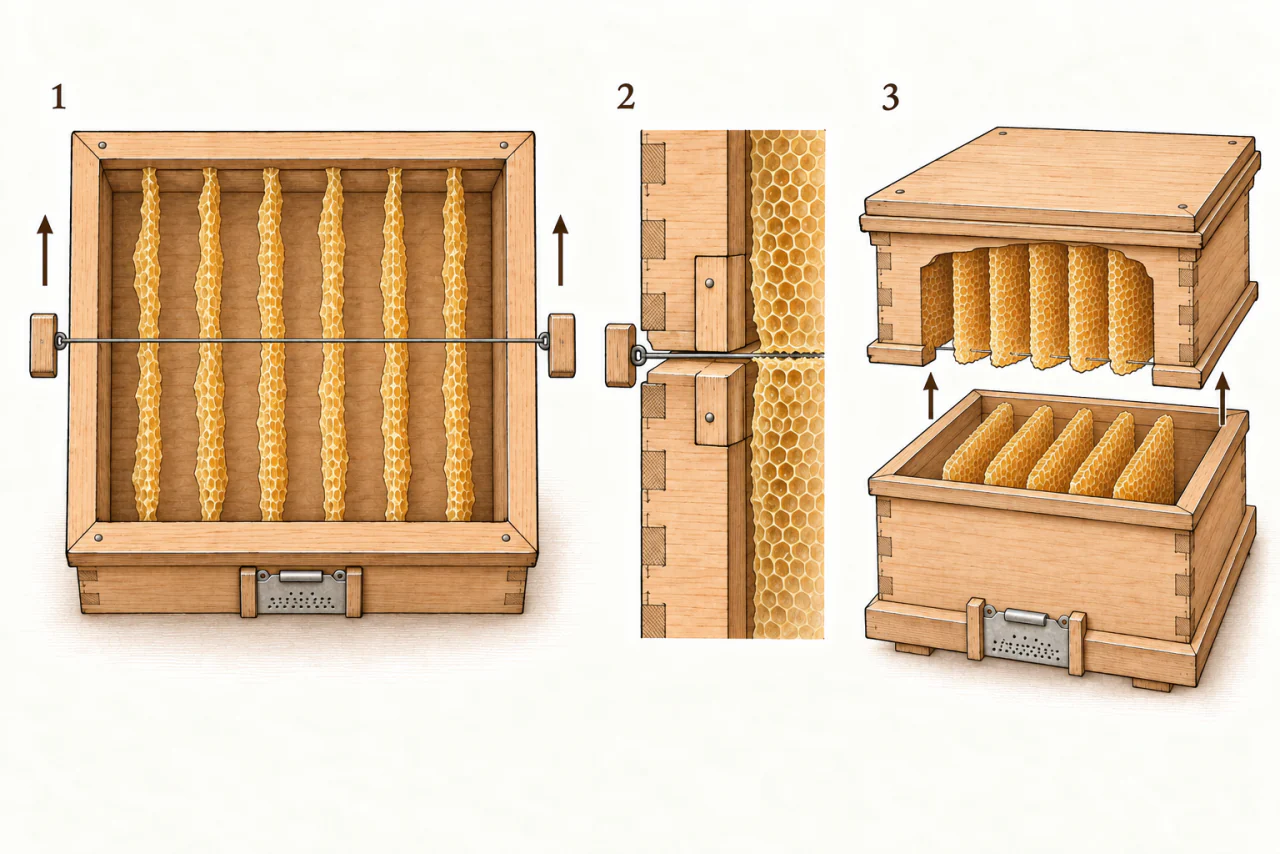
Separating boxes with a wire, after Christ (K6 §6; K7 §3): 1 draw the taut wire from the entrance towards the rear; 2 sever the wax connections at the joint; 3 lift off the whole honey box. The fixed bars are omitted from the comb views. AI-generated schematic illustration.
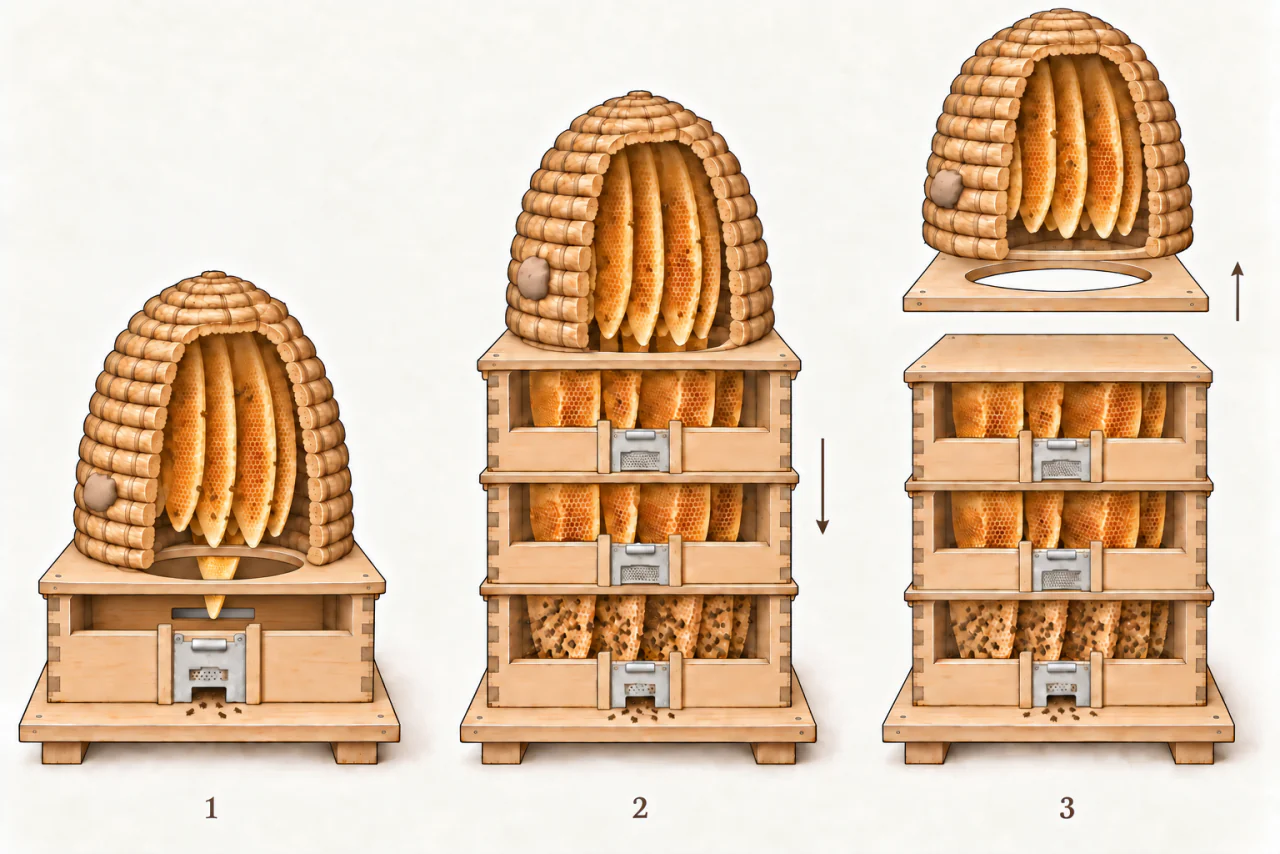
From a straw skep to a magazine hive, after Christ (K3 §10): 1 a lower box with a cut-out adapter board; 2 further construction downwards; 3 remove the skep after its bees have been driven into the built wooden boxes. Sufficient comb and stores must be present. AI-generated schematic illustration.
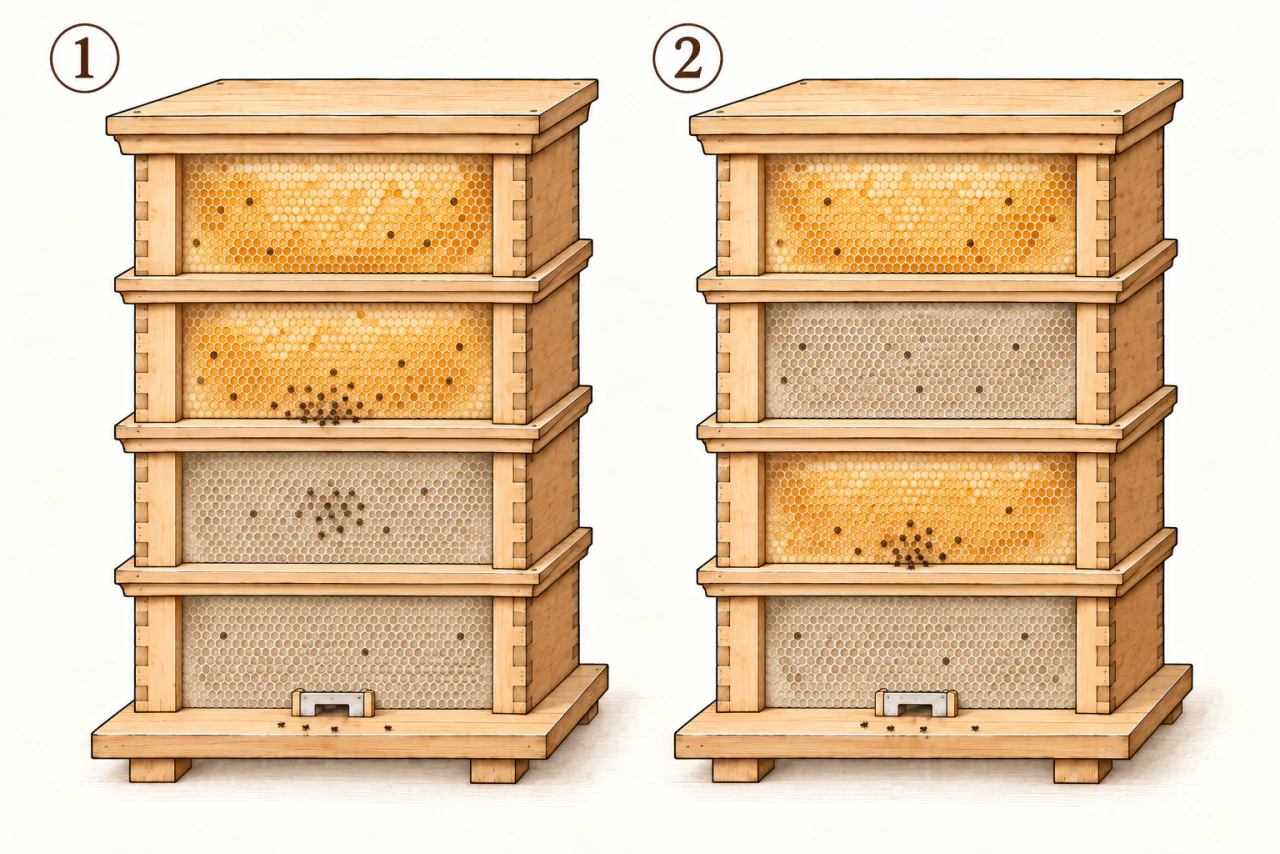
Winter stores after Christ (K3 §10): in 1, the honey boxes are directly above one another at the top. In 2, comb without honey interrupts the route to the upper stores. Christ warns that a colony may starve despite honey remaining above. Box counts are examples. AI-generated schematic illustration.
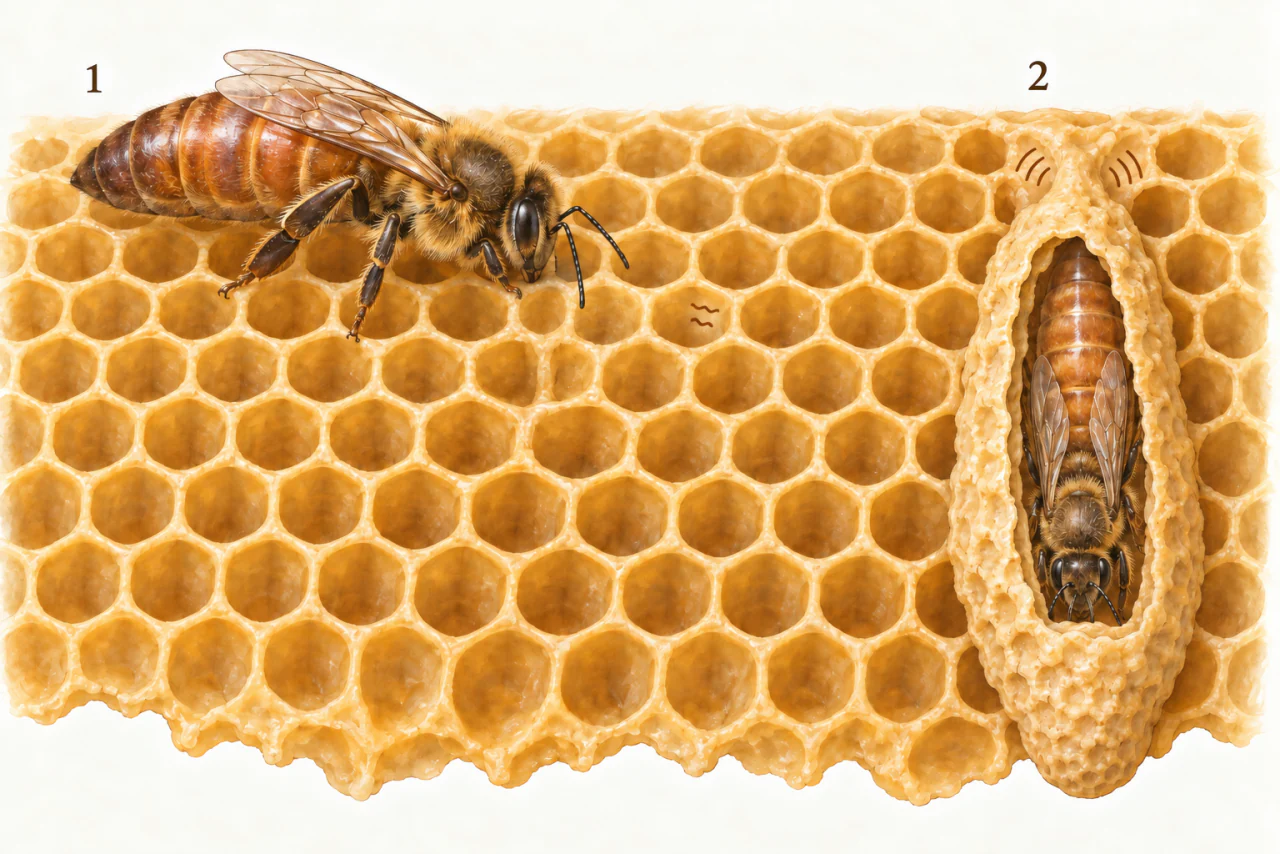
1: Tooting by a free queen in contact with the comb. 2: Quacking by a queen still confined in her cell, shown in cutaway. The sparse vibration marks schematically indicate transmission through the wax (K1 §3; Michelsen et al. 1986). AI-generated schematic illustration.
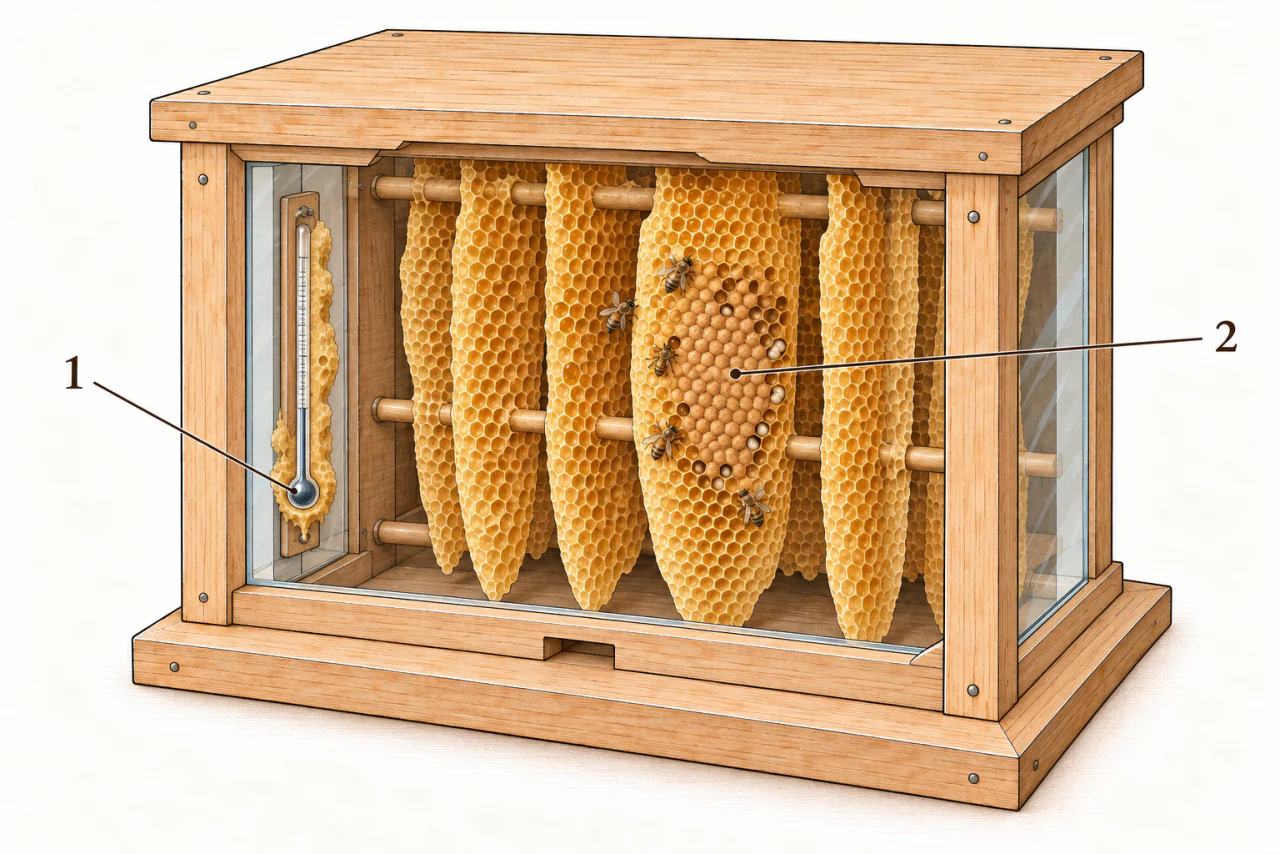
1: Christ’s thermometer on the inside of the observation hive’s north wall. 2: The brood nest as a different measurement location. This simplified cutaway compares locations, not temperatures recorded at the same time (K6 §13; Stabentheiner et al. 2021). AI-generated schematic illustration.
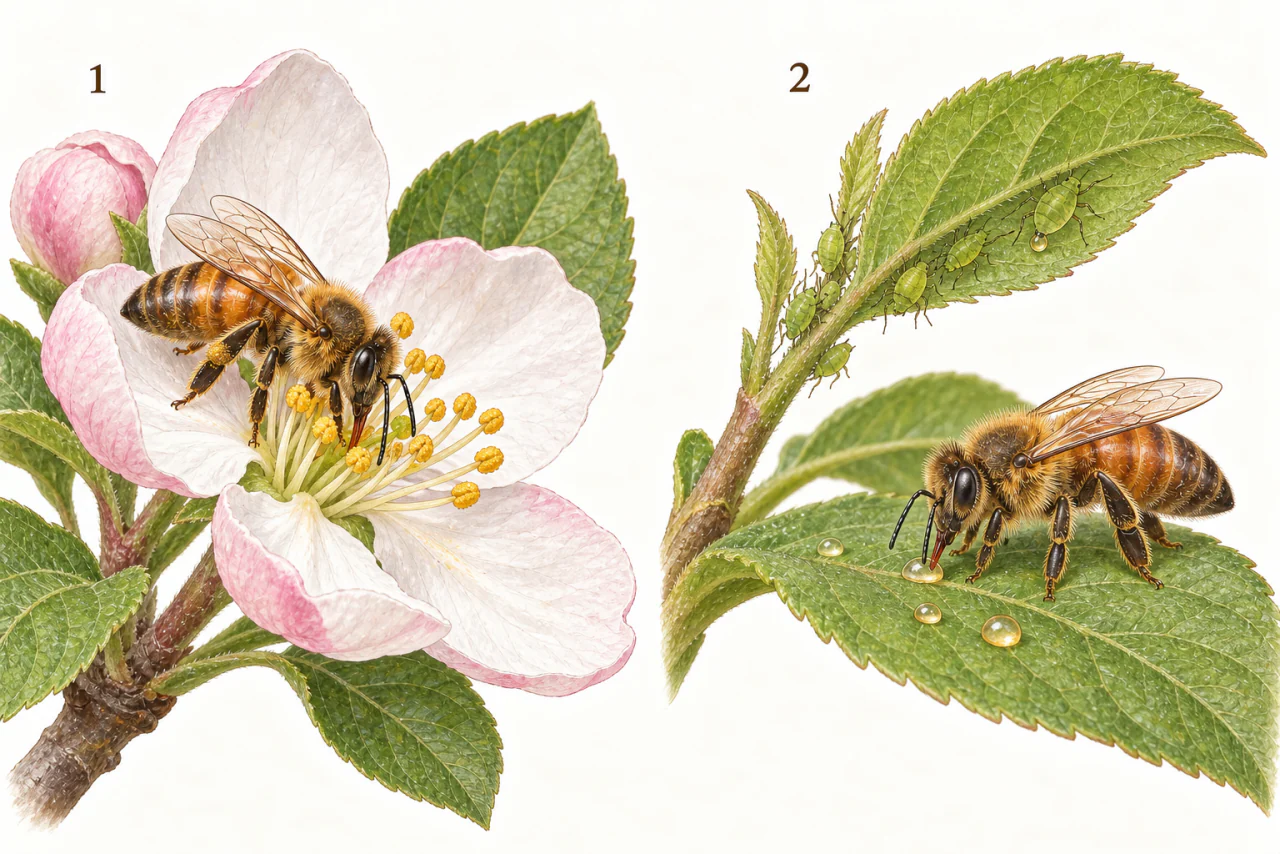
1: A forager collects floral nectar. 2: Aphids excrete honeydew, which a bee gathers from a leaf. Christ already distinguished these two food sources (chapter 6, sections 1 and 4). AI-generated schematic illustration.
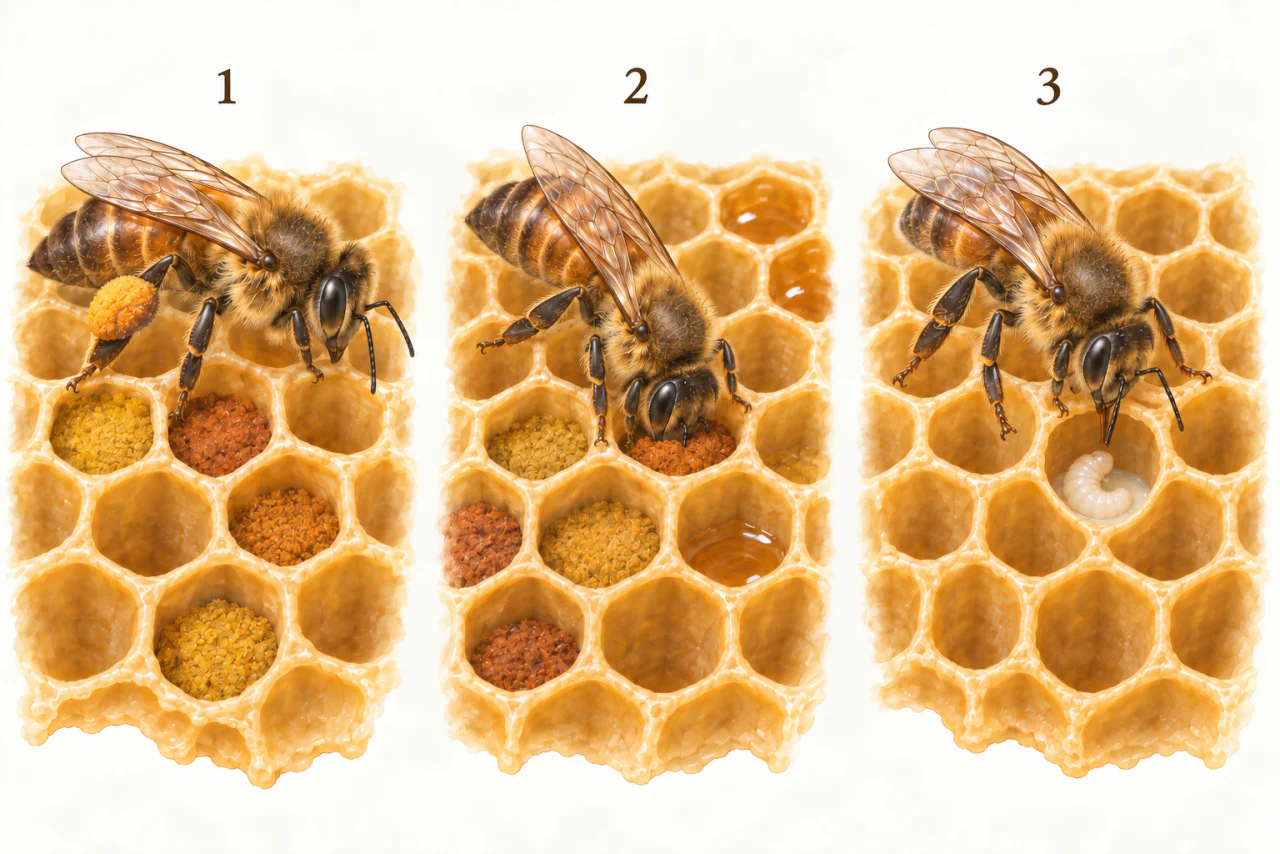
1: A forager brings in pollen. 2: Nurse bees consume the stored pollen, chiefly a source of protein and fat. 3: They provide young larvae with brood food produced by their glands. The three views show division of labour in the colony as understood today (Ohashi et al. 1999; Avni et al. 2014; Wright et al. 2018). AI-generated schematic illustration.
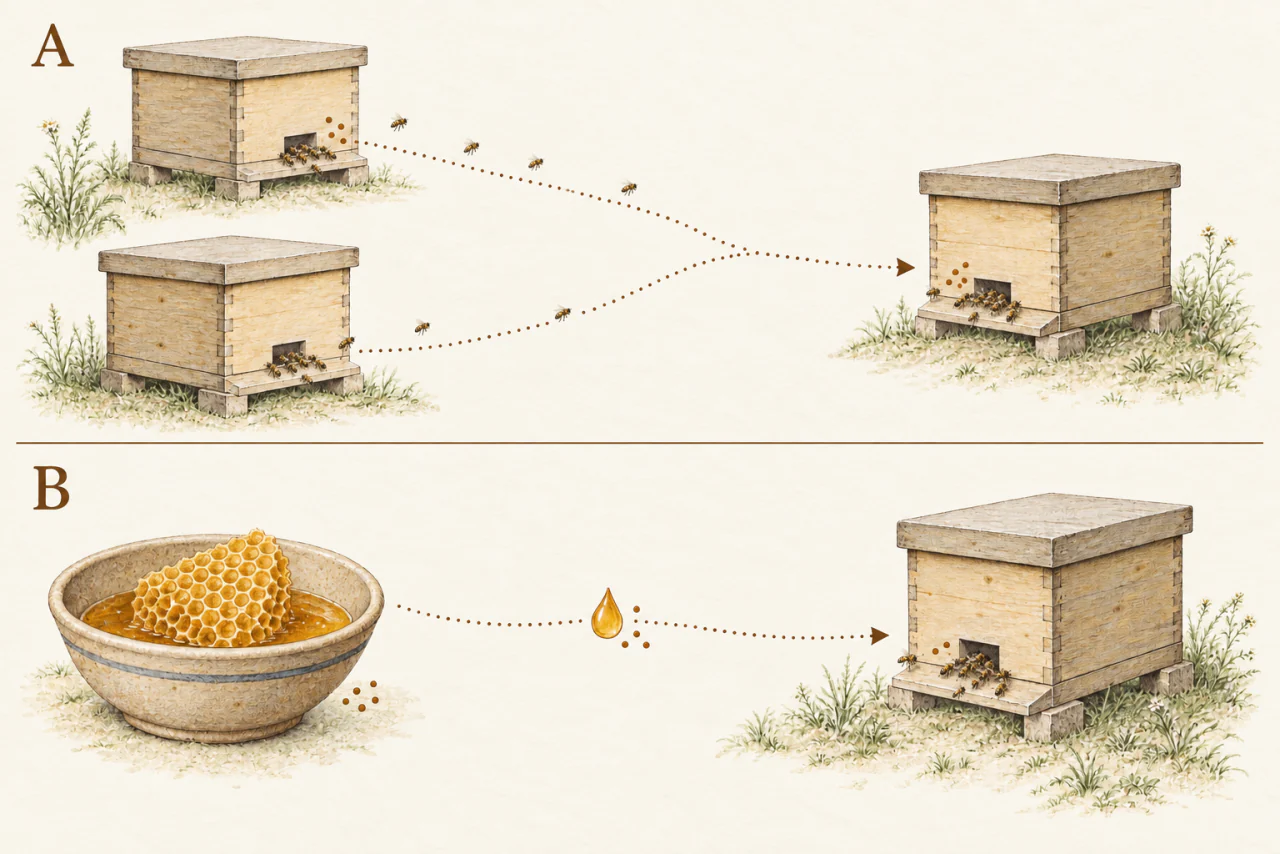
A: Combining colonies. B: Feeding contaminated honey. Both actions can transfer American foulbrood spores, making Christ’s recommendation unsuitable for this disease in the light of present knowledge (K5 §12; USDA ARS; FDA). Small clusters of dots symbolise spores; dotted arrows show possible transmission routes. His description does not allow a firm diagnosis of the brood disease he observed. AI-generated schematic illustration.
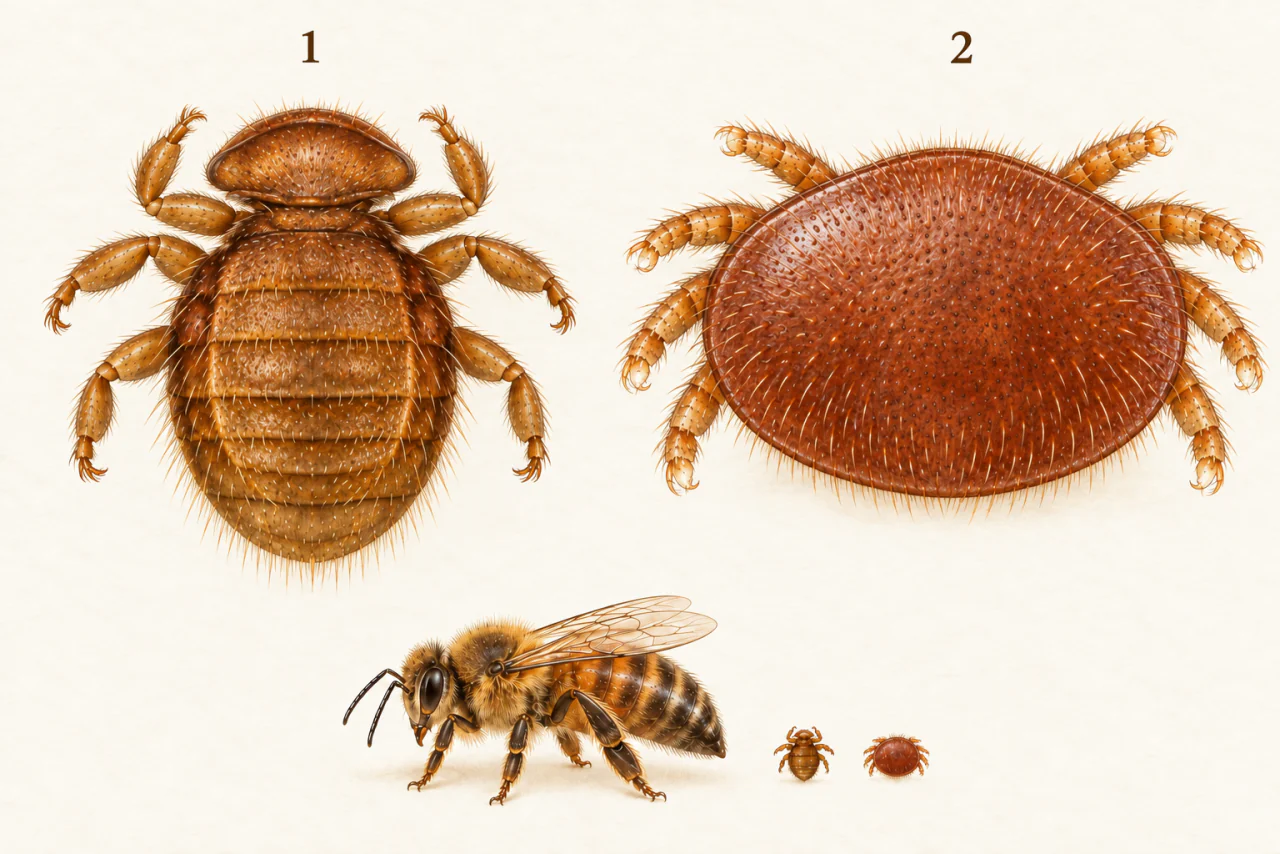
1: Adult bee louse (Braula coeca), a wingless fly with six legs. 2: Female Varroa mite (Varroa destructor), with eight legs and a body wider than it is long. The main views are greatly enlarged; the small group below gives an approximate size comparison with a worker bee. Christ describes the bee louse in K5 §14. Varroa is not described in his book and appears here as a modern comparison. AI-generated schematic illustration.
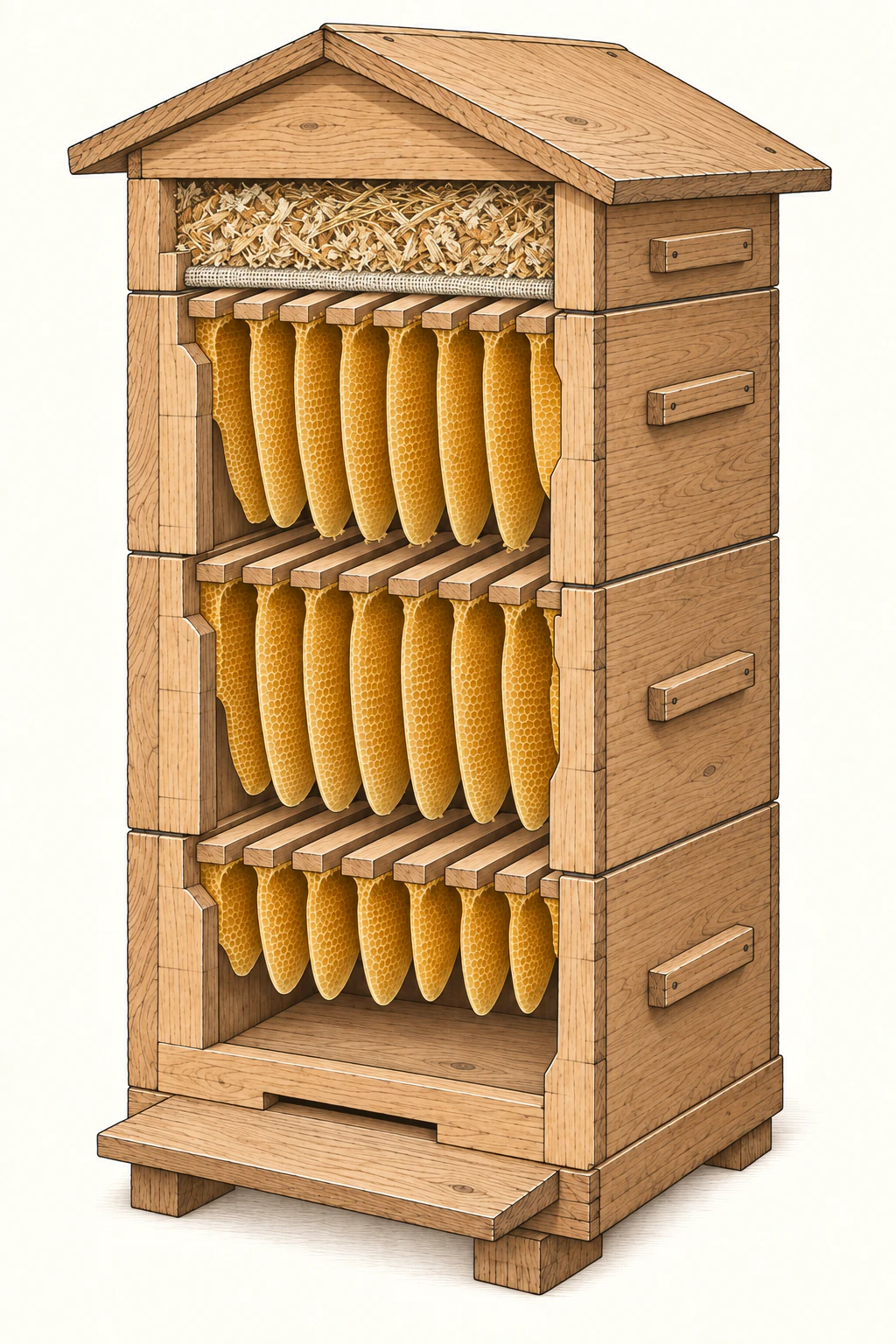
A Warré fixed-comb hive with three boxes and a quilt box. AI-generated schematic illustration.
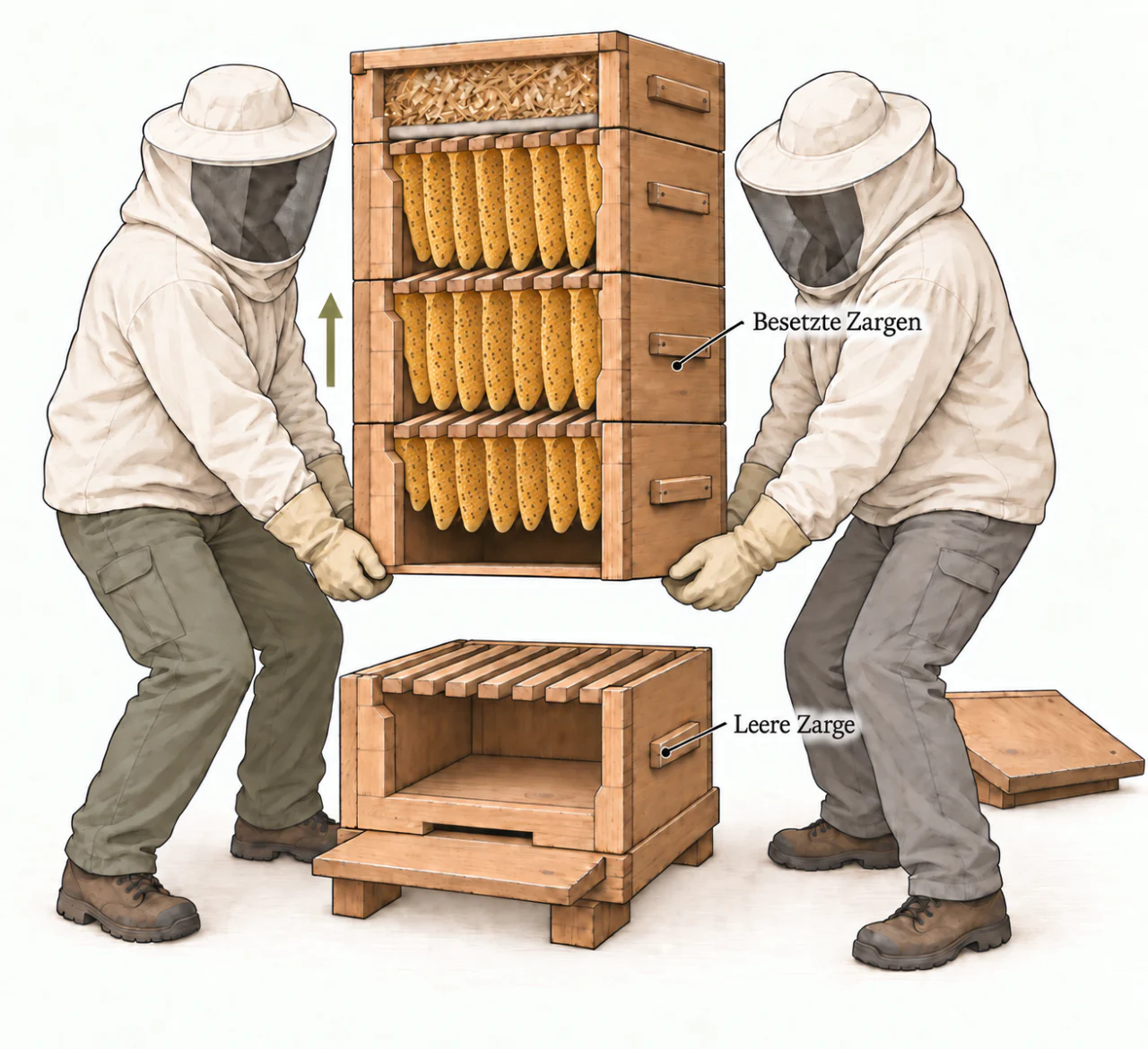
Two beekeepers lift the occupied boxes (“Besetzte Zargen”) to add an empty box (“Leere Zarge”) underneath. AI-generated schematic illustration.
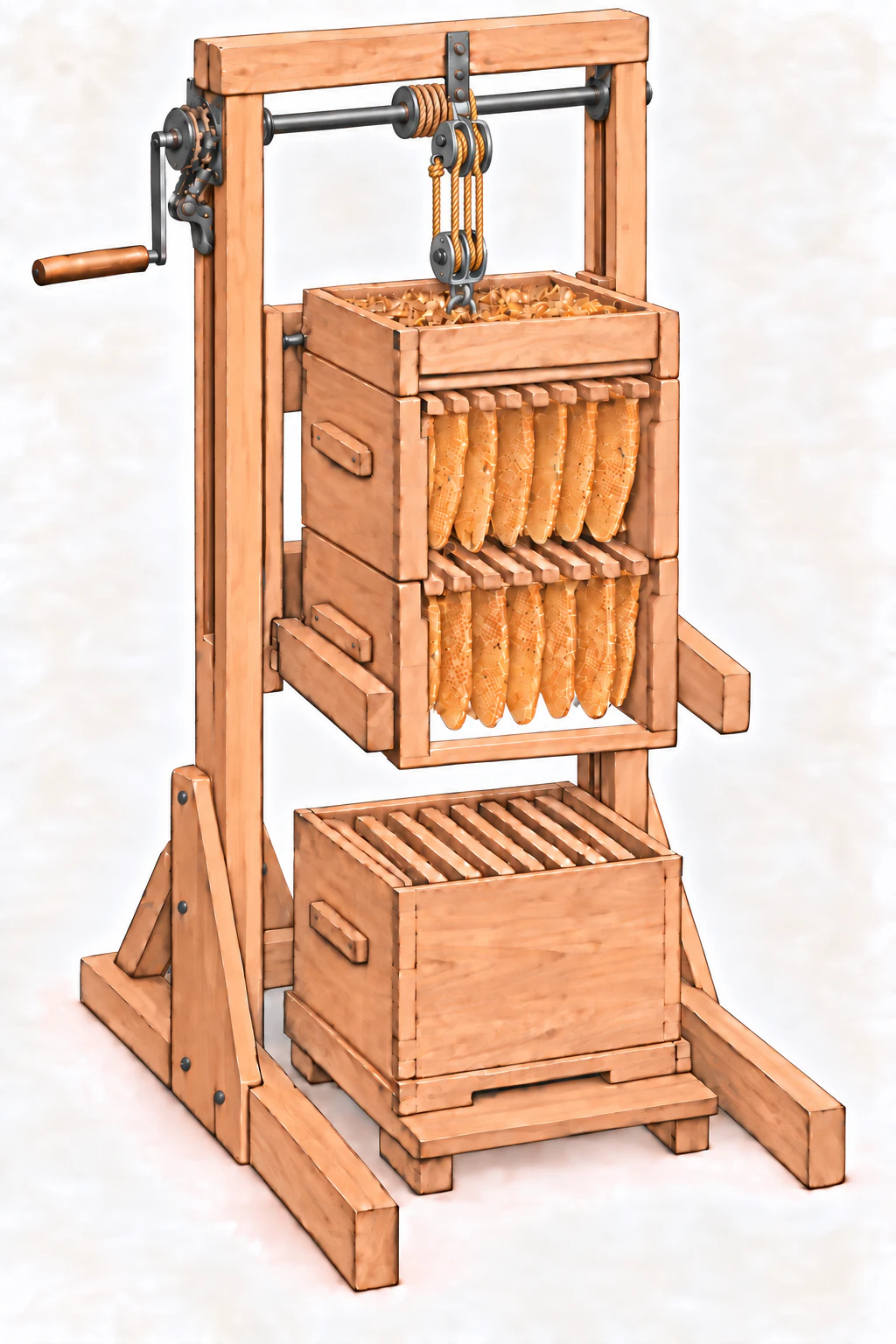
Hive lift based on the Gatineau design, used to add a box beneath a Warré hive. AI-generated schematic illustration.
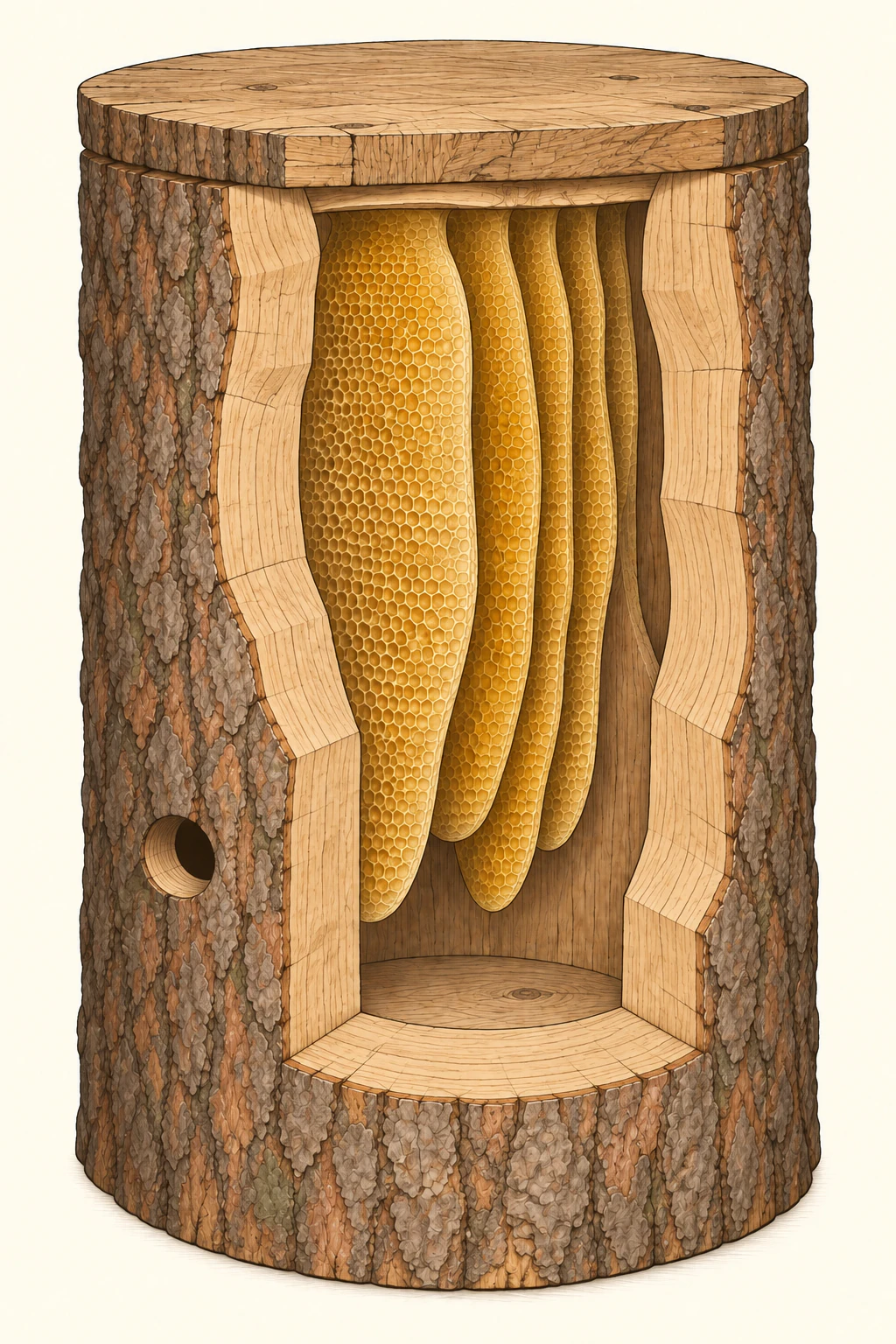
An upright log hive in section. AI-generated schematic illustration.
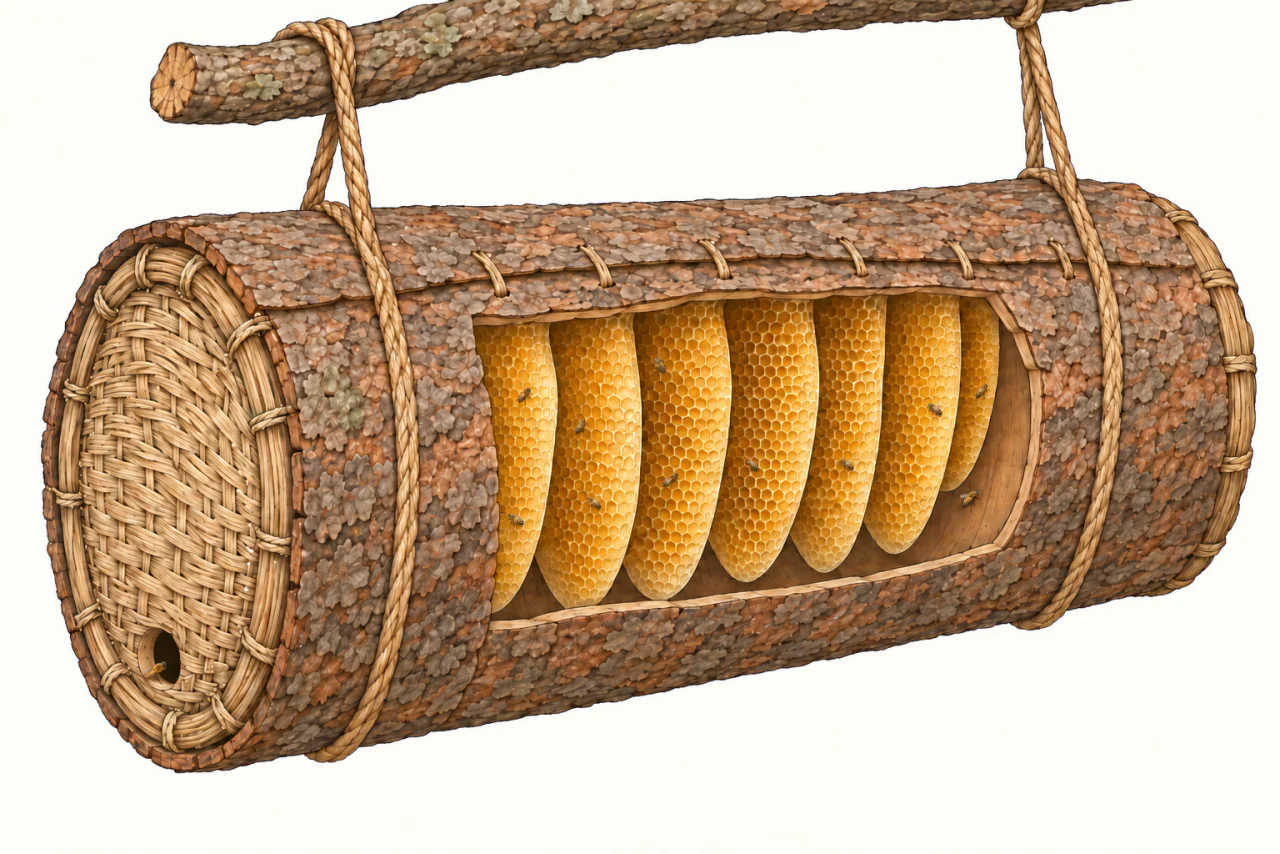
Suspended bark hive with a woven end closure and fixed natural comb. AI-generated schematic illustration.
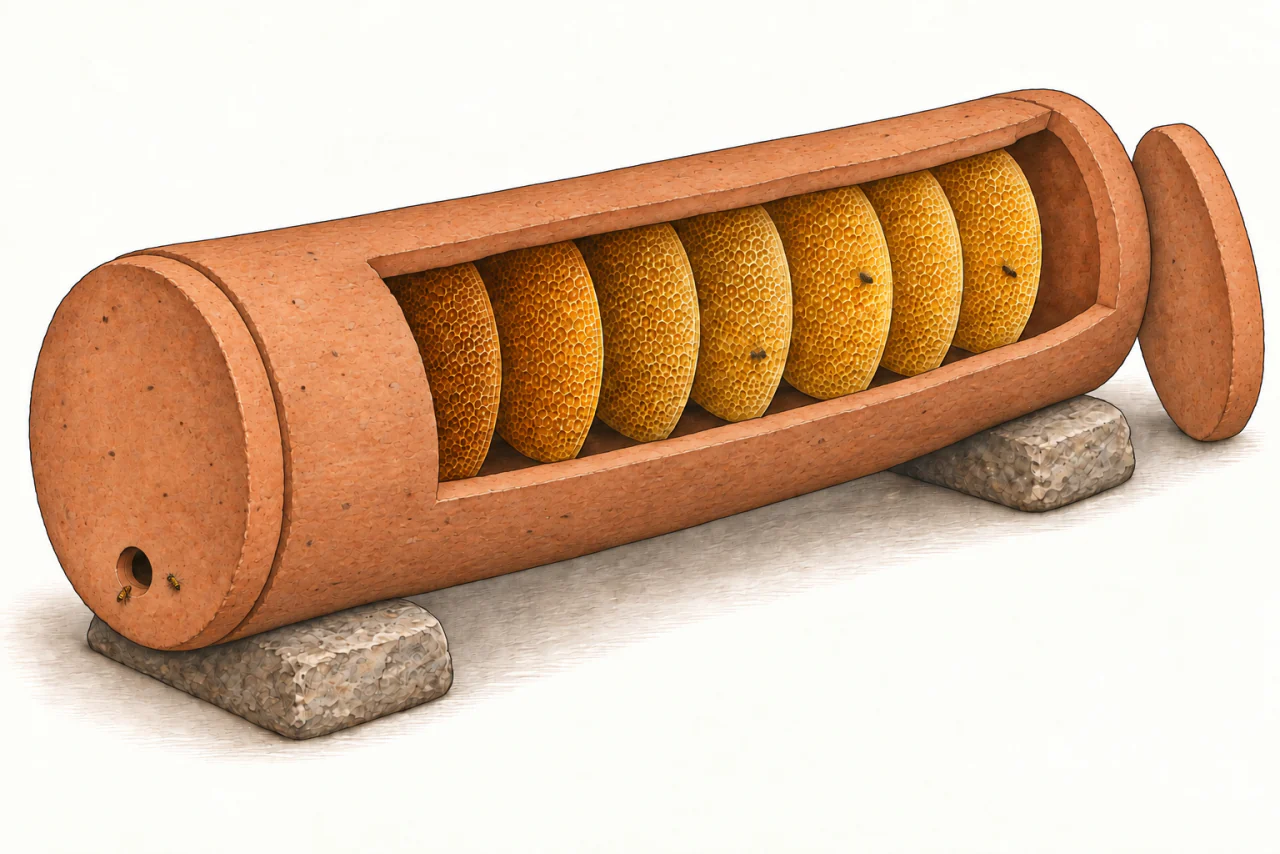
Horizontal clay-tube hive with transverse natural combs and a removable end cap. AI-generated schematic illustration.
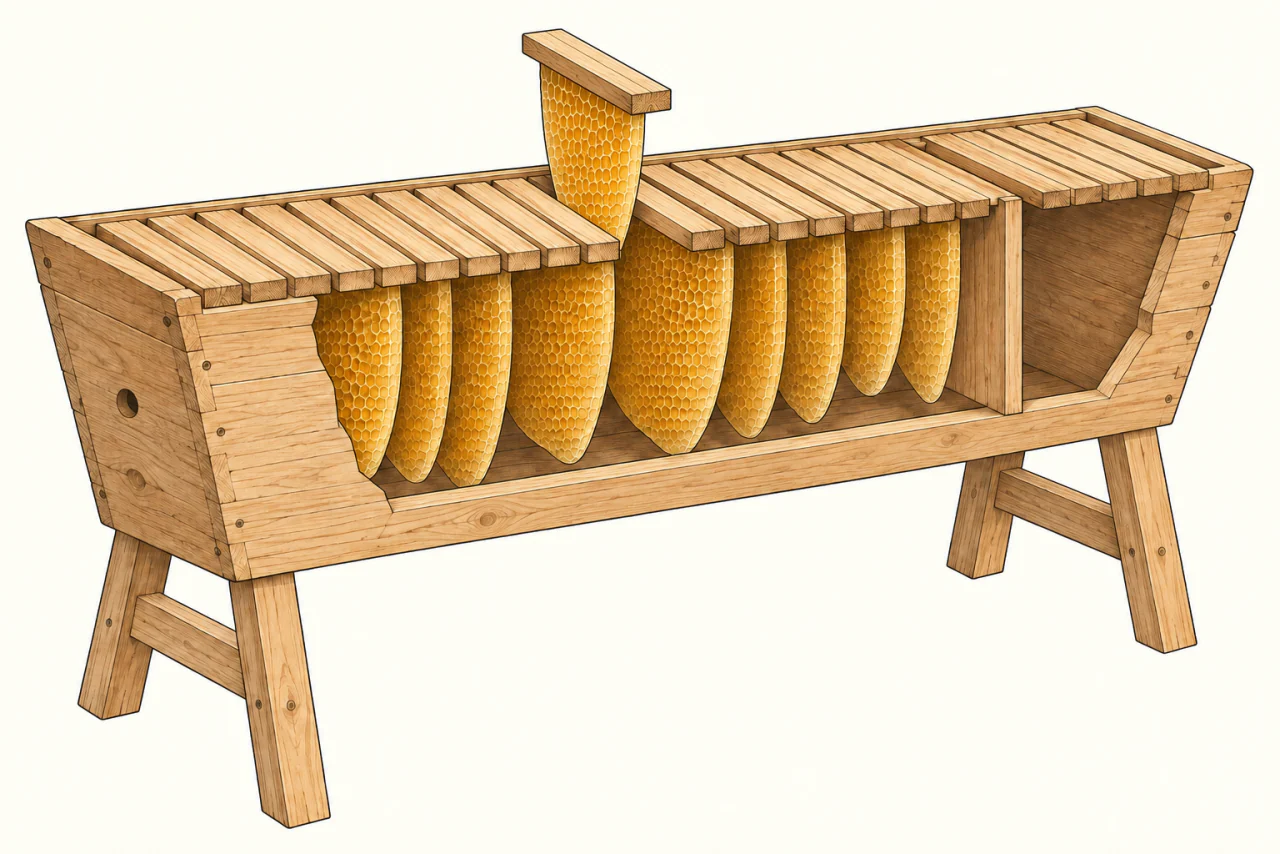
A horizontal top-bar hive with a removable comb on its top bar. AI-generated schematic illustration.
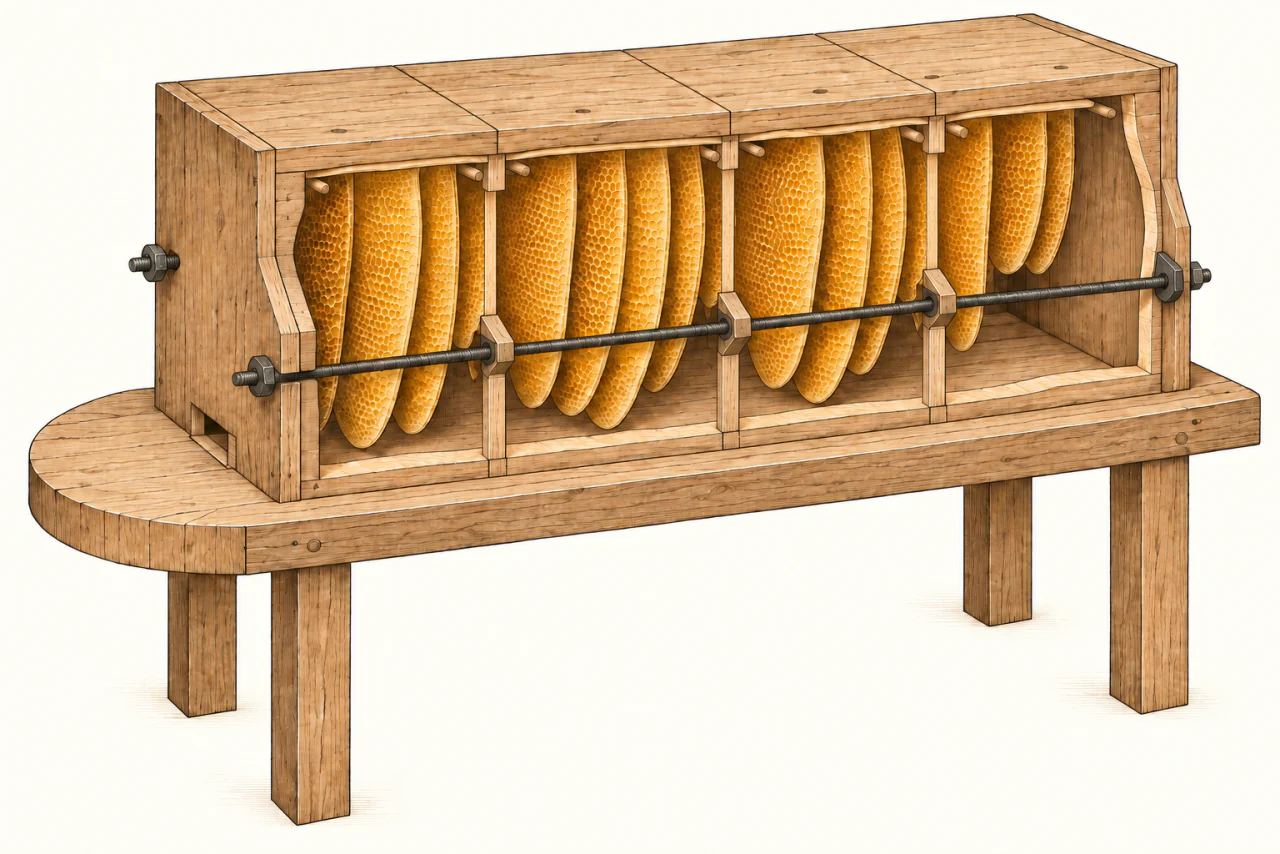
A hive extended sideways, after Vicat’s design. AI-generated schematic illustration.
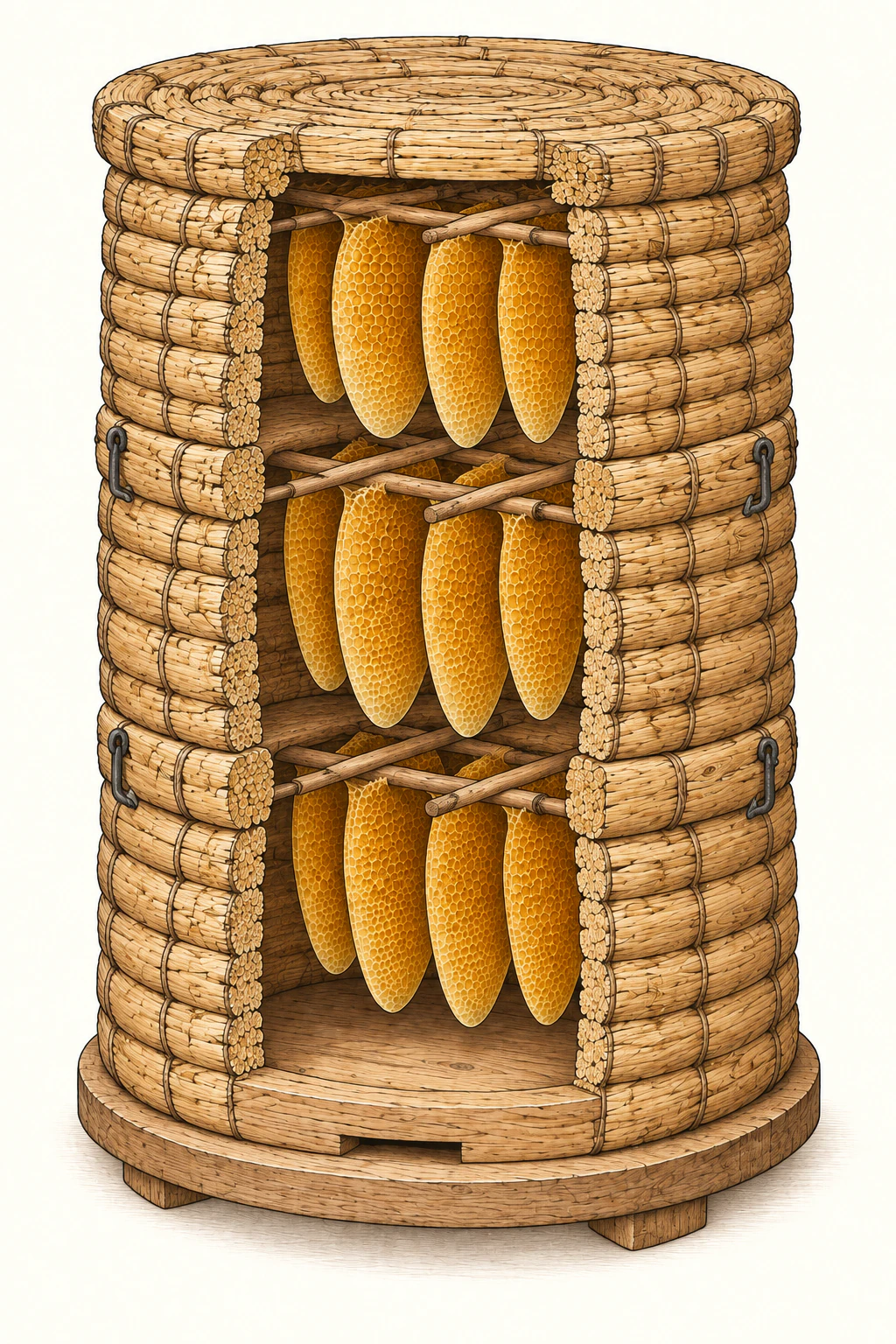
Cutaway of a ring skep made of three straw rings. AI-generated schematic illustration after Fleischer (1777).
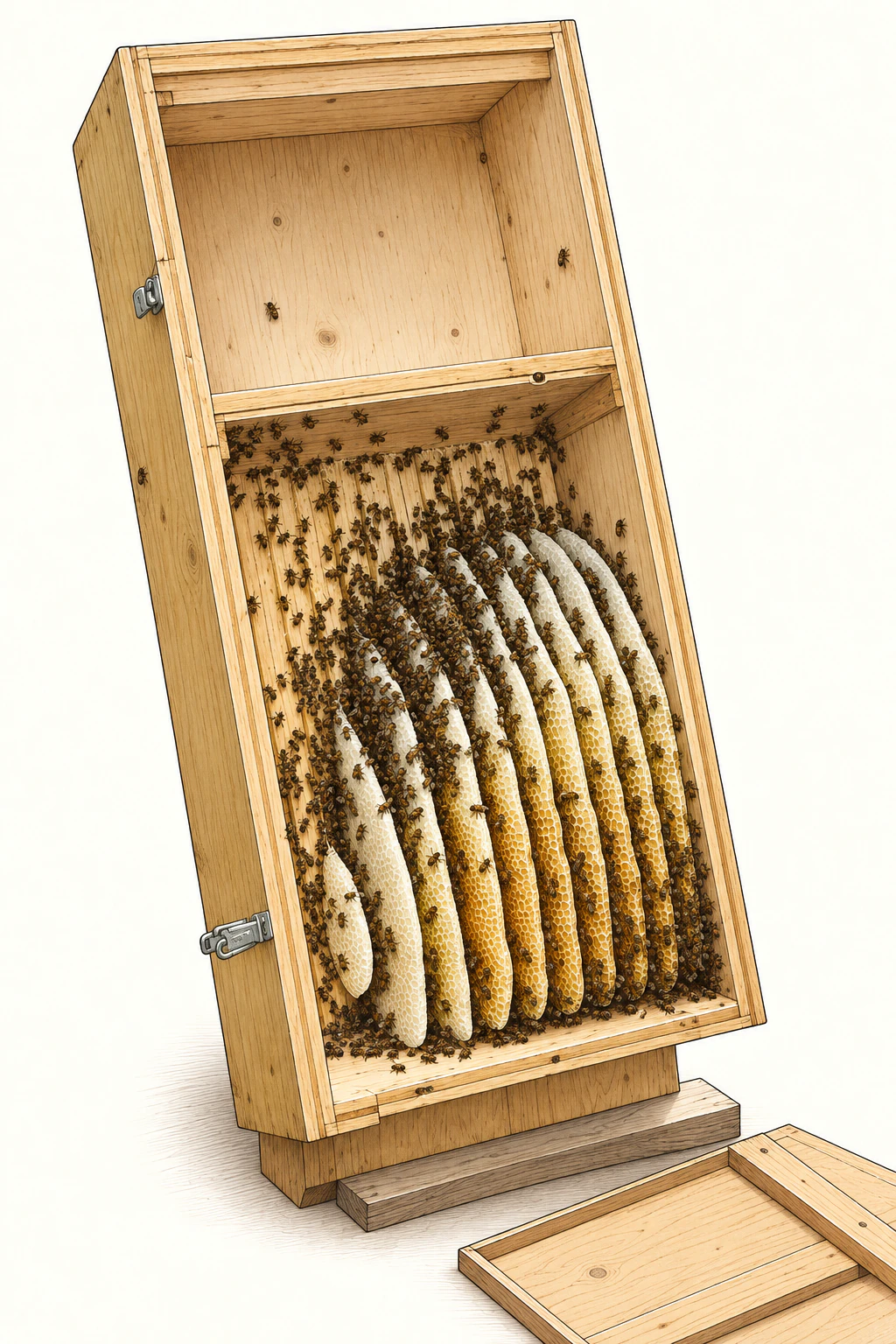
Bienenkiste raised for inspection with its floor removed. AI-generated schematic illustration.
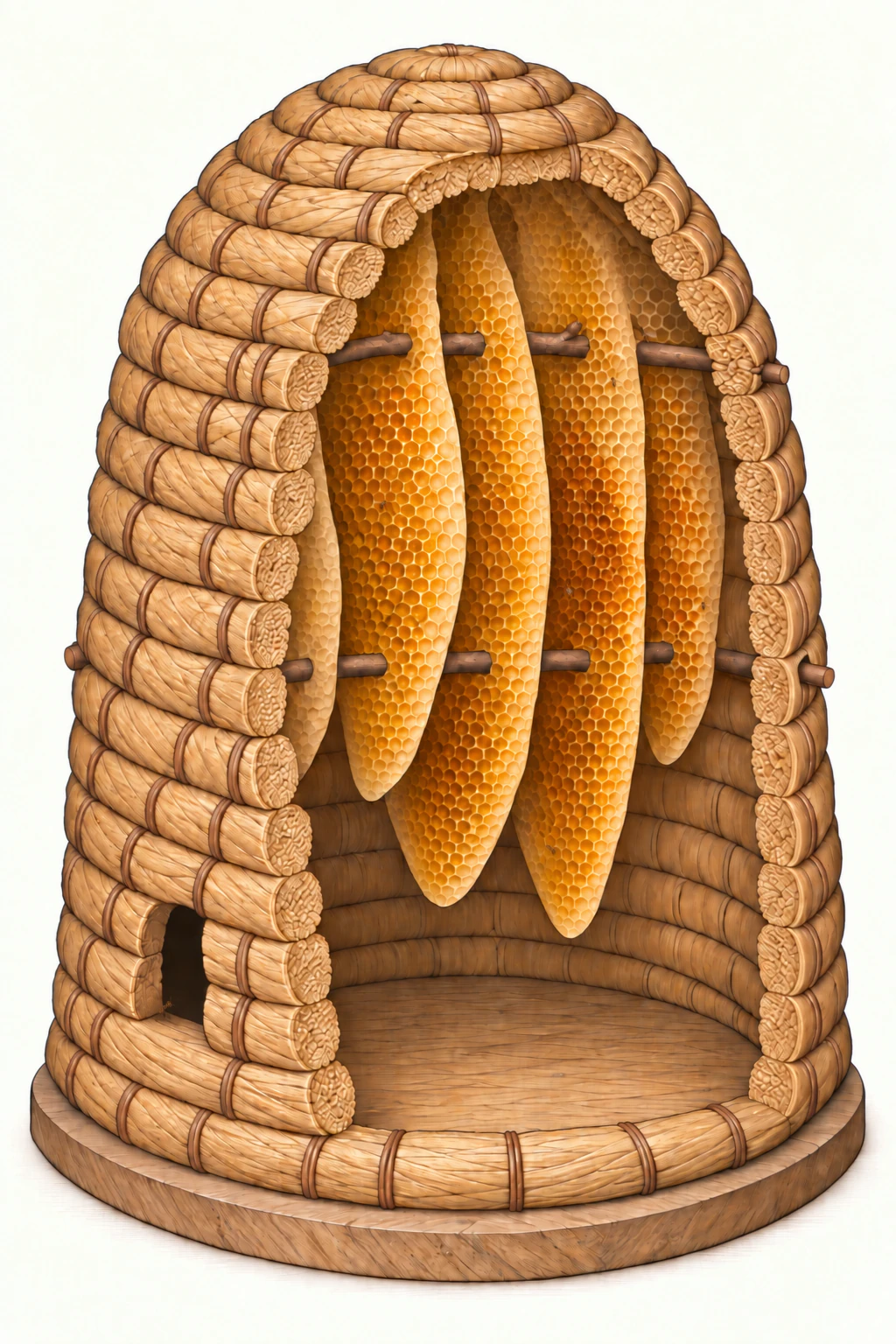
Cutaway of a one-piece straw skep with fixed support sticks and natural comb. AI-generated schematic illustration.
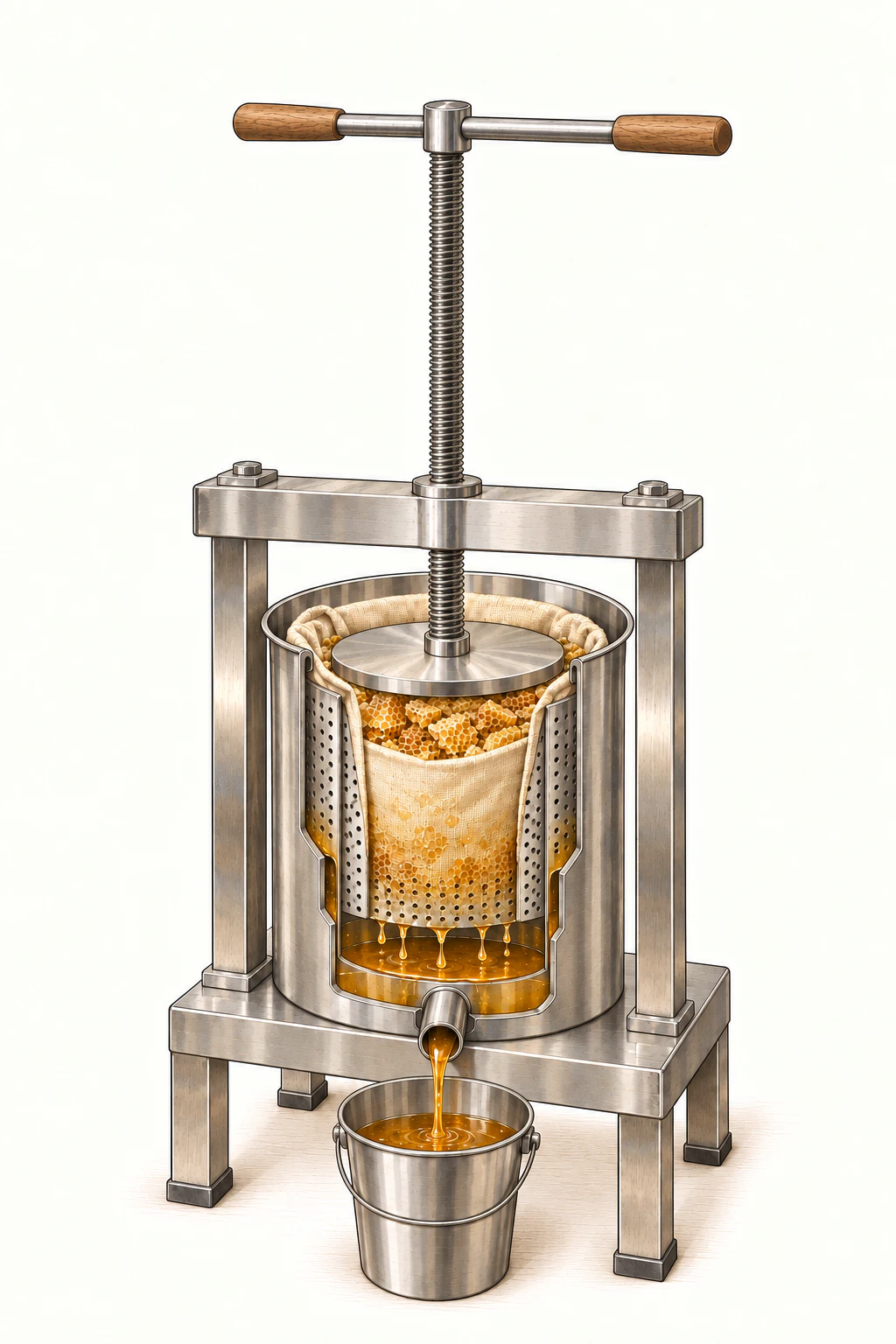
Cutaway of a honey press with a screw, straining bag and perforated basket. AI-generated schematic illustration.
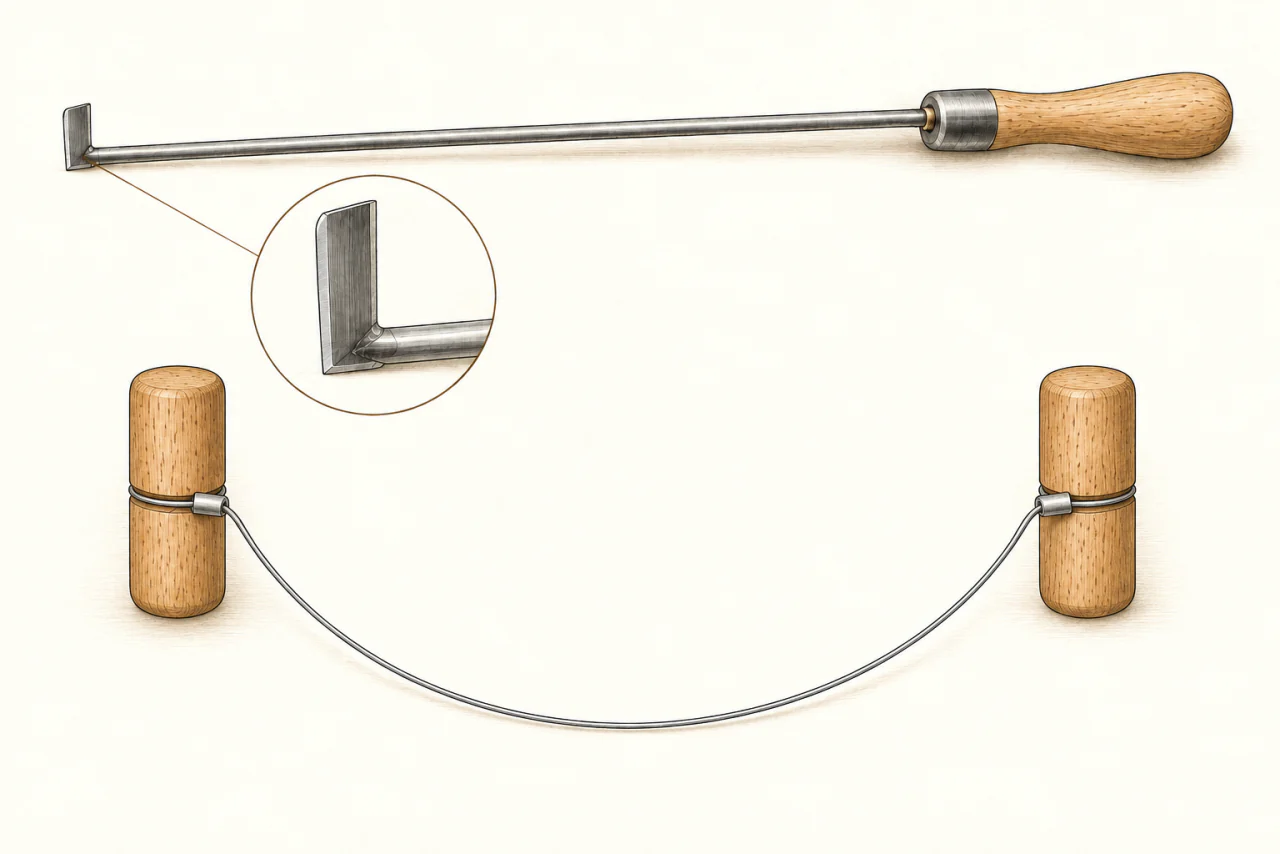
Hooked knife for freeing attached comb and a separating wire for parting occupied hive boxes. AI-generated schematic illustration.
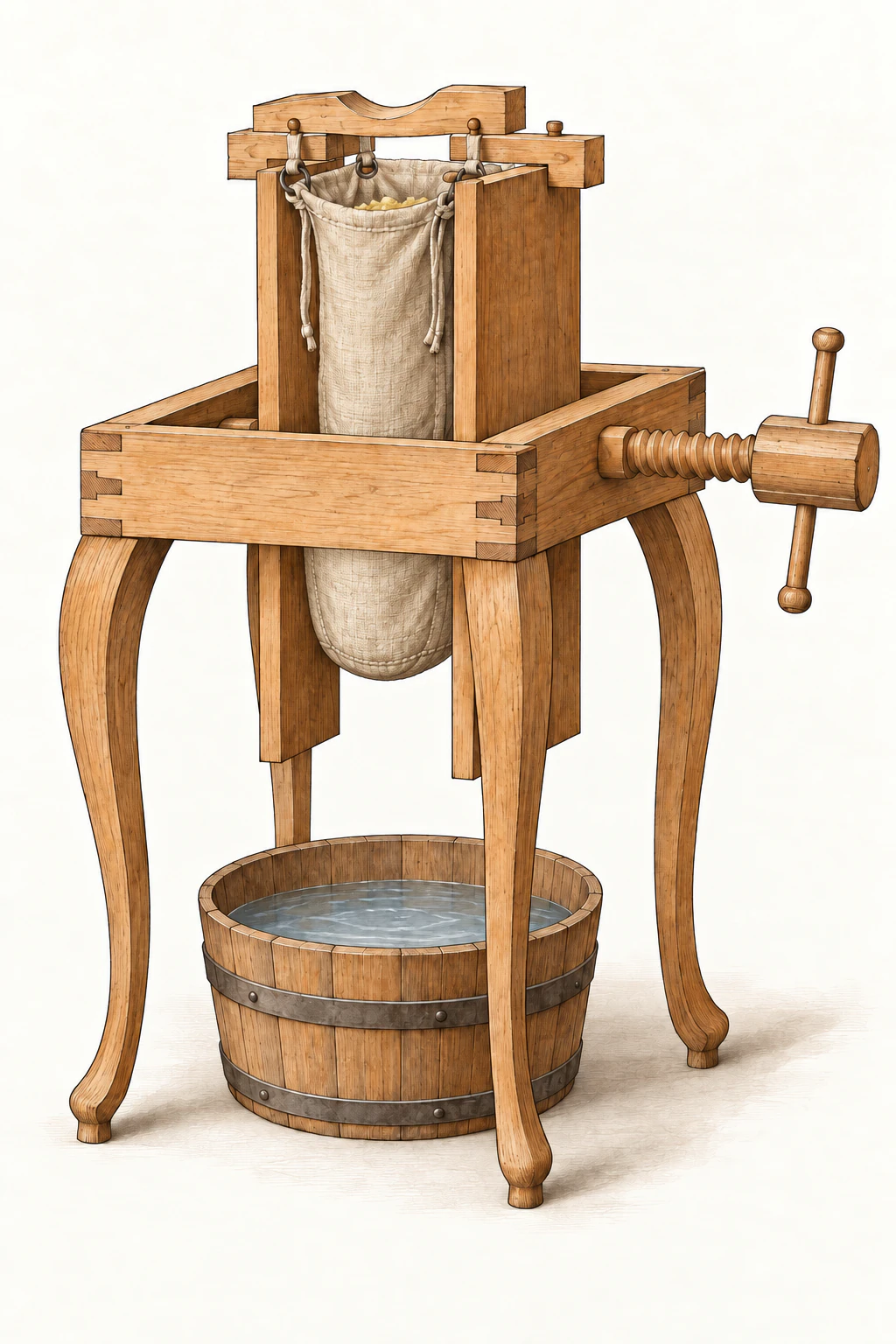
Christ's hanging wax press in its filling configuration: a hemp sack hangs between two pressing boards, with a tub of water below. After Christ (1798), plate V, figure 1 and chapter 6, section 12. AI-generated schematic illustration.
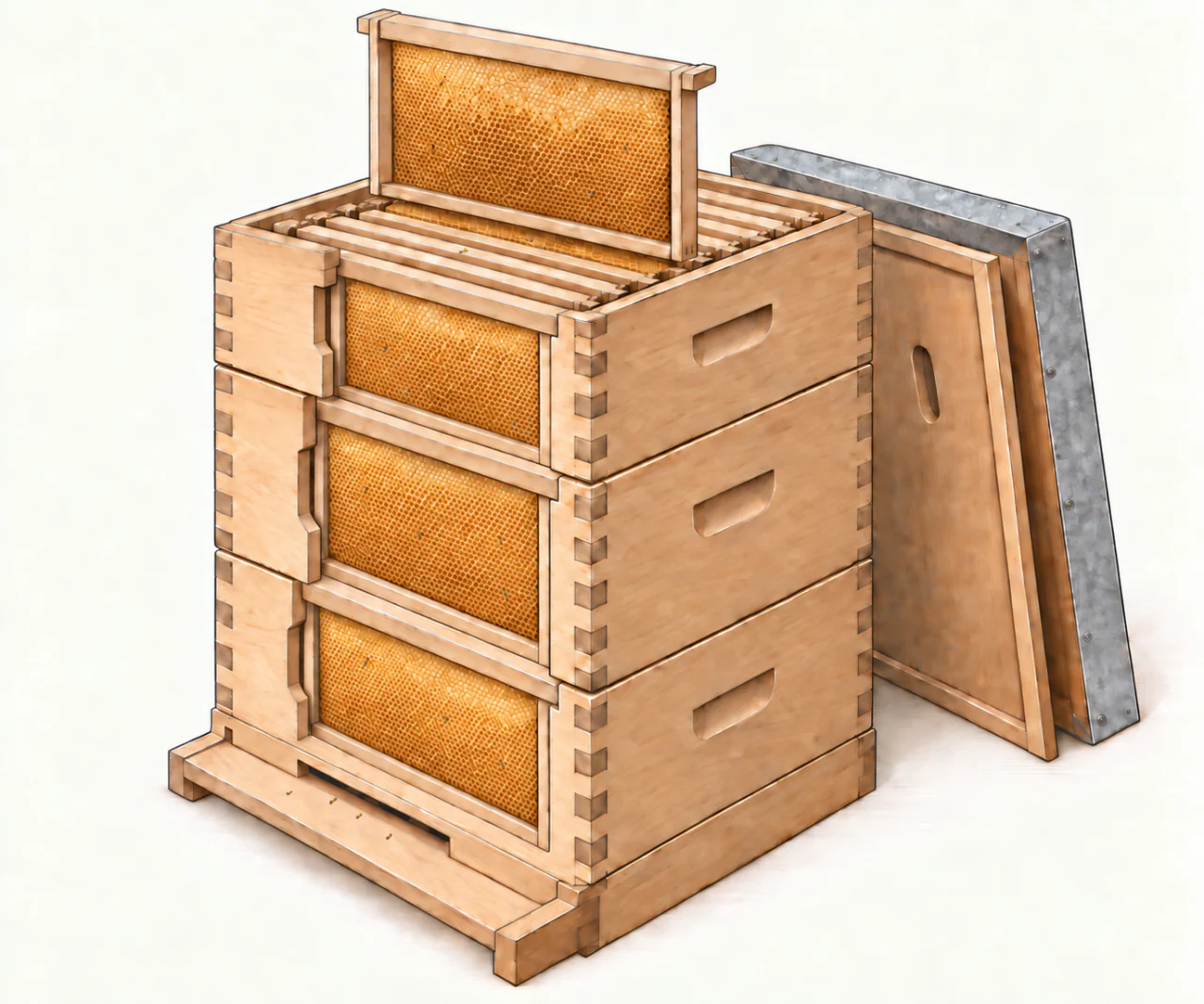
Langstroth hive with individually removable frames, shown for comparison with fixed-comb hives. AI-generated schematic illustration.