His hive, colony management through the year and his account of bee biology.
The first two parts explain how Christ’s hive is built and how he manages his colonies through the year, from stocking the hive to preparing it for winter. They describe his methods and the reasons he gives for them. The third part compares his observations and explanations of bee biology with later research findings. Sources for these comparisons accompany the statements they address.
References lead to the corresponding passages in the book: (K3 §4), for example, denotes the fourth paragraph of the third chapter. Clicking a reference opens the passage beside the text or takes the reader to the reading edition. Historical units are retained. As a rough guide, one Zoll is two and a half centimetres, one Schuh is twelve Zoll, one Maß is just under two litres and one Pfund is about half a kilogram. Prices and costs are given in Kreuzer and Gulden.
Christ’s hive
The construction, materials and fittings of the hive as described by Christ.
The basic principle
Shallow wooden boxes stacked above one another form a hive whose size can be adjusted.
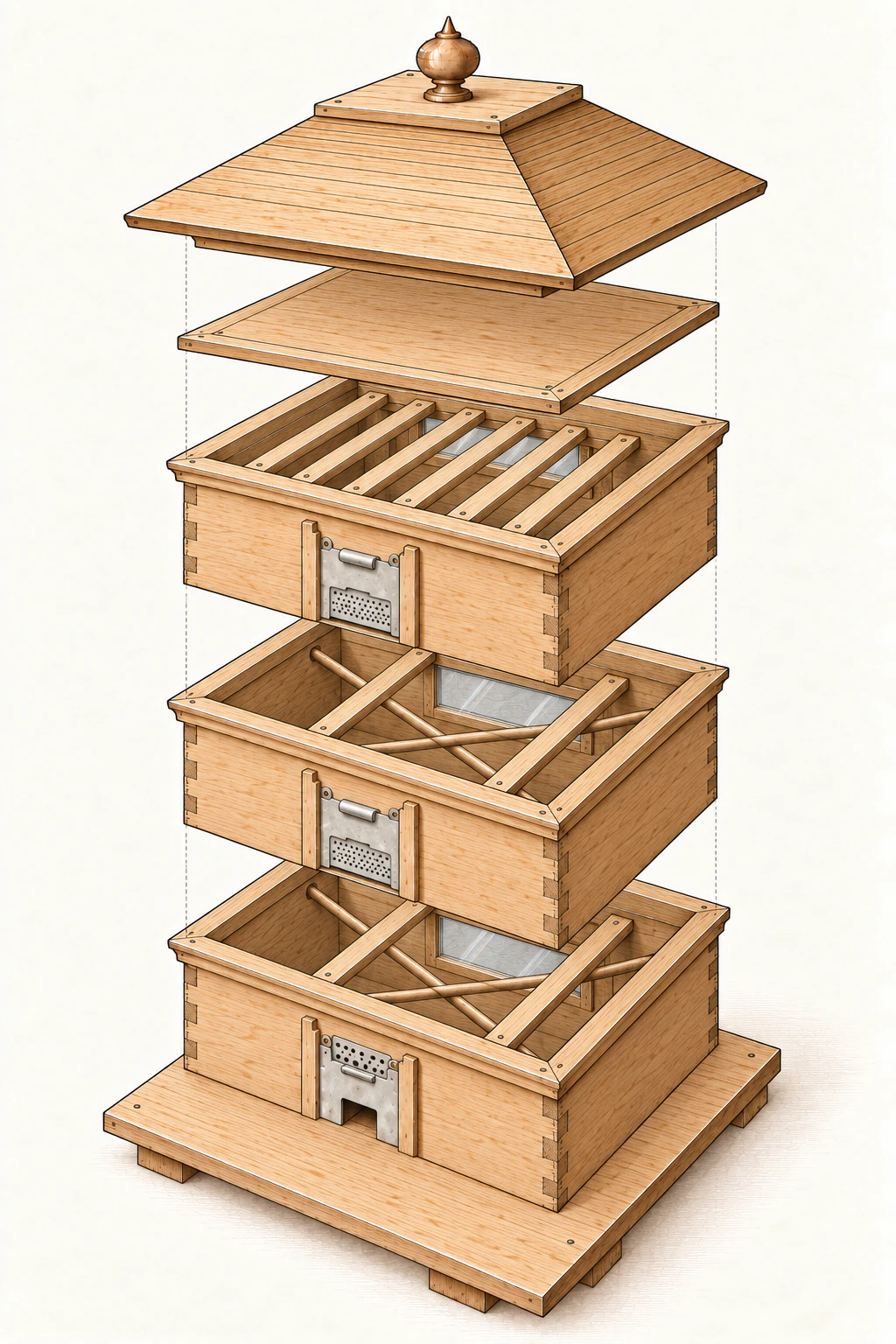
Exploded view of Christ’s hive, illustrated with three sections. The top section has six fixed bars; each lower section has two bars and crossed sticks. Observation windows are set into the rear walls. AI-generated schematic illustration after plate II and chapter 3.
Christ’s hive consists of matching wooden boxes, which he calls Aufsätze. They form a continuous interior that the beekeeper can enlarge by adding boxes or reduce by removing them. Christ values these hives, “in which the bees have their household in joined supers that are increased or reduced from time to time as circumstances, the season and one's intentions require”(K3 §3).
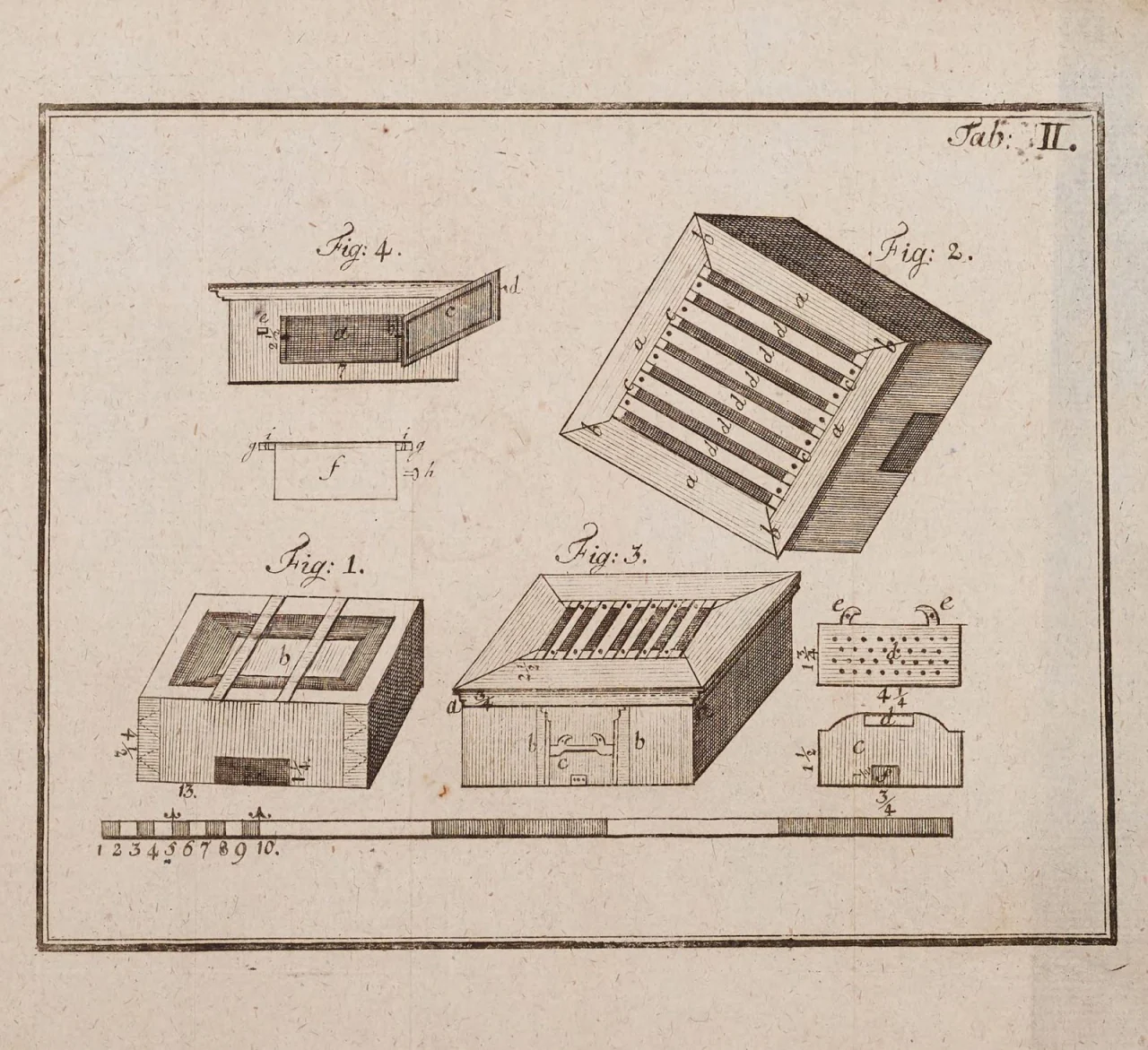
Hives made of stacked straw sections were already known. Christ uses planed boards for his version and fits each box with a glass pane (K3 §3). He criticises the lack of visibility in straw hives: from outside, he says, it is impossible to tell when the colony needs more room. He also reports that bees are crushed when the sections are lifted, that the rings sit unsteadily on one another and that wax moths eat their way in between them (K3 §3). His wooden boxes have a square base measuring thirteen Zoll on each side, are four and a half Zoll high and hold four Maß (K3 §4, Vorrede).
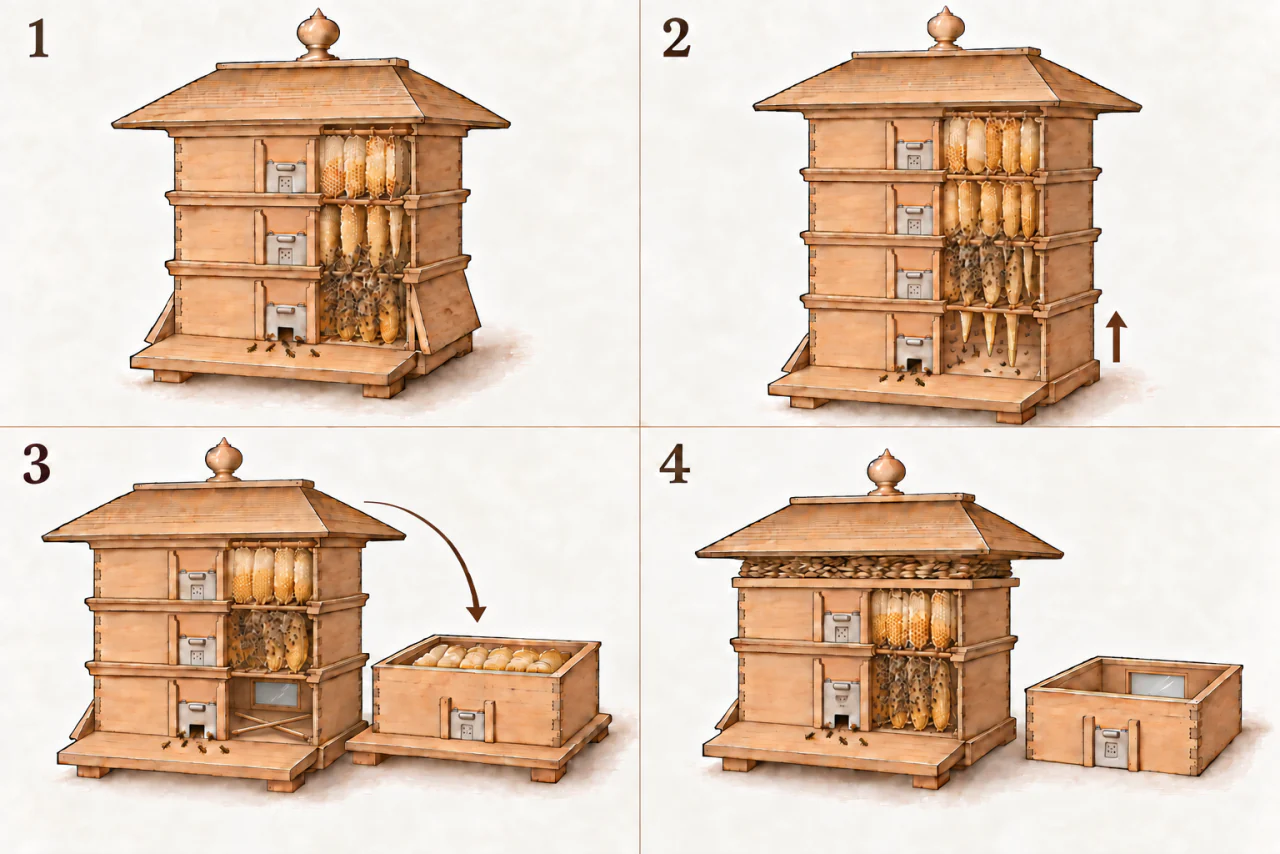
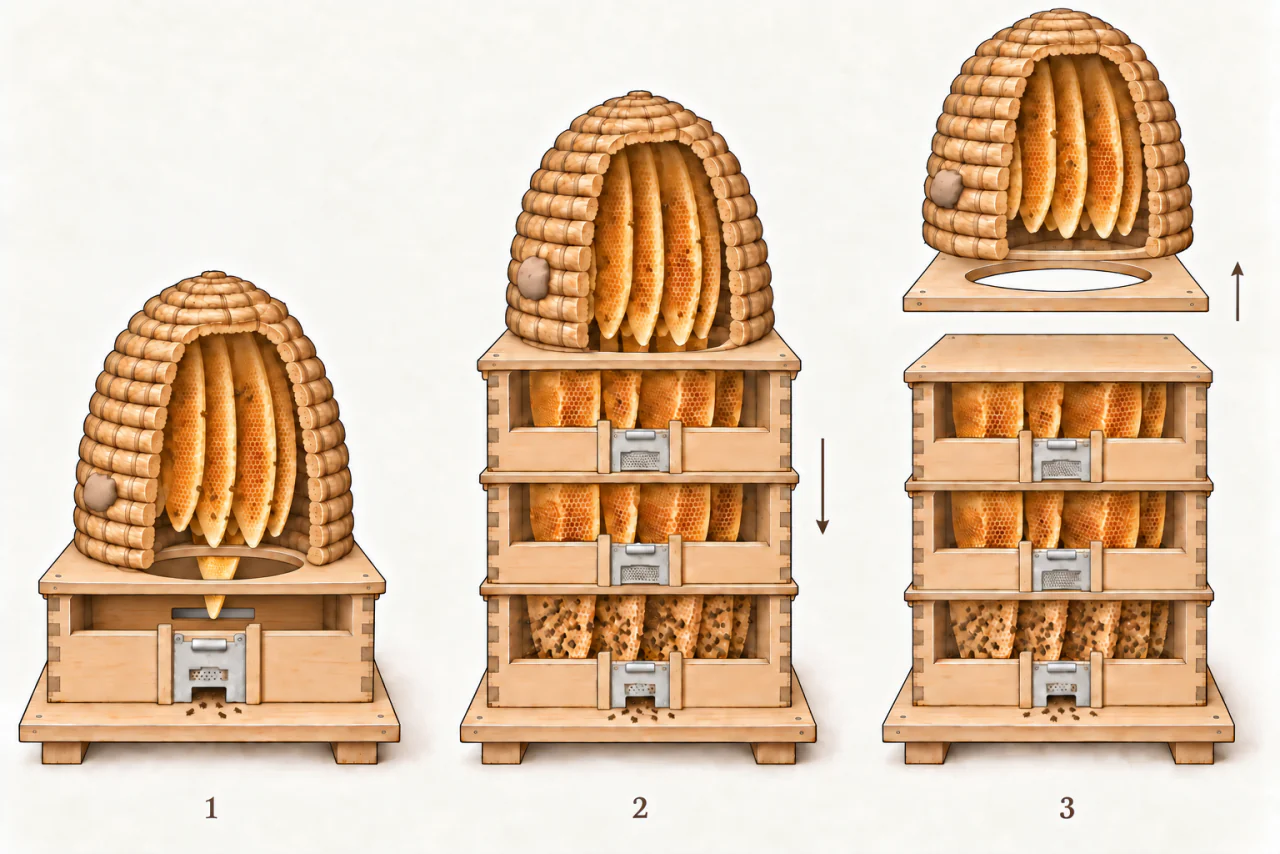
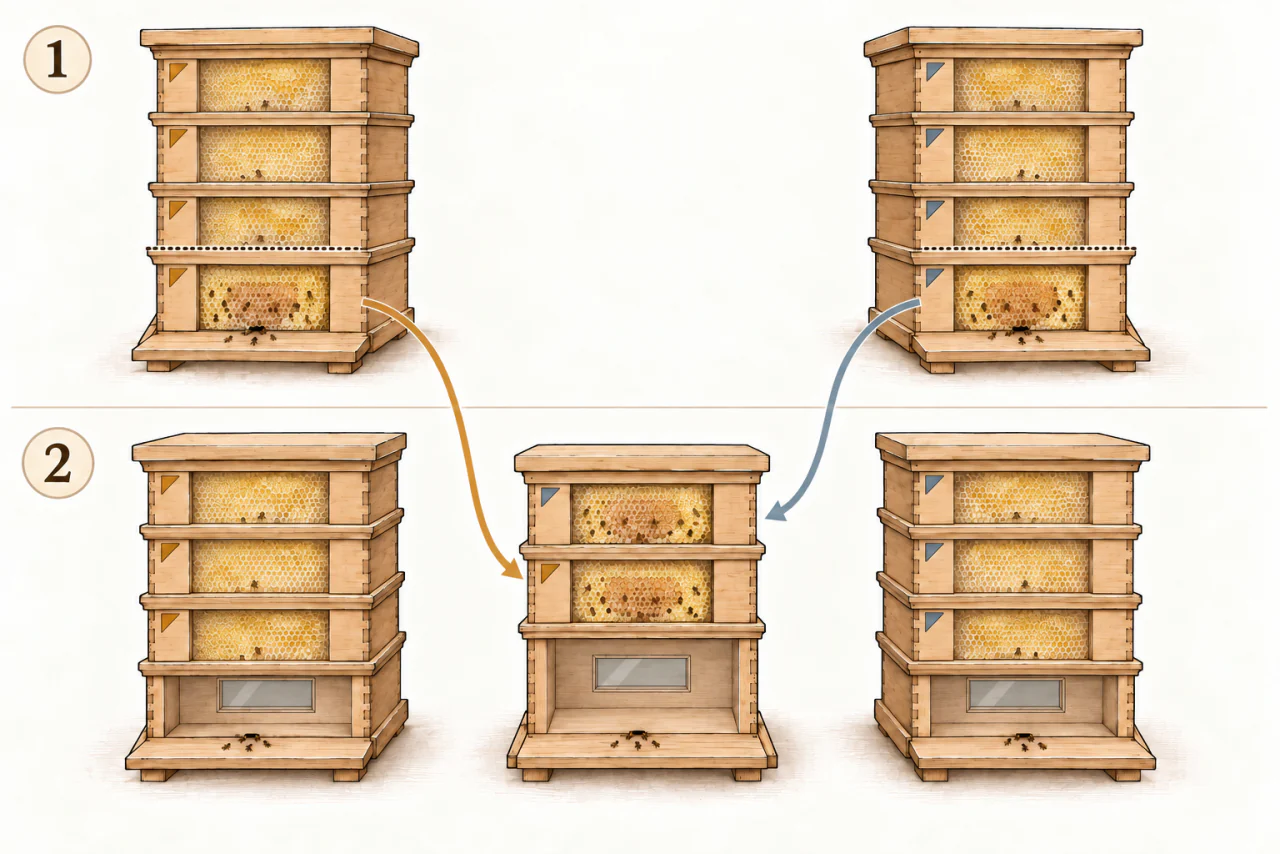
To enlarge the hive, Christ places an empty box beneath the occupied ones. He bases this on his observation that bees extend their comb downwards and are reluctant to occupy space added above (K4 §26). Honey accumulates in the upper boxes, which he separates with a wire and lifts off at harvest (K6 §6). The colony survives the harvest; continued comb building below is intended to renew its comb progressively. For this reason, Christ does not consider even a colony that has existed for twenty-five years to be too old (K3 §6).
Christ favours strong colonies: “A single really populous hive is worth more and brings in more than four weak hives.”(K3 §1) By enlarging the hive, he aims to allow the colony to grow while preventing swarming. He calculates the cost of a wooden box with paint and glass at fifteen Kreuzer, compared with twelve for a woven straw section (K3 §4). He claims the invention as his own, saying that he read about the similar boxes of Palteau and Madame Vicat only years later (Vorrede).
Christ’s hive through the year: 1 occupied hive; 2 space added below; 3 honey removed above; 4 unused lower space removed where needed and winter covering fitted. Box counts are examples and do not indicate the winter stores required. After K2 §6, K3 §§4 and 9, K4 §26 and K6 §§5–7. AI-generated schematic illustration.
The individual box
Dimensions, materials, entrance, comb supports and joints between boxes.
The magazine super: thirteen inches square, four and a half high
For each box, Christ takes a thin double board or a stout single board, planes both faces smooth and cuts it lengthways. Half the board’s width determines the height of the box: four and a half Zoll. The sides are cut to thirteen Zoll and dovetailed at the corners. He also describes a simpler joint made with lath nails. For this version, the side pieces are shortened by the thickness of the board so that the outside dimensions remain thirteen Zoll square (K3 §4).
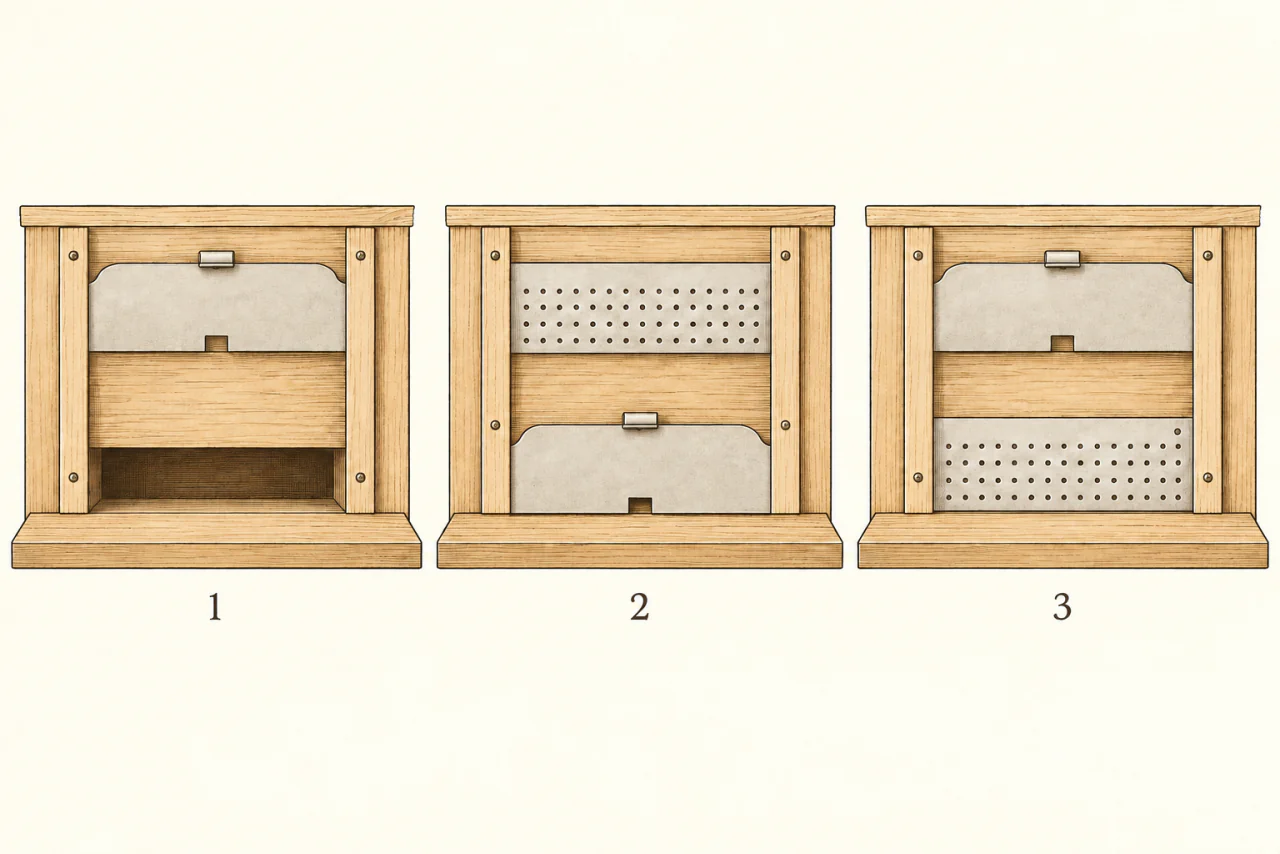
The entrance in the front wall is four Zoll long and one and a quarter Zoll high. This large opening is intended to provide ventilation when the bees are confined or the weather is very hot; sliding shutters reduce it for normal flight activity (K3 §4). Two glued strips guide the tinplate shutters. The front shutter has a half-Zoll cut-out along its lower edge through which bees can fly even when the entrance is reduced. Christ uses it in spring and when robbing threatens. The rear shutter is one and three-quarter Zoll high and pierced with holes too small for a bee’s head. It ventilates the closed hive (K3 §4). As a cheaper alternative, Christ suggests thin wooden box bottoms with their edges rubbed with soap to help them slide (K3 §4).
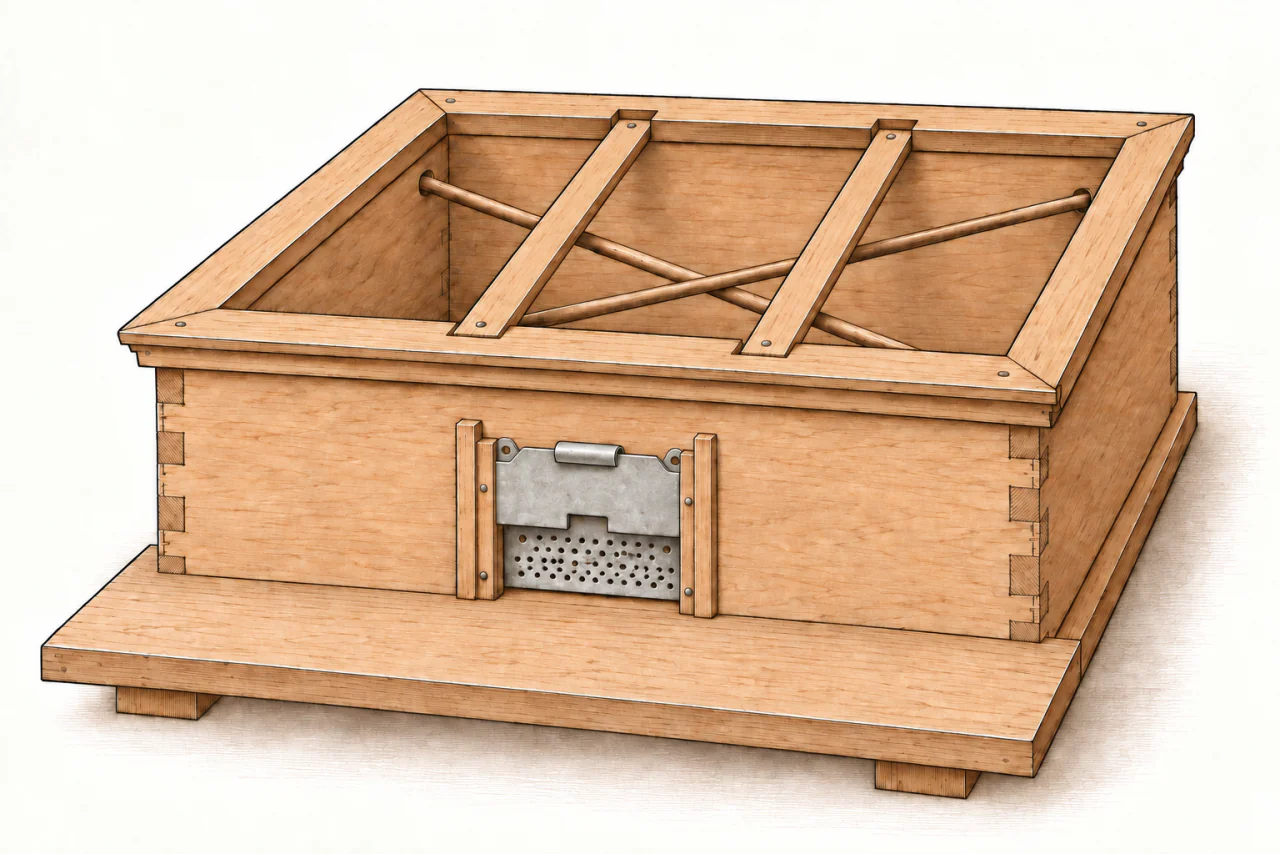
The two entrance slides after Christ (K3 §4): 1 the large opening exposed; 2 reduced to a small bee passage; 3 closed to bees by the perforated rear slide, which admits air. AI-generated schematic illustration.Lower section of Christ’s hive with two fixed wooden slats, crossed sticks and two entrance slides. After plate II. AI-generated schematic illustration.
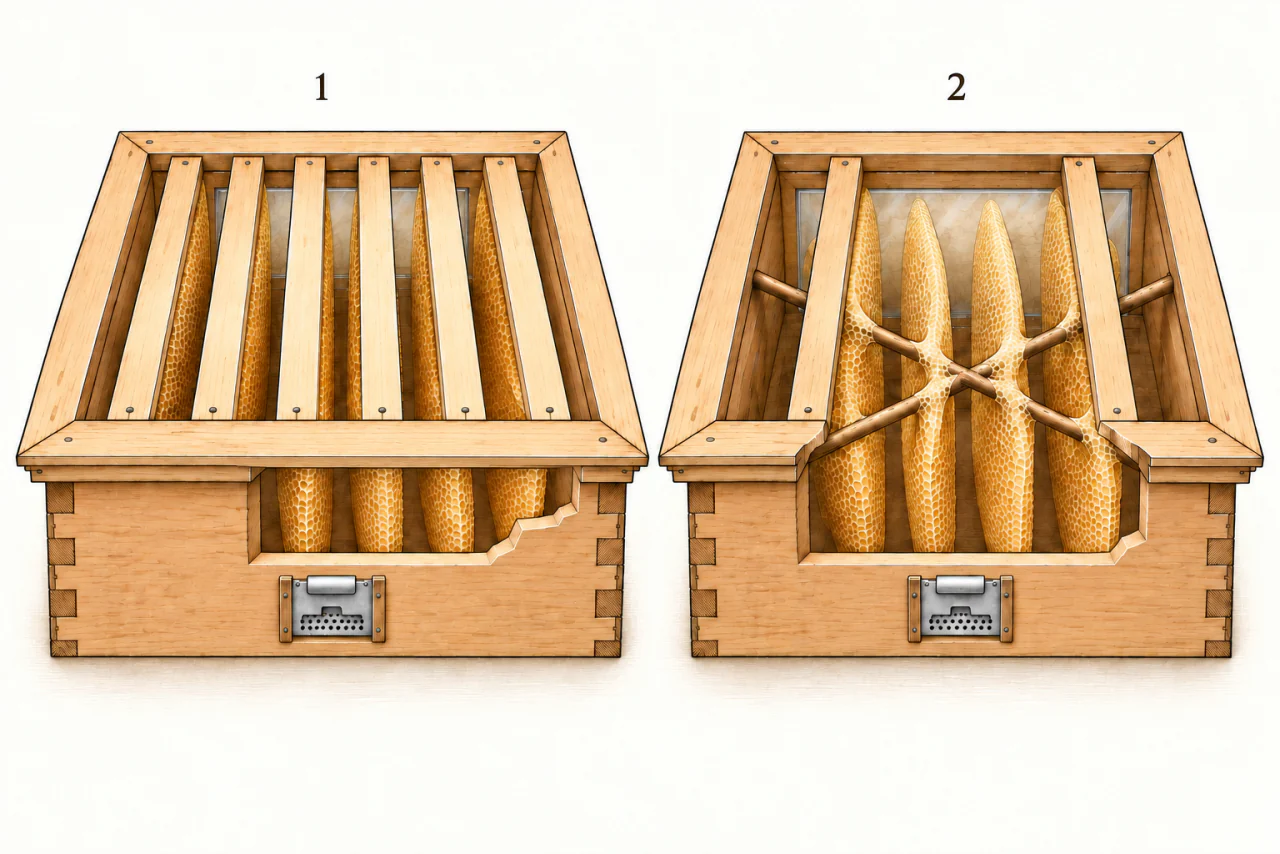
Four mitred strips, glued and nailed in place, form the upper rim. They project a quarter of a Zoll outwards and support the next box, so that boxes of slightly different sizes can still stand securely on one another (K3 §4; the explanation of the plates gives three-quarters of a Zoll). In the uppermost box, a groove in the front and rear strips holds six comb supports, each one Zoll wide. Christ calls this arrangement the Rost. The bars are nailed in place and run from the entrance to the rear wall. He intends them to guide the direction of the combs and allow air to pass through the spaces between them (K3 §4). In the lower boxes, he provides just two bars running in the same direction: the bees should be able to continue the comb they have begun, the winter cluster should remain connected and debris should fall freely to the bottom (K3 §4). Each lower box also has a cross made of two flexible willow or hazel sticks above the entrance, supporting the heavy honeycombs (K3 §4).
Comb supports after Christ (K3 §4): 1 the uppermost section with six fixed strips; 2 a lower section with two strips and thin crossed sticks. Cutaways reveal how the comb is attached and supported. AI-generated schematic illustration.
An opening seven Zoll long and two and a half Zoll high is cut into the rear wall for the glass pane (K3 §4). The outside of the box is painted with oil paint. Christ recommends a stone-coloured paint as a cheap, durable finish and also describes how to make the varnish (K3 §4). He simplifies the construction for readers with little money: nailed boards, recessed comb supports, wooden entrance shutters and a removable board over the window. He estimates the cost of ten such boxes at fifty-four Kreuzer. The inside faces remain planed; even in this version, he is reluctant to dispense with the window: “A glass pane in the rear board, however, is almost indispensable.”(K3 §4)
The assembled hive
The floorboard, stacked boxes and top cover.
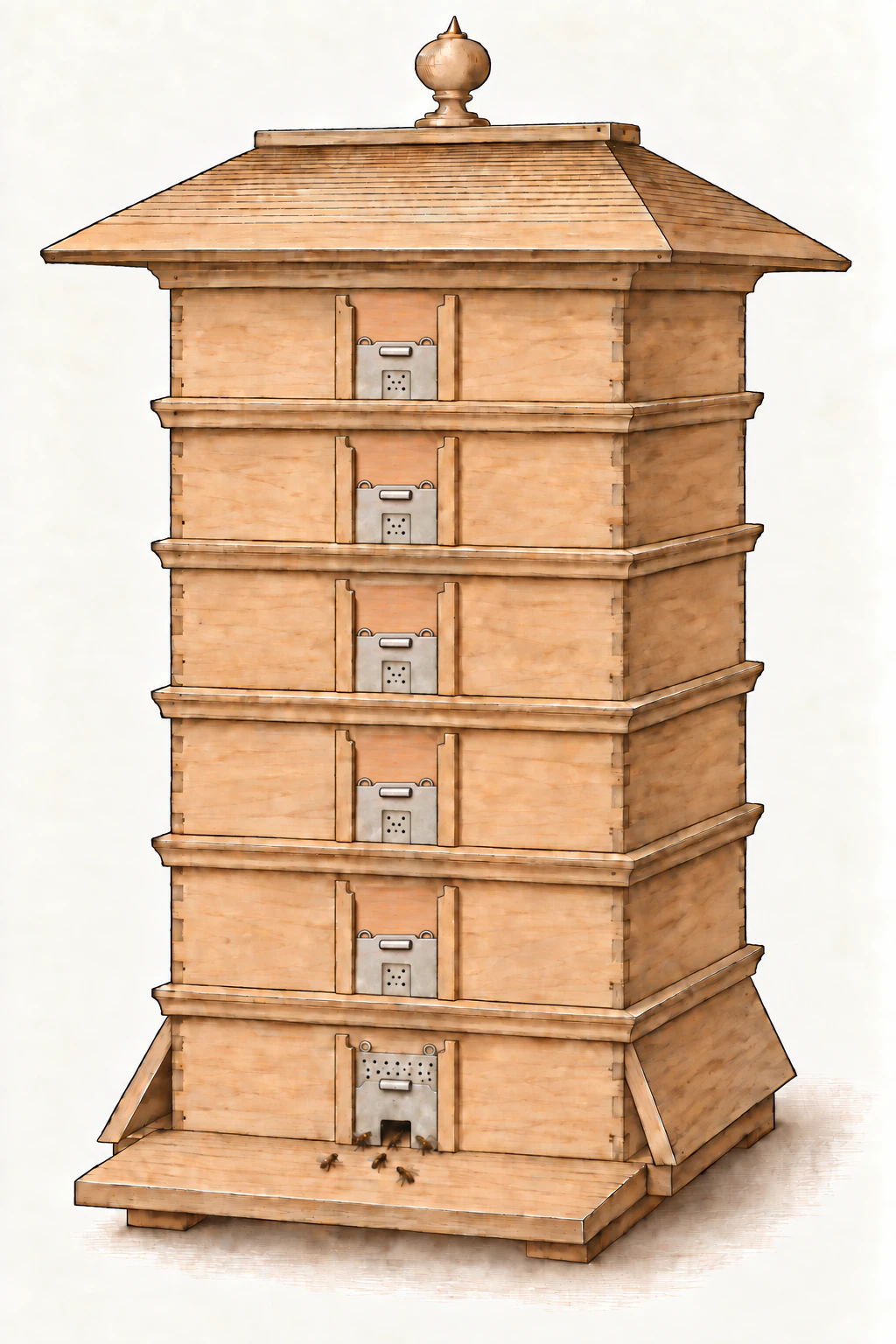
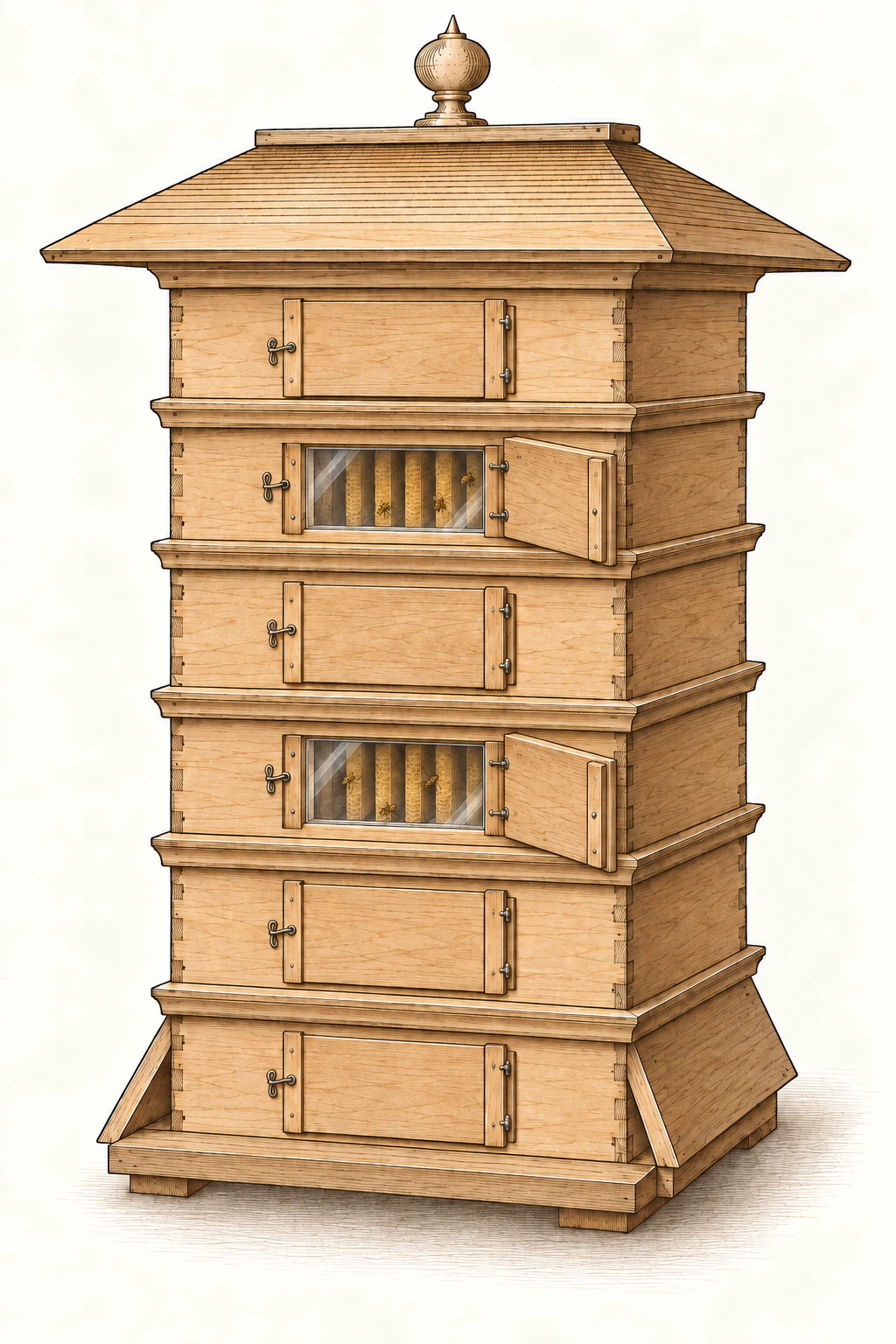
Christ’s magazine hive with six shallow sections and a weather roof. After plate III and chapter 3 (1798). AI-generated schematic illustration.
Each hive has its own floorboard, which Christ calls an Untersatzbrett or Flugbrett. It measures one Schuh and eight Zoll in length and one Schuh and three Zoll in width. The half-Schuh projection at the front provides a landing and resting surface for the bees. In Christ’s experience, oak boards continued to warp for years; he therefore prefers fir boards joined with glue and dowels, with battens fitted into grooves to prevent warping (K3 §9). He calls placing a hive directly on a shared bench “a reprehensible and harmful slovenliness”(K5 §2).
Christ stacks the boxes on the floorboard without fastening them together with hooks or straps. He seals gaps with a mixture of equal parts clay and cow dung, which he says does not crack and can be removed again with a knife (K3 §9). The rear of the hive stands half a Zoll higher than the front so that water does not collect on the floorboard in winter. It is intended to drain towards the entrance, keeping the combs from becoming mouldy (K2 §8).
Christ adjusts the number of boxes to the season and the colony’s development. He initially places a newly caught swarm in three or four boxes (K3 §9). In a good summer, he allows eight boxes for a colony that is not intended to swarm, and six for a newly caught swarm. He calculates that an apiary of ten established colonies needs about a hundred boxes, of which some forty become available again in autumn (K4 §26). Accordingly, the apiary shown in the first copperplate has room for eight boxes per hive (Tafelerklärung).
The lowest entrance serves as the way in and out. After adding a box below, Christ closes the opening above it after two or three hours, having observed that otherwise the bees do not continue building comb (K3 §9). He also considers two entrances open at once to encourage robbing: he says the bees guard only the lower one, allowing bees from other colonies to enter through the upper opening (K5 §16).
A fir board or a glazed frame covers the top, with a straw cover used in winter (K3 §4). Christ describes a separate roof for hives standing in the open. Boards placed against the sides of the lowest box keep driving rain off the floorboard; the third copperplate shows this arrangement with six boxes (Tafelerklärung; Kupfertafeln). He values a hive with a well-populated colony at eleven Gulden (K4 §26).
The glass pane
Observation windows, shutters and glazed covers.
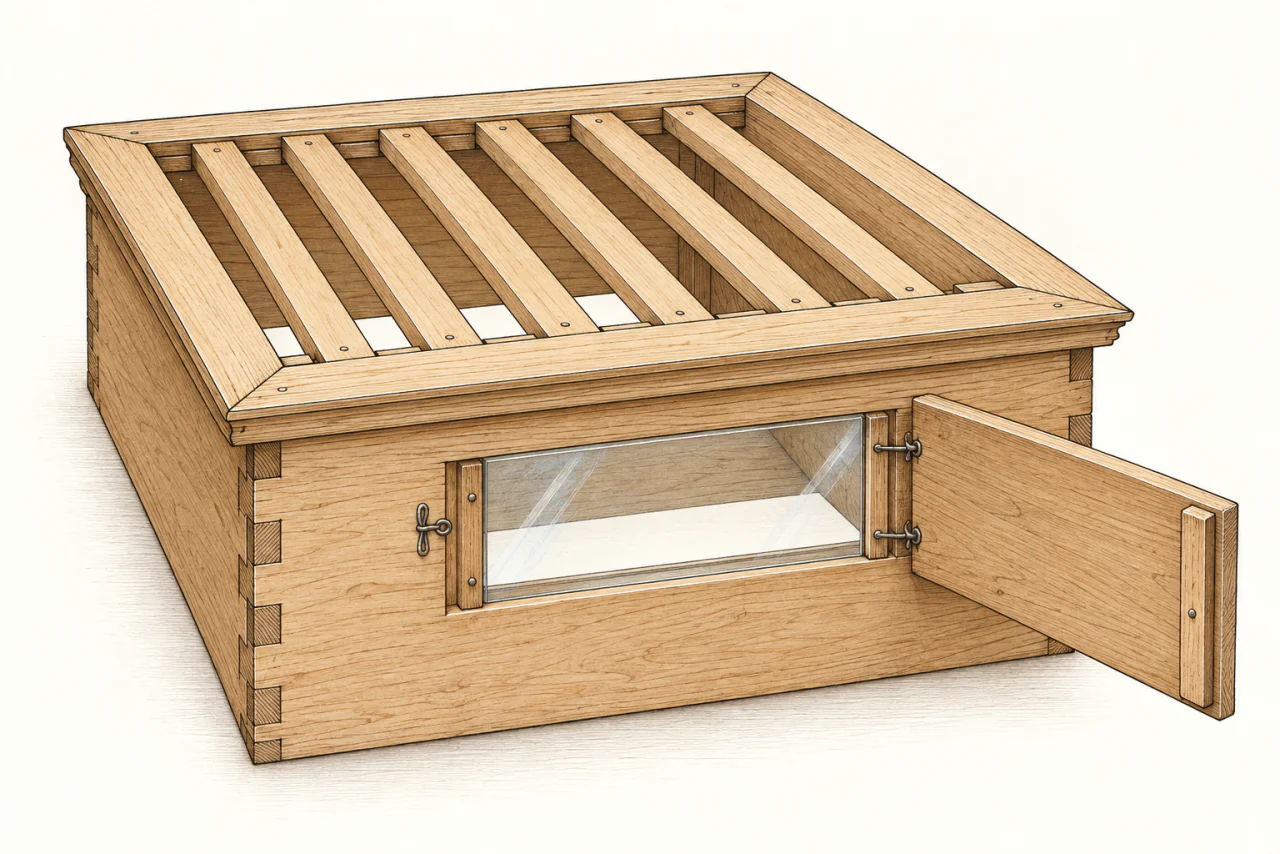
Top section of Christ’s hive: six fixed wooden slats and a window behind its open shutter. After plate II. AI-generated schematic illustration.
The rear wall of each box has a window seven Zoll long and two and a half Zoll high. Two nailed pieces of wood support the glass from inside, while two pins hold it from outside. Christ prefers a version in which chiselling out the opening leaves an inner lip to support the pane (K3 §4). A pane costs one Kreuzer (K3 §3). Additional windows can also be fitted in the side walls (K3 §4).
A small shutter shields the glass from light. Christ observes that if it is left uncovered all the time, the bees coat it with wax and propolis. If the shutter is usually kept closed, the glass remains clear; he says it can then be exposed for a whole day of observation (K3 §4). The shutter hangs on sheet-metal hinges or wire and is secured with a wire hook. A simpler version consists of a small board whose two projecting pins rest in bent wires, allowing it to fall shut by itself (K3 §4). For the cheapest version, a board hung on two wooden pegs is sufficient and can be removed for inspection (K3 §4).
Rear view of Christ’s hive with observation windows and two open shutters. AI-generated schematic illustration.
Through the window, Christ can see how far the bees have built comb in a box and decide when to add space below, divide the colony or harvest. The number of boxes filled with capped honey tells him how many he may remove without using the winter stores. With straw hives, he would have to weigh the whole hive and still estimate the amount he could harvest (K3 §7). Before dividing a colony, he checks through the windows that both intended halves contain brood (K3 §7). In May and June, he sometimes also observes the queen and the bees around her (K3 §7). He conducts the main spring inspection through the glass as well, without opening the hive (K5 §2).
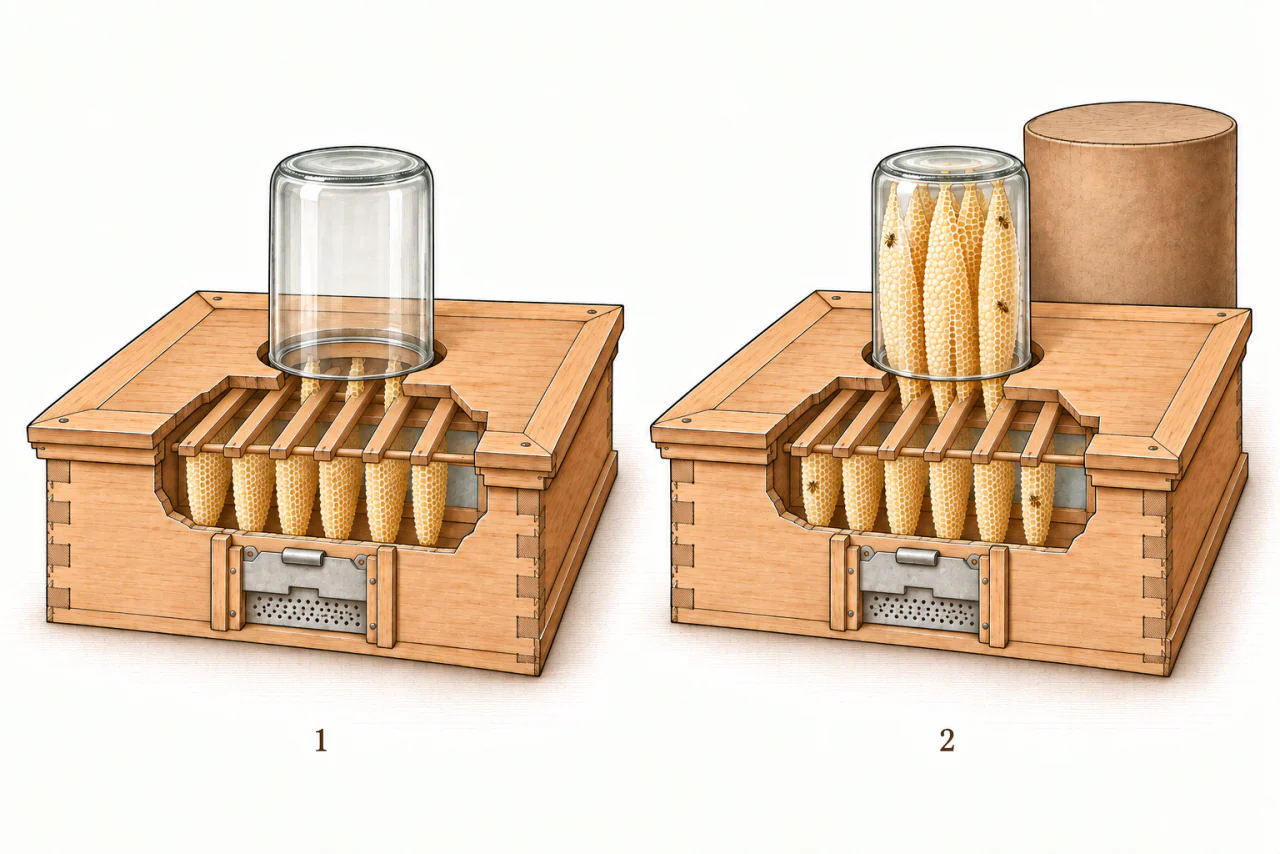
Christ also describes glazed top covers: a square pane with sides of six to eight Zoll, held in four wooden strips, or a rectangular pane eight to nine Zoll long and six Zoll wide. One glass cover is enough for six or seven boxes. Instead of sealing its joints, it can be fixed with screws one Zoll long (K3 §4). More often, however, Christ uses a board with round openings over which he inverts glass or porcelain vessels. The bees build pale comb up into them from below and store honey that he describes as particularly pure. He separates a filled vessel with a silk thread or thin piano wire and replaces it with an empty one (K3 §5).
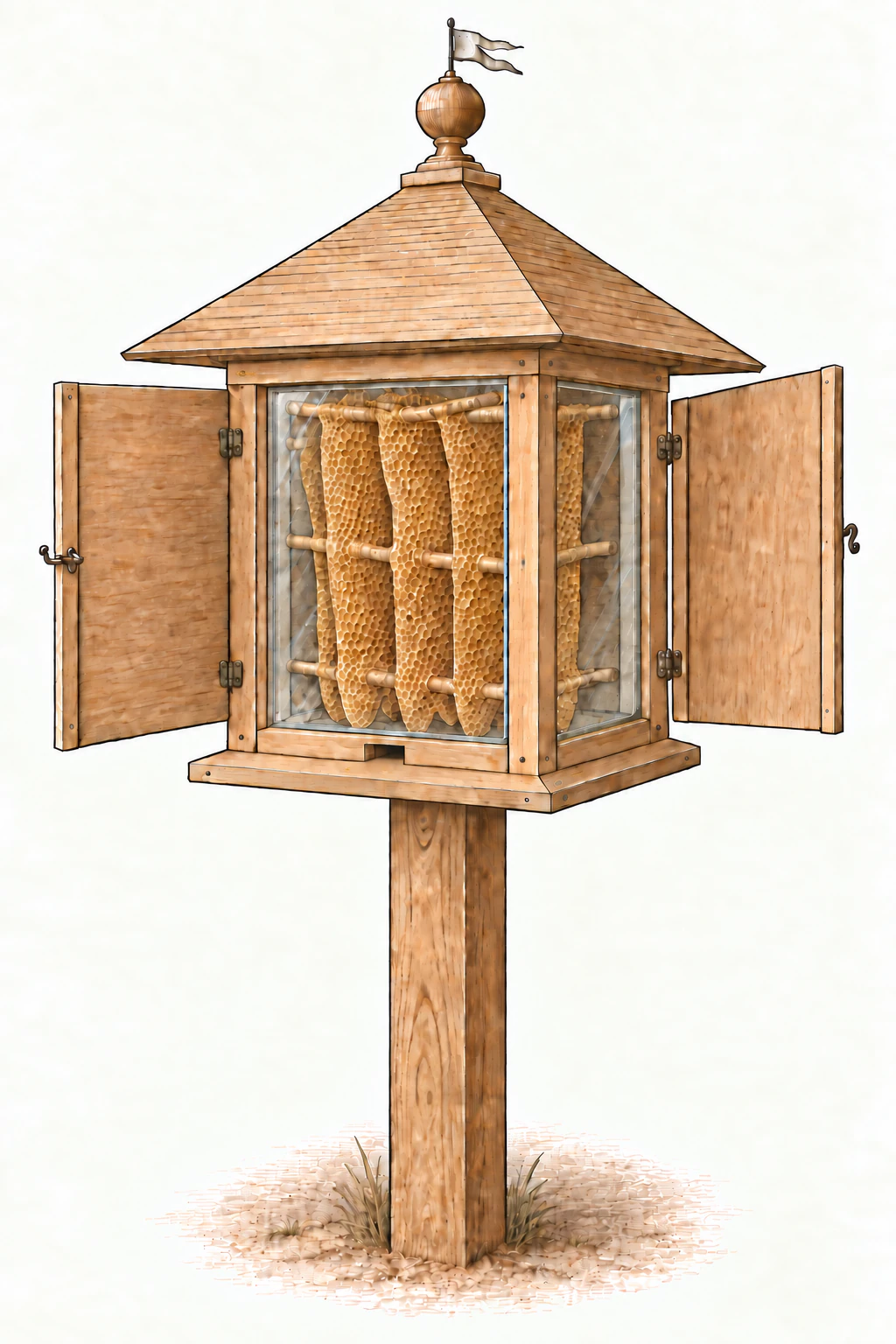
(1) An empty glass is inverted over an opening in the cover. (2) The bees have extended the combs of the upper box into the glass; its cardboard cover has been removed. After Christ (1798), chapter 3, section 5. AI-generated schematic illustration.Christ’s glass observation hive with wooden shutters and fixed cross-sticks. After plate IV and chapter 3. AI-generated schematic illustration.
For observation, Christ also uses hives glazed on all four sides, each of which can be darkened with a shutter. One such hive has a square base with sides of one Schuh and one and a half Zoll, stands one Schuh and seven Zoll high and holds eighteen Maß. It rests on a post three Schuh above the ground and is accessible from every side, allowing observers to sit around it (K3 §11, Tafelerklärung; Kupfertafeln). Christ writes: “One can perceive more in them in two years than with baskets in 20 years.”(K3 §11)
Summer and winter
Glass or wooden covers, straw insulation, ventilation and protection from the weather.
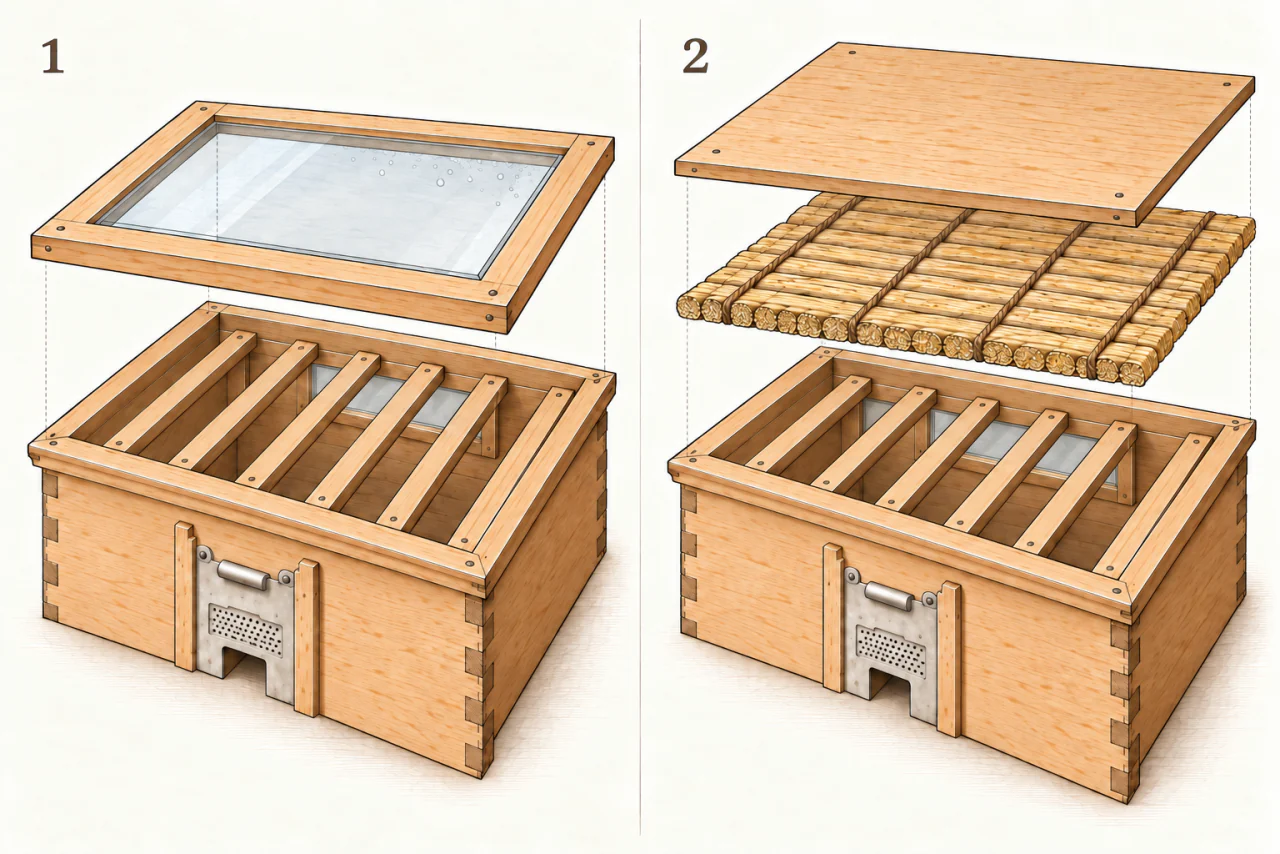
At the beginning of winter, Christ replaces the glass covers with straw ones. Moisture released by the bees condenses on cold glass into droplets that can fall back onto the colony; straw absorbs the moisture (K3 §4). The cover consists of thumb-thick bundles of straw wrapped with willow rods or twine and laid side by side. A weight or nails at the corners hold it in place, and a board laid over it protects against mice (K3 §4). Christ says the straw cover can also remain in place during summer; he regards a glass cover as optional (K3 §4).
Top closures after Christ (K3 §4): 1 a glass lid in a wooden frame; 2 a thin mat of bound straw cords with a protective board against mice. The straw closure replaces the glass in winter and may also remain in summer. Parts are separated for clarity. AI-generated schematic illustration.
He regulates ventilation with the entrance shutters. The large opening is intended to supply confined colonies with air and provide ventilation in very hot weather; it is reduced for normal flight activity (K3 §4). On sultry summer days, he opens the front shutters so that air can pass through the holes in the rear ones. He does the same during prolonged cold when the colonies make a loud roaring sound (K3 §7). In mild, damp winter weather, he also opens the front shutters of the upper boxes. This additional ventilation is intended to prevent mould (K5 §8).
The lowest entrance remains open for flight throughout the winter, even when there is snow. Christ explains this by the bees’ cleansing flights on warm days: if confined, he says, they would defecate inside the hive or die from retaining their faeces; they might also exhaust themselves against the perforated shutter (K5 §8). He lays boards over the snow in front of the apiary and turns them over after fresh snowfall (K5 §8). In severe frost, he checks whether the entrance has frozen shut (K5 §8).
Christ considers cold alone harmless to a strong colony with ample honey stores. He sees the greater danger in moisture that condenses on the walls in freezing weather and drips onto the winter cluster. From this he derives his recommendation: “It is therefore a chief rule, in order to secure good hives against the harm of severe cold, that one give them air at the top”(K2 §6). He protects weak colonies with a roofed stand and sacks and mats draped over them. He leaves no empty space beneath their combs, whereas for very strong colonies he recommends a gap of three or four fingerbreadths (K2 §6).
In summer, the hives need protection from overheating. Christ reports that in great heat, honey runs out of young, still delicate combs and bees drown in it. In this case, he recommends wet sacks around the hive and an empty box beneath it (K2 §4). Newly caught swarms, he says, may abscond on the second or third day if exposed to the midday sun; branches or a board placed in front should provide shade (K4 §18). The apiary roof therefore extends low enough at the front to shade about half of each hive at midday (K2 §4). A separate roof on a freestanding hive also protects it against driving rain, which wets the floorboard and can cause it to warp later in the sun (K2 §6).
The apiary
Siting, roofing, entrance direction and access from the rear.
Christ recommends a warm, dry, sheltered site for the apiary. Besides sunlight, he considers the location itself decisive: winter cold lingers in a hollow, while draughts between buildings or hills can chill the site. He gives the example of a neighbour whose colonies scarcely grew and did not swarm. At an open site only thirty paces away, he says, they multiplied well (K2 §3). Walls, buildings or a timber screen should keep out northerly winds and rain from the west (K2 §3). He considers smoke from bakehouses and breweries, decaying animal remains and flour dust unfavourable, but regards small streams and manure heaps as useful (K2 §2). Because of vibrations, he advises against sites beside threshing barns, smithies and paved roads. Church bells, however, do not disturb the bees in his account (K2 §3).
He faces the entrances south-east so that the hives receive morning sun and shade during the greatest midday heat. He rejects west, south-west and north-facing entrances (K2 §4). The hives should stand at least two Schuh above the ground. If necessary, he also allows a higher position, such as a house roof, in which case colonies should be propagated solely by division (K2 §5). The ground in front of the apiary is paved or covered with a surface dressing and kept clean, making it possible to find a queen that has fallen during swarming (K2 §3). Low trees make swarms easier to catch. Christ recommends a few quince trees, on which he has observed swarms clustering particularly often (K2 §3).
Christ requires a clear passage behind the stand so that the colonies can be worked from the rear, where he says the bees do not sting (K2 §3, K5 §23). He leaves enough room between hives to set down an empty box beside one when adding space below. He allows ten Schuh of stand width for five hives (K3 §9).
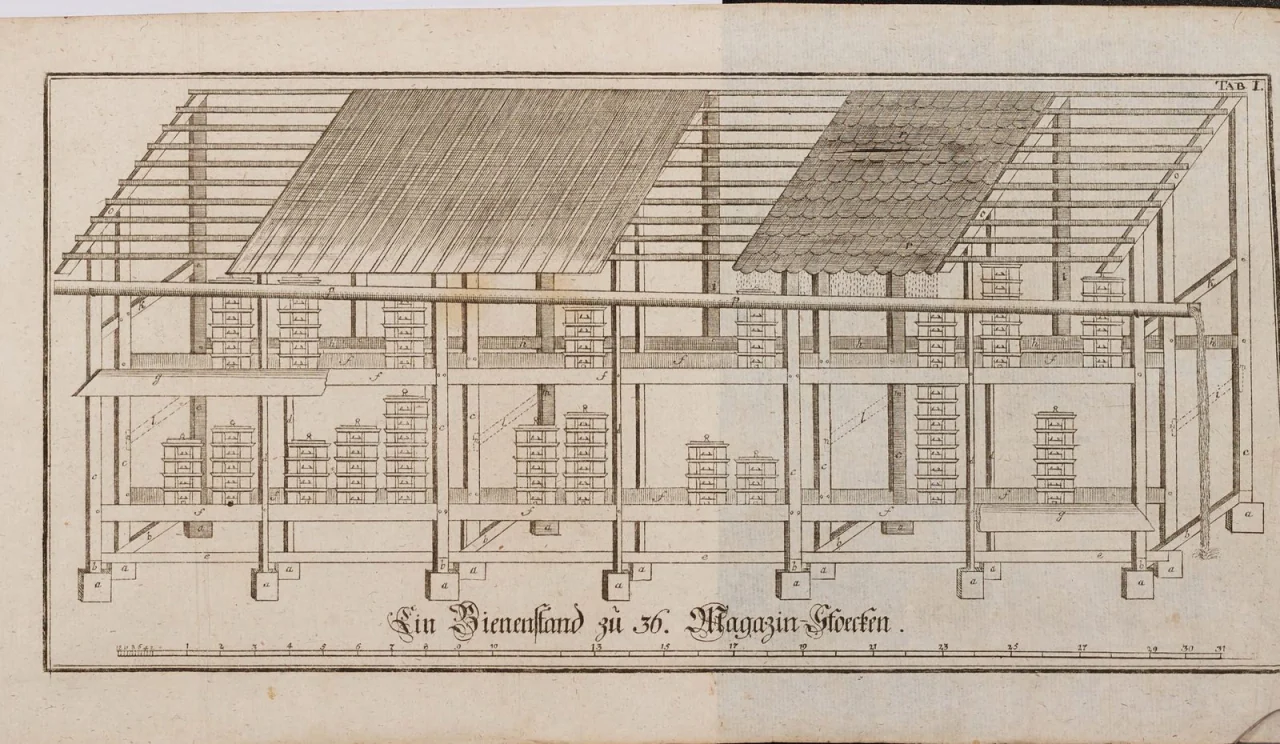
Christ's bee stand for 36 magazine hives
The roofed stand in the first copperplate accommodates thirty-six hives in two tiers. Built against a building, it is thirty-one Schuh long and four Schuh wide. For a freestanding version, Christ specifies a width of six Schuh and a roof extending over both sides (K2 §7). The posts rest on dressed stones; double planks six Zoll wide support the hives. Sloping boards fitted beneath them give returning bees a place to rest and shield the lower row from driving rain (K2 §7). The roof is made of short, straight lengths of board, with strips covering the joints so that rainwater runs off. Christ calculates that roof tiles cost more and considers slate the most attractive and durable covering (K2 §7). He gives the costs of timber, carpentry and paint, assuming that the investment will pay off over several years (K2 §7).
Tools and equipment
Cutting wire, bee knife, bellows, feeder and wax press.
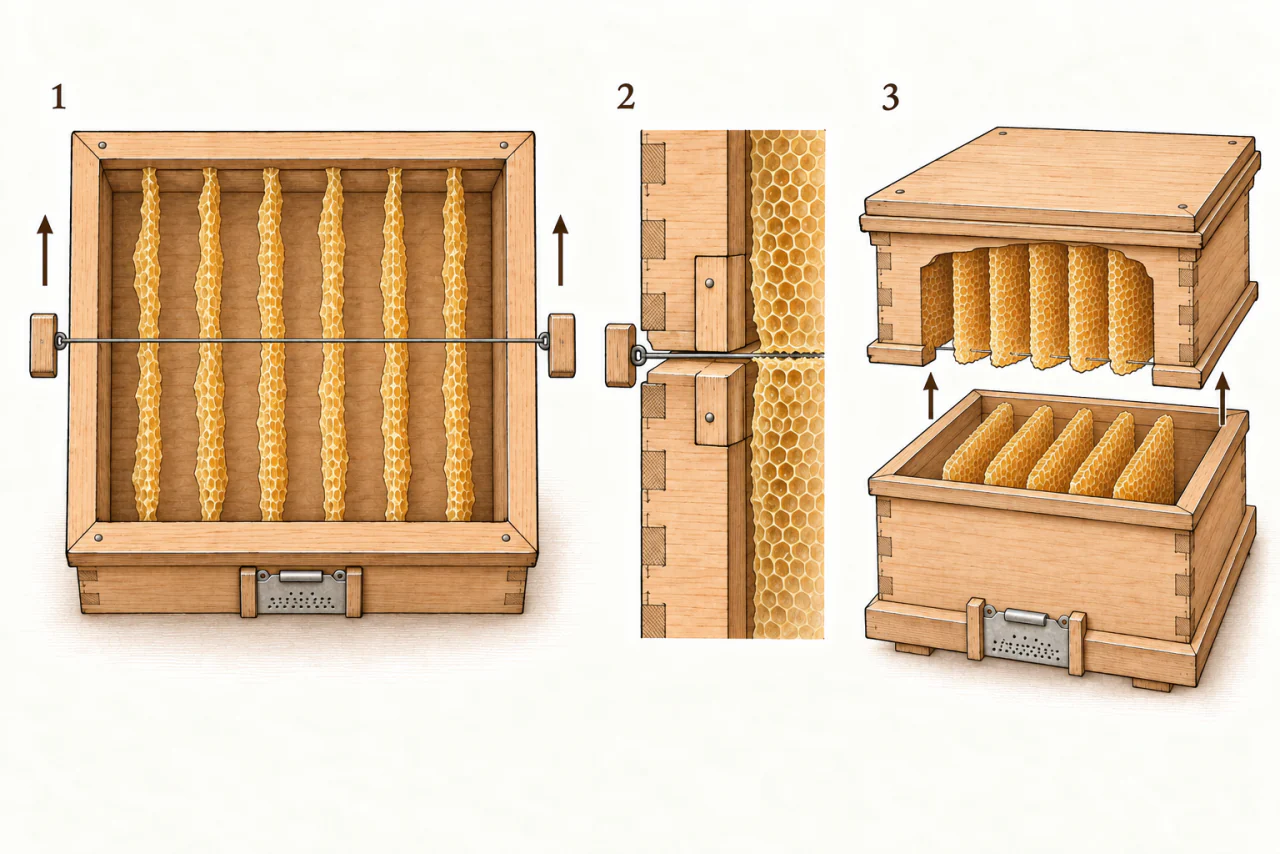
To separate occupied boxes, Christ uses a brass or annealed iron wire about two Schuh long, with a handle at each end. It is drawn between the boxes when dividing a colony or harvesting honey, for example (K7 §3). He specifies piano wire of gauge zero or one for this purpose (K4 §2). The wire is pulled along the combs from the entrance towards the rear wall (K6 §6). A thin chisel is used to lift the boxes slightly apart (K4 §2, K7 §3).
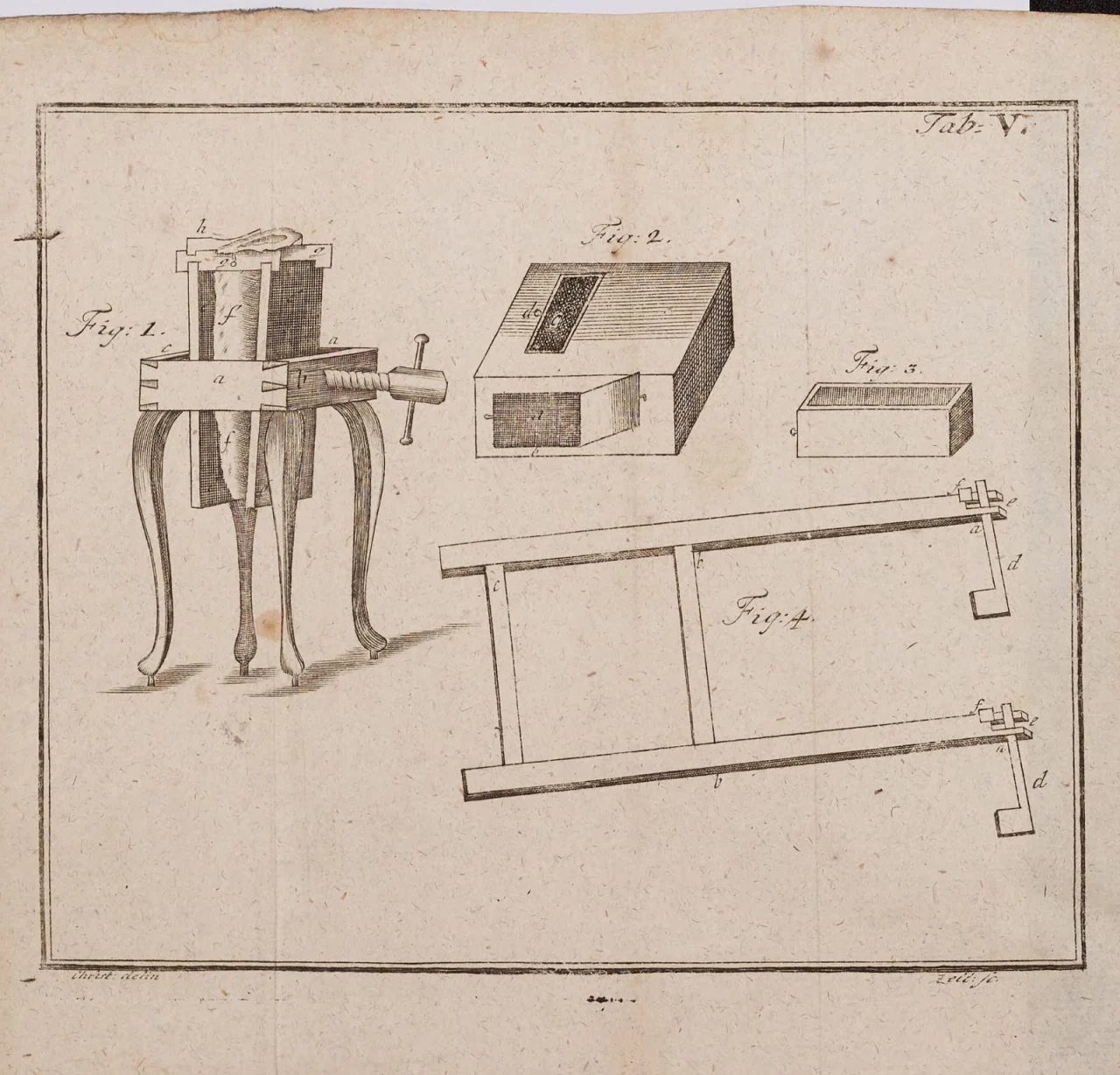
The narrow, double-edged tip of the iron bee knife can be bent as required. The third copperplate shows it beside the bellows (K7 §3, Tafelerklärung). A tinplate smoke capsule attached to the bellows’ valve holds a smouldering wick. Christ uses this to direct smoke through the entrance or down between the combs (K7 §3). He considers the smoke of puffball fungus, which grows in pastures, almost indispensable. He describes its effect as a few minutes of stupefaction that does not harm the bees (K3 §9). Protective equipment includes a bee veil, gloves of wool or greased leather and boots (K7 §2, K4 §24). His own head covering consists of a basket of fine wire mesh with cloth around the neck. He says one can breathe freely inside it and even push a tobacco pipe through the mesh (K4 §24).
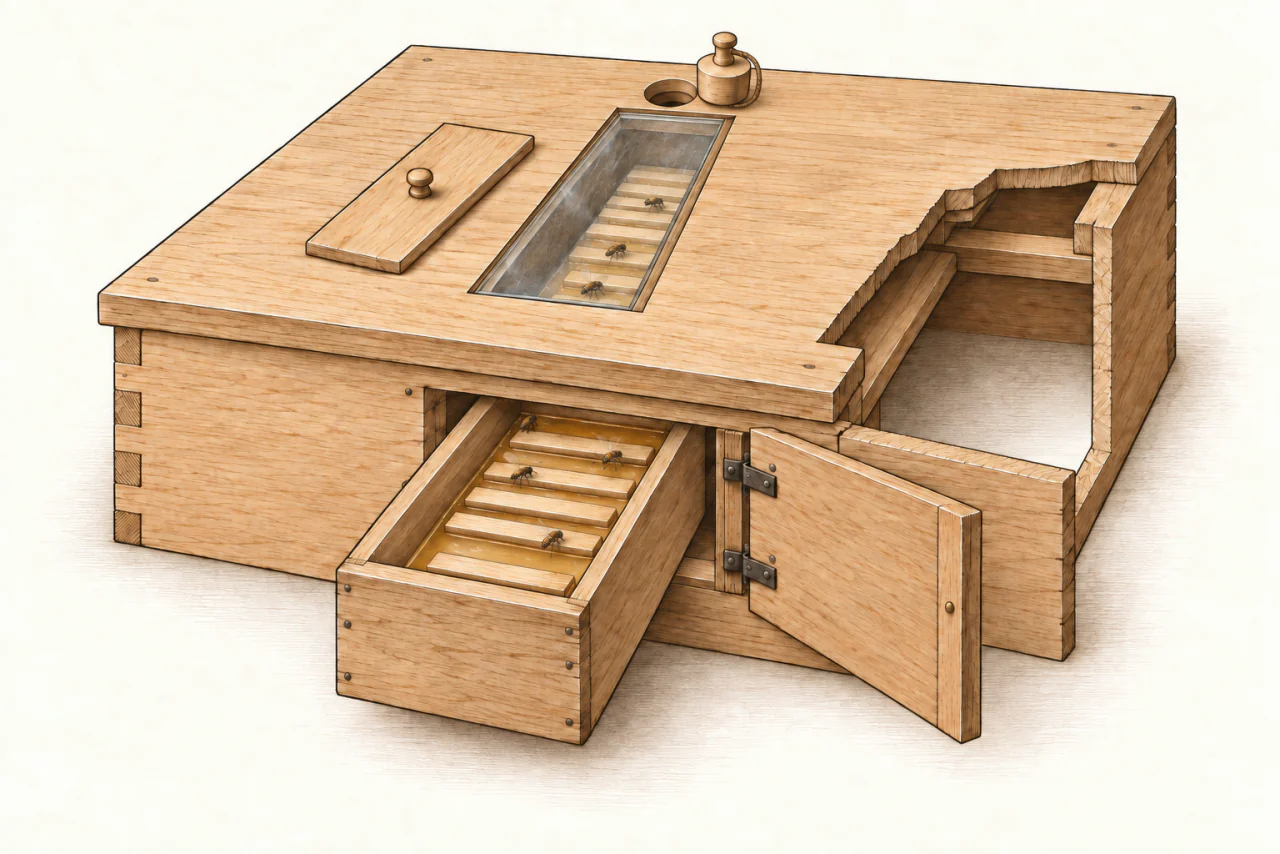
Christ’s feeding box with a sliding trough, floating wood slivers and a glass cover. After plate V and chapter 5. AI-generated schematic illustration.
Christ’s feeder is placed on top of the hive, where the bees are already gathered. It has the footprint of a hive box, is half a board’s width high and has a glass pane in the lid. A small door allows a trough ten Zoll long, four and a half Zoll wide and two and a half Zoll deep to be inserted; it holds about half a Maß of honey. An opening in the lid allows refilling with a funnel. Perforated wood shavings float on the honey to give the bees a foothold and prevent drowning. Christ sees this as a way to feed by day or night without attracting robbers (K5 §3). For feeding at the entrance, he describes simple troughs made from thin wooden box bottoms lined with wax (K5 §3).
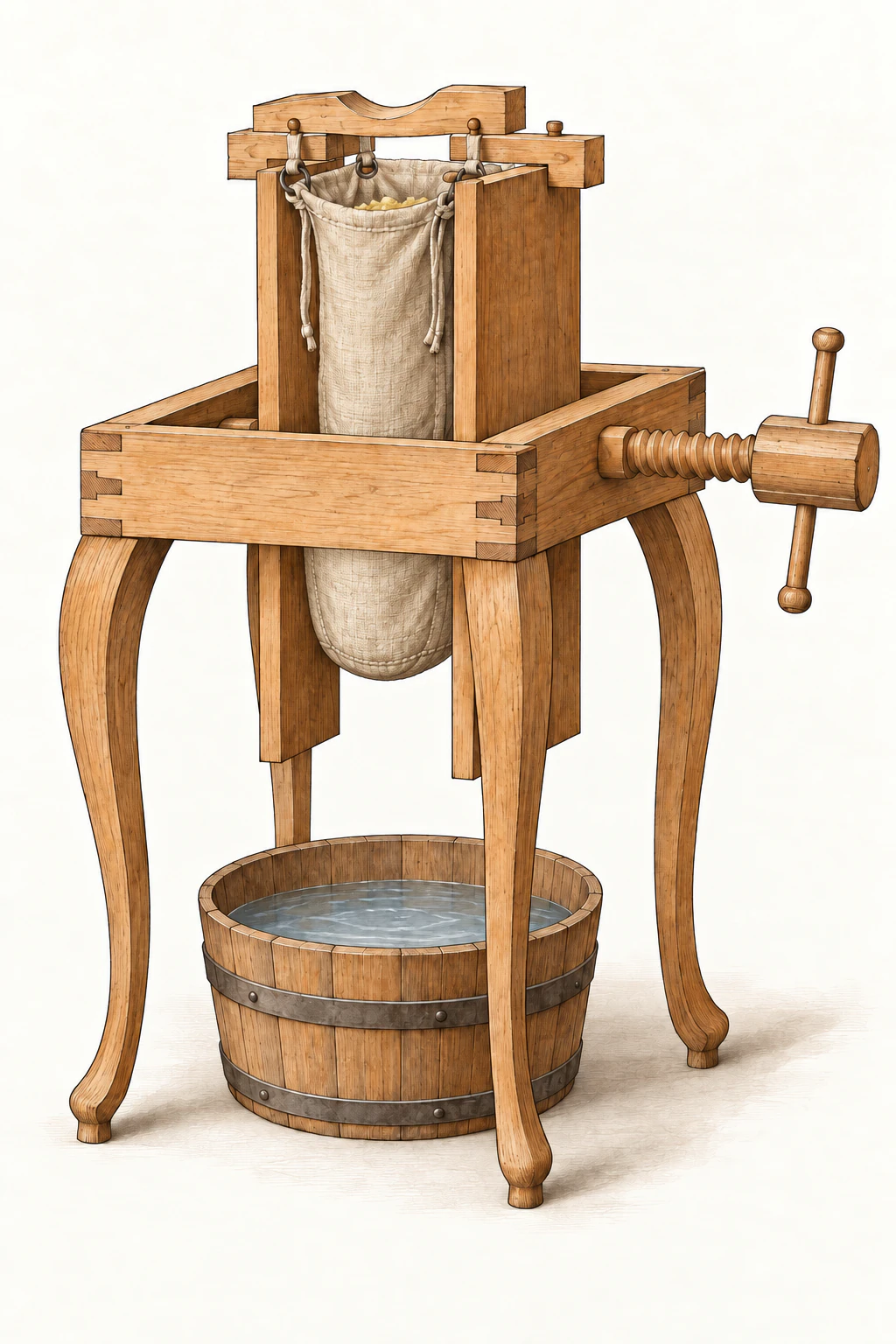
Christ's hanging wax press in its filling configuration: a hemp sack hangs between two pressing boards, with a tub of water below. After Christ (1798), plate V, figure 1 and chapter 6, section 12. AI-generated schematic illustration.
The wax press consists of four dovetailed pieces of beech and stands two Schuh and nine Zoll high, including its feet. A sack of coarse hemp cloth hangs between two oak pressing boards, each two Schuh long and eleven and a half Zoll wide. A screw ten Zoll long presses the boards together. Boiling wax is poured into the sack and collected in a tub of water beneath it. After the first pressing, the sack is folded double and pressed again (K6 §12). For extracting honey, Christ describes an earthenware apparatus with a pan, sieve and lid, as well as a basket of peeled willow through which the honey can drain (K6 §9). When adding boxes below, a slatted shelf suspended from the stand’s supporting beams helps by holding the floorboard and the bees resting on it (K3 §9).
The wax press, beside it the feeding box and the little feeding trough
For catching swarms, Christ keeps ladders, a hand syringe made from a gun barrel, poles with hooks and a sack, a sieve or tub, brooms, water, honey, clay and propolis ready (K7 §2). His other equipment includes puffball fungus, crushed chalk for marking robbing bees, hellebore, a weather glass, feeding troughs, yellow wax and lavender spirit for swellings after stings. He also keeps a honey reserve for poor years (K7 §3). The equipment can be acquired gradually; Christ places importance on quality and durability when choosing it (K7 §1).
Christ’s beekeeping methods
Christ’s methods for stocking the hive and caring for colonies through the year.
Stocking the hive
Starting with a swarm or a purchased colony, moving the hive and providing initial care.
With a captured swarm
For a swarm, Christ prepares a hive of three or four boxes stacked without fastenings; only the joints are sealed with clay. An early, strong swarm receives four boxes, while one from an ordinary straw skep receives three. He says that too little room can cause the bees to abscond on the very next hot day. He also considers excessive space unfavourable: of two equally strong swarms, the one initially housed in three boxes went on to fill four with comb, while the other, housed in four, stopped at the second. It resumed building only after Christ removed the fourth box (K3 §9).
The boxes are swept out in preparation, and diluted honey is spread on the upper faces of the comb supports. Honey underneath would delay the bees as they moved in, because they would stop to lick it up (K4 §12). Christ prefers used boxes already coated with propolis, or melts a little propolis into the corners, intending its smell to encourage the bees to stay (K4 §21).
Beneath the swarm, the hive stands on its floorboard and a white cloth, with the front raised one or two fingerbreadths. The clustered bees are sprayed with water, shaken into a sieve and placed before the entrance. In Christ’s account, the queen usually walks in first, followed by several rows of bees (K4 §12). He gradually brushes the bees remaining outside into the hive with a feather brush and shades it (K4 §18). It should be taken to its permanent position at once, as the bees would otherwise become accustomed to the temporary site (K4 §19). He considers it unnecessary to find and confine the queen separately (K4 §20).
With a purchased colony
When buying bees, Christ recommends young colonies with white, delicate combs from a well-kept apiary. They should be active, populous and heavy. He advises against the very heaviest skeps, however, because a queen in a hive completely filled with honey lacks empty brood cells in spring (K2 §10). Among other signs, he assesses colony strength by the sound after tapping the hive: he takes a brief response to indicate a weak colony and sustained humming to indicate a strong one. He also blows into the entrance, observes how many bees emerge and lifts the skep to inspect the combs, brood and any wax moth infestation (K2 §10).
He considers buying newly issued swarms the best option. The seller is given three or four boxes with a glass cover and floorboard and puts the swarm directly into them; it is collected on the first night (K2 §10). Christ specifies transport at night on a carrying frame, with a screened board beneath the hive. He considers transport by cart dangerous (K2 §11).
His method allows existing straw skeps to be replaced gradually with wooden hives. He lets half the colonies swarm and houses the swarms in boxes. A box is placed beneath a skep that has swarmed, with a board containing a cut-out covering its comb supports. The skep’s entrance is closed, so that the bees fly through the box and continue building there. After St Bartholomew’s Day, once enough boxes have been built out and filled, he drives the bees down with smoke and removes the skep (K3 §10).
From a straw skep to a magazine hive, after Christ (K3 §10): 1 a lower box with a cut-out adapter board; 2 further construction downwards; 3 remove the skep after its bees have been driven into the built wooden boxes. Sufficient comb and stores must be present. AI-generated schematic illustration.
Moving the hive and providing initial care
Christ allows a short-distance move only in late January or early February, before the bees have learnt their location. He considers a move of more than an hour’s journey possible at any time of year (K2 §9). If rainy weather follows hiving, he requires the new swarm to be fed, saying it would otherwise perish (K4 §25). As soon as the lowest box is half to three-quarters built out, another is added beneath it and the previous entrance is closed (K3 §9).
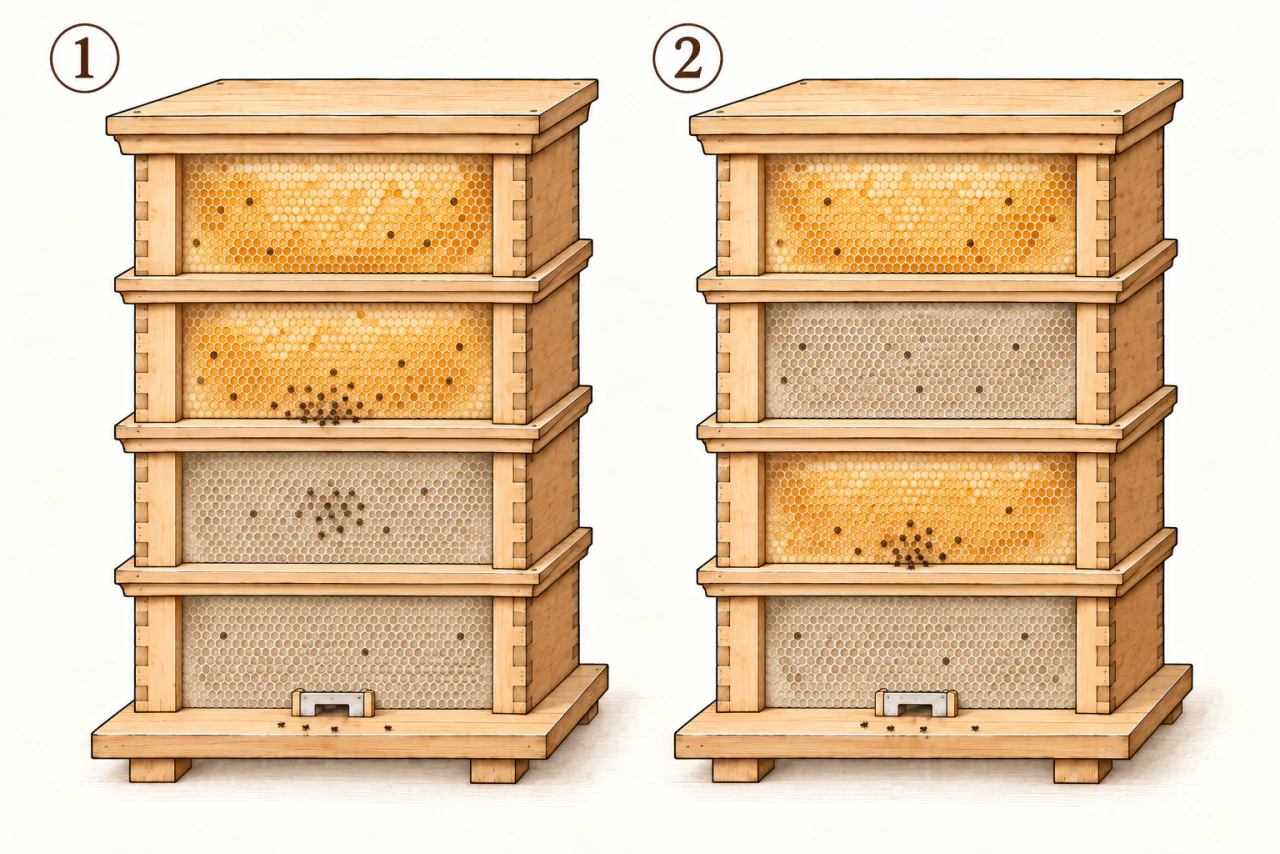
He gives late and small swarms a box of empty combs from another hive, estimating that this gains them ten to fourteen days (K3 §9). A late, strong swarm without winter stores receives a full box of honey from another colony (K3 §7). The honey boxes must remain directly above one another in the upper part of the hive. Christ bases this rule on losses of his own: with an empty box between the stores, the bees might remain there and starve beneath the available honey (K3 §10).
The spring inspection
Cleaning the floorboard, opening entrances and checking the colony and its stores.
Before the first mild days, Christ checks whether dead bees and debris are blocking the entrances. He describes debris accumulating at the entrance when the bees spend winter near the front of the hive. Together with freezing moisture, this can form a barrier behind which whole colonies suffocate when trying to make their first flight. He recommends replacing the old floorboard with a fresh, dry one as the best remedy. On mild days, he makes this change even during winter (K5 §2).
The main inspection takes place around St Peter’s Day in February. Through the glass, Christ assesses the honey stores and the condition of the bees and combs; he recognises healthy bees by a sheen that he compares to varnish (K5 §2). Cleaning includes replacing the floorboard and removing mouldy lower combs. In his stacked hives, he separates the lowest affected box and adds an empty one below. If only the edges of the combs are mouldy, he leaves the cleaning to the bees (K5 §2, K5 §5). He collects floorboard debris to recover the wax, which he considers the best wax (K5 §2).
He adjusts the number of boxes to the colony’s strength. A strong colony with two full honey boxes keeps four boxes, or at most five; he says that two lower boxes of empty comb are sufficient for brood. He removes surplus lower boxes with empty or mouldy combs, renewing the comb from below in this way (K5 §2). Finally, he seals the lower joints again (K5 §2).
By early March, Christ requires stores of two Maß of honey, equivalent to one full box of capped honeycombs. He bases this amount on the increased consumption during brood rearing: in spring, he says, a colony consumes as much in eight days as it does in eight weeks during winter (K5 §3). If stores are lower, feeding should begin in good time (K5 §3).
With the bees’ first flights, he also checks for the presence of a queen. He lists bees walking singly on the landing board, a lack of incoming pollen and little defensive response as signs of queenlessness. He describes a broken, mournful sound when the hive is tapped, together with the absence of bees standing at the entrance facing the hive and fanning their wings (K5 §6). He sees placing the queenless colony beneath a good colony with a queen as the quickest remedy. If the number of colonies is to be maintained, he recommends giving a box of brood or a piece of comb with eggs instead (K5 §6).
Christ collects chilled bees from in front of the apiary in a glass and takes them into a warm room. He reports that they recover within minutes and fly back to their colonies (K5 §7). He keeps the entrances small until the full nectar flow begins, protecting the colonies during the early spring robbing season (K5 §16).
Early forage and colony development
Observing colonies, feeding when needed and recognising the growing need for space.
Christ checks his colonies daily in spring. To illustrate the damage an unnoticed problem can cause, he recalls an incident in August when evicted drones blocked an entrance so densely that the colony behind it began to suffocate (K5 §1). In spring, he values a bee that has survived the winter more highly than four or five bees in summer (K5 §1).
He expects food consumption to be greatest during spring development. During a cold spell in April or May, he feeds at least a generous half-Schoppen at a time. He rejects small daily amounts of a few spoonfuls, because the bees should carry the honey into the cells. To prepare it, honey is warmed over coals and mixed with one-sixth water; when the bees are gathered at the top, he gives it lukewarm. Feeding takes place in the evening or during rain, with the entrance shutters closed (K5 §3).
Even capped honeycombs already in the hive do not deter Christ from supplementary feeding: a colony with much brood should not use up all its stores (K5 §3). He describes the feeder on top of the hive as the most convenient solution (K5 §3). Against the view that feeding makes bees idle, he cites his experience that abundant stores encourage their activity (K5 §3). He regards sugar, syrup and juices as unsuitable substitutes, some of them harmful. In times of shortage, however, he uses a honey substitute made from pear juice or barley malt syrup with a little honey (K5 §3).
He takes bees standing before the entrance, facing the hive and fanning, as a sign of a healthy colony. On cool mornings, he also looks for moisture released by the bees, condensing a handbreadth in front of the entrance (K5 §6). Through the window, he observes how densely the boxes are occupied and whether the lower ones already contain brood. From this, he judges which colony will be ready to swarm sooner (K4 §2).
Christ waits for warm weather and abundant forage before adding boxes below. He argues that with earlier expansion, the bees do not yet begin building, cannot occupy the entrance and are more exposed to robbers (K4 §26). In spring, he also recommends protection against redstarts, wagtails and sparrows at the apiary, against ants in May and against robbing bees at the entrance (K5 §16, K5 §19, K5 §21). He considers strong colonies least in need of help: “At least I have never yet seen a strong and populous colony sick or faint.”(K5 §9)
Providing space during the main nectar flow
Enlarging the hive with additional boxes.
As soon as the nectar flow begins in April, the robbing season is over and temperatures permit comb building, Christ adds an empty box beneath each colony that is not intended to swarm. He limits expansion to one box because, he says, bees are reluctant to build out two empty boxes. The longer climb costs returning bees time, and the entrance is left unoccupied (K3 §9). Once the new box is a little more than half built out, the next follows. He repeats this until the comb-building season ends in August (K4 §26). Two or three hours after each expansion, he closes the previous entrance (K3 §9).
He places the new boxes beneath the occupied ones, referring to the direction of comb building: “The nature of bees is to build from the top downwards, and to go on building where they have left off.”(K4 §26) Of ten colonies, he says, scarcely one or two would build in small skeps added above; empty space below the combs, by contrast, encourages building because the bees have to pass through it (K4 §26).
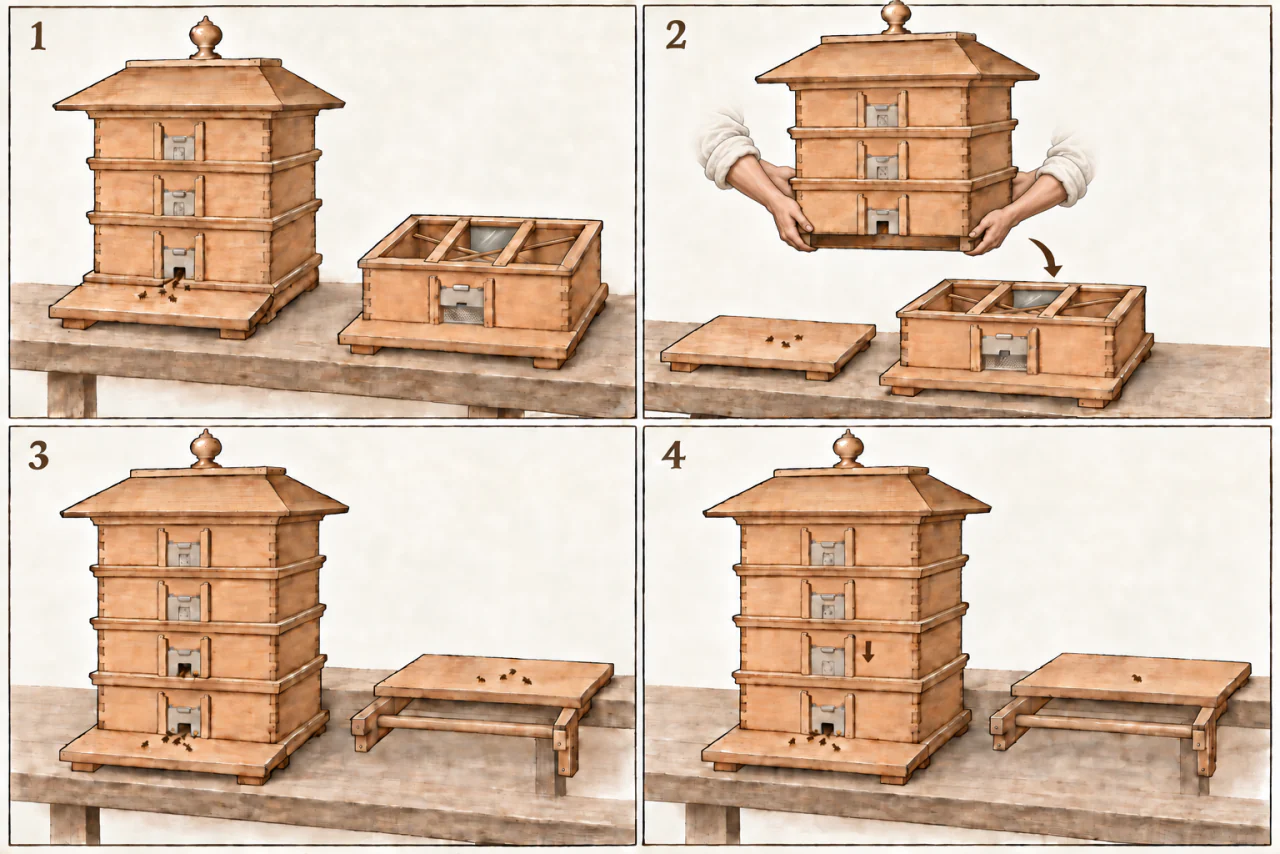
At first, Christ enlarged the hives in the morning with an assistant, who lifted the stack while he removed the floorboard and slid an empty box underneath. Later, he moved the work to midday, when flight activity was greatest. He says the bees were then so occupied with bringing in forage that he could work without a veil and no bees were harmed. Where there is space between colonies, he sets the new box and floorboard there and lifts the hive onto them; otherwise, he uses a chair behind the stand. He places the old floorboard, with its remaining bees, on the shelf provided for it, from which they can walk back into their hive (K3 §9).
Adding a box below, after Christ (K3 §9): 1 prepare an empty box on a new floorboard; 2 move the occupied stack onto it; 3 place the old floorboard with its remaining bees on the shelf; 4 close the former entrance later. AI-generated schematic illustration.
Christ takes bees hanging in clusters outside the hive as a sign that space is lacking. “Let a man only keep giving them under-boxes, and he will soon find that they are no idlers.”(K4 §7) He urges timely expansion, especially in May and June. Once the hive is fully built out and the bees have begun rearing a queen, he says they will swarm even if another box is added below (K4 §26).
During a good nectar flow, the hives sometimes become too heavy to lift. Christ then separates one or two uppermost boxes with the wire on a fine morning, harvesting during summer (K4 §26). For particularly pure comb, he places inverted glass vessels on the cover; during a good flow, they are filled within a few days (K3 §5). He illustrates potential yield with honeydew: twenty-five strong colonies, he says, could collect about a hundred Maß in eight days (K6 §3). He allows eight boxes in summer for a colony that does not swarm, and keeps about a hundred boxes for an apiary of ten such colonies (K4 §26).
The swarming season
Allowing or preventing swarming, catching swarms and making new colonies by division.
While his apiary is still small, Christ initially lets half his colonies swarm; later, he limits this to a third (K4 §26). These colonies receive no additional box below in spring. Once they have swarmed, either within the same hour or at midday the next day, he gives them an empty box and then enlarges them regularly to prevent afterswarms (K3 §9, K4 §26). Each colony should produce only one swarm or one new colony by division. In his judgement, afterswarms weaken the parent colony, take honey with them and scarcely succeed once in seven years (K4 §26). After the week of St John’s Day, he adds boxes beneath all colonies and aims to prevent further swarming (K4 §26).
If an afterswarm still leaves, Christ reunites it with its parent colony after eight days or in autumn. As another option, he describes stupefying the swarm with puffball smoke, removing its queen and placing the bees beneath the parent colony (K3 §9).
Christ gives May, June and July as the swarming months. Prime swarms usually leave between nine and twelve in the morning, and afterswarms in the afternoon (K4 §5). Before an afterswarm, the queen can be heard piping on the previous day. On the morning of departure, the bees move restlessly at the entrance; those previously outside go in to take up honey before the swarm leaves (K4 §7). Christ does not alter the entrance at this time. Once the queen has emerged, he sprays water beneath the flying swarm; he dismisses the practice of clanging scythes (K4 §8, K4 §10). He takes a swarm flying quietly and in a scattered pattern as a sign that the queen is missing. In that case, he says, she usually lies on the ground in front of the stand beneath a small cluster of bees (K4 §11).
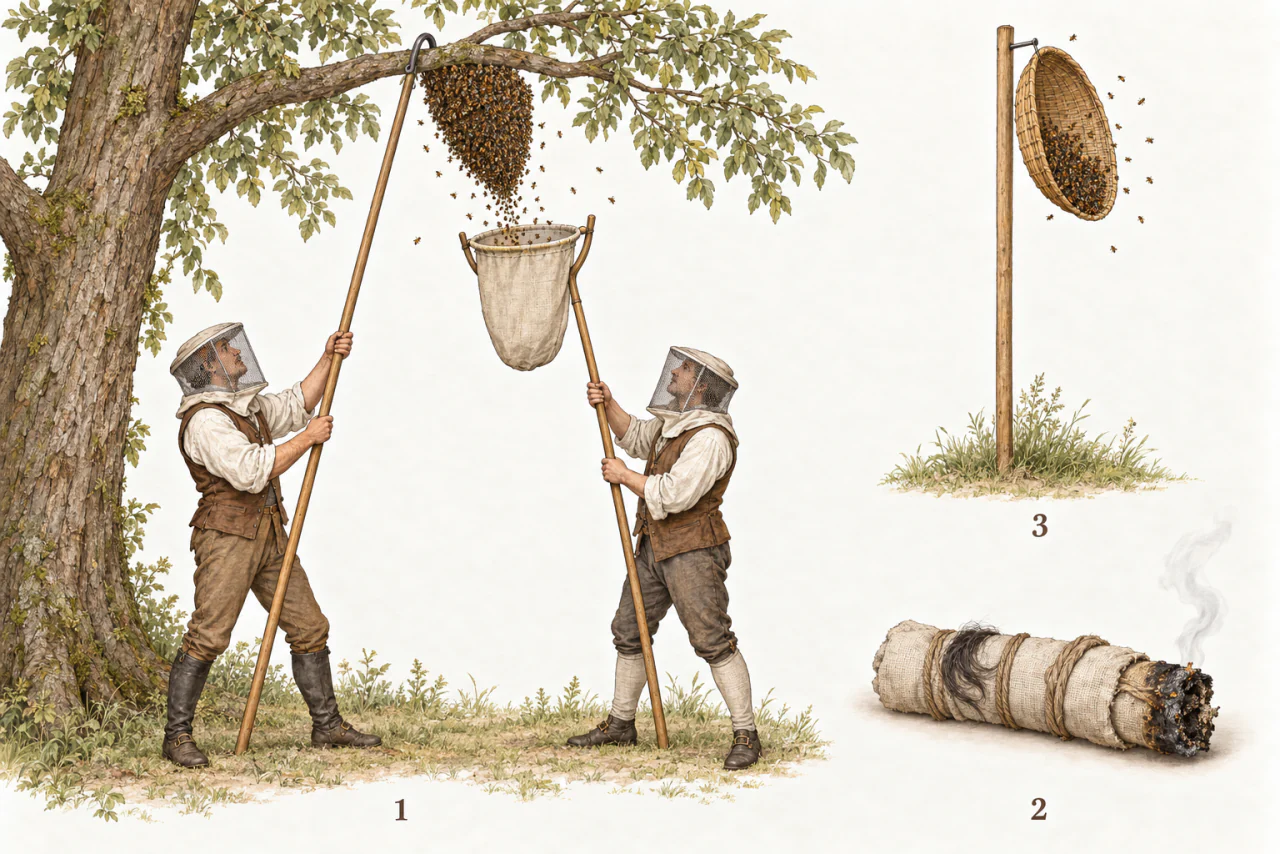
Once the swarm has clustered, he catches it as described in the section on stocking a hive. He keeps poles with hooks and a sack for tall trees. To dislodge tightly attached clusters, he uses smoke from a wick containing a lock of human hair (K4 §15, K4 §17). Where there are no trees, he mounts tubs on poles eight Schuh high; he reports that in some years almost all the swarms settled in them (K4 §22).
1: Swarm capture with two poles: a hook on the branch and a sack suspended in a fork beneath the swarm. 2: Smouldering cloth roll containing human hair. 3: Basket hung freely from a nail as a gathering place. Its shape and angle are reconstructed. After Christ, K4 §§15, 17, 22; K7 §2. AI-generated schematic illustration.
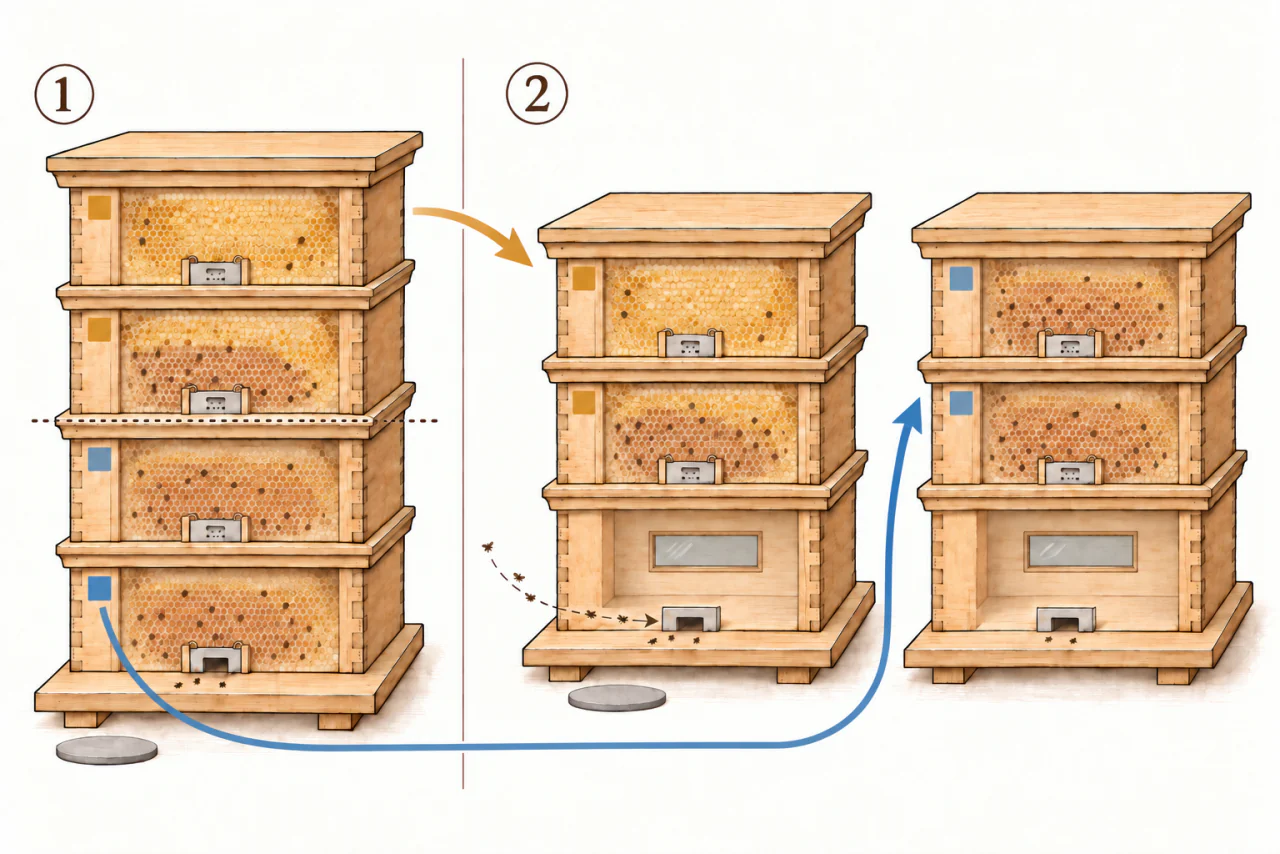
Christ considers making new colonies by division more reliable than natural swarming. On a fine day, he divides a hive of four or five boxes with the wire between the second and third. The second box must contain brood comb as well as honey. An assistant lifts the upper boxes onto an empty box prepared for them, while the other person covers the lower ones. Each resulting colony receives an empty box beneath it; the weaker one remains at the original site to receive the returning foragers. The queenless colony is expected to rear a new queen from the brood it already has (K4 §2).
Dividing a colony after Christ (K4 §2), at the start of the swarming season with abundant forage: four occupied boxes become two colonies, each with two occupied boxes and an empty box below. Colours track their origin; the stone marks the original site for the weaker part. Both need brood. AI-generated schematic illustration with simplified comb views.
His preferred method, however, is to take the lowest box with brood and bees from each of two or three good colonies and stack these boxes together. He says bees from different colonies immediately tolerate one another in this arrangement (K4 §2). For both methods, he requires the start of the swarming season and abundant forage (K4 §2). Calm bees fanning before the entrance after a few hours indicate to him that a queen is present or is already being reared. If they remain listless after eight days, he reunites the two parts (K4 §2). Among the advantages of division, he lists the honey stores already available for rainy weather and the work saved by not having to wait for swarms or retrieve them from trees (K4 §3).
Making a new colony from several colonies, after Christ (K4 §2), at the start of the swarming season with abundant forage: the lowest brood box from each of two colonies forms the new colony. It receives an empty box below, as does each donor to replace the removed box. Colours identify the donors. AI-generated schematic illustration with simplified comb views.
Harvesting honey
Assessing honey ripeness and removing full boxes.
Christ harvests by removing the uppermost boxes filled with honey. He judges how many he can take by looking through the glass at the amount of honey and the capping of the combs (K3 §7, K6 §7). He gives the yield of a full box as two Maß and half a Schoppen of drained honey (K6 §7). An empty box holds four Maß; at harvest, it yields about a quarter of a Pfund of wax in addition to the honey (K3 §7).
Christ gives September and October as the harvesting season, when cool nights draw the bees back into the middle boxes. He reports being able to lift off two boxes then without finding ten bees in them (K6 §5). If the hive becomes too heavy in summer, he also harvests at that time, but expects more work and agitated bees (K6 §5). He regards spring harvesting as the safest, because the colony has already survived the winter. In autumn, he therefore takes only surplus honey, leaving enough for a further harvest to be possible in April (K6 §5).
He prefers a bright, cool morning for removing the boxes and considers a second person’s help essential. After closing the entrance and setting out a cover, he draws the wire between the boxes, parallel to the combs, from the front corners by the entrance towards the rear. In warm weather, he separates the boxes the previous evening and lifts them off the next morning, when the bees are quiet. The removed boxes are turned upside down or placed on a bowl to keep the combs from breaking (K6 §6).
Separating boxes with a wire, after Christ (K6 §6; K7 §3): 1 draw the taut wire from the entrance towards the rear; 2 sever the wax connections at the joint; 3 lift off the whole honey box. The fixed bars are omitted from the comb views. AI-generated schematic illustration.
“One may not reckon a populous hive less than two really full supers for its winter food”(K6 §7); Christ leaves a third as well in case spring arrives late. Unused stores remain available the following year (K6 §7). To provide for an entire year without adequate forage, however, he stores a honey harvest in pots (K6 §7, K5 §3). This calculation also underlies the yield stated on the title page: a hundred Gulden from twenty-five colonies in an average year, and two hundred in a good one (K6 §7).
He extracts the honey by cutting up the combs and warming them in a bread oven, using either an earthenware apparatus with a pan, sieve and lid or a willow basket. The oven must be cool enough for a hand to be held inside it (K6 §9). Virgin honey from white combs without brood or pollen is allowed to drain without warming (K6 §9). The honey is stored in glazed pots covered with tied paper, protected against mice, ants and bread crumbs (K6 §9). He uses the wax residues and rinsing water for mead or vinegar (K6 §9). The wax is pressed twice in the suspended press (K6 §11). Empty combs that have been cut out are melted down promptly so that wax moths do not destroy them (K5 §2).
Late forage and autumn
Assessing stores and preparing the colony for winter.
After St Bartholomew’s Day, when the nectar flow ends, Christ checks through the windows how many boxes each colony has built out and filled with honey. He allows two full boxes containing four Maß of honey in total as winter stores (K3 §10, K5 §3). If these stores are lacking, he adds a full box from another hive on top. The honey boxes should sit directly above one another, with no empty combs separating the stores (K3 §7, K3 §10). If no full boxes are available, he cuts honeycombs from harvested straw skeps and fixes them on skewers in empty boxes. He reports assembling fully provisioned hives this way too (K3 §10).
He unites weak colonies, for example by placing two weak ones above a stronger one. He then removes the empty boxes gradually so that the honey stores remain together in the upper part (K5 §4). “It is better to make ten or fifteen good colonies out of thirty than that all of them should stand in evident danger of dying out.”(K5 §4) In his account, bees united in autumn tolerate one another without fighting. In summer, he applies a little puffball smoke at the entrance, intending to give both colonies the same smell (K3 §9, K4 §26). He considers united bees and bees driven from their hives the most industrious. He therefore places another colony above a sluggish one or one with many drones even in midsummer (K3 §12). In autumn, he also buys bees from skep beekeepers who kill their colonies at harvest. He drives these bees from their skeps and places them beneath his own hives (K3 §12).
Christ describes drones as usually being expelled towards the end of July and in August, though in some colonies only in autumn. If a colony tolerates them for a long time, he intervenes by injuring a few drones and letting them walk back into the hive. He says the bees do not tolerate mutilated individuals, attack these drones and thereby acquire the habit of expelling them (K1 §12).
For Christ, the end of the nectar flow marks a second robbing season. He reduces entrances, leaves no honey exposed and removes empty lower boxes (K5 §16). He marks robbing bees from his own apiary with chalk to identify their colony, then moves it to the other end of the stand (K5 §16).
From colonies intended to swarm or provide a new colony by division the following year, Christ removes a lower box of empty combs. Some empty combs must remain, however, to provide brood cells in spring; boxes filled only with honey are insufficient for this (K6 §7). For supplementary feeding with lower-grade honey, he uses the feeder. To fit it, he drives back the bees gathered at the top with a little smoke (K5 §3).
Preparing for winter
Adjusting space, protecting the hive and ensuring ventilation.
Before winter, Christ reduces the hives by removing empty lower boxes and those not yet built out. He leaves weak colonies no empty space; beneath the combs of very strong colonies, a gap of three or four fingerbreadths may remain (K2 §6). When uniting colonies or adding boxes above, he follows the same arrangement as in autumn provisioning: honey stores together at the top, with empty combs below (K3 §10, K3 §12). He replaces the glass cover with straw and lays a board over it to protect against mice (K3 §4).
Winter stores after Christ (K3 §10): in 1, the honey boxes are directly above one another at the top. In 2, comb without honey interrupts the route to the upper stores. Christ warns that a colony may starve despite honey remaining above. Box counts are examples. AI-generated schematic illustration.
Christ winters his colonies at the apiary. He advises against taking them into rooms, where he says the combs become mouldy and noise disturbs the bees, causing them to consume more stores (K5 §8). His experience of burying hives was also poor: scarcely two or three of ten colonies survived his trials. Their combs were mouldy, and the surviving bees had already begun rearing brood. He found no evidence of hibernation (K5 §8). In his account, bees consume food in winter too, which is why they collect stores during summer (K5 §8).
For a colony in good condition, he estimates consumption during cold weather at barely one Maß, equivalent to five Pfund, in eight to ten weeks (K5 §3). He nevertheless rejects the idea that bees need less food in cold winters than in warm ones. He considers the timing of spring decisive, since the greatest consumption begins with brood rearing towards the end of winter (K5 §22). He also expects mould in damp, warm winters (K5 §22).
Christ keeps the entrance narrowly open even in snow. Closing it with only the perforated shutter is unsuitable, he says, because the bees exhaust themselves to death against it (K5 §8). In mild, damp weather, he opens the front shutters of the upper boxes to admit air (K5 §8). During cold weather, the hive should neither be lifted nor shaken: bees dislodged from the winter cluster could freeze on the outer combs (K5 §8). He also checks for a frozen entrance and lays boards over the snow before the stand (K5 §8). He considers the wooden hives secure against mice entering them (K5 §8).
In his account, the queen in a good colony resumes laying as early as January, or around Christmas in mild winters, in the warm centre of the hive (K1 §15). Christ recommends using the winter to build boxes for the following year and arranging colonies on the stand with enough space beside them for making divisions (K4 §2).
Christ’s account of bee biology
Christ’s observations and explanations of bee biology compared with modern research findings.
The colony as a whole
Christ’s account of the colony and research on division of labour and communication.
Christ calls the colony a republic with a „constitution of state" and writes that “so many thousand members are united for one purpose”(Vorrede). He distinguishes the queen, worker bees and drones (K1 §1). He allows twenty thousand workers per colony, of which only a third fly out each day; a colony in his stacked hive could grow to thirty or forty thousand bees (K3 §1, K1 §2). His account of the division of labour covers many activities: some bees build, while others hang in chains, polish cells, clean the hive, seal joints, pack down bee bread, feed brood or stand guard. They perform these tasks „for a time" and then change duties (K1 §14).
The idea of the colony as a unit also appears in later biology. In 1911, Wheeler described the ant colony as an organism without using the word superorganism (). Biologists continue to debate how useful this concept is (). Seeley’s 1982 account of age-related division of labour describes four stages: cell cleaning during the first two days is followed by brood care, work with stores and finally foraging (). Christ’s phrase „change about" can thus be understood as a change of tasks during a worker’s life.
Christ writes cautiously about bee communication. He says they have „certain natural, uniform signs"; a bee that has found honey prompts others to fly with her by moving her wings and making sounds (K1 §16). The dance language studied by von Frisch explains how foragers communicate a food source: a bee dances on the comb in darkness, with the duration of her waggle run indicating distance and its angle to the vertical indicating direction relative to the sun. Floral scent on her body helps the other bees find the relevant flowers (). This does not require them to see in the dark hive, as Christ assumed (K1 §3). Followers track the dancer through touch, with gravity providing the reference for direction ().
Christ believes that bees can hear, but that „the sound and the noise in itself has no influence whatever on the bees"; he says they feel only vibrations of the ground (K2 §3). Sounds such as church bells and threshing flails, however, cannot establish how bees respond to airborne sound in general. Towne and Kirchner showed in 1989 that bees perceive air-particle movements, though only within the few millimetres around a dancer producing sound ().
Christ explains the recruitment of other bees by a sting through their sense of smell: they are attracted because they “at once catch the sourish smell from the torn poison sac”(K5 §23). The sting does carry volatile substances that stimulate defensive behaviour. Huber had already provoked attacks by guard bees using excised stings ().
The queen, drones and reproduction
Christ’s knowledge of queens, drones and workers compared with later studies.
For Christ, the queen is the mother of all bees. He states that she produces more than thirty thousand offspring in a quarter of a year and lays about two hundred eggs a day. He takes her placing worker and drone eggs in the appropriate cells as a sign that she distinguishes between the two types before laying (K1 §2, K1 §15). He gives the queen’s lifespan as several years and a worker’s as no more than one year (K1 §17).
A queen, he says, can develop from any worker larva no more than three days old if given a larger cell and richer food. Christ adopts this explanation from Schirach and sees it confirmed in the colonies he makes by division. He concludes that all workers „belong originally to the female sex" and are undeveloped females (K1 §5). Modern research also describes the importance of larval food: Wright and colleagues identify the nurse bees’ glandular secretion as the main food of larvae and the queen ().
Christ writes cautiously about mating, noting that he has never witnessed it himself: drones “are held to be the males of the queen”(K1 §10). In the accompanying note, he considers whether the queen might be fertile without mating, or might pass on the fertility she had once acquired to her daughter and granddaughter (K1 §10). In the preliminary notice to the third edition, he recounts Mr Lucas’s theory that the queen is fertilised by male worker bees during „billing". Christ objects that he has seen the queen lay drone eggs a thousand times, but has never seen workers do so (Vorbericht). The question of mating remains unresolved for him.
Half a century later, Dzierzon describes young queens returning from flight with the drone’s mating sign. He records that mating takes place in the air and that the sperm supply „für ihr ganzes Leben ausreicht" [lasts for her entire life] . An unmated queen unable to fly laid only drone eggs for him, which do not require fertilisation. These findings could answer two of Christ’s questions: why queens are fertile in spring when no drones are present, and why some produce only drones.
There is also evidence for egg laying by workers, as described by Christ’s informant Riem. In queenless colonies, workers lay unfertilised eggs, preferably in drone cells. Such a colony can still produce thousands of drones before it dies; in colonies with a queen, worker egg laying is very rare (). Christ had never observed a queenless colony and concedes that it may occur there (Vorbericht).
He explains the death of drones after mating by their mating organ’s inability to retract (K1 §10). He also describes how they gather no food and are driven from the hive in late summer (K1 §11, K1 §12).
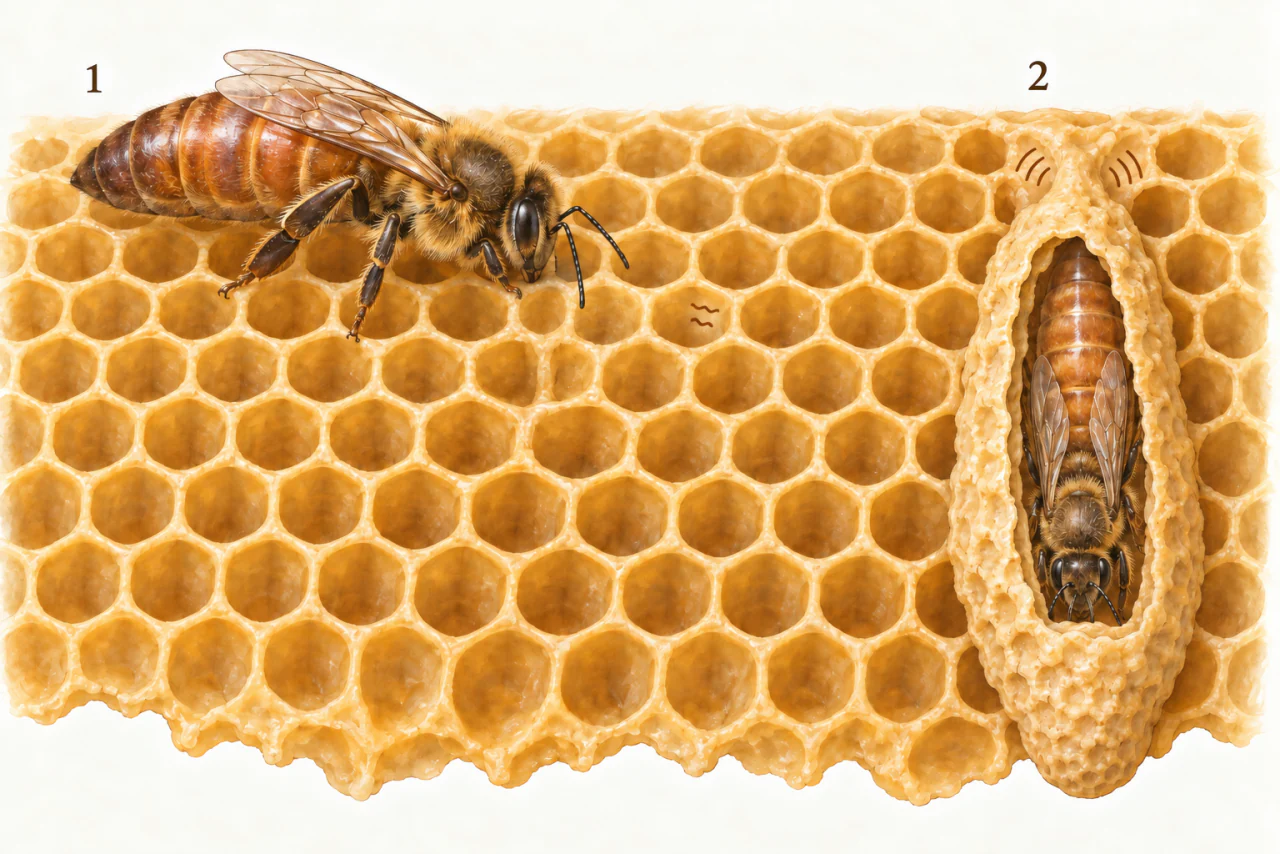
When the queen pipes before swarming, he observes her gripping the cells „so that her body lies hard against them". He explains the sound as coming from her breathing openings, to which young queens in their cells respond by quacking, “almost as the frogs do”(K1 §3). Michelsen and colleagues studied both sounds in 1986 as vibrations of the comb: piping by the free queen elicits quacking from queens still enclosed in their cells (). The body pressed against the comb, which Christ observed, transmits the signal. The measurements do not support his explanation of the breathing openings as its source.
1: Tooting by a free queen in contact with the comb. 2: Quacking by a queen still confined in her cell, shown in cutaway. The sparse vibration marks schematically indicate transmission through the wax (K1 §3; Michelsen et al. 1986). AI-generated schematic illustration.
Christ attributes the killing of young queens solely to the old queen, who he says kills one rival after another at night without the workers taking part (K5 §6). In 2001, Gilley also observed workers intervening in five queen duels. Young queens patrolled queen cells and killed their rivals, while workers restrained queens and thereby made them vulnerable to attack ().
Modern research distinguishes between short-lived summer bees and long-lived winter bees (). Christ’s general figure of one year does not account for this difference. His observation that older bees begin to shrink in June and July and die with torn wings (K1 §17) concerns the summer months. He describes development from the egg through the fed larva, capping and cocoon spinning to the pupa, stating that the bee emerges on the twenty-first day (K1 §15). Jay describes the same developmental stages in 1963 (). We have not checked Christ’s timings for the individual stages against a source.
Swarming
Christ’s account of swarming and studies of space requirements, nest-site selection and wild colony survival.
Christ understands swarming as a reproductive instinct given by the Creator. In his account, when food is plentiful, young bees leave with a newly emerged queen after quickly taking up honey (K4 §4). A swarm that would scarcely weigh a few Pfund without these stores thereby reaches six to eight Pfund (K4 §4). He distinguishes prime swarms, afterswarms, swarms issued by newly founded colonies, emergency swarms and swarms leaving because of hunger (K4 §6), and describes the signs of departure (K4 §7). Frequent swarming, he says, can destroy a colony (K4 §26).
He places the idea that scouts choose a home before swarming “quite among the mere conjectures”(K4 §9). In the same paragraph, he tells of a friend whose empty glass hive was cleaned by a few bees, then occupied three days later by a swarm from elsewhere. At least for swarms leaving because of hunger, he considers prior nest-site searching probable (K4 §9).
Lindauer studied nest-site selection by swarms in 1955. Successful scouts dance on the swarm cluster to indicate the location of nest sites they have found. Several sites are advertised at once before the swarm settles on one after hours or days. The future nest site could be predicted from the dances; in three cases, it was found before the swarm moved there (). In 1978, Seeley and Morse studied preferred nest features: a cavity of about forty litres, a small entrance low down and a position several metres above the ground (). We know this study only through secondary accounts.
Christ recommends timely expansion below to counter swarming. If delayed too long in May, he says, the hive is already fully built out and swarm cells have been started (K4 §26). In the 2016 experiment by Loftus, Smith and Seeley, colonies in small hives also issued more swarms than those in large ones (). This finding alone does not establish the effect of adding boxes beneath Christ’s hive.
A study in southern German forests provides an indication of survival after swarming: most of the wild colonies studied there did not survive their first winter (). Christ himself advises catching a swarm on the day it issues, saying it will leave for hollow trees or walls after an hour (K4 §5). His advice concerns catching the swarm in time; it says nothing about these swarms’ subsequent chances of survival.
Two of his claims remain unchecked: spraying water beneath a flying swarm to prevent it leaving (K4 §10), and the observation that swarms prefer to cluster on quince trees (K2 §3).
Comb building and wax
Wax production, propolis and the direction of comb building in Christ’s account and later research.
Christ calls wax „a true fat of the plants and of their honey juice", which the bees separate from honey within their bodies. He says they „sweat out the wax through the rings of their abdomen"; they pull out the emerging scales with their feet, knead them in their mouths and build with them (K6 §13). He places this separation in a second stomach, which he calls the wax stomach, and also attributes a role to acid from the venom sac (K1 §14, K6 §13). Without honey, he says, no building takes place; he leaves the contribution of pollen unresolved (K6 §13). He names warmth as a prerequisite for comb building, specifying an outside temperature of at least fifteen degrees Réaumur (K6 §13). He admires the economy of wax and space in the hexagonal cells with bases made of three rhombuses (K1 §14).
The small flakes Christ describes can be identified as wax scales. Wax is produced in the wax glands of young workers and emerges on the abdomen (). There is no basis, however, for his explanation involving a „wax stomach" and acid from the venom sac; it belongs to the chemistry of his time.
He describes Vorwachs, or propolis, as a sticky resin that bees bite from the buds of poplars, birches and other trees and use without processing (K1 §14). A later study found that a propolis envelope inside the hive strengthened the colony’s defences, though the effect was marked in only one of the two study years (). Rough interior walls encouraged bees to rebuild such an envelope ().
In Christ’s account, bees build from top to bottom and continue where they left off; they are reluctant to occupy space added above (K4 §26). His comb supports guide the combs from the entrance towards the rear wall (K3 §4). In a 2024 experiment, almost all colonies in elongated boxes began building near the entrance rather than at the ceiling. Where the entrance was far from the ceiling, they built from the walls (). In Christ’s boxes, the entrance is at the bottom and the comb supports at the top. How the findings from the elongated experimental boxes apply to this arrangement remains open.
Another experiment concerned the effect of existing empty honeycombs: colonies with more of these combs brought in more forage (). This finding needs to be distinguished from the effect of adding an empty box without comb beneath a colony.
Christ also expects a yield of about three-quarters of a Pfund of wax from combs containing four Maß of honey. He values the wax in relation to the honey at a ratio of one to six (K6 §11). These figures describe the yield and value of the products in his own operation.
Heat and conditions inside the hive
Christ’s temperature measurements and research on the winter cluster, moisture and food consumption.
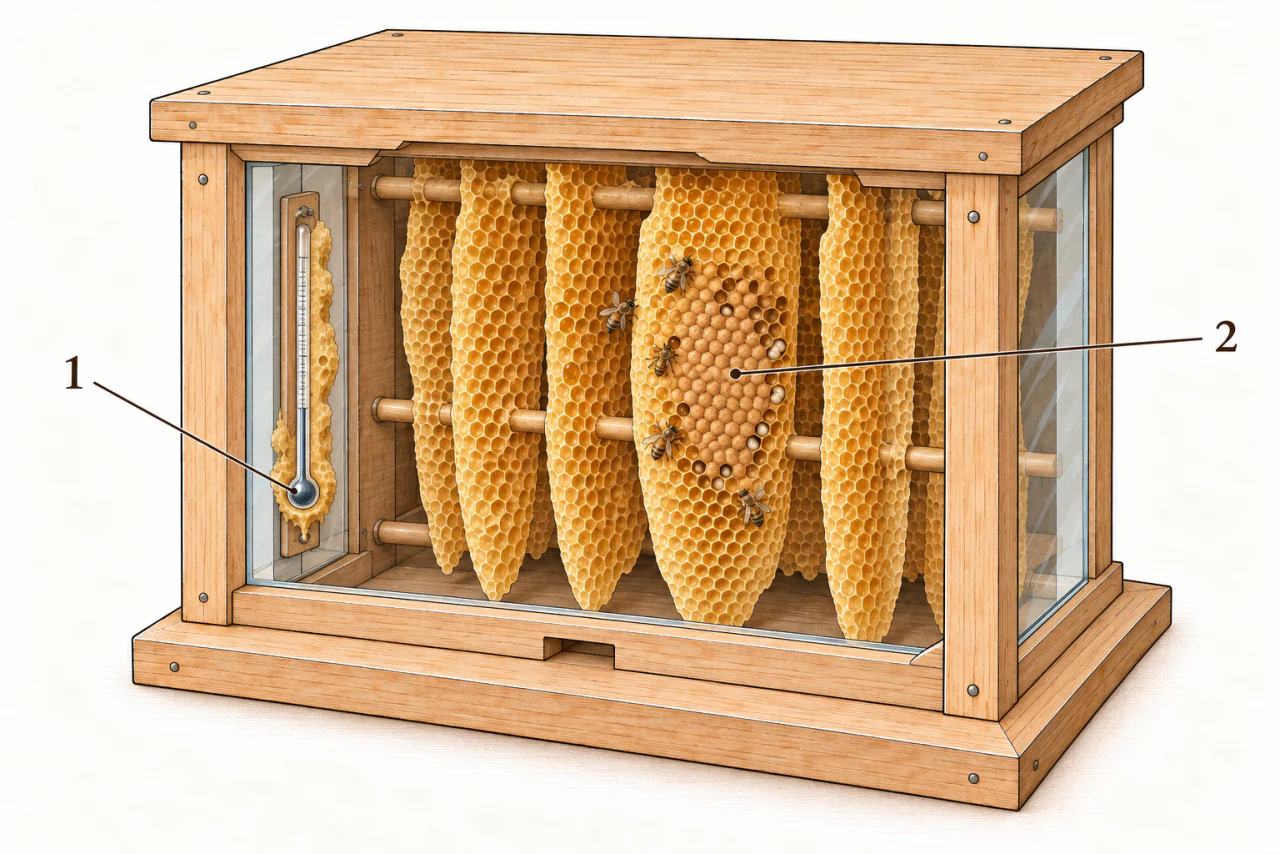
In a freestanding glass hive, Christ fitted a Réaumur thermometer on the north side, let the bees build comb around it and read it hourly. In moderate weather, the hive was six to seven degrees warmer than the shade; with seventeen degrees outside, he measured twenty-three to twenty-four inside, and with twenty outside, twenty-eight to twenty-nine (K6 §13). In winter, he describes the bees drawing closer together as the weather grows colder. He attributes warmth and damp vapour to their exhalations and humming; the glass, he says, is covered with droplets and freezes at the edges (K2 §6). He observes that the colony does not hibernate (K5 §8).
More recent measurements show a colony keeping its brood at just under thirty-five degrees Celsius while the outside temperature ranges from thirteen to forty-one degrees (). Christ’s thermometer hung on the north wall, not in the brood nest, so his readings cannot be compared directly with these brood temperatures. His twenty-four degrees Réaumur convert to thirty degrees Celsius.
1: Christ’s thermometer on the inside of the observation hive’s north wall. 2: The brood nest as a different measurement location. This simplified cutaway compares locations, not temperatures recorded at the same time (K6 §13; Stabentheiner et al. 2021). AI-generated schematic illustration.
The effect of the winter cluster on heat loss is assessed differently. A 2023 model suggests that its mantle conducts heat outwards and provides little insulation; the study interprets clustering as a sign of distress (). In a field trial with forty-three colonies, wrapping the hive reduced food consumption and winter mortality (). Christ recommends a roofed stand, sacks and mats to protect weak colonies, while he aims to help strong colonies cope with moisture by admitting air from above (K2 §6). Neither study tests this distinction or the question of ventilation.
Christ estimates winter consumption for a good colony at barely one Maß, or five Pfund of honey, in eight to ten weeks (K5 §3). He considers the assumption that bees consume more in warm winters than in cold ones mistaken (K5 §22). Measurements over one winter in southern Sweden found daily weight losses of about thirty-five to forty-five grams, depending on the bee race (). Christ’s five Pfund over ten weeks are of the same order of magnitude. He observes the greatest demand towards the end of winter and attributes it to brood rearing (K5 §22), consistent with his statement that brood rearing begins around Christmas and in January (K1 §15).
Food and forage
The sources of bee food, how it is processed and the distance to forage.
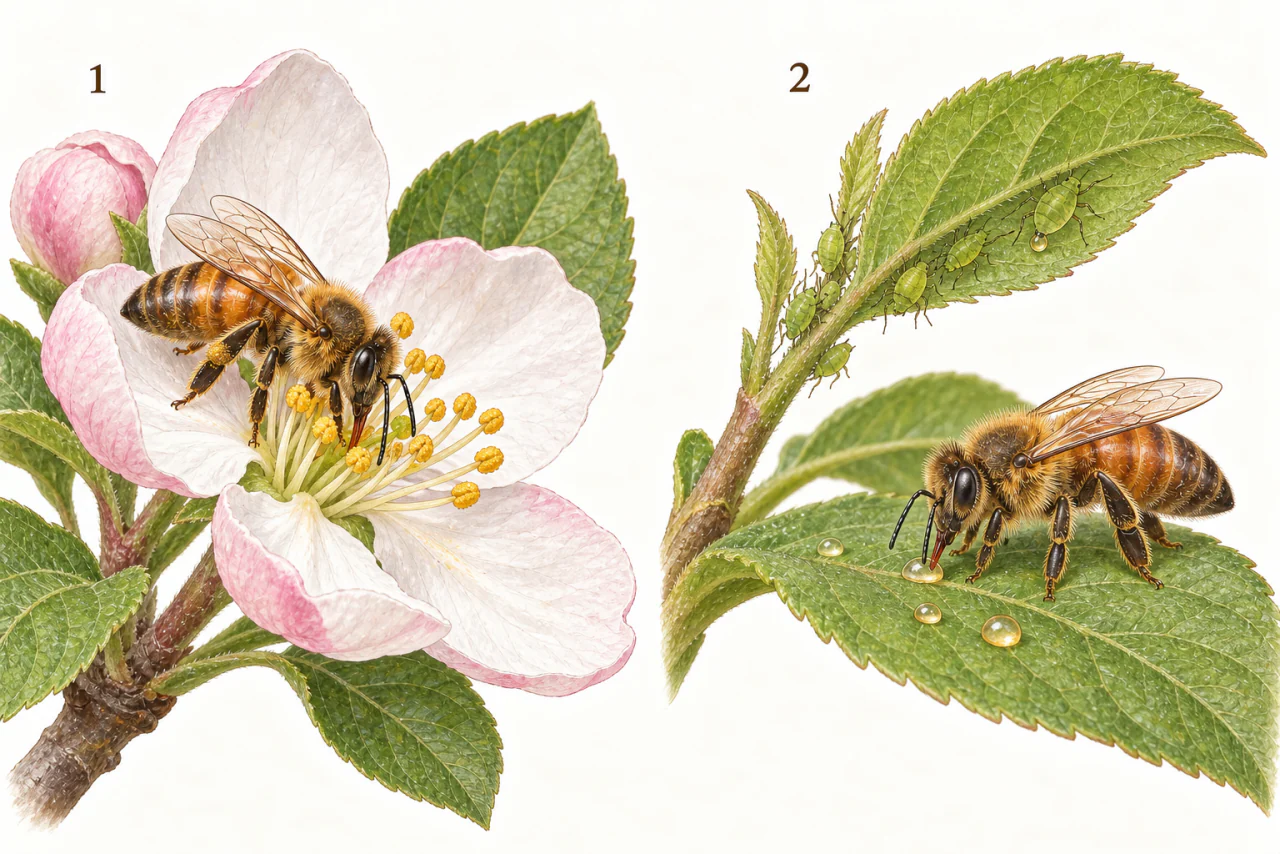
According to Christ, honey comes from the sweet liquid at the base of flowers and from honeydew (K6 §1). He distinguishes two kinds of honeydew. He explains the first, which seems to occur in warm, humid air and atmospheric haze, as sap from leaves. To support his view that honeydew does not fall from the air, he points to covered leaves that nevertheless carry it (K6 §3). He describes the second kind as aphid excretions, “a very good, flavourful honey”(K6 §4), which bees collect eagerly.
He also calls pollen, his Blumenmehl, bee bread. He imagines brood food as a mixture of honey and pollen. Bees cannot live on pollen alone, he argues, because even colonies that have starved still contain a supply of it (K1 §14, K1 §15). He describes bees collecting water from streams and manure puddles, taking in substances he calls nitrous at the same time (K1 §14, K2 §2). In his account, floral nectar is „prepared and cooked into true, proper honey" in the bee’s stomach with the help of acid from the venom sac (K1 §14, K1 §6).
The present distinction between blossom honey and honeydew honey corresponds to Christ’s classification. Blossom honey comes from nectar, while honeydew honey comes from secretions of living plant parts or the excretions of plant-sucking insects (). This also allows the two kinds of honeydew described by Christ to be classified; he was correct in rejecting an origin in the air.
1: A forager collects floral nectar. 2: Aphids excrete honeydew, which a bee gathers from a leaf. Christ already distinguished these two food sources (chapter 6, sections 1 and 4). AI-generated schematic illustration.
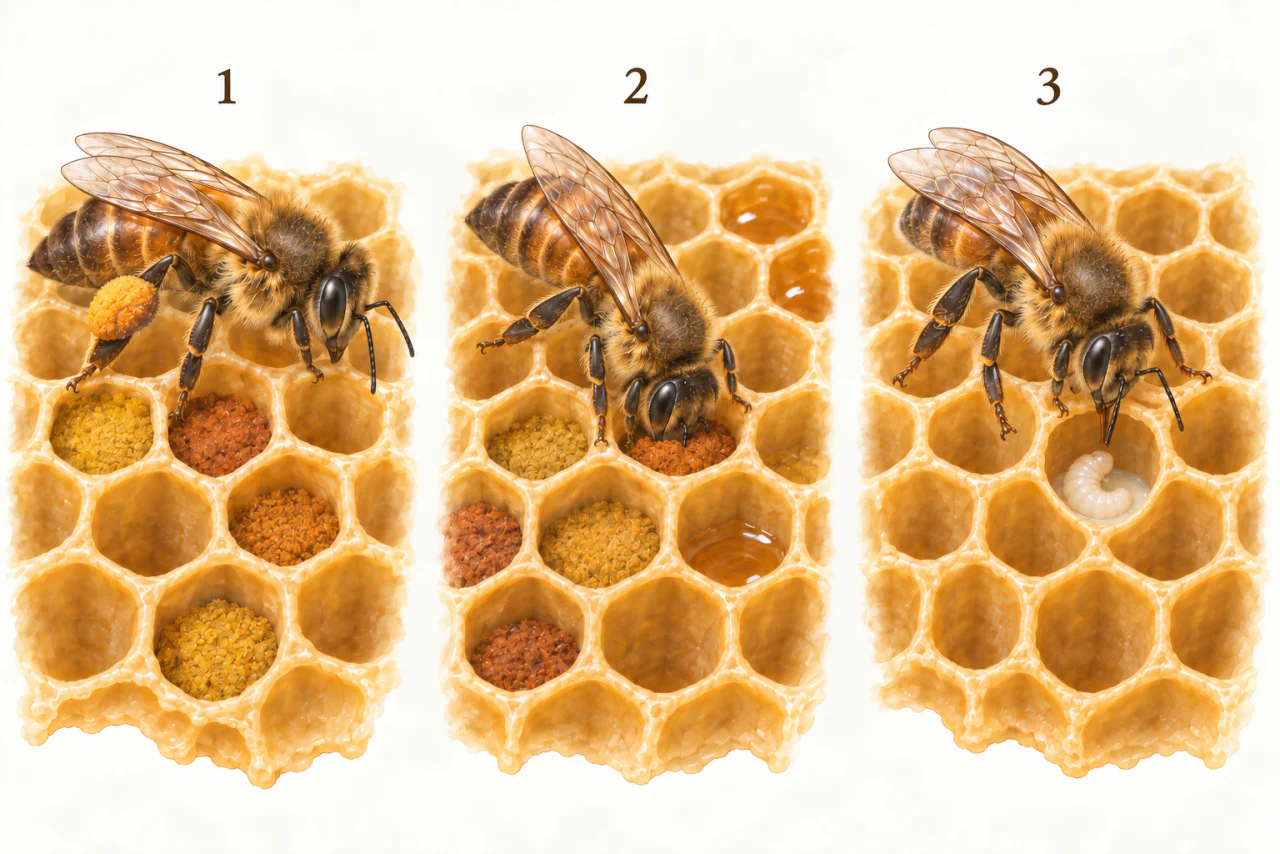
Enzymes produced in the head glands of foragers help process nectar. In young nurse bees, the same glands supply brood food (). This glandular secretion feeds larvae and the queen; Christ’s idea of a mixture of honey and pollen kneaded by the bees does not explain its production (). The nutritional importance of pollen was shown, among other examples, in Israeli colonies where it was the main source of protein and fat ().
1: A forager brings in pollen. 2: Nurse bees consume the stored pollen, chiefly a source of protein and fat. 3: They provide young larvae with brood food produced by their glands. The three views show division of labour in the colony as understood today (Ohashi et al. 1999; Avni et al. 2014; Wright et al. 2018). AI-generated schematic illustration.
Christ recommends forage no more than half an hour’s journey away, arguing that greater distances give bees less time to collect food and expose them to more accidents. He says they can smell honey an hour’s journey away (K2 §1). Von Frisch’s experiments with feeding stations up to four and a half kilometres away show that foragers can fly such distances and indicate them in their dances (). With his half-hour recommendation, Christ is suggesting a distance favourable to yield.
His list of bee plants (K8) ranges from buckwheat and heather through lime, willow and fruit trees to garden herbs. He states that bees cannot reach red clover nectar with their tongues (K8 §2) and avoid chamomile, hellebore and wormwood (K8 §3). He reports the claim that honey from crown imperial and monkshood is harmful as the opinion of others (K8 §3). We have not checked these claims individually.
Diseases
Christ’s descriptions of diseases and parasites, and the limits of his recommendations.
“I come now to the diseases of the bees. But let no one expect a great list here, since fortunately I know of no true bee disease and all quackery with bees is repugnant to me.”(K5 §9) Christ recommends strong colonies, honey with a little old wine and uniting colonies; he places a weakened colony beneath a healthy one (K5 §9). He attributes dysentery, which he recognises by reddish excrement on the combs, to confinement in winter and prolonged cold (K5 §10).
He describes foulbrood by the sunken cell caps over dead brood. He lists impure honey, brood chilling after the loss of many bees, excessive smoking and spoiled pollen as causes. He advises driving the bees out, uniting them with a healthy colony and feeding them the honey (K5 §12). A general plague of bees, he says, is “not known to me from any account”(K5 §12).
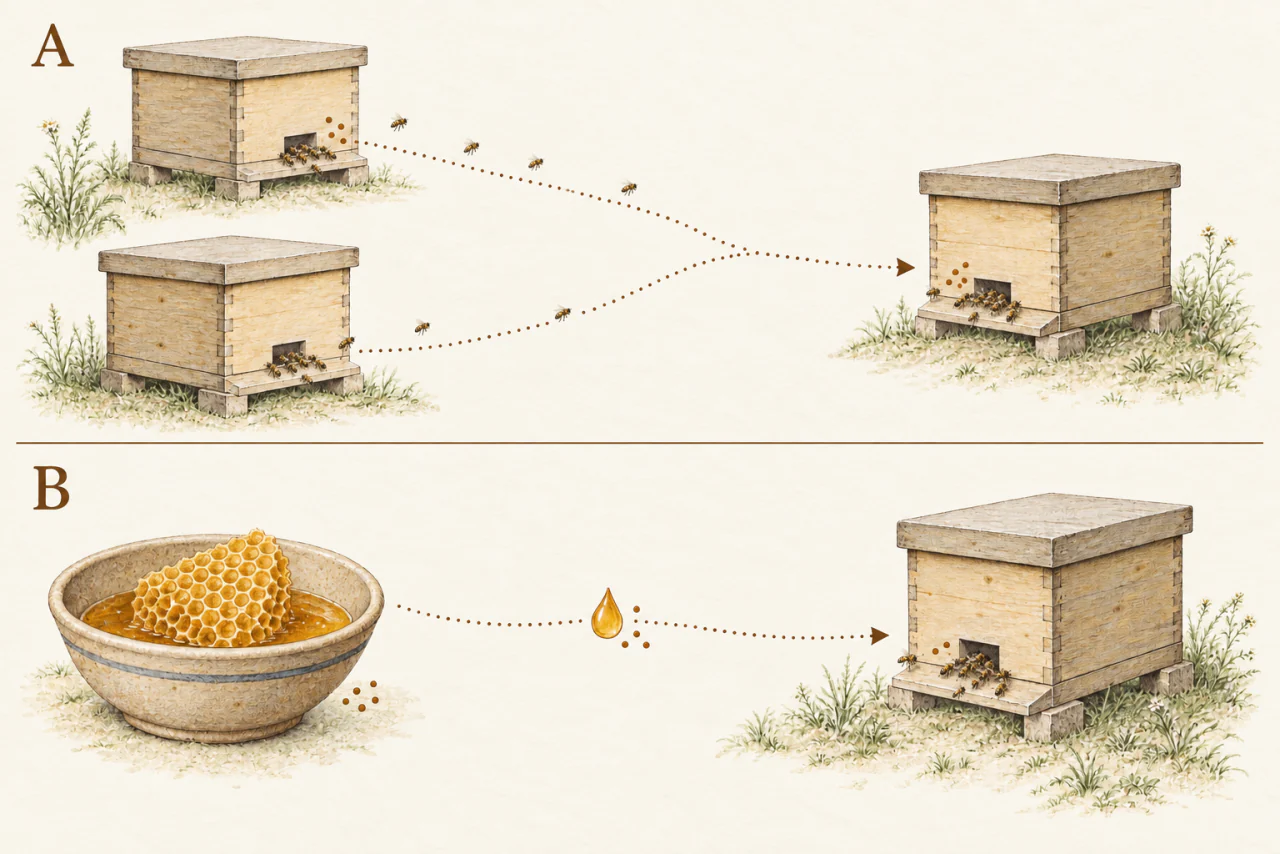
American foulbrood is caused by the spore-forming bacterium Paenibacillus larvae and remains one of the most destructive bee diseases after more than a century of research (). It is notifiable in Germany (), where the Bee Diseases Ordinance regulates what must happen to colonies, combs and honey (). Christ’s recommended practice of uniting bees from a foulbrood-infected hive with a healthy colony and feeding the honey spreads spores; it is now prohibited, and the authorities decide what action is required. This recommendation should be distinguished from his observation that isolated cases of dead, decaying brood also occur in the best hives and are removed by the colony (K5 §12).
A: Combining colonies. B: Feeding contaminated honey. Both actions can transfer American foulbrood spores, making Christ’s recommendation unsuitable for this disease in the light of present knowledge (K5 §12; USDA ARS; FDA). Small clusters of dots symbolise spores; dotted arrows show possible transmission routes. His description does not allow a firm diagnosis of the brood disease he observed. AI-generated schematic illustration.
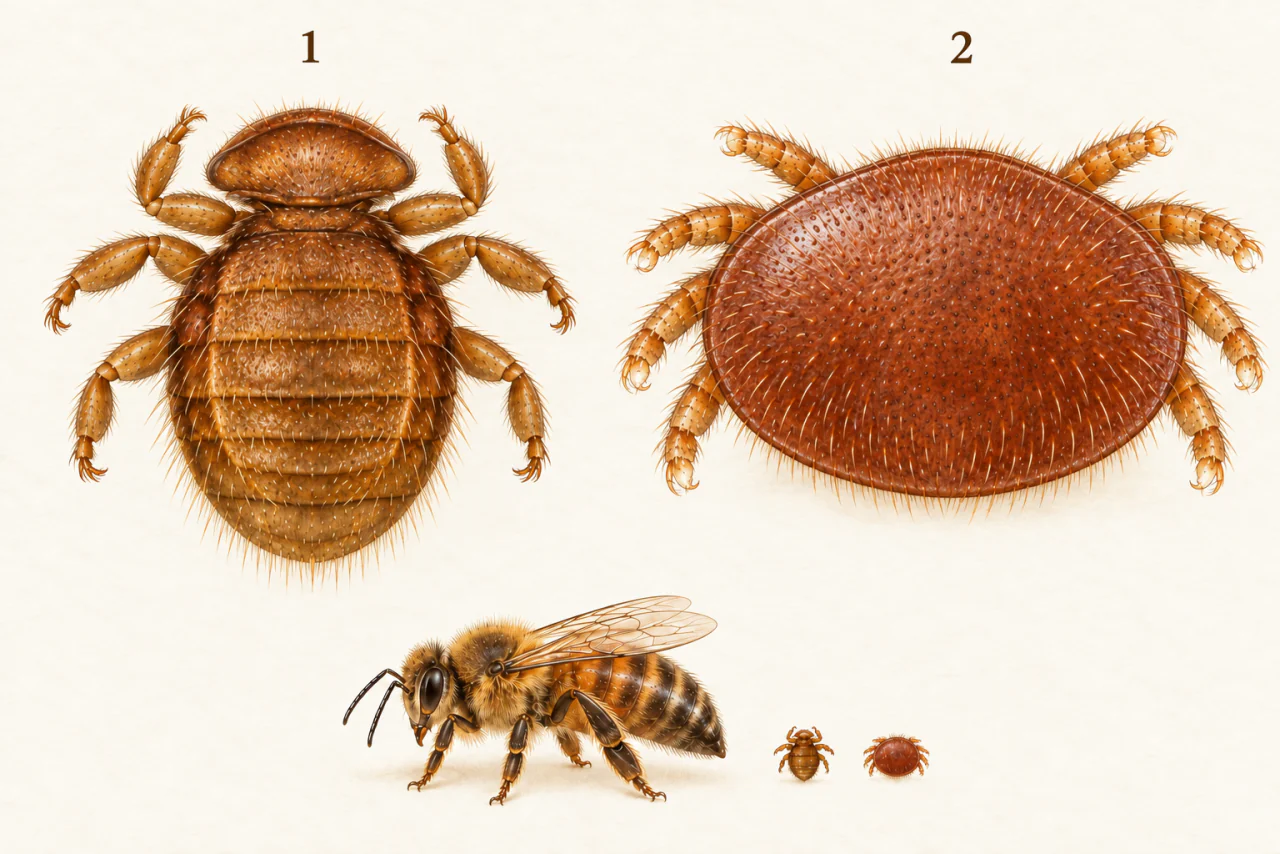
Christ describes the bee louse as a reddish creature the size of a millet grain, sitting on a bee’s back and biting painfully; he mentions seven on a queen. Its origin is unknown to him (K5 §14). The bee louse Braula coeca is a wingless, blind fly related to fruit flies, living in the hive on honey, pollen and wax (). While riding on a worker, it takes food from the bee’s mouth (). Christ advises leaving the bee louse untreated and feeding the colony honey. His decision not to control it is compatible with the limited harm caused by the parasite.
1: Adult bee louse (Braula coeca), a wingless fly with six legs. 2: Female Varroa mite (Varroa destructor), with eight legs and a body wider than it is long. The main views are greatly enlarged; the small group below gives an approximate size comparison with a worker bee. Christ describes the bee louse in K5 §14. Varroa is not described in his book and appears here as a modern comparison. AI-generated schematic illustration.
Under „horn disease", Christ describes yellow tufts with up to forty-eight branches appearing between the antennae in May and being bitten off by other bees. He himself considers them pollen picked up in flowers, rather than a disease (K5 §13). We could not identify them securely from the sources. His interpretation of pollen sticking to the head during flower visits seems plausible. The mite Varroa destructor does not appear in his book; studies of colony survival under Varroa infestation concern a later situation (, ).
Christ’s knowledge of bees in the light of later research
Supported observations, later explanations and open questions from the preceding sections.
Supported observations. Christ recognised the importance of the cell and food in the development of a queen, and also identified workers as female (K1 §5; ). The drone dies during mating (K1 §10; ). Wax emerges as scales between the abdominal segments (K6 §13; ), and propolis comes from resin on tree buds (K1 §14; ). Honeydew comes from plants and aphids; it does not fall from the air (K6 §3, K6 §4; ). The smell of the sting attracts other bees (K5 §23; ).
Christ describes a swarm taking honey with it. His statements about scouts searching for a home are contradictory; later research established that this search takes place (K4 §4, K4 §9; ). Bees do not hibernate, but consume their stores (K5 §8; ). The colony maintains its own warmth (K6 §13; ). Christ describes comb building as proceeding from top to bottom. A more recent study also shows that entrance position affects where building begins (K4 §26; ).
Later explanations and corrections. Christ left open whether the queen could be fertile without males. Mating takes place in flight, the sperm supply lasts her lifetime and unfertilised eggs develop into drones (K1 §10; ). Workers can also lay eggs in the absence of a queen (K1 §5; ). Christ attributed the killing of young queens solely to the old queen. Workers have also been observed intervening by restraining queens (K5 §6; ).
Enzymes from the head glands help produce honey; Christ’s explanation involving acid from the venom sac in the stomach is incorrect (K1 §14; ). Brood food is a secretion from the nurse bees’ glands (K1 §15; ). There is no wax stomach (K6 §13; ). In the dark hive, bees follow a dancer through touch (K1 §3; ). They also perceive airborne sound, though only at very close range (K2 §3; ). Foulbrood is a bacterial disease that can be spread by uniting colonies (K5 §12; , ). Summer bees live for only weeks (K1 §17; ).
Open questions. For queen quacking, the observation of the sound must be distinguished from its explanation: the measurements do not support the breathing openings as the sound source (K1 §3; ). We could not securely identify horn disease (K5 §13). We have not checked against sources Christ’s developmental timings, spraying water to prevent a swarm leaving, the preference for quince trees, the effect of puffball smoke or the toxicity of individual flowers (K1 §15, K4 §10, K2 §3, K3 §9, K8 §3).
Christ’s expectations of observation. At the end of the preliminary notice, Christ argues that no naturalist since Réaumur and Swammerdam has substantially advanced knowledge of bees. He wishes for a member of a beekeeping society to devote a year exclusively to this task, using glass hives and magnifying glasses, so that there would no longer be a need to “quarrel over hypotheses”(Vorbericht). In natural history, he calls himself „very unbelieving" and refuses to agree without examining matters himself (K1 §5). His accounts of heat, wax, honeydew and swarming contain observations later supported by research. In explaining them, he also drew on the chemistry and anatomy of his time.
Nucleus colony
A new colony formed by the beekeeper rather than by waiting for a swarm. Brood and bees from a strong colony are placed in an empty hive.
Christ makes nucleus colonies “after the Franconian manner”: a piece of brood comb four to five inches square is placed in an empty hive, and the bees rear a queen from it (K1 §5). He prefers this method to swarming and allows about a hundred boxes for an apiary of ten colonies, four of which are to swarm (K4 §26).
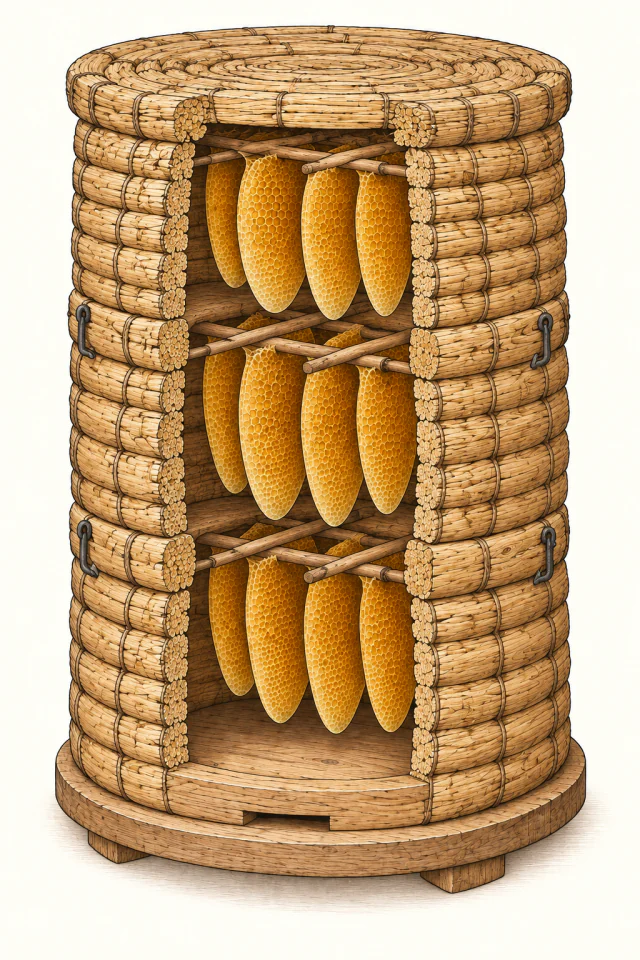
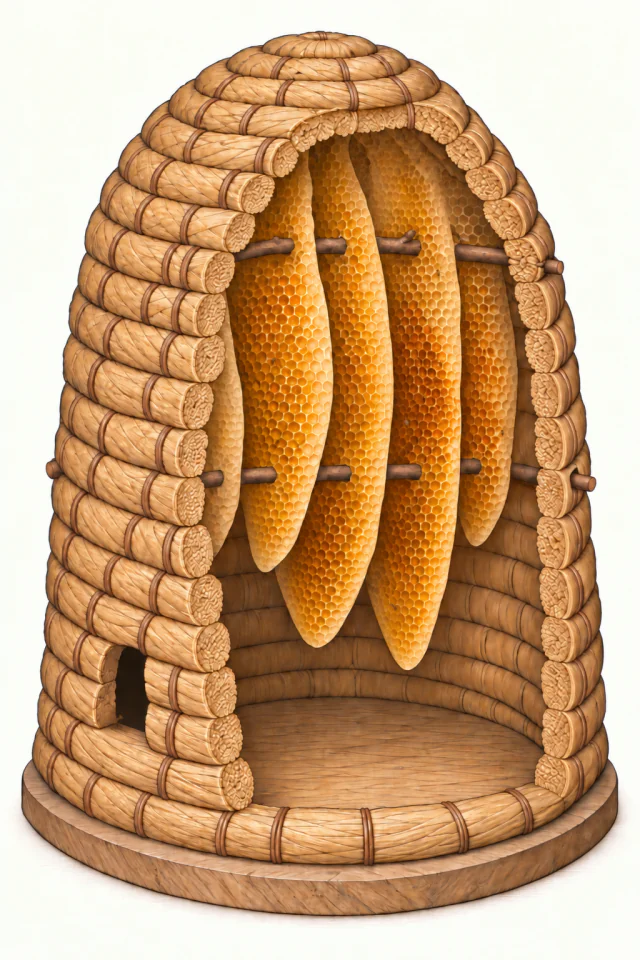
Combs in a straw skep are fixed in place. Harvesting the honey requires cutting them out and destroys the colony in the process. The usual practice was to set the skep over burning sulphur and suffocate the bees.
Christ calls this the “old routine of most country people, which can hardly be rooted out: in autumn they slaughter and suffocate the heaviest and the lightest hives, irresponsibly and quite sinfully” (K3 §2).
Christ also objects to the quality of honey obtained this way: it is “fouled with brood, dead bees, the smell of sulphur and the like” (K3 §6).
Christ’s word for an individual box in his stacked hive. It consists of four planed boards, measures thirteen inches square externally and four and a half inches high, and has an entrance at the front, a pane of glass at the back, a cornice at the top and a grid beneath it (K3 §4).
The boxes have neither floors nor lids. The lowest stands on a floorboard that also serves as a landing board (K3 §9); the top one receives a cover of wood, glass or plaited straw (K3 §4).
For a colony that is not to swarm, Christ allows eight boxes over the summer; for a young swarm, six (K4 §26).
Placing an empty box on top of a full one. Christ considers this easier, but nevertheless does not use it to expand the hive:
“Setting on would of course be somewhat more comfortable than setting under; but it will not do. The nature of bees is to build from the top downwards, and to go on building where they have left off.” (K4 §26, footnote)
He does add vessels above for harvesting. Glasses and porcelain vessels are inverted on the top box’s cover so that the bees can build into them from below; the comb is cut with a silk thread or thin piano wire (K3 §5).
The modern German word for any human-made bee dwelling originated in forest beekeeping. Christ writes that forest bees are “drawn into hollow trees or into Büten or Beuten hewn out expressly for the purpose” and belong to the forest owner (K9 §2).
He does not use the word for his own boxes, which he calls Aufsatz, Kästchen, Magazin or Bienenwohnung.
The gap bees leave open in their hive rather than filling it with comb. Combs hung at this distance can be removed individually without cutting. Lorenzo Langstroth described the spacing in 1851 and received a patent for a hive using it on 5 October 1852.
In this repository, the statement is supported by a search summary covering several pages rather than by the patent document itself (source key langstroth-1852).
A measurement from a source read directly appears in Warré. He leaves twelve millimetres between two top bars, expressly “pour le passage des abeilles” [for the bees to pass through] (Warré 1948, p. 49).
Dzierzon
The priest associated with beekeeping’s transition to movable comb. Writing in 1889, Johann Witzgall recounts that Dzierzon began keeping bees “mit dem Christ'schen Magazinstocke” [with Christ’s stacked-box hive] and through experimentation developed “den jetzt allgemein verbreiteten Stock mit beweglichen Waben” [the now widely used hive with movable combs] (Witzgall, Geschichte der Bienenzucht 1889, p. 56).
The changes began with Christ’s comb-supporting grid. Dzierzon fitted the boxes with movable bars and attached comb to them so that each comb could be lifted out separately. Side doors, fixed floorboards, ledges on the inner walls, shorter and taller boxes and a fixed lid followed (Witzgall, Geschichte der Bienenzucht 1889, p. 56). Christ nails down the six wooden strips of his grid (K3 §4).
In 1844, Dzierzon presented his invention publicly. The distinction between movable- and fixed-comb beekeeping dates from that year (Witzgall/Felgentreu 1889, p. 102).
Witzgall writes forty years after the event and does not quote Dzierzon himself.
The opening through which bees enter and leave. Every box in Christ’s hive has one, four inches long and 1¼ inches high, with two metal slides in front (K3 §4).
Christ explains its size in terms of the air bees need when confinement is necessary and the ease of feeding (K3 §4, footnote).
Since every box has its own entrance, adding a box underneath requires another step: two or three hours later, the upper entrance is closed completely, “otherwise they do not readily build on” (K3 §9).
Four strips of wood glued and nailed to the top of each box. They support the grid and project a quarter of an inch outwards (K3 §4).
Christ gives two purposes for the projection. It forms an ornament, shaped with an ogee plane, and ensures that “all the supers fit well on one another and stand firm if one should turn out ¼ or ½ inch larger or smaller than another” (K3 §4).
This projecting rim prevents wall thickness from being read off the engraved plate. The oblique view in Fig. 1 shows the wall and cornice together at the edge.
Émile Warré (1867–1951) was a French priest and beekeeper. His Ruche
Populaire (“People’s Hive”) was intended to be simple to build and manage.
He described its construction and management in L’Apiculture pour tous,
whose twelfth edition appeared in 1948.
Christ’s own addition to the stacked-box hive. A hole seven inches long and two and a half inches high is chiselled in the rear wall of each box, the glass is fitted into it, and a small shutter excludes the light (K3 §4).
At the end of the same section, in a passage for readers wishing to omit all other refinements, he gives his judgement: “A glass pane in the rear board, however, is almost indispensable.” (K3 §4)
He answers the obvious objection from observation. Bees attach comb to glass as firmly as to wood or straw and keep it clean; what they coat in autumn, they clean again in spring (K3 §11).
The French word for a box placed above another. Palteau’s hive consists of a table, three legs, several hausses, a cover and a landing board; each box measures one foot square and three inches high (Palteau 1777, pp. 7–11).
Christ has not read Palteau in the original. In a footnote to the preface, he writes that only years after his own invention did he read “something of similar bee dwellings”, “such as those of Herr Palteau in France and the Vicat one, which Schirach in his allgemeinen Bienenvater describes” (Vorrede).
A textbook of religious doctrine arranged in questions and answers. Every child worked through it in lessons and learnt the answers by heart; the form was therefore familiar even to readers who read little else.
In 1784, Christ applies it to bees while distinguishing his purpose from that of the classroom. Catechetical teaching is “für den gemeinen Mann die faßlichste und deutlichste” [the easiest for ordinary people to grasp and understand]; he intends no catechism “zum Auswendiglernen, sondern blos zum Unterricht und Nachschlagen” [for memorising, but only for instruction and reference] (Christ 1784, p. VI). His Bienencatechismus für das Landvolk consists of 197 numbered questions, some of which state the opinions he opposes.
Log hive
A log hive is a hollowed section of a felled trunk used to house bees. Unlike a cavity in a living tree, the whole hive can be taken to another site.
A word at the foot of a printed page that repeats the first word of the next. The compositor used it to keep the sheets in order.
It can cause errors in this project: including the catchword when transcribing an old page duplicates a word. In the Vicat source text, three catchwords appear at the head of the following page rather than the foot of the preceding one: “festiget,” (110/111), “einiche,” (118/119), “voraus,” (120/121).
Stacked-box hive, Magazin
A hive made up of several boxes stacked vertically, each removable separately. Christ calls it a Magazin or Magazinstock.
He describes bees having “their household in joined supers … that are increased or reduced from time to time as circumstances, the season and one's intentions require” (K3 §3).
Christ presents wood and glass as innovations. The usual stacked hives had been made of straw, “at least I have seen none of any other kind”; their drawbacks led him to square wooden boxes with a pane of glass (K3 §3).
Beekeeping with movable combs. Its German name arose alongside the contrasting term Stabilbau. In 1889, Witzgall and Felgentreu date both to 1844: “Seit 1844, wo Dr. Dzierzon zuerst mit seiner Erfindung öffentlich hervortrat, spricht man in Imkerkreisen von einem beweglichen oder unbeweglichen Bienenstocke, vom Mobil- oder Stabilbau.” [Since 1844, when Dr Dzierzon first presented his invention publicly, beekeepers have spoken of movable or immovable hives, of movable- or fixed-comb beekeeping.] (Witzgall/Felgentreu 1889, p. 102)
Christ predates this distinction. The bee specialist F. Gerstung later defined his contribution precisely: “in Deutschland der eigentliche Begründer der Mobilbienenzucht … freilich nicht so sehr der Beweglichkeit jeder einzelnen Wabe … als vielmehr der Mobilität, d.h. der Beweglichkeit von Teilen des Bienenstockes, von Auf- und Untersätzen” [in Germany the true founder of movable-comb beekeeping … admittedly less of the mobility of each individual comb … than of the mobility of parts of the hive, of upper and lower boxes] (quoted in Bode 1984, p. 381).
Witzgall/Felgentreu 1889, p. 102
Nadiring
The technical term for adding a box underneath: an empty box is placed below a full one. It describes the operation Christ calls Untersetzen.
The earliest vertically divided hive using this method documented in the project is Gedde’s octagonal box. It has two iron handles “for lifting it up when another is to be placed under it” (Gedde 1677, pp. 18–19).
Top bar
A top bar is a wooden strip to whose underside the bees attach a comb. The comb may also be attached to the hive walls. A top bar alone therefore does not make the comb individually movable.
Lorenzo Langstroth described bee space in 1851: a gap of about a centimetre that bees leave open rather than filling it with comb. He received a patent for it on 5 October 1852. Since then, combs have hung in frames that can be removed individually; this remains the most widespread construction in much of the world.
Christ’s stacked-box hive predates this development. In his hive, the movable unit is the box, lifted off whole while its combs remain inside. The bee specialist F. Gerstung therefore called him the founder “der Mobilität, d.h. der Beweglichkeit von Teilen des Bienenstockes, von Auf- und Untersätzen” [of mobility, that is, the mobility of parts of the hive, of upper and lower boxes] (quoted in Bode 1984, p. 381).
Christ uses the word Rähmchen once, in a different sense: the pane of glass in a straw box is “fitted into a small wooden frame” (K3 §8).
A ring skep consists of straw rings of equal diameter, stacked to form a
shared interior. More rings can be added to enlarge the hive. Fixed crossbars
support the combs and allow individual sections to be removed with their comb.
AI-generated schematic illustration after Fleischer (1777).
Fleischer 1777, pp. 311–314; explanation of the plate, Figs. 2–4
Rose, Rosentafel
Christ’s term for a comb. He uses it as a synonym for Wachstafel and combines the two when explaining how young colonies can be recognised: “by the whiteness and delicacy of their wax combs or roses” (K2 §10).
Compound forms occur throughout the book. Honigrosen are honey-filled combs (K3 §5), while Bruttafeln contain brood (K4 §2).
The comb guide in Christ’s box. Wooden strips, each one inch wide, are nailed into the rebates of the front and rear cornice strips; the bees align their comb with them (K3 §4).
The number depends on the position in the stack. Only the top box receives six strips, “so that the bees attach and build their combs in this direction, from the rear wall toward the flight hole”. The lower boxes receive two, since the bees continue in the direction already established (K3 §4).
Christ gives three reasons for using fewer strips below: the colony clusters more closely in winter, debris does not collect on the wood, and bees can move up and down more easily (K3 §4). To support heavy honey combs, each box with two strips also receives a cross made of two round willow or hazel sticks (K3 §4).
A bee that flies out before a swarm to seek a new dwelling.
Spurbiene is Christ’s own term, although he considers the behaviour unproven. The idea that bees “some days before swarming, seek out a hollow tree by means of scouts, or so-called scout bees” belongs, in his view, “in truth quite among the mere conjectures” (K4 §9). He nevertheless accepts it for hunger swarms, having watched individual bees clean an empty hive for days before a swarm moved in three days later. He does not regard scouts as a separate caste: they are “of course no special kind of bee” (K4 §9).
A hundred and eighty years later, experiments with boxes in the forest measured the criteria by which a swarm chooses a nest. These criteria underpin the story “A bee in search of a home” (Seeley and Morse 1978, cited indirectly rather than read in full).
Beekeeping in hives without movable frames. Comb is firmly attached to the ceiling and walls. To remove it, the comb is cut free or taken out with the hive section to which it is attached.
Witzgall and Felgentreu date the distinction between fixed- and movable-comb beekeeping to 1844, the year Dzierzon presented his invention publicly (Witzgall/Felgentreu 1889, p. 102). By 1889, the same authors already regard fixed comb as needing justification. They open their chapter by suggesting that some readers may be surprised to find it included, “nachdem man ja doch schon längst den Stabilbetrieb als veraltet und für die heutigen Zeiten als abgethan betrachtet…” [since fixed-comb management has long been regarded as outdated and no longer relevant to the present day…] (Witzgall/Felgentreu 1889, p. 209).
Christ does not know the term. In his time, there is nothing from which fixed-comb beekeeping needs to be distinguished.
Witzgall/Felgentreu 1889, pp. 102 and 209
Straw skep
The ordinary bee dwelling of country people in Christ’s time: a basket coiled from straw ropes, made in one piece and impossible to divide. Honey is harvested by cutting out the comb, and the colony dies in the process (K3 §2).
Christ proposes his stacked-box hives instead. An apiary of thirty to thirty-six of them is “worth more than an apiary of 100 pieces in straw baskets” (K4 §26).
He also describes continued use of the skep. In K3 §10, he explains how to place a straw skep on a lower hive box, seal the skep’s entrance and thereby draw the bees down into the boxes.
A small basket placed on top of a straw skep for the bees to fill with honey comb. Christ uses the country people’s terms: “the small baskets (caps, hoods) which the country people set on the straw baskets” (K4 §26, footnote).
Their limited use strengthens his objection to adding space above. Of ten colonies, scarcely one or two build into them, and only in a particularly good honey year; many prefer to build outside rather than in the basket above (K4 §26, footnote).
The same box as an Aufsatz, occupying a different position in the stack. Christ explains the term in a footnote:
“I shall hardly need to remark that by lower supers I understand nothing else than those supers which stand lowest, because they are mostly only ever set underneath; and they may all be called little boxes, on account of their likeness to such.” (K3 §4, footnote)
The name follows the position in the stack. The comb-supporting grid differs: six strips in the top box, two in the lower boxes (K3 §4).
Placing an empty box beneath a full one. This is Christ’s way of expanding the hive and the operation around which his entire management system is organised.
He specifies the timing: once the lowest box is “built somewhat more than half or to three parts full”, the next goes beneath it, and so on into August (K3 §9). Only one is added at a time, since “the bees build more readily into one empty super than into two” (K3 §9).
He describes the work twice. His earlier method takes place very early in the morning, with a helper lifting the hive while the other person withdraws the floorboard (K3 §9). His later, improved method is at midday, during peak flight, when “Out of industry and eagerness in bringing in they trouble themselves about nothing” (K3 §9).
The resin bees use to seal crevices and attach comb, now called propolis.
Christ explicitly distinguishes it from wax: “The cement or fore-wax, which is different from wax and is properly a sticky resin, though after being worked and especially in the cold it becomes quite hard” (K1 §14).
He uses it when populating a hive. Melted over coals and brushed into the corners of a new box, it keeps a young swarm in place; a previously used box already coated with resin provides the same advantage without the work (K4 §21).
The old German word for the queen. Christ uses both terms together: “The queen, called by the ancients the Weisel” (K1 §1).
In compounds, the older term has remained more common. Weisellosigkeit means the condition of a colony without a queen; Christ devotes a separate section to it (K5 §6).
A medieval forest beekeeper who kept bees in hollow trees and paid dues for doing so. In his chapter on law, Christ connects the occupation with rights over trees: “the Zeidler company formerly arose from this, who pay a certain rent in honey and wax to the forester or to some other lord of the forest” (K9 §2).
For him, this belongs to the past. The house and garden bees of his own time belong “among our domestic animals” (K9 §2).
The unit of length Christ uses has not been conclusively identified. There was no uniform inch; each region had its own.
Only once in the whole book does Christ write “lines Paris inch”, when giving the length of a queen. Before that, he has already used inch twenty-four times without qualification (Anmerkungen des Übertragers).
The transcriber compared the construction dimensions with Christ’s stated volume of four Maß. Using the Paris inch (2.71 cm) produces a discrepancy of 27 to 34 per cent; the Frankfurt inch (2.37 cm), one of 1 to 8 per cent. He concludes that the lengths cannot be expressed in Paris inches and that the conversion factor lies between 2.4 and 2.5 (Anmerkungen des Übertragers).
This is an inference, not a statement by Christ, who nowhere specifies which inch he means.
The old church due: approximately a tenth of a farm’s annual produce, delivered as crops, wine or livestock. Part of it paid the parish priest, who collected it from the same people to whom he preached on Sundays.
Christ collected tithes himself and went to court over them. When a tithe income ceased, he received land instead, a “Besoldungsstük zum Ersaz des Zehnden” [a plot of land forming part of his salary in compensation for the tithe] (Bode 1984, p. 181).
Bode 1984, p. 181
Bienenkiste
The Bienenkiste is a long, horizontal fixed-comb hive with the brood area at the front and the honey area at the rear. Its removable floor gives access to the combs from below.
Zeidlerei is a traditional form of forest beekeeping in which bees are kept in cavities cut into living trees. Current initiatives revive the craft both for keeping bees and for creating habitats for species that live in tree cavities.
This sample contains stored food taken from close to the brood nest. A laboratory examines it for spores of the bacterium that causes American foulbrood.
Hive debris is material that falls from the colony onto the hive floor, such as wax particles, pollen and dead mites. Its composition and distribution give clues to activity in the colony, including comb building, food consumption and the position of the winter cluster.
Flavonoids are secondary plant compounds that also occur in honey. Their measured total content describes one aspect of its chemical composition. A higher value alone does not demonstrate an additional health benefit from the honey.
David Heaf is a beekeeper and author in Wales. Together with Patricia Heaf, he translated Warré’s L’Apiculture pour tous into English. His website brings together plans, management methods and accounts of beekeeping with the Warré hive.
Phil Chandler is a beekeeper and the author of The Barefoot Beekeeper. He developed his own horizontal top-bar hive for beekeeping with few interventions in the brood nest and published freely available construction plans.
The magazine hive of six supers, with bellows and knife
Johann Ludwig Christ, Anweisung zur nützlichsten und angenehmsten Bienenzucht für alle Gegenden, dritte Auflage, Leipzig 1798 · Third copperplate, to chapter 7 · Photograph: Münchener DigitalisierungsZentrum, Bayerische Staatsbibliothek
Exploded view of Christ’s hive, illustrated with three sections. The top section has six fixed bars; each lower section has two bars and crossed sticks. Observation windows are set into the rear walls. AI-generated schematic illustration after plate II and chapter 3.
Christ’s hive through the year: 1 occupied hive; 2 space added below; 3 honey removed above; 4 unused lower space removed where needed and winter covering fitted. Box counts are examples and do not indicate the winter stores required. After K2 §6, K3 §§4 and 9, K4 §26 and K6 §§5–7. AI-generated schematic illustration.
The magazine super: thirteen inches square, four and a half high
Johann Ludwig Christ, Anweisung zur nützlichsten und angenehmsten Bienenzucht für alle Gegenden, dritte Auflage, Leipzig 1798 · Second copperplate, to chapter 3 §4 · Photograph: Münchener DigitalisierungsZentrum, Bayerische Staatsbibliothek
The two entrance slides after Christ (K3 §4): 1 the large opening exposed; 2 reduced to a small bee passage; 3 closed to bees by the perforated rear slide, which admits air. AI-generated schematic illustration.
Lower section of Christ’s hive with two fixed wooden slats, crossed sticks and two entrance slides. After plate II. AI-generated schematic illustration.
Comb supports after Christ (K3 §4): 1 the uppermost section with six fixed strips; 2 a lower section with two strips and thin crossed sticks. Cutaways reveal how the comb is attached and supported. AI-generated schematic illustration.
Christ’s magazine hive with six shallow sections and a weather roof. After plate III and chapter 3 (1798). AI-generated schematic illustration.
Top section of Christ’s hive: six fixed wooden slats and a window behind its open shutter. After plate II. AI-generated schematic illustration.
Rear view of Christ’s hive with observation windows and two open shutters. AI-generated schematic illustration.
(1) An empty glass is inverted over an opening in the cover. (2) The bees have extended the combs of the upper box into the glass; its cardboard cover has been removed. After Christ (1798), chapter 3, section 5. AI-generated schematic illustration.
Christ’s glass observation hive with wooden shutters and fixed cross-sticks. After plate IV and chapter 3. AI-generated schematic illustration.
Top closures after Christ (K3 §4): 1 a glass lid in a wooden frame; 2 a thin mat of bound straw cords with a protective board against mice. The straw closure replaces the glass in winter and may also remain in summer. Parts are separated for clarity. AI-generated schematic illustration.
Christ's bee stand for 36 magazine hives
Johann Ludwig Christ, Anweisung zur nützlichsten und angenehmsten Bienenzucht für alle Gegenden, dritte Auflage, Leipzig 1798 · First copperplate, to chapter 2 §7 · Photograph: Münchener DigitalisierungsZentrum, Bayerische Staatsbibliothek
The wax press, beside it the feeding box and the little feeding trough
Johann Ludwig Christ, Anweisung zur nützlichsten und angenehmsten Bienenzucht für alle Gegenden, dritte Auflage, Leipzig 1798 · Fifth copperplate, to chapter 5 §3 and chapter 6 §12 · Photograph: Münchener DigitalisierungsZentrum, Bayerische Staatsbibliothek
Christ’s feeding box with a sliding trough, floating wood slivers and a glass cover. After plate V and chapter 5. AI-generated schematic illustration.
Christ's hanging wax press in its filling configuration: a hemp sack hangs between two pressing boards, with a tub of water below. After Christ (1798), plate V, figure 1 and chapter 6, section 12. AI-generated schematic illustration.
From a straw skep to a magazine hive, after Christ (K3 §10): 1 a lower box with a cut-out adapter board; 2 further construction downwards; 3 remove the skep after its bees have been driven into the built wooden boxes. Sufficient comb and stores must be present. AI-generated schematic illustration.
Adding a box below, after Christ (K3 §9): 1 prepare an empty box on a new floorboard; 2 move the occupied stack onto it; 3 place the old floorboard with its remaining bees on the shelf; 4 close the former entrance later. AI-generated schematic illustration.
1: Swarm capture with two poles: a hook on the branch and a sack suspended in a fork beneath the swarm. 2: Smouldering cloth roll containing human hair. 3: Basket hung freely from a nail as a gathering place. Its shape and angle are reconstructed. After Christ, K4 §§15, 17, 22; K7 §2. AI-generated schematic illustration.
Dividing a colony after Christ (K4 §2), at the start of the swarming season with abundant forage: four occupied boxes become two colonies, each with two occupied boxes and an empty box below. Colours track their origin; the stone marks the original site for the weaker part. Both need brood. AI-generated schematic illustration with simplified comb views.
Making a new colony from several colonies, after Christ (K4 §2), at the start of the swarming season with abundant forage: the lowest brood box from each of two colonies forms the new colony. It receives an empty box below, as does each donor to replace the removed box. Colours identify the donors. AI-generated schematic illustration with simplified comb views.
Separating boxes with a wire, after Christ (K6 §6; K7 §3): 1 draw the taut wire from the entrance towards the rear; 2 sever the wax connections at the joint; 3 lift off the whole honey box. The fixed bars are omitted from the comb views. AI-generated schematic illustration.
Winter stores after Christ (K3 §10): in 1, the honey boxes are directly above one another at the top. In 2, comb without honey interrupts the route to the upper stores. Christ warns that a colony may starve despite honey remaining above. Box counts are examples. AI-generated schematic illustration.
1: Tooting by a free queen in contact with the comb. 2: Quacking by a queen still confined in her cell, shown in cutaway. The sparse vibration marks schematically indicate transmission through the wax (K1 §3; Michelsen et al. 1986). AI-generated schematic illustration.
1: Christ’s thermometer on the inside of the observation hive’s north wall. 2: The brood nest as a different measurement location. This simplified cutaway compares locations, not temperatures recorded at the same time (K6 §13; Stabentheiner et al. 2021). AI-generated schematic illustration.
1: A forager collects floral nectar. 2: Aphids excrete honeydew, which a bee gathers from a leaf. Christ already distinguished these two food sources (chapter 6, sections 1 and 4). AI-generated schematic illustration.
1: A forager brings in pollen. 2: Nurse bees consume the stored pollen, chiefly a source of protein and fat. 3: They provide young larvae with brood food produced by their glands. The three views show division of labour in the colony as understood today (Ohashi et al. 1999; Avni et al. 2014; Wright et al. 2018). AI-generated schematic illustration.
A: Combining colonies. B: Feeding contaminated honey. Both actions can transfer American foulbrood spores, making Christ’s recommendation unsuitable for this disease in the light of present knowledge (K5 §12; USDA ARS; FDA). Small clusters of dots symbolise spores; dotted arrows show possible transmission routes. His description does not allow a firm diagnosis of the brood disease he observed. AI-generated schematic illustration.
1: Adult bee louse (Braula coeca), a wingless fly with six legs. 2: Female Varroa mite (Varroa destructor), with eight legs and a body wider than it is long. The main views are greatly enlarged; the small group below gives an approximate size comparison with a worker bee. Christ describes the bee louse in K5 §14. Varroa is not described in his book and appears here as a modern comparison. AI-generated schematic illustration.