Johann Ludwig Christ, 1739–1813. Parson in Kronberg, pomologist, entomologist and beekeeper.
Johann Ludwig Christ is today hardly more than a name on a street corner in Kronberg am Taunus; the monument beside it he owes to a horticultural society that remembered him long after his death.
I came across him while reading about bees. When I looked closer, he fascinated me as a man and as a maker: a village parson who wanted to „bis auf das Würzelchen auskundschaften" [ferret out down to the last rootlet] whatever he came upon, as he writes himself (Bode 1984, S. 35), and who passed on everything he found out to the farmers and craftsmen who needed it for their living. For them he reckoned a bee box down to three Kreuzer; for them he sat in the parlours of an evening and talked about the tilling of the fields. His church elders denounced him for it.
What carried him through all this can only be guessed at. He buried three sons in five weeks, and two wives; for twenty-eight years he quarrelled over a bee stand, an espalier and five bundles of peas; at seventy he was still writing his largest book. Mistakes he made, of course, in his haste to spread what was good. The friend who held them up to him he thanked for it.
Such people exist in every landscape and in every age. Mostly they make no great fuss about themselves. Yet beside earning their bread they lay the stones on which we build. Whoever looks more closely finds a life behind the name, sometimes one as many-coloured as Christ's: a man who slept in the moss on the Feldberg so as to draw the sunrise.
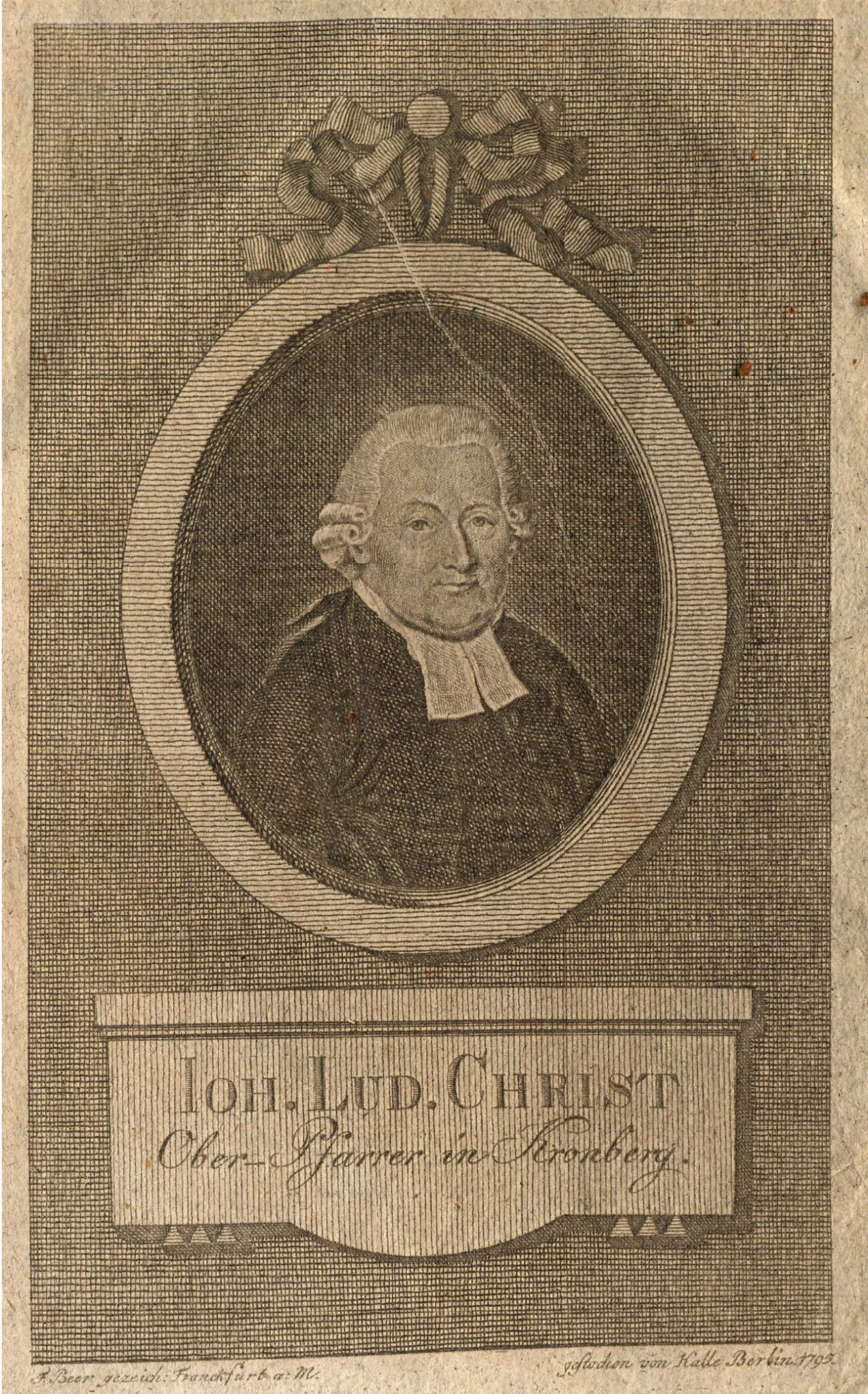
Portrait
The Kronbergers who had known him described him, three decades after his death, to their parson Doerr, who was writing a chronicle of the town. They had seen him riding through the fields on a small horse, the pipe in his hand or hanging out of his coat pocket, almost always nibbling at sweetmeats, in a green overcoat with large buttons; they had taken him for an agriculturist or a forester. Doerr writes this down and sets behind it: „So sagen mir die Leute, die ihn gekannt haben." [So the people tell me who knew him.] (Doerr, zitiert bei ) He had written a bee book, they said, and often owned only a single hive while he did so; he had come to the town quite poor and left a handsome fortune behind (ebenda).
Before he came, those same Kronbergers had written to Mainz that one heard of him that he inclined more to worldly things than to the spiritual teaching office . Fifteen years later a Prussian commissioner of agriculture rode over from Frankfurt to appraise the husbandry of the district. He found a tirelessly active agriculturist and an agreeable companion, whose tree nurseries ran to more than two Morgen. At the grafting he saw the parson put his own hand to the work and cut the scions, with particular exactness, as he notes (Cranz, zitiert bei ).
How he worked he wrote to a friend at forty-two. In summer he had climbed the Feldberg to take down the views from there in drawings, in autumn once more, into the clouds, and now he offered himself as a companion for the winter, with the thermometer: „Sie wissen, wenn ich an etwas komme, so mögte ichs gern bis auf das Würzelchen auskundschaften, und da ist mir keine Arbeit zu viel, und keine Unbequemlichkeit unüberwindlich." [You know, when I come upon something, I like to ferret it out down to the last rootlet, and then no labour is too much for me and no discomfort insurmountable.]
Forty-nine years he stood in office, as a village parson in the Hanau lands and in the Wetterau, then as first parson of the little town in the Taunus. The books came into being alongside. When a dictionary of scholars asked him for an account of himself, he called what he had pursued besides theology his spare hours: mathematics, civil architecture, geometry, optics and drawing . Out of such spare hours came some twenty-five titles (), on field husbandry, on insects, on fruit trees and on bees.
For whom he wrote stands in the first sentence of a preface that he had printed in the year after his arrival in Kronberg: „Ich liebe die Bauren, weil sie diejenigen Menschen sind, ohne welche niemand leben kann und die nüzlichste und nothwendigste Beschäftigung unter allen Menschen treiben." [I love the farmers, because they are those people without whom nobody can live, and who pursue the most useful and most necessary occupation among all men.] (Christ 1787, zitiert bei ) His bee book for the countryman he wrote in question and answer, because he held this manner of teaching to be the most graspable there was for the common man . In it he reckoned out what one little box of his hive costs if a man nails it together himself: a board at nine Kreuzer gives five boxes, the pane of glass costs one Kreuzer, the nails four, „und also stünde ein Kästchen auf drei Kreuzer und ⅘ Heller" [and so a little box would stand at three Kreuzer and ⅘ Heller] . The straw skep the country people had used until then cost twenty-four .
Of an evening townsmen sat with him; to the people he went in their houses. His church elders made of this, in a written complaint, the fomenting of conspiracy and sedition . To the government he answered that he talked with the members of his parish about their livelihood and their field husbandry, because good could be done in that too; in their houses he visited them without distinction, whether friend or foe .
Mistakes he certainly made. Two men who bought his trees wrote them down. The physician Diel, the younger and stricter pomologist, charged him three years after his death with having often sent out wrongly named and unknown hotchpotch (Diel 1816, zitiert bei ). The Freiherr Truchseß at the Bettenburg, who knew him from a long correspondence and never saw him, held against this that many a stone thrown at Christ had struck „nicht einen Betrüger, sondern einen gutmüthigen Selbstgetäuschten" [not a deceiver but a good-natured man deceived by himself], „der im Drang, Gutes schnell zu verbreiten, wieder täuschen mußte" [who, in his urge to spread what was good quickly, was bound to deceive in his turn] (Truchseß, zitiert bei ). He had taken everything that was sent to him on trust and passed it on the same way (ebenda).
Christ was probably not wholly without temper, as one can read in the Catholic priest of the town, who saw him at odds with his brother in office for eighteen years. He held him to be hot-headed; with the pen, he wrote, Christ was more modest and more master of his heat than in speech (Ihl, zitiert bei ). Of this quarrel the Kronbergers whom Doerr questioned knew as well. Christ had lived in long-standing enmity with his colleague Bleichenbach, they said, but had found affection in the parish (Doerr, zitiert bei ).
The Parson
He was born in Öhringen, the small residence town of the Counts of Hohenlohe, the son of a chamber clerk who later became auditor of accounts to the Imperial Knighthood in Heilbronn and lastly bailiff in a village nearby . His mother died when he was thirteen, his father in the year in which he began his studies at Tübingen, of consumption, at fifty-one . Mother and grandmother were parsons' daughters, the first of his godfathers a parson; the fathers before them had been cap-makers and braid-weavers, the oldest Christ known a villager from Hüffenhardt on the Neckar . After Tübingen came Erlangen and Altdorf, then some years as a private tutor in other people's houses, where such a tutor was often reckoned among the servants . What he pursued on the side in these years he later listed himself: mathematics, civil architecture, geometry, optics, drawing .
At twenty-four he received his first parish, Bergen near Frankfurt, a Lutheran minority in a Reformed village, which held its services in an old chapel because the church belonged to the others. Eleven parsons had held the post in the fifty-two years before him . He stayed three and a half years and left behind, in the daughter parish of Berkersheim, a church. The consistory in Hanau had decided on the new building, and the ground plan and elevation of church and tower had been made, as he wrote himself in the church register, „von mir Johann Ludwig Christ" [by me, Johann Ludwig Christ] (Kirchenbuch, zitiert bei ), at twenty-six, together with the supervision of the building. Into the foundation stone went a little glass box with an inscription in his hand on parchment and the newly minted Hanau coins of the year, from the Gulden down to the Kreuzer . The building still stands.
In January of the same year in which the tower was finished he had married Marie Regine Prinz from Stuttgart, twenty-seven years old . In the autumn the couple moved with their first son to Rüdigheim near Hanau, where besides the village he had four small Lutheran congregations across the country to serve .
Three Sons in Five Weeks
In Rüdigheim four more children were born, three sons and the daughter Wilhelmine Friederike Sabine . In January and February 1776 the three eldest sons died within five weeks, nine, seven and five years old. Of what, we do not know; Bode supposes an illness in the village against which the physicians had nothing to set . The father wrote in the church register of the children, whom he had „dem Heiland in seine Wunden gelegt" [laid in the wounds of the Saviour] (Kirchenbuch, zitiert bei ). The turn of phrase is a prayer from Johann Arndt's Paradiesgärtlein; Bode reads it as a sign that Christ had encountered Pietism . At Christmas of the same year he took up the parish of Rodheim vor der Höhe, in the Wetterau, at thirty-seven .
The Writer
Rodheim was again a Lutheran minority beside a larger and wealthier Reformed congregation . In the ten years there he became a writer. Nine books came into being, on tobacco growing, on field husbandry, which alone filled almost seven hundred pages, on distilling brandy, on the history of the body of the earth, and the essays for the Hanauisches Magazin besides; whoever adds up the book pages of these years comes close to two thousand . The Anweisung zur nützlichsten und angenehmsten Bienenzucht appeared in 1780 and had to be reissued after three years, enlarged by sixty pages; in 1784 the Bienencatechismus followed it. His publishers sat in Frankfurt . The bee dwelling of which the Anweisung treats he had built before that: “Several years ago, therefore, I made another invention of wooden magazine houses”(Vorrede).
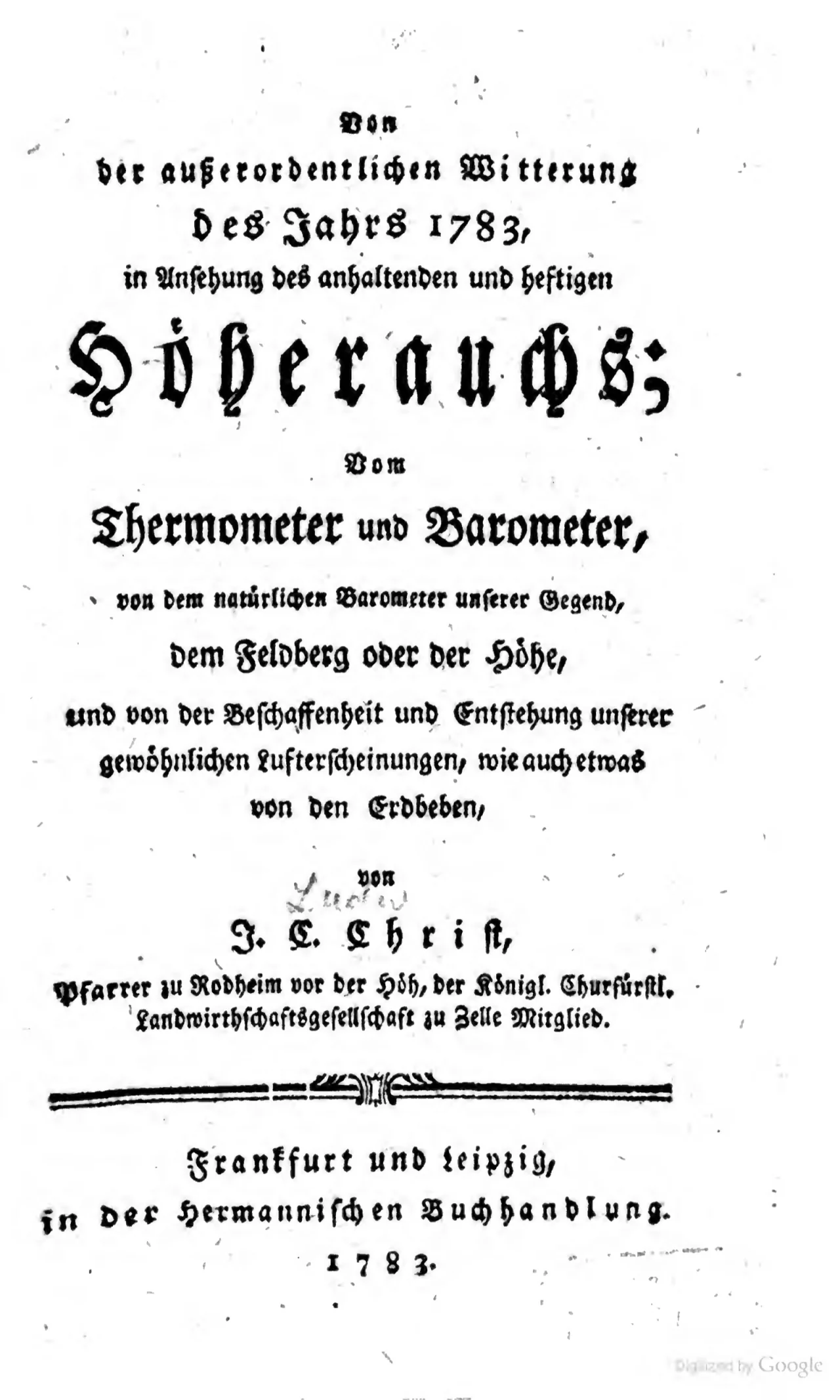
The title page of 1783, printed in the Rodheim years
He worked fast. How fast, the thinnest of these books shows. On 16 June 1783 he saw the Höherauch for the first time, the dry fog that lay over wide parts of Europe that summer; on 11 July he began to write. From the extraordinary density he inferred an extraordinary cause and named fires in the earth, in Sicily, in Calabria and, after more recent reports from Iceland, a burning island „an den äußern Vögelklippen" [at the outer bird cliffs] . With that he hit the right region. The cause was the eruption of the Laki fissure on Iceland, of which he could know nothing, for reliable news reached Copenhagen only on 1 September; what had been reported to him was the eruption off Reykjanes in May (). Today's literature counts him among those who weighed the connection early ().
All this he wrote for people who were to live better from their work. In his own parish he helped them with money. For the poorer people in the daughter village of Holzhausen he set up in these years a free-school fund out of bequests and collections, which was to free them from school fees and from the firewood money ; whoever had nothing should still be able to send his children to school.
The Night on the Feldberg
From one summer of these years two letters survive to a friend whom he does not name. The Hanauisches Magazin printed them; his biographer counts them among Christ's finest prose . They stand here almost entire, because the rest of his correspondence is burnt and the files have preserved only the quarrels. In these two letters he tells of himself.
On St John's Day, forty-two years old, he climbed the Feldberg with a small, select company. He wanted to take down the views from there in drawings and needed for that at least two days of clear sky; everything succeeded . The first afternoon he did no work. His telescope carried his gaze thirty German miles, as far as Strasbourg. Towards evening the wind on the summit turned rough and cold; they made a strong fire, built a hut of green branches against the rock, the Brunhildisstein, and made themselves a bed on the moss, to sleep nearer to heaven and to see the sun rise . Until eleven they sat by the fire and a pipe of tobacco. Then they lay down, and Christ wrote to his friend that no man could have persuaded him „daß der große Mogul ein prächtigeres und erhabeneres Bette haben könnte, als ich" [that the Great Mogul could have a more splendid and more exalted bed than I] . The moon stood full. At one o'clock the cold drove them up; they burnt the hut with bed and bedstead, so that the flame stood as high as a house, and sat wrapped in sheets, with white caps over their ears and pipes in their mouths, around the fire, until the lark woke them, which one hears only on the Feldberg . They boiled coffee and watched the sun rise.
Three days he drew in constant sunshine, which made him as brown as the Romans may have looked after a campaign . When he laid down the pencil on the third evening, a thunderstorm rose over the Rhine. They packed the instruments, filled themselves a pipe, settled on the moss and watched. The storm broke out beneath their feet, the lightning went from the earth up into the upper air and down from above, the thunder rolled along beneath them, and on the summit the sun shone . On the descent in the rain one of the companions ran in slippers, because he had left his boots at the lodging on account of the heat, and had to run after them whenever the water swept them away .
The drawings he wanted to have engraved, twelve copper plates with the names of the visible towns, in black, for colour exceeded his strength and his leisure: „wer sie gemalt haben will, mag sie malen lassen" [whoever wants them painted may have them painted] . And he asked the friend whether he did not know rich enthusiasts who would put together a hundred Taler for a little stone house on the summit, without doors and windows, so that the many who climbed the mountain could eat their provisions in the dry; the stones lay not fifty paces from there . The friend promised the money. In autumn Christ climbed up once more, into the clouds, which whirled so thickly around him that nobody was allowed to move ten paces from the next man, flushed a golden eagle the size of a goose from under the rock and offered himself as a companion for the winter, with the thermometer ; from this second letter comes the sentence about the rootlet. The little house, as far as Bode knows, was never built, and the drawings he holds to be lost .
The Arrival
Kronberg am Taunus was a small town under the Elector of Mainz, that is under Catholic sovereignty, with a Protestant majority; at Christ's arrival it numbered barely eleven hundred souls . When the first Lutheran pastorate there fell vacant, the Kronbergers did not want him. Their church elders wrote to Mainz that they had heard he inclined more to worldly things than to the spiritual teaching office. They had a man of their own: Balthasar Bleichenbach, born in the town, sixteen years younger than Christ, son of the well-to-do locksmith and church senior, related to the landlord of the Black Eagle and to the master of the hospital, „das eintzige Landes und Einheimische Kindt" [the only child of the country and native-born] .
Christ, forty-six, came in November for the inspection and introduced himself to the church elders with the words that he was their senior parson, though nothing had been decided; of the parsonage he complained that there was no room here for his bee bench . The next day he preached, the paper before him, to poor applause from the congregation, as three Kronbergers reported to Mainz . The Catholic Amtskeller Brückner, who had to judge the matter, passed on the accusations unvarnished, that Christ made book-writing his chief business and stayed for weeks with his printers; then he dismissed them, for on his small income the man had had to think of a side income . The examination certificate the following January placed him at the top . In April 1786 he moved in, as senior parson, with Bleichenbach as second parson, with whom from now on he shared house, altar and pulpit. Three vehicles came over from Rodheim: in the coach the ailing parson's wife and the children, on two wagons the furniture, a planing bench and everything that belonged to beekeeping, the well-secured bees included . What he brought with him the church elders soon charged to his account: the Präsenz, the church's capital stock, had had to pay for his equipage transported from Rodheim, „so mehrentheils in schwerem Gehöltz der Bienenstände, item Schreiner Hobel Bank und dergleichen Bestanden" [which consisted for the most part of the heavy timber of the bee stands, item a joiner's planing bench and the like] .
Barely four months after the move he wrote in the church register:
„Den 24. Juli abends 6 Uhr starb dahier nach anderthalbjähriger Krankheit
Maria Regina Christin, meine, Joh. Ludwig Christ, d. Z. Ersteren Pfarrers
dahier, Ehefrau, im 48. Jahr ihres Alters. Sie wurde nach ihrem Verlangen
früh in der Stille begraben, den 27. Juli. Gott versammle uns dorten alle vor
seinem Throne in verklärter Herrlichkeit." [On 24 July at 6 in the evening
died here, after an illness of a year and a half, Maria Regina Christin,
wife of me, Joh. Ludwig Christ, at present first parson here, in the 48th
year of her age. She was buried early and in quiet, according to her wish,
on 27 July. God gather us all yonder before his throne in transfigured
glory.]
(Kirchenbuch, zitiert bei )
She had borne him six children. Three were still living. Of what she died, Bode does not know either . Christ married again, and five years later he wrote the entry a second time, for Katharina Luisa, dead of the dropsy, buried „früh in der Stille" [early and in quiet] (Kirchenbuch, zitiert bei ). Of the second marriage this entry has remained and nothing else. From then on the daughter kept house, at nineteen .
Twelve Hives in the Parsonage Yard
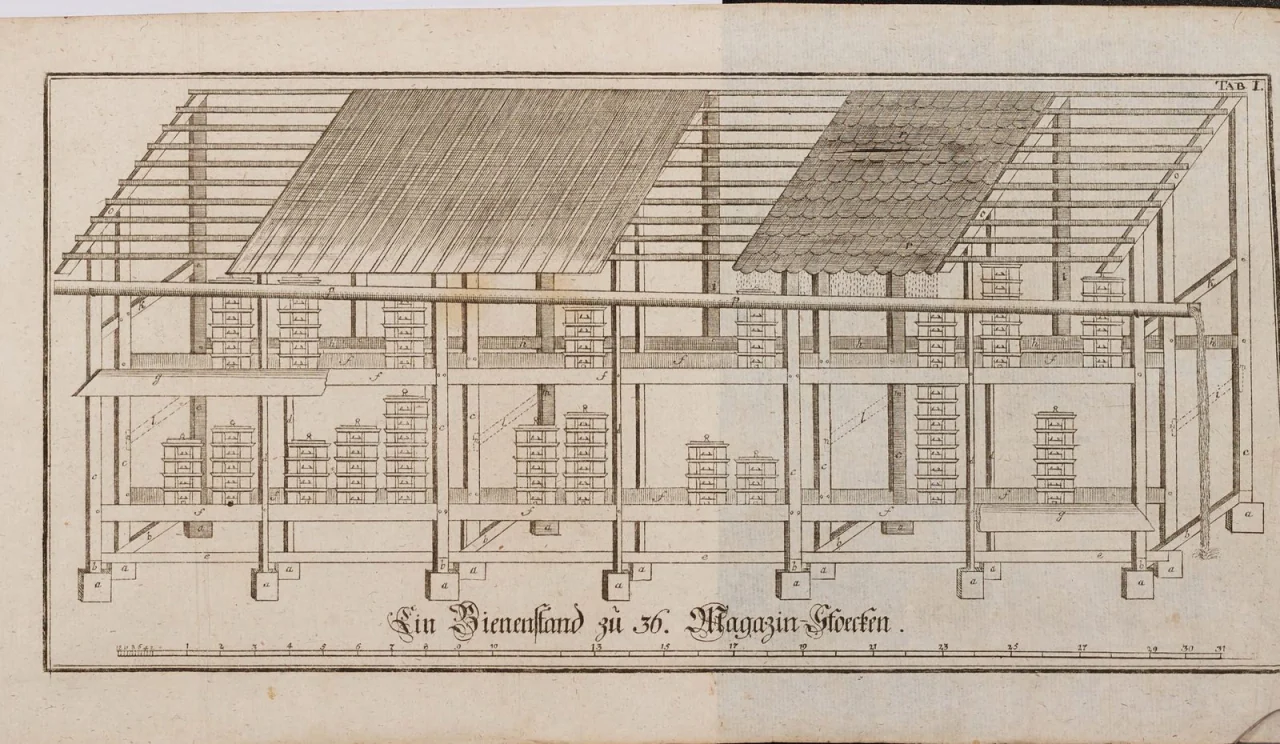
Christ's bee stand for 36 magazine hives
The bees he set up in the yard that parsonage and chaplaincy used in common, and the church elders named these in their complaint as the core of the discord between the two clergymen, „unseres Herr Pfarrer Christ vor sich allein wiederrechtlich errichteter Bienenstandt" [our Parson Christ's bee stand, unlawfully erected for himself alone] . The first bee house blocked the passage beside the dung heap and had to be pulled down on official order . The second stand the office had inspected by experts; Christ waited for them, but rebuilt before the verdict, harmlessly according to the official report . The same word he used himself of his bees between the houses: they flew away over the church; the ringing of the bells was „ganz unschädlich" [quite harmless] to them (zitiert bei ).
A year after the move he lost them. The bees of some townsmen had turned robber bees and ruined his whole stock, a loss of a hundred Gulden, he wrote to the Freiherr von Strauß, to whom he had dedicated his book for the farmers . To save two or three hives he reached for the remedy from his own bee book, honey with hellebore; Brückner, who had recommended him at his application, rounded on him for it before six townsmen like a schoolboy and scolded him as „einen Vergifter der Bienen der Untertanen seines Fürsten" [a poisoner of the bees of his prince's subjects] . Fifteen years later the Prussian commissioner Cranz counted in his yard twelve magazine hives with four to five supers under one roof, set up according to the Anweisung, without further protection in winter (Cranz, zitiert bei ). It is the only figure we have for his own stand.
Wall to Wall
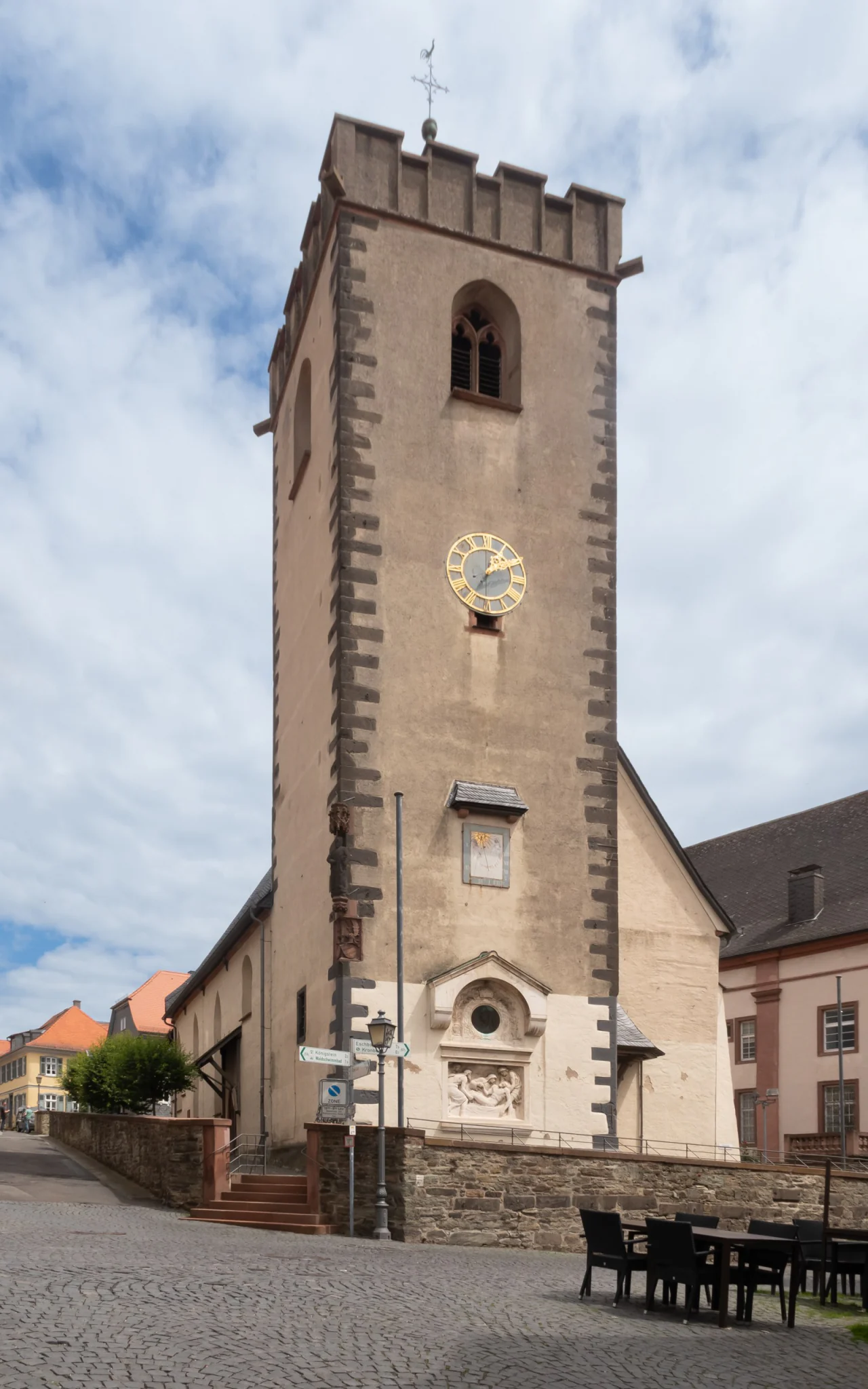
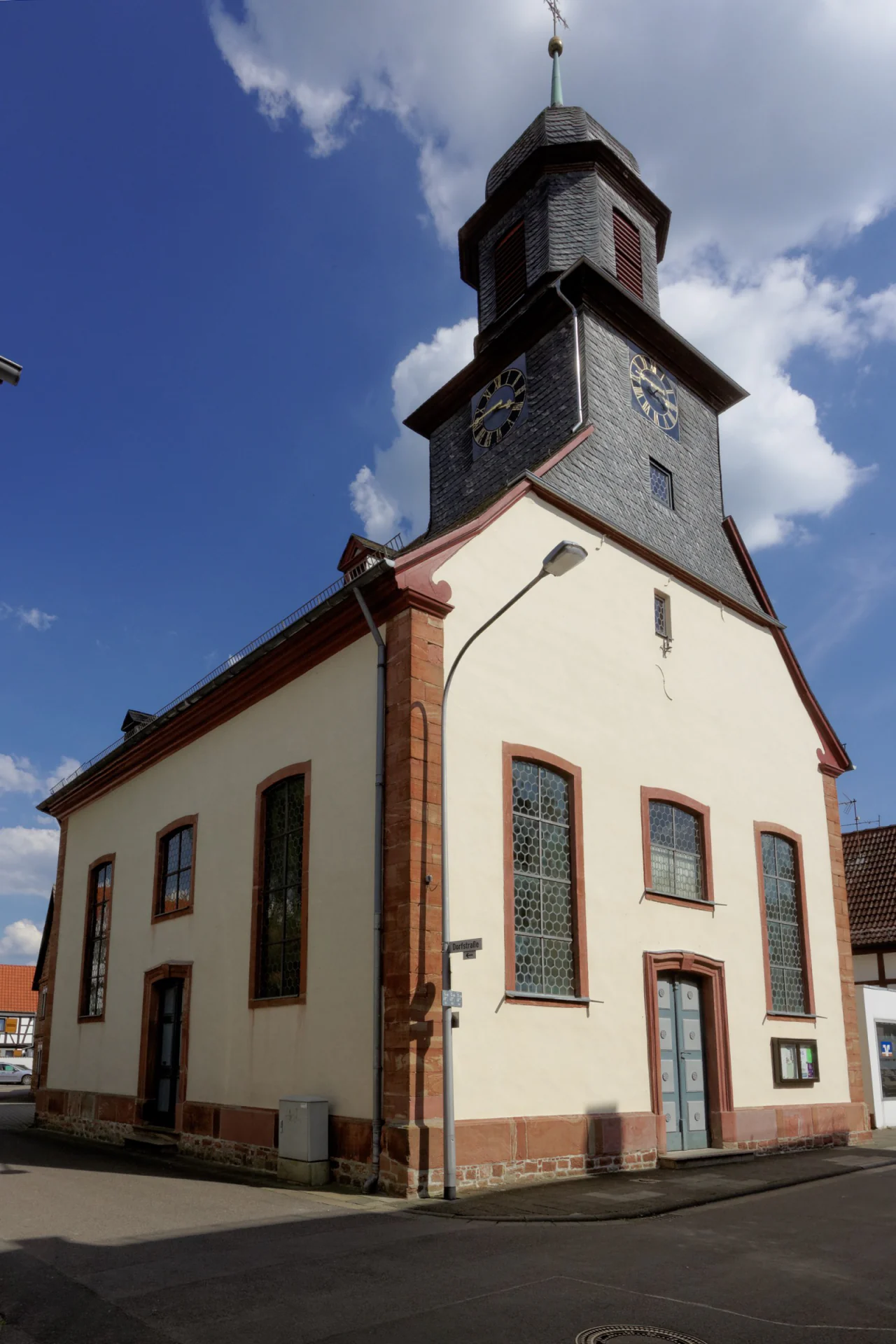
The town church of St. Johann, Christ's church in KronbergMichielverbeek, Wikimedia Commons, CC BY 4.0 Original photographLicence
For eighteen years Christ and Bleichenbach lived under one roof . Brückner charged both with the same thing, Christ's pride and high-handed conduct and the equally strong arrogance of Parson Bleichenbach . The Catholic priest Ihl held them to be equally hot-headed, only Christ was more master of his heat with the pen; Bleichenbach had once preached a sermon like Cicero in his own cause and wept aloud in it over his persecutions, which even his friends and relations had not taken well . The church elders, four men, stood on Bleichenbach's side: his father, the locksmith, the Eagle landlord, the cobbler Koch at seventy-three, an old campaigner from the church quarrel, and the baker Kunz, who had a head of his own and soon no longer followed the two Bleichenbachs .
When Christ was fifty-eight, the Eagle landlord, at first one of his opponents, married his son Adam Philipp to Christ's daughter Wilhelmine; the bridegroom was twenty-four, the bride twenty-five . Christ bought the couple the house next to the parsonage. The year after, Bleichenbach permitted Christ to break a lockable door through the yard wall at his own expense, so that the daughter could look in on her father without having to go into the street .
The quarrel went on. At sixty-three Christ had an espalier put up that reached as far as his colleague's living room, and Bleichenbach complained to the office. The tree had stood sixteen years, Christ answered; he let no leaf grow over the window . The case he compared with the fable of the wolf and the lamb, which drank from the brook downstream and was accused by the wolf of muddying its water. The Oberschultheiß found for Bleichenbach. Christ declared that he would desist as proof of his peaceableness, and paid 2 Gulden 38 Kreuzer . The superintendent Bickel recorded in the same year that Bleichenbach as an informer kept up the division in the congregation . After eighteen years he was transferred to Schierstein .
The Tithe Round
The was a part of his salary. He collected it himself, in kind and on the field, from the first ripening into late autumn. The Kronberg fields were strange to him; he drew little maps of every tithable plot, coloured and labelled them and bound them into a little volume for the pocket. It lies in the town archive and lists the field names, the Sauwasem Feld, the Erbsenstück, the Münch and Kugelberg, with the name of every owner on every strip as narrow as a towel . In a letter from the war years he defended himself against the reproach that he was away too often: because of his burdensome husbandry he could travel little, and with the tithe he had so much to do the whole summer and autumn „daß ich an keine Reise denken darf" [that I may not think of any journey] .
At fifty-four he lost the garden house on the piece of land that had been allotted to him for tithe that had lapsed. Malicious hands had ruined it, he wrote to the office; the office awarded him compensation, the court and council of the town refused it, and eight days after this refusal the whole house was laid waste . Who did it, Bode does not say either; he asks whether it was a boys' prank or a planned act of revenge . The town sent a counter-statement to Mainz, that Christ advertised in newspapers fruit varieties he had not grown himself, and Brückner reported on it that his merits in the nurseries were not to be mistaken, „sollte er auch sich hier und da eine schriftstellerische Übertreibung erlauben" [even should he here and there permit himself a writer's exaggeration] .
In old age he was mostly on horseback, because he could no longer stand walking the whole day. His daughter, a widow since her husband's death, tithed before another gate . In a petition he wrote to the office about two brothers who, when he rode past their field, trumpeted after him with their hands and laughed as long as they could see him, and who miscounted the sacks for his daughter. That mocked a servant of the church in his old age, he wrote; before his own parishioners he had to feel ashamed . At seventy-two he wrote on account of the farmer Gundlach, who had harvested his field on the Sauwasem without leaving the tithe, and who, as he wrote to the office, cheated him every year wherever he could. Then he reckoned: „Mäßig gerechnet schuldt er mir 4 bis 5 Säcke oder wenigstens 3 Malter Kartoffeln und 5 Gebund Erbsen." [Moderately reckoned he owes me 4 to 5 sacks or at least 3 Malter of potatoes and 5 bundles of peas.]
The Slanderer
In the spring in which Bleichenbach left, the consistory sent a second parson, who had been a teacher in Katzenelnbogen, a doctor of philosophy, not yet ordained, a reader of Lessing . Christ, sixty-five, looked forward to him. He asked the superintendent Bickel to lodge with him for the induction; he would grieve himself to death if he withheld this honour from him; his daughter awaited the Mademoiselle with pleasure . Bickel was the man to whom he opened his heart. A year before he had written to him as a „bedrängter und für die Zukunft bekümmerter Vater" [hard-pressed father anxious for the future], after a decision that imposed on him a new levy of sixty Gulden a year: for himself he was willing to bear it, but after his death the income ceased, and the interest on his money did not suffice to maintain his unfortunate son .
The new colleague was called Thurn. Before Christmas he was already complaining to the consistory about the alms and about the widow who washed his linen and to whom Christ had refused an alms .
At Christmas Christ had to announce to the congregation that the Christmas matins had been abolished. A visitation had forbidden the matins by candlelight, because much mischief was done at them, particularly among the mixed townspeople, and danger and misfortune could easily arise; he was to hold the service instead directly after the afternoon church. The year before he had held the candlelight church nevertheless, and four Kronbergers thereupon asked the superintendent to forbid it to him in good time . Three times townspeople came and asked him at least to hold the sermon by day. To Bickel he confessed that he had regretted not doing so: the bitterness of the whole congregation had risen to the highest pitch, and of the little band that had pushed the petition, eight men and with Thurn nine, none had dared to show himself, there would have been bloody heads . Thurn declared from the pulpit that he had no part in the abolition . On 28 December 1804 an article appeared in the Reichs-Anzeiger from Gotha, number 349, on Kronberg's tree culture and tree trade. The Kronbergers, it said, had instructed the parson Christ, who at his appointment had been a layman, in tree culture; hardly had he scented the mercantile side than he had drawn the sole trade to himself; „Die Cultur des Geistes ist hier nicht zu Hause. Man liest nichts." [The culture of the mind is not at home here. One reads nothing.] The article was signed with the names of several townsmen and of the Catholic priest Ihl .
Christ wrote first to Gotha and asked after the author . In January he denounced him to the consistory. It was his own colleague: Thurn had had the article inserted, without the knowledge and will of those whose names stood beneath it. Ihl knew nothing of it, Philipp Jäger had no nursery at all; one of the townsmen named admitted that Thurn had asked his consent beforehand. His colleague sought nothing less, Christ wrote, „als meiner Kinder künftiges Brod zu vernichten" [than to destroy my children's future bread]; he himself planted nothing but table fruit and left the economic kind to the townsmen . Bode too holds the author not hard to guess . The consistory reproved Thurn for his squabbles and his heterodox opinions, demoted him to chaplain and made him promise an apology; the charge over the article its minutes did not enter into . On the fifth Sunday after Epiphany Thurn wrote to Bickel that he and his colleague were reconciled: „Nicht Waffenstillstand ist es, sondern Friede." [It is no armistice, but peace.] A week later he wrote to him: „Heute trank ich und meine Frau den Caffee bei ihm. Wir haben uns als Amtsbrüder umarmt." [Today I and my wife took coffee at his house. We embraced as brothers in office.]
The Sermon
The reproach of 1785 stuck to him. Bickel, his confidant, wrote after his visitation that Christ was in his dealings a very obliging and engaging man, one whom scholarly knowledge could not be denied; he really lived, though, more for his economic and trading affairs than for his pastoral office, and just this the congregation held against him . The same was said by the church elders, by Thurn, and decades later by the Kronbergers whom Doerr questioned: Parson Christ had not studied much on his sermon (Doerr, zitiert bei ). Christ himself wrote to Bickel that he was right glad no longer to have to preach a third time at Christmas, since in the morning there was a strong communion anyway and on the second feast day there was studying to do again . It remains curious that he cited his husbandry as proof of his presence: what Bickel read as neglect kept him, according to his own letter, in the town the whole summer and autumn .
The Sentence About the Jews
To him belongs also a sentence from his bee book for the countryman. In the Bienencatechismus he warns against adulteration and fraud in honey and in wax and names as those who do it „gewinnſüchtige und niederträchtige Juden" [profit-seeking and base Jews] . In the Anweisung of 1798 the matter stands without the epithets: the wax was sold unpressed for half its value “to the Jews who trade in it”(K6 §11). What else he left behind about the Jews of his town is a number: in the list of parishioners that he drew up in his first year, house by house and lane by lane, he counts them too, beside 725 Protestant and 300 Catholic souls the „Judenschaft 14. Familien / 3. Wittweiber" [Jewry 14 families / 3 widows] .
The End
At sixty-eight he lost his son-in-law, thirty-three years old, dead of a violent nervous fever; he had wanted to make him the continuer of his pomology, and the publisher had already announced it . On 1 April 1813 his son Johann Heinrich died after nine days' illness, thirty-six years old. This son was feeble-minded; „blödsinnig" [imbecile] the father wrote bluntly in a letter . His unfortunate one he called him, because this son would not be able to provide for himself once the father was dead. About his provision he had worried for years; the interest on his money, he reckoned out to Bickel, did not suffice for it .
In the same year the war came to the Taunus. Napoleon had raised a new army after the destruction of the Grande Armée in Russia and reviewed it in Mainz in April; after the battle of Leipzig in October the French fell back across the Main, and the allies followed . From 18 September on, wounded Frenchmen arrived in droves, with hospital fever; Kronberg and the neighbouring places too had to house them, and for the two parsons the sick soldiers were a task they had to face as Christians . At the end of October Napoleon fought his way through at Hanau, on 30 October the first Cossacks rode into Frankfurt, and two days later they stood in Kronberg . From 2 to 20 November 15 552 men lay in the small town, Cossacks, Russian troops of the line, hussars, frontier troops from the Banat . The Cossacks camped before the Frankfurt Gate and took the wood for building and roasting from the palisades with which the Kronbergers had fenced their orchards; the town's list of damages carries the garden of Parson Christ at five hundred Gulden . The destruction of his garden by the town wall he lived to see, by Bode's supposition; by the same supposition he caught the infection in caring for a sick man, perhaps a Frenchman left behind . Snell, the second parson, wrote in the church register:
„Den 19. November morgens 4 Uhr starb an dem Fleckenfieber und wurde in der
Stille beerdigt HE. Johann Ludwig Christ, evangelischer Pfarrer dahier. Er
stand 50 Jahre im Amt, in Cronberg 29 Jahre, war 74 Jahr, 5 Wochen alt. Von
seinen 6 Kindern ist noch eine Tochter am Leben." [On 19 November at 4 in
the morning died of the spotted fever and was buried in quiet Herr Johann
Ludwig Christ, Protestant parson here. He stood 50 years in office, 29 years
in Cronberg, was 74 years, 5 weeks old. Of his 6 children one daughter is
still living.]
(Kirchenbuch, zitiert bei )
At the grave in those days probably stood few besides the widowed Madame Bleichenbach and her two children : his daughter, who had married the son of the Eagle landlord, with her son, who was called Johann Ludwig like his grandfather .
The Books and the Trees
The Tree Trade
In the year after his arrival in Kronberg he appended seventy pages to his Güldenes A,B,C für die Bauern, a notice of young fruit trees to be had in Kronberg, with a preface of its own . In it stands what he found and what brought him to it. The soil of the little country town, he writes, was as excellent for fruit trees as he had found it nowhere far and wide; for more than eighty years, since the vineyards had been converted, the townspeople had lived from fruit, from vinegar and from the tree trade; the fruit went „bis Petersburg und Moskau" [as far as Petersburg and Moscow] (Christ 1787, zitiert bei ). The names for it were what he lacked. The Kronbergers grew the most famous French fruit, which others had sent from Metz at heavy cost, but sold it under provincial names or under the name of whoever had first grafted it, Schusterbirn, Schrotbirn, Posthornsbirn, so that two hours' walk away nobody knew what varieties were to be understood by them . And he names his reason for concerning himself with it: from his youth he had been a lover of fruit, tree gardening was an agreeable side occupation to him, and besides, the fruit tithe was a part of the senior parson's stipend .
The trees for the greater part belonged to the Kronbergers. Tree planters there were, by Christ's count, forty to fifty in the town, householders with nurseries of their own, and by his statement there lay around the town a nursery of some forty Morgen with „schwerlich unter 400000 verkäuflicher Bäume" [hardly under 400000 saleable trees] and a newly laid out one of ten Morgen . His own garden with its nursery measured half a Morgen and stood to the nurseries of the Kronbergers „wie 1 zu 80" [as 1 to 80]; the trees he sent out he bought from them, and paid them for those more than a thousand Gulden a year . He contributed the order: a list of the varieties, rows with numbered stakes, little labels on the trunks, and the tree planters, as he recorded, accommodated themselves more and more to marking their young trees and keeping a register of their nursery . Cranz, the Prussian commissioner, saw it fifteen years later: a badly built town on the slope of a hill, whose inhabitants in good years sold fruit, fruit wine and vinegar for forty thousand Gulden and, through the efforts of the senior parson, sent young trees every year for several thousand Gulden to the remotest parts of the world; every spot that seemed barren was planted with trees, some thousand hundredweight of mirabelles were dried and sold in a year, and a conveniently situated Morgen cost twelve hundred Gulden (Cranz, zitiert bei ).
The Amtskeller Brückner had at first made fun of the nurseries . Five years after Christ's arrival he reported to Mainz that several thousand Gulden came into the place every year through them, for the most part paid from abroad, and three years later that sales to the remotest foreign parts had risen uncommonly since Christ had been here and that ten Morgen of new nurseries did not suffice for the orders . Christ himself reckoned it out for the prince when he asked in the war years for a concession in the billeting: he had raised the livelihood of the parish by several thousand Gulden a year, and the value of the nurseries had risen from a hundred Gulden to twelve hundred and more, because their fruit trade had become known abroad through him. The decision refused the concession, in spite of „seiner angerühmten Verdienste um die Beförderung der Baumzucht" [his vaunted merits in the furtherance of tree culture] .
The Tree Gardener in the Village
On the trees hangs his larger work, and with it the byname „Obstpfarrer" [fruit parson]. For the specialist he wrote the Handbuch über die Obstbaumzucht und Obstlehre, which went through four editions, a Pomologisches Handwörterbuch for reference, a volume besides on the diseases and enemies of fruit trees, and last, at seventy and at seventy-three, the two volumes of the Vollständige Pomologie, whose ordering of the varieties pomology counts as his merit to this day (). For the village he wrote, at fifty-two, the Baumgärtner auf dem Dorfe. In it the farmer Velten asks and the author answers . The preliminary notice begins with the finding that in such enlightened times one would hardly believe how neglected fruit culture still was in many districts; one need only go into those villages of the Odenwald, the Thuringian Forest, Swabia and Hesse that lie far from the great towns, „wo das Menschenkind wohl 1000 Jahre von guter Obstzucht zurückgeblieben ist" [where the child of man has fallen a good 1000 years behind in good fruit growing]. It ends with the blessing of the great Father of the household on the housekeeping and the trade of his readers (Christ 1792, zitiert bei ). Three editions and two unauthorised reprints the book went through .
The Golden A,B,C
The Güldene A,B,C für die Bauern; oder das Wesentliche der Landwirthschaft, which begins with the sentence about his love for them, has four chapters. They deal with fodder herbs and clover, with manure, with the crops to be planted and with livestock; the appendix of the second edition with the drying oven, with the household plaster, with beet syrup, with baking bread from sprouted grain, with brewing beer and with distilling brandy . In the drying oven with its encircling smoke flues fruit could be dried and made to keep for the winter, for people without a full cellar; specimens of it are said to survive at the Kronberg town wall (). And in the last volume of the Hanauisches Magazin stood his essay „Von der Verbesserung des Bauernstandes, eine patriotische Phantasie" [On the improvement of the farming estate, a patriotic fancy], which begins like this: „Dieser Stand, der uns alle trägt, der den Segen der Natur aus der ersten Hand empfängt, und der Stand der ersten glücklichen Weltbewohner war, verdiente mit mehr Achtung geschätzt, unterstützt und verbessert zu werden, als gemeiniglich geschiehet." [This estate, which bears us all, which receives the blessing of nature at first hand, and which was the estate of the first happy inhabitants of the world, deserved to be valued with more respect, supported and improved than commonly happens.] (Christ 1785, zitiert bei )
To these come the books of the Rodheim years, on tobacco, on field husbandry, on distilling brandy, on the body of the earth, and beside them the one book on insects; the bibliography by his biographer orders the whole into five groups, natural research, bee science, agriculture and viticulture, pomology, garden . At seventy-two the University of Marburg conferred the doctorate on him. The diploma names him first parson at Kronberg, member of numerous economic societies and tireless explorer of nature, deserving above all of rural life .
The Bee Books
His first book, the one that made him known, was the Anweisung zur nützlichsten und angenehmsten Bienenzucht, written in Rodheim around a hive of wooden boxes he had invented there; it went through three editions in his lifetime and four reprints without his permission, and by his own account its method was imitated „bis 130 Meilwegs weit" [as far as 130 German miles off] . It is the subject of this site; the reading edition stands beside it, with what the book itself says about its hive, its reckoning and its readers. Four years later he wrote the matter out again for the country people, in simpler form: a hundred and ninety-seven questions and answers, in which the reader now and then speaks with the prejudices of beekeeping, „ganz geflißentlich" [quite deliberately] . In the first chapter he holds up to his teacher what his neighbour says, and the answer begins: „Euer Nachbar ist ein besonderer Philosoph." [Your neighbour is a singular philosopher.] The Bienencatechismus went through five editions, the last fifteen years after his death under the title Christs Korbbienenzucht . A dictionary on bees came at sixty-five . Of who bought these books little is known; print runs, prices and testimonies of readers are wanting. His own account, though, we have: at the first edition he had not believed that it would so soon find so many followers among the country people too, now there were „gar viele Landleute weit und breit" [a great many country people far and wide] (Christ 1784, Vorbericht).
The Draughtsman
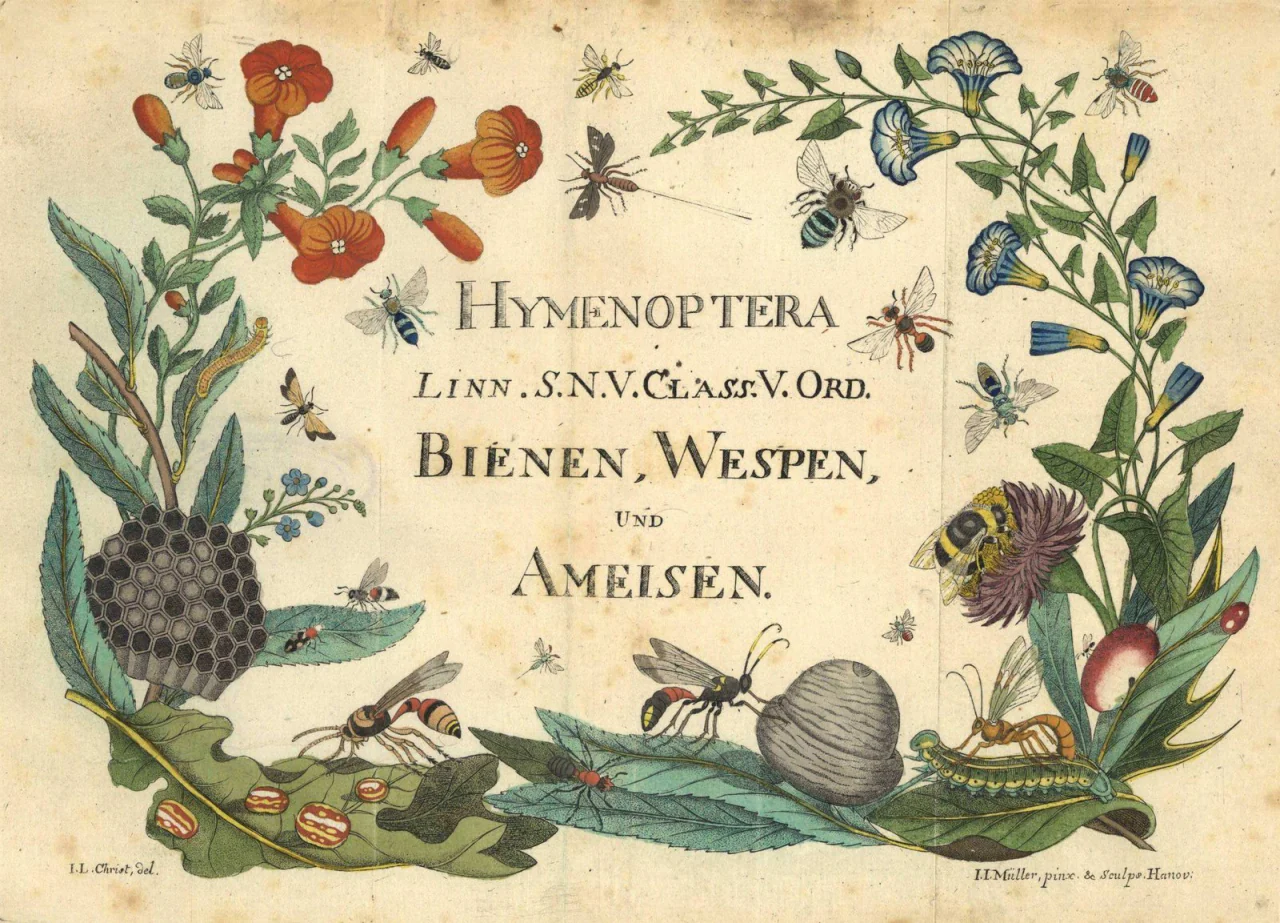
Frontispiece to Christ's work on insects, hand-coloured
Drawing he had taught himself as a private tutor, alongside mathematics and architecture . The plate of the Catechismus bears his signature, „Chriſt: del:", he drew it. For the insect book, the Naturgeschichte, Klassification und Nomenclatur der Insekten vom Bienen-, Wespen- und Ameisengeschlecht of 1791, he had reared many native insects himself and observed them for years, and in drawing and colouring he took pains to stay true to nature. From his originals I. I. Müller engraved the plates, but the frontispiece bears “I.L.Christ, del.” . Names he gave in this book hold to this day.
The church at Harreshausen, built in 1784 to Christ's designE-W/Wikipedia, CC BY-SA 3.0 de Original photographLicence
He designed churches as well: after Berkersheim that of Harreshausen, whose pen drawing Bode reproduces, dated „83" in the drawing . Both buildings stand.
In Farmers' and Townsmen's Parlours
The newspaper of his town today counts him among the popular enlighteners who in the eighteenth century carried the new knowledge into the countryside so that the people there might live better (). Bode calls them educators of the people, mostly Protestant clergymen, who wanted to show the farmer in the village and the craftsman in the small town how he could secure and improve his existence, and Christ is to him one of the most significant among them . Why literary history nevertheless does not know him, he explains on the same page: it leaves specialist and practical writing aside, and Christ's books have been „im wörtlichen Sinne in Bauern- und Bürgerstuben verbraucht und damit selten geworden" [in the literal sense used up in farmers' and townsmen's parlours and thereby become rare] .
The Legacy
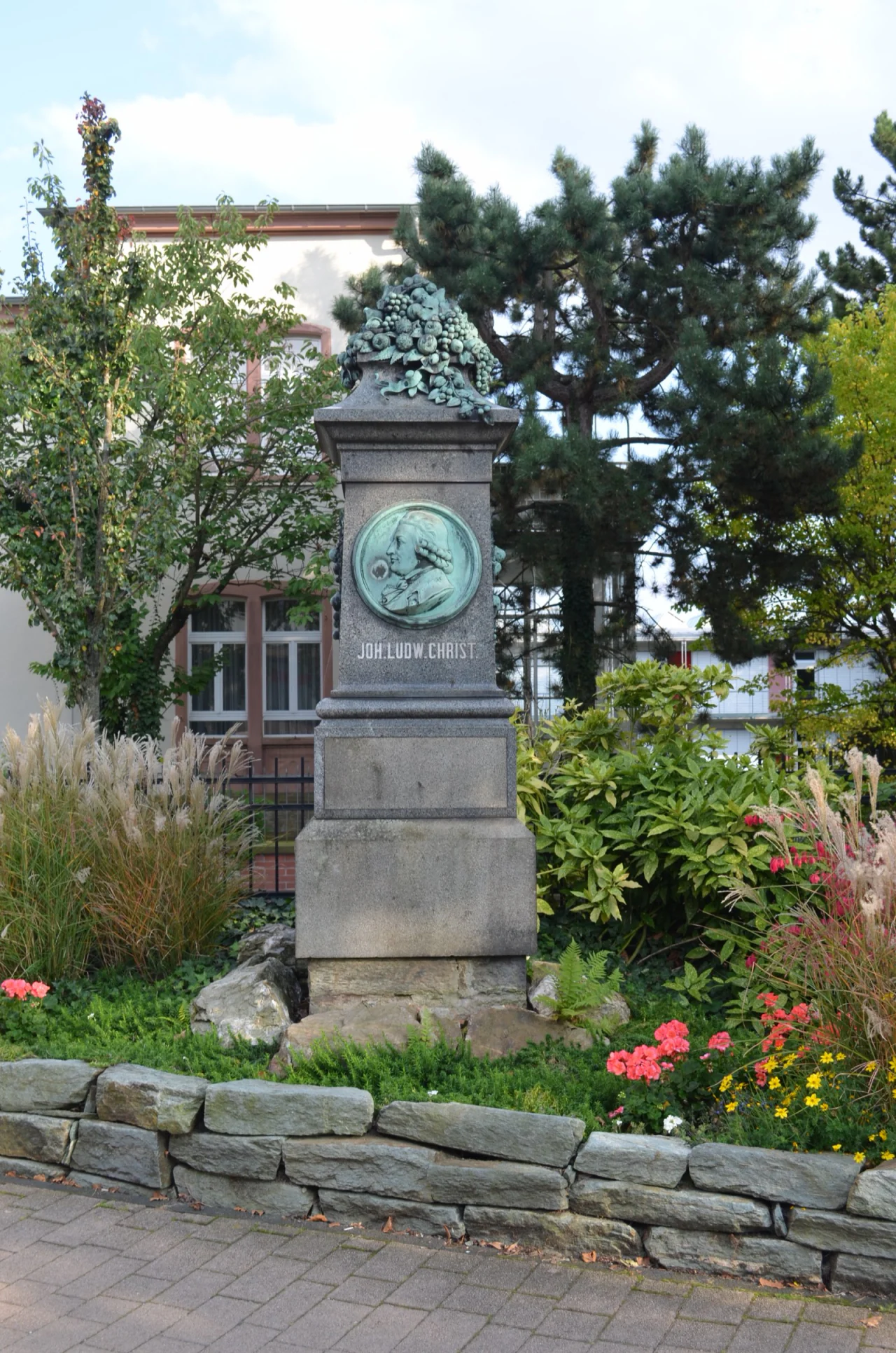
The Kronberg monument of 1885, with portrait plaque and wreath of fruitKarsten Ratzke, Wikimedia Commons, CC0 Original photographLicence
Seventy-two years after his death Kronberg set up a monument to him, on the Katharinenstraße, where the Christ nurseries had stood (). The impulse probably came from a book: the Nassau physician Carl Thomae had described fruit growing in Nassau, to which Kronberg had belonged since 1803, and in it paid tribute to the achievement of the Kronberg senior parson. The Kronbergers remembered their Christ; a citizens' committee formed, behind which stood above all the newly founded fruit and horticultural society . The plaque on the stone shows „einen stark idealisierten Christ" [a strongly idealised Christ] . Today a street bears his name (), so does an orchard meadow on the Schwalbacher Straße with old mirabelle trees and display boards about his life (), and in the Museum Stadtgeschichte pieces relating to his work lie among the crafts of the town (). At the monument begin three circular walks through the orchards of the town (). Rodheim too, where he was parson for ten years, holds on to him: the local history society of the place keeps a page of its own about him () and in 2022 devoted two contributions to him in the eleventh of its Rodheimer Hefte, one on his Rodheim decade and one on the Höherauch of 1783 ().
The Baker's Oven
His letters are for the most part burnt. His daughter gave the letters and orders that were still arriving from Russia and America one and two decades after his death by the basketful to a baker, who heated his oven with them . There remained his printed books, the entries in the church registers, the little maps of the tithe in the town archive, two letters in the Hanauisches Magazin, and what the offices filed away about him: complaints, petitions, reports, decisions. Four letters in his hand lie in archives in Weimar, Leipzig and Berlin, to a publisher, to a bookshop and to a scholar; nobody has yet read them for this biography.
Dzierzon Builds on Christ
Of his readers one stayed in the field, the Silesian parson Johann . What he brought into beekeeping was the comb on the movable bar; the frame in which the comb hangs everywhere today goes back to the patent that Lorenzo Langstroth received in the United States in 1852 (), and Dzierzon had come before the public eight years earlier. Since 1844 the field has distinguished movable comb from fixed comb (, S. 102). What Dzierzon began with, Johann Witzgall writes in his history of beekeeping: „Anfangs imkerte Pfarrer Dzierzon mit dem Christ'schen Magazinstocke. Auf experimentellem Weg erfand er die in Wirklichkeit vollkommenste Bienenwohnung, den jetzt allgemein verbreiteten Stock mit beweglichen Waben." [At first Parson Dzierzon kept bees with Christ's magazine hive. By way of experiment he invented the in truth most perfect bee dwelling, the hive with movable combs now everywhere in use.] (, S. 56) He fitted the boxes of Christ's hive with a movable grate of bars, to which he stuck combs so that each could be lifted out singly; when he did that Witzgall does not say, who writes in 1889 about events around 1845 and does not quote Dzierzon himself. In Christ the six pieces of wood of the grate, each an inch wide, are nailed on with little nails (K3 §4); movable they became with Dzierzon.
Soon Among the Antiquities
Whoever appeals to him later does so in passing. Kanitz in Friedland in East Prussia builds himself a dwelling in 1848 „nach dem Muſter des Chriſt'ſchen Magazins" [after the pattern of Christ's magazine] (, S. 71), the only replica anyone wrote down with name and measurements. Rothe shows five years later how a magazine beekeeper makes a nucleus with the „ſogenannten Chriſtſchen Käſtchen" [so-called Christ boxes] (, S. 116). In 1862 Busch predicts that Christ's magazine boxes would „bald zu den Antiquitäten gehören" [soon belong among the antiquities] (, S. 100). The latest witness is a picture: the Illustrierte Handbuch of 1889 lists Christ's box hive among the figures of the magazine method (, S. 186). When his hive went out of use we cannot say.
The Vienna Replica
It surfaced again in Vienna, in 1946. The beekeeper Johann Thür publishes there his book Bienenzucht. Naturgerecht einfach und erfolgsicher (), whose second part begins with Christ: „Vor rund 200 Jahren verbreitete der nassauische Pfarrer Christ die nach ihm benannte Christsche Magazinsbeute, von denen mancherorts noch heute welche in Verwendung stehen sollen." [Some 200 years ago the Nassau parson Christ spread the Christ magazine hive named after him, of which in some places a few are said to be in use even today.] (, S. 12) What he reports about it are Christ's own figures from the third chapter, passed on with his judgement that this hive is „in der Tat etwas Geniales" [indeed something of genius] (, S. 14). Then he builds one himself, in centimetres instead of inches and with eight bars instead of six, and sets his hive expressly upon Christ's: „In dieser neuen Gestalt feiert die altbewährte Christsche Magazinsbeute als schichtenbewegliche Naturbau-Magazinsbeute ihre Auferstehung" [In this new form the well-tried old Christ magazine hive celebrates its resurrection as a natural-comb magazine hive with movable tiers] (, S. 17). Of the harvest in the straw skep he writes that sulphuring is barbaric and cutting out harmful (, S. 15); the same objection Christ had set in his preface a hundred and sixty-six years earlier as the second of his principles; Thür does not name him for it. His book is a polemic in which all frame hives are called „naturwidrig und verwerflich" [contrary to nature and reprehensible] (, S. 8); his loss figures stand without a source. What it attests is that Christ's boxes still brought somebody to build in 1946.
Individuals build them to this day. An essay of 2023 pictures a reconstruction of Christ's hive and names in the caption the man who built it (); in a German-language beekeeping forum one writer has described since 2011 his conversion with all the measurements, another collects sources, a third reports that his hive is regularly occupied and stands at events as a show hive (; ). More than these single cases we have not found. The German Bee Museum in Weimar shows bee dwellings from various times and regions and names neither a hive type nor a person ().
Pohl and Oehme
Two editors reworked the Anweisung after Christ's death. In 1820 it came out in a fifth edition from Friedrich Fleischer in Leipzig, seen through the press by Friedrich Pohl, professor of economics and technology. Pohl refrained from recasting the work, „weil Christ eigentlich nur seine eigene Bienenwirthschaft beschreibt" [because Christ really only describes his own bee husbandry] ; out of nine chapters and 116 paragraphs he made twelve chapters and 225, the last a bibliography from his own hand, and the passages in which Christ writes against the teaching of his time all still stand there. Gone is the preliminary notice to the third edition, in which Christ had caught two winged ants in the act of mating and concluded from it: “Two hypotheses are once again struck to the ground by this occurrence”(Vorbericht); the three references to it in the first chapter Pohl struck out and left the sentences around them standing.
Two decades later Heinrich Friedrich Oehme reached deeper. He edited the sixth edition in 1841 and rewrote the natural history of the first chapter. Christ's paragraph is headed “The drones are held to be the males of the queen”(K1 §10); Oehme declared that refuted, gave the drones the office of warming the brood, and concluded eight pages on that by far the greater part of the worker bees were of the male sex . By today's knowledge the drone is the male and the worker bee a female; on this point Christ's book of 1798 stood right, and the correction spoiled it. His own position in the matter was uncertain, for he held the queen to be fertile without mating.
The book that outlived him longest is about gardens. The Allgemein-practische Gartenbuch appeared two years after his death in Vienna and Prague, reprinted the same year in Heilbronn. The fourth edition was edited in 1876 by Eduard Lucas, who directed the Pomological Institute in Reutlingen; in the preface to the fifth he wrote of the „Gefühl der Pietät für den alten würdigen Oberpfarrer" [feeling of piety for the old and worthy senior parson] and called Christ a clergyman who, besides the care for his parish, had „ein offenes Herz für das materielle Wohl seiner Nebenmenschen" [an open heart for the material welfare of his fellow men] (Lucas 1880, zitiert bei ). Until 1930 the book went through twenty-four editions with Eugen Ulmer in Stuttgart, at the last completely reworked, under the name Christ-Lucas, Gartenbuch . More than a hundred years after his death his name still stood on the title of a book that hardly contained his sentences any more.
Three Disciplines
Three disciplines have kept him, each differently. The paper wasp Polistes dominula carries his authorship to this day, “(Christ, 1791)” (); the brackets show that the species was later placed in another genus. Pomology lists his ordering of the fruit varieties as his lasting merit, and as the greater one (). In beekeeping the parson Gerstung called him in 1906, in a collective work by thirty-four specialists, „in Deutschland der eigentliche Begründer der Mobilbienenzucht" [in Germany the real founder of movable-comb beekeeping], meant as „Beweglichkeit von Teilen des Bienenstockes, von Auf- und Untersätzen mit Waben" [movability of parts of the beehive, of supers and lower supers with combs] (zitiert bei ). Bode sets beside it that the bee scholars today no longer wished to let him pass as the first inventor of magazine beekeeping; when Christ invented his hive, however, he did not know that beekeepers in other countries had devised something similar .
The Stone Thrown at Christ
On Christ the beekeeper no judgement of his time survives. Bode's chapter on his friends and critics deals over thirty pages with three men, and all three are pomologists . The quarrel handed down about him turns on one single thing: he passed on fruit varieties he had not tested.
August Friedrich Adrian Diel, an apothecary's son from Gladenbach, district physician at twenty-six, then house physician to a count's family in Wetzlar and spa physician at Bad Ems, a man who translated thirty-four medical titles from the English, was the leading pomologist of his day and called Christ in his letters his dearest friend . Three years after Christ's death he wrote how well Christ would have done had he tested first before drawing up great catalogues. The spread of the fruit trees was a truly great merit, „und die gehören Christ ohnstreitig" [and those belong to Christ indisputably], but his consignments had harmed the study of pomology (Diel 1816, zitiert bei ).
Against him stands the Freiherr Christian Truchseß von Wetzhausen at the Bettenburg in Franconia, a giant of a man whom people in Kassel had called the Götz, who had his castle painted with scenes from Wieland and Goethe, remained unwed in lifelong mourning for a youthful love named Friederike and carried close on four hundred and forty-one cherry varieties in his catalogue . With Christ he had, from his first order of trees on, the liveliest correspondence of all; they never set eyes on one another . Of the judgements that circulated in Christ's last years, that he had deceived his customers, he wrote: „Ich glaubte dieß nie und werde es nie glauben" [I never believed this and never shall]; from the letters it had become clear to him that it was a real concern to Christ, with the good he found or received, „möglichst schnell, fast in Hast zu verbreiten" [to spread it as quickly as possible, almost in haste] . Truchseß had himself publicly described cherry varieties that stood under wrong names with Christ and cast a critical light on the namings .
To the reproach a single answer from Christ has come down. He wrote it to Truchseß, who renders it from memory, „ohngefähr dies" [roughly this]: „Lieber Freund, Sie haben mir manchen scharfen Rauch in die Augen geblasen; aber er schärfte mir die Augen, und er kam aus einem wahrhaften und gütigen Mund." [Dear friend, you have blown many a sharp smoke into my eyes; but it sharpened my eyes, and it came from a truthful and kindly mouth.]
Nucleus colony
A new colony formed by the beekeeper rather than by waiting for a swarm. Brood and bees from a strong colony are placed in an empty hive.
Christ makes nucleus colonies “after the Franconian manner”: a piece of brood comb four to five inches square is placed in an empty hive, and the bees rear a queen from it (K1 §5). He prefers this method to swarming and allows about a hundred boxes for an apiary of ten colonies, four of which are to swarm (K4 §26).
Combs in a straw skep are fixed in place. Harvesting the honey requires cutting them out and destroys the colony in the process. The usual practice was to set the skep over burning sulphur and suffocate the bees.
Christ calls this the “old routine of most country people, which can hardly be rooted out: in autumn they slaughter and suffocate the heaviest and the lightest hives, irresponsibly and quite sinfully” (K3 §2).
Christ also objects to the quality of honey obtained this way: it is “fouled with brood, dead bees, the smell of sulphur and the like” (K3 §6).
Christ’s word for an individual box in his stacked hive. It consists of four planed boards, measures thirteen inches square externally and four and a half inches high, and has an entrance at the front, a pane of glass at the back, a cornice at the top and a grid beneath it (K3 §4).
The boxes have neither floors nor lids. The lowest stands on a floorboard that also serves as a landing board (K3 §9); the top one receives a cover of wood, glass or plaited straw (K3 §4).
For a colony that is not to swarm, Christ allows eight boxes over the summer; for a young swarm, six (K4 §26).
Placing an empty box on top of a full one. Christ considers this easier, but nevertheless does not use it to expand the hive:
“Setting on would of course be somewhat more comfortable than setting under; but it will not do. The nature of bees is to build from the top downwards, and to go on building where they have left off.” (K4 §26, footnote)
He does add vessels above for harvesting. Glasses and porcelain vessels are inverted on the top box’s cover so that the bees can build into them from below; the comb is cut with a silk thread or thin piano wire (K3 §5).
The modern German word for any human-made bee dwelling originated in forest beekeeping. Christ writes that forest bees are “drawn into hollow trees or into Büten or Beuten hewn out expressly for the purpose” and belong to the forest owner (K9 §2).
He does not use the word for his own boxes, which he calls Aufsatz, Kästchen, Magazin or Bienenwohnung.
The gap bees leave open in their hive rather than filling it with comb. Combs hung at this distance can be removed individually without cutting. Lorenzo Langstroth described the spacing in 1851 and received a patent for a hive using it on 5 October 1852.
In this repository, the statement is supported by a search summary covering several pages rather than by the patent document itself (source key langstroth-1852).
A measurement from a source read directly appears in Warré. He leaves twelve millimetres between two top bars, expressly “pour le passage des abeilles” [for the bees to pass through] (Warré 1948, p. 49).
Dzierzon
The priest associated with beekeeping’s transition to movable comb. Writing in 1889, Johann Witzgall recounts that Dzierzon began keeping bees “mit dem Christ'schen Magazinstocke” [with Christ’s stacked-box hive] and through experimentation developed “den jetzt allgemein verbreiteten Stock mit beweglichen Waben” [the now widely used hive with movable combs] (Witzgall, Geschichte der Bienenzucht 1889, p. 56).
The changes began with Christ’s comb-supporting grid. Dzierzon fitted the boxes with movable bars and attached comb to them so that each comb could be lifted out separately. Side doors, fixed floorboards, ledges on the inner walls, shorter and taller boxes and a fixed lid followed (Witzgall, Geschichte der Bienenzucht 1889, p. 56). Christ nails down the six wooden strips of his grid (K3 §4).
In 1844, Dzierzon presented his invention publicly. The distinction between movable- and fixed-comb beekeeping dates from that year (Witzgall/Felgentreu 1889, p. 102).
Witzgall writes forty years after the event and does not quote Dzierzon himself.
The opening through which bees enter and leave. Every box in Christ’s hive has one, four inches long and 1¼ inches high, with two metal slides in front (K3 §4).
Christ explains its size in terms of the air bees need when confinement is necessary and the ease of feeding (K3 §4, footnote).
Since every box has its own entrance, adding a box underneath requires another step: two or three hours later, the upper entrance is closed completely, “otherwise they do not readily build on” (K3 §9).
Four strips of wood glued and nailed to the top of each box. They support the grid and project a quarter of an inch outwards (K3 §4).
Christ gives two purposes for the projection. It forms an ornament, shaped with an ogee plane, and ensures that “all the supers fit well on one another and stand firm if one should turn out ¼ or ½ inch larger or smaller than another” (K3 §4).
This projecting rim prevents wall thickness from being read off the engraved plate. The oblique view in Fig. 1 shows the wall and cornice together at the edge.
Émile Warré (1867–1951) was a French priest and beekeeper. His Ruche
Populaire (“People’s Hive”) was intended to be simple to build and manage.
He described its construction and management in L’Apiculture pour tous,
whose twelfth edition appeared in 1948.
Christ’s own addition to the stacked-box hive. A hole seven inches long and two and a half inches high is chiselled in the rear wall of each box, the glass is fitted into it, and a small shutter excludes the light (K3 §4).
At the end of the same section, in a passage for readers wishing to omit all other refinements, he gives his judgement: “A glass pane in the rear board, however, is almost indispensable.” (K3 §4)
He answers the obvious objection from observation. Bees attach comb to glass as firmly as to wood or straw and keep it clean; what they coat in autumn, they clean again in spring (K3 §11).
The French word for a box placed above another. Palteau’s hive consists of a table, three legs, several hausses, a cover and a landing board; each box measures one foot square and three inches high (Palteau 1777, pp. 7–11).
Christ has not read Palteau in the original. In a footnote to the preface, he writes that only years after his own invention did he read “something of similar bee dwellings”, “such as those of Herr Palteau in France and the Vicat one, which Schirach in his allgemeinen Bienenvater describes” (Vorrede).
A textbook of religious doctrine arranged in questions and answers. Every child worked through it in lessons and learnt the answers by heart; the form was therefore familiar even to readers who read little else.
In 1784, Christ applies it to bees while distinguishing his purpose from that of the classroom. Catechetical teaching is “für den gemeinen Mann die faßlichste und deutlichste” [the easiest for ordinary people to grasp and understand]; he intends no catechism “zum Auswendiglernen, sondern blos zum Unterricht und Nachschlagen” [for memorising, but only for instruction and reference] (Christ 1784, p. VI). His Bienencatechismus für das Landvolk consists of 197 numbered questions, some of which state the opinions he opposes.
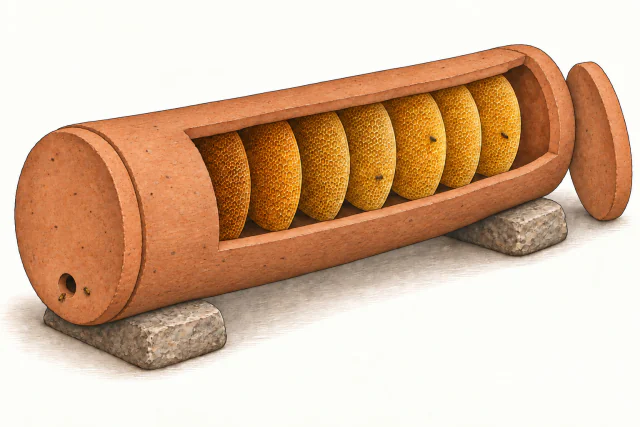
Log hive
A log hive is a hollowed section of a felled trunk used to house bees. Unlike a cavity in a living tree, the whole hive can be taken to another site.
A word at the foot of a printed page that repeats the first word of the next. The compositor used it to keep the sheets in order.
It can cause errors in this project: including the catchword when transcribing an old page duplicates a word. In the Vicat source text, three catchwords appear at the head of the following page rather than the foot of the preceding one: “festiget,” (110/111), “einiche,” (118/119), “voraus,” (120/121).
Stacked-box hive, Magazin
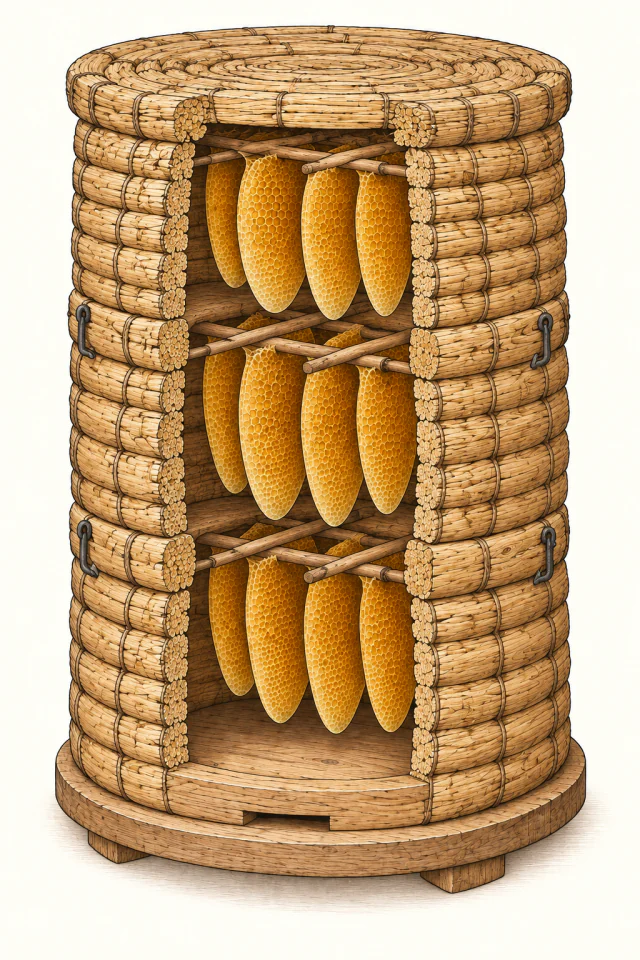
A hive made up of several boxes stacked vertically, each removable separately. Christ calls it a Magazin or Magazinstock.
He describes bees having “their household in joined supers … that are increased or reduced from time to time as circumstances, the season and one's intentions require” (K3 §3).
Christ presents wood and glass as innovations. The usual stacked hives had been made of straw, “at least I have seen none of any other kind”; their drawbacks led him to square wooden boxes with a pane of glass (K3 §3).
Beekeeping with movable combs. Its German name arose alongside the contrasting term Stabilbau. In 1889, Witzgall and Felgentreu date both to 1844: “Seit 1844, wo Dr. Dzierzon zuerst mit seiner Erfindung öffentlich hervortrat, spricht man in Imkerkreisen von einem beweglichen oder unbeweglichen Bienenstocke, vom Mobil- oder Stabilbau.” [Since 1844, when Dr Dzierzon first presented his invention publicly, beekeepers have spoken of movable or immovable hives, of movable- or fixed-comb beekeeping.] (Witzgall/Felgentreu 1889, p. 102)
Christ predates this distinction. The bee specialist F. Gerstung later defined his contribution precisely: “in Deutschland der eigentliche Begründer der Mobilbienenzucht … freilich nicht so sehr der Beweglichkeit jeder einzelnen Wabe … als vielmehr der Mobilität, d.h. der Beweglichkeit von Teilen des Bienenstockes, von Auf- und Untersätzen” [in Germany the true founder of movable-comb beekeeping … admittedly less of the mobility of each individual comb … than of the mobility of parts of the hive, of upper and lower boxes] (quoted in Bode 1984, p. 381).
Witzgall/Felgentreu 1889, p. 102
Nadiring
The technical term for adding a box underneath: an empty box is placed below a full one. It describes the operation Christ calls Untersetzen.
The earliest vertically divided hive using this method documented in the project is Gedde’s octagonal box. It has two iron handles “for lifting it up when another is to be placed under it” (Gedde 1677, pp. 18–19).
Top bar
A top bar is a wooden strip to whose underside the bees attach a comb. The comb may also be attached to the hive walls. A top bar alone therefore does not make the comb individually movable.
Lorenzo Langstroth described bee space in 1851: a gap of about a centimetre that bees leave open rather than filling it with comb. He received a patent for it on 5 October 1852. Since then, combs have hung in frames that can be removed individually; this remains the most widespread construction in much of the world.
Christ’s stacked-box hive predates this development. In his hive, the movable unit is the box, lifted off whole while its combs remain inside. The bee specialist F. Gerstung therefore called him the founder “der Mobilität, d.h. der Beweglichkeit von Teilen des Bienenstockes, von Auf- und Untersätzen” [of mobility, that is, the mobility of parts of the hive, of upper and lower boxes] (quoted in Bode 1984, p. 381).
Christ uses the word Rähmchen once, in a different sense: the pane of glass in a straw box is “fitted into a small wooden frame” (K3 §8).
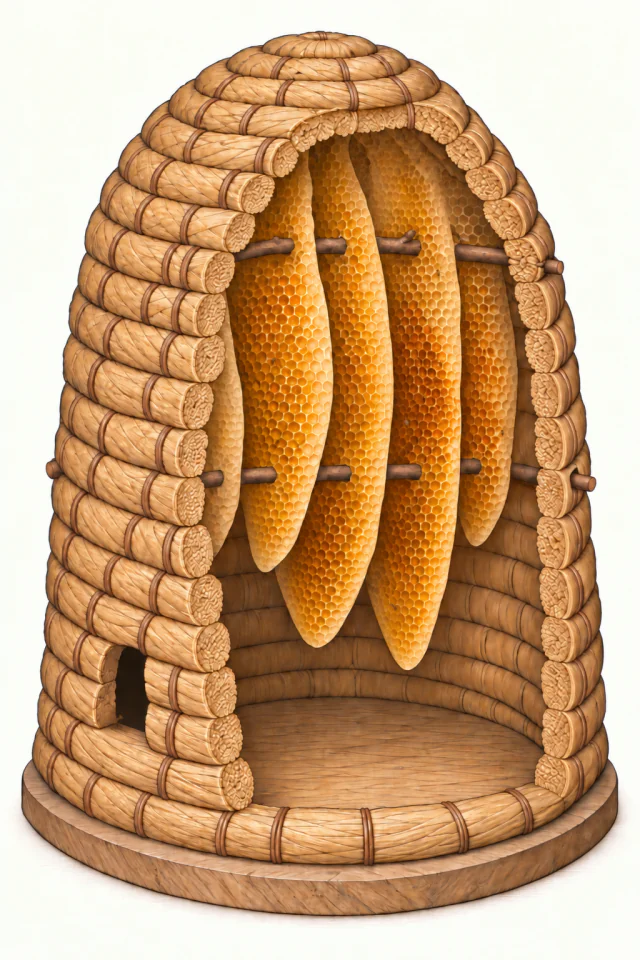
A ring skep consists of straw rings of equal diameter, stacked to form a
shared interior. More rings can be added to enlarge the hive. Fixed crossbars
support the combs and allow individual sections to be removed with their comb.
AI-generated schematic illustration after Fleischer (1777).
Fleischer 1777, pp. 311–314; explanation of the plate, Figs. 2–4
Rose, Rosentafel
Christ’s term for a comb. He uses it as a synonym for Wachstafel and combines the two when explaining how young colonies can be recognised: “by the whiteness and delicacy of their wax combs or roses” (K2 §10).
Compound forms occur throughout the book. Honigrosen are honey-filled combs (K3 §5), while Bruttafeln contain brood (K4 §2).
The comb guide in Christ’s box. Wooden strips, each one inch wide, are nailed into the rebates of the front and rear cornice strips; the bees align their comb with them (K3 §4).
The number depends on the position in the stack. Only the top box receives six strips, “so that the bees attach and build their combs in this direction, from the rear wall toward the flight hole”. The lower boxes receive two, since the bees continue in the direction already established (K3 §4).
Christ gives three reasons for using fewer strips below: the colony clusters more closely in winter, debris does not collect on the wood, and bees can move up and down more easily (K3 §4). To support heavy honey combs, each box with two strips also receives a cross made of two round willow or hazel sticks (K3 §4).
A bee that flies out before a swarm to seek a new dwelling.
Spurbiene is Christ’s own term, although he considers the behaviour unproven. The idea that bees “some days before swarming, seek out a hollow tree by means of scouts, or so-called scout bees” belongs, in his view, “in truth quite among the mere conjectures” (K4 §9). He nevertheless accepts it for hunger swarms, having watched individual bees clean an empty hive for days before a swarm moved in three days later. He does not regard scouts as a separate caste: they are “of course no special kind of bee” (K4 §9).
A hundred and eighty years later, experiments with boxes in the forest measured the criteria by which a swarm chooses a nest. These criteria underpin the story “A bee in search of a home” (Seeley and Morse 1978, cited indirectly rather than read in full).
Beekeeping in hives without movable frames. Comb is firmly attached to the ceiling and walls. To remove it, the comb is cut free or taken out with the hive section to which it is attached.
Witzgall and Felgentreu date the distinction between fixed- and movable-comb beekeeping to 1844, the year Dzierzon presented his invention publicly (Witzgall/Felgentreu 1889, p. 102). By 1889, the same authors already regard fixed comb as needing justification. They open their chapter by suggesting that some readers may be surprised to find it included, “nachdem man ja doch schon längst den Stabilbetrieb als veraltet und für die heutigen Zeiten als abgethan betrachtet…” [since fixed-comb management has long been regarded as outdated and no longer relevant to the present day…] (Witzgall/Felgentreu 1889, p. 209).
Christ does not know the term. In his time, there is nothing from which fixed-comb beekeeping needs to be distinguished.
Witzgall/Felgentreu 1889, pp. 102 and 209
Straw skep
The ordinary bee dwelling of country people in Christ’s time: a basket coiled from straw ropes, made in one piece and impossible to divide. Honey is harvested by cutting out the comb, and the colony dies in the process (K3 §2).
Christ proposes his stacked-box hives instead. An apiary of thirty to thirty-six of them is “worth more than an apiary of 100 pieces in straw baskets” (K4 §26).
He also describes continued use of the skep. In K3 §10, he explains how to place a straw skep on a lower hive box, seal the skep’s entrance and thereby draw the bees down into the boxes.
A small basket placed on top of a straw skep for the bees to fill with honey comb. Christ uses the country people’s terms: “the small baskets (caps, hoods) which the country people set on the straw baskets” (K4 §26, footnote).
Their limited use strengthens his objection to adding space above. Of ten colonies, scarcely one or two build into them, and only in a particularly good honey year; many prefer to build outside rather than in the basket above (K4 §26, footnote).
The same box as an Aufsatz, occupying a different position in the stack. Christ explains the term in a footnote:
“I shall hardly need to remark that by lower supers I understand nothing else than those supers which stand lowest, because they are mostly only ever set underneath; and they may all be called little boxes, on account of their likeness to such.” (K3 §4, footnote)
The name follows the position in the stack. The comb-supporting grid differs: six strips in the top box, two in the lower boxes (K3 §4).
Placing an empty box beneath a full one. This is Christ’s way of expanding the hive and the operation around which his entire management system is organised.
He specifies the timing: once the lowest box is “built somewhat more than half or to three parts full”, the next goes beneath it, and so on into August (K3 §9). Only one is added at a time, since “the bees build more readily into one empty super than into two” (K3 §9).
He describes the work twice. His earlier method takes place very early in the morning, with a helper lifting the hive while the other person withdraws the floorboard (K3 §9). His later, improved method is at midday, during peak flight, when “Out of industry and eagerness in bringing in they trouble themselves about nothing” (K3 §9).
The resin bees use to seal crevices and attach comb, now called propolis.
Christ explicitly distinguishes it from wax: “The cement or fore-wax, which is different from wax and is properly a sticky resin, though after being worked and especially in the cold it becomes quite hard” (K1 §14).
He uses it when populating a hive. Melted over coals and brushed into the corners of a new box, it keeps a young swarm in place; a previously used box already coated with resin provides the same advantage without the work (K4 §21).
The old German word for the queen. Christ uses both terms together: “The queen, called by the ancients the Weisel” (K1 §1).
In compounds, the older term has remained more common. Weisellosigkeit means the condition of a colony without a queen; Christ devotes a separate section to it (K5 §6).
A medieval forest beekeeper who kept bees in hollow trees and paid dues for doing so. In his chapter on law, Christ connects the occupation with rights over trees: “the Zeidler company formerly arose from this, who pay a certain rent in honey and wax to the forester or to some other lord of the forest” (K9 §2).
For him, this belongs to the past. The house and garden bees of his own time belong “among our domestic animals” (K9 §2).
The unit of length Christ uses has not been conclusively identified. There was no uniform inch; each region had its own.
Only once in the whole book does Christ write “lines Paris inch”, when giving the length of a queen. Before that, he has already used inch twenty-four times without qualification (Anmerkungen des Übertragers).
The transcriber compared the construction dimensions with Christ’s stated volume of four Maß. Using the Paris inch (2.71 cm) produces a discrepancy of 27 to 34 per cent; the Frankfurt inch (2.37 cm), one of 1 to 8 per cent. He concludes that the lengths cannot be expressed in Paris inches and that the conversion factor lies between 2.4 and 2.5 (Anmerkungen des Übertragers).
This is an inference, not a statement by Christ, who nowhere specifies which inch he means.
The old church due: approximately a tenth of a farm’s annual produce, delivered as crops, wine or livestock. Part of it paid the parish priest, who collected it from the same people to whom he preached on Sundays.
Christ collected tithes himself and went to court over them. When a tithe income ceased, he received land instead, a “Besoldungsstük zum Ersaz des Zehnden” [a plot of land forming part of his salary in compensation for the tithe] (Bode 1984, p. 181).
Bode 1984, p. 181
Bienenkiste
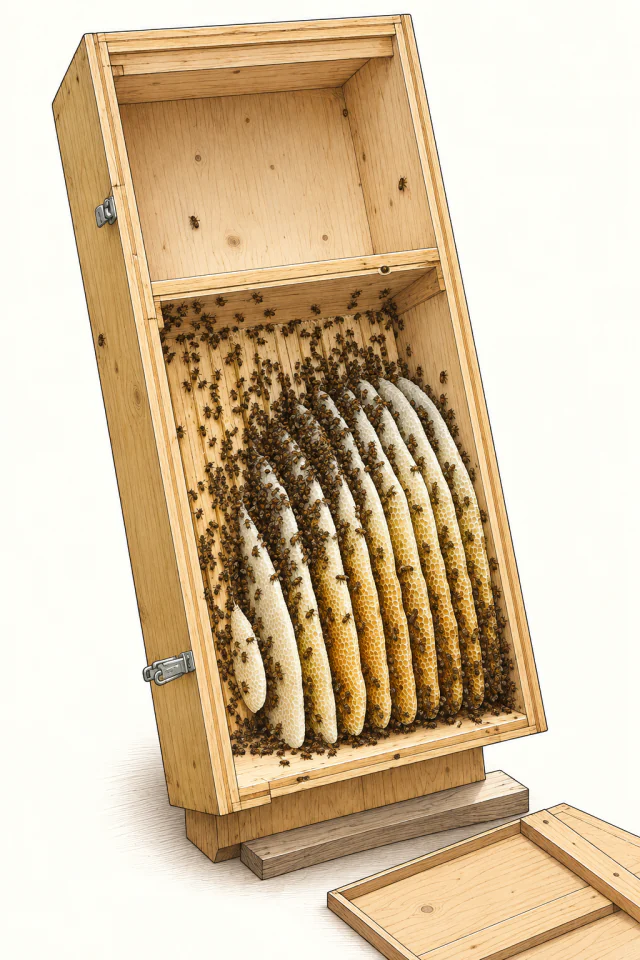
The Bienenkiste is a long, horizontal fixed-comb hive with the brood area at the front and the honey area at the rear. Its removable floor gives access to the combs from below.
Zeidlerei is a traditional form of forest beekeeping in which bees are kept in cavities cut into living trees. Current initiatives revive the craft both for keeping bees and for creating habitats for species that live in tree cavities.
This sample contains stored food taken from close to the brood nest. A laboratory examines it for spores of the bacterium that causes American foulbrood.
Hive debris is material that falls from the colony onto the hive floor, such as wax particles, pollen and dead mites. Its composition and distribution give clues to activity in the colony, including comb building, food consumption and the position of the winter cluster.
Flavonoids are secondary plant compounds that also occur in honey. Their measured total content describes one aspect of its chemical composition. A higher value alone does not demonstrate an additional health benefit from the honey.
David Heaf is a beekeeper and author in Wales. Together with Patricia Heaf, he translated Warré’s L’Apiculture pour tous into English. His website brings together plans, management methods and accounts of beekeeping with the Warré hive.
Phil Chandler is a beekeeper and the author of The Barefoot Beekeeper. He developed his own horizontal top-bar hive for beekeeping with few interventions in the brood nest and published freely available construction plans.
Christ as senior parson in Kronberg, the plate dated 1795
Johann Georg Krünitz, Oeconomische Encyclopädie, oder allgemeines System der Land- Haus- und Staats-Wirthschaft, Band 73. Berlin: Pauli, 1798 · Frontispiece of the volume. Etching after a drawing by Johann Friedrich Beer (1741–1804), engraved by Johann Samuel Ludwig Halle (1763–1829); the plate itself is dated 1795, the volume appeared in 1798. · Photograph: Trierer Porträtdatenbank tripota der Universität Trier, Datensatz 121_krue_0073
The title page of 1783, printed in the Rodheim years
Johann Ludwig Christ, Von der außerordentlichen Witterung des Jahrs 1783, in Ansehung des anhaltenden und heftigen Höherauchs, Frankfurt und Leipzig, in der Hermannischen Buchhandlung, 1783 · Title page, page 3 of the digitisation · Photograph: Internet Archive, bub_gb_XpQ5AAAAcAAJ, aus einer Google-Digitalisierung; am Fuß des Blattes die eingebrannte Zeile „Digitized by Google"
Johann Ludwig Christ, Anweisung zur nützlichsten und angenehmsten Bienenzucht für alle Gegenden, dritte Auflage, Leipzig 1798 · First copperplate, to chapter 2 §7 · Photograph: Münchener DigitalisierungsZentrum, Bayerische Staatsbibliothek
The town church of St. Johann, Christ's church in Kronberg
Wikimedia Commons, Aufnahme von Michielverbeek · Kronberg im Taunus, the town church of St. Johann, from the south · Photograph: Wikimedia Commons, File:Kronberg im Taunus, evangelische Pfarrkirche Johannes der Täufer Dm99116 IMG 1692 2024-05-27 13
Frontispiece to Christ's work on insects, hand-coloured
Johann Ludwig Christ, Naturgeschichte, Klassification und Nomenclatur der Insekten vom Bienen-, Wespen- und Ameisengeschlecht, Frankfurt am Main 1791, in der Hermannischen Buchhandlung · PDF page 535 of the digitised copy; unpaginated title leaf of the plate volume. The title page of the text volume (PDF page 1) announces: „Mit LX. ausgemalten Kupfertafeln in einem besondern Band, und einem ausgemalten Titelkupfer.“ [With LX coloured copperplates in a separate volume, and a coloured title engraving.] · Origin of the digitised image cannot be determined
The church at Harreshausen, built in 1784 to Christ's design
Wikimedia Commons, Aufnahme von E-W · Harreshausen, a district of Babenhausen in Hesse · Photograph: Wikimedia Commons, File:Harreshausen_Evangelische_Kirche
The Kronberg monument of 1885, with portrait plaque and wreath of fruit
Wikimedia Commons, Aufnahme von Karsten Ratzke · Kronberg im Taunus, in the Katharinenstrasse, on the former grounds of Christ's nurseries · Photograph: Wikimedia Commons, File:Kronberg,_Denkmal_Johann_Ludwig_Christ