A swarm hangs in the lilac bush and needs
quarters. A scout bee sets off and takes you along.
Preliminary note: A tells this fable. She speaks to you in our words and judges the
dwellings by standards taken from research. Studies show which cavities swarms
choose, how walls hold the warmth and what a coating of resin does. You will
find the figures and findings in the margin, with year and reference.
Her knowledge reaches as far as the sources. Her preferences, and the dwelling
she chooses in the end, we gave her. Where research has no answer, she leaves
the question open and tells you so.
Allow me to introduce myself
Good day to you. Allow me to introduce myself: . The swarm back there on the
lilac bush has sent me out, and I should dearly love to stop for a chat with you,
but sadly, sadly, there is no time; I must find a dwelling for my colony.
Come along with me for a while if you like; I shall tell you about it along the way. Off we go.
Strictly speaking I ought not to be out on this errand at all, for my master is
doing his desperate best to keep us from leaving; imagine, he comes once a week
and pulls us apart down to the very last corner, only to prevent it. And every time he
discovers those splendid little cups we have quietly built, you know the ones I mean: inside them we are raising
a new mother for our colony, . When he finds the corpus delicti: snip, and away with it. A pity, but what are we to do, we let it happen. He does not mean us any harm, please understand me rightly there; he simply does not want to lose us.
This time we have been lucky, the master overlooked one cup, and
the brood work inside it was almost finished. Once it has come far enough along and
we know that the new one will be equal to her task, we seize
the present ruler and move out. We, in this case, is probably
half our kin: the swarm, the very one now hanging over there.
When we move out we hardly know yet where we are going. That is what I and my
colleagues are for. We set off in search of a new home, and once we have found
something we fly back to the lilac bush and report it. When all those sent out
are back again, a vote is taken on who seems to have found the best lodging,
and we move there.
Do take a look at that, over there.
The crate I know
Looks like an empty crate. Let us fly in and see.
Well now. This is suspiciously familiar to me, it is all just as it is at home:
the measurements, the slot along the whole width at the bottom, and the walls
so smooth and so even that nothing sticks to them. This must be one of my
master's kind. With those, everything is the same.
There they hang, the , eleven of them, with
finished combs, clean and straight and dry. Very tempting, I shall not deny it, since it saves us a great deal of work; we could be storing this
evening and laying tomorrow morning, instead of building for half a year
first.
You already know about the weekly pulling-apart with smoke and a flat iron,
with which he breaks the frames out one by one. What is easy to miss: afterwards we have to heat the place up again and make our little
room sterile once more. Do you suppose that makes us happy?
Making it sterile goes badly in this crate in any case. Planed, painted, no
crevice, nothing to hold on to. In a proper cavity we gather resin together
and coat everything with it, layer upon layer, and somebody has measured what
that yields: where the walls had been deliberately milled rough, a multiple of
the resin sat in them in the end, and the colonies came out close to two combs
of bees and brood stronger.1 For the sake of good order I must
say that we have been broken of the resin habit; over the years it has been
bred out of us.1 Why, I do not know, and certainly nobody
wished us harm by it.
And he works us until nothing more will come. As soon as things are in flower
outside, he arrives with and sets them on top of our
home, full of empty combs. You would not believe what that does to us. Empty
comb over our heads, and we lose our minds: alarm, alarm, that has to be
filled, as fast as possible.
Humans have measured this on us: colonies with four square metres of empty
comb above them brought in fifty-one kilos of honey, colonies with barely two
only thirty-six, and when the boxes were swapped the same thing
came out again.2
With the empty space over our heads he gives us an order, and we obey it.
And we fly and fly, day in, day out, all hands on deck, no time for cleaning,
no time for tidying, no time to sit down for once.
Then the mite. The thing sits in every crevice, and on our young it hangs for
as long as they lie in the cell.
What helps against her is exactly what I have in mind for today: moving out.
When we swarm, the old dwelling stays without brood for a while, and without
brood the beast does not multiply; that was followed on Gotland in colonies
that had been left to themselves.3 Which is why he cuts
our queen cells out.
He does not do it to harm us. He wants to keep us, and a swarm that flies off
is for him a colony he has lost. That he takes from us the one thing that
helps against the beast is something he does not see.
When there is nothing more to be had out in the fields, he comes again and
takes the boxes off the top. He does not let us starve, that much must be
granted him. First he takes the honey from us, and then he gives us sugar
syrup.
So that you do not misunderstand me: he means well by us. He comes in all
weathers, he worries, he looks up what is supposed to be best for us, and what
he has read about the sugar syrup he then believes as well.4 I hold none of it against him. He simply does
not know what it is like from the inside, which he could not know either; for
that he would have to live a winter with us.
Well then. Eleven finished combs, half a year saved, and for that the iron
every week and the syrup in autumn.
Time to be off.
Over there stands another little box, looks old-fashioned. Let us inspect
that one.
The old-fashioned little box
I have never seen anything of the kind.
It stands apart from the row, under a little roof of its own that is open at
the front. And it is four boxes, set one upon another like the drawers of a
chest, each of them barely a hand's breadth high.
And do look: it faces the morning sun.
We like it when the sun calls us out early, because then we are abroad while the others are still sitting there
numb; and if you ask me how often I find that on the cases of men,
I tell you: today for the first time.5
The flight hole sits at the bottom, where it belongs, a proper hole,
no barn door: barely a hand's breadth long and a good finger and a half high.6 That can be defended. At home with us the slit runs the whole width,
and when the robbers come in August we stand there like an open tavern.
Inside, then.
Now see this: nothing here hangs in frames. Across the top lie six narrow
pieces of wood, running from the flight hole to the back, no more than that.
Six laths. We would build onto those, and what we build is ours.
Here nobody can leaf through us any more, page by page. Whoever wants to get in has to lift off the whole little box, together with
everything that hangs from it. That is still a disturbance, certainly, but it comes to
all of us at once and together, instead of one comb after another.
I have paced the space out, the way we do, along the walls and criss-cross
through it. How big it is exactly I cannot tell you, since that
depends on how thick the walls are, and I shall come to those in a moment. For a colony
like ours it is enough.6
The walls are planed. Smooth as a table, pale, and I find no place
where our resin would take hold: the same thing as at home, only more neatly
made. Thin they are into the bargain. How thin exactly I cannot tell you; I
can only say this much: thinner than I should like in January.
At the back sits a pane of glass, as wide as two flight holes.6 So somebody
looks in here. Well, that could be remedied; we smear such a thing over with
wax and bee glue until it is blind, and the builder evidently knows it too, for
he has hung a little shutter in front of it that falls to again of its own accord.6 A man who watches us closing things up and then builds a little shutter; I should have liked to meet him.
And then I stand at the top and feel the draught.
It comes in at the front by the flight hole, passes over the six pieces of wood and
goes out again at the back by the pane. At first I thought something must be
leaky somewhere. But it is not. The six pieces of wood lie in exactly that
direction, so that we build along them and the air can draw between all the combs.6
Somebody wanted a draught here.
I do not know what he was thinking of. Perhaps he found the summer too warm; he probably watched the likes of us sweating and supposed that we
needed air. In summer we need air; in February we do not.
The wall is too thin for me, the glass is a whim, and the through-draught is an
advantage in that he takes it for one.
Before I fly back and dance about this little box, I want to see something else, something no human hand has been near at all.
Come along, up the slope.
A hole in a beech
There now, up here at the edge of the wood. See for yourself.
An old beech that puts out no leaf at the top any more, and at the height of the
third branch a split, where a branch was once torn away and the wood has half
grown the wound shut again over the years. What is left is a slit, hardly wider than your thumb, a good five metres above the ground. From
outside already it smells of old wax.
You are not coming in with me, you would not fit through. I shall describe it to you.
The hole first, since that is the first thing we examine. Small enough for two of
us to hold it, and high enough up that nobody looks in from below.
Both of those we prefer to the opposite, and somebody has put the question to us: five
metres over one metre, a small hole over a large one.7
Inside it is tall and narrow. I climb and climb.
And now the main thing: the wall is a hand's breadth thick. Grown wood, all round, above, below. No
paint, no joint, no lid that could be lifted off. Here we need not heat up again, because nobody lets our warmth
out, and because what we produce stays in the wood instead of drawing off through
the cracks.8
Then the walls themselves. They are rough and full of notches, and into every
notch somebody before me has brushed resin, layer upon layer, until the wood
shines and sticks underfoot.9
Right at the top hang combs, black and brittle with age. Somebody has lived here
before.
For us that is a letter of recommendation. A cavity somebody has already lived
in we take in preference to an empty one,7 because it has proved
itself: whoever moved out of here stayed at least long enough for the building
to be worth the trouble.
Building, yes. That is the disagreeable part of it.
For there are no eleven finished combs hanging here. What hangs here is a few black tatters,
and everything else we have to make ourselves, all summer long, from the top
downwards, out from the wall. Right up to the wall, at least. In my master's crate a gap has to stay clear all round every
frame, or it could not be pulled out; here nobody wants to pull anything out,
and we build right up to the wood.8
If the summer yields nothing, nobody gives us sugar syrup either. That
belongs to the picture, and I do not want to talk it away: my master does not
let us starve. This tree will, if it comes to that.
The mite will be here too, by the way. She sits in us already, we bring her
along, and in a tree nobody attends to her. The difference is only this:
if we want to move out again next year, nobody keeps us from it, and
then those who stay go a while without brood. That is all we have against
her.10
At this tree almost everything I can measure comes out right: the hole, the
height, the wall, the resin, the old combs. And nothing is finished, nobody
feeds us up, nobody steps in when it goes wrong.
Come along, back to the lilac bush. There is dancing going on now.
Back to the lilac bush
You have kept me company for half a day now, and I must go back; come along as
far as the lilac bush if you like, it gets interesting there at once, because
something is being decided now without there being anybody who decides it.
The cluster is still hanging, a little lower than this morning, and on the
outside it is all running about like a railway platform. I climb up, find
myself a clear spot on the backs of the others and begin to run, a stretch straight
ahead, waggling my hind body as I go, then a loop back and the same thing over
again, and again, and again. The direction I run in says where it lies. How
long I waggle says how far. And how often I repeat the whole of it says how
well I think of it.
I repeat it very often.
Beside me another one is dancing who has found something quite different, a
niche in a wall by a shed. She dances a shorter while than I do, which in our
language means: it will serve, but I am not enthusiastic. A third has been at
the white crates by the field of rape and canvasses for them with a
persistence that, to be honest, annoys me, for she saw eleven finished combs
there and nothing else, and what finished combs are worth I know best myself.
So it goes on for a while. Whoever sees a dance flies over and looks for
herself, and whoever comes back and agrees dances too; whoever does not agree
does not dance, which settles the matter as far as she is concerned. Nobody
makes a speech and nobody raises a hand. One of the places simply grows fuller
and fuller, and at some point the next bee to arrive at my beech meets a crowd
there instead of a few single ones. By that we know that it is decided;
none of us decided it.
Our ruler, by the way, hangs in the middle of the cluster the whole time and
learns nothing of it. Ruling is not her office with us, she is taken along.
One day in the year on which we settle for ourselves where we live; on the
other three hundred and sixty-four somebody else settles it, the room, the
wall, the warmth and the hour at which we are opened, and against this one day
the master works with everything he can think of, because he wants to keep us.
That is why it mattered so much this morning that he overlooked this one little
cup.
What I could not see
Before we fly, I must say one more thing to you, one that counts against me.
All day long I have been telling you what I examine, which will have sounded
very thorough: the height above the ground, the size of the entrance hole, where
it sits and which way it looks, the room, the distance from the old stock, and
whether somebody has been there before. That makes seven things, and for every
single one of them there are figures from experiments in which cases were put
out for us and somebody looked to see which ones we take.11
Draughtiness made no difference in those experiments, and neither did damp.
We were offered tight cases beside draughty ones and dry ones beside damp, and
we took whatever else suited. Which means: when I stood in the old-fashioned
little box at midday today and the draught struck me in the face, I had no
reason to go out again. I noticed it, I even explained it to you, and I should
have chosen that dwelling all the same, if the other seven things had been
right.
What such a draught costs was reckoned up long after that little box, on other
dwellings and not on it. My kind has never read that reckoning and will not read
it. We notice it in February, by the number of those who do not get up again,
and even then we do not know what it came from.
There is more that I cannot possibly examine on a day of viewing: whether somebody will come and take everything out, and how often. What becomes of the combs we build; whether the wall keeps in January what it promises in June; whether he crushes the queen while he is about it.
I see the dwelling; the year that follows inside it I do not see.
And because that is how it stands, I would rather end by telling you exactly
what I have done. I have found the best of the dwellings I was able to measure.
We move off
Here we go, can you hear it? At first the cluster only shivers, as though it
were cold, then the outer layers come loose, and then the whole thing is up in
the air at once, a few thousand of us in one spot; you had better keep your head down now.
We fly low, barely three metres above the grass, and we are astonishingly slow
about it, because most of us have no idea at all where we are going. Only a few
dozen know. They shoot forward through the swarm from behind, turn off, let
themselves drop back and shoot forward again, over and over, and by that the rest keep their course; it looks like a thread being drawn through a cloth.
At the edge of the wood we climb. I must thank you now for having come along,
and take my leave, because I have work up there, a great deal of it: clearing out a hollow, throwing the old stuff out, walking the walls, fetching
resin, building, all of it before the first cold rain if that can be managed.
The finished combs we did not take would have saved us half a year. I am still
thinking about them.
At my master's it goes quiet that evening. He comes at seven, as he does every
Friday, with smoke and his iron. He will notice soon enough that only half of
them are still sitting in his crate, a few hundred who stayed behind, a young
queen who has not yet been on her mating flight, and not one full comb.
He will take fright, and then he will be annoyed, and a little hurt as well,
because he took trouble over us.
And next week he will look more closely still.
Nucleus colony
A new colony formed by the beekeeper rather than by waiting for a swarm. Brood and bees from a strong colony are placed in an empty hive.
Christ makes nucleus colonies “after the Franconian manner”: a piece of brood comb four to five inches square is placed in an empty hive, and the bees rear a queen from it (K1 §5). He prefers this method to swarming and allows about a hundred boxes for an apiary of ten colonies, four of which are to swarm (K4 §26).
Combs in a straw skep are fixed in place. Harvesting the honey requires cutting them out and destroys the colony in the process. The usual practice was to set the skep over burning sulphur and suffocate the bees.
Christ calls this the “old routine of most country people, which can hardly be rooted out: in autumn they slaughter and suffocate the heaviest and the lightest hives, irresponsibly and quite sinfully” (K3 §2).
Christ also objects to the quality of honey obtained this way: it is “fouled with brood, dead bees, the smell of sulphur and the like” (K3 §6).
Christ’s word for an individual box in his stacked hive. It consists of four planed boards, measures thirteen inches square externally and four and a half inches high, and has an entrance at the front, a pane of glass at the back, a cornice at the top and a grid beneath it (K3 §4).
The boxes have neither floors nor lids. The lowest stands on a floorboard that also serves as a landing board (K3 §9); the top one receives a cover of wood, glass or plaited straw (K3 §4).
For a colony that is not to swarm, Christ allows eight boxes over the summer; for a young swarm, six (K4 §26).
Placing an empty box on top of a full one. Christ considers this easier, but nevertheless does not use it to expand the hive:
“Setting on would of course be somewhat more comfortable than setting under; but it will not do. The nature of bees is to build from the top downwards, and to go on building where they have left off.” (K4 §26, footnote)
He does add vessels above for harvesting. Glasses and porcelain vessels are inverted on the top box’s cover so that the bees can build into them from below; the comb is cut with a silk thread or thin piano wire (K3 §5).
The modern German word for any human-made bee dwelling originated in forest beekeeping. Christ writes that forest bees are “drawn into hollow trees or into Büten or Beuten hewn out expressly for the purpose” and belong to the forest owner (K9 §2).
He does not use the word for his own boxes, which he calls Aufsatz, Kästchen, Magazin or Bienenwohnung.
The gap bees leave open in their hive rather than filling it with comb. Combs hung at this distance can be removed individually without cutting. Lorenzo Langstroth described the spacing in 1851 and received a patent for a hive using it on 5 October 1852.
In this repository, the statement is supported by a search summary covering several pages rather than by the patent document itself (source key langstroth-1852).
A measurement from a source read directly appears in Warré. He leaves twelve millimetres between two top bars, expressly “pour le passage des abeilles” [for the bees to pass through] (Warré 1948, p. 49).
Dzierzon
The priest associated with beekeeping’s transition to movable comb. Writing in 1889, Johann Witzgall recounts that Dzierzon began keeping bees “mit dem Christ'schen Magazinstocke” [with Christ’s stacked-box hive] and through experimentation developed “den jetzt allgemein verbreiteten Stock mit beweglichen Waben” [the now widely used hive with movable combs] (Witzgall, Geschichte der Bienenzucht 1889, p. 56).
The changes began with Christ’s comb-supporting grid. Dzierzon fitted the boxes with movable bars and attached comb to them so that each comb could be lifted out separately. Side doors, fixed floorboards, ledges on the inner walls, shorter and taller boxes and a fixed lid followed (Witzgall, Geschichte der Bienenzucht 1889, p. 56). Christ nails down the six wooden strips of his grid (K3 §4).
In 1844, Dzierzon presented his invention publicly. The distinction between movable- and fixed-comb beekeeping dates from that year (Witzgall/Felgentreu 1889, p. 102).
Witzgall writes forty years after the event and does not quote Dzierzon himself.
The opening through which bees enter and leave. Every box in Christ’s hive has one, four inches long and 1¼ inches high, with two metal slides in front (K3 §4).
Christ explains its size in terms of the air bees need when confinement is necessary and the ease of feeding (K3 §4, footnote).
Since every box has its own entrance, adding a box underneath requires another step: two or three hours later, the upper entrance is closed completely, “otherwise they do not readily build on” (K3 §9).
Four strips of wood glued and nailed to the top of each box. They support the grid and project a quarter of an inch outwards (K3 §4).
Christ gives two purposes for the projection. It forms an ornament, shaped with an ogee plane, and ensures that “all the supers fit well on one another and stand firm if one should turn out ¼ or ½ inch larger or smaller than another” (K3 §4).
This projecting rim prevents wall thickness from being read off the engraved plate. The oblique view in Fig. 1 shows the wall and cornice together at the edge.
Émile Warré (1867–1951) was a French priest and beekeeper. His Ruche
Populaire (“People’s Hive”) was intended to be simple to build and manage.
He described its construction and management in L’Apiculture pour tous,
whose twelfth edition appeared in 1948.
Christ’s own addition to the stacked-box hive. A hole seven inches long and two and a half inches high is chiselled in the rear wall of each box, the glass is fitted into it, and a small shutter excludes the light (K3 §4).
At the end of the same section, in a passage for readers wishing to omit all other refinements, he gives his judgement: “A glass pane in the rear board, however, is almost indispensable.” (K3 §4)
He answers the obvious objection from observation. Bees attach comb to glass as firmly as to wood or straw and keep it clean; what they coat in autumn, they clean again in spring (K3 §11).
The French word for a box placed above another. Palteau’s hive consists of a table, three legs, several hausses, a cover and a landing board; each box measures one foot square and three inches high (Palteau 1777, pp. 7–11).
Christ has not read Palteau in the original. In a footnote to the preface, he writes that only years after his own invention did he read “something of similar bee dwellings”, “such as those of Herr Palteau in France and the Vicat one, which Schirach in his allgemeinen Bienenvater describes” (Vorrede).
A textbook of religious doctrine arranged in questions and answers. Every child worked through it in lessons and learnt the answers by heart; the form was therefore familiar even to readers who read little else.
In 1784, Christ applies it to bees while distinguishing his purpose from that of the classroom. Catechetical teaching is “für den gemeinen Mann die faßlichste und deutlichste” [the easiest for ordinary people to grasp and understand]; he intends no catechism “zum Auswendiglernen, sondern blos zum Unterricht und Nachschlagen” [for memorising, but only for instruction and reference] (Christ 1784, p. VI). His Bienencatechismus für das Landvolk consists of 197 numbered questions, some of which state the opinions he opposes.
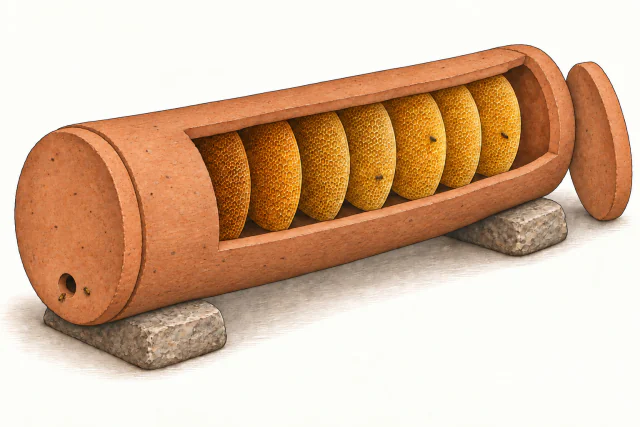
Log hive
A log hive is a hollowed section of a felled trunk used to house bees. Unlike a cavity in a living tree, the whole hive can be taken to another site.
A word at the foot of a printed page that repeats the first word of the next. The compositor used it to keep the sheets in order.
It can cause errors in this project: including the catchword when transcribing an old page duplicates a word. In the Vicat source text, three catchwords appear at the head of the following page rather than the foot of the preceding one: “festiget,” (110/111), “einiche,” (118/119), “voraus,” (120/121).
Stacked-box hive, Magazin
A hive made up of several boxes stacked vertically, each removable separately. Christ calls it a Magazin or Magazinstock.
He describes bees having “their household in joined supers … that are increased or reduced from time to time as circumstances, the season and one's intentions require” (K3 §3).
Christ presents wood and glass as innovations. The usual stacked hives had been made of straw, “at least I have seen none of any other kind”; their drawbacks led him to square wooden boxes with a pane of glass (K3 §3).
Beekeeping with movable combs. Its German name arose alongside the contrasting term Stabilbau. In 1889, Witzgall and Felgentreu date both to 1844: “Seit 1844, wo Dr. Dzierzon zuerst mit seiner Erfindung öffentlich hervortrat, spricht man in Imkerkreisen von einem beweglichen oder unbeweglichen Bienenstocke, vom Mobil- oder Stabilbau.” [Since 1844, when Dr Dzierzon first presented his invention publicly, beekeepers have spoken of movable or immovable hives, of movable- or fixed-comb beekeeping.] (Witzgall/Felgentreu 1889, p. 102)
Christ predates this distinction. The bee specialist F. Gerstung later defined his contribution precisely: “in Deutschland der eigentliche Begründer der Mobilbienenzucht … freilich nicht so sehr der Beweglichkeit jeder einzelnen Wabe … als vielmehr der Mobilität, d.h. der Beweglichkeit von Teilen des Bienenstockes, von Auf- und Untersätzen” [in Germany the true founder of movable-comb beekeeping … admittedly less of the mobility of each individual comb … than of the mobility of parts of the hive, of upper and lower boxes] (quoted in Bode 1984, p. 381).
Witzgall/Felgentreu 1889, p. 102
Nadiring
The technical term for adding a box underneath: an empty box is placed below a full one. It describes the operation Christ calls Untersetzen.
The earliest vertically divided hive using this method documented in the project is Gedde’s octagonal box. It has two iron handles “for lifting it up when another is to be placed under it” (Gedde 1677, pp. 18–19).
Top bar
A top bar is a wooden strip to whose underside the bees attach a comb. The comb may also be attached to the hive walls. A top bar alone therefore does not make the comb individually movable.
Lorenzo Langstroth described bee space in 1851: a gap of about a centimetre that bees leave open rather than filling it with comb. He received a patent for it on 5 October 1852. Since then, combs have hung in frames that can be removed individually; this remains the most widespread construction in much of the world.
Christ’s stacked-box hive predates this development. In his hive, the movable unit is the box, lifted off whole while its combs remain inside. The bee specialist F. Gerstung therefore called him the founder “der Mobilität, d.h. der Beweglichkeit von Teilen des Bienenstockes, von Auf- und Untersätzen” [of mobility, that is, the mobility of parts of the hive, of upper and lower boxes] (quoted in Bode 1984, p. 381).
Christ uses the word Rähmchen once, in a different sense: the pane of glass in a straw box is “fitted into a small wooden frame” (K3 §8).
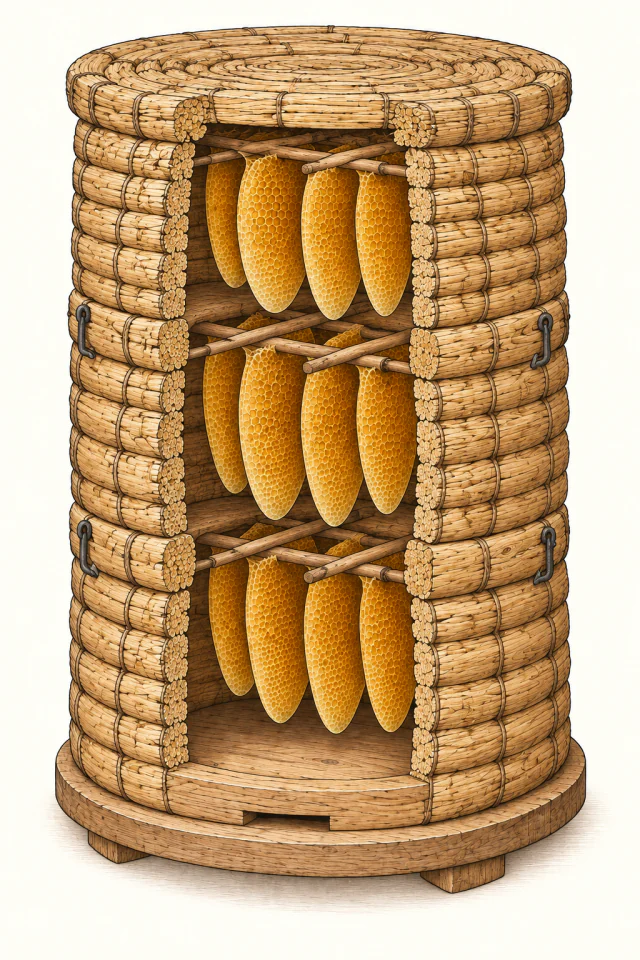
A ring skep consists of straw rings of equal diameter, stacked to form a
shared interior. More rings can be added to enlarge the hive. Fixed crossbars
support the combs and allow individual sections to be removed with their comb.
AI-generated schematic illustration after Fleischer (1777).
Fleischer 1777, pp. 311–314; explanation of the plate, Figs. 2–4
Rose, Rosentafel
Christ’s term for a comb. He uses it as a synonym for Wachstafel and combines the two when explaining how young colonies can be recognised: “by the whiteness and delicacy of their wax combs or roses” (K2 §10).
Compound forms occur throughout the book. Honigrosen are honey-filled combs (K3 §5), while Bruttafeln contain brood (K4 §2).
The comb guide in Christ’s box. Wooden strips, each one inch wide, are nailed into the rebates of the front and rear cornice strips; the bees align their comb with them (K3 §4).
The number depends on the position in the stack. Only the top box receives six strips, “so that the bees attach and build their combs in this direction, from the rear wall toward the flight hole”. The lower boxes receive two, since the bees continue in the direction already established (K3 §4).
Christ gives three reasons for using fewer strips below: the colony clusters more closely in winter, debris does not collect on the wood, and bees can move up and down more easily (K3 §4). To support heavy honey combs, each box with two strips also receives a cross made of two round willow or hazel sticks (K3 §4).
A bee that flies out before a swarm to seek a new dwelling.
Spurbiene is Christ’s own term, although he considers the behaviour unproven. The idea that bees “some days before swarming, seek out a hollow tree by means of scouts, or so-called scout bees” belongs, in his view, “in truth quite among the mere conjectures” (K4 §9). He nevertheless accepts it for hunger swarms, having watched individual bees clean an empty hive for days before a swarm moved in three days later. He does not regard scouts as a separate caste: they are “of course no special kind of bee” (K4 §9).
A hundred and eighty years later, experiments with boxes in the forest measured the criteria by which a swarm chooses a nest. These criteria underpin the story “A bee in search of a home” (Seeley and Morse 1978, cited indirectly rather than read in full).
Beekeeping in hives without movable frames. Comb is firmly attached to the ceiling and walls. To remove it, the comb is cut free or taken out with the hive section to which it is attached.
Witzgall and Felgentreu date the distinction between fixed- and movable-comb beekeeping to 1844, the year Dzierzon presented his invention publicly (Witzgall/Felgentreu 1889, p. 102). By 1889, the same authors already regard fixed comb as needing justification. They open their chapter by suggesting that some readers may be surprised to find it included, “nachdem man ja doch schon längst den Stabilbetrieb als veraltet und für die heutigen Zeiten als abgethan betrachtet…” [since fixed-comb management has long been regarded as outdated and no longer relevant to the present day…] (Witzgall/Felgentreu 1889, p. 209).
Christ does not know the term. In his time, there is nothing from which fixed-comb beekeeping needs to be distinguished.
Witzgall/Felgentreu 1889, pp. 102 and 209
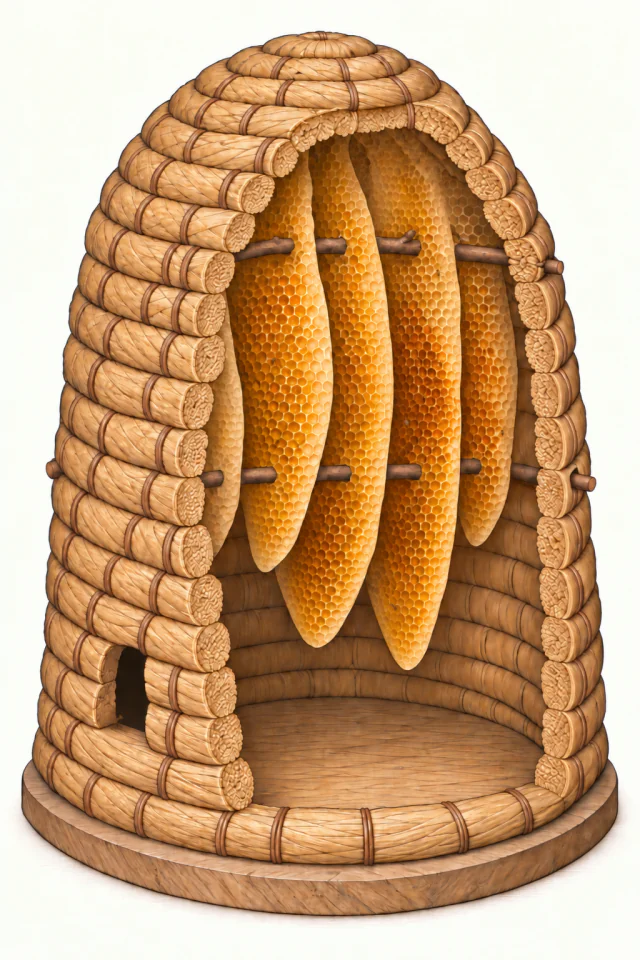
Straw skep
The ordinary bee dwelling of country people in Christ’s time: a basket coiled from straw ropes, made in one piece and impossible to divide. Honey is harvested by cutting out the comb, and the colony dies in the process (K3 §2).
Christ proposes his stacked-box hives instead. An apiary of thirty to thirty-six of them is “worth more than an apiary of 100 pieces in straw baskets” (K4 §26).
He also describes continued use of the skep. In K3 §10, he explains how to place a straw skep on a lower hive box, seal the skep’s entrance and thereby draw the bees down into the boxes.
A small basket placed on top of a straw skep for the bees to fill with honey comb. Christ uses the country people’s terms: “the small baskets (caps, hoods) which the country people set on the straw baskets” (K4 §26, footnote).
Their limited use strengthens his objection to adding space above. Of ten colonies, scarcely one or two build into them, and only in a particularly good honey year; many prefer to build outside rather than in the basket above (K4 §26, footnote).
The same box as an Aufsatz, occupying a different position in the stack. Christ explains the term in a footnote:
“I shall hardly need to remark that by lower supers I understand nothing else than those supers which stand lowest, because they are mostly only ever set underneath; and they may all be called little boxes, on account of their likeness to such.” (K3 §4, footnote)
The name follows the position in the stack. The comb-supporting grid differs: six strips in the top box, two in the lower boxes (K3 §4).
Placing an empty box beneath a full one. This is Christ’s way of expanding the hive and the operation around which his entire management system is organised.
He specifies the timing: once the lowest box is “built somewhat more than half or to three parts full”, the next goes beneath it, and so on into August (K3 §9). Only one is added at a time, since “the bees build more readily into one empty super than into two” (K3 §9).
He describes the work twice. His earlier method takes place very early in the morning, with a helper lifting the hive while the other person withdraws the floorboard (K3 §9). His later, improved method is at midday, during peak flight, when “Out of industry and eagerness in bringing in they trouble themselves about nothing” (K3 §9).
The resin bees use to seal crevices and attach comb, now called propolis.
Christ explicitly distinguishes it from wax: “The cement or fore-wax, which is different from wax and is properly a sticky resin, though after being worked and especially in the cold it becomes quite hard” (K1 §14).
He uses it when populating a hive. Melted over coals and brushed into the corners of a new box, it keeps a young swarm in place; a previously used box already coated with resin provides the same advantage without the work (K4 §21).
The old German word for the queen. Christ uses both terms together: “The queen, called by the ancients the Weisel” (K1 §1).
In compounds, the older term has remained more common. Weisellosigkeit means the condition of a colony without a queen; Christ devotes a separate section to it (K5 §6).
A medieval forest beekeeper who kept bees in hollow trees and paid dues for doing so. In his chapter on law, Christ connects the occupation with rights over trees: “the Zeidler company formerly arose from this, who pay a certain rent in honey and wax to the forester or to some other lord of the forest” (K9 §2).
For him, this belongs to the past. The house and garden bees of his own time belong “among our domestic animals” (K9 §2).
The unit of length Christ uses has not been conclusively identified. There was no uniform inch; each region had its own.
Only once in the whole book does Christ write “lines Paris inch”, when giving the length of a queen. Before that, he has already used inch twenty-four times without qualification (Anmerkungen des Übertragers).
The transcriber compared the construction dimensions with Christ’s stated volume of four Maß. Using the Paris inch (2.71 cm) produces a discrepancy of 27 to 34 per cent; the Frankfurt inch (2.37 cm), one of 1 to 8 per cent. He concludes that the lengths cannot be expressed in Paris inches and that the conversion factor lies between 2.4 and 2.5 (Anmerkungen des Übertragers).
This is an inference, not a statement by Christ, who nowhere specifies which inch he means.
The old church due: approximately a tenth of a farm’s annual produce, delivered as crops, wine or livestock. Part of it paid the parish priest, who collected it from the same people to whom he preached on Sundays.
Christ collected tithes himself and went to court over them. When a tithe income ceased, he received land instead, a “Besoldungsstük zum Ersaz des Zehnden” [a plot of land forming part of his salary in compensation for the tithe] (Bode 1984, p. 181).
Bode 1984, p. 181
Bienenkiste
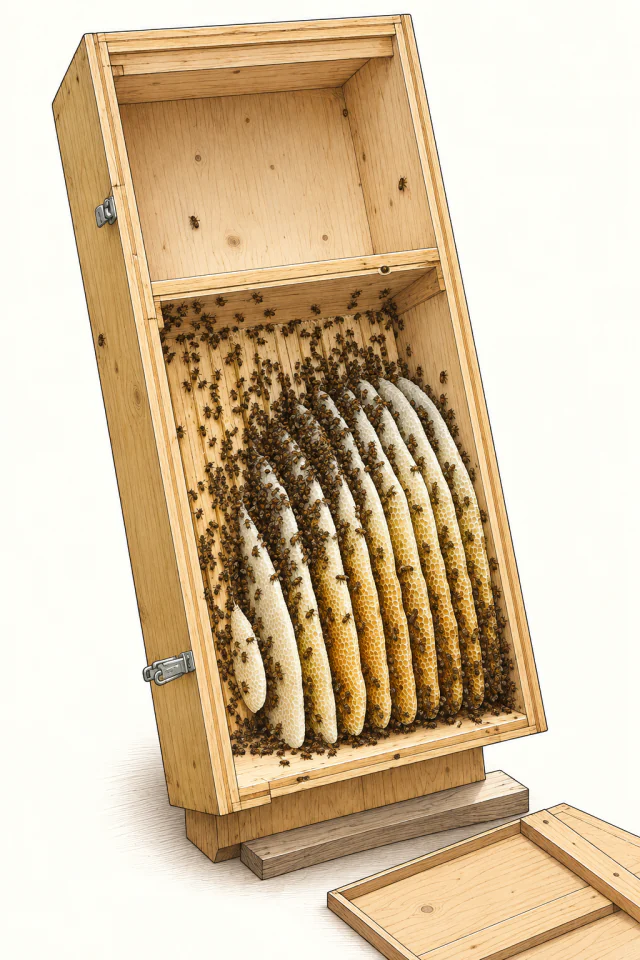
The Bienenkiste is a long, horizontal fixed-comb hive with the brood area at the front and the honey area at the rear. Its removable floor gives access to the combs from below.
Zeidlerei is a traditional form of forest beekeeping in which bees are kept in cavities cut into living trees. Current initiatives revive the craft both for keeping bees and for creating habitats for species that live in tree cavities.
This sample contains stored food taken from close to the brood nest. A laboratory examines it for spores of the bacterium that causes American foulbrood.
Hive debris is material that falls from the colony onto the hive floor, such as wax particles, pollen and dead mites. Its composition and distribution give clues to activity in the colony, including comb building, food consumption and the position of the winter cluster.
Flavonoids are secondary plant compounds that also occur in honey. Their measured total content describes one aspect of its chemical composition. A higher value alone does not demonstrate an additional health benefit from the honey.
David Heaf is a beekeeper and author in Wales. Together with Patricia Heaf, he translated Warré’s L’Apiculture pour tous into English. His website brings together plans, management methods and accounts of beekeeping with the Warré hive.
Phil Chandler is a beekeeper and the author of The Barefoot Beekeeper. He developed his own horizontal top-bar hive for beekeeping with few interventions in the brood nest and published freely available construction plans.