Instructions for the most useful and pleasant beekeeping for all regions
by Johann Ludwig Christ (1798)
Modernized version, abridged and annotated.
Brief description and overview
This work is a practical guide to beekeeping from the late 18th century. The author, a pastor and naturalist, combines observations of bee life with practical advice for beekeepers. He describes the organization of the bee colony, suitable locations, dwellings, swarming behavior, honey and wax harvesting, equipment, bee law, and much more.
The original, often archaic language has been modernized and made easier to understand. Footnotes and marginal notes have been integrated into the text. The content of the less important chapters has been shortened by about 50% without losing any essential information.
However, chapters 3 and 4, which are important for understanding the principle of beekeeping described by Christ, have been reproduced almost in their entirety, albeit in modified form.
Chapter overview
-
Preface and preliminary report
Christ explains why he wrote this book: to provide an easy-to-understand, practical guide to beekeeping. He emphasizes the benefits of bees and their amazing order. -
Chapter 1 – About bees in general
Structure of the bee colony: queen, drones, and worker bees. Their tasks, lifespan, order, and "language." Introduction to the fascinating social life of bees. -
Chapter 2 – The apiary and its location
Choosing the best location: proximity to nectar-bearing plants, protection from wind and moisture, correct orientation and construction of the apiary. -
Chapter 3 – The best type of bee housing
Comparison of traditional straw hives with modern magazine hives. Advantages of wooden and glass supers, construction instructions, and gentle honey harvesting. -
Chapter 4 – On the propagation of beehives
Natural swarming, recognizing swarming behavior, methods for catching and relocating swarms. Artificial propagation through splits and their advantages. -
Chapter 5 – Care and maintenance of bee colonies
The annual cycle of beekeeping: spring development, nectar flow, feeding, protection against robbery, diseases, and winter preparation. -
Chapter 6 – Harvesting honey and wax
How to extract honey cleanly and gently, use residual honey, and make mead or vinegar. Wax extraction, cleaning, and bleaching. Description of simple wax presses. -
Chapter 7 – Equipment and tools
Overview of all necessary and useful tools: from swarm catchers and smokers to honey extractors and wax presses. -
Chapter 8 – Useful plants for bees
List of trees, herbs, and flowers that provide bees with abundant nectar and pollen. Tips for improving the foraging environment. -
Chapter 9 – Bee law
Who owns a swarm, what applies in the event of robbery or damage, penalties for bee theft, legal status of beehives.
Together, these chapters form a comprehensive, practical introduction to traditional beekeeping—with many insights that are still useful today.
The book
Title page
Instructions for the most useful and pleasant beekeeping for all regions
by J. L. Christ
First pastor in Kronberg an der Höh, member of the royal electoral agricultural society in Zelle Agricultural Society in Zelle
Third greatly expanded and improved edition.
Leipzig, 1798 by Johann Benjamin Georg Fleischer.
Preface to the first edition
In the great book of nature, which shows us the wisdom of the Creator, bees occupy a special place. Many animals impress us with their skill: beavers build elaborate homes with storage chambers and move tree trunks into position with great effort. Antlions dig perfect funnels to catch their prey. Spiders weave fine webs that are almost invisible yet strong.
But all these examples pale in comparison to the wonder of the bee republic. Here, thousands work together as if in a state. They act with an order and determination that is almost reminiscent of human intelligence. Every bee knows its task—whether it is building honeycombs, collecting food, or defending the hive.
The beehive combines virtues that we admire: order, diligence, cleanliness, community spirit, and self-sacrifice. Even in difficult situations, they find clever solutions. For example, they wall up a dead intruder so that its smell does not harm the colony.
The nature of bees is fixed; they act without learning how to do so. Humans, on the other hand, can learn and develop. This shows that the human soul is created for more than just this earthly life. Observing bees thus leads us from nature to the knowledge of the Creator.
Why this book was written
Why this book was written
Many people have written about beekeeping, but not every work is useful. Some are only understandable to experts, others are based on mere theories or make beekeeping too complicated. Such methods discourage beginners and are of little use.
I wanted to create a book that is short, reliable, and proven by experience. It should be useful to everyone—even people who only keep a few colonies. Everything I describe has been tried and tested by me. Those who follow my instructions will achieve the greatest benefit with the least effort.
Beekeeping is not only a useful occupation, but also an enjoyable one. It combines profit with nature observation and inner peace. May this book help more people to recognize the joy and value of bees.
The author
Preface on the third edition
The need for a new edition fills me with joy. It shows that my approach to beekeeping and the design of the hives I have developed for this purpose have been well received.
This third edition gives me the opportunity to present some improvements that I have tested over the past few years. These mainly concern practical handling and ease of bee care. The focus remains on economic benefits, i.e., how to achieve the highest yield with the least effort and expense.
As far as the physical and scientific principles are concerned, I stick to the tried and tested and generally accepted views. Newer hypotheses on the biology of bees—such as those concerning queen mating or the role of drones—are interesting, but not yet sufficiently proven to be taken as a basis. Furthermore, I currently lack the leisure to continue my observations of nature in the detail that would be necessary for definitive statements.
A new theory on the ancestry of bees and the determination of drones is currently emerging, particularly with regard to the mating of the queen. Mr. Lucas from Nischwitz published particularly noteworthy thoughts on this in his "Unterricht zur Bienenzucht" (Lessons on Beekeeping, Leipzig 1794) and in his "Physikalische Gründe zur Bienenzucht" (Physical Reasons for Beekeeping, Leipzig 1796). For the time being, I will leave these new considerations to other researchers and practitioners.
Thus, my work remains primarily a practical guide that will benefit every bee lover, whether experienced or inexperienced, and make beekeeping easier and more successful.
The author
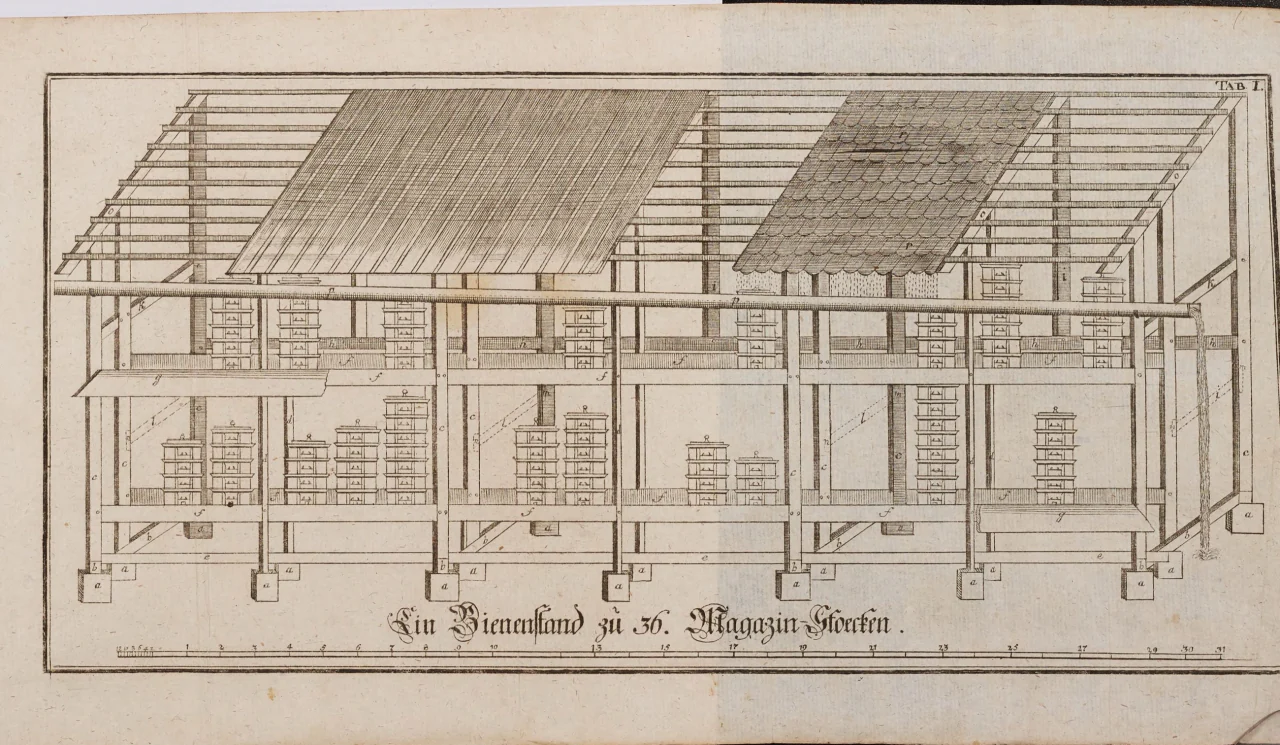
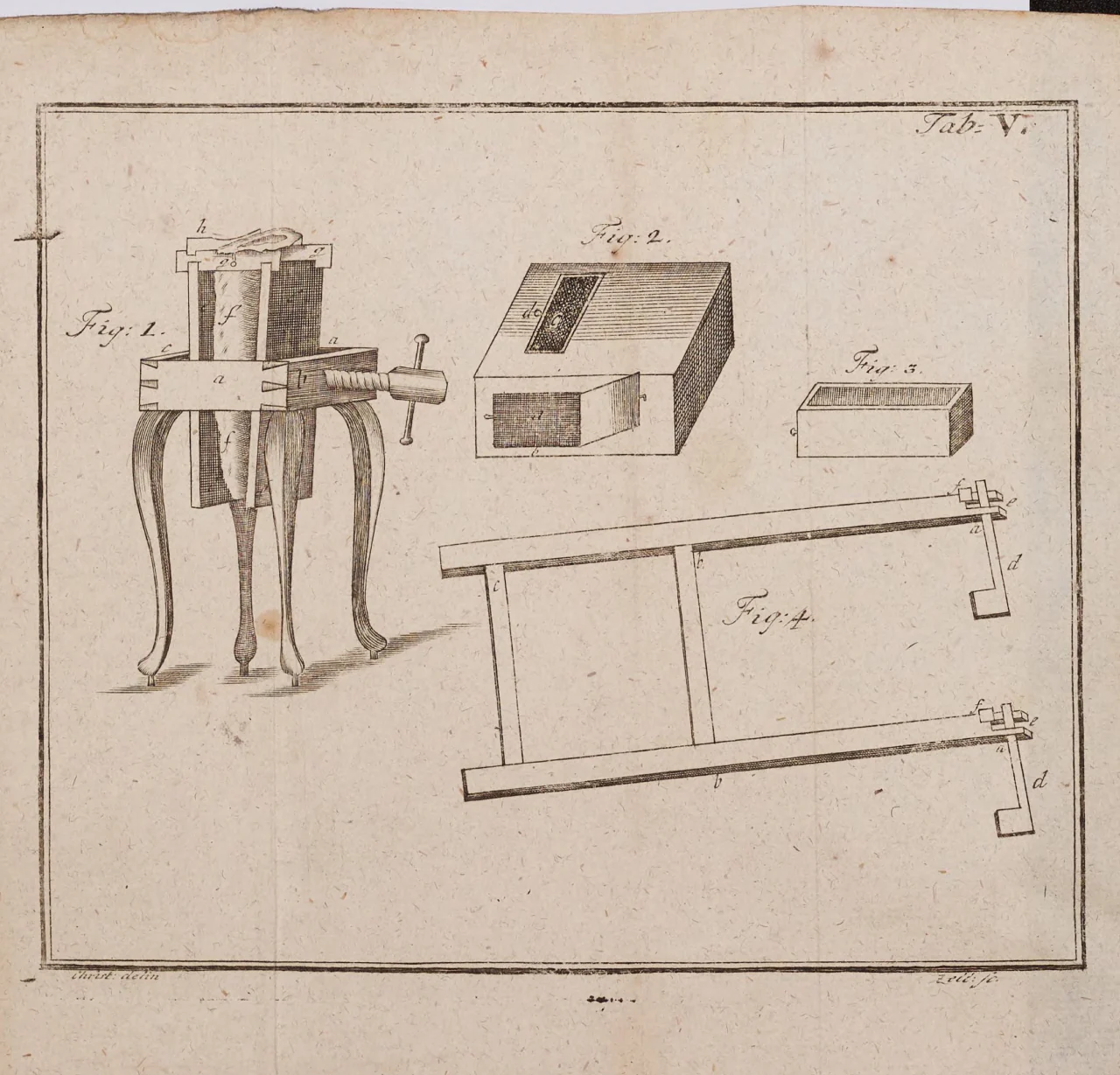
Preliminary explanation of the copper plates
The copper plates show the most important designs and tools for beekeeping. They are intended as a supplement to make the instructions described in the book easier to understand and follow.
First plate:
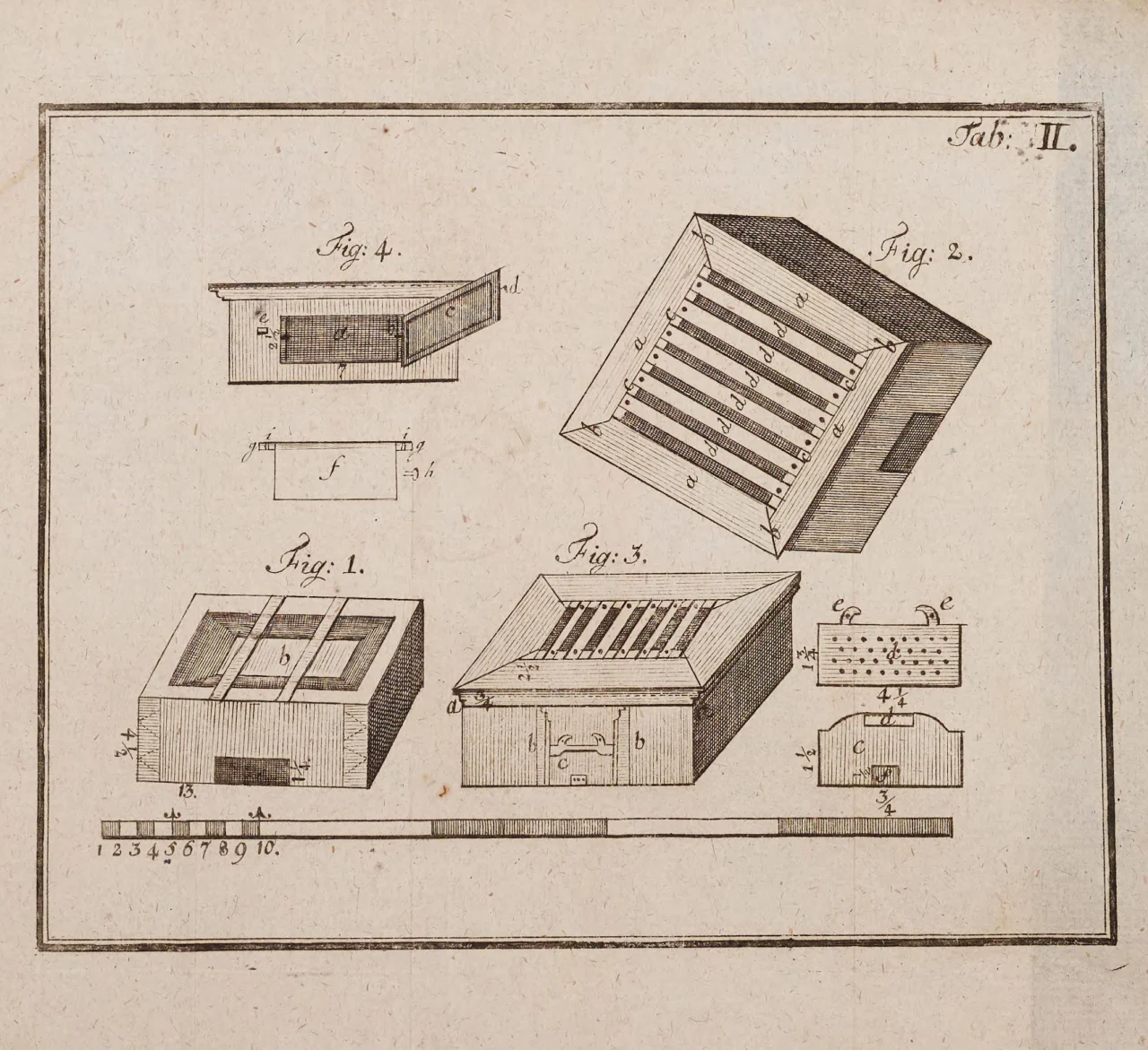
Second plate:
- The box is square with 13-inch edges and a height of 4½ inches.
- There is a flight hole at the front and a hole for a glass pane at the back.
- A grate made of slats is placed on top, connected at the corners at a 45-degree angle.
- There are metal sliders that can narrow or completely close the flight hole, e.g., during transport or if there is a risk of robbery.
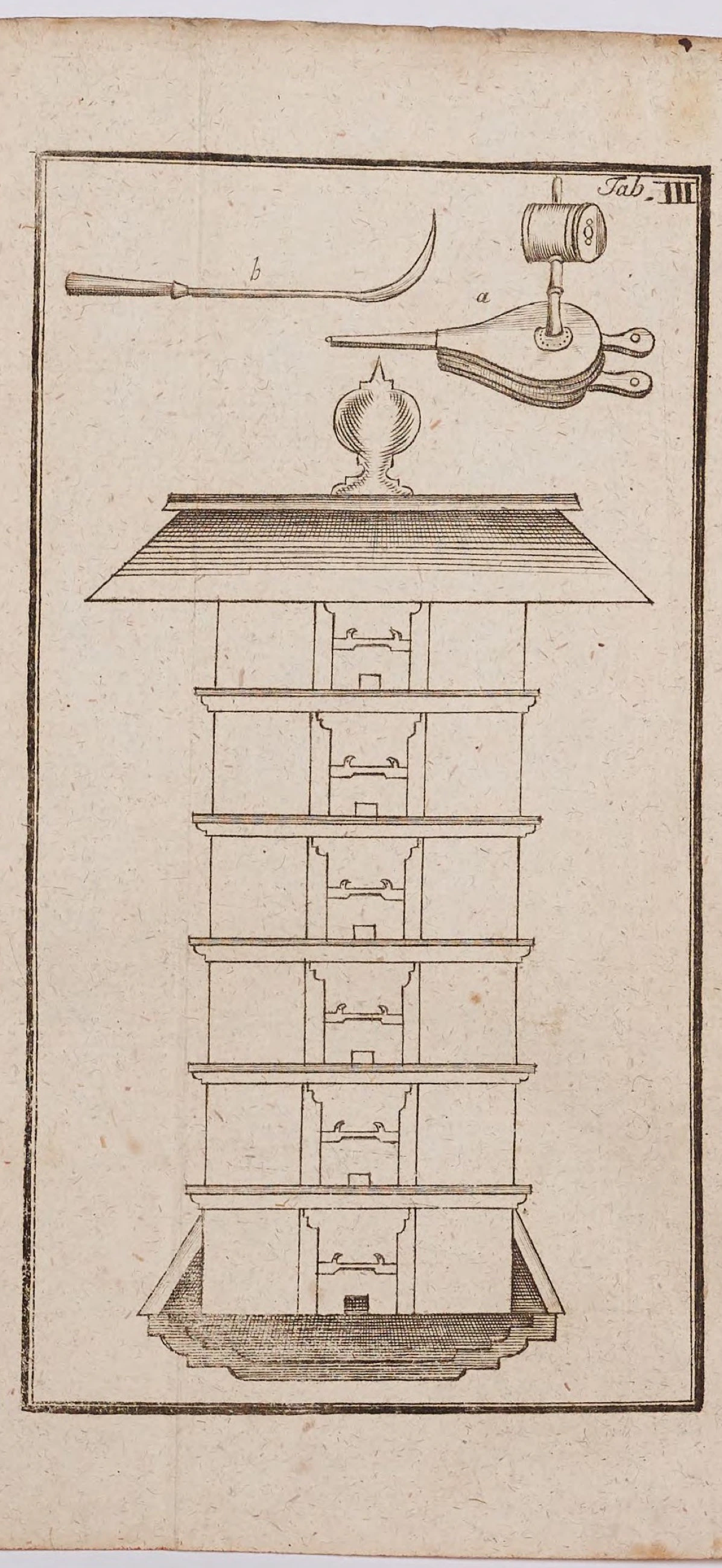
Third panel:
Fig. a.: Bellows with a smoke capsule that is inserted into its valve and
Fig. b: ordinary bee knife, whose tip is curved and double-edged.
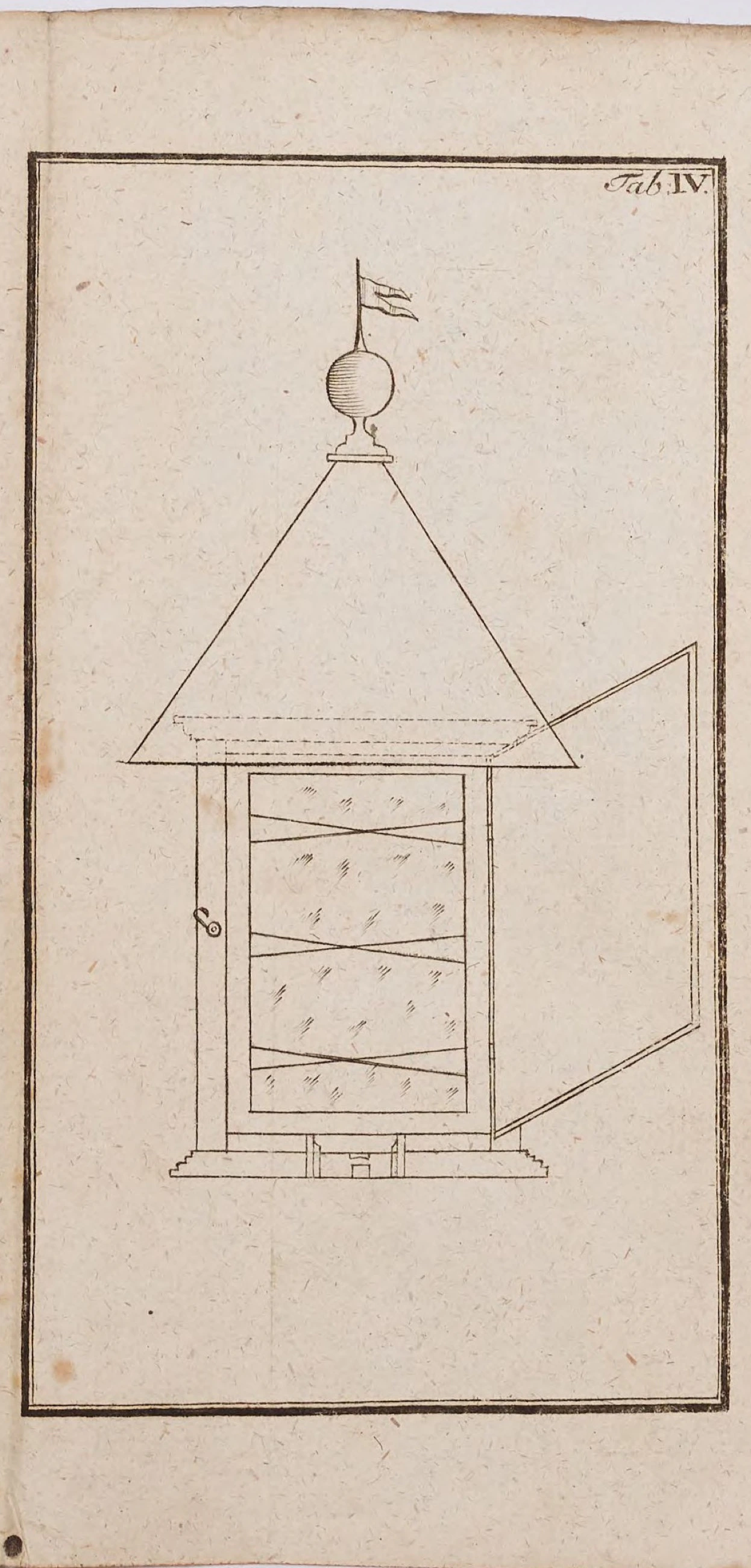
Fourth plate:
Fifth panel:
Chapter 1 – About bees in general
There are three types of bees in every hive: the queen, the worker bees (also known as incomplete females) and the drones. Drones are not found all year round, but mainly in summer.
The queen – the center of the colony
The queen is the most important bee. Without her, the colony would scatter and perish. She is the mother of all bees and incredibly fertile: she can lay over 30,000 eggs in just three months. A swarm usually has 12,000–15,000 bees, and yet at the end of summer the hive is just as full as it was at the beginning of spring – despite losses due to birds, wind, and weather. A strong hive that is not allowed to swarm can grow to 30,000 to 40,000 bees.
The queen is larger than the other bees, with a longer abdomen and a rounded head. She has a shorter proboscis and serrated jaws, which she uses to kill other queens. She has no pollen baskets and is less hairy.
A special feature is her voice: before swarming, you can hear a loud "toot, toot" that can be heard several steps away. Young queens sound higher-pitched. In the evening, when honeydew is being collected, you can hear a soft croaking sound. These sounds are signals in the bee colony.
The queen is raised in a special, larger cell that hangs vertically and is more richly filled. Whether an egg develops into a worker or a queen is determined solely by the type of care and feeding it receives.
The drones – useless masters of the hive
Drones are the male bees. They are more robustly built but have no stingers and do little work. Their only task is to mate with young queens. After the mating season, they are driven away or killed by the worker bees so that they do not consume the winter stores.
The worker bees – carriers of the state
The worker bees are the numerous "businesswomen" of the hive. They are incompletely developed females because they are raised in smaller cells and fed differently. If they were raised in queen cells, they would also become fertile.
They perform all tasks: collecting nectar and pollen, building honeycombs, caring for the brood, defending the hive, and keeping it clean. They also prepare wax from honey and pollen. In summer, they live for only a few weeks, but in winter they live for several months.
Order and language of bees
Bees have an amazing sense of order. They recognize their queen by her scent and surround her with a kind of bodyguard. They communicate through movements, scents, and buzzing sounds.
Dead bees are carried out of the hive so that it always remains clean. This shows how much they serve the whole. Each beehive is a state unto itself, in which all members work together as if they had a collective mind.
Chapter 2 – The apiary and its location
Choosing the right location is crucial for the health and yield of bees. A good location saves work, prevents losses, and increases the amount of honey produced.
The surroundings of the apiary
Bees need plenty of food within easy reach. The best areas are those with heathland, buckwheat, lots of meadows, fruit trees, lime trees, and chestnut trees, or fields with rapeseed, beans, and other flowering plants. Buckwheat and heathland areas produce a lot of honey in just a few weeks, but they are weather-dependent: if the flowers are damaged, there is no food.
Bees should not have to fly more than half an hour to reach their foraging grounds. The shorter the distance, the more they collect. Although they can smell honey-rich flowers from a distance of up to an hour, they lose a lot of time on long flights and are more exposed to dangers such as rain, wind, and birds.
Wide rivers are unfavorable because bees can easily crash when flying over them. Forests, on the other hand, can be well suited: they offer abundant flowers, protection from the wind, and fewer disturbances, even if there are more hornets and wasps.
What should be nearby – and what should not
Small streams and dung heaps are useful near the apiary, as bees collect salty particles from them. Smoke from ovens, breweries, or smelting works, as well as foul odors and dead animals, should be avoided at all costs. Flour dust from mills is also harmful because it spoils the honey.
The ground in front of the apiary should be clean and free of tall grass. This makes it easier to see if a queen falls out of the hive when the swarm emerges, which would otherwise lead to losses.
Location and protection
The apiary should be protected from cold north winds and rain from the west by walls, hedges, or fences. It is important to choose a warm, dry location, not just one with plenty of sun. A low-lying spot will remain cold for a long time in spring because walls or trees block the warm air. Snow will remain on the ground longer, and the soil will remain damp and cool.
I have seen apiaries that were well built but located in cold, damp hollows. They attracted few swarms and often died out. After being moved just a few steps further to a warmer location, the colonies developed excellently. The warmer the location, the earlier the bees swarm and the better they thrive.
Orientation toward the sun
The best orientation is toward the southeast or east. The morning sun wakes the bees early and warms the hive. A pure south-facing location is possible, but in hot summers they need shade at midday, otherwise the fresh honeycomb will melt. The sun must not shine directly on the hive from afternoon to evening, otherwise young swarms will leave the hive.
Height and construction of the stand
Whether the hives are positioned high or low is less important, but they should be easily accessible. Hives at hip height make work easier. Covered stands protect against rain and heat, extend the life of the hives, and prevent rain from disturbing the flight hole.
A well-built, covered stand for many hives facilitates maintenance and protects the bees. It should have a passage at the rear so that the hives can be easily accessed from behind.
Transport and purchase
Bees can only be moved a few meters in summer, otherwise they will return to their old location. In winter, they can be moved to other locations. During transport, flight holes must be well sealed but adequately ventilated. When purchasing, choose healthy, strong colonies.
A well-chosen location saves a lot of effort. Warmth, dryness, short flight paths, and protection from the wind are more important than anything else. A poorly located stand, on the other hand, can ruin even the best care.
Chapter 3 – The best and most beautiful types of bee dwellings
1: A basic rule of beekeeping
Anyone who works with bees must always observe one important rule:
Only keep strong, well-populated colonies.
A strong colony is superior to any weak one – not only because it collects more honey, but also because it stays healthier and requires less care. A colony with around 20,000 worker bees in spring can send out 8,000 to 9,000 foragers every day. The remaining bees take care of brood care, comb building, and work in the hive.
If you compare this with three weak colonies, each with only 8,000 bees, you can see the difference: these three small colonies together do not produce as much as a single strong colony. This is because small colonies lack enough nurse bees to care for the brood and enough builder bees to expand the honeycomb. In addition, several weak colonies consume more food in relation to their yield.
A strong colony builds several combs in a few days and fills them with honey. Weak colonies, on the other hand, need weeks to do this and often fall behind during the nectar flow. Therefore, it is better to maintain a single strong colony than to keep four weak ones.
Why weak colonies cost time and money
Weak colonies cost beekeepers twice as much: they require the same amount of attention as strong colonies, but yield very little. They are fed in the spring, protected from predators and disease – and yet in the fall they are often unable to survive the winter. In the end, they must be combined with other colonies or lost.
Strong colonies, on the other hand, require less help. They defend themselves against predators, survive cold nights better, keep their brood warm, and start collecting nectar on the first warm days. They make full use of every nectar flow, while weak colonies are still struggling to survive.
How to achieve strong colonies
For colonies to become strong, they need timely care in the spring. Make sure they have enough food and that the queen can lay plenty of brood. If nectar is scarce, light feeding will help. Weak colonies should be combined early so that they do not weaken each other.
The right bee housing is also important: small colonies lose too much heat in hives that are too large or unsuitable. In well-adapted hives, on the other hand, they can develop better. This is discussed in detail in the following sections.
Key point:
A strong colony produces more honey than four weak ones combined. Strength saves work, time, and feed—it is the foundation of successful beekeeping.
2: Why you cannot achieve the full benefits with ordinary straw baskets
Traditionally, bees are kept in simple straw baskets. Although this design has been used for centuries, it has many disadvantages that prevent beekeepers from getting the most out of their colonies.
Lack of control
In straw baskets, it is impossible to see inside the colony. It is not possible to tell in time whether the queen is missing, whether there are diseases, or whether the bees have too little space. Weak colonies go unnoticed until it is too late. The beekeeper has to wait and see what happens without being able to intervene.
Laborious and harmful honey extraction
To harvest honey from straw hives, the honeycomb must be removed from the hive and cut out or even cut off. This often destroys the brood, confuses the colony, and weakens it considerably. In lean years, every honey harvest means a threat to the bees' lives because they lack food reserves. In the past, entire colonies often had to be killed to obtain honey and wax – a cruel and uneconomical method.
No way to strengthen colonies
Straw baskets do not allow targeted care. It is not possible to move combs, support weak colonies with brood or feed, or isolate sick colonies in time. Everything is left to chance.
Losses in bad years
In years with little nectar flow, the beekeeper cannot protect the bees. If there are no honey plants or if it rains too much, weak colonies starve because straw baskets cannot provide them with a feeding space. Often, entire colonies have to be replaced.
No observation of bee life
Another disadvantage is that beekeepers who keep bees in straw hives cannot observe their lives directly. They learn little about their behavior, cannot recognize diseases or swarming in time, and miss many opportunities to support the colony.
Conclusion:
Straw baskets are a simple but imperfect form of housing. They do not allow for any control, make honey extraction difficult and are harmful to the colonies. If you want to reap the full benefits of beekeeping, you need a better design – this is described in the next section.
3: Magazine hives with glass tops – the better bee dwelling
Now that we know the disadvantages of straw baskets, let's turn our attention to magazine hives. These are stackable boxes that can be placed on top of each other. Wooden tops with a glass pane have proven particularly effective and offer many advantages over straw baskets.
Basic idea of magazine hives
Each magazine attachment is a handy box that can be easily moved. Several attachments stacked on top of each other form the entire hive. The brood chamber remains at the bottom, and honey chambers are placed on top as needed. This design mimics the natural bee hive: the brood is always at the bottom, and the honey is stored above it.
The glass window allows you to see inside without disturbing the bees. This makes it easy to see:
- whether the queen is present,
- whether the colony is healthy,
- if there is a lack of space, or
- if it's time to harvest honey.
Structure of the essays
An extension is usually square, about 13 inches wide and 4 to 5 inches high. At the front is a flight hole that can be adjusted or closed with a metal or wooden slider—for example, during transport or if there is a risk of robbery. At the back is an opening for the glass pane, which is closed with a lid.
Inside are strips or grids that guide the bees to build straight combs. This keeps the combs at a good distance apart and makes them easy to remove.
Several attachments can be stacked stably and tightly on top of each other. The tower is closed at the top with a cover board or roof. The beekeeper can add new honey chambers or remove empty ones at any time.
Advantages over straw baskets
- Gentle honey extraction: Only the upper honey chambers are harvested without destroying the brood combs.
- Easy maintenance: Weak colonies can be strengthened with brood combs from other hives.
- Better observation: You can see at any time whether the colony is healthy and has enough space.
- Faster comb building: The bees fill new supers quickly because the design takes advantage of their natural tendency to build upwards.
- Longer durability: Wooden supers last for many years, while straw baskets often rot after a few winters.
Honey harvest without damage
When the upper honey chamber is full, it is removed and replaced with an empty one. The bees continue to carry in honey while the brood remains undisturbed below. This results in clean honeycombs without brood residue – and the colony remains strong.
With straw baskets, entire colonies had to be killed in order to harvest honey and wax. With magazine hives, this problem is completely eliminated. You can even harvest several times a year without harming the bees.
Observation and enjoyment
The glass window has another advantage: it allows you to look into the life of the bees without opening the hive. You can see how honeycombs are built, brood is cared for, and honey is stored. This is not only educational, but also a quiet pleasure.
Variations and additions
If desired, magazine attachments can also be made from straw, but they are less durable and do not allow for such clear observation. For scientific or educational purposes, complete glass hives can be built – these are more for viewing than for honey production.
Transferring from straw baskets
To transfer a colony from a straw basket to a magazine hive, place the new hive in the place of the old basket. The bees will move in voluntarily when the old basket is emptied. Brood combs and food residues can also be transferred so that the colony can continue working without interruption.
Conclusion:
Magazine hives with glass are far superior to the old straw baskets. They are gentle on the bees, make all work easier, provide clean honey, and allow the beekeeper to better understand and care for his colony.
4: Instructions for making magazine hives
Now that the benefits of the magazine attachments have been demonstrated, here are the detailed construction instructions. They are so simple that any handy craftsman or skilled beekeeper can make the hives themselves.
Basic dimensions of the attachments
Each attachment is square, with an inner width of 13 inches and a height of 4½ inches. These dimensions have proven themselves: they are easy to handle, easy to stack, and provide the bees with enough space to build their combs.
The attachments consist of four boards approximately 1 inch thick. The corners are connected with tenons and slots and additionally glued or screwed together to ensure that they are airtight and stable.
Entrance hole and glass window
There is a flight hole on the front that is approximately 4 inches wide and 1 inch high. It is equipped with a slider that narrows or completely closes the hole, for example during transport or when there is a risk of predators.
At the rear, an opening for a glass pane is cut out, approximately 8 inches wide and 3 inches high. The glass is inserted into a simple frame and covered with a wooden slider so that it can be closed to prevent light from entering if necessary.
Interior construction – strips and grates
Place strips or grates inside. These give the bees direction for building the honeycomb and keep the combs at the correct distance apart. To do this, use four narrow wooden strips with grooves into which several thin slats (about a finger's width) are inserted. These form a removable grid.
These frames make it easier to remove the combs and prevent the bees from building them criss-cross. The bees are happy to follow these guidelines if you insert them as soon as you set up the new honey chamber.
Stacking and sealing
Several supers are placed on top of each other. To prevent gaps from forming, the top and bottom edges are fitted with a simple tongue and groove joint or narrow frame strips, which also prevent rain from entering. Gaps can be sealed with a narrow strip of wax or linseed oil putty if necessary.
The attachments are closed at the top with a cover board. For winter storage or transport, the hive can be protected with a simple metal or wooden roof.
Recommended materials
Light, dry softwood, such as spruce or fir, is best. It is warm, easy to work with and less prone to warping. The inner surfaces should be smoothly planed so that the bees can coat them more easily with propolis.
The outside of the hives can be weatherproofed with linseed oil or a thin coat of paint. Thick paint or toxic varnishes are unsuitable because they mask the smell of the wood and could harm the bees.
Additional equipment
- For transport, you can attach small bolts or hooks to hold the attachments together.
- A protective screen for the queen can be used if you want to keep her away from the honey chamber.
- If desired, a feed frame can be inserted at the top to provide the bees with nectar or sugar water in spring or during periods of low nectar flow.
Manufacturing costs
These magazine attachments cost little more than a well-made straw box, but last for many years. A skilled carpenter can make several attachments in a day. Compared to straw baskets, the slight additional expense is worthwhile because they are more durable, practical, and productive.
Conclusion:
The magazine hive is easy to make. It requires only a few boards, a glass pane, and some careful work. The result is a durable, convenient, and bee-friendly home that provides the beekeeper with control, honey yield, and enjoyment.
5: Harvesting pure honeycombs without disturbing the bees
A major advantage of magazine hives is that honey can be harvested all year round without harming the brood or bees. This not only makes harvesting easier, but also ensures that the honey is cleaner and of the highest quality.
The principle of gentle harvesting
Bees always build and fill their combs from bottom to top. The brood is at the bottom, with the stores above it. In magazine hives, the lower space is therefore always reserved for brood and food. New honey chambers are placed on top, which are only intended for fresh nectar.
As soon as an upper super is filled and capped, it is simply removed and replaced with an empty one. The bees continue to carry in honey without being disturbed in the brood chamber. This allows several honey harvests to take place each year.
Advantages of this method
- No brood loss – Unlike with straw baskets, there is no need to cut out combs, which often resulted in brood destruction in the past.
- Bees remain calm – Since only the upper honey chamber is removed, the bees do not feel threatened.
- Honey stays clean – The upper combs contain only fresh honey, no pollen residues or brood.
- Multiple harvests possible – After the early harvest, summer and late harvests can also be harvested cleanly.
When to remove the honey chambers
The best time is when most of the combs in the upper super are capped. Capped honey is mature and ready for storage. Leave uncapped combs for a few more days until the bees have thickened the honey.
After harvesting, immediately place a new, empty super on top. The bees will immediately begin building new combs and storing the next harvest.
Handling the honeycombs
The removed supers are placed in a quiet location. If you want to offer pure honey in frames, leave the combs in the frames and simply cover them. For larger quantities, extract the honey and return the empty combs to the colony later—the bees will immediately put them back into use.
Feeding the bees
It is important to leave enough honey in the brood chamber so that the bees do not go hungry. They must not be left with too little, especially before periods of low nectar flow and towards winter. Magazine hives make this easier to check, as you can look into the lower chambers at any time.
Cleaning and maintenance
After harvesting the honey, you should clean and dry the empty supers to prevent wax moths. Glass windows and wood can be wiped with a soft cloth. Well-maintained supers will last for many years.
Conclusion:
Magazine hives allow you to harvest honey cleanly several times a year without disturbing the bees or destroying the brood. This method saves work, maintains strong colonies, and produces the best quality honey.
6: The benefits of magazine hives in general
Magazines are not only a more convenient design, they also offer a significant advantage for beekeeping as a whole. They allow bees to be kept in a species-appropriate and economical manner without unnecessarily disturbing or weakening them.
Honey and wax yield without destruction
With magazine hives, honey and wax can be harvested without killing the colony or destroying the brood. In the past, entire colonies often had to be destroyed in order to obtain honey and honeycombs from straw baskets. Now, only the upper honey chambers are removed, while the brood chamber remains undisturbed.
This makes the honey purer and of better quality, as it contains no pollen residues. The wax can also be extracted gently: old honeycombs can be melted down without harming the colony.
Multiple benefits throughout the year
By adding new honey chambers, bees can take advantage of several harvests per year. Early, summer, and late harvests can be harvested separately. This allows beekeepers to offer different types of honey.
In addition, harvest gaps are better bridged because the bees can refill the combs they have already built instead of having to build new ones.
Less maintenance
Magazine hives make maintenance easier and faster. You can reinforce colonies as needed, form splits, or expand honey chambers without moving the entire colony. Weak colonies can be easily supported with brood combs from strong colonies.
Monitoring is also easier: the glass windows allow you to see at an early stage whether the queen is missing, whether there is a lack of space or whether diseases are occurring.
Longer lifespan of the hives
Magazine attachments are more durable than straw baskets. With proper care, they will last for many years. Even if a part is damaged, it can be replaced individually without losing the entire hive.
Enjoyment and insight
Last but not least, magazine hives also make beekeeping more enjoyable. The glass windows allow you to see life in the hive: how the bees build, care for their brood, store honey, and work together. This is not only educational, but also a quiet pleasure for any nature lover.
Conclusion:
Magazines combine utility and protection. They enable multiple honey harvests per year, facilitate maintenance, extend the life of the hives, and allow beekeepers to better understand and observe their bees.
7: Special advantages of wooden magazine frames with glass
Of all the types of magazine, wooden attachments with glass windows are the best. They combine durability, ease of use, and the ability to observe the bees' life directly.
More durable and weatherproof
Wood is more durable than straw. A well-built wooden attachment can be used for many years, while straw attachments often decay after just a few winters. In addition, wood provides better protection against cold, heat, and moisture when properly processed and maintained.
Easy to check
The glass pane on the back allows you to see how far the bees have expanded the space at any time:
- whether the queen is laying eggs,
- whether there is brood,
- whether honey is being stored,
- whether there is a threat of robbery or disease.
This allows the beekeeper to intervene at an early stage without having to open the hive or disturb the bees. This insight is particularly valuable in spring and before the honey harvest.
Gentle honey extraction
The glass attachments make honey harvesting particularly easy: you can see whether the honey is capped and only remove the filled honey chambers. The bees remain calm because they are not touched in the brood chamber.
The honey from these supers is lighter and purer because it consists only of fresh combs that were created for honey production.
Easier to clean and store
Wooden glass supers are easy to clean after the honey harvest and can be stored in a dry place. They are less susceptible to mold or wax moths if treated properly. The glass can also be easily removed and cleaned.
Enjoy watching
The opportunity to observe is a special advantage. You can see the honeycomb construction, brood care, and the work of the foragers up close without disturbing the colony. This is educational for beginners and curious observers, and helps experienced beekeepers to improve their care. Visitors and schoolchildren can also marvel at the life of bees.
Conclusion:
Wooden magazine frames with glass combine practical advantages such as durability and control with the pleasure of watching the bees. They are the best choice for any beekeeper who wants to combine care, yield, and enjoyment.
8: Straw magazine attachments
In addition to wooden magazine racks, there are also straw racks, which are similar in design but made of woven straw. They are a cheaper alternative, but have some disadvantages compared to wood.
Advantages of straw attachments
- Lower production costs: Straw is cheap and easy to work with. If you can weave yourself, you can make these attachments quickly and with little material.
- Low weight: Straw attachments are lighter than wood, which makes them easier to remove and attach.
- Thermal insulation: Straw provides good protection against summer heat and winter cold, so the bees need to expend less energy on climate regulation in the hive.
Disadvantages of straw attachments
- Less durable: Straw is sensitive to moisture and pests. After a few years, it becomes brittle or is eaten by mice, wax moths, and other insects.
- More difficult to clean: After the honey harvest, straw covers cannot be cleaned as thoroughly as wood. They absorb honey residues and moisture and attract mold or vermin.
- No glass windows: Straw attachments do not allow you to see inside. This means you cannot see how far the bees have built or whether the honey is capped.
Who are straw supers suitable for?
Straw supers are a temporary solution for beekeepers who want to switch from straw baskets to magazine hives but are not yet able to have wooden supers made. They are also suitable for small secondary colonies or for beekeepers who only want to keep bees for a few years.
However, if you want to keep bees permanently, you will save more time and money in the long run with wooden glass supers, as they last for many years and are more practical.
Conclusion:
Straw magazine attachments are lightweight, warm, and inexpensive, but they are not durable and less hygienic. They can temporarily replace wooden attachments, but they are not an equivalent alternative for long-term, high-yield beekeeping.
9: How to use magazine attachments correctly in beekeeping
To get the most out of magazine attachments, you need to use them at the right time and in the right way. Success depends less on the design than on skillful handling.
Placing new honey chambers
- In spring, as soon as the bees are strong enough and the brood chamber is well filled, place the first honey super on top.
- As soon as this is filled and partially capped, remove it and immediately place a new empty honey chamber on top.
- This allows the bees to take advantage of the nectar flow without interruption.
It is important not to wait too long, otherwise the bees will run out of space. This can lead to swarming or wild comb building.
Observation through the glass window
Through the glass window, you can see:
- whether the bees have already expanded into the new space,
- how much honey has already been stored,
- and whether the honey is capped and ready to be harvested.
This check saves work and avoids unnecessary opening of the hive.
Harvesting the honey chambers
Once a super is almost completely capped, it can be carefully removed. The bees will remain calm because the brood and stores in the lower part remain untouched. The removed super is immediately replaced with an empty one to maintain the building instinct.
This allows several harvests to be harvested separately each year:
- Early harvest (e.g., fruit blossoms)
- Summer harvest (clover, linden),
- Late harvest (heather, buckwheat).
Use of old honeycombs
Empty honeycombs from the supers can be reused. If you place them in a new honey chamber, the bees save a lot of time and refill them more quickly. This increases the yield and protects the harvest.
Care of the supers
After the honey harvest, the supers should be cleaned and stored in a dry place. Wooden supers are easy to clean, but straw supers require special attention to prevent mold and wax moths.
Conclusion:
Those who place the magazine attachments at the right time and harvest in good time will reap the greatest benefits. Glass windows help with observation, and repeatedly placing new honey chambers allows several clean harvests per year without disturbing the bees.
10: How to transfer bees from straw baskets to magazine supers
If you have been keeping bees in straw baskets, you can easily transfer them to magazine hives. The process is simple and does not harm the bees if it is done at the right time and calmly.
The best time
It is best to transfer colonies in spring or early summer, when the bees are already flying actively but are not yet in full flight. At this time, the brood is present but the hive is not too heavy. You should not transfer colonies in cool weather or heavy rain.
Preparing the magazine hive
- Place the new magazine bottom in the place of the straw bale.
- Prepare a ready-made super with frames and, if necessary, a built-out comb.
- Have a second empty super ready for the bee colony.
Everything must be ready in advance so that the bees can move in quickly.
Moving the bees
- Carefully remove the straw basket and turn it upside down.
- Gently tap the bees out of the basket into an empty, prepared hive.
- Place the attachment with the bees on the new magazine base.
Most bees will run in voluntarily, especially if they smell their queen. You can calm them down with a little smoke or a light mist of water.
Transferring the brood combs
To enable the bees to start caring for their brood immediately, remove a few brood combs from the straw box and place them in the lower super. This allows the bees to keep their offspring and quickly feel at home again.
Completion of the transfer
- The bees usually remain calm and immediately begin building combs.
- Place another honey super on top immediately to take advantage of the bees' building instinct.
- After one to two days, the bees will fly to their new location as usual.
Why this method is gentle
The bees are not unnecessarily agitated because they remain at their old location. The queen stays with the colony, and the brood combs they have taken over give them immediate work and orientation. Within a few days, they will be working in the hive just as they did before in the straw hive.
Conclusion:
With a little preparation, bees can be transferred easily and without losses from straw baskets to magazine attachments. This allows you to take over existing colonies and switch to a better hive design at the same time.
11: Square bee houses with large glass panels – more for pleasure than for practical use
In addition to the practical magazine attachments, there are also special beehives with large glass panels, which are primarily intended for observing the life of bees. They are less for economic yield and more for curious individuals, schools, or nature lovers.
Construction of such bee houses
- These bee houses are square and made almost entirely of glass, so that the hive can be seen from all sides.
- Honeycomb frames or strips are attached inside, on which the bees build their honeycombs.
- To prevent the colony from being exposed to too much light, there are shutters or covers that can be used to darken the glass if necessary.
This allows you to watch the bees at work at any time without opening the hive.
Purpose and benefits
The main purpose is observation and education:
- You can see how the queen lays eggs and how the worker bees care for the brood.
- You can follow the construction of the honeycomb step by step.
- Visitors and students get a direct impression of bee life.
Such glass houses are also useful for scientific experiments. You can see exactly how the bees react to changes without disturbing the colony.
Disadvantages for the bees
Such glasshouses are less suitable for practical use:
- Bees do not like constant brightness. Too much light confuses them and disrupts their work.
- Glass provides less protection from heat in summer and cold in winter.
- The honey yield is lower because the bees are more restless.
For this reason, the glass should usually be covered and only opened for observation. If honey is important to you, it is better to choose normal magazine hives.
Conclusion:
Square glass bee houses are primarily intended for educational purposes and hobbyists. They provide a vivid insight into the life of bees, but are less practical for productive beekeeping.
12: Expelled and united bees are the most industrious
An interesting observation in beekeeping is that expelled or united bees are often particularly hard-working and peaceful.
Expelled bees
When a colony is driven out of a straw hive, e.g. to transfer it to a magazine hive, these bees are unusually industrious afterwards.
- They have no old combs or stores to cling to, but must start from scratch.
- This makes them very eager to build and they take every opportunity to create new combs and collect honey.
- The swarming mood also disappears for a long time because the bees are initially busy rebuilding.
Uniting colonies
The same behavior is observed in combined colonies, i.e., when two weak colonies are brought together:
- The bees become calmer because they suddenly have a larger community.
- They immediately start building honeycombs and caring for the brood together.
- Often, the queen of the weaker colony is not attacked, but the bees quickly join the stronger queen.
Why these bees are more industrious
Bees are more eager to work when they:
- have enough space to build honeycombs,
- have a clear task (building, stockpiling)
- and are not "tied down" by old stores or outdated honeycombs.
Expelled and united colonies have exactly these conditions: they are in a new home, full of building instinct and without old burdens.
Conclusion:
Bees that have been driven out of old hives or united with other colonies work particularly hard and are more peaceful. Anyone wishing to renew or rejuvenate colonies can take advantage of this effect.
Chapter 4 – On the propagation of beehives
1: The reproduction of beehives is an essential part of beekeeping
The reproduction of bee colonies is one of the most important tasks of a beekeeper. Those who have only a few colonies and do not reproduce them cannot maintain their beekeeping for long. Colonies are constantly being destroyed by the aging of the queen, disease, winter losses, or accidents. Without replacement, the population shrinks.
Why reproduction is important
-
Preserving the population
Every year, some colonies are lost. Those who do not form new ones must purchase expensive new colonies or give up beekeeping altogether. -
Improving yields
Young, newly formed colonies are particularly hard-working. Their bees are full of building instinct and collect more honey. Old, overcrowded colonies are more prone to swarming and work less. -
Renewal of queens
Reproduction attracts new queens. Old queens lay fewer eggs, and the colony becomes weaker. Young queens ensure strong colonies with plenty of brood and honey yields. -
Protection against losses
Those who only have a few colonies risk losing their entire stock in a single harsh winter. Having several colonies ensures survival.
Types of reproduction
There are two main ways to reproduce bee colonies:
- Natural reproduction through swarming – the old hive divides itself by part of the colony leaving with the old queen.
- Artificial reproduction through splits – the beekeeper takes brood combs and bees from strong colonies and uses them to form new ones.
Both methods have their advantages and disadvantages. Swarms are strong but unpredictable. Offshoots can be planned but are weaker at first.
The right time
The best time to propagate is in spring and early summer, when there is plenty of nectar and the colonies are strong. Dividing too early weakens the colony, while dividing too late means that the young colonies will not be ready before winter.
Connection with honey yield
Those who propagate usually have less honey in the same year because the bees use their energy to build combs and rear brood. However, this investment is worthwhile: a newly formed colony produces more honey in the following year than is lost in the year of propagation.
Conclusion:
The reproduction of bee colonies is necessary to maintain the population, replace queens, and secure long-term yields. Whether through swarms or splits, every beekeeper must form several new colonies each year.
2: How bees naturally swarm and reproduce
The natural reproduction of bees occurs through swarming. When a colony has grown strong in the spring and has produced a lot of brood and honey, it begins to raise new queens. Shortly before the first young queen hatches, the old queen leaves the hive—and part of the colony leaves with her. This creates a new swarm.
Signs of swarming
An experienced beekeeper can recognize when a colony is about to swarm:
- The bees hang in dense clusters in front of the flight hole.
- They fly out less, even though the weather is good.
- You can hear a distinctive, high-pitched buzzing or "trompeting" from the old queen in the hive.
- In the brood chamber, you can see queen cells, which are special queen cells that are larger and built vertically.
These signs usually appear in late spring, when the first major nectar flow is coming to an end and the colony is very strong.
The swarming process
On a warm, windless day – usually around midday – the swarm suddenly leaves the hive. It rises high into the air, circles above the apiary for a few minutes, and then gathers on a nearby branch, bush, or fence post to form a large cluster.
The swarm usually stays there for half an hour to a few hours until scout bees have found a new home. If the beekeeper catches it during this time, he can knock it into a prepared hive.
After the swarm leaves, new queens hatch in the old hive. One of them takes over the colony. If several queens remain, sub-swarms may form – smaller swarms that leave with a young queen.
Advantages and disadvantages of natural swarming
- Advantages: Swarms are full of energy and building instinct. They quickly build new combs and collect nectar and pollen.
- Disadvantages: Swarms often come unexpectedly. Sometimes they fly away before the beekeeper can catch them. In addition, each swarm reduces the honey harvest of the mother colony.
Why swarming should be controlled
It is better for the yield if the beekeeper prevents or controls swarming in good time:
- Too many swarms weaken the colony and the honey harvest suffers.
- Unexpected swarms can be lost.
- With planned nuclei, you can increase the number of colonies without uncontrolled swarming.
This is why many beekeepers intervene and create artificial swarms or splits, which are easier to control. The next section explains how this is done.
Conclusion:
Natural swarming is the way bees reproduce on their own. It is useful for beekeepers, but unpredictable. If you want to harvest honey and still reproduce, you must recognize swarms in time, capture them, or replace them with planned splits.
3: The different types of artificial swarms or splits and which is the best and easiest
In addition to natural swarms, there are artificial swarms, also known as splits. These are not left to chance, but are deliberately formed by the beekeeper. Earlier bee researchers such as Swammerdam and later Pastor Schirach described various methods. However, many of these old methods are cumbersome and laborious, so they were rarely imitated. Today, there are simpler and better methods that are suitable for every beekeeper.
Schirach's method – historical but laborious
Schirach recommended taking a colony with a large population on a warm morning in spring – at the end of April or beginning of May – driving the bees upwards with smoke and then cutting a few hand-sized pieces of comb with brood from the middle. These pieces were placed in small wooden boxes, where the bees raised new queens without an old queen.
This method is instructive, demonstrating the principle of laying, but it is labor-intensive and impractical.
Simple modern colony splitting
Today, entire brood combs with bees are taken from a strong colony. To do this:
- Select 2–3 combs with plenty of brood and young bees.
- Hang them in a prepared hive or box, supplemented with feed combs or foundation sheets.
- Place the split in a different location so that the flying bees cannot return.
The bees will raise a new queen from the youngest larvae. In 3–4 weeks, the nucleus colony will be an independent colony.
Offshoot with queen
It is even safer to add a mated young queen right away. This saves time on breeding and allows the colony to develop more quickly.
Combining several colonies
A particularly good method is to take one brood comb from two or three strong colonies and use it to form a split. Such splits are stronger and weaken the mother colonies less.
When to form splits
- Spring and early summer are the best times. There is enough brood available and the bees are in the mood to build.
- In bad weather or when there is a lack of nectar, you should feed the colony so that it does not starve.
Why splits do not cause any harm
Some beekeepers are afraid to form splits because they believe it will weaken their colonies too much. However, if a colony is large enough and has plenty of brood, it will recover in a few weeks. After 14 days, you will usually see that the mother colony is strong again and full of brood.
Conclusion:
There are many ways to make splits. The older methods, such as Schirach's, are cumbersome. The best and easiest way is to combine several brood combs with bees from several colonies or to add a young queen right away. Such splits are strong, safe, and only slightly weaken the mother colonies.
3: The benefits of splitting colonies and when it is best to do so
The main benefit of swarming is that you get new colonies early – often several weeks earlier than natural swarms. You save yourself the trouble of spending the whole day watching for swarms, which often take a long time to appear, are difficult to reach, or can even get lost.
Advantages over natural swarming
- Splits can be planned, with no surprises.
- You don't have to catch swarms from tall trees and risk them flying away.
- In areas where bees swarm late or rarely, offshoots are the only reliable method of propagation.
Who are splits particularly suitable for?
- Those who have their apiary in a shaded or cool location where swarms are less common.
- Those who do not have time to be in the garden constantly during swarming season or do not want to hire help.
- Those who have many tall trees around their apiary, making swarms difficult to reach.
- Those who have their bees on the upper floor of a house, where swarms are particularly difficult to catch.
For all these beekeepers, nucs are the best solution for safely forming new colonies.
Weather advantage of splits
Another advantage: natural swarms can starve during long periods of rainy weather or when there is a lack of nectar if they are not fed immediately.
Splits, on the other hand, already have honey and food reserves in their boxes. They can also survive longer periods of bad weather without suffering any damage.
But swarms also have advantages
Nevertheless, natural swarms also have their charms:
- They are often stronger and more eager to build.
- Catching a swarm is a special treat for many beekeepers, especially when it settles on low trees or in hanging baskets.
That is why swarms continue to have many enthusiasts – and it is worthwhile to master the art of catching swarms.
Conclusion:
Offshoots are predictable, safe, and independent of weather and location. They are suitable for anyone who is unable to monitor or catch swarms. Natural swarms, on the other hand, have their own charm and produce strong young colonies. Both methods therefore have their merits.
4: Natural swarming and how it works
When bees find abundant food in the fields in spring, their natural urge to reproduce awakens. They want to found new colonies so that their species can survive. As soon as a hive is large and strong enough, the bees raise young queens – future mothers and rulers of the colony.
Preparing the swarm
Before the swarm leaves, the bees prepare carefully:
- They fill their honey stomachs with supplies for the first few days in their new home.
- They choose a warm, windless time, usually a sunny morning.
- They often hang in large clusters in the hive while waiting for the right moment.
This supply of honey is important because bad weather may follow after they leave, during which they would be unable to gather anything. However, they do not take wax from old cells – they sweat it out later when they build new combs.
The departure
When the right day arrives, the old queen leaves the hive with part of the colony. Suddenly, a loud buzzing fills the air. The swarm rises in wide circles, hovers over the apiary for a while, and then settles on a nearby branch, bush, or post.
There it forms a dense bee cluster, which often remains suspended for several hours. During this time, so-called scout bees search for a suitable new home. Once they find one, the queen leads the way and the entire swarm follows.
What remains in the mother hive
Meanwhile, the new queens hatch in the old hive. One of them takes over the colony. If there are several, after-swarms often form – smaller swarms that leave with a young queen.
Each swarm weakens the mother colony because it takes many flying bees with it and also reduces the food supply. This is why good colonies often starve in the spring if too many swarms leave.
Why swarms are heavy
A newly emerged swarm weighs much more than you might think. A colony that would weigh only a few pounds on an empty stomach weighs six to eight pounds when loaded with honey. This shows how large the supply is that the bees take with them for their new "economy" – and why swarming is such a burden on the mother colony.
Conclusion:
Swarming is the natural way for bees to reproduce. It happens according to fixed rules: preparation with honey reserves, departure with the old queen, formation of a cluster, search for a new home. For beekeepers, it is fascinating, but also associated with losses if they do not intervene in time.
5: The usual time and hour of swarming
The months in which bees swarm most frequently are May, June, and July. Swarms in May are considered the strongest and most valuable. Swarms in July are often too late to build up a strong colony before winter, even with a good late summer.
Uncertain swarming time
The exact time of swarming cannot be predicted. Therefore, during swarming season – in dry, warm weather – you must keep a constant eye on the bees or ask someone else to do so.
If you do not notice the swarm in time, you risk the bees taking off again after a short time and flying into:
- hollow trees,
- crevices in walls
or other hard-to-reach places.
Especially when the bees are exposed to the sun and are not sprayed with water, they rarely hang around for more than half an hour. They then move on – often irretrievably for the beekeeper.
Exceptions
In rare cases, a swarm may remain in place for two hours, for example in cool weather or when it is raining. Sometimes swarms even remain in place until the next morning after rain.
Times of day when swarms occur
- Pre-swarms (the first, strongest swarms) usually fly between 9 and 12 noon.
However, I have also seen pre-swarms before 8 a.m. or even as late as 5 p.m. - Late swarms usually occur between noon and 5 p.m., almost never in the morning.
Conclusion:
The main swarming months are May to July. Pre-swarms usually occur in the morning, with after-swarms in the afternoon. Because the exact time is unpredictable, special vigilance is required during this period – otherwise, an entire swarm could be lost.
6: The different types of swarms and their names
Not all bee swarms are the same. Depending on the time, cause, and composition, there are several types of swarms, each with its own name.
Pre-swarm or main swarm
The pre-swarm, also known as the main swarm, is the first swarm of the year to leave a colony. It contains the old queen and a large proportion of the flying bees. Main swarms are strong and have the greatest urge to build.
Sub-swarms or afterswarms
The sub-swarms are the second, third, or fourth swarms that follow from the same mother colony, depending on the weather and the beekeeper's care.
- The first after-swarm usually arrives on the 7th to 9th day after the pre-swarm.
- In bad weather, it can be delayed until the 14th or 17th day. In this case, several after-swarms often unite and leave together.
- Late swarms often contain 5–6 young queens, while early swarms only carry 2–3.
Even splits can occasionally produce a second swarm.
Virgin swarm
A virgin swarm develops:
- either from a pre-swarm, i.e. the first swarm of the year,
- or from a young offshoot.
It usually occurs in the morning, often only 40 days after the pre-swarm has been detected.
About 7 days after a maiden swarm, a small secondary swarm sometimes follows.
Emergency swarm
An emergency swarm leaves unusually early – often as early as April or early May. It comes from a colony that has many bees but too little honey reserves or combs that are not yet fully developed.
An emergency swarm can also occur in summer or fall if the old queen is missing and several young queens have been raised. To prevent them from killing each other, one of the weaker queens leaves with part of the colony.
The departure is often announced by bagging the queen.
Hunger swarm or begging swarm
A hunger swarm occurs when a colony is completely depleted. It leaves the fully developed hive with its queen because there is no more food available.
Such swarms hardly attach themselves anywhere, but usually move directly into another hive rich in honey to beg for food.
Conclusion:
A distinction is made between main swarms, secondary swarms, virgin swarms, emergency swarms, and starvation swarms. The name provides information about the time of departure and the cause of the swarm. It is important for beekeepers to know these differences in order to act correctly.
7: The various signs of imminent swarming
The signs of imminent swarming are usually uncertain. Although they provide clues, they are never completely reliable. Nevertheless, there are some observations that often indicate that swarming is imminent.
The queen's buzzing
The calling or queening of the young queen is the most reliable sign, especially in the case of secondary swarms.
- If you hear the capping, the swarm can usually be expected the next day – provided it does not rain.
- If rain comes, the calling continues until the third day, then the bees leave as soon as the weather permits.
- If they are still unable to swarm, the bees will kill the young queens and the colony will remain together.
Sometimes, however, the bees do not follow the queen calling them to leave, but remain with the old queen and kill the young queens – even in fine weather.
Presence of bees
If many bees are hanging in front of the hive like a cluster, this is another sign:
- It indicates a large colony and warmth in the hive.
- However, bees can also remain there for weeks without ever swarming.
Hanging around for a long time is harmful because the bees cannot work. This problem can be solved by giving the colony additional space. Then they will start bringing in pollen and building again.
(The author points out that bees in this situation are not "lazy"—they are simply blocked because the hive is overcrowded. If they are given space, they will immediately continue working.)
Other subtle signs
- Bees returning from the field keep their pollen baskets on their legs instead of stripping them off in the hive – a sign that they are saving the supply for their new home.
- Drones fly in and out more frequently, especially in the morning.
- The bees hanging in front of the hive suddenly retreat into the hive to stock up on food. You can then hear a loud buzzing and scurrying around in the hive.
- Shortly before departure, there is hectic activity at the flight hole, with individual bees running back and forth until they give the signal to the rest. Then suddenly many bees rush out and fly off with a loud buzzing sound – the swarm is on its way.
Which bees swarm?
It is not only young bees that fly away. Some older bees also accompany the swarm, not to "train" the young – because every bee is fully capable of working after just one or two days – but because they voluntarily follow the new queen. Likewise, some bees voluntarily stay behind.
Conclusion:
The surest sign that swarming is imminent is queen cell building, followed by the bees retreating into the hive and buzzing inside. Other signs, such as the presence or increased flight of drones, are less reliable. Ultimately, the exact moment always remains somewhat unpredictable.
8: What to do when the bees really do move out – considering the flight hole
If the bees do swarm, you should handle the flight hole with care. Many people make mistakes here:
-
Do not open it too wide!
Some people believe that you have to open the flight hole as wide as possible or even lift the hive so that the bees can get out quickly and everywhere. This is wrong. If all the bees rush out at once, the swarm will fly away too quickly and be more difficult to catch. -
But don't make it too narrow either!
If the opening is too small, the queen will not be able to find the exit quickly enough. She will get lost in the hive, fall behind, and the swarm will return to the old hive.
The correct setting of the flight hole
It is best to leave the flight hole open exactly as wide as for a normal strong flight.
This means that the departure takes longer:
- The first half of the bees will swarm around in the air for a while and become somewhat tired.
- They settle nearby until the queen arrives with the rest of the colony.
This keeps the swarm calm and makes it easier to catch.
Why the swarm attaches itself
The forming, i.e. the gathering of the swarm on a branch or post, has only one purpose:
- To gather all the bees in one place.
- They also wait there for the bees that were still in the field during the swarming and will return home later.
A swarm usually stays in this place for no more than an hour. If you have not offered it a new home by then or sprayed it lightly with water, it will move on – and is often lost to the beekeeper.
(Note: In rain or thunderstorms, a swarm may remain in place for half a day or even overnight.)
Conclusion:
When swarming, the flight hole should be neither too wide nor too narrow. The bees need time to gather and wait for the queen. If the swarm is left unattended for too long, it will move on and be difficult to retrieve.
9: What should you do about so-called scout bees?
It is often said that bees send out so-called "scout bees" or scouts days before swarming to explore a hollow tree or other suitable dwelling place where the swarm can settle. Many believe that these scouts select the destination in advance.
Observations and doubts
However, such reports are mostly based on mere speculation.
It is true that bees have often been seen flying into hollow trees, old boxes or baskets provided for them, cleaning and tidying them up. Shortly afterwards, the swarm actually moved in. But it is not certain whether the bees really do scout these places days in advance.
I myself have experienced the following:
A friend of mine had a beehive with glass panels. Inside were empty honeycombs from a colony that had died in the winter. Some bees flew in, cleared out the space, and cleaned it. We were curious to see if a swarm would move in—and sure enough, shortly thereafter a young swarm arrived and took up residence in the prepared home.
Possible explanation
It is likely that when swarming, bees prefer nearby empty dwellings if they are clean and smell of wax. However, it remains unclear whether they explore these places long in advance or whether scout bees are sent out during the swarming process. One thing is certain:
- Bees like to accept prepared, cleaned hives.
- If the swarm finds a suitable home, it moves in more quickly instead of hanging around outside for a long time.
Conclusion:
So-called scout bees are not a proven fact, but rather an observation: bees sometimes fly into empty dwellings, clean them, and move in with the swarm shortly thereafter. Whether they really plan this days in advance is doubtful—the only thing that is certain is that clean hives that smell of wax attract the swarm.
10: Spraying at the right time is most helpful when swarming – ringing bells does not help.
When the swarm is halfway out of the hive and already circling high in the air, the beekeeper can use water spraying to encourage it to settle nearby.
Spraying correctly
- Use pure water that lightly wets the bees' wings.
- Wet wings become heavy, the bees tire more quickly and soon settle.
- In addition, the bees think it is raining and will therefore look for a place to land.
But:
- Do not spray too early! You should only spray when you see or suspect that the queen has already left the hive.
- If the queen sees wet bees when she emerges, she will remain in the hive because she believes it is raining. The entire swarm will then turn back.
- Likewise, no drops should fall on the flight hole, otherwise the queen will be scared away.
Which device is suitable?
A standard watering can is not sufficient, as it is rarely possible to spray as high as the bees fly.
A small hand sprayer, e.g., made from an old shotgun or pistol barrel, is best suited. This allows you to reach two to three stories high. Spray lightly over the swarm so that the drops fall below the bees. A jet that is too hard will only cause damage.
The useless ringing
Ringing scythes, bells, or cowbells—an old custom—has no effect on bees.
- Bees have good hearing, but they are not deterred by music or noise.
- The only purpose of ringing is to warn neighbors so that it is clear that the swarm that is leaving belongs to your own apiary and will not be unlawfully appropriated.
Conclusion:
If you want to guide swarms, spray them with water at the right time to encourage them to settle quickly. Ringing bells and making noise, on the other hand, does not help – it only serves to communicate with other beekeepers.
11: Why bees sometimes don't all land and the swarm retreats
Once the swarm is in the air, you should watch its flight and buzzing closely. This will tell you whether the swarm is complete or not.
Flight and sound reveal the queen
- If the bees fly in tight circles and draw closer and closer together while their buzzing sounds bright and cheerful, then the queen is with them. In this case, the swarm will soon settle on a branch or other place.
- If they fly around in a scattered manner and their buzzing is quiet and subdued, the queen is missing. She has either stayed behind in the hive or fallen to the ground during the flight.
Consequences of a missing queen
If the swarm does not have the queen with it, it will not settle.
- Even if individual clusters of bees settle somewhere, they soon disperse, join the rest of the bees, and eventually return to the mother hive.
What to do if the swarm remains restless?
If the bees do not gather together but wander around scattered, you should search near the apiary:
- Often the queen is lying on the ground because she is still too young and unable to fly properly.
- Sometimes the queen has a defect in her wings, which can happen with young queens. There are even queens that have no wings at all.
The queen is easy to find if you look for a small cluster of bees – they gather around their queen.
Conclusion:
You can tell whether the swarm is complete by its flight and sound. If the queen stays behind or is unable to fly, the swarm will not settle but return. In such cases, you must search for the queen and bring her back to the bees.
12: What to consider when the swarm is hanging and how to catch it
Once the swarm has completely attached itself and is calm, you can begin to catch it.
Preparing and calming the swarm
First, spray the swarm lightly with water:
- Use a dustpan and brush, or a bundle of straw or fresh twigs.
- Dip the broom in fresh water and shake off the large drops so that only a fine spray remains.
- Once moistened, carefully sprinkle the bees so that they remain calm.
(It is remarkable how the bees at the top of the cluster carry a load that is many times heavier than themselves. Thousands of other bees often hang from just a few legs. The strength and elasticity of these small animals is astonishing.)
By sprinkling them lightly, the bees fly less when shaken off. However, do not make them too wet, otherwise they will become sluggish and stick together.
Preparing the new home
While the swarm is hanging, prepare the new home:
- Place the new bee house on a white cloth directly under or next to the tree where the swarm is hanging.
- Open the flight hole one to two fingers wide so that the bees can easily fly in.
Shaking off the swarm
Once the bees are calm, shake the cluster carefully into a basket or directly in front of the new hive:
- A strong blow or a gentle sweep with the broom will loosen the swarm from the branch.
- Most of the bees will fall onto the cloth and gather there.
- Once the queen has found her way into the new home, the rest of the bees will follow her automatically.
Stragglers
Some bees will still remain on the branch or fly around. These will usually follow on their own as soon as they smell the queen from the new home.
If desired, the last stragglers can be driven away with smoke or fragrant herbs such as wormwood or chamomile.
Conclusion:
A hanging swarm can be easily calmed with water and then carefully shaken into the new hive. It is important that the new home is prepared and that the queen can enter safely – the entire colony will then follow her of its own accord.
13: What to do if the swarm has settled around a tree trunk or post
Sometimes a swarm does not settle on a branch or an easily accessible spot, but around an entire tree trunk or post. In this case, you cannot simply shake it off.
Procedure for swarms that are difficult to access
- The bees must be carefully swept into a sieve or basket with a broom or fly swatter.
- This is more laborious and often makes the bees restless or aggressive.
To make it easier to loosen the swarm:
- Drive them away with smoke or
- Even better, use a handful of wormwood. The smell of wormwood is unpleasant to bees, causing them to huddle together and making them easier to catch.
Alternative – driving them into a stick
If it is possible to place the prepared beehive on a branch near the swarm or tie it there, you can drive the swarm directly into its new home with smoke.
The bees will then move in on their own because they are avoiding the smoke.
Conclusion:
If a swarm has settled around a tree trunk or post, you must either carefully brush it off or drive it closer together with smoke and wormwood. The easiest way is to bring the new hive close by and drive the swarm directly into it.
14: What to do if the swarm is hanging on a small branch
If the swarm is attached to a thin branch that can be easily cut off, it is particularly easy to catch:
- Carefully cut off the branch with the swarm.
- Then place it directly in front of the prepared new home.
- The bees will run into the hive by themselves.
Important:
- The twig should be cut off without shaking it too much.
- If the branch is shaken too much, the bees will fall to the ground and fly away again, making the work more difficult.
Conclusion:
If the swarm is hanging from a small, easily accessible branch, carefully cut it off and place it in front of the new hive. This will prevent the bees from being shaken off or disturbed unnecessarily.
15: What to do if the swarm is hanging from a tall tree or has moved into a hollow tree
Sometimes the swarm hangs so high that you cannot reach it with a ladder. In such cases, you need special tools.
Swarm on a tall tree
- Use two long poles:
- Attach an iron hook to one pole to shake the branch.
- A tub, basket, or swarm bag stretched with a ring is tied to the other pole and held under the swarm.
- One helper shakes the branch with the hook while the other holds the tub.
- This way, the swarm falls directly into the container provided and can then be brought to its new home.
Swarm in a hollow tree
If a swarm has retreated into a hollow tree or branch, the procedure depends on the circumstances:
- If you can saw off the branch, place the opening directly in front of the flight hole of the new hive and drive the bees into the hive by tapping continuously.
- If this is not possible, blow smoke into the hollow from behind so that the bees leave the tree and settle outside.
- Alternatively, you can introduce smoke through a drilled opening to drive the bees out and catch them.
Tools for smoke
A bellows with a smoke capsule is best suited for this type of work. A simple piece of smoldering fuse often does not produce enough smoke to drive the bees out of the cavity. The bellows distributes the smoke evenly and deeply into the cavity, ensuring that the swarm leaves safely.
Conclusion:
If the swarm is high up, the only solution is a combination of long poles, hooks, and a catch basket. If it moves into a hollow tree, you will need to drive it out with smoke or by tapping or saw off the branch. A bellows makes the job much easier.
16: What to do if the swarm is spread out in different clusters
Sometimes a swarm divides into several smaller clusters that hang in different places.
Reason: multiple queens
This is a clear sign that several queens flew with the swarm. Each queen gathers her bees around her, which is why several clusters form.
Procedure
In this case:
- First leave all the clusters of bees hanging until they are calm.
- Then take one cluster at a time and place it in front of the prepared new home.
- The next day, the bees will have chosen a queen and killed the surplus queens.
In this way, the swarm parts unite by themselves into a single colony.
Conclusion:
If a swarm splits into several clusters, there are several queens. The swarm parts are collected individually and brought to the same hive. The bees will decide within a day which queen to keep.
17: A method for driving away and expelling a swarm that surpasses all others
Not all cases in which swarms settle in unusual places can be predicted. Each beekeeper must decide for themselves how to proceed depending on the circumstances. However, there is a proven aid that has proven superior in particularly stubborn situations: smoke.
Smoke as the most effective remedy
- Water often helps if the swarm just needs to be moved, but
- smoke is the safest method if the bees have settled in an impossible place or cannot be driven out of a hollow space.
Relocating the swarm
If the swarm is hanging in such a way that it cannot be reached:
- Drive it up with a smoldering fuse.
- This will cause the bees to leave their old location and look for a new, more accessible place to settle.
Chasing stubborn swarms from cavities
If the bees are particularly stubborn, mix a lock of human hair into the fuse.
- The smell of burning hair is stronger and forces even stubborn bees out of a hollow tree or crevice if steaming or smoking does not work.
Prevent them from coming back
Since bees like to return to the same place because of the scent of the queen, you must make the old place unattractive after driving them out:
- Coat the area with wormwood, nettles, chamomile, or other strong-smelling herbs.
- Bees particularly dislike wormwood. It acts almost like smoke and reliably drives them away.
- It is therefore useful to grow wormwood in the garden at a distance from the apiary.
Note on the fuse
The best fuse is loosely tied from strips of linen or cotton (calico) wrapped around a solid "sausage." This allows it to burn evenly and for a long time without going out.
Conclusion:
For swarms that are difficult to access, smoke is particularly effective, reinforced with human hair if necessary. This can even be used to drive stubborn bees out of a hollow tree. To prevent them from returning, coat the old spot with wormwood or other strong-smelling herbs.
18: What to do when the swarm is enclosed
After the swarm has been enclosed and poured onto the white cloth in front of the new hive, some of the bees may gather on the outside of the hive instead of going inside.
If bees remain outside
- Sometimes half of the swarm will settle on the outside, and occasionally the queen will remain with them.
- Bees sitting on the outside should not be left there for too long, especially if there are many of them.
- Otherwise, they may rise again, buzz loudly, and leave once more – and the entire swarm will fly away.
Therefore, the bees sitting on the outside must be:
- gradually brush them into the hive with the fly swatter,
- sprinkling them lightly as you do so to keep them calm.
Protection from the sun
The swarm will become restless again very easily if the sun shines strongly on the new hive:
- Direct sunlight can cause the bees on the outside to rise.
- In the worst case, the swarm will leave its new home again.
It is therefore important to shade the new hive immediately if it is not already in the shade.
- You can cover it with brushwood, boards, or a cloth to provide shade.
- You should also shade the hive during the next few days if it is very hot until the swarm has settled in.
The author's own experience
The author reports that the heat of the sun drove away a trapped swarm the next day, even though he had already built honeycombs and introduced brood. This example shows how important it is to protect the swarm from excessive heat.
Conclusion:
If bees remain outside the hive after it has been knocked down, they must be carefully brought inside and the hive shaded. Strong sunlight can drive a freshly enclosed swarm away again, even if it has already started to build.
19: It should be carried immediately to its place in the apiary.
As soon as the enclosed bees are calm and have completely moved into the new hive – a few stragglers are not a cause for concern – place the hive properly on the flight board.
It is important not to leave it where the swarm attached itself until evening. Many people make this mistake. Instead, the swarm should be carried immediately to its designated place in the apiary, where it should remain throughout the summer.
Why move it immediately?
If you leave the swarm at its original location until evening:
- Many bees will remember this location as their new home and will return there for the next 3–4 days.
- This results in unnecessary bee losses or bees hanging around searching for the hive.
If, on the other hand, the swarm is placed in its final location immediately:
- The bees will start bringing in nectar and pollen on the same day.
- They immediately set up their new "economy" and continue working as if nothing had happened.
Conclusion:
A freshly captured swarm must be taken to its final location in the apiary immediately. If it is left at the swarming site for an unnecessarily long time, many bees will be lost and the establishment of the new colony will be delayed.
20: Selecting and confining the queen
Some beekeepers recommend selecting and confining the queen when the swarm emerges so that the swarm does not leave again. I do not think much of this, and I would also find it too laborious.
Why picking her out isn't a good idea
- Who wants to search through thousands of bees to find the queen every time a swarm forms?
- It disturbs the entire swarm unnecessarily and causes stress for both the bees and the beekeeper.
- There is also always the risk of accidentally harming the queen, which could ruin the entire swarm.
Even if one out of 50 swarms moves away, it is better to lose that one than to do this laborious and risky work 50 times.
Swarms rarely move again
As a rule, bees do not move out again once they have been caught and have not flown away before being knocked down. The only important thing is:
- The new hives must be clean.
- They must not contain mouse droppings, cat hair, or other contaminants.
- If the bees find something unpleasant in their new home, they will leave it.
Conclusion:
Searching for and trapping the queen is unnecessary and risky. If you keep the new hives clean and free of debris, the swarms will usually remain in their new home.
21: A good and natural way to prevent an enclosed swarm from leaving its home again
There is a very simple and natural method to prevent a newly enclosed swarm from leaving its new home again.
The familiar smell of the bee hive
Bees love the smell of their previous home, especially the scent of propolis (pre-wax), which they use to seal all cracks and openings. This smell can be used to make the new hive familiar and pleasant for the swarm.
Here's how to do it:
- Take some propolis from old honeycombs or baskets.
- Melt it in a tin spoon over hot coals.
- Coat some corners and cracks of the new beehive with the warm, sticky mixture.
The familiar scent calms the swarm and makes it consider its new home as its own.
Even better: used magazine racks
The bees will be even more willing if you use the following for the swarm:
- Magazine frames that have already been used, which are already sealed with propolis and have been colonized by bees.
- These used supers are full of propolis scent, which is very pleasant for bees.
So if you have old, empty supers in stock, you should use them for new swarms. The bees will then much prefer to move in and are more likely to stay.
Where to obtain propolis
- You can scrape the pre-wax out of old straw sticks.
- Or you can knock it out of a barrel like tartar.
- It can also be used as smoking material, similar to mastic resin.
Conclusion:
The natural scent of propolis is the best way to prevent a newly captured swarm from flying away again. Coat the new hive with melted propolis or use previously used attachments – this will make the swarm feel at home right away.
22: Attaching swarms to suspended trays or baskets
It is possible to make catching swarms easier, especially in apiaries where there are few or no trees.
Tubs or baskets as collection points
- Hang one or two baskets or tubs on high poles, about eight feet (approx. 2.5 m) high.
- Place these poles 15 to 20 steps away from the apiary.
The swarms that emerge like to settle in these containers. Once a swarm has settled there, the later swarms usually follow suit and choose these locations as well.
The advantage:
- In some years, almost all swarms have moved into such a tub on their own.
- In other years, it doesn't always work – but when it does, catching the bees is particularly convenient and safe.
All you have to do is remove the tray and pour the swarm in front of its new home.
Important notes
- The tray must not be tied tightly to the pole. It should only hang loosely from a nail or small branch so that it can be easily removed.
- If the tub is hung too tightly or directly on a fixed post, half the swarm will often remain stuck to the pole. This means you will have to laboriously pull the pole out of the ground, which is unnecessary work.
Other methods
In some areas, swarms are caught directly in the beehive, immediately covered with a cloth, and carried away.
With magazine sticks (boxes), this direct capture is not possible, so pouring in front of the hive is usually just as convenient.
Conclusion:
Placing tubs or baskets on poles is a simple method of attracting swarms to treeless apiaries. It saves effort because many swarms settle there voluntarily and only need to be poured into the prepared hive.
23: What to do if two swarms attach themselves to each other
Sometimes two swarms from different colonies leave at the same time and merge into one large cluster at the same location.
If you notice it in time
If you see that the first swarm has already joined together while the second is still flying towards it, you can:
- cover it with a cloth or place it directly into a basket.
- This prevents the two swarms from mixing.
If they have already joined together
If both swarms have already flown into each other and are hanging together:
- Catch them together and place them in an enlarged enclosure with additional magazine attachments.
- They will often divide themselves into two groups, so that you can separate them again later.
However, if they remain together, this is not a disadvantage:
- A united swarm is particularly strong and usually produces more honey and a better yield than two separate swarms that are only half as large.
Conclusion:
If two swarms meet in one place, they can be separated in time. However, if they have already joined together, they should be placed together in a larger hive. If they remain together, this is actually advantageous because a large, strong swarm is more productive than two smaller ones.
24: Protective clothing when catching swarms – a particularly comfortable type of bee cap
When catching swarms, it is advisable to protect yourself – especially with a bee cap, or even better with boots as well.
You don't always need protection, though:
- Often, you can catch half a dozen swarms without being stung by a single bee.
- But every now and then you come across a particularly aggressive swarm that you could hardly survive without protection.
Why conventional bee caps are uncomfortable
The usual bee caps are very cumbersome:
- They are usually made of thick fabric and allow hardly any air to pass through.
- Since swarm catching usually takes place in the heat of summer, heat and perspiration accumulate underneath, so you can quickly become overheated.
A newly invented, comfortable bee cap
The author describes his own invention of a bee cap that is much more comfortable:
- It is made entirely of fine wire mesh and looks like a round basket with a flat, round lid – also made of wire.
- The material can be obtained from screen makers, who stock it for mills (so-called "Abreiter").
- A piece of wire mesh 1¼ el long and 1½ quarter el wide is sufficient for the circumference of the cap.
- To make the cap slightly wider at the mouth than at the top, insert a hand-wide gusset made from an old wire sieve at the back.
- The lid consists of a round piece of wire for small sieves.
Both parts are:
- Edged with ribbon and sewn together.
- A half-foot wide piece of soft fabric is sewn around the bottom and closed with two ribbons at the neck.
Advantages of this wire bee cap
- Under this basket-like cap, you have free air and do not suffer from stifling heat.
- It is lightweight, inconspicuous, and much more comfortable than the usual bulky bee caps.
- It does not disfigure the beekeeper and is practical for all work at the apiary.
In addition, you can add the following to the front near the mouth:
- A small hole with a plug can be added at the front to insert a short tobacco pipe if necessary.
- This means you always have smoke at hand, which is very useful for some tasks.
Conclusion:
Even though swarms can often be caught without being stung, a lightweight, well-ventilated wire bee hood is the best protection for unpredictable situations. It is comfortable to wear, allows air to circulate and even has space for a whistle to produce smoke if necessary.
25: Young swarms must be fed if bad weather occurs in the first few days.
If rainy weather sets in during the first few days after capturing a swarm, preventing the bees from flying out and collecting nectar, it is essential to feed them.
Why feeding is so important
- Freshly captured swarms do not yet have any supplies in their new home.
- If they are unable to fly out for 8 to 14 days right at the start, they will suffer and be weakened for the entire summer.
- An early swarm that encounters bad weather after settling often develops worse than a swarm that arrives three weeks later but has good weather for gathering from the start.
So if you fail to feed them, you risk losing the swarm – it can perish in a matter of days.
Conclusion:
If bad weather sets in during the first 1–2 weeks after a swarm has settled, the young bees must be fed immediately. An early swarm with rain is less valuable than a later swarm that can collect nectar from the start.
26: How many and which hives should be allowed to swarm or be used for splits?
As appealing as swarming bees may be to beekeepers, and as beneficial as it can be when done in moderation and in an orderly manner, it is harmful to allow too many bees to swarm, too often, or too late.
Why frequent swarming is harmful
- Allowing a hive to swarm more than once is harmful to the colony.
- Each swarm takes honey as dowry with it and depopulates the mother hive.
- If the colony is too weak, the hive will barely be able to collect honey.
- If the late summer is also poor, the secondary swarm will also be ruined, especially in areas without late nectar sources such as heathland.
Even if all swarms – including the second or third – are successful, they will destroy the mother hive.
A colony that swarms only once or produces only one offshoot is much more profitable and stable in the long term than one that is allowed to swarm several times.
Weak colonies should not be allowed to swarm at all.
Rare exceptions
Occasionally, the following may occur:
- second swarms or maiden swarms also turn out well and
- the old hives recover and produce honey in the fall.
However, this only happens in exceptionally good years, which also have ideal weather in late summer.
Such years are rare, perhaps once in seven years – it is unwise to speculate on them.
It is therefore better to prevent multiple swarms, even if the summer turns out to be unexpectedly good.
Practical rule
Especially in areas without late nectar sources (no heather), you should:
- After St. John's Week (end of June), do not wish for any more swarms.
- Give substrates (additional space) to the hives that have not swarmed by then.
This gives the bees something to do and keeps them busy instead of lying idle for weeks on end.
Even if a queen is still ready to swarm, she will do so with a base – but many bees that would otherwise remain idle will continue to build and be usefully occupied.
How many hives should be allowed to swarm?
That depends on the beekeeper's capabilities:
- How many magazine hives can he set up?
- How many colonies can they care for and monitor?
If he only has a few hives:
- Can he designate about half for laying or swarming?
- This allows him to increase his bee population and temporarily forego a higher honey yield.
- In the following years, he will have more and stronger colonies and therefore more honey.
If he already has a large number:
- He dedicates only one third of the hives to swarming.
- The rest remain strong and provide plenty of honey.
Planning and materials
Above all, you must do the following in good time:
- Estimate how many splits or swarms you will need.
- Have enough magazine attachments and other materials ready.
These attachments are a one-time purchase and can be used for years.
- For a magazine colony that is not supposed to swarm or produce offshoots, you will need about eight attachments in summer (if the summer is good).
- Six attachments are sufficient for a young swarm.
Example:
- An apiary with ten colonies, four of which are intended for swarming, requires around 100 supers.
- Of these, around 40 will be empty again in the fall and ready for use the following year.
Important for placing
Magazine supers should be placed underneath, not on top.
- Bees prefer to build from top to bottom, where they last left off.
- Spaces that are placed on top are rarely expanded.
- Spaces that are placed underneath remind the bees of the empty space they dislike – this drives them to fill it.
However, you should not add space at the bottom early in the year because:
- Bees are more vulnerable to predators in empty spaces in spring,
- and because they only start building when there is plenty of food outside anyway.
Once two-thirds or half of the available space has been built out, you can add more.
Conclusion:
Only strong hives should swarm once a year or produce a split. Frequent and late swarming weakens the mother hive and is not worthwhile. If you want to propagate, you need to have the space and materials for new colonies and plan ahead. It is best to allow swarming until St. John's Day, after which you should provide bases and end the swarming season.
Chapter 5 – Caring for the bees
1: Beekeeping requires tireless care and attention.
Anyone who wants to keep bees must devote more care and attention to them than to many other farm animals.
- Bees are not undemanding pets that you just feed and then leave to their own devices.
- Keeping them requires constant observation of the weather, nectar flow, colony strength, and diseases.
Beekeepers must:
- Know the right time for swarm control, colony splitting, and honey harvesting.
- Be able to interpret the signs of the colony, such as swarming, robbing, or disease.
- Adjust the location, equipment, and care.
Those who neglect this will not only lose honey, but often entire colonies. That is why beekeeping is not a hobby, but requires regular, loving care.
2: What constitutes the main care of bees
The beekeeper's most important duty is to provide the bees with:
- Good housing – dry, warm, well ventilated, but protected from predators and the weather.
- Give them space in good time – so that they can build and store supplies.
- Enough food during periods of low nectar flow – so that no colony starves.
- Keep pests and diseases away.
- Swarming and splitting at the right time.
Bees require less direct "care" than cows or chickens. However, they do require foresight and observation so that they can help themselves. A beekeeper should not constantly disturb the hive, but only intervene when necessary.
3: Main enemies of bees – general overview
Bees have many enemies, which can be divided into three groups:
-
Weather and seasons
- Cold weather in spring and fall, lack of nectar, long periods of rain.
-
Predatory animals
- Mice, birds, wasps, hornets, and other insects.
-
Internal enemies
- Diseases, epidemics, hunger, or poor queens.
Beekeepers must recognize all three dangers and prevent them. Vigilance is particularly important in spring, when colonies are still weak and vulnerable.
4: About spring and the dangers of spring
Spring is the most difficult time for bees:
- After winter, colonies are often weakened, have few reserves, and must care for a lot of brood at the same time.
- Cool nights and sudden frosts can chill the brood.
- Gaps in the nectar flow quickly lead to hunger.
Therefore, in spring, beekeepers must:
- Check the colonies to see if they have enough food.
- Provide honeycomb or syrup if necessary.
- Keep the hives dry and warm and avoid draughts.
- Watch out for early signs of disease that may appear in the brood.
Only those who survive the spring well will have strong colonies for the summer harvest.
5: About summer and the dangers of summer
In summer, the colonies are strong and full of building instinct, but dangers lurk here too:
- Raiding by other colonies or wasps can ruin weak hives.
- In extreme heat, bees need plenty of water to cool down – a lack of water will harm the brood.
- Too little space leads to swarming or wild comb building.
Summer measures:
- Provide enough magazine attachments so that the bees have enough space.
- Set up water sources nearby.
- Reduce the size of flight holes if there is a risk of robbery.
- Identify and guide swarms in good time to prevent honey losses.
6: How to recognize and fix lack of whiteness
A queenless colony—i.e., one without a queen—is doomed unless the beekeeper acts quickly.
Characteristics of a queenless colony:
- Restless buzzing, especially in the evening.
- The bees run restlessly over the combs and appear aimless.
- No new brood areas, only old, capped cells.
- The bees are often more aggressive or apathetic.
Remedy:
- Immediately add a new queen, either from a nucleus colony or a mated queen from a breeder.
- Alternatively, you can add a queen cell with a young queen about to hatch from another colony.
- The sooner this is done, the better – if you wait too long, the workers will lay eggs themselves and only drones will be produced.
7: Reviving bees that appear frozen or dead in spring
In early spring, bees can appear to "freeze" when there is a sudden cold snap:
- They lie motionless on the ground and appear to be dead.
- They are often still alive and can be saved.
Rescue:
- Bring the bees to a warm room (around 68°F).
- Warm them up slowly and give them some liquid food (e.g., honey water).
- Many will recover and can later be returned to the colony.
Such cases often occur after an early cleansing flight or a sudden cold snap.
8: Necessary supervision in winter
In winter, bees need rest and protection, but also attention:
- Check that the flight holes are free of snow or ice so that air can circulate.
- Watch out for mice and set traps if necessary.
- Avoid vibrations – do not knock loudly or move the hives.
- Only check the flight hole briefly on mild days and remove dead bees if necessary.
Opening the hives too often is harmful because it disrupts the heat balance. Nevertheless, beekeepers should not leave the colonies completely unattended.
9: On the diseases of bees
Bees are susceptible to several diseases, which are mostly caused by:
- Poor care,
- poor housing,
- or unfavorable weather conditions.
Main diseases:
- Dysentery (diarrhoea)
- Cold paralysis and exhaustion
- Foulbrood and plague
- Horn disease (curvature of limbs)
- Parasites such as bee lice
Prevention is better than cure:
- Always keep hives clean and dry.
- Provide sufficient food and good winter quarters.
- Combine weak or sick colonies with strong ones at an early stage.
10: On the Ruhr and its causes
The dysentery is a digestive disorder in bees, recognizable by:
- Dark, foul-smelling fecal stains on the hive and honeycombs.
- The bees appear listless and often die in large numbers.
Main causes:
- Poor-quality food (e.g., fermented honey, too much melicitose).
- Hives that are too damp and poorly ventilated.
- Too long in captivity without cleaning flights.
Prevention and treatment:
- Only provide perfect winter feed.
- Keep the hives dry and well ventilated.
- Allow the bees to clean the hive on mild winter days.
- If an outbreak occurs, remove the diseased combs and place the colony in a clean hive.
11: The weakening and stiffening of cold
Sudden cold spells often cause bees to:
- freeze to death on the flight board or in front of the hive or fall into cold torpor.
- Especially after early cleaning flights, many bees are too weak to return home.
Prevention and rescue:
- Only open the flight holes in really mild weather so that the bees do not fly out prematurely.
- Bees damaged by the cold can be brought into the warmth, slowly warmed up, and strengthened with honey water.
12: Foulbrood, bee pest, and mad disease
Foulbrood (also known as bee pest) is a dangerous brood disease:
- The brood rots, smells bad, and sticks to the cells.
- The colony weakens until it perishes.
Mad disease is characterized by:
- Restless bees that run around aimlessly, tremble, or crawl in circles.
- They lose their sense of direction and often die in front of the hive.
Causes:
- Usually poor hygiene, spoiled combs, overly damp hives, or importation of diseased colonies.
Remedy:
- Remove diseased combs and thoroughly clean the hive.
- Transfer the colony to a clean hive with fresh combs.
- Severe infestations often require melting down all the material to prevent infection.
13: The so-called horn disease
In horn disease, the limbs of bees become deformed:
- Antennae and legs become horny or crippled.
- The bees can no longer fly or work.
Suspected causes:
- Poor food, fermented honey, or prolonged exposure to moisture.
- Sometimes also too cramped, moldy hives.
Remedy:
- Transfer diseased colonies to dry, clean hives.
- Provide plenty of fresh food.
- Melt down old, moldy combs.
14: About bee lice
Bee lice are small parasites that sit on bees and weaken them:
- They suck body fluids and transmit diseases.
- Infested colonies appear restless and produce less honey.
Control:
- Remove infested combs and melt them down.
- Smoke out and clean the hive.
- Strong, healthy colonies are less susceptible – therefore, always ensure good care.
15: Of the enemies of bees
Bees have many external enemies:
- Mice gnaw on honeycombs and eat honey and bees.
- Birds (e.g., chickadees) catch bees in front of the flight holes.
- Wasps and hornets steal honey and kill bees.
- Spiders also catch bees in their webs.
Protective measures:
- Secure flight holes with mouse guards.
- Reduce the size of flight holes if predation occurs.
- Install scarecrows or close-meshed nets.
- Remove wasp nests in the vicinity.
16: Of robber bees and an effective remedy against them
Robber bees are foreign bees that plunder weak colonies:
- They enter the flight hole, steal honey, and often kill many hive bees in the process.
- Weak colonies are particularly at risk during periods of low nectar flow.
Recognizable by:
- Restless flight in front of the hive, many bees fighting at the flight hole.
- Dead bees and wax crumbs in front of the hive.
Remedy:
- Narrow the flight hole considerably so that only one bee can pass through at a time.
- Feed infested colonies so that they do not become even weaker.
- A useful remedy is a bee fence or a small grid in front of the flight hole to confuse the predators.
17: Of the moths or caterpillars of the night butterflies
Wax moths lay their eggs in unprotected honeycombs:
- The maggots eat wax, pollen, and webs, leaving holes in the honeycombs.
- Weak colonies can be completely destroyed as a result.
Prevention:
- Only keep strong colonies that can defend their own honeycomb.
- Melt down old, uninhabited honeycombs or store them in an airtight container.
- Check and clean hives regularly.
18: About earworms
Earwigs like to nest in cracks and lids of their prey:
- Although they hardly eat any honey or bees, they contaminate the hive.
- In large numbers, they can harm young brood.
Prevention:
- Keep lids and cracks dry and clean.
- Set out small traps (greased tubes or rolled-up straw) and empty them regularly.
19: Of the birds that harm bees
Certain birds catch bees in flight or directly in front of the entrance hole:
- Chickadees, swallows, and woodpeckers are among the biggest enemies.
- Especially in spring, when other food is scarce, they lurk in front of the hives.
Protection:
- Set up scarecrows or nets.
- Do not place the apiary directly next to trees where woodpeckers can easily knock on the hives.
20: About spiders
Spiders build webs near the flight holes:
- They catch bees returning home and weaken the colony.
Prevention:
- Check flight holes regularly and remove spider webs.
- Smooth surfaces around the flight hole make it more difficult for spiders to settle.
21: About ants and how to keep them away
Ants like to invade beehives:
- They steal honey and disturb the bees.
- This causes additional damage to particularly weak colonies.
Protective measures:
- Place the legs of beehives in water or oil trays – ants cannot cross these.
- Seal flight holes and cracks.
- Sprinkle a circle of chalk or ash around the hive – ants will avoid it.
22: Harmful weather conditions
Weather and climate are often the bees' greatest enemies:
- Long periods of rain prevent bees from collecting nectar.
- Sudden cold spells in spring or fall damage brood and weaken colonies.
- Extreme heat leads to food shortages and increases water requirements.
Prevention:
- Ensure a good location – sheltered from the wind, sunny, but not too hot.
- During rainy periods, feed in good time.
- In midsummer, shade the hives and provide water sources.
23: Bee stings – characteristics, prevention, and a proven remedy
Bee stings are painful but usually harmless:
- The stinger often remains in the skin and secretes venom.
- Multiple stings can cause swelling or fever.
How to avoid stings:
- Move calmly, avoid sudden movements.
- Only work with a stick in good weather and when the smoke is light.
- Wear light-colored clothing and avoid strong-smelling perfumes.
Proven home remedy for stings:
- Carefully remove the stinger immediately.
- Rub the area with cold vinegar water, onion juice, or plantain.
- If you have multiple stings or an allergic reaction, seek medical attention immediately.
Chapter 6 – From the honey and wax harvest
1: How bees collect honey
Bees collect honey from flower nectar or from sweet juices that seep out of plants.
- They suck up the liquid with their proboscis and store it in their honey sac.
- In the hive, they pass the nectar on to other worker bees, who store it in the honeycombs.
- Heat and ventilation cause the water to evaporate until the honey becomes thick and preservable.
- Finally, the bees seal the cells with a thin layer of wax.
Honey is therefore a preserved plant sap, refined by bees. Its taste and color vary depending on the nectar source, location, and season.
2: Different types of honey
There are many types of honey, which differ according to the origin of the nectar:
-
Blossom honey
Light, mild honey from spring flowers (e.g., fruit trees, rapeseed, clover). It usually crystallizes quickly. -
Forest or honeydew blossom honey
Dark, strong honey, often from spruce or fir trees. It remains liquid for longer. -
Late summer honey
Obtained from heather, buckwheat, or sunflowers. It is spicy, sometimes slightly tart.
Each region has its own typical honey flavor, depending on the local flora. Beekeepers can use this to harvest specific varieties of honey.
3: From honeydew from plants and trees
In addition to nectar, bees also use honeydew – sweet secretions that lie on leaves and needles:
- In some trees (e.g., linden, maple), juice oozes from the leaves when it is hot or when insects attack.
- This sap dries into small drops, which are collected by bees.
Honeydew honey is often darker, stronger, and has more minerals. It is very popular, but excessive consumption can lead to digestive problems in bees during winter (too much melicitose, which is difficult to digest).
4: From the honeydew of aphids
An important part of honeydew comes from aphids and other sucking insects:
- They pierce leaves or needles, suck plant sap, and excrete the excess sugar as honeydew.
- Bees collect this sweet juice from the leaves and twigs.
Honeydew is an important source of food, especially in summer and fall when there are few flowers.
- However, honeydew honey is less suitable as winter feed because it is difficult to digest and can cause diarrhea.
- For humans, however, it is aromatic and highly valued, e.g., fir or forest honey.
5: The right time for harvesting honey
Honey should be harvested neither too early nor too late:
- Harvesting too early – The honey is not yet ripe, contains too much water and may ferment.
- Harvesting too late – The bees are already consuming their reserves again or the honey crystallizes in the combs.
The optimal time is:
- After the main nectar flow, when most of the cells are covered.
- In regions with a late nectar flow (e.g., heathland), wait until the end of late summer flowering.
Always check beforehand how much honey needs to remain in the hive for winter supplies.
6: How to remove the honey-filled caps
When removing the honey supers, calm and caution are required:
- Only harvest in good weather when there are lots of bees flying around.
- Calme the hive with smoke, but do not overdo it.
- Carefully remove the supers so that no combs break.
To remove bees from the honeycombs:
- Use a broom or quill to gently brush the bees away.
- Or use a bee escape to drive the bees into the lower frame.
Immediately place the honeycombs in a closed container to prevent robbing.
7: How much honey to leave for the bees as food
Bees need enough supplies for:
- hibernation,
- spring brood until the first nectar flow.
As a guideline:
- In harsh winters, 10–12 kg of honey per colony.
- In milder regions 6–8 kg.
Never remove everything – starved colonies cost more than a few kilograms of honey. If the supplies are insufficient, the beekeeper must supplement the feed.
8: How to extract and process honey
After removing the honeycombs:
- Carefully open the honeycombs with a fork or knife.
- Either squeeze the honey out or spin it in a spinner (honey extractor).
Advantages of the extractor:
- The honeycombs remain intact and can be returned to the hive.
- The honey is clearer and cleaner.
Then process the honey:
- Filter it through a fine sieve,
- Leave to rest in a cool room for a few days so that air bubbles and wax particles can settle.
9: How to use leftover honey and make a drink or vinegar from it
After spinning or pressing, there is always some residual honey left in the wax combs:
- This so-called residual honey is not as pure as extracted honey, but it is still usable.
It can be used to make:
- Honey water or a light drink (similar to mead) by dissolving the residual honey in warm water.
- If you leave this drink to ferment for a few weeks, you will get a honey-flavored vinegar that is great for salads or preserving food.
This way, nothing goes to waste – even the leftovers can be used to make valuable products.
10: Residual honey as a sweetener for food
You can also use the residual honey directly:
- Use to sweeten food and drinks,
- Or use it in baking, e.g. for honey cakes or spiced bread.
It has a stronger flavor than delicate blossom honey, but is very nutritious and versatile.
11: The best way to squeeze wax
After honey extraction, honeycomb remnants remain. These can be used to obtain wax:
- Dissolve the residue in warm water to remove any honey residue.
- Place the honeycomb material in a wax press or weigh it down with stones to squeeze out the liquid wax.
- Filter the melted wax through a cloth to clean it.
It is important not to set the temperature too high so that the wax does not burn and retains its light color.
12: Description of a convenient wax press
A simple wax press consists of:
- A sturdy wooden frame,
- A perforated insert or bag for the honeycomb remnants,
- And a screw mechanism that creates pressure.
The wax is softened with moderate heat, filled into the bag, and pressed out with the screw.
This allows much more wax to be extracted from the honeycomb remnants than if they were only melted once in a water bath.
Conclusion on §9–12:
Even leftover honey and old honeycombs are valuable: they can be used to make drinks, vinegar, sweeteners, and high-quality wax. A simple wax press can significantly increase the yield.
Section 13: How and where wax is produced and how to bleach it
The wax is produced in the bee's body itself:
- Worker bees secrete it in fine scales on the underside of their abdomen.
- They use their legs to detach the wax flakes, chew them soft, and shape them into honeycombs.
Wax is therefore a body's own building material, not obtained directly from nectar, but from the bees' protein and sugar reserves.
- Young worker bees produce the most wax, especially during the nectar flow.
Bleaching wax and restoring it to white
Fresh beeswax is light yellow. Old or reused wax turns dark. To lighten it again:
- Pull the wax into thin sheets or strands.
- Spread out in a sunny, airy place – sun bleaching will gradually lighten it.
- Repeated dissolving and re-bleaching will enhance the effect.
This produces almost snow-white wax, which is particularly valued for fine candles or ointments.
Chapter 7 – On the equipment and tools used in beekeeping
1: Why a detailed list of equipment is useful
A well-equipped apiary needs certain tools and aids to make all tasks easier and safer.
- Some things are absolutely essential, e.g., hives, smokers, and protective clothing.
- Others are not essential, but make the work easier and save time.
Here is an overview of the most important equipment needed for swarming and maintaining the apiary.
2: Equipment for swarming
The following items are required for swarm catching:
- Bee hood or veil
For protection against stings, as light and airy as possible. - Bee brush or swarm brush
For sweeping away or sprinkling the swarm. - Water sprayer
Helps to get the swarm to settle more quickly by lightly moistening it. - Swarm basket or tub
For catching the swarm or pouring it into its new home. - Long poles with hooks or catch basket
For reaching swarms hanging high in trees. - Smoke device or fuse
If the swarm has settled in cavities and needs to be driven out. - White cloths
To spread out in front of the new hive so that the bees enter in an orderly fashion.
If you have many colonies, you should have several baskets and cloths ready, as several swarms often fall at the same time.
3: Tools for general work at the apiary
The following are useful for regular maintenance and honey harvesting:
- Chisel or lever
For loosening stuck parts of the hive. - Smoker
To gently calm the bees. - Honey extractor or press
For extracting honey without destroying the honeycombs. - Sieve and filling containers
For filtering and storing the honey. - Wax melter or simple wax press
For processing old honeycombs. - Scales
For checking the weight of the colonies and estimating feed supplies. - Protective gloves
For sensitive hands or when working with more aggressive colonies. - Spare hives and magazine attachments
For splits and as a reserve if an unexpected number of swarms fall.
Conclusion:
A well-organized beekeeper saves time and effort by keeping the most important equipment handy. For swarms, you need protective clothing, brooms, cloths, and baskets; for general work at the apiary, a few practical tools such as a hive tool, smoker, honey extractor, and wax press are sufficient.
Chapter 8 – List of useful plants for bees
1: Why such a list is important
Bees depend on a rich supply of flowering plants to collect nectar for honey, pollen, and resins for propolis.
Beekeepers should know which plants are particularly beneficial to their bees so that they can create bee pastures or choose locations accordingly.
2: Plants that are of great benefit to an entire region
Plants that bloom abundantly and over a long period of time are particularly valuable. They provide a lot of nectar and pollen for many colonies at the same time. Examples:
- Fruit trees (apple, cherry, plum) – provide large amounts of nectar early in the year.
- Linden – one of the best summer crops, gives off a strong honey scent.
- Clover and alfalfa – important food plants for bees and livestock, bloom for a long time.
- Heather – provides late honey in late summer and is vital for bees after the main harvest.
- Rapeseed and mustard – mass nectar plants that make entire regions rich in honey.
Such plants shape the character of the honey in a region.
3: Individual trees, flowers, and herbs that are particularly valuable
In addition to large forage plants, there are many smaller plants that are also helpful:
- Willows – important in early spring, provide pollen for the first brood.
- Acacia (black locust) – produces light, mild honey and blooms after the fruit trees.
- Chestnut – provides both pollen and honey, with a strong flavor.
- Thyme, sage, lavender – herbs that provide aromatic nectar.
- Sunflower, buckwheat – good summer crops, provide darker, spicy honey.
Meadow flowers such as poppy, bellflower, and cornflower also contribute to the range of flowers available, as do forest plants such as raspberry and blackberry.
Conclusion:
A diverse bee pasture is crucial for healthy and strong bee colonies. Massive nectar sources such as linden, fruit trees, clover, or heather ensure large honey harvests, while many herbs and wild plants provide additional sources of nectar and pollen. Beekeepers should therefore choose their location carefully based on the available plants or provide their own nectar plants.
Chapter 9 – A little about bee law
1: Old law and its significance today
In the past, Roman law and old German law regulated who owned a swarm of bees if it flew away or moved to foreign territory.
- These old regulations no longer apply directly today.
- Instead, modern bee rights are governed by local laws or general property law.
2: Who owns a flock that has flown away?
If a swarm moves away from an apiary:
- It remains the property of the beekeeper as long as they visibly follow the swarm.
- If the beekeeper gives up the pursuit or loses sight of the swarm, it is considered ownerless.
- If someone else finds the swarm and takes it in, it becomes their property.
If the swarm moves into a foreign hive, the owner of the hive is not required to hand it over, but may keep the swarm.
3: Rights in the case of robber bees
If foreign bees plunder a weak colony:
- There is no right to take action against the neighbor, as the bees are acting on instinct.
- The beekeeper must take precautions himself (narrow the flight hole, prevent robbery).
4: Liability for damage caused by bees
Bees are legally considered pets, therefore:
- The beekeeper is liable for damage caused by his bees only if he has acted negligently.
- If a bee stings someone for no apparent reason, this is not a case of liability because stinging is natural behavior.
5: Bee theft and damage
Anyone who steals or deliberately destroys beehives:
- Commits theft or damage to property and shall be punished accordingly.
- In old laws, the penalties for bee theft were particularly severe because bees are valuable livestock.
6: Are bees part of the inventory?
In the event of the sale or lease of an asset:
- Bee colonies are only considered inventory if they are expressly mentioned in the contract.
- Otherwise, they remain the property of the previous beekeeper.
7: Difference between house bees and forest bees
In the past, a distinction was made between:
- Honey bees – domesticated and kept in hives, belonging to beekeepers.
- Forest bees – living in hollow trees, considered ownerless until someone caught them.
Today, this distinction is largely irrelevant.
Conclusion:
Bee law only provides limited protection for beekeepers. A swarm remains the property of its owner only as long as it is pursued. Robbery and stings are natural occurrences. In the event of theft or wilful damage, general property rights apply.